
Weight loss medications are prescription drugs, and one over-the-counter drug, that help some people lose a clinically meaningful amount of weight by changing appetite, fullness or fat absorption, and the honest answer to “do they work” is that it depends enormously on which one you mean. The newest injectable and oral GLP-1 medications have produced average weight loss of 11% to nearly 21% of body weight in large randomized trials. Several older pills produce real but far smaller results, typically in the mid-single digits, and one widely prescribed stimulant has no modern trial behind it at all.
That spread matters more than most marketing admits. “Weight loss medication” gets used as if it describes one product with one expected outcome, when it actually spans six FDA-approved long-term drug classes, a handful of short-term stimulants, and at least one diabetes drug that doctors sometimes prescribe off-label for its weight effect. Mixing those categories together is how a reader ends up comparing a $10-a-month generic to a $300-a-month injection as if they were interchangeable, when their evidence, their risks and their realistic results aren’t remotely the same.
The pace of change compounds the confusion. Four of the eleven medications in this guide, the Wegovy pill, Foundayo, generic liraglutide and Wegovy HD, reached the market or changed form within the twelve months before this guide’s October 2026 publication date, which means a comparison written even a year earlier would already be missing a third of today’s options. That’s part of why this guide treats pricing, approval status and access rules as dated facts that need rechecking, not permanent truths, throughout every section that follows.
This guide organizes every FDA-approved weight loss medication by mechanism and by the strength of its evidence, not by brand recognition. Our assessment is based on current FDA prescribing information, DailyMed records, the published pivotal trials behind each drug, and pricing and coverage pages checked in the days around October 2, 2026, not on hands-on testing or personal experience with any product. You’ll find what each drug actually showed in its own trial, what its label requires you to watch for, who typically qualifies for a prescription, what it costs with and without insurance, and how this whole category stacks up against lifestyle programs, over-the-counter pills and bariatric surgery. If you’re looking for a deeper dive on one piece of this picture, our prescription vs. OTC comparison, pills vs. injections guide and prescription appetite suppressant guide each go further on their specific slice of it. Think of this guide as the map rather than the deepest possible dive on any single drug; wherever one medication deserves more detail than a roster-level comparison can give it, a more focused article is linked at that point, and you can always come back here to see how that one option fits into the bigger picture.
The Short Answer on Weight Loss Medications
Start with the boundaries of the category and a preview of how confident the evidence actually is before the rest of this guide unpacks each drug individually.
What Counts as a Weight Loss Medication in This Guide
People use “weight loss medication,” “diet pill” and “weight loss drug” almost interchangeably online, which blurs together products with very different regulatory status.
The Six Drugs Approved for Long-Term Use, Plus the Short-Term and Off-Label Options
The National Institute of Diabetes and Digestive and Kidney Diseases names six medications currently approved for long-term, chronic weight management: orlistat (Xenical, alli), phentermine-topiramate (Qsymia), naltrexone-bupropion (Contrave), liraglutide (Saxenda), semaglutide (Wegovy, including the oral Wegovy pill) and tirzepatide (Zepbound). A seventh drug, orforglipron (Foundayo), was approved in April 2026 on the same long-term chronic-weight-management pathway. Together, those seven drugs cover three distinct mechanisms, injectable and oral GLP-1 receptor activation, a dual GLP-1/GIP pathway, and fat absorption blocking, which is a wider range of legitimate, FDA-reviewed options than most comparison articles acknowledge exists. Phentermine and three related stimulants, diethylpropion, phendimetrazine and benzphetamine, are approved only for short-term use, typically described on the label as “a few weeks.” Metformin, a decades-old diabetes medication, isn’t FDA-approved for weight management at all, but some clinicians prescribe it off-label for its modest weight effect, particularly in people with insulin resistance or polycystic ovary syndrome. Counting carefully like this matters because the number of “weight loss medications” a given article claims exist is itself a useful signal of how rigorous that article is being; a source that only names three or four options is almost certainly skipping the older, cheaper or less heavily marketed ones rather than reflecting a genuinely smaller category.
This guide covers all of those categories in one place: the article at /weight-loss-medications/ that organizes the rest of the cluster. If you’ve already narrowed your interest to one slice of this landscape, our prescription appetite suppressant guide goes deeper on the sympathomimetic-amine and combination pills specifically, our pills vs. injections comparison focuses on how the pill and injection formats of GLP-1 drugs compare, and our best weight loss pills for women pillar covers the broader landscape that also includes over-the-counter and supplement options this guide excludes.
What This Guide Doesn’t Cover
This guide is limited to FDA-approved prescription weight loss drugs, orlistat’s OTC version, and metformin’s off-label use. It doesn’t cover dietary supplements, compounded or “research chemical” versions of GLP-1 drugs sold outside the regulated supply chain, or bariatric surgery as procedures, though it does compare medications against surgery later on. Compounded semaglutide and tirzepatide carry their own distinct safety concerns, including dosing inconsistency and counterfeit risk, that FDA has flagged directly; our safety section touches on this, but readers specifically weighing a compounded product should start with FDA’s own guidance on the subject.
This guide also treats two terms carefully throughout: “FDA-approved for weight management” and “available by prescription.” A drug can be legally prescribed off-label, the way metformin sometimes is, without ever being FDA-approved for that purpose, and a drug can be approved for weight management but still require a specific BMI, age or health-condition criterion most people never see spelled out. Watching for that distinction is one of the more reliable ways to separate a credible claim from marketing shorthand as you read the rest of this guide, or any other source covering this category.
How Evidence Quality Differs Across This Drug Class
Not every weight loss medication has been studied the same way, and that gap is the single most important thing to understand before comparing any two drugs on this list.
Where the Evidence Is Strongest
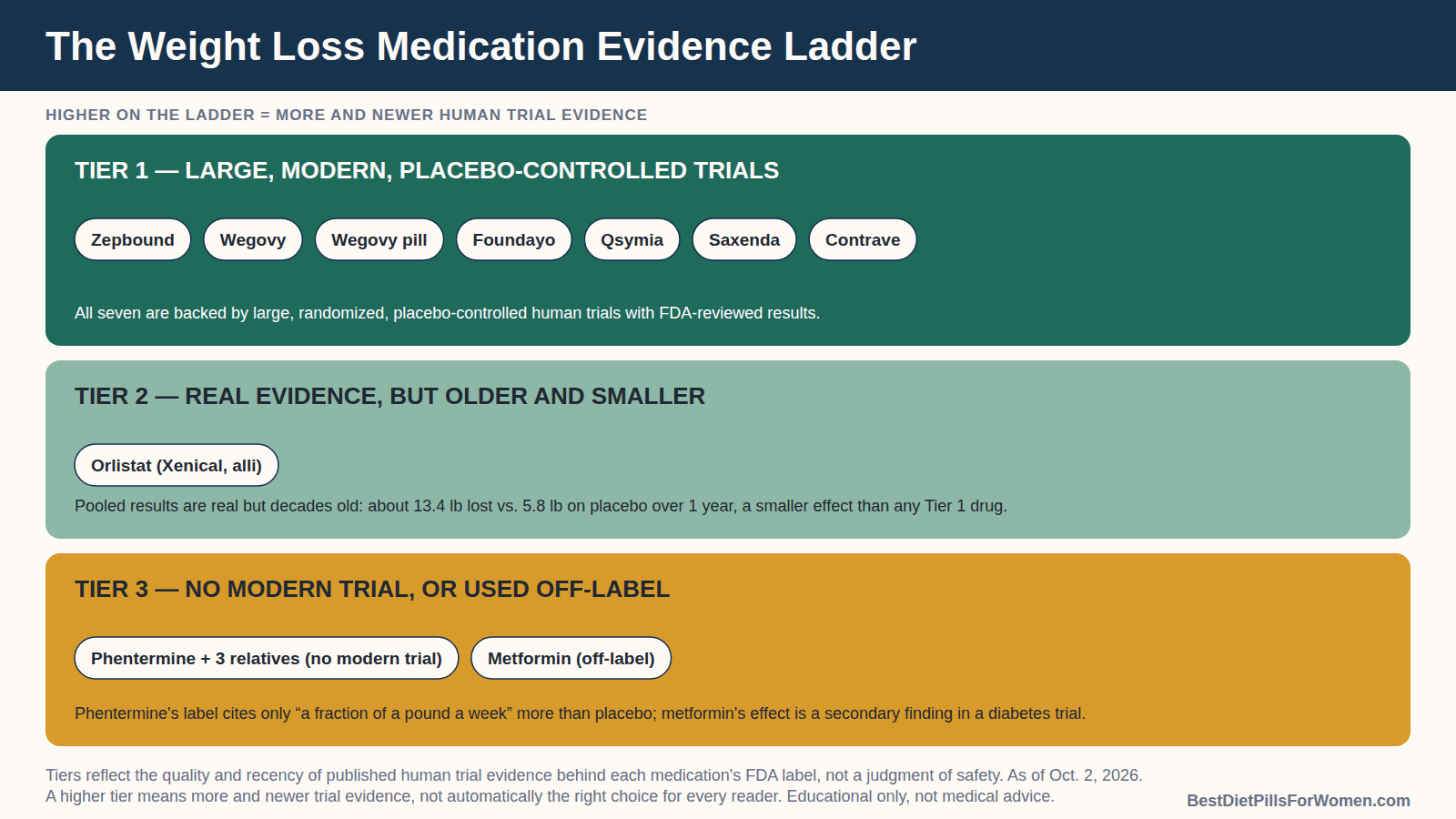
The six GLP-1 and GIP-based medications, Wegovy, Zepbound, the Wegovy pill, Foundayo, and Saxenda, along with Qsymia and Contrave, share large, modern, randomized, placebo-controlled trials with defined populations, published results and FDA review of the complete data package. Those seven drugs are where you’ll find the most trustworthy numbers in this guide, and not coincidentally, they’re also the drugs with the most detailed, systematically collected safety data. That doesn’t mean every question about these seven drugs is settled. Long-term cardiovascular, bone and psychological outcomes beyond a few years of use are still accumulating, and head-to-head trials between drugs in this tier remain rare, which is why comparisons later in this guide are flagged as indirect wherever a true head-to-head trial doesn’t exist.
Where the Evidence Is Older or Thinner
Orlistat’s evidence is real but older and smaller in effect than the GLP-1 drugs’, built on trials that are now decades old. Phentermine’s own FDA label describes its effect as “only a fraction of a pound a week” more than placebo, and a clinical roundtable notes no cardiovascular outcome trial has been run since the drug’s 1959 approval. Diethylpropion, phendimetrazine and benzphetamine are older still, with no modern randomized outcome trial identified in the sources reviewed for this guide. Metformin’s weight effect comes from a diabetes-prevention trial where weight change was a secondary measure, not the primary question the study was designed to answer. None of that means these drugs don’t work for some people. It means the confidence you can place in “it works” is genuinely different depending on which drug you’re asking about. That gap in evidence doesn’t necessarily mean the older drugs don’t help anyone; decades of real-world prescribing experience exist even without a modern trial behind them. It means this guide can’t make the same evidence-backed statement about those drugs that it can about the newer ones, and it says so plainly rather than borrowing the newer drugs’ evidence by implication.
The Options at a Glance
Table 1 lines up every medication in this guide before the rest of the article unpacks each one individually.
The Quick-Answer Table
| Medication | Drug class | Best-available evidence | Typical length of use | FDA-approved for weight management? |
|---|---|---|---|---|
| Tirzepatide (Zepbound) | GLP-1/GIP dual receptor agonist, injectable | SURMOUNT-1: up to −20.9% vs. −3.1% placebo, 72 weeks | Long-term | Yes |
| Semaglutide (Wegovy) | GLP-1 receptor agonist, injectable | STEP 1: −14.9% vs. −2.4% placebo, 68 weeks | Long-term | Yes |
| Oral semaglutide (Wegovy pill) | GLP-1 receptor agonist, oral | OASIS 4: −13.6% vs. −2.2% placebo, 64 weeks | Long-term | Yes |
| Orforglipron (Foundayo) | GLP-1 receptor agonist, oral | ATTAIN-1: −11.1% vs. −2.1% placebo, 72 weeks | Long-term | Yes |
| Phentermine-topiramate (Qsymia) | Sympathomimetic amine + anticonvulsant | CONQUER: up to −9.8% vs. −1.2% placebo, 56 weeks | Long-term, with REMS monitoring | Yes |
| Liraglutide (Saxenda) | GLP-1 receptor agonist, injectable | SCALE: −7.4% vs. −3.0% placebo, 56 weeks | Long-term | Yes |
| Naltrexone-bupropion (Contrave) | Opioid antagonist + antidepressant | COR program: −5.4% to −8.1% vs. −1.3% to −4.9% placebo, 56 weeks | Long-term | Yes |
| Orlistat (Xenical, alli) | Lipase inhibitor | Pooled trials: about 3 percentage points more than placebo at 1 year | Long-term | Yes |
| Phentermine (and 3 older relatives) | Sympathomimetic amine | Label language only; no modern placebo-controlled percentage | Short-term (“a few weeks”) | Yes, short-term use only |
| Metformin | Biguanide (type 2 diabetes drug) | DPP: modest weight effect as a secondary finding in a diabetes-prevention trial | Used off-label, indefinitely | No, not approved for weight management |
Table 1 method: drug classes and approval status come from each medication’s current FDA label or DailyMed record. Trial results come from the pivotal trials and label sections. Figures come from different trials with different populations, doses and durations and can’t be ranked head to head; see the evidence section later in this guide for that caveat in full.
How to Read the Table
Two patterns are worth noticing before you read further. First, the drugs near the top of Table 1, ranked loosely by effect size, are also the newest ones, which tracks with how much trial standards and gut-hormone science have advanced since phentermine’s 1959 approval. Second, “long-term” and “short-term” on the label aren’t marketing language; they reflect what each drug’s own evidence actually supports, and that distinction drives a lot of the practical differences covered later in this guide, from how a prescription gets renewed to what a full year of treatment really costs.
One more pattern worth flagging: evidence quality and FDA approval status aren’t the same axis. Every drug in Table 1 is FDA-approved for its labeled use, including the four short-term stimulants, but “approved” describes what FDA found acceptable to allow on the market, not how large or well-documented the weight-loss effect is. Keeping those two ideas separate is what lets this guide call phentermine both “FDA-approved” and “thin on modern evidence” without contradicting itself.
How Weight Loss Medications Actually Work
Every drug in this guide suppresses appetite, blocks fat absorption, or does some combination of the two, but the biology behind those effects varies more than most comparison articles let on. Understanding roughly how a drug works isn’t required to use it safely under a clinician’s care, but it does make the safety warnings in the next major section easier to understand, since nearly every side effect and contraindication in this guide traces back directly to one of the mechanisms described here.
The GLP-1 and GIP Hormone Pathway
The newest and best-studied weight loss medications all work through hormones your gut already makes after you eat.
What GLP-1 Does in the Body
Glucagon-like peptide-1 (GLP-1) is a hormone released by the intestine after a meal that slows stomach emptying, signals fullness to the brain, and helps regulate blood sugar by boosting insulin release. GLP-1 belongs to a broader category scientists call incretins, gut hormones released in response to eating that help the body manage the glucose and calories that just arrived, which is also why several drugs in this guide were developed first as diabetes treatments before their weight effect became the bigger story. Semaglutide, the active ingredient in Wegovy, the Wegovy pill and Ozempic, and liraglutide, the active ingredient in Saxenda, are both GLP-1 receptor agonists: lab-made molecules engineered to activate that same receptor far more persistently than your body’s own GLP-1, which is broken down within minutes. Orforglipron (Foundayo) activates the same receptor through a different, non-peptide chemical structure that happens to survive digestion, which is why it can be taken as a tablet rather than needing to be injected.
Why Tirzepatide Adds a Second Hormone Pathway
Tirzepatide, the active ingredient in Zepbound, activates both the GLP-1 receptor and a second gut hormone receptor, GIP (glucose-dependent insulinotropic polypeptide), in a single molecule. Researchers believe combining both pathways is part of why Zepbound produced larger average results than any single-pathway GLP-1 drug in head-to-head and placebo-controlled trials, though the exact reason a dual agonist outperforms a single one isn’t fully settled. What is settled is the outcome: in SURMOUNT-1, the trial behind Zepbound’s approval, average weight loss at the top dose reached 20.9% of body weight over 72 weeks, the largest result of any drug in this guide. GIP is itself an incretin, released from the small intestine and historically studied mainly for its role in insulin secretion; its specific contribution to tirzepatide’s weight effect, separate from the GLP-1 component it’s paired with, is still being worked out in ongoing research, which is a reminder that “dual agonist” describes the drug’s design, not a fully mapped explanation of why it outperforms single-pathway drugs.
Older Mechanisms: Appetite Suppression and Fat Blocking
Before GLP-1 drugs existed, weight loss medications worked through the central nervous system or the digestive tract directly, and those older mechanisms are still in active use today.
Sympathomimetic Amines (Phentermine and Its Relatives)
Phentermine, diethylpropion, phendimetrazine and benzphetamine are sympathomimetic amines, a chemical class that stimulates the release of norepinephrine and, to a lesser extent, dopamine in the brain. That stimulation suppresses appetite through the hypothalamus, the brain region that regulates hunger, but it also raises heart rate and blood pressure, which is the same mechanism responsible for most of this drug class’s side effects and contraindications, covered in the safety section below. These four drugs share chemical ancestry with amphetamine, which is part of why all four are federally controlled substances. The mechanism is genuinely old science: it predates the randomized controlled trial as the standard way to prove a drug works, which is a structural reason, not just a commercial one, for why so little modern trial data exists behind this specific drug class.
Orlistat’s Fat-Blocking Mechanism Is Entirely Different
Orlistat doesn’t touch appetite or the brain at all. It works in the gut, where it blocks roughly 25% to 30% of an enzyme called lipase from breaking down dietary fat, so that fat passes through the digestive system unabsorbed rather than being stored as calories. That mechanism explains both orlistat’s modest effect size, since it does nothing to reduce hunger or cravings, and its most notorious side effects, since unabsorbed fat has to go somewhere once it reaches the lower digestive tract. It also explains why orlistat is the one drug in this guide whose effectiveness is largely under the user’s own control: eating a lower-fat meal produces fewer digestive side effects and, by definition, leaves less fat for the drug to block in the first place, which ties its real-world result more tightly to dietary choices than any other medication covered here.
Combination Mechanisms
Two widely prescribed pills combine two older mechanisms into a single product, each for a specific reason tied to the drug’s history.
Qsymia: Stimulant Plus Anticonvulsant
Qsymia pairs low-dose phentermine with topiramate, a drug originally approved for seizures and migraines that, somewhat unexpectedly, also suppresses appetite and increases satiety through mechanisms that aren’t completely understood, though they appear to involve effects on taste perception and the brain’s reward circuitry. Combining the two at lower doses than either drug uses alone was intended to add their appetite-suppressing effects while limiting each drug’s individual side-effect burden, and the CONQUER trial behind Qsymia’s approval suggests that strategy worked: average weight loss reached 9.8% of body weight at the top dose, the largest result of any non-GLP-1 pill in this guide. Lower-dose combination therapy is a recognized strategy across pharmacology generally, not something unique to weight management, but it does mean Qsymia’s side-effect profile is genuinely different from taking either phentermine or topiramate alone at a typical single-drug dose, which the safety section below treats as its own distinct profile rather than simply adding the two drugs’ individual side-effect lists together.
Contrave: Opioid-Receptor and Dopamine/Norepinephrine Pathways
Contrave pairs naltrexone, which blocks opioid receptors, with bupropion, an antidepressant that affects dopamine and norepinephrine. The combination is designed to act on the brain’s reward and hunger circuitry simultaneously: bupropion is thought to activate appetite-suppressing neurons in the hypothalamus, while naltrexone blocks an internal feedback loop that would otherwise limit that activation. Bupropion is also sold on its own as an antidepressant and smoking-cessation aid, under different brand names and doses than Contrave uses, which is a separate, already-FDA-reviewed use of the same molecule rather than evidence specific to its weight-loss combination. The two drugs individually have much smaller or inconsistent weight effects; the FDA-reviewed rationale for approving them as a combination was that together, they produced a more reliable and somewhat larger result than either alone.
Why a Mechanism Being Plausible Doesn’t Prove It Works
Understanding how a drug is supposed to work is useful, but it’s a different question from whether it actually produces meaningful weight loss in real people.
What Mechanism Research Can and Can’t Tell You
A biologically plausible mechanism tells you a drug could work, not that it does, how much it will, or for whom. GLP-1 receptor agonists are the clearest example of why the distinction matters in practice: dozens of molecules can activate the GLP-1 receptor in a lab dish, but only a handful have gone through the large, controlled human trials needed to show they translate into meaningful, safe weight loss at a tolerable dose. That’s exactly why this guide treats every drug’s trial data as the real evidence and its mechanism as background context, not proof.
This category has a specific history of plausible mechanisms that didn’t hold up once drugs reached the broader market. Sibutramine (Meridia), a drug that suppressed appetite through a serotonin-and-norepinephrine mechanism with a reasonable biological story behind it, was pulled from the U.S. market in 2010 after a large post-approval trial linked it to an increased risk of heart attack and stroke. Lorcaserin (Belviq), approved in 2012 on a serotonin-receptor mechanism designed to avoid sibutramine’s cardiovascular issues, was voluntarily withdrawn in 2020 after FDA requested its removal over a signal for increased cancer risk found in a required long-term safety trial. Neither drug lacked a plausible mechanism; both lacked a long enough track record of real-world safety data before the problem surfaced, which is precisely the gap every new entrant in this guide, including the drugs approved in just the past year, hasn’t yet had the chance to fully close.
Why This Guide Separates Mechanism From Outcome Data
Every section from here forward keeps that separation explicit: mechanism explains why a drug might work, and the trial and label data in the next two sections tell you what it actually did in the people who took it. When the two disagree, as they sometimes do, this guide defaults to the trial data every time, because a compelling biological story has misled the weight loss industry before, and it will again. Major clinical practice guidelines follow the same logic: the Endocrine Society’s obesity-pharmacotherapy guideline grades its recommendations by the strength of the human trial evidence behind each drug, not by how well-understood or novel its mechanism is, which is the same standard this guide tries to hold every medication to. Keep that distinction in mind as you move into the next two sections: the roster section that follows introduces each drug mechanism-first, because that’s the most natural way to group a crowded field, but the evidence section after it is where the actual proof lives, and it’s worth reading both before drawing a conclusion about any single option.
The Full Roster of FDA-Approved Weight Loss Medications
Most comparison articles mention three or four brand names and stop. This section walks through all eleven options in this guide, drug by drug, before Table 2 puts the whole roster side by side.
GLP-1 and Dual-Agonist Medications (Injectable)
The two injectable GLP-1-pathway drugs currently dominate both the headlines and the evidence in this category.
Semaglutide (Wegovy) and Higher-Dose Wegovy HD
Wegovy (semaglutide), originally approved in 2021, is a once-weekly injection that produced an average of 14.9% weight loss versus 2.4% on placebo over 68 weeks in the STEP 1 trial, a result that held up in a population that was 73% women. In March 2026, FDA approved a higher maintenance dose, Wegovy HD at 7.2 mg, for people whose weight loss plateaus on the standard top dose of 2.4 mg, and it reached the market through FDA’s National Priority Voucher program, a newer pathway meant to speed review of certain drugs FDA considers a public-health priority. Wegovy isn’t a controlled substance, and its label carries a boxed warning for thyroid C-cell tumors seen in rodent studies, a class-wide warning shared by every GLP-1 and GIP drug in this guide. Semaglutide itself isn’t exclusive to Wegovy; the same molecule is sold under a different brand, at different doses, specifically for type 2 diabetes, which is a separate FDA-reviewed indication from the chronic-weight-management approval this guide focuses on.
Tirzepatide (Zepbound)
Zepbound (tirzepatide), approved in 2023, is also a once-weekly injection, but it activates two gut-hormone receptors instead of one. In SURMOUNT-1, the trial behind its approval, average weight loss reached 15.0% at the 5 mg dose, 19.5% at 10 mg and 20.9% at the top 15 mg dose, each compared against 3.1% on placebo, over 72 weeks in 2,539 adults who were 67.5% women. That 20.9% figure is the largest average result of any drug in this guide, prescription or OTC. SURMOUNT-5, a later head-to-head trial, found tirzepatide also outperformed semaglutide directly rather than only beating its own placebo group, though that comparison used a different dose of semaglutide than Wegovy’s approved maintenance dose, a distinction covered in the evidence section below. Tirzepatide, like semaglutide, also has a separate brand and FDA approval for type 2 diabetes at different doses, which is worth knowing if you see the same drug name attached to a second product with a different price and insurance pathway than Zepbound’s. Our dedicated semaglutide vs. tirzepatide comparison goes deeper on that head-to-head trial and what it does and doesn’t prove. Both Zepbound and Wegovy use prefilled, single-dose pens with an enclosed needle designed to limit how much of the needle a user sees or handles directly, a somewhat different injection experience than Saxenda’s older-style daily pen; if needle anxiety or hand dexterity is a practical concern, it’s a reasonable question to raise with a prescriber before choosing between them.
Oral GLP-1 Medications
Until December 2025, every GLP-1-pathway weight loss drug required an injection. Two oral options have since reached the market.
Oral Semaglutide (the Wegovy Pill)
The Wegovy pill, FDA-approved in December 2025 as a 25 mg oral tablet, is chemically the same active ingredient as the injectable Wegovy, formulated with an absorption enhancer so enough of the drug survives the stomach to reach the bloodstream. In OASIS 4, the trial supporting its approval, it produced 13.6% average weight loss versus 2.2% on placebo over 64 weeks, making it the second-largest average result of any pill, injectable or oral, in this entire guide. Like injectable Wegovy, it carries the class-wide thyroid C-cell tumor boxed warning and isn’t a controlled substance. For someone who meets the eligibility bar but doesn’t want to self-inject, the Wegovy pill’s 13.6% average result is a meaningfully different trade-off than reaching for an older, smaller-effect pill purely to avoid a needle.
Orforglipron (Foundayo)
Foundayo (orforglipron), approved April 1, 2026, is a different kind of GLP-1 drug entirely: a small, non-peptide molecule that activates the GLP-1 receptor but, unlike oral semaglutide, doesn’t require special formulation to survive digestion, so it can be taken at any time of day, with or without food. In ATTAIN-1, it produced 11.1% average weight loss versus 2.1% on placebo at its top label dose over 72 weeks. A companion trial, ATTAIN-MAINTAIN, also found it helped people switching from an injectable GLP-1 drug maintain their weight loss, though maintaining a result after switching drugs is a different question from losing weight on the drug in the first place. Because orforglipron is a small molecule rather than a peptide, it can be manufactured using more conventional tablet-making processes than injectable GLP-1 drugs require; whether that translates into fewer supply interruptions than the injectable shortages of recent years isn’t yet something this guide can confirm one way or the other, and it’s a fact worth rechecking as real-world demand for Foundayo builds.
Older Prescription Options
Six more FDA-approved prescription medications predate the GLP-1 era by anywhere from a decade to nearly seven.
Phentermine and Its Older Relatives
Phentermine, approved in 1959 and sold as Adipex-P, Lomaira and generics, is the oldest and most widely prescribed drug in this guide, and its label describes the expected benefit over placebo as “only a fraction of a pound a week,” with no modern randomized trial behind that figure. Three related sympathomimetic amines, diethylpropion, phendimetrazine and benzphetamine, were approved within a few years of phentermine and share its short-term-only labeling and lack of modern trial data. All four are federally controlled substances (phentermine and diethylpropion Schedule IV; phendimetrazine and benzphetamine Schedule III), and all four are explicitly excluded from the long-term chronic-weight-management category that NIDDK and the newer drugs in this guide occupy. This drug class also carries a notorious chapter in weight-loss history worth knowing: in the 1990s, phentermine was commonly co-prescribed off-label with fenfluramine, a combination nicknamed “fen-phen,” until fenfluramine and its related drug dexfenfluramine were withdrawn from the U.S. market in 1997 over links to heart valve damage. Phentermine itself wasn’t the drug withdrawn, and it has remained FDA-approved and in use since 1959, but the episode is part of why this drug class draws more caution from clinicians than its long approval history alone might suggest. Our prescription appetite suppressant guide covers all four of these older stimulants, including dosing, real-world pharmacy availability and telehealth access, in far more depth than this cornerstone guide attempts.
Qsymia, Contrave, Saxenda and Orlistat
Qsymia (phentermine-topiramate), approved in 2012, is a Schedule IV controlled substance that requires enrollment in a Risk Evaluation and Mitigation Strategy program because of topiramate’s link to birth defects. Contrave (naltrexone-bupropion), approved in 2014, isn’t a controlled substance but carries a boxed warning for suicidal thoughts and behaviors. Saxenda (liraglutide), also approved in 2014, is a daily injection rather than a weekly one, and a generic version, approved in August 2025, became the first generic GLP-1 weight loss drug on the U.S. market. Orlistat, approved by prescription as Xenical in 1999 and later cleared for over-the-counter sale as alli in 2007, is the only drug in this guide that doesn’t touch appetite at all, working instead by blocking fat absorption in the gut.
Medications Used Off-Label or Not Approved for Weight Loss
One widely prescribed drug in this space has no FDA approval for weight management whatsoever.
Metformin’s Off-Label Role
Metformin is FDA-approved to treat type 2 diabetes, not to manage weight, and NIDDK’s list of long-term weight-management medications doesn’t include it. Its weight effect comes mainly from the Diabetes Prevention Program, a landmark trial designed to test whether metformin or an intensive lifestyle program could prevent type 2 diabetes in people with prediabetes; weight change was a secondary measure in that trial, not its primary question, and the effect was consistently smaller than the lifestyle-intervention arm’s. Clinicians sometimes prescribe metformin off-label for weight-related reasons anyway, especially for women with polycystic ovary syndrome or insulin resistance, where it has a separate, better-established role treating the underlying metabolic picture rather than weight on its own. Metformin is also sometimes combined with a GLP-1 drug in people who have both type 2 diabetes and a weight-management goal, which is a different clinical scenario than using metformin by itself for weight loss and isn’t something the DPP trial was designed to evaluate.
Why “Off-Label” Doesn’t Mean Unsafe or Unapproved for Everything
Off-label prescribing is legal, common and sometimes clinically reasonable across nearly every area of medicine, not just weight management; it simply means a drug is being used for a purpose FDA hasn’t specifically reviewed and approved. Metformin’s diabetes approval and long safety record don’t transfer automatically into proof that it’s an effective weight loss drug on its own, and this guide treats its inclusion here as a transparency choice, not an endorsement of it as a weight-loss option, so you can recognize why its box in Table 1 and Table 2 looks different from every drug around it.
Putting the Full Roster Side by Side
Table 2 lines up every medication’s form, approval history and regulatory status in one place.
The Roster Table
| Medication | Brand(s) | Form | Original FDA approval | Current regulatory status |
|---|---|---|---|---|
| Tirzepatide | Zepbound | Weekly injection | 2023 | Rx, not a controlled substance |
| Semaglutide | Wegovy, Wegovy HD | Weekly injection | 2021 (Wegovy HD, 2026) | Rx, not a controlled substance |
| Oral semaglutide | Wegovy pill | Daily tablet | 2025 | Rx, not a controlled substance |
| Orforglipron | Foundayo | Daily tablet | 2026 | Rx, not a controlled substance |
| Liraglutide | Saxenda, generic liraglutide | Daily injection | 2014 (generic, 2025) | Rx, not a controlled substance |
| Phentermine-topiramate ER | Qsymia | Daily capsule | 2012 | Rx, Schedule IV, REMS required |
| Naltrexone-bupropion ER | Contrave | Daily tablet | 2014 | Rx, not a controlled substance |
| Orlistat | Xenical (Rx), alli (OTC) | Capsule, 3×/day | 1999 (Xenical); 2007 (alli OTC) | Rx and OTC, not a controlled substance |
| Phentermine | Adipex-P, Lomaira, generics | Daily tablet | 1959 | Rx, Schedule IV, short-term label only |
| Diethylpropion, phendimetrazine, benzphetamine | Generics | Daily tablets | 1959–1961 | Rx, Schedule III/IV, short-term label only |
| Metformin | Glucophage, generics | Tablet, 1–2×/day | 1994–1995 (for type 2 diabetes) | Rx, off-label for weight; not controlled |
Table 2 method: approval years and regulatory status come from each medication’s current FDA label, DailyMed record, or FDA approval announcement. “Current regulatory status” reflects controlled-substance scheduling and whether long-term weight-management use is an FDA-reviewed indication, not a judgment about safety.
What the Roster Doesn’t Tell You
A roster this size can make the category look more uniform than it is. Approval year and controlled-substance status are facts, but they don’t tell you how large an effect to expect, what the real safety trade-offs are, or what any of this actually costs, which is exactly what the next three sections of this guide work through, one at a time. It’s also worth noticing how much the roster itself has grown in a short window: five of these eleven medications, oral semaglutide, orforglipron, Wegovy HD, generic liraglutide and the most recent round of self-pay price cuts behind several of them, are all developments from roughly the twelve months before this guide’s publication date, which is a faster rate of change than this category has seen in its prior six decades combined. Whichever drug you end up researching further after reading this roster, treat its approval date and current label as a starting point to verify independently, since this guide cannot promise either one will stay unchanged indefinitely after publication.
How Much Weight Loss the Evidence Actually Shows
Average results are only half the picture. This section goes beyond the headline percentages to show how many people actually hit a meaningful threshold, and what happens when the medication stops. Reading percentages alone can also obscure how the trials themselves were run; two drugs with similar average results can still differ in how strict their trial’s dropout handling was, whether the result reflects everyone who started treatment or only those who finished, and how closely the trial population matches people outside a research setting.
Injectable GLP-1 and Dual-Agonist Trial Results
The two injectable options have the largest trials and the most granular published data of any drugs in this guide, which is a direct consequence of how much commercial and regulatory attention this specific drug class has drawn since 2021.
STEP 1 and Wegovy’s Results
In STEP 1, 1,961 adults took either semaglutide 2.4 mg or placebo for 68 weeks alongside lifestyle counseling; 86.4% of the semaglutide group lost at least 5% of body weight, versus 31.5% on placebo, and half the semaglutide group (50.5%) lost at least 15%, versus just 4.9% on placebo. Those response-rate numbers matter more than the 14.9% average on its own, because they show the average isn’t being dragged up by a handful of exceptional responders; most people in the semaglutide group lost a clinically meaningful amount, even if not everyone reached the trial’s own average. STEP 1 is also one of the few trials in this guide with published results stretching past its main 68-week endpoint, since many of the same participants were tracked afterward in a separate extension study, which is part of why Wegovy’s real-world evidence base is unusually deep compared to several newer entrants on this list. STEP 1 also tracked waist circumference and several cardiometabolic markers as secondary outcomes alongside body weight, which is part of why the drug’s cardiovascular benefit, confirmed later in the separate SELECT trial discussed in the safety section below, wasn’t a complete surprise when it was reported.
SURMOUNT-1 and Zepbound’s Results
Tirzepatide’s SURMOUNT-1 trial showed an even wider response: at the 15 mg dose, 96% of participants lost at least 5% of body weight versus 28% on placebo, and 63% lost at least 20%, a threshold placebo essentially never reached (1.3%). A later trial, SURMOUNT-5, compared tirzepatide directly against semaglutide rather than against placebo and found tirzepatide produced significantly more weight loss, though it used semaglutide 2.4 mg as the comparator rather than any higher dose, a detail worth knowing before treating that trial as the final word on which drug is “stronger.” SURMOUNT-1 also enrolled people without type 2 diabetes specifically, which matters because every GLP-1 and GIP trial in this guide has found smaller average weight loss in people who have diabetes than in people who don’t, likely related to how diabetes itself affects metabolism and how some diabetes medications can blunt weight loss; that pattern is worth knowing if you’re comparing your own likely result to Table 3’s figures and you have a diabetes diagnosis.
Oral GLP-1 Trial Results
Both oral GLP-1 drugs are new enough that their trial data is still the primary source most people will see repeated elsewhere.
OASIS 4 and the Wegovy Pill
OASIS 4 tested oral semaglutide 25 mg against placebo over 64 weeks and found 13.6% average weight loss versus 2.2%, a result large enough that, on average alone, the Wegovy pill outperformed every pill in this guide except Zepbound’s injection. Because OASIS 4 is one trial testing one oral dose, it hasn’t yet accumulated the multi-year extension data or the sheer trial volume that injectable Wegovy has built up since 2021. That’s a meaningful caveat even though the headline number looks competitive with the injectable drugs: a single 64-week trial, however well-designed, tells you less about rare long-term risks and real-world durability than six-plus years of accumulated data across tens of thousands of patients does.
ATTAIN-1 and Foundayo
ATTAIN-1 tested orforglipron across several doses over 72 weeks; at the top dose it produced 11.1% average weight loss versus 2.1% on placebo. Foundayo’s manufacturer also reported a separate maintenance trial, ATTAIN-MAINTAIN, in which people who switched from an injectable GLP-1 drug to Foundayo largely held onto their prior weight loss, though “held onto a result achieved on a different drug” is a different claim than “produced that result itself,” and this guide treats the two claims separately. ATTAIN-1’s 11.1% average also came with a wider dose range than most other trials in this guide tested at once, which is part of why orforglipron’s label gives prescribers more room to individualize dosing than a drug with a single approved maintenance dose does.
Older-Drug Trial Results
The pre-GLP-1 drugs in this guide have smaller trials, smaller effects, or in phentermine’s case, no modern placebo-controlled trial at all.
Qsymia’s CONQUER/SEQUEL Data and Saxenda’s SCALE Data
Qsymia’s CONQUER trial followed 2,487 adults (70% women) for 56 weeks and found average weight loss of 7.8% at the mid dose and 9.8% at the top dose, versus 1.2% on placebo; a follow-on trial, SEQUEL, found the effect held up over two years in people who continued treatment. Saxenda’s SCALE trial followed 3,731 adults (79% women) for 56 weeks and found 7.4% average weight loss versus 3.0% on placebo, with 62.3% of the Saxenda group reaching at least 5% weight loss versus 34.4% on placebo. Both trials predate the dual-agonist and newer single-pathway drugs by roughly a decade, and both still hold up reasonably well against orlistat and the older stimulants, even if the field has since moved past them in raw effect size.
Contrave’s COR Program and Orlistat’s Label Data
Contrave’s COR trial program, run across several separate studies in a population about 83% women, found results ranging from 5.4% to 8.1% weight loss depending on the specific trial and whether it paired the drug with intensive behavioral counseling, versus 1.3% to 4.9% on placebo. Orlistat’s evidence looks different because its mechanism is different: pooled results across five trials found 1-year average weight loss of 13.4 pounds with orlistat versus 5.8 pounds on placebo, with 57% of orlistat-treated completers losing at least 5% of body weight versus 31% on placebo, a real but clearly smaller effect than any GLP-1 drug in this guide. Reporting orlistat’s result in pounds rather than a percentage, which is how its own label presents the data, is itself a reminder of how much trial reporting conventions have evolved; nearly every drug approved since has reported its pivotal results as a percentage of body weight specifically because that framing travels better across people who start at very different weights.
Seeing the Whole Class on One Table
Table 3 puts every trial’s headline result side by side, which makes the size of the gap between drug generations easy to see at a glance.
The Evidence Table
| Medication | Trial | Population | Duration | Result vs. placebo |
|---|---|---|---|---|
| Tirzepatide (Zepbound), 15 mg | SURMOUNT-1 | 2,539 adults, 67.5% women, no diabetes | 72 weeks | −20.9% vs. −3.1% |
| Semaglutide (Wegovy), 2.4 mg | STEP 1 | 1,961 adults, 73% women, no diabetes | 68 weeks | −14.9% vs. −2.4% |
| Oral semaglutide (Wegovy pill), 25 mg | OASIS 4 | Adults with overweight or obesity | 64 weeks | −13.6% vs. −2.2% |
| Orforglipron (Foundayo), top dose | ATTAIN-1 | Adults with overweight or obesity | 72 weeks | −11.1% vs. −2.1% |
| Phentermine-topiramate (Qsymia), top dose | CONQUER | 2,487 adults, 70% women | 56 weeks | −9.8% vs. −1.2% |
| Liraglutide (Saxenda), 3 mg | SCALE | 3,731 adults, 79% women | 56 weeks | −7.4% vs. −3.0% |
| Naltrexone-bupropion (Contrave) | COR program | Adults, about 83% women, across several trials | 56 weeks | −5.4% to −8.1% vs. −1.3% to −4.9% |
| Orlistat (Xenical, alli) | Pooled 5 trials | Adults with overweight or obesity | 1 year | 13.4 lb vs. 5.8 lb mean loss (about 3 percentage points) |
| Phentermine and 3 older stimulants | None identified | Not applicable | Not applicable | No modern placebo-controlled percentage |
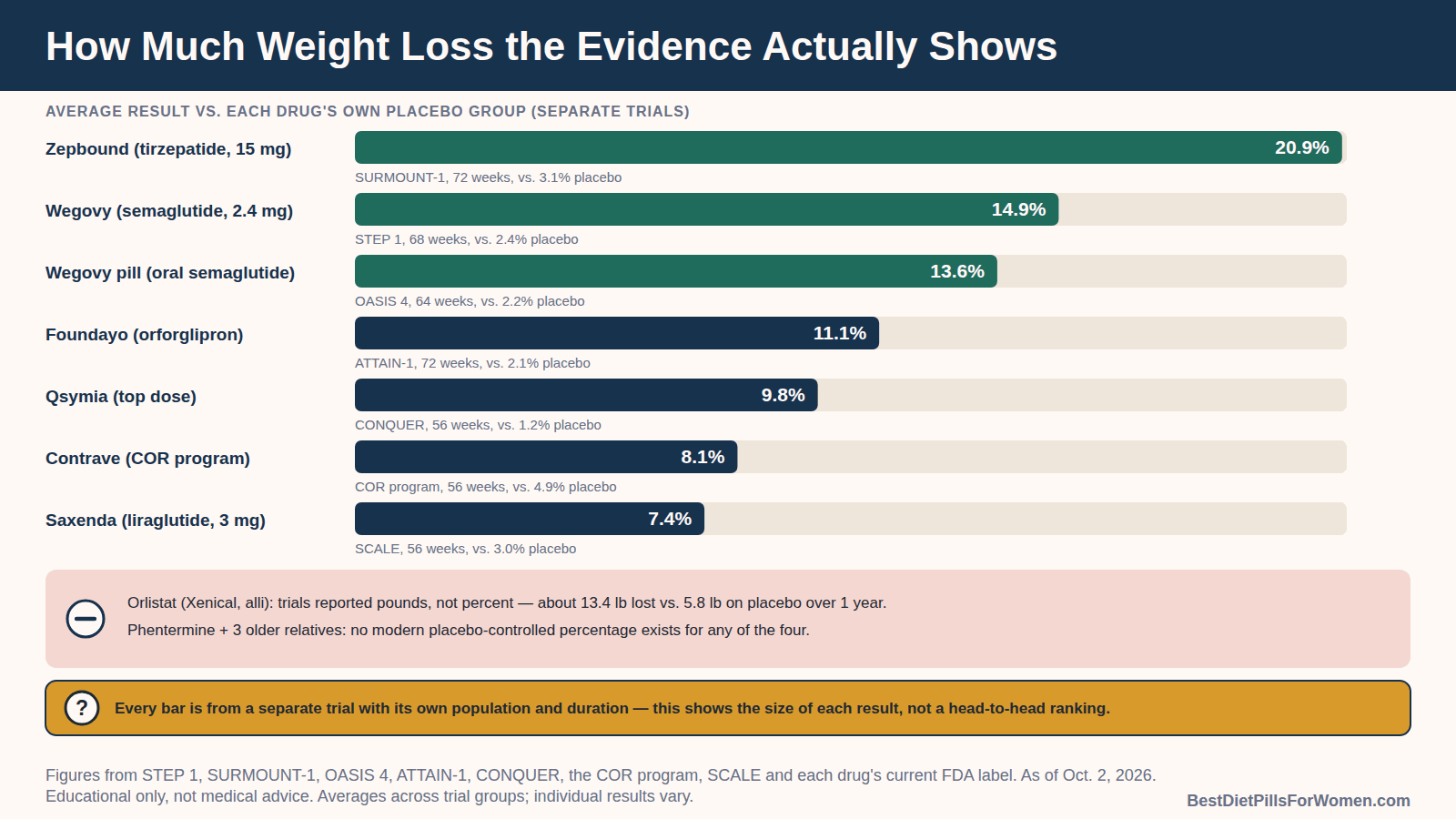
Table 3 method: figures come from the pivotal trials and FDA labels. Every drug was tested against its own placebo group in a separate trial with its own population and duration, so this table shows the size of each result, not a head-to-head ranking. A 2025 network meta-analysis attempted to rank several of these drugs against each other statistically rather than only against placebo; see the note below the table.
Why These Numbers Aren’t a Head-to-Head Ranking
Reading Table 3 top to bottom looks like a ranking, but it isn’t one in the way a single head-to-head trial would be. Each row comes from a different trial, with a different population, a different placebo-response rate, and a different number of weeks, so a few percentage points of difference between two drugs can reflect trial design as much as a real difference in effectiveness. A 2025 network meta-analysis that statistically combined 56 randomized trials across several weight-management medications attempted to address exactly this limitation, and its direct comparisons generally supported the same rough ordering shown in Table 3, with the GLP-1 and dual-agonist drugs outperforming the older pills; still, a network meta-analysis is a statistical model built from separate trials, not a new head-to-head trial, so some uncertainty in the exact size of each gap remains. The World Health Organization’s 2025 global guideline on GLP-1 medicines for obesity reaches a similarly measured conclusion: it supports using these drugs within a structured care plan rather than ranking them against each other as if the question had one settled answer, and it explicitly calls for more comparative, real-world and long-term data across the class.
What Happens If You Stop Taking the Medication
Every trial above measured what happens while someone keeps taking a drug, not what happens afterward, and that second question has a consistent, somewhat sobering answer across this entire category.
Weight Regain After Discontinuation
A 2026 systematic review and meta-analysis covering studies of multiple weight-management medications found that people regain weight after stopping at an average rate of about 0.4 kg a month, with a projected return to baseline around 1.7 years post-discontinuation. Drug-specific extension studies tell the same story: a STEP 1 extension found meaningful regain in the year after people stopped semaglutide, and a separate SURMOUNT-4 trial found that people who continued tirzepatide after an initial run-in period kept losing weight, while those switched to placebo regained a substantial share of what they’d lost. SURMOUNT-4’s design is worth understanding on its own: every participant first spent 36 weeks on tirzepatide before being randomized to either continue the drug or switch to placebo, which means the trial specifically isolated what happens after stopping in people who had already responded, rather than mixing in people who never lost weight in the first place. None of this regain pattern is unique to GLP-1 drugs; it reflects how the body’s hunger and metabolic signals respond once a medication’s effect on them is removed, a pattern also seen to varying degrees with the older pills in this guide.
What That Means for Planning
Weight regain after stopping isn’t a sign a medication “stopped working” or that the earlier weight loss wasn’t real; it’s evidence that obesity and significant overweight are managed, not cured, by any medication in this guide, in much the same way blood pressure medication controls blood pressure only while it’s being taken. That reframes “how long do I need to take this” from a question with a simple answer into a planning conversation worth having with a prescriber before you start, not after you’ve already invested months of treatment and cost into a drug you assumed you’d eventually stop without consequence. Some people and prescribers plan around this by aiming for a lower, less expensive maintenance dose once a weight goal is reached rather than stopping outright, though how well that specific strategy preserves results long-term hasn’t been tested in a dedicated trial the way starting and stopping has, so it remains a reasonable idea rather than a proven protocol. Whatever approach you discuss, the underlying math in Table 6’s cost section only gets more relevant the longer a drug stays part of the plan, which is exactly why cost deserves its own dedicated section rather than a passing mention.
Safety: What Every Weight Loss Medication Requires You to Watch
Every drug in this guide carries real trade-offs, and what deserves attention differs sharply by mechanism. This section is general education, not a substitute for a clinician who knows your personal and family health history. It’s organized the same way a prescriber would likely walk through it with you: common, usually-tolerable effects first, then the serious warnings that actually change whether a drug is appropriate for you, then the practical interactions and nutritional considerations that matter once you’re already taking something.
Gastrointestinal and Common Side Effects
Nearly every weight loss medication in this guide affects digestion in some way, though the specific symptoms and their likely cause differ by drug class.
Why GI Side Effects Are So Common With GLP-1 Drugs
GLP-1 and dual-agonist drugs slow stomach emptying as part of how they work, which is also why nausea, vomiting, diarrhea and constipation are their most common side effects. Across the pooled trials behind each label, nausea occurred in about 25% of people on Wegovy, 25% to 29% on Zepbound depending on dose, and 39.3% on Saxenda, versus 8% to 14% on placebo in each trial. These effects tend to cluster around dose increases and generally ease over time, which is exactly why every GLP-1 drug’s label calls for a slow, staged dose titration rather than starting at the maintenance dose. Discontinuation specifically because of a GI side effect happened in about 4.3% of the Wegovy group versus 0.7% on placebo, a useful reminder that even a “common and usually mild” side effect still drives real people to stop treatment. Injection-site reactions, redness, itching or mild bruising where the needle goes in, are also commonly reported with every injectable drug in this guide, generally resolve within a few days, and are a separate issue from the systemic GI side effects described above.
Common Side Effects of the Older Drugs
Orlistat’s side effects come from its mechanism directly: unabsorbed dietary fat passing through the digestive tract causes oily spotting (26.6% of people in year 1), flatus with discharge (23.9%), fecal urgency (22.1%) and fatty, oily stools (20.0%), effects that ease substantially when fat intake stays under about 30% of calories. FDA updated the OTC orlistat (alli) label in 2026 to add a warning about kidney stones and a rare but serious risk of kidney injury, a reminder that even a decades-old, over-the-counter drug’s safety label isn’t frozen in time and is worth rereading periodically rather than assuming it hasn’t changed since you first picked up the box. The stimulant-class drugs cause a different cluster: insomnia, dry mouth, tremor and a racing or pounding heartbeat, tied directly to their effect on the nervous system. Qsymia adds tingling in the hands and feet (about 20% at the top dose) from its topiramate component, and Contrave’s most common side effect is nausea, reported in about 32.5% of its trial participants versus 6.7% on placebo.
Serious Risks and Boxed Warnings
Beyond the common, usually-tolerable side effects above, several drugs in this guide carry a boxed warning, FDA’s strongest label warning, reserved for risks serious enough to put front and center.
Thyroid C-Cell Tumor Warning (GLP-1/GIP Drugs)
Every GLP-1 and GIP-based drug in this guide, Wegovy, the Wegovy pill, Zepbound, Foundayo and Saxenda, carries a boxed warning stating the drug causes thyroid C-cell tumors in rodents, with the human risk unknown, and all five are contraindicated in anyone with a personal or family history of medullary thyroid carcinoma or Multiple Endocrine Neoplasia syndrome type 2. That’s a class-wide warning based on animal data, not a confirmed human cancer risk, and it’s worth understanding the distinction: it means the honest answer is genuine uncertainty, not a known elevated risk, which is exactly the kind of warning worth raising directly with a prescriber rather than dismissing or over-interpreting on your own.
A separate, more recently confirmed risk is worth flagging specifically for semaglutide: European regulators concluded in 2025 that a rare eye condition called non-arteritic anterior ischemic optic neuropathy (NAION), which can cause sudden vision loss, is a genuine very rare side effect of semaglutide medicines, including Wegovy. It’s a useful, concrete example of why this guide keeps repeating that the safety picture for even the best-studied drugs here isn’t fully closed, years after initial approval.
Hypersensitivity and Allergic Reactions
Serious allergic reactions are uncommon but labeled for several drugs in this guide, and they’re worth knowing how to recognize separately from routine GI upset or injection-site irritation. GLP-1 and dual-agonist drug labels note rare reports of serious hypersensitivity reactions, including anaphylaxis and angioedema, which can involve swelling of the face, lips, tongue or throat, difficulty breathing, or a widespread rash, and warrant immediate medical attention rather than a wait-and-see approach. Anyone with a known allergy to a specific drug’s active ingredient or inactive components should flag that clearly before a first dose, since a reaction to a first injection is a different situation than ordinary nausea appearing a few hours later.
Cardiovascular and Psychiatric Warnings (Stimulant and Combination Drugs)
The sympathomimetic-amine drugs, phentermine, diethylpropion, phendimetrazine and benzphetamine, along with Qsymia because it contains phentermine, carry warnings for elevated heart rate and blood pressure, and anorectic agents used beyond three months have been associated with roughly a 23-fold increase in the risk of pulmonary hypertension, a serious lung condition. Contrave carries a boxed warning for suicidal thoughts and behaviors, particularly in children, adolescents and young adults, inherited from its bupropion component, and is contraindicated in seizure disorders and eating disorders. One further large trial adds useful context for the GLP-1 class specifically: the SELECT trial, in 17,604 adults with established cardiovascular disease and overweight or obesity but no diabetes, found semaglutide reduced major cardiovascular events, evidence that at least one GLP-1 drug carries a demonstrated cardiovascular benefit in a high-risk population, not only a cardiovascular risk to manage. The American College of Cardiology’s 2025 clinical guidance on weight-management drugs for cardiovascular health points to that same body of evidence in recommending that clinicians weigh a GLP-1 drug’s cardiovascular profile, not only its weight-loss percentage, when it’s being considered for someone who already has heart disease.
Who Needs Extra Caution or Should Avoid These Drugs
Every medication in this guide has a different contraindication list, but a few categories of caution recur across most of them.
Pregnancy, Breastfeeding and Reproductive Planning
None of the medications in this guide is established as safe during pregnancy, and several carry explicit instructions about stopping well before a planned pregnancy. Wegovy’s label directs discontinuing the drug at least two months before a planned pregnancy to account for semaglutide’s long half-life, and Zepbound’s label carries similar guidance. Qsymia requires a negative pregnancy test before starting and monthly pregnancy tests during treatment because of topiramate’s link to birth defects, and it can also reduce the effectiveness of combined oral contraceptives. Contrave is contraindicated in pregnancy outright, since weight loss offers no benefit to a pregnant patient and animal data suggest possible fetal harm, and phentermine’s own patient-information sheet recommends against pregnancy use as well. Breastfeeding guidance is similarly cautious across the board: most labels in this guide either contraindicate use while nursing or say safety data are too limited to recommend it, which is a meaningfully different, weaker claim than a drug that has actually been studied and found safe in that situation. A related, frequently asked question deserves a direct answer here: hormonal birth control can become less reliable during the GI upset common with GLP-1 drugs, specifically from vomiting or severe diarrhea that could affect oral contraceptive absorption, and Qsymia’s own label separately flags reduced contraceptive effectiveness from topiramate; anyone who could become pregnant and isn’t planning to should discuss backup contraception with a prescriber before starting treatment, not assume the medication itself changes fertility.
Personal or Family History That Changes the Calculus
A personal or family history of medullary thyroid carcinoma or MEN 2 rules out every GLP-1 and GIP drug in this guide outright. Uncontrolled hypertension, significant cardiovascular disease, hyperthyroidism or a history of drug misuse generally rules out the stimulant-class drugs and Qsymia. A seizure disorder or an eating disorder such as bulimia or anorexia rules out Contrave, because its bupropion component lowers the seizure threshold. Gallbladder disease deserves its own mention: rapid, substantial weight loss from any effective medication, not only GLP-1 drugs, can increase the risk of gallstones, and Foundayo’s label specifically flags gallbladder disease as a risk to monitor.
Drug and Supplement Interactions
What else you’re taking, prescription or over-the-counter, changes the risk picture for every drug in this guide.
Stacking GLP-1 Drugs With Other Medications
GLP-1 drugs slow stomach emptying, which can delay the absorption of other oral medications taken around the same time, a consideration for anyone on a drug with a narrow therapeutic window, such as certain blood thinners or seizure medications. Insulin and sulfonylurea diabetes medications combined with a GLP-1 drug can increase the risk of low blood sugar, which matters most for the subset of people using these drugs off-label alongside diabetes treatment rather than for weight management alone. Alcohol isn’t a formally labeled drug interaction for any medication in this guide, but it’s worth a practical mention: alcohol can worsen GI side effects already common with GLP-1 drugs, add to Contrave’s seizure-risk concerns, and interact unpredictably with the appetite-suppressing stimulants, so it’s a reasonable topic to raise during a prescribing visit even though no label here lists it as a formal contraindication.
Interactions Specific to the Older Drugs
The sympathomimetic-amine drugs and Qsymia are contraindicated within 14 days of an MAO inhibitor, a class of antidepressant that can interact dangerously with stimulants. Contrave’s naltrexone component blocks the effect of opioid pain medications entirely and can trigger withdrawal in anyone physically dependent on opioids, which matters for planning around any future surgery that might need opioid-based pain control. Orlistat can reduce the absorption of fat-soluble vitamins (A, D, E and K) and has specific labeled interactions with cyclosporine and levothyroxine, which is why its label recommends taking a multivitamin and separating the timing of certain other medications from an orlistat dose. Any prescriber or pharmacist should see your complete, current medication and supplement list before you start any drug in this guide, not just the prescriptions you think are relevant.
Muscle, Bone and Nutritional Considerations
Rapid, substantial weight loss affects more than fat tissue, and this is an area where the GLP-1 drugs’ sheer effect size has created a genuinely new practical concern. It’s a concern that simply didn’t come up as often with the older, smaller-effect drugs in this guide, because losing 5% to 10% of body weight doesn’t put the same strain on muscle and bone reserves that losing 15% to 20% can.
Lean Mass Loss With GLP-1 Treatment
A systematic review and meta-analysis of GLP-1 receptor agonists dosed for obesity management found that a meaningful share of total weight lost on these drugs comes from lean mass (muscle and related tissue), not fat alone, and a separate review found measurable effects on bone health in some patients. That doesn’t make these drugs unsafe, and losing some lean mass alongside fat is common with any significant weight loss, medication-driven or not. It does mean that losing 50 or 60 pounds on a GLP-1 drug without attention to muscle isn’t the same body-composition outcome as losing that same number through diet and resistance training alone.
Why a Protein and Strength-Training Plan Matters
A joint clinical advisory from several obesity- and nutrition-focused medical societies recommends adequate protein intake and resistance exercise specifically for people on GLP-1 therapy, aimed at preserving muscle mass and bone density while the medication does the heavy lifting on appetite and fat loss. That’s a genuinely practical takeaway buried in the muscle-loss research: a GLP-1 drug’s trial percentage describes total weight lost, not the proportion of that loss you’d actually want to keep, and protein and strength training are the two levers you control that shift the balance back toward fat.
Side Effects at a Glance
Table 4 lines up the most consequential side effects and warnings across the entire roster, so you can see where real risk concentrates before narrowing your own options.
The Side-Effect Table
| Medication | Most common side effects | Reported frequency | Serious warning to know |
|---|---|---|---|
| Tirzepatide (Zepbound) | Nausea, diarrhea, vomiting, constipation | Nausea up to 29% vs. 8% placebo | Boxed warning for thyroid C-cell tumors (rodent studies) |
| Semaglutide (Wegovy) | Nausea, diarrhea, vomiting, constipation | Nausea 25% vs. 10% placebo | Boxed warning for thyroid C-cell tumors (rodent studies) |
| Oral semaglutide (Wegovy pill) | Nausea, vomiting, diarrhea | Any digestive-system event 74.0% vs. 42.2% | Boxed warning for thyroid C-cell tumors |
| Orforglipron (Foundayo) | Nausea, vomiting, hair loss | Nausea 26%–35% vs. 10% | Boxed warning for thyroid C-cell tumors; gallbladder disease risk |
| Liraglutide (Saxenda) | Nausea, vomiting, diarrhea, constipation | Nausea 39.3% vs. 13.8% placebo | Boxed warning for thyroid C-cell tumors |
| Phentermine-topiramate (Qsymia) | Tingling, dry mouth, constipation, altered taste | Tingling about 20% at top dose | Birth defects (oral clefts); requires REMS and monthly pregnancy tests |
| Naltrexone-bupropion (Contrave) | Nausea, constipation, headache, dizziness | Nausea 32.5% vs. 6.7% | Boxed warning for suicidal thoughts and behaviors |
| Orlistat (Xenical, alli) | Oily spotting, fecal urgency, flatus with discharge | Oily spotting 26.6% in year 1 | Reduces fat-soluble vitamin absorption; rare reports of kidney injury |
| Phentermine and 3 older stimulants | Palpitations, rapid heart rate, elevated blood pressure, insomnia | No frequencies given in the labels | Pulmonary hypertension risk rises roughly 23-fold with use beyond 3 months |
Table 4 method: frequencies are copied from the FDA labels, trials and label mirrors (drug versus placebo) and aren’t directly comparable across drugs, since trial design and dosing differ. “Serious warning to know” summarizes each label’s most consequential boxed warning or contraindication, not a complete safety profile.
When a Side Effect Warrants a Call to Your Clinician
Most of the effects in Table 4, mild nausea, occasional constipation, tingling, tend to ease with time or resolve once a drug is stopped or its dose is adjusted, and many prescribers address them with practical steps first, such as slowing a planned dose increase, before concluding a drug isn’t tolerable. A smaller set warrants contacting a clinician promptly rather than waiting it out: severe or persistent abdominal pain, which can signal gallbladder or pancreas problems on a GLP-1 drug; chest pain, fainting or a racing heart on any stimulant-class drug; new or worsening depression or thoughts of self-harm on Contrave or Qsymia; a lump or swelling in the neck on any GLP-1 or GIP drug; and severe diarrhea or dehydration on orlistat. Knowing which category a symptom falls into before you start treatment is easier than trying to sort it out while you’re experiencing it.
Who Qualifies, and What Getting a Prescription Involves
Meeting a BMI number is only the first of several gates between “I’m interested in a weight loss medication” and actually walking out of a pharmacy with one. This section walks through those gates roughly in the order you’d actually encounter them: the clinical eligibility bar first, then what a typical prescribing visit covers, then the access realities, telehealth, compounding and insurance, that determine whether meeting the eligibility bar actually translates into a filled prescription.
BMI and Health-Condition Eligibility
Every drug in this guide uses roughly the same starting eligibility bar, inherited from how FDA has defined the chronic-weight-management indication for decades.
The Standard BMI Thresholds
The standard FDA-reviewed eligibility bar for a weight loss medication is a body mass index of 30 or higher, or 27 or higher if you also have a weight-related health condition such as high blood pressure, type 2 diabetes or high cholesterol. That threshold appears, in some form, on the label of every long-term weight-management drug in this guide, from orlistat through Zepbound. It’s a starting point, not a guarantee: a clinician still has to review your specific health history against each drug’s own contraindications before writing a prescription, and an insurer’s coverage criteria can add its own, sometimes stricter, requirements layered on top of the FDA bar. BMI itself is a known imperfect measure, calculated from height and weight alone, and the CDC notes it doesn’t directly measure body fat or account for differences in muscle mass, bone density or where fat is distributed on the body. That’s part of why the “27-plus with a weight-related condition” pathway exists in the first place: it gives a clinician a route to prescribe based on actual health risk for someone whose BMI alone sits just under the standard 30 cutoff but whose blood pressure, blood sugar or cholesterol numbers tell a more urgent story.
Age Limits and Other Label Restrictions
Several drugs in this guide are also approved for adolescents 12 and older, including orlistat, Qsymia, Saxenda and Wegovy, while Zepbound and Contrave are approved for adults only. The four older stimulant-class drugs carry their own age and duration restrictions tied to their short-term-use labeling, and Qsymia’s REMS program adds pregnancy-testing requirements specifically for anyone who can become pregnant, regardless of age. NIDDK also notes a practical benchmark worth knowing before you start any of these drugs: if you haven’t lost at least 5% of body weight after about 12 weeks at the full dose, continuing that specific drug usually isn’t recommended, since response at 12 weeks is a reasonably reliable predictor of longer-term results. That 12-week checkpoint is worth asking about explicitly before you start, since it’s the point at which a reasonable prescriber should be willing to discuss switching drugs, adjusting dose, or stopping altogether rather than continuing a medication on faith alone.
What a Prescribing Visit Typically Covers
A prescription for any drug in this guide starts with a clinical visit, whether in person or by telehealth, not a questionnaire alone.
Before the Visit
Most prescribers want your current weight and height (or a recent, verifiable BMI), a list of every medication and supplement you currently take, your blood pressure history, and any personal or family history of thyroid cancer, MEN 2, seizures, eating disorders or heart disease, since those histories rule specific drugs in or out before a prescription is even discussed. Bringing a clear weight history, including prior attempts at lifestyle change or other medications, generally makes for a more useful conversation than showing up only with a BMI number and a brand name in mind. If a prior weight loss attempt included a specific medication, even an older one not covered in detail elsewhere in this guide, note how long you took it, what dose, and why you stopped; that history often shapes which option a prescriber suggests next more than any other single piece of information you bring.
What the Clinician Checks
During the visit, expect questions about pregnancy plans or current pregnancy status, a review of contraindications specific to the drug under discussion, and, depending on the drug, baseline labs such as thyroid function or kidney function. For a controlled substance such as phentermine or Qsymia, many states also require checking a prescription drug monitoring database before writing the prescription. A responsible prescriber should also discuss what happens if the drug doesn’t produce the hoped-for result by the 12-week mark, rather than assuming every patient will be an average-case responder from Table 3. It’s also worth asking directly how a prescriber plans to handle dose titration, since nearly every drug in this guide starts at a lower dose and increases gradually, and knowing the planned schedule up front makes it easier to anticipate both the timeline for results and the cost pattern covered in the next section.
Telehealth, Compounding and Access Realities
How you actually get a prescription filled has become its own source of confusion in this category, separate from whether you’re eligible for one. A clinician can clear every clinical hurdle in a fifteen-minute visit and you can still walk away without a filled prescription if the access route itself has a problem, which is exactly why this guide treats access as its own distinct topic rather than folding it quietly into the eligibility discussion above.
Telehealth Prescribing: What’s Legitimate and What’s Risky
Telehealth has made prescribing for this entire drug category faster and more accessible, but it isn’t without regulatory friction, particularly for the four controlled-substance options. A temporary federal flexibility currently allows some controlled substances, phentermine and Qsymia among them, to be prescribed via telehealth without a prior in-person visit; as of this guide’s publication, that flexibility is extended through the end of 2026, and whether it’s extended again, made permanent, or allowed to lapse is a genuinely live regulatory question. Separately, FTC’s enforcement action against the telehealth provider NextMed for allegedly deceptive weight loss drug marketing is a useful reminder that “available by telehealth” and “operating within the rules” aren’t automatically the same thing, and it’s worth checking that any telehealth platform you use is transparent about its prescribing clinicians and its actual fees before you hand over a credit card. A legitimate telehealth platform should be able to name the specific state-licensed clinician who will review your case, disclose its full fee structure before you enter payment information, and explain clearly whether it’s prescribing an FDA-approved product or something else, three details a less transparent platform tends to make surprisingly hard to find.
Compounded GLP-1 Drugs: Why the Rules Changed
During the worst of the Wegovy and Zepbound supply shortages, some compounding pharmacies legally produced compounded semaglutide and tirzepatide under exceptions meant for genuine drug shortages. FDA has since clarified its position as the national GLP-1 supply has stabilized, tightening the conditions under which compounded versions of these drugs can still be sold, and FDA and Stanford Medicine have both flagged real concerns about dosing consistency and quality control in some compounded products. FDA has also separately warned about counterfeit semaglutide entering the supply chain outright, a distinct and more serious problem from a legitimately compounded product made by a licensed pharmacy. If a price looks dramatically lower than every brand-name and generic option in this guide’s cost section below, that gap is worth investigating before, not after, you’ve taken the product. A legitimate compounding pharmacy will be able to tell you, clearly and specifically, what state board licenses it, what active pharmaceutical ingredient supplier it uses, and why your specific clinical situation warrants a compounded product rather than an FDA-approved one; hesitation or vagueness on any of those three questions is itself a useful warning sign.
The Eligibility Table
Table 5 summarizes who typically qualifies and what access looks like for each drug family in one place.
Eligibility and Access at a Glance
| Drug family | Typical BMI eligibility | Age range approved | Controlled substance? | Typical access route |
|---|---|---|---|---|
| GLP-1/GIP injectables (Wegovy, Zepbound, Saxenda) | 30+, or 27+ with a weight-related condition | 12+ (Wegovy, Saxenda); adults only (Zepbound) | No | In-person or telehealth visit; self-injection at home |
| Oral GLP-1 drugs (Wegovy pill, Foundayo) | 30+, or 27+ with a weight-related condition | Adults | No | In-person or telehealth visit; daily oral dose |
| Qsymia | 30+, or 27+ with a weight-related condition | 12+ | Yes, Schedule IV | Requires REMS enrollment; telehealth access tied to a time-limited federal flexibility |
| Contrave | 30+, or 27+ with a weight-related condition | Adults only | No | In-person or telehealth visit |
| Orlistat (Xenical/alli) | 30+, or 27+ with a weight-related condition (Xenical); no prescription needed for alli | 12+ | No | Xenical by prescription; alli sold directly over the counter |
| Phentermine and 3 older stimulants | 30+, or 27+ with a weight-related condition | Adults (age limits vary by product) | Yes, Schedule III/IV | Short-term label only; telehealth access tied to the same time-limited flexibility as Qsymia |
| Metformin (off-label) | No specific weight-loss BMI criterion; prescribed for diabetes or insulin resistance | Varies by indication | No | Standard prescription; weight effect is a secondary consideration |
Table 5 method: BMI and age criteria come from each medication’s current FDA label or DailyMed record and NIDDK’s summary of approved weight-management drugs. Controlled-substance status reflects DEA scheduling. “Typical access route” describes common current practice, not a guarantee of coverage or availability from any specific insurer or pharmacy.
Why Meeting the BMI Cutoff Doesn’t Guarantee Coverage
Meeting a drug’s FDA-reviewed eligibility bar and getting your insurance to pay for it are two separate hurdles, and the gap between them has become one of the most common sources of frustration in this entire category. UnitedHealthcare’s commercial prior-authorization policy, for example, lists phentermine, Qsymia, Contrave and the GLP-1 drugs as requiring prior authorization before coverage, on top of whatever clinical eligibility a prescriber has already confirmed. A denied prior authorization isn’t necessarily final, either: most insurers have a formal appeals process, and a prescriber willing to document why a specific drug, rather than a formulary alternative, is medically necessary for your situation can sometimes reverse an initial denial, though the process can take weeks and doesn’t always succeed. The cost section just ahead goes through exactly what that coverage gap can mean for your wallet, drug by drug.
Eligibility also looks different depending on your life stage, and this guide deliberately stays general rather than repeating what we’ve already covered elsewhere in depth. If you’re specifically weighing this evidence against menopause, perimenopause, PCOS, or being over 40 or over 50, our dedicated guides on weight loss pills for menopause, perimenopause, PCOS, women over 40 and women over 50 apply this same medication evidence to the specific hormonal and metabolic context of each life stage.
What Weight Loss Medications Actually Cost
Cost varies more across this single category than almost anywhere else in consumer health care, from about $10 a month to well over $1,500. Every price below was checked in the days around October 2, 2026, and cash prices in this category change often, so treat this section as a dated snapshot rather than a quote. The goal of this section isn’t to tell you what you’ll personally pay, since that depends on your specific insurance, pharmacy and prescriber, but to give you a realistic, apples-to-apples starting point before you start calling around.
Injectable GLP-1 and Dual-Agonist Costs
The two newest injectables have the highest list prices in this guide, but manufacturer self-pay programs have brought their actual out-of-pocket cost down substantially, often more than people expect before they actually call or check the manufacturer’s own site.
Wegovy and Zepbound Self-Pay Prices
Without insurance, Zepbound runs $299 a month at the lowest 2.5 mg dose, rising to $399 at 5 mg and $449 at the 7.5 mg to 15 mg doses, through Eli Lilly’s self-pay LillyDirect program. Wegovy runs a flat $349 a month across every dose through NovoCare Pharmacy’s self-pay program, with new patients eligible for a promotional $199 a month for each of their first two months at the lowest two doses. Both companies tied these self-pay reductions to separate 2025-2026 agreements with the federal government on U.S. drug pricing, and Novo has also cut its underlying list price and widened self-pay access through retail and telehealth partners including Costco and GoodRx. Both self-pay programs also require the lower-dose starter pens or vials specifically, meaning someone titrating up to a higher maintenance dose should confirm the current self-pay price at their actual dose, not just the lowest advertised starting price, before assuming that figure will hold for the rest of treatment.
What Insurance, Medicare and Medicaid Actually Cover
Commercial insurance coverage for GLP-1 weight loss drugs remains inconsistent and often requires prior authorization; UnitedHealthcare’s policy, for example, lists the GLP-1 drugs alongside Qsymia, Contrave and phentermine as requiring it. A 2025 employer survey found a majority of large employers now cover at least one GLP-1 drug for weight management, though coverage details and utilization-management rules vary considerably by plan. Traditional Medicare has historically excluded weight-loss-only coverage for these drugs, though a federal demonstration model and a separate “Medicare GLP-1 Bridge” framework have been floated to expand access under specific conditions, with the Part D portion of one such expansion delayed as of this guide’s most recent check. Medicaid coverage varies by state, and some state employee health plans, including Massachusetts’s, have debated or adjusted GLP-1 coverage for cost reasons. The practical lesson across all three payer types, employer insurance, Medicare and Medicaid, is the same: coverage rules in this category are genuinely in flux, and a policy that applied six months ago isn’t a safe assumption today, which is exactly why this guide treats “check your specific plan’s current coverage” as a required step rather than optional advice.
Oral Medication Costs
The newest oral GLP-1 drugs and the older generic pills sit at opposite ends of this category’s price range.
The Wegovy Pill and Foundayo
The Wegovy pill runs from $149 a month at its starting 1.5 mg dose up to $299 a month at the 25 mg maintenance dose through NovoCare’s self-pay program. Foundayo follows a similar tiered structure, from $149 at its starting dose to $299 at most higher doses, rising to $349 if a refill isn’t completed within 45 days of the previous one, a cost driven by billing rules rather than the drug’s clinical dose. Our Wegovy pill cost guide breaks down titration-year arithmetic and insurance scenarios for that specific drug.
Qsymia, Contrave, Saxenda, Orlistat and Phentermine
Qsymia’s manufacturer offers home delivery for $74.99 a month with titration packs included, and Costco members can pay as little as $65.99 in cash; average retail without those programs runs closer to $258. Contrave costs $99 a month through its manufacturer program, or up to $199 at a retail pharmacy with a savings card and no insurance. Saxenda, and the generic liraglutide for weight management that launched in 2025, are the most expensive drugs in this entire guide without a discount: a full month at the 3 mg maintenance dose requires 5 pens, which runs roughly $1,575 for generic liraglutide or close to $1,900 for brand Saxenda at average cash prices, though a pharmacy discount card can bring that down to around $525 to $530 a month for either version. Prescription-strength orlistat (Xenical) carries a surprisingly high cash price, often $630 to $730 a month at full dosing, while the over-the-counter version, alli, runs roughly $55 to $90 a month at typical dosing, which is why most people who want orlistat’s effect choose the OTC version instead. Generic phentermine remains the cheapest drug in this entire guide at roughly $10 to $23 a month with a pharmacy coupon. That roughly 100-fold price gap between phentermine and full-dose Saxenda, both decades-old drugs rather than new ones, is a useful reminder that a drug’s age and FDA-approval history don’t predict its price; patent status, dosing requirements and manufacturing format drive cost far more than how long a drug has been on the market.
Hidden and Ongoing Costs
Sticker prices leave out costs that add up over a full year of treatment, regardless of which drug you choose.
Clinician Visits, Labs and Titration Timing
None of the cash prices above includes the clinician visit needed to get and renew a prescription, and telehealth platforms often charge separate consultation fees on top of the medication itself. Qsymia’s REMS program and any controlled-substance prescription may also require more frequent clinician contact than a non-controlled drug, depending on state law and individual prescriber policy. Budgeting for a drug’s monthly price without budgeting for the visits that keep the prescription active is one of the more common cost surprises in this category.
The injectable drugs carry one more small but recurring cost that’s easy to overlook: pen needles. Most GLP-1 injection pens arrive with a limited number of needles or none at all, and a 50-count box of standard pen needles runs around $8 at a major retailer, which works out to just a few dollars a month even for someone injecting weekly and keeping some in reserve, trivial next to a $300-plus monthly drug price, but still a real line item worth knowing about before your first pharmacy visit rather than a surprise at the checkout counter. A sharps disposal container, while sometimes available free through a pharmacy or local health department, is another small, recurring item worth budgeting for rather than discovering mid-treatment.
What Happens Financially If You Stop
Because several of these drugs are controlled substances, a lapsed prescription can mean restarting the approval and dosing process rather than simply picking up where you left off. For the GLP-1 drugs, stopping and later restarting usually means titrating up from the lowest dose again, which costs more in the first few months than resuming at a prior maintenance dose would, on top of the weight-regain pattern described in the evidence section above.
What Each Option Costs Over a Year
Table 6 turns the monthly prices above into a rough annual figure for direct comparison across the whole roster.
The Cost Table
| Medication | Monthly cash price | Rough 12-month cost | Price source |
|---|---|---|---|
| Phentermine (generic) | $9.91–$23.04 with coupons | About $119–$277 | |
| Metformin (generic, off-label) | About $7–$25 with coupons | About $84–$300 | |
| Orlistat, alli (OTC) | About $55–$90 at typical dosing | About $660–$1,080 | |
| Qsymia | $65.99–$74.99 (manufacturer/Costco) | About $792–$900 | |
| Contrave | $99 (manufacturer) to $199 (retail with card) | $1,188–$2,388 | |
| Orlistat, Xenical (Rx) | About $630–$730 at full dosing | About $7,560–$8,760 | |
| Wegovy pill | $149–$299 by dose | About $1,788–$3,588 depending on titration pace | |
| Foundayo | $149–$299 (or $349 if refilled late) by dose | About $1,788–$4,188 depending on titration pace | |
| Zepbound (self-pay) | $299–$449 by dose | About $3,588–$5,388 | |
| Wegovy (self-pay) | $349 flat, or $199 for the first 2 months | About $3,888–$4,188 | |
| Saxenda / generic liraglutide | About $527–$1,899 at the 5-pen maintenance dose, with vs. without a discount card | About $6,324–$22,788 |
Table 6 method: monthly prices are self-pay, manufacturer-program or lowest-coupon prices from the manufacturer and price-comparison pages, checked in the days around October 2, 2026. Twelve-month figures multiply the monthly price by 12 as a simplified estimate; they exclude clinician visits, labs and telehealth fees, don’t reflect any insurance benefit, and several of the underlying prices are promotional and subject to change without notice.
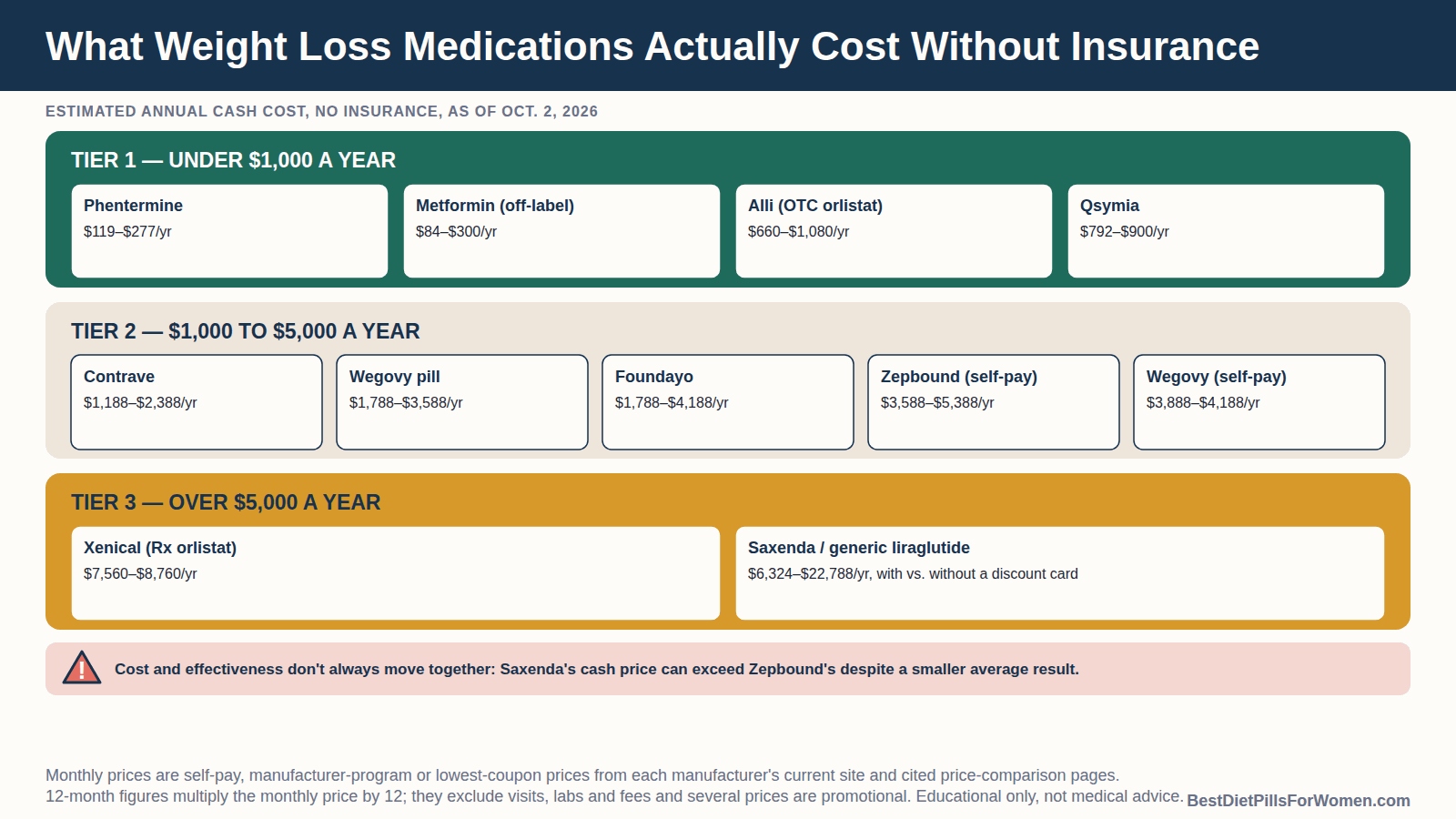
The spread in Table 6, from about $120 a year for generic phentermine to well over $20,000 a year for brand Saxenda without a discount, is wider than the price range across many entirely different categories of medicine. Effectiveness and cost move in roughly the same direction for most of this list, but not always: Saxenda’s cash price without a coupon is far higher than Zepbound’s or Wegovy’s despite a meaningfully smaller average effect, which is exactly the kind of mismatch worth catching before you commit to a specific drug based on brand familiarity alone.
How to Estimate Your Own Likely Cost
The maintenance-dose prices in Table 6 overstate what a first year on a titrating GLP-1 drug actually costs, since most of these drugs start at a lower dose and lower price for the first month or two. A first year on the Wegovy pill that spends one month each at $149 and $199 before settling into $299 a month for the remaining ten months comes to about $3,338, noticeably less than simply multiplying the $299 maintenance price by 12 would suggest. The most reliable way to estimate your own cost is to ask your specific prescriber or pharmacy for the titration schedule they plan to use, then price out each step rather than assuming the maintenance-dose price applies to the whole first year.
It’s also worth asking whether a manufacturer’s self-pay program has an enrollment fee, an income cap, or a maximum number of months it applies for, since several of these programs are explicitly described as introductory or promotional rather than a permanent price. A savings program that looks identical to a competitor’s on its headline number can still differ meaningfully in its fine print, and that’s exactly the kind of detail worth reading before enrolling rather than after your second or third fill arrives at a different price than the first.
Weight Loss Medications vs. Other Approaches
A weight loss medication is one tool among several, and knowing how it stacks up against the alternatives matters as much as knowing how it compares to other drugs on this list. This section intentionally sets aside the drug-by-drug evidence from earlier and asks a broader question: medication compared against what, exactly, and for whom does each comparison actually hold up.
Medications vs. Lifestyle-Only Programs
The oldest comparison in weight management is medication versus diet and exercise alone, and the evidence on that comparison is clearer than most people expect.
What the Comparative Evidence Shows
The U.S. Preventive Services Task Force recommends intensive, multicomponent behavioral interventions for adults with obesity, and the evidence behind that recommendation shows lifestyle programs alone typically produce modest results, in the range of a few percent of body weight, smaller than any FDA-approved medication’s average effect in Table 3. The Diabetes Prevention Program, a landmark trial comparing an intensive lifestyle intervention, metformin and placebo, found the lifestyle arm produced more weight loss than metformin over the study’s multi-year follow-up, even though metformin’s effect was still measurable. The Look AHEAD trial, which followed people with type 2 diabetes on an intensive lifestyle intervention for up to eight years, found meaningful sustained weight loss was achievable through lifestyle change alone, though the average effect size across participants was still smaller than what the newer GLP-1 medications produce in a comparable timeframe. What Look AHEAD demonstrates especially well is durability: eight years is longer than any medication trial cited in this guide, and the fact that a meaningful fraction of participants sustained real weight loss that long through lifestyle change alone is a genuinely useful data point for anyone who assumes medication is the only path to a durable result.
Why Medications and Lifestyle Change Aren’t Either/Or
Every pivotal trial behind every medication in this guide, including Zepbound’s and Wegovy’s, paired the drug with lifestyle counseling for every participant, medication and placebo groups alike. That’s a detail worth sitting with: the 20.9% and 14.9% headline results already include a baseline level of diet and activity support, not medication acting in a vacuum. Framing this as “medication versus lifestyle” misses what the trials actually tested, which was “medication plus lifestyle support versus lifestyle support alone.” For most people starting any drug in this guide, the realistic choice isn’t between a pill and a lifestyle change; it’s whether to add a medication on top of the lifestyle changes a clinician would recommend either way.
Medications vs. OTC Diet Pills and Supplements
Over-the-counter diet pills and supplements occupy a completely different evidence tier than the prescription drugs in this guide, and the gap is worth stating plainly.
Why the Evidence Gap Is So Large
A systematic review of dietary supplements and alternative therapies for weight loss found limited, inconsistent evidence of meaningful effect across the ingredients studied, nothing close to the large, modern, placebo-controlled trials behind the GLP-1 drugs, Qsymia or Contrave. Dietary supplements don’t require FDA approval before they’re sold, and FDA has repeatedly found weight loss products on the market containing undeclared, potentially dangerous pharmaceutical ingredients not listed on the label. The National Institutes of Health’s own fact sheet on dietary supplements for weight loss reaches a similarly cautious conclusion: the evidence for most individual ingredients marketed for weight loss doesn’t support the claims made about them.
When an OTC Product Might Still Make Sense
Alli, the over-the-counter version of orlistat, is the one product in this guide that straddles both categories: it’s sold without a prescription, but it’s the same FDA-approved active ingredient and mechanism as prescription Xenical, with real, FDA-reviewed trial data behind it, not a supplement’s thin evidence base. For someone who wants a legitimate, evidence-backed option without navigating a prescription, insurance or telehealth visit, alli is a reasonable starting point precisely because it isn’t a typical supplement, though its 2026 kidney-injury label update covered in the safety section above is worth reading before assuming “over the counter” means “no safety considerations at all”; our OTC appetite suppressant guide, natural appetite suppressant guide and best appetite suppressant for women cover the broader supplement landscape and where the evidence does and doesn’t hold up.
Medications vs. Bariatric Surgery
For people with higher BMIs or more severe weight-related health conditions, bariatric surgery remains the option with the largest average effect of anything covered on this site, and it’s worth comparing honestly rather than treating it as a separate topic this guide can safely ignore.
How the Outcomes Compare
Bariatric surgery, including sleeve gastrectomy and gastric bypass, typically produces larger and more durable weight loss than any medication in this guide, with some studies finding meaningful weight loss maintained many years after the procedure. That larger effect comes with a different risk profile entirely: surgery is an irreversible or difficult-to-reverse procedure with its own surgical risks, recovery time and long-term nutritional monitoring needs, which is a fundamentally different trade-off than starting or stopping a pill or injection. Recovery from a modern laparoscopic sleeve gastrectomy or gastric bypass typically runs a few weeks before returning to normal activity, shorter than many people assume, but the lifelong requirements that follow, vitamin and mineral supplementation, regular lab monitoring and permanent changes to how much and how fast you can eat, continue long after the incisions heal, in a way that stopping a pill or injection simply doesn’t require.
Who Typically Considers Surgery Instead
Current surgical-society guidelines generally reserve bariatric surgery for people with a BMI of 35 or higher, or 30 or higher with a serious weight-related condition, though practice varies, and some surgeons and insurers now also consider it for people who haven’t achieved their goals on medication alone. Increasingly, the two approaches overlap rather than compete: some people use a GLP-1 medication before surgery to reduce surgical risk, and others use one afterward if weight regain occurs years later, which is a meaningfully different picture than the old “pills versus surgery” framing suggests. NIDDK’s own patient materials frame surgery similarly, as one option among several rather than a last resort reserved only for people who have “failed” every medication first, a framing this guide deliberately echoes rather than treating surgery as a more extreme or more desperate choice than starting a prescription.
A Practical Decision Framework
None of this guide’s evidence can tell you which specific option fits your own health history, budget and goals, but a short, structured set of questions can narrow the field considerably.
Five Questions That Narrow the Field
Ask yourself, and eventually a clinician, these five questions: What’s my current BMI and do I have a weight-related condition that changes my eligibility? Am I pregnant, breastfeeding, or planning a pregnancy in the near future? Does my personal or family health history rule out a specific drug class outright, such as a thyroid cancer history ruling out every GLP-1 drug, or a seizure history ruling out Contrave? What can I realistically afford or get covered, factoring in the gap between list price and self-pay programs shown in Table 6? And how do I feel about the mechanism itself, an injection versus a pill, a controlled substance versus not, a drug I might take indefinitely versus one labeled for short-term use only? Answering those five narrows a list of eleven options down to a short, personally relevant shortlist before you ever sit down with a prescriber. A sixth, often-overlooked question is worth adding to the list: how would a serious side effect or a disappointing 12-week result actually affect your plans, financially and practically, and does your shortlist include a fallback option if your first choice doesn’t pan out?
What to Bring to a Clinician Conversation
Bring your answers to those five questions, your current medication and supplement list, and a specific question about what happens if your first choice doesn’t produce the hoped-for 12-week response described earlier in this guide. A good prescribing conversation treats this as an iterative decision, not a one-time choice: what you start with isn’t necessarily what you’ll end up on a year later, and planning for that possibility up front tends to produce less frustration than assuming the first prescription will be the final answer. That iterative mindset is really the throughline connecting every comparison in this section: lifestyle change, OTC options, prescription medication and surgery aren’t ranked tiers where you’re only allowed to move in one direction, and the right combination for most people who take any of this seriously tends to change as results, side effects and life circumstances change over time.
Frequently Asked Questions About Weight Loss Medications
Effectiveness and Evidence
Which Weight Loss Medication Works Best?
Tirzepatide (Zepbound) produced the largest average effect in this guide, 20.9% of body weight at its top dose in SURMOUNT-1, followed by semaglutide (Wegovy) at 14.9% and oral semaglutide (the Wegovy pill) at 13.6%. “Best” for a specific person also depends on eligibility, side-effect tolerance, cost and personal preference about pills versus injections, so the largest average effect isn’t automatically the right fit for everyone.
A woman with no contraindications and a flexible budget might reasonably prioritize the largest average effect. Someone with a personal or family history of medullary thyroid carcinoma would rule out every GLP-1 drug regardless of its results, and someone prioritizing the lowest possible cost might reasonably start with generic phentermine or alli despite their smaller effects. A fourth person managing a seizure disorder would rule out Contrave specifically, regardless of how its average result compares to anything else on this list. “Best” has a different answer for each of those scenarios, which is exactly why this guide leads with the full roster rather than a single recommendation.
Do Weight Loss Medications Work Without Diet Changes?
Most of the trials behind these drugs paired the medication with some level of lifestyle counseling for every participant, so “medication alone, with zero dietary changes” isn’t really what any pivotal trial tested. In practice, these drugs reduce appetite and food intake on their own, so some weight loss can occur with minimal deliberate dietary change, but the trial results in Table 3 describe medication plus baseline lifestyle support, not medication in total isolation.
Why Don’t Phentermine, Diethylpropion, Phendimetrazine and Benzphetamine Have Modern Trial Data?
All four were approved in the late 1950s or early 1960s, when FDA’s evidence standards for weight-loss drugs were far less rigorous than they are today, and none has attracted the kind of large, modern randomized trial that newer drugs like Zepbound and Wegovy have undergone. Limited commercial interest in re-studying decades-old generic drugs, rather than any specific safety finding, appears to be the main reason no such trial exists in the sources reviewed for this guide.
Safety and Practical Questions
Is It Safe to Take a Weight Loss Medication Long-Term?
It depends entirely on which drug and your own health history; the six long-term-approved medications (orlistat, Qsymia, Contrave, Saxenda, Wegovy and Zepbound) are specifically studied and labeled for extended use, while phentermine and its three older relatives are labeled for short-term use only. NIDDK’s own guidance is that people can generally continue a long-term-approved medication as long as they’re benefiting and not experiencing serious side effects, which is a meaningfully different standard than “safe forever with no monitoring.”
Long-term use of any of these drugs still calls for periodic clinician check-ins, since side-effect profiles, health conditions and medication interactions can all change over months or years of treatment. A drug being FDA-approved for long-term use describes what the label supports, not a guarantee that it’s the right long-term choice for your specific situation without ongoing medical supervision.
Can I Take a Weight Loss Medication While Breastfeeding?
Not without a specific conversation with your clinician, and for most drugs in this guide, the label leans toward no or “insufficient data to recommend.” Phentermine and its three older relatives are contraindicated while breastfeeding, Contrave’s label notes its components are present in breast milk, and Qsymia’s label doesn’t recommend use while nursing because of limited safety data. The GLP-1 drugs’ labels similarly don’t recommend use during breastfeeding, reflecting a lack of specific safety data rather than a confirmed risk.
What If a Weight Loss Medication Doesn’t Work for Me?
If you haven’t lost at least 5% of body weight after about 12 weeks at your medication’s full dose, that’s the point NIDDK and most drug labels suggest revisiting the plan with your prescriber rather than continuing indefinitely on faith. Options at that point typically include switching to a different drug class, adjusting dose where the label allows it, or stepping back to reassess whether a non-medication approach, or a combination of approaches, fits better.
Not responding to one medication doesn’t predict how you’ll respond to another; people who don’t reach a meaningful threshold on one GLP-1 drug, for instance, sometimes respond differently to a dual-agonist or a different mechanism entirely. That’s part of why this guide treats the eleven options here as a roster to work through with a prescriber, not a single bet to place once.
Life Stage and Combination Questions
Do Weight Loss Medications Work Differently After Menopause?
The large trials behind the newest drugs in this guide enrolled substantial numbers of women across a wide age range, including many past typical menopause age, but none of the pivotal trials cited in this guide broke results out specifically by menopausal status. That means this guide can’t point to a dedicated number showing whether a postmenopausal woman should expect a meaningfully different result than the trial averages in Table 3.
Hormonal shifts around menopause are independently associated with changes in body composition and where fat is stored, which is a separate, well-documented phenomenon from how any specific drug performs. Our dedicated guides on weight loss pills for menopause and women over 50 apply this same medication evidence specifically to that hormonal context in more depth than this general guide attempts.
Are These Medications Safe to Combine With Hormone Therapy?
No GLP-1, GIP or dual-agonist drug label reviewed for this guide lists menopausal hormone therapy as a specific contraindication or a flagged drug interaction worth separate warning language. That’s a meaningfully different statement than “proven safe to combine,” though; it simply means none of the labels in this guide’s reference chain singles out that specific combination as a known problem.
If you’re taking or considering hormone therapy alongside any weight loss medication in this guide, it’s worth making sure both prescribers, if they’re different people, know your complete medication list, since a drug that’s well-studied on its own isn’t automatically well-studied in every possible combination with every other treatment you might be using.
Is Any Weight Loss Medication Specifically Studied for PCOS?
No drug in this guide carries an FDA indication specifically for polycystic ovary syndrome, but several, including metformin and the GLP-1 drugs, are commonly prescribed off-label or alongside PCOS treatment because insulin resistance plays a central role in both PCOS and in how these drugs work. Metformin in particular has the longest track record in PCOS care specifically, generally for its effect on insulin resistance and menstrual regularity rather than a dedicated weight-loss indication.
Our best weight loss pills for PCOS guide goes deeper on how this specific condition changes the risk-benefit picture for several drugs covered in this roster, including which ones have the most relevant supporting evidence for someone with PCOS specifically.
How Quickly Will I Know If a Medication Is Working?
Most prescribers use the 12-week mark described earlier in this guide as the first real checkpoint, since a drug’s label-defined response threshold, typically at least 5% weight loss, is measured at or around that point for most options in this guide. Noticeable appetite changes often show up well before 12 weeks for the GLP-1 and dual-agonist drugs specifically, sometimes within the first few doses, though early appetite changes aren’t the same as a confirmed, durable weight-loss result.
Weighing yourself more often than weekly, or expecting a perfectly linear decline, tends to create more frustration than useful information, since week-to-week weight naturally fluctuates with water retention, digestion and other factors unrelated to whether a medication is working.
Cost and Access
Why Do Weight Loss Medications Cost So Much?
Brand-name list prices reflect years of research and development costs, patent protection with no generic competition yet for most of the newest drugs, and, for the GLP-1 class specifically, manufacturing complexity for a biologic injection. Self-pay programs, manufacturer savings cards and, where available, insurance coverage can bring the real out-of-pocket cost down substantially from the sticker price shown on a pharmacy shelf, which is exactly why Table 6 in the cost section above lists both the list-style price and the realistic self-pay or coupon price for each drug.
Will Insurance or Medicare Cover a Weight Loss Medication?
It depends heavily on your specific plan, your employer, and sometimes your state. A growing share of large employers now cover at least one GLP-1 drug for weight management, but prior authorization and utilization-management rules are common even when coverage technically exists. Traditional Medicare has historically not covered these drugs for weight loss alone, though specific demonstration programs and policy proposals aimed at expanding access have been debated, with implementation details still evolving as of this guide’s most recent check.
Can I Use an HSA or FSA to Pay for a Weight Loss Medication?
Generally yes: a prescription medication, including any drug in this guide written by a licensed prescriber, is typically an eligible expense under a health savings account or flexible spending account, which can meaningfully offset a self-pay price. Over-the-counter alli typically qualifies too, since OTC drugs generally became HSA/FSA-eligible without a prescription requirement under federal rules adopted in 2020.
Specific plan rules can vary, and an FSA in particular may have a “use it or lose it” deadline that’s worth checking against a drug’s titration schedule before committing a full year of contributions to a single prescription. Confirming eligibility with your specific plan administrator before counting on this as a cost-offset strategy is worth the five-minute phone call.
The Bottom Line on Weight Loss Medications
Eleven options, three evidence tiers and a wide range of costs boil down to a few things worth holding onto before you act on anything in this guide. If you read nothing else here, read this section; it’s the part of this guide meant to travel with you into an actual decision, not just add to the research pile.
What the Evidence Means for You
The honest summary of this entire category is that newer almost always means better-studied and more effective, but “better-studied and more effective” doesn’t automatically mean “right for you.” Eligibility, cost, personal risk tolerance and plain preference about pills versus injections all belong in that decision alongside effect size, and none of this guide’s trial data can weigh those factors for you.
The Biggest Realistic Advantage
The newest GLP-1 and dual-agonist medications in this guide, especially Zepbound and Wegovy, offer the strongest combination of evidence, effect size and long-term data of any weight loss medication available today, with Qsymia, Contrave, Saxenda and the two newer oral GLP-1 drugs a step behind but still backed by large, modern, placebo-controlled trials. For someone who meets the eligibility criteria and can access one of these drugs, that’s a genuinely different proposition than anything sold without a prescription, both in realistic expected results and in how thoroughly the risks have been studied and monitored. That advantage isn’t limited to the newest injectables, either: Qsymia’s 9.8%, Contrave’s 5.4% to 8.1% and Saxenda’s 7.4% average results are each backed by their own placebo-controlled trial and over a decade of real-world prescribing experience, which is still a fundamentally stronger evidence base than anything available without a prescription.
The Biggest Limitation or Safety Concern
No drug in this guide is risk-free, and the risks cluster differently by drug class rather than concentrating in one obvious place. The GLP-1 and dual-agonist drugs carry a shared boxed warning for thyroid C-cell tumors based on animal data, common gastrointestinal side effects serious enough to drive real discontinuation rates, measurable lean-mass loss alongside fat loss, and a cost structure that remains a genuine barrier even with generous self-pay programs. Phentermine and its three older relatives carry a real limitation that no amount of clinical experience fully resolves: none has a modern randomized trial reporting a placebo-subtracted result, and their stimulant mechanism rules them out for anyone with significant cardiovascular disease. Orlistat and the four short-term stimulants have their own distinct limitation worth restating plainly here: orlistat’s digestive side effects are common enough to end treatment for many users regardless of how disciplined their diet is, and the stimulant-class drugs’ complete lack of modern trial data means their real-world effect size is, honestly, a matter of clinical experience rather than published proof. And every single drug in this guide shares one limitation in common: stopping treatment tends to bring weight back, at an average rate that would return most people to their starting weight within roughly two years, which means long-term planning matters more in this category than in almost any other area of medicine.
A Rational Next Step
Neither a drug label nor this guide can tell you which of these eleven options, if any, fits your own health history, budget and goals. A short, structured conversation can narrow the list considerably.
Questions for a Clinician
Bring these questions to a prescriber weighing a weight loss medication: Which drugs am I actually eligible for, given my BMI, blood pressure, personal and family health history? If my first choice doesn’t produce at least 5% weight loss by 12 weeks, what’s the plan, and does my insurance make switching drugs difficult or expensive? What would change your recommendation, a different mechanism, a controlled substance I should avoid, an injection versus a pill? And realistically, how long do you expect me to need this medication, and what does stopping eventually look like?
Two more questions are worth adding if you’re a woman specifically weighing this evidence against a particular life stage: does being in perimenopause, menopause, or managing PCOS change which of these eleven options you’d recommend, or change the dose or monitoring plan for the one we’re discussing? And is there anything about my current hormone therapy, if I’m on any, or my reproductive plans that should factor into this specific choice? Neither question has a universal answer in this guide, which is exactly why they belong in a conversation with a clinician who knows your full history rather than in a general comparison like this one.
How This Guide Fits Into a Larger Decision
This guide can tell you what the evidence shows, what a label requires you to watch for, and roughly what a drug costs without insurance; it can’t tell you whether your specific blood pressure history rules out a stimulant, whether your insurance plan’s specific formulary covers one GLP-1 drug but not another, or how you’ll personally weigh a larger average effect against a needle, a higher price, or a controlled-substance designation. Those are the genuinely personal pieces of this decision, and no comparison article, however thorough, can responsibly make them for you.
What this guide can do is make sure you walk into that decision already knowing the right questions to ask, the real evidence behind each answer you’re given, and the difference between a marketing claim and a label-supported fact. That’s a meaningfully different starting point than most of what gets written about this category, and it’s the standard this entire guide was built to meet.
What to Re-Check Before You Start or Spend Money
Prices, insurance rules, and even FDA approval status in this category change quickly. Before committing to a specific drug, re-check its current self-pay price and manufacturer savings program, confirm your insurer’s current prior-authorization criteria, and, if you’re considering a controlled substance such as phentermine or Qsymia through telehealth without an in-person visit, confirm the federal flexibility that allows that is still active, since it’s currently time-limited and its future beyond 2026 isn’t yet settled. If a compounded or unusually cheap version of a GLP-1 drug is part of the plan, confirm it’s coming from a legitimate, licensed source before you take it, not after.
A few numbers in this guide are worth rechecking for the same reason, specifically because they move faster than an article’s publish date: self-pay prices for every GLP-1 and dual-agonist drug in Table 6, current prior-authorization and formulary rules for your specific insurer, and whether a drug’s FDA approval, REMS requirements, or boxed warnings have been updated since October 2026. None of that uncertainty should be read as a reason to distrust the evidence summarized throughout this guide; it’s a reason to treat the evidence as current as of a specific date and to build a five-minute recheck into your decision process before you spend real money or start a new medication. That habit, more than any single fact in this guide, is probably the most durable protection against outdated information in a category that changes this quickly.
Related Reading
- Wegovy cost and insurance breakdown
- Wegovy pill (oral semaglutide) cost guide
- metformin cost guide
- Ozempic cost guide
- Wegovy vs. Zepbound comparison
- Ozempic vs. Wegovy comparison
- Mounjaro vs. Zepbound comparison
- semaglutide vs. tirzepatide comparison
- metformin vs. Wegovy comparison
- metformin vs. Zepbound comparison
- Wegovy insurance coverage guide
- Ozempic insurance coverage guide
- weight loss pills vs. GLP-1 injections comparison
- Wegovy pill vs. Wegovy injection comparison
- Wegovy weight-loss results guide
- our complete guide to GLP-1 weight loss medications
- Ozempic for weight loss guide
- Ozempic weight-loss results guide
- Wegovy dosage and titration guide
- prescription vs. OTC weight loss pills comparison
- prescription appetite suppressants guide
Sources
These are the main sources behind this guide, chosen because they are the ones to check first for current facts. Labels, trial pages, prices and coverage pages change, so confirm the latest version before you make decisions.
- National Institute of Diabetes and Digestive and Kidney Diseases. Prescription medications to treat overweight and obesity (last reviewed June 2024). https://www.niddk.nih.gov/health-information/weight-management/prescription-medications-treat-overweight-obesity
- Novo Nordisk. Wegovy (semaglutide) injection and tablets, prescribing information (label revised 06/2026). https://www.novo-pi.com/wegovy.pdf ; DailyMed set ID ee06186f-2aa3-4990-a760-757579d8f77b.
- Eli Lilly and Company. Zepbound (tirzepatide) prescribing information (revised 08/2026). https://pi.lilly.com/us/zepbound-uspi.pdf
- Wilding JPH, et al. Once-weekly semaglutide in adults with overweight or obesity (STEP 1). N Engl J Med. 2021;384:989-1002. doi:10.1056/NEJMoa2032183
- Jastreboff AM, et al. Tirzepatide once weekly for the treatment of obesity (SURMOUNT-1). N Engl J Med. 2022;387:205-216. doi:10.1056/NEJMoa2206038; and Zepbound prescribing information, Table 2. https://www.accessdata.fda.gov/drugsatfda_docs/label/2026/217806s042lbl.pdf
- VIVUS LLC. Qsymia (phentermine and topiramate extended-release) capsules, prescribing information (label revised April 2026), DailyMed set ID 40dd5602-53da-45ac-bb4b-15789aba40f9. https://dailymed.nlm.nih.gov/dailymed/drugInfo.cfm?setid=40dd5602-53da-45ac-bb4b-15789aba40f9
- Nalpropion Pharmaceuticals LLC. Contrave (naltrexone HCl/bupropion HCl extended-release) tablets, prescribing information (DailyMed revision 11/2025), set ID 485ff360-32c8-11df-928b-0002a5d5c51b. https://dailymed.nlm.nih.gov/dailymed/drugInfo.cfm?setid=485ff360-32c8-11df-928b-0002a5d5c51b
- Novo Nordisk. Saxenda (liraglutide) injection 3 mg, prescribing information (novo-pi.com copy showing revision 02/2026; DailyMed showed 6/2026 with the same adverse-reaction table; page summaries). https://www.novo-pi.com/saxenda.pdf
- H2-Pharma LLC. Xenical (orlistat) capsules, prescribing information (revised 07/2024), DailyMed set ID 6240792b-9224-2d10-e053-2a91aa0a2c3e. https://dailymed.nlm.nih.gov/dailymed/drugInfo.cfm?setid=6240792b-9224-2d10-e053-2a91aa0a2c3e
- Teva Pharmaceuticals. Adipex-P (phentermine) prescribing information (revised 03/2024), DailyMed set ID f5b2f9d8-2226-476e-9caf-9d41e6891c46, and KVK-Tech. Lomaira (phentermine 8 mg) prescribing information (December 2023), set ID cde9fb09-e5af-434d-8874-e4f9f974d893 (re-read on September 24, 2026 through a page summary, whose wording of the mechanism sentence differed slightly from an earlier reading, so the article paraphrases it). https://dailymed.nlm.nih.gov/dailymed/drugInfo.cfm?setid=f5b2f9d8-2226-476e-9caf-9d41e6891c46

