

The best weight loss pills for women over 50, judged by the strength of the evidence, are the same prescription medicines that lead the field at any adult age: the newer GLP-1 pills, the Wegovy pill and Foundayo, along with their weekly injectable versions. What’s different after 50 is the evidence base itself. A post hoc analysis of Foundayo’s trials found similar weight loss in adults 65 and older as in younger adults, and a related semaglutide trial enrolled thousands of adults over 45 with heart disease, though it was only about 28% women. Older prescription pills such as Qsymia, Contrave and phentermine trail on average results, and over-the-counter pills haven’t shown comparable effects.
Here’s the catch: turning 50 doesn’t reset who qualifies for a medicine, since eligibility still runs on body mass index (BMI), not age. What does change by 50 is the body underneath the number. The average American woman reaches menopause at 52, so most readers of this guide are postmenopausal or close to it, and bone loss speeds up once estrogen falls. Blood pressure is common enough by this age that more than seven in ten adults 60 and older have it, and a majority of adults in their 60s and 70s now qualify for a statin under the 2026 cholesterol guideline. That means more women arrive at this decision already taking other medicines, which raises real questions about interactions, monitoring and what a pill does to muscle and bone on top of what menopause has already done.
This guide checks what the evidence says about each pill category specifically for women past 50, tests the “metabolism crashes after 50” idea against what actually changes, and lays out the safety, interaction and cost questions that matter most at this stage, including Medicare’s new GLP-1 program. It’s part of our wider coverage of the best weight loss pills for women and our guide for women over 40, and it’s meant to sharpen the questions you bring to a clinician or pharmacist, not to tell you to start or stop anything.
Best Weight Loss Pills for Women Over 50: The Short Answer
Start with the conclusions, then check them against the sections that follow. Each answer says how sure we are and what limits it.
The Direct Answer and How Sure We Are
Two things need separating: what the evidence says and how much weight it can bear.
What Are the Best Weight Loss Pills for Women Over 50?
For women over 50 who qualify and can take them safely, the prescription GLP-1 pills, the Wegovy pill and Foundayo, still have the strongest evidence among pills. Their trials produced average weight losses of roughly 7% to 14% of body weight against about 2% on placebo, and a 65-and-older subgroup analysis of Foundayo’s trials found comparable results to younger adults. The older prescription pills post smaller average results, and over-the-counter supplements have no good evidence of meaningful weight loss at any age.
How Sure We Are About That Answer
We’re most confident about what the labels say, since the warnings, contraindications and interaction language come from FDA-approved prescribing information, though we read those labels through summaries and label mirrors. We’re moderately confident about the trial results, which are averages from separate studies in different groups, so any ranking is indirect. We have low confidence about how a specific woman over 50, let alone over 70 or 80, will respond, because most of these trials still reported age mostly as a mean rather than enrolling to answer an age-specific question, and the one large trial built around older adults with heart disease enrolled mostly men. The age-65-and-older analyses we found were post hoc, meaning researchers looked at a subgroup after the trial ended, and some were funded by the drugmaker.
How We Judged “Best”
“Best” means different things to different readers, so we say what we used. The judgment is about evidence and fit, not a ranking of products from most to least worth buying.
The Four Criteria We Used
We looked at four things for each option. First, the strength of the human evidence, meaning randomized trials and systematic reviews before any mechanism or animal work. Second, how closely the people studied resemble women over 50, judged by mean age, the share of women and any reporting on adults 65 and older. Third, safety and label restrictions, weighted toward issues that grow more common past 50, such as blood pressure, bone density, and interactions with medicines for the heart, thyroid and blood sugar. Fourth, access and cost, including Medicare coverage where it applies. We didn’t weight manufacturer claims, retailer reviews or affiliate commissions.
What This Assessment Is and Isn’t
Our assessment rests on desk research: current prescribing information, published trials and post hoc analyses, federal health-agency pages, guideline summaries, manufacturer price pages and regulator notices, nearly all read through abstracts, label mirrors and page summaries. We didn’t test any product. We don’t recommend that you start, stop or change any medicine or supplement, and we don’t number the options from first to last, because they come from separate trials that nobody ran against each other.
The Options at a Glance
Table 1 lines up every option covered in this guide, including the two injections. It puts the age and sex mix of each main trial next to the result, because that’s the closest thing to an age-specific answer most of the published evidence offers, and it notes where a separate analysis says more about adults past 50 or 65.
The Summary Table
Read across each row before you read down a column, because an option’s results and its cautions belong together.
| Option | Main trial: mean age, share of women | Average weight change, drug vs placebo | Biggest consideration after 50 |
|---|---|---|---|
| Wegovy pill (semaglutide, daily; prescription) | OASIS 4: 48, 76% | −13.6% vs −2.4% (label analysis) | Raised levothyroxine exposure by 33%; take at least 30 minutes before other oral medicines |
| Wegovy injection (semaglutide, weekly; not a pill) | STEP 1: 46, 73% | −14.9% vs −2.4% | The related SELECT trial found fewer heart attacks and strokes in adults 45+ with heart disease, but that trial was only about 28% women |
| Foundayo (orforglipron, daily; prescription) | ATTAIN-1: 45, 64% | −7.4%, −8.3%, −11.1% vs −2.1% | A 65-and-older analysis found similar weight loss to younger adults, but more of them stopped from side effects |
| Zepbound (tirzepatide, weekly; not a pill) | SURMOUNT-1: 45, 68% | −15.0%, −19.5%, −20.9% vs −3.1% | Oral contraceptive users need backup contraception, though pregnancy prevention matters to far fewer women over 50 |
| Contrave (naltrexone-bupropion, daily; prescription) | Pooled trials: 46, 82% | −5.4% vs −1.3% (first trial) | Boxed warning on suicidal thoughts; not for uncontrolled high blood pressure, which affects most adults over 60 |
| Qsymia (phentermine-topiramate, daily; prescription) | CONQUER: age not read, 70% | −7.81% and −9.84% vs −1.24% | The label reports only 7% of trial participants were 65 to 69, and none 70 or older |
| Phentermine (short-term; prescription) | Not in the label | A fraction of a pound a week over placebo (label) | Contraindicated with cardiovascular disease and uncontrolled high blood pressure, both more common after 50 |
| Orlistat (alli 60 mg OTC; Xenical 120 mg prescription) | Not read | About 2.9 kg (6.4 lb) more than placebo in a 2007 pooled analysis | Can lower vitamin K absorption, so women on warfarin or another blood thinner need extra monitoring |
| Supplements (fibers, caffeine blends, “hormone balance” and “bone support” formulas) | Varies | Small or inconsistent in the trials we found | Some contain undeclared drugs; caffeine and stimulant totals add up on top of any prescription |
Table 1 method: mean ages, sex shares and weight figures are as reported in the labels and abstracts, and no result was recalculated. Percentages are mean weight change from baseline. The trials differ in length, dose and population, so the rows form an indirect comparison and not a head-to-head ranking, and the CONQUER age wasn’t in the page we read. The SELECT and Foundayo 65-and-older findings come from separate analyses of the same drugs rather than from a trial of women over 50 specifically, and are included as context. Trial, label and price details were read through abstracts, label mirrors and page summaries as of September 25, 2026.
How to Read the Table
Table 1 isn’t a shopping list. The two GLP-1 pills sit at the top because their trials produced the largest average results among pills, and because separate analyses of those same drugs say more than most trials do about people past 65. The older pills post smaller results and carry heavier exclusion lists, and some women do better on them, or can’t take a GLP-1 drug at all. The middle rows are the injections, which aren’t pills but come up constantly in comparisons; our guide to weight loss pills vs injections covers that trade-off in full. Every row’s “biggest consideration” column is there because, past 50, the caution often matters as much as the number above it.
What Changes After 50: Menopause, Bone, Muscle and Heart Risk
Fifty isn’t a biological cliff edge any more than 40 is, but it lands close to one real transition. The average American woman reaches menopause, defined as 12 months without a period, at age 52, so a large share of the women reading this guide are newly postmenopausal, a few years in, or close enough to feel the effects. That matters more for this guide than the calendar does.
Menopause Is Behind Most Women by 50
The menopause transition itself, not the number 50, is what reshapes a woman’s weight and body composition. By 50, most women have already been through it or are finishing it.
Is Weight Gain After Menopause Inevitable?
No, but the transition does speed up fat gain for a few years, and it changes where that fat settles. In the SWAN study of 1,246 women, the rate of fat gain rose by about 70%, roughly one and a half times its earlier pace, during the menopause transition, from about 1.0% of fat mass a year before it to about 1.7% a year during it, before leveling off afterward. Aging, sleep, stress and activity levels still do a lot of the work, alongside menopause itself.
What the SWAN Study Found
SWAN followed the same 1,246 women for up to 15 years, tracking body composition through nearly the whole transition, and it’s one of the few long studies that separated menopause’s effect from ordinary aging. Fat mass rose faster during the roughly two-year window around the final period, at about 0.45 kg (1 lb) a year on top of the aging trend, and it settled more toward the abdomen. Lean mass fell too, by about 0.2% a year during that window, a small number that adds up over a decade. The rate of fat gain didn’t keep accelerating after the transition ended; it returned closer to the pre-transition pace.
Bone and Muscle Loss Speed Up After Menopause
Estrogen protects bone, and its drop at menopause is why bone loss and muscle loss both pick up pace right around the age this guide covers, not gradually over an entire adult life.
Why Do Calcium Needs Go Up at Age 51?
Because bone loss accelerates once estrogen falls, and the government’s own nutrient targets reflect it: the recommended calcium intake for women rises from 1,000 mg a day before 51 to 1,200 mg a day at 51 and older, with an upper limit of 2,000 mg. It’s one of the few federal nutrition guidelines that draws a real line at a specific age rather than treating adulthood as one long stretch.
Vitamin D’s recommended intake follows a similar, later step: 600 IU (15 mcg) a day through age 70, then 800 IU (20 mcg) a day after that, with an upper limit of 4,000 IU (100 mcg) at both ages. Neither target is proof that supplementing prevents a fracture on its own; they’re baseline nutrient goals meant to support bone health alongside, not instead of, the weight-bearing exercise covered later in this guide.
Sarcopenic Obesity: When Muscle Loss and Excess Weight Combine
A 2022 consensus statement from two obesity societies defined sarcopenic obesity as the combination of excess body fat and reduced muscle mass or function in the same person, which can hide behind a normal-looking weight or BMI. The statement lays out a two-step diagnosis: first checking muscle strength and function, then confirming both low muscle mass and excess fat with a body-composition test, and it stages the condition by whether complications like reduced mobility are already present. It’s a newer, still-evolving framework, and screening for it isn’t yet routine, but it names a real pattern that becomes more common with age: losing weight the ordinary way can remove muscle a woman can’t afford to lose.
Metabolism, Thyroid and Other Reasons Health Risk Rises After 50
Before blaming a slow metabolism, it’s worth checking what the research on metabolism after 50 actually shows, and what else commonly changes at this age that has nothing to do with metabolic rate.
Does Metabolism Really Slow Down After 50?
Not sharply at 50 itself. A 2021 study of 6,421 people found that total and resting energy expenditure, after adjusting for muscle and fat mass, stayed essentially flat from age 20 to 60, then declined by about 0.7% a year after 60. So a woman in her early or mid-50s likely burns calories at close to the same underlying rate she did at 35, once body composition is accounted for; the real shift, when it comes, tends to arrive later and more gradually than “after 50” marketing suggests.
Medicines and Thyroid Problems That Add Weight
Thyroid disease becomes more likely with age and is far more common in women, affecting an estimated 20 million Americans, with women 5 to 8 times more likely to have a thyroid condition and up to 60% of cases undiagnosed. Hypothyroidism in particular tends to show up more after menopause and can slow metabolism and add weight, which is one reason a thyroid check is a reasonable step before assuming a pill is the answer. Prescription medicines are another common, overlooked cause. Table 2 lists drug classes linked to weight gain that show up often in a woman’s medicine cabinet by her 50s and 60s, since polypharmacy, taking several medicines at once, becomes the norm rather than the exception in this age group.
| Category | Examples | What’s reported |
|---|---|---|
| Diabetes medicines | Insulin, sulfonylureas, thiazolidinediones | Higher weight-gain risk; metformin and GLP-1 drugs are lower-risk alternatives |
| Blood pressure medicines | Older beta-blockers such as metoprolol tartrate | Weight gain reported; ACE inhibitors, ARBs and calcium channel blockers are lower-risk |
| Antidepressants | Paroxetine, mirtazapine, some tricyclics | More likely to cause weight gain than other antidepressants |
| Steroids and antihistamines | Corticosteroids; some allergy medicines | Weight gain reported, often dose- and duration-dependent |
| Untreated hypothyroidism | Low thyroid hormone | Can slow metabolism and cause weight gain; more common after menopause |
Table 2 method: this table summarizes categories flagged in a clinical guidance review and a women’s-health page, both read through page summaries; it isn’t a complete list, and it isn’t advice to stop or switch any medicine without a prescriber’s involvement.
None of this is a reason to write off medication for weight, and it isn’t a case for blaming everything on a slow metabolism either. It’s a reason to have a real conversation with a prescriber about what else is going on before adding a pill on top.
Who Qualifies for Weight Loss Medication After 50: The Numbers and the Guidelines
Before comparing pills, it helps to know how many women over 50 are actually dealing with obesity, what tends to come with it at this age, and what the official rules for a prescription actually say.
The Numbers for Women Over 50
Federal survey data doesn’t slice its age bands neatly at 50, but the two bands it does use, 40 to 59 and 60 and older, bracket this guide’s audience well enough to be useful.
How Common Is Obesity in Women Over 50?
Obesity affects an estimated 47.4% of women aged 40 to 59 and 39.6% of women 60 and older, compared with 41.3% of women overall, based on national survey data from August 2021 to August 2023. Severe obesity affects about 14.7% of women 40 to 59. The dip after 60 is a real pattern in the data, not a typo, though it may partly reflect who survives to be counted in that group rather than individual women losing weight as they age.
How Common Are Related Conditions Like High Blood Pressure and High Cholesterol?
High blood pressure affects 52.5% of adults aged 40 to 59 and 71.6% of adults 60 and older, versus 47.7% of all adults, and only about one in five of those with hypertension has it fully controlled. That single statistic does a lot of work later in this guide, since two of the older prescription pills are contraindicated with uncontrolled blood pressure.
Cholesterol management follows a similar age curve. Under the 2026 ACC/AHA guideline, an estimated 85% of adults 60 to 69 and 93% of adults 70 to 79 now qualify for statin therapy, though roughly three-quarters of those who should be on a lipid-lowering medicine for primary prevention aren’t currently taking one. The takeaway isn’t that every woman over 50 is on multiple medicines, but that it’s common enough to plan around, which is why a later section covers interactions with statins, blood pressure medicine, blood thinners and thyroid medicine in some detail.
Who Medication Is For
Eligibility for a prescription weight loss medicine hasn’t moved with age; it’s still set by body mass index and related health conditions, the same as it is for a 35-year-old.
Who Qualifies for a Prescription Weight Loss Medicine?
The National Institute of Diabetes and Digestive and Kidney Diseases describes prescription weight loss medicine as an option for adults with a BMI of 30 or higher, or 27 or higher with a weight-related condition such as high blood pressure, type 2 diabetes or high cholesterol. Age isn’t a listed exclusion in that criteria, though individual drug labels carry their own age-related cautions, covered in the sections ahead.
Two 2026 clinical guidelines add more structure to that basic criteria. One comes from a joint effort of the Obesity Society, Obesity Medicine Association and the Obesity Action Coalition; the other is a separate living guideline from the American College of Physicians. Both address when and how to add medication to lifestyle treatment for adults with overweight or obesity, though we read summaries of both rather than the full guideline text, so specific recommendation strengths and evidence grades weren’t available to us this session. Neither guideline, as far as we could confirm, sets a different BMI threshold or a different process for women over 50 specifically.
What Osteoporosis and Heart Screening Add to the Picture
Two screening thresholds sit close enough to this age range that they’re worth knowing alongside the weight loss discussion, since bone and heart status can shape which pill, if any, makes sense. The US Preventive Services Task Force recommends bone density screening for all women 65 and older, and for postmenopausal women younger than 65 who have a risk factor such as low body weight, a parent’s hip fracture, smoking or heavy alcohol use. None of this determines eligibility for a weight loss pill, but a woman heading into that conversation with her bone and cardiovascular risk already checked is in a stronger position to weigh a drug’s trade-offs, a theme this guide returns to in the sections on protecting muscle and bone and on interactions with other medicines.
What the Weight Loss Trials Show for Women Over 50 and Older Adults
The trials behind these pills weren’t built to answer “does this work for a 55-year-old woman” or “what about a 72-year-old.” But between trial demographics, label subsections and a handful of newer post hoc analyses, there’s more age-specific information here than for most drug categories, and it’s worth laying out plainly.
Who Was in the Major Weight Loss Trials
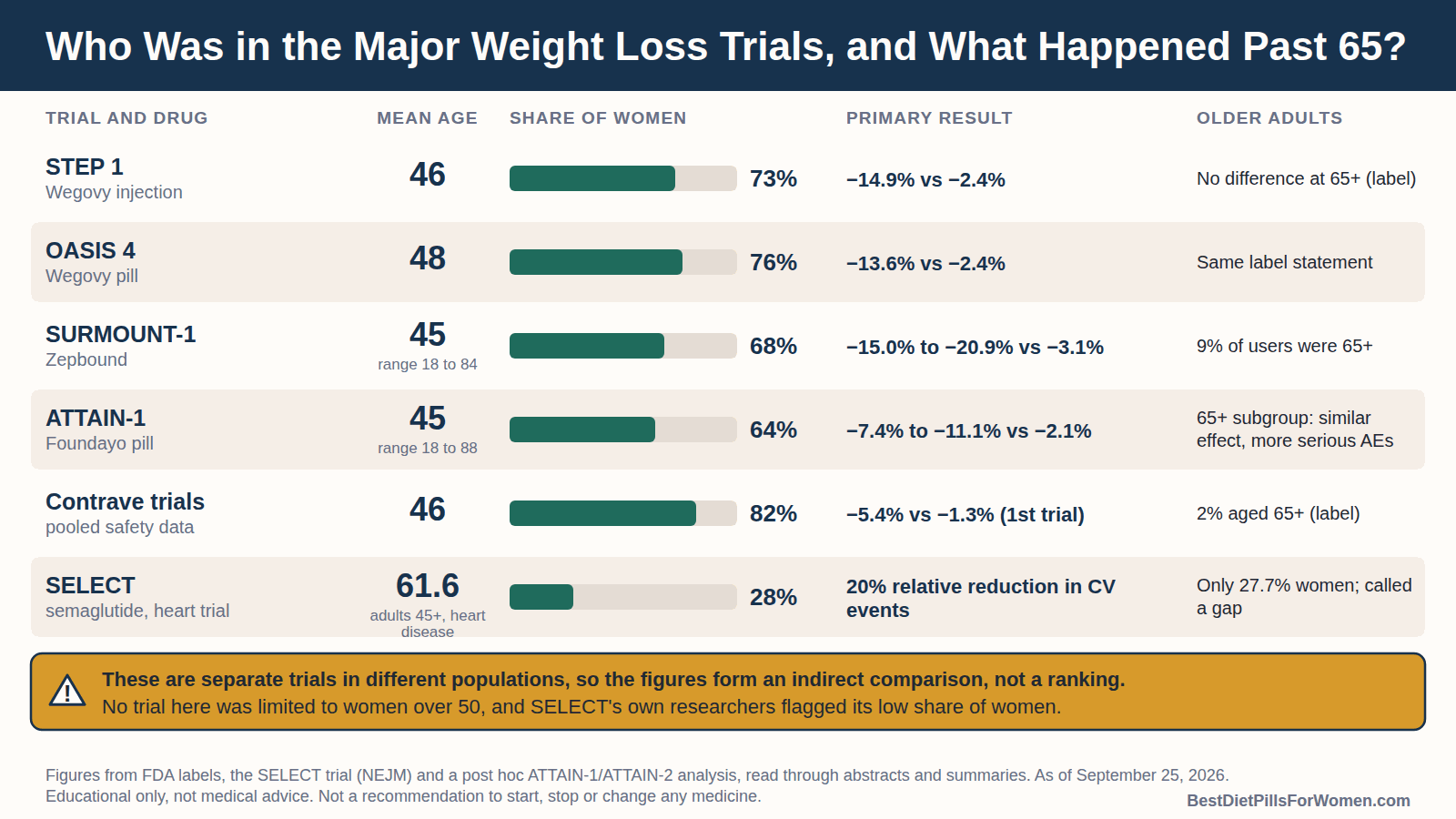
Every major trial reports a mean age and a share of women, and most labels include a short statement on patients 65 and older. Table 3 puts both next to each other.
The Trial Participants at a Glance
Read the right-hand column as what’s known, not as a verdict; “no overall difference” in a label means the drugmaker didn’t find one in the numbers it examined, not that a study was designed and powered specifically to detect one.
| Trial and drug | Mean age, share of women | Result, drug vs placebo | What’s reported for older adults |
|---|---|---|---|
| STEP 1, Wegovy injection | 46, 73% | −14.9% vs −2.4% | Label: no overall difference in effectiveness at 65 and older |
| OASIS 4, Wegovy pill | 48, 76% | −13.6% vs −2.4% | Same label statement |
| SURMOUNT-1, Zepbound | 45 (range 18-84), 68% | −15.0% to −20.9% vs −3.1% | 9% of Zepbound-treated participants were 65+; label reports no overall differences |
| ATTAIN-1, Foundayo, no diabetes | 45 (range 18-88), 64% | −7.4% to −11.1% vs −2.1% | 65+ subgroup: −7.9% to −13.0% vs −1.6%, broadly similar to younger adults |
| ATTAIN-2, Foundayo, with type 2 diabetes | Age and sex share not read | −10.5% (36 mg dose) vs −2.2% | 65+ subgroup: −7.5% to −12.2% vs −2.3% |
| Contrave pooled trials | 46, 82% | −5.4% vs −1.3% (first trial) | 2% of participants were 65+; label notes older patients may be more sensitive to nervous-system side effects |
| CONQUER, Qsymia | Age not read, 70% | −7.81% and −9.84% vs −1.24% | 7% were 65 to 69; none 70 or older |
| SELECT, semaglutide injection for heart protection, not weight loss | 61.6, 27.7% | 20% relative reduction in heart attack, stroke or cardiovascular death (8.0% to 6.5% absolute, over about 3 years) | Built around an older population with existing heart disease, but only about 1 in 4 participants was a woman |
Table 3 method: figures are as reported in the labels, trial abstracts and a post hoc analysis, and none were recalculated except where noted. ATTAIN-2 enrolled adults with obesity or overweight and type 2 diabetes, which skews the trial older than ATTAIN-1; we didn’t find its mean age or sex share in the sources we read. These are separate trials in different populations, so the table is an indirect comparison, not a head-to-head ranking. Read through abstracts, label mirrors and page summaries as of September 25, 2026.
What the Labels Say About Patients 65 and Older
Every GLP-1 label in Table 3 says essentially the same thing: no overall difference in effectiveness was seen in patients 65 and older, but the number of older participants was often too small to detect a real difference even if one existed. Qsymia and Contrave are more candid about the gap; Qsymia’s label states plainly that clinical studies didn’t include enough patients 65 and older to know if they respond differently, and Contrave flags that older individuals may be more sensitive to nervous-system side effects. Orlistat’s label goes further and simply says there weren’t enough patients 65 and older in its studies to draw a conclusion either way.
A Closer Look at Results Past 65
Two newer sources go beyond a label’s one-line disclaimer, and both are worth knowing in some detail because they’re closer to a real answer than most of what’s cited in Table 3.
What Did a New Analysis Find for Orforglipron After 65?
A post hoc analysis of the ATTAIN-1 and ATTAIN-2 trials, covering roughly 600 participants 65 and older, found weight loss broadly consistent with younger adults: up to about 13.0% at the highest dose in the trial without diabetes, and up to about 12.2% in the trial with type 2 diabetes, both well above placebo.
That’s a genuinely reassuring finding on effectiveness, but it comes with a real trade-off on tolerability. Serious adverse events were more common in the 65-and-older group than in younger participants in the same trials, and gastrointestinal side effects, sometimes severe, were the most frequent complaint in both age groups. That pattern, strong results paired with a rougher tolerability profile in older adults, lines up with what clinicians who treat older patients on these drugs report more broadly, covered later in this guide’s safety section.
What the SELECT Heart-Health Trial Adds, and Its Limits
SELECT tested semaglutide injection, not for weight loss primarily but to see if it could prevent heart attacks, strokes and cardiovascular death in adults 45 and older who already had heart disease and were overweight or obese but didn’t have diabetes. Across 17,604 participants and a mean age of 61.6, it found a 20% relative reduction in that combined outcome, with 67 people needing treatment to prevent one event. That’s a genuinely large trial built around an age group this guide covers, which is rare. Its limit is candidly acknowledged even by researchers who ran it: only about 27.7% of participants were women, and one cardiologist commenting on the full results said she was “disappointed” that a heart-disease trial in obesity didn’t enroll more women, calling it a gap the field still needs to close. Read the cardiovascular benefit as real for the population studied, and read the women’s share as a genuine limit on how confidently it generalizes to women specifically.
Trial results are averages, and individual women land on both sides of them. In a pooled analysis of women in the ATTAIN-1 and ATTAIN-2 trials, up to 23% of those on placebo still lost at least 5% of their weight, while up to 83% on orforglipron did. No trial in Table 3 was limited to women, let alone women over 50, so an average of 13% or 20% doesn’t mean 13% or 20% for any one reader.
Infographic 1 below puts the trial demographics and older-adult findings from Table 3 into a single picture.
The Older Prescription Pills After 50: Phentermine, Contrave, Qsymia and Orlistat
These four predate the GLP-1 pills by years and remain in use, often because they’re far cheaper. Each carries restrictions that were written for the general adult population, but several of those restrictions brush up against conditions that become more common specifically after 50.
Phentermine and Contrave
Both are stimulant-adjacent or brain-acting appetite suppressants, and both have cardiovascular or psychiatric cautions that deserve a second look at this age.
Why Does Phentermine’s Heart Warning Matter More After 50?
Because phentermine is contraindicated with cardiovascular disease and uncontrolled high blood pressure, and both become far more common with age. It’s a stimulant-like drug meant for short-term use, typically a matter of weeks, and it can raise heart rate and blood pressure on top of whatever a woman’s baseline already is. With roughly seven in ten adults 60 and older living with hypertension, a real share of women in this age group are simply excluded by the label before any discussion of results even starts.
Contrave: Boxed Warning and Who Should Avoid It
Contrave combines naltrexone and bupropion, and it carries a boxed warning about suicidal thoughts and behaviors, a class warning tied to bupropion, that applies at every age. It’s also contraindicated in uncontrolled high blood pressure, seizure disorders, a current or recent eating disorder, and for anyone using opioids or in the middle of stopping alcohol or a benzodiazepine abruptly. Its own pooled trials were 82% women with a mean age of 46, and the label separately notes that older individuals may be more sensitive to its nervous-system side effects, which is worth flagging to a prescriber rather than assuming it applies the same way it did at 35.
Qsymia and Orlistat
One of these has an unusually clear statement about what its trials didn’t include; the other has almost no age-specific data on record at all.
Qsymia: Results and What the Age Data Shows
Qsymia combines phentermine and topiramate, and its main trial, CONQUER, produced average losses of 7.81% and 9.84% of body weight at its two doses, against 1.24% on placebo. It’s contraindicated in pregnancy, glaucoma and hyperthyroidism, and it requires a restricted prescribing program because of the pregnancy risk. On age, the label is unusually specific: only 7% of participants were 65 to 69, and none were 70 or older, so there’s effectively no trial evidence at all for how it performs, or how safe it is, past 69.
Does Orlistat’s Label Say Anything About Older Adults?
Yes, and it’s blunt about it: orlistat’s label states that its clinical studies “did not include sufficient numbers of patients aged 65 years and older to determine whether they respond differently than younger patients,” and it offers no age-specific dosing guidance as a result. That’s a rarer, more direct admission than most labels in this guide make.
Orlistat also works differently from the other three drugs in this section, blocking fat absorption in the gut rather than acting on the brain, which is why its main side effects are gastrointestinal rather than cardiovascular or psychiatric. That mechanism also means it can reduce absorption of fat-soluble vitamins, including vitamin K, a detail that matters a great deal for any woman taking a blood thinner, covered in full in the interactions section later in this guide. Our guide to prescription appetite suppressants covers phentermine, Contrave and Qsymia in more depth for readers weighing this category specifically.
Over-the-Counter Weight Loss Pills Marketed to Women Over 50: What the Claims Miss
Supplement marketing aimed at women over 50 leans hard on menopause, hormones and a “sluggish” metabolism, three things that sound plausible together but don’t hold up as a sales pitch for a pill.
Claims Aimed at This Age Group
The words change with the audience; the pattern behind the claims usually doesn’t.
Do “Hormone Balance” or Menopause Pills Work?
There’s no good evidence that an over-the-counter “hormone balance,” “menopause belly” or cortisol-control pill produces meaningful weight loss. The pitch is aimed squarely at this age group, but the underlying evidence gap is the same one that’s followed this product category for years.
The Federal Trade Commission has been pursuing this exact category for two decades. In 2004 it targeted marketers of cortisol-focused products and sent warning letters to more than 25 sites, stating it wasn’t aware of any competent, reliable scientific evidence behind the claims, and in 2007 it settled with several more, including Xenadrine EFX and CortiSlim, over allegations of unsubstantiated weight loss claims. Our guide to over-the-counter appetite suppressants covers this broader category, including the ingredients below, in more depth.
Ashwagandha, Iodine and “Thyroid Support” Claims
Ashwagandha is often marketed to women over 50 for stress and cortisol, and the National Institutes of Health notes it may modestly reduce stress markers, but its fact sheet reports no evidence for weight loss, flags rare case reports of thyrotoxicosis and acute liver injury, and lists interactions with diabetes, blood pressure, immune-suppressing and sedative medicines, a list that overlaps heavily with what women over 50 are already taking. Iodine-based “thyroid support” pills carry a sharper risk: the recommended intake is 150 mcg a day with an upper limit of 1,100 mcg, and excess iodine, including from concentrated kelp supplements, can trigger hypothyroidism, hyperthyroidism or thyroiditis, ironic given how often these pills are marketed as a thyroid fix.
What Has Some Evidence, and a Claim Audit
Not everything on a supplement shelf is equally unsupported, and it’s worth separating the categories with a real, if modest, evidence base from the ones with essentially none.
Fiber, Protein and Caffeine: The Best-Studied Ingredients
Viscous fibers like glucomannan and psyllium have the most human evidence of any OTC weight-loss ingredient, though pooled results are typically small and inconsistent, and caffeine and green tea extract show modest, short-term effects on energy expenditure that rarely translate into meaningful weight loss on their own. Stimulant blends built around bitter orange deserve extra caution at this age specifically: a National Center for Complementary and Integrative Health review reports that bitter orange raised blood pressure and heart rate in pooled trials, a concerning combination for a demographic in which hypertension is already common. Protein itself, eaten in food rather than swallowed as a capsule, has better evidence for supporting fullness and preserving muscle during any weight loss effort, a theme the muscle and bone section returns to.
Hidden Drugs and a Claim-by-Claim Audit
FDA has repeatedly found weight loss products, sold as dietary supplements, that secretly contain active pharmaceutical ingredients, including prescription stimulants and, in some cases, undeclared antidepressants. Combined with a woman’s own prescriptions, an undisclosed stimulant is a genuine safety issue, not just a labeling technicality. Table 4 audits the marketing claims most common in this category against what the evidence actually supports.
| Claim | Audit | Why |
|---|---|---|
| “Rebalances your hormones for weight loss” | Unsupported | No cited trial shows a supplement corrects a hormone imbalance in a way that produces meaningful weight loss |
| “Targets menopause belly fat” | Unsupported | No supplement trial we found demonstrated site-specific fat loss at any age |
| “Supports your thyroid” (iodine-based) | Misleading without context | Most Americans get enough iodine from diet; excess iodine can itself cause thyroid problems |
| “Lowers cortisol to melt fat” | Unsupported | FTC has pursued this exact claim category since 2004 as scientifically unsubstantiated |
| “Clinically studied fiber blend” | Plausible but modest | Some viscous fibers show small effects in pooled trials; results are inconsistent across products |
| “All-natural, so it’s safe at any age” | Misleading | Natural ingredients can still interact with prescription medicines or contain undisclosed drugs |
Table 4 method: claims are composites of language commonly seen in this product category, not quotes from one specific brand, audited against the regulatory and evidence sources.
Protecting Muscle and Bone While Losing Weight After 50
Every weight loss method removes some muscle along with fat. That’s true at any age, but after 50, layered on top of the muscle and bone loss menopause already causes, it deserves its own section rather than a footnote.
Why This Matters More After 50
The physiology here isn’t unique to weight loss pills, but pills that produce larger, faster weight loss make the muscle and bone question larger and faster too.
What Do Trials Show About Lean Mass Loss?
A 2026 meta-analysis of 7 randomized trials with 821 people taking GLP-1 medicines for weight loss found that lean mass fell by an average of 1.74 kg (about 3.06% of body weight), while lean mass as a share of total weight actually rose slightly because fat fell faster still. None of the pooled trials measured whether that lean mass loss affected strength or physical function, which is the practical question that matters most and remains genuinely unanswered.
A separate joint advisory from four obesity and nutrition organizations puts a rough number on how much of a typical loss is lean tissue: about 20% of total weight lost on these drugs, rising to a modeled 10% to 15% in women without structured strength training, versus 20% to 25% in men. That gap between men and women is notable on its own, and it’s the reason the practical plan below leans so heavily on protein and resistance training rather than on the drug alone.
The “Perfect Storm”: Menopause, GLP-1 Drugs and Bone
A University of Colorado geriatric medicine researcher, Wendy Kohrt, has described the current moment for postmenopausal women as a “perfect storm” for bone loss: menopause itself accelerates bone loss as estrogen falls, GLP-1 drug use has surged particularly among women 50 to 64, with an estimated 1 in 5 having used one, and intentional weight loss causes bone loss regardless of whether it comes with exercise. An estimated 15% of American adult women, about 19 million, currently use a GLP-1 drug, and roughly two-thirds of users stop within a year, often regaining about two-thirds of the weight they lost, a durability problem layered on top of the bone question. A separate retrospective study of 255 GLP-1 users and 255 matched non-users, mean age 64, found hip bone density fell by about 1% versus 0.6% in people without diabetes over the study period, a modest but real difference.
A Practical Muscle and Bone Plan
None of this is a reason to avoid these medicines outright; it’s a case for pairing them with specific, known-useful steps rather than treating the number on the scale as the only outcome that matters.
Protein, Resistance Training and Bone Testing
Table 5 lays out the main components of a muscle- and bone-protective plan as described in the cited sources, using a woman weighing about 150 lb (68 kg) as a worked example for the protein target.
| Step | Target | Why it’s suggested |
|---|---|---|
| Protein intake | 1.2 to 1.6 g per kg body weight a day (about 82 to 109 g for a 150 lb woman) or 80 to 120 g a day | Supports lean mass preservation during calorie deficit |
| Resistance training | At least 3 days a week (joint advisory) or at least 2 days a week (CDC) | Muscle-strengthening activity is the main tool shown to blunt lean mass loss |
| Aerobic activity | About 150 minutes a week, moderate intensity | General cardiovascular and metabolic health guidance for adults |
| Calcium and vitamin D | 1,200 mg calcium and 600 to 800 IU vitamin D a day after age 51 | Federal nutrient targets rise at this age as bone loss accelerates |
| Baseline bone density check | A DXA scan before starting, especially if postmenopausal | Suggested by a geriatric medicine researcher given the combined bone-loss risk of menopause and GLP-1 use |
Table 5 method: each row summarizes the source cited in it, and the numbers are as reported and weren’t recalculated except the 82 to 109 gram figure, which is our arithmetic: 68 kilograms multiplied by 1.2 and by 1.6. The sources address people taking GLP-1 medicines or postmenopausal women in general, not specifically phentermine, Contrave, Qsymia or orlistat users, and none of this is medical advice.
When Weight Loss Itself May Not Be the Right Goal
Two sources push back gently on the assumption that more weight loss is always better after a certain age. One geriatric medicine researcher notes that for women over 65 specifically, maintaining current weight or even a modest gain can be reasonable, since fat tissue converts other hormones into a weak form of estrogen that offers some ongoing protection once the ovaries stop producing it. Separately, physicians interviewed about GLP-1 use in older adults point to research linking weight loss, especially losses over 10% of body weight, to higher all-cause mortality in older adults, particularly men, which is one reason clinicians are urged to “start low, and go slow” with dosing in this age group and to weigh strength and independence alongside the number on the scale. Neither point argues against treatment; both argue for a conversation about goals, not just a number, before starting.
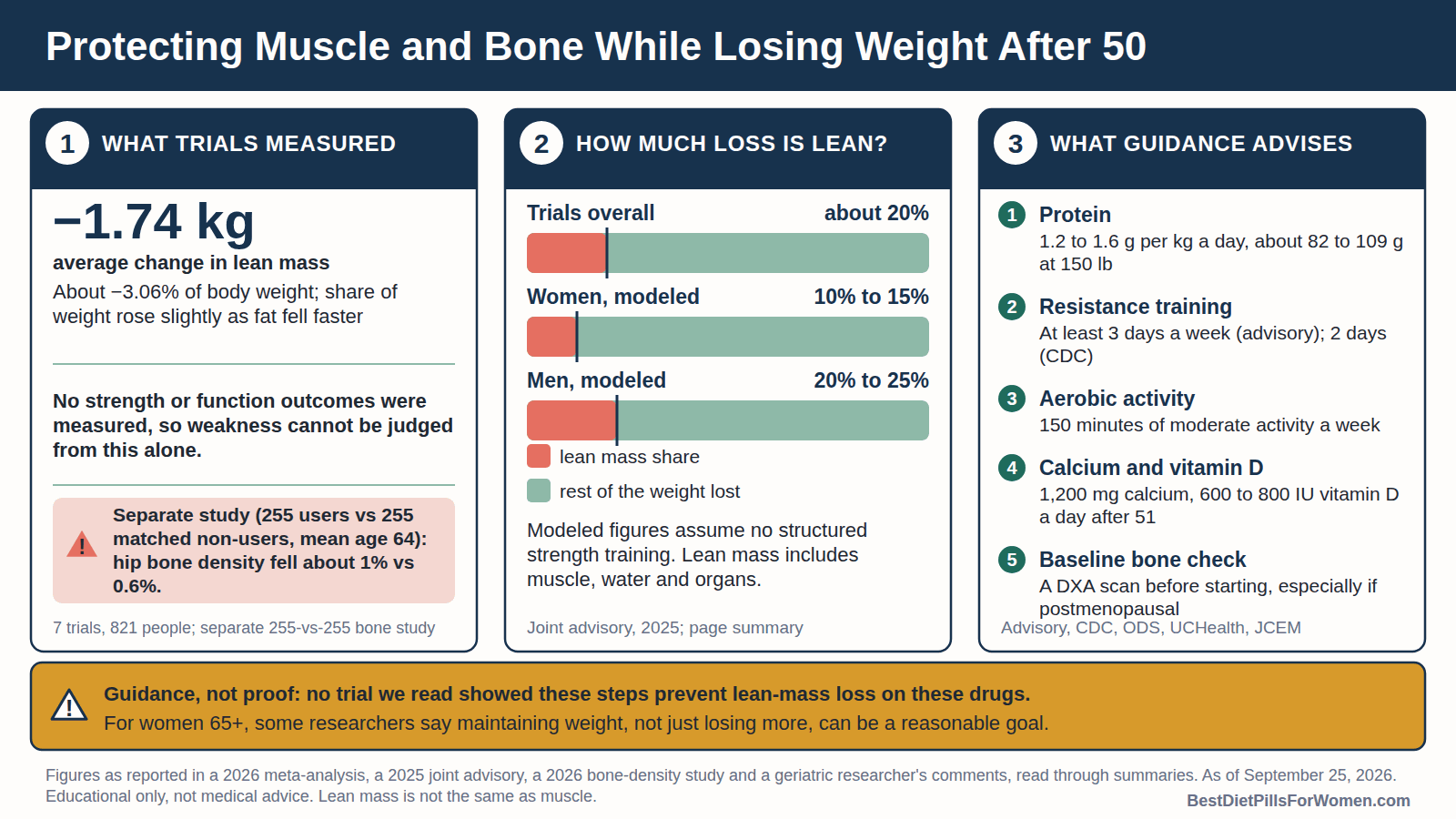
Infographic 2 below summarizes what trials measured, how much of a typical loss is lean mass, and what the guidance above recommends.
Taking Weight Loss Pills With Other Medicines Common After 50: What the Labels Say
By 50, and especially by 60 or 70, most women aren’t taking just one medicine. This section covers what the labels and related research say about the drug categories most likely to already be in a woman’s routine.
Heart, Blood Pressure, Cholesterol and Diabetes Medicines
Statins and blood pressure medicines are common enough by this age that Table 6 is worth reading even if a reader isn’t currently on either one.
Statins and Blood Pressure Medicines
Statins don’t have a flagged pharmacokinetic interaction with the weight loss pills in this guide, but two practical points still matter. First, GLP-1 pills slow stomach emptying, and both the Wegovy pill and Foundayo labels advise taking other oral medicines with some separation, since delayed emptying can change how much of another pill gets absorbed and when. Second, tirzepatide (Zepbound) has been shown to lower systolic blood pressure by roughly 7 to 11 mm Hg across doses in a SURMOUNT-1 sub-study, an effect one researcher said “rivaled what is seen for many hypertension medications.” That’s a benefit, but it’s also a reason for a woman already on blood pressure medicine to have her numbers rechecked after starting, since two blood-pressure-lowering effects stacked together can occasionally push readings lower than intended.
| Medicine type | Example | What to raise with a prescriber |
|---|---|---|
| Statins, blood pressure pills | Atorvastatin, lisinopril, amlodipine | Whether timing relative to a GLP-1 pill matters, and whether blood pressure needs rechecking |
| Insulin, sulfonylureas | Insulin, glipizide, glimepiride | Low blood sugar risk rises when combined with a GLP-1 drug; doses are often adjusted |
| Levothyroxine (thyroid) | Levothyroxine, Synthroid | The Wegovy pill raised levothyroxine exposure by 33% in a label-cited analysis; timing and monitoring matter |
| Warfarin or another blood thinner | Warfarin, apixaban | Orlistat can reduce vitamin K absorption and affect anticoagulant control, requiring closer monitoring |
| Menopausal hormone therapy | Estrogen, estrogen-progestin | Not a direct drug interaction, but the two are often considered together for midlife weight and symptom management |
Table 6 method: this table summarizes cautions stated in the FDA labels, a manufacturer sub-study report and a clinical review, all read through summaries or label mirrors; it isn’t a complete interaction list, and a pharmacist or prescriber should review a woman’s full medicine list before starting anything new.
Diabetes Medicines and Low Blood Sugar Risk
Every GLP-1 label in this guide carries a warning about low blood sugar, hypoglycemia, when combined with insulin or a sulfonylurea, both older classes of diabetes medicine that lower blood sugar on their own. The usual response is a dose adjustment to the diabetes medicine, done by a prescriber, not a reason to avoid the combination outright; many women with type 2 diabetes take a GLP-1 drug specifically for its dual benefit on blood sugar and weight. It is, however, a conversation to have before starting rather than after a low blood sugar episode.
Blood Thinners, Thyroid Medicine and Hormone Therapy
Two of the interactions below involve a genuine, labeled mechanism; the third is more about timing a decision than a drug interaction at all.
Why Do Orlistat and Blood Thinners Need Monitoring Together?
Because orlistat’s own label states that vitamin K absorption may decrease with its use, and that patients on a stable dose of warfarin or another anticoagulant should be monitored closely for changes in their coagulation numbers. A pharmacokinetic study cited in the label found that while warfarin blood levels themselves weren’t changed, vitamin K levels tended to fall in people taking orlistat, which is what prompted the monitoring advice.
For a woman on a blood thinner for atrial fibrillation or a prior clot, both more common after 50, that’s a conversation to have with a prescriber before adding orlistat, not an automatic disqualifier. It’s also a good example of why this guide keeps returning to the same point: a drug’s biggest practical risk after 50 is often an interaction with something else, not the drug’s headline side effect.
Does Hormone Therapy Help With Weight After 50?
Not directly. A Cochrane review of 28 randomized trials in 28,559 women found menopausal hormone therapy had no effect on body weight, though it may modestly reduce visceral fat and help preserve lean mass. For weight specifically, the honest answer is that hormone therapy is a menopause-symptom treatment with some incidental body-composition effects, not a weight loss drug.
Age matters more here than for almost any other question in this guide, because of what’s known as the timing hypothesis. Research, including subgroup findings from the Women’s Health Initiative, suggests starting hormone therapy within 10 years of menopause or before age 60 carries a different, generally more favorable cardiovascular risk profile than starting it later, which is why major societies generally frame it as a consideration mainly for women under 60 and close to their final period, individualized to each woman’s own risk. The age-60 line is a real one to raise with a clinician regardless of what a woman decides about weight loss pills, and our guide to weight loss pills and menopause covers hormone-related weight questions in more depth.
Safety of Weight Loss Pills for Women Over 50: Side Effects, Warnings and When to Get Help
Safety information doesn’t change by age group in the label itself, but how it applies, and how closely it needs watching, does shift once a woman is older, on more medicines, or managing more than one condition at once.
Common and Serious Side Effects
Gastrointestinal side effects dominate the GLP-1 pills; psychiatric and cardiovascular warnings dominate the older prescription pills.
Common Side Effects by Option
Nausea, constipation, diarrhea and vomiting are the most common complaints across every GLP-1 option in this guide, and they’re also the leading reason people stop taking them. Table 7 compares how often people discontinued each drug because of side effects, against how often people on placebo did the same.
| Option | Stopped due to side effects (drug) | Stopped due to side effects (placebo) | Difference |
|---|---|---|---|
| Wegovy injection | 6.8% | 3.2% | 3.6 points |
| Wegovy pill | 6.9% | 5.9% | 1.0 point |
| Zepbound | 6.7% | 3.4% | 3.3 points |
| Foundayo | 10% | 3% | 7 points |
| Contrave | 24% | 12% | 12 points |
Table 7 method: figures are as reported in each drug’s prescribing information, read through label mirrors, and reflect discontinuation due to adverse reactions in the pivotal trials; they aren’t directly comparable across drugs because the trials differ in length, dose and population.
Boxed Warnings and Who Should Avoid Certain Options
Contrave carries the most serious labeled warning in this guide, a boxed warning for suicidal thoughts and behaviors, and it’s contraindicated in uncontrolled high blood pressure, seizure disorders and current or recent eating disorders. Phentermine and Qsymia are contraindicated with uncontrolled high blood pressure and cardiovascular disease or hyperthyroidism, and Qsymia additionally requires monthly pregnancy testing under its restricted prescribing program. The GLP-1 drugs carry their own contraindication: a personal or family history of medullary thyroid cancer or multiple endocrine neoplasia type 2, unrelated to age but worth confirming with a prescriber regardless. Our guide to the best appetite suppressants for women covers these same warnings across a wider age range, alongside supplement options.
Extra Caution Points After 50
Two things are worth naming plainly, because they apply more forcefully in this age group than the general safety information suggests on its own.
Why Does “Start Low, Go Slow” Matter More Now?
Because older adults tolerate these drugs differently, not necessarily worse, but differently, and clinicians who treat them say so directly. Physicians interviewed about GLP-1 use in older patients describe prioritizing gradual dose increases, “start low, and go slow,” and weighing quality of life and physical function alongside the weight-loss number itself, rather than pushing to the highest tolerated dose by default.
That approach is backed by data, not just caution for its own sake. A 2018 clinical trial analysis found that older adults reported stopping GLP-1 drugs due to gastrointestinal side effects at a higher rate than younger participants did, a pattern that lines up with the older-adult discontinuation numbers in the Foundayo subgroup analysis discussed earlier in this guide. The practical upshot for a woman starting any of these drugs after 50 is that a slower dose escalation than a younger relative might use isn’t a sign something is wrong; it’s often the more sensible default.
When to Get Medical Help and How to Report a Problem
Get medical help right away for a fast or irregular heartbeat, chest pain, severe abdominal pain, signs of pancreatitis, vision changes, thoughts of self-harm, or a severe allergic reaction, whichever drug is involved. For any other side effect that feels wrong or doesn’t improve, call the prescriber before deciding on your own to stop or change a dose, since some of these medicines, particularly the older ones, shouldn’t be stopped abruptly. Side effects and product problems can also be reported directly to the FDA through its MedWatch program, which helps regulators track patterns that individual doctors and pharmacists might not otherwise see.
What Weight Loss Pills Cost for Women Over 50, Medicare and How to Get a Prescription
Cost is where age genuinely changes the picture, mostly because Medicare eligibility starts at 65 and a new federal program aimed squarely at this age group launched in 2026.
What a Year Costs Without Insurance
List prices and manufacturer self-pay programs both move often, so treat Table 8 as a snapshot, not a guarantee.
The Cost Table
| Option | Monthly self-pay price | Estimated annual cost |
|---|---|---|
| Wegovy pill (1.5 mg to 25 mg) | $149 to $299 | $1,788 to $3,588 |
| Wegovy injection, standard doses | $349 ($399 for the 7.2 mg dose) | $4,188 ($4,788 for 7.2 mg) |
| Zepbound single-dose vials | $299 to $449 | $3,588 to $5,388 |
| Foundayo (0.8 mg to 17.2 mg) | $149 to $299 | $1,788 to $3,588 |
| Contrave | About $199 | About $2,388 |
| Qsymia | About $75 | About $900 |
| Phentermine | About $16 | About $192 |
| Alli (OTC orlistat 60 mg) | About $88 | About $1,056 |
| Xenical (prescription orlistat 120 mg) | About $431 | About $5,172 |
| OTC supplements (fibers, caffeine blends) | About $8 to $107 | About $100 to $1,300 |
Table 8 method: monthly figures are self-pay or lowest-listed prices from manufacturer cost pages, an investor press release and a retail price aggregator, read through page summaries on September 25, 2026, and annualized by multiplying by 12; totals exclude clinician visits, lab tests, telehealth fees, shipping and needles, and assume no missed fills. The Wegovy injection’s temporary $199 introductory price for the first two months, and Foundayo’s temporarily reduced 2.5 mg and 5.5 mg tiers, both run through December 31, 2026, and aren’t reflected in the annualized figures above.
How Women Get a Prescription
A prescription for any drug in this guide starts with a clinician visit, in person or through telehealth, where BMI, related conditions and current medicines are reviewed. The federal telehealth flexibility that lets many prescribers issue controlled-substance prescriptions, which covers phentermine and Qsymia, remotely without an in-person exam first has been extended through the DEA and is currently set to run through December 31, 2026, though that date has moved before and is worth confirming closer to any appointment. Our Wegovy pill cost guide and Wegovy insurance coverage guide go deeper on one option’s pricing and paperwork specifically, for readers who’ve settled on that drug.
Medicare and What May Change Soon
Medicare doesn’t cover most of these drugs when prescribed for weight loss alone, but that’s shifting for the first time in 2026.
What Is the Medicare GLP-1 Bridge?
It’s a time-limited CMS demonstration that lets eligible Medicare Part D beneficiaries access certain GLP-1 drugs for a $50 monthly copay, running from July 1, 2026 through December 31, 2027, and it operates outside the standard Part D deductible and out-of-pocket tracking. For a woman on Medicare who’s been priced out of these drugs, that’s a meaningful potential change, not a marginal one.
The program doesn’t require Part D plans to opt in, since CMS manages claims through a central processor, and it doesn’t come with a low-income subsidy on top. We didn’t find a page during this research spelling out full eligibility rules, such as a specific BMI threshold or a requirement to have tried other treatments first, so anyone on Medicare should check medicare.gov/glp1bridge or call 1-800-MEDICARE directly rather than assume they qualify based on this summary alone.
What Else May Change
A few developments could shift this cost picture again before this guide is next updated. Novo Nordisk filed for FDA approval of CagriSema, a combined GLP-1 and amylin drug, in December 2025, with an FDA decision expected sometime in 2026; it isn’t approved as this guide is written. Medicare’s GLP-1 Bridge program itself runs only through the end of 2027 unless extended or made permanent. And every manufacturer savings program listed in Table 8, along with the DEA telehealth flexibility, has its own end date that Congress, CMS or the company involved can move. None of that changes what a woman should do today, but it’s a reason to re-check prices and terms close to any actual purchase or prescription rather than relying on figures from this article months later.
How to Choose: A Decision Guide for Women Over 50
There’s no single best answer here, but there is a better and worse way to work through the decision, and it starts with matching the option to a woman’s actual situation rather than to whichever drug is most talked about.
Questions to Work Through Before Choosing a Pill
Table 9 groups common situations after 50 with what the evidence and labels in this guide say about them.
The Situation Guide
| Your situation | What matters most | Worth raising with a clinician |
|---|---|---|
| Postmenopausal, no other conditions | GLP-1 pills have the strongest weight-loss evidence; muscle and bone plan still applies | A baseline bone density scan if none has been done |
| High blood pressure or heart disease | Phentermine and Contrave are contraindicated with uncontrolled blood pressure; the SELECT trial supports a heart benefit for semaglutide in adults with existing heart disease | Whether your blood pressure medicine needs monitoring after starting a GLP-1 drug |
| On a blood thinner | Orlistat can affect vitamin K absorption and anticoagulant control | Closer coagulation monitoring if orlistat is considered |
| Osteoporosis or a prior fracture | Rapid weight loss adds to existing bone-loss risk | Whether a slower approach or added bone-protective medicine makes sense |
| 65 or older | Foundayo’s 65+ subgroup data and each drug’s geriatric-use label section are the closest things to age-specific evidence | Starting at a lower dose and increasing more gradually |
| On Medicare | The GLP-1 Bridge program may lower cost for certain drugs through 2027 | Confirming eligibility directly with Medicare |
| Considering hormone therapy too | Hormone therapy doesn’t treat weight directly, and its own risk profile shifts around age 60 | Sequencing or combining the two decisions with one clinician |
Table 9 method: this table groups the guidance already cited throughout this article by situation rather than by drug; it’s a starting point for a conversation, not a set of eligibility rules, and it doesn’t cover every possible health situation.
Non-Pill Options With Evidence
Pills aren’t the only options with real evidence behind them at this age. Structured lifestyle programs combining diet changes, activity and behavioral support have outperformed usual care in trials for decades, and for women focused specifically on preserving muscle and bone, resistance training has evidence independent of any pill, covered in detail earlier in this guide. Metabolic and bariatric surgery remains an option for higher BMI levels, covered in more detail below.
Five Checks and Other Paths to Consider
Five questions come up in almost every row of Table 9, and it’s worth turning them into a short checklist before any appointment.
The Five Checks Before Choosing
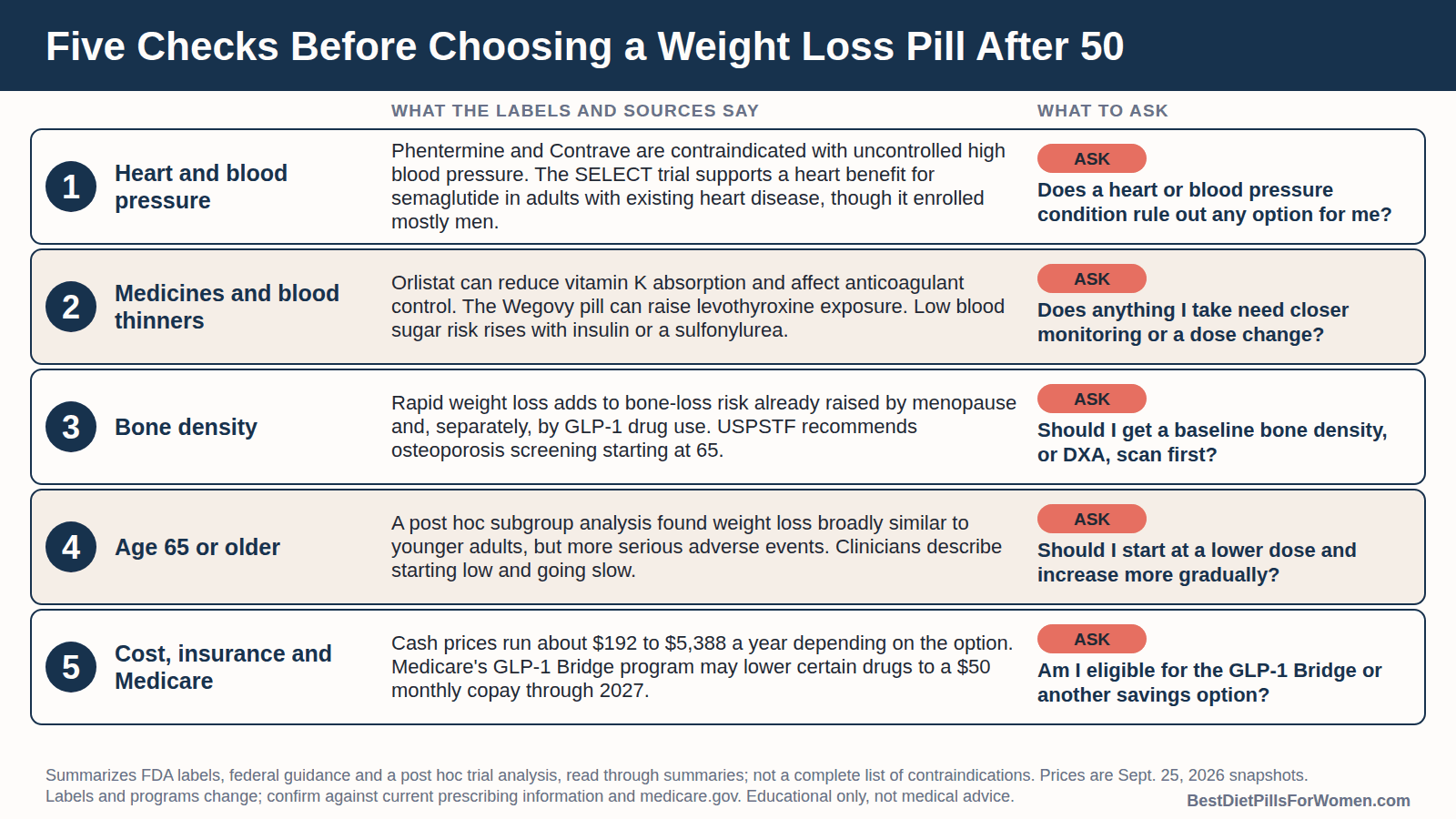
The checks are: whether a heart or blood pressure condition rules any option out; whether a blood thinner or another regular medicine needs monitoring alongside a new pill; whether bone density has been checked, or should be, before starting; whether age 65 or older changes the starting dose or the pace of increases; and whether cost, insurance or Medicare’s new bridge program changes which option is realistic. Infographic 3 below turns these into a short list with the specific facts behind each one.
Surgery and Other Medical Routes
The American Society for Metabolic and Bariatric Surgery and the International Federation for the Surgery of Obesity have recommended surgery starting at a BMI of 35 or higher regardless of other conditions, and for consideration at 30 to 34.9 when a condition like diabetes is present, with perioperative mortality in the range of 0.03% to 0.2%. NIDDK reports that many people who have weight loss surgery lose 15% to 30% of their starting weight on average, a larger and generally more durable result than most pills achieve, though it’s major surgery with its own risks, a lasting change to how the digestive system works, and lifelong nutrition monitoring, including for the same calcium, vitamin D and protein concerns raised earlier in this guide. Whether surgery, a GLP-1 drug, an older pill or a structured lifestyle program fits best is a conversation for a surgeon, an obesity-medicine specialist or a primary care clinician who knows a woman’s full history, not a conclusion this guide can reach for anyone. Our overview of weight loss medications puts the drug options in a wider context.
Frequently Asked Questions About Weight Loss Pills for Women Over 50
These answers summarize points made earlier in this guide; read the linked section for the full evidence and caveats behind each one.
Effectiveness and Expectations
Four questions cover what these pills actually do, and don’t do, once a woman passes 50.
Do Weight Loss Pills Work as Well After 50?
Largely yes, based on what’s been checked. GLP-1 drug labels report no overall difference in effectiveness for patients 65 and older, and a post hoc analysis of Foundayo’s trials found weight loss in the 65-and-older group broadly consistent with younger adults. The caveat is that these trials weren’t built to answer the question with the same confidence they answer it for a 40-year-old, since older participants made up a small share of most trials.
How Much Weight Can I Realistically Expect to Lose?
It depends on the drug and the person, but published averages run from a few percent of body weight on the older pills to around 14% to 20% on the newest GLP-1 options, measured against roughly 2% to 3% on placebo. Those are trial averages, not guarantees, and a meaningful share of people on placebo also lost weight, so individual results spread widely in both directions around any published number.
What Happens If I Stop Taking a Weight Loss Pill?
Weight regain is common once a GLP-1 drug is stopped, and one estimate suggests roughly two-thirds of users discontinue within a year and regain about two-thirds of the weight they lost. That pattern is a reason to think of these drugs, when they’re used, as part of a longer-term plan rather than a short course, and to discuss a stopping or tapering strategy with a prescriber in advance rather than after the fact.
Does Menopause Change How These Pills Work?
Not in a way that’s been clearly demonstrated. Post hoc analyses of semaglutide and orforglipron trials found weight loss was broadly similar across premenopausal, perimenopausal and postmenopausal women, though these were secondary analyses, not the trials’ main design. What menopause does change is the body a pill works on: more bone loss, more muscle loss risk and a different cardiovascular risk profile, covered in earlier sections.
Safety and Medicines
These three questions come up often once a woman is also managing a heart, thyroid or bone condition.
Can I Take a Weight Loss Pill With High Blood Pressure or Heart Disease?
Some options are contraindicated and others may help, so this depends heavily on which pill and how well controlled the condition is. Phentermine and Contrave are both contraindicated with uncontrolled high blood pressure, while the SELECT trial found a cardiovascular benefit for semaglutide injection in adults with existing heart disease, though mostly in men. This is a conversation for a cardiologist or primary care clinician, not a decision to make from a label alone.
Will a Weight Loss Pill Affect My Thyroid Medicine or Blood Thinner?
Potentially, yes, on both counts. The Wegovy pill’s label reports a 33% increase in levothyroxine exposure when taken together, and orlistat’s label states it can reduce vitamin K absorption, requiring closer monitoring for anyone on warfarin or a similar anticoagulant. Neither issue is a reason to avoid these combinations outright, but both call for a prescriber or pharmacist to review timing and monitoring before starting.
Is It Safe to Take a Weight Loss Pill in My 70s or 80s?
The evidence here is thinner than at any other age this guide covers, and several labels say so directly. Qsymia’s label reports no participants 70 or older in its main trial, and orlistat’s label states there weren’t enough patients 65 and older to know if they respond differently. Clinicians who treat older adults generally favor starting at a lower dose and increasing more slowly, and weighing strength and independence alongside any weight-loss goal.
Hormones, Cost and Next Steps
The last three questions cover hormone therapy, Medicare and how to start the conversation.
Should I Try Hormone Therapy Instead of a Weight Loss Pill?
Hormone therapy isn’t a weight loss treatment; a Cochrane review of 28 trials in 28,559 women found it had no effect on body weight, though it may modestly help preserve lean mass. Its own risk-benefit picture also shifts around age 60 and the number of years since a woman’s final period, so it’s worth discussing on its own terms with a clinician, separately from, or alongside, any weight loss pill decision.
Does Medicare Cover Weight Loss Pills?
Traditionally, no, but a new demonstration program changes that for some drugs. The Medicare GLP-1 Bridge offers a $50 monthly copay on certain GLP-1 medicines from July 1, 2026 through December 31, 2027 for eligible Part D beneficiaries, though full eligibility details weren’t available on the pages we read. Checking directly with Medicare is the only reliable way to confirm eligibility for a specific situation.
What Should I Ask My Doctor Before Starting?
Bring your full medicine list, your blood pressure and bone density history if known, and a clear sense of your goals beyond the number on the scale. Useful questions include which option fits your heart, bone and medicine profile, what monitoring you’ll need, what a realistic timeline looks like, and what the plan is if you stop. This guide is meant to prepare you for that conversation, not to replace it.
The Bottom Line on the Best Weight Loss Pills for Women Over 50
Pulling the evidence in this guide together into a single, honest answer means naming what’s solid, what’s still uncertain, and what to do with both.
What the Total Evidence Means for You
The clearest finding across every section here is that the same drugs that lead the field at any age still lead it after 50, but the case for them past 65 rests on thinner, newer evidence than the case for a 45-year-old.
The Biggest Realistic Benefit
The GLP-1 pills, the Wegovy pill and Foundayo, offer the largest average weight loss of anything covered here, roughly 7% to 14% of body weight against about 2% on placebo, and the newest age-specific data, a 65-and-older subgroup analysis of Foundayo’s trials, found comparable results in that older group. For women with heart disease specifically, the related SELECT trial adds a genuinely large piece of evidence that semaglutide’s benefits may extend beyond the scale, to fewer heart attacks and strokes, in an older population much like this guide’s readers.
The Biggest Limitation and Safety Concern
Two limits stand out. First, evidence quality declines as age climbs within this guide’s own range: strong at 50, reasonably supported at 65, and genuinely thin past 70, by several labels’ own admission. Second, weight loss at this age isn’t free of trade-offs the way it might have felt at 30: bone loss accelerates after menopause, GLP-1 use adds to that risk, and clinicians who treat older adults specifically caution that unmonitored, rapid weight loss can cost strength and independence along with fat. Neither point argues against treatment; both argue for treating this as a monitored process; not a pill taken and forgotten.
A Rational Next Step
The honest next step isn’t a purchase; it’s a short list of questions worth bringing into a real conversation.
Questions for a Clinician
A useful appointment covers: which option fits your blood pressure, bone density and current medicine list; whether a baseline DXA scan or blood pressure check makes sense first; what a realistic protein and strength-training plan looks like alongside any pill; how Medicare’s new bridge program or a manufacturer’s savings offer might change the cost; and what the plan is if the first option doesn’t work or causes side effects that don’t improve. None of that requires deciding anything today.
What to Re-Check Before You Spend Money
Before spending money on any option in this guide, re-check three things close to the date you plan to act: the current price and any savings program terms, since several run only through the end of 2026; the current FDA-approved label for whichever drug you’re considering, since labels are updated; and your own Medicare or insurance coverage details directly with the plan, since coverage rules and demonstration programs like the GLP-1 Bridge can change. This article reflects what we found as of September 25, 2026, and none of it should stand in for a conversation with a clinician or pharmacist who knows your full history.
Related Reading
Sources
These are the main sources behind this guide, chosen because they are the ones to check first for current facts. Labels, prices, coverage rules and regulator pages change, so confirm the latest version before you make decisions.
- Novo Nordisk. Wegovy (semaglutide) injection and tablets, prescribing information (revised June 2026). https://www.novo-pi.com/wegovy.pdf
- Eli Lilly and Company. Zepbound (tirzepatide) prescribing information (revised August 2026). https://pi.lilly.com/us/zepbound-uspi.pdf
- Eli Lilly and Company. Foundayo (orforglipron) tablets, prescribing information (revised July 2026). https://pi.lilly.com/us/foundayo-uspi.pdf
- Prescribing information for the older prescription pills, on DailyMed: Adipex-P (phentermine, Teva; https://dailymed.nlm.nih.gov/dailymed/drugInfo.cfm?setid=f5b2f9d8-2226-476e-9caf-9d41e6891c46), Contrave (naltrexone and bupropion; https://dailymed.nlm.nih.gov/dailymed/drugInfo.cfm?setid=485ff360-32c8-11df-928b-0002a5d5c51b) and Qsymia (phentermine and topiramate; https://dailymed.nlm.nih.gov/dailymed/drugInfo.cfm?setid=40dd5602-53da-45ac-bb4b-15789aba40f9).
- H2-Pharma LLC. Xenical (orlistat) capsules, prescribing information (revised 07/2024), including its vitamin K/anticoagulant interaction and geriatric-use sections. https://dailymed.nlm.nih.gov/dailymed/drugInfo.cfm?setid=6240792b-9224-2d10-e053-2a91aa0a2c3e
- National Institute of Diabetes and Digestive and Kidney Diseases. Prescription medications to treat overweight and obesity (last reviewed June 2024). https://www.niddk.nih.gov/health-information/weight-management/prescription-medications-treat-overweight-obesity
- Lincoff AM, et al. Semaglutide and cardiovascular outcomes in obesity without diabetes. N Engl J Med. 2023;389:2221-2232. https://pubmed.ncbi.nlm.nih.gov/37952131/
- US Preventive Services Task Force. Screening for osteoporosis to prevent fractures: recommendation statement (January 14, 2025). https://www.uspreventiveservicestaskforce.org/uspstf/recommendation/osteoporosis-screening
- UCHealth Today. A ‘perfect storm’ for bone loss in women: menopause and GLP-1 weight-loss drugs (citing Wendy Kohrt, PhD). https://www.uchealth.org/today/menopause-and-glp-1-weight-loss-drugs-and-bone-loss/
- Centers for Medicare & Medicaid Services. Medicare GLP-1 Bridge. https://www.cms.gov/medicare/coverage/prescription-drug-coverage/medicare-glp-1-bridge


