
A prescription appetite suppressant is a drug your clinician prescribes specifically to reduce hunger or increase fullness, and the category is smaller and older than most marketing suggests: it comes down to four stimulant-type pills approved decades ago, two newer combination drugs, and two GLP-1 pills that suppress appetite as part of a broader effect on digestion.
That short list matters because “diet pill” marketing blurs categories that work in very different ways and carry very different evidence. Orlistat, sold as Xenical by prescription, isn’t an appetite suppressant at all; it blocks fat absorption in the gut. Injectable GLP-1 drugs work through the same hormone pathway as the newer appetite-suppressant pills but aren’t pills, so they sit outside this guide’s scope. What’s left, once you draw those lines correctly, is a genuinely useful category to understand on its own terms, because the honest differences between a $10 generic and a $300-a-month brand-name pill are less about hype and more about how old the evidence is, how tightly a drug is regulated, and what your own health history rules in or out.
This guide walks through every FDA-approved prescription appetite suppressant, drug by drug: what the trials actually found, what the safety label requires you to watch for, who can realistically get a prescription, and what each option costs once you add up a year of refills. We’re not testing or recommending a specific pill here. This is a research-based synthesis of FDA labels, clinical trials and current pricing pages, not personal or clinical experience, and nothing in it replaces a conversation with a prescriber who knows your health history. If you’re comparing this category with over-the-counter options or with injections, our prescription vs. OTC comparison and pills vs. injections guide go deeper on those specific questions.
The Short Answer on Prescription Appetite Suppressants
Start with what the category actually contains and how confident the evidence is, then use the rest of this guide to check those claims against the trials and labels behind them.
What “Prescription Appetite Suppressant” Actually Means as a Drug Category
The phrase gets used loosely online. Here’s the boundary we use in this guide, and why it excludes a couple of drugs people often lump in with it.
The Short List of FDA-Approved Options
Eight FDA-approved prescription pills work at least partly by suppressing appetite: phentermine (Adipex-P, Lomaira), diethylpropion, phendimetrazine, benzphetamine, Qsymia (phentermine-topiramate), Contrave (naltrexone-bupropion), the Wegovy pill (oral semaglutide 25 mg) and Foundayo (orforglipron). Four of those eight (phentermine, diethylpropion, phendimetrazine and benzphetamine) are older stimulant-type drugs approved decades ago on thin evidence; the other four combine that mechanism with something newer, or replace it with a different appetite pathway entirely.
This guide covers pills only, not injections, and it covers appetite suppressants specifically, not the whole prescription weight-loss category. Our full lineup of prescription and OTC options covers the broader landscape, including orlistat and injectable drugs that don’t fit the appetite-suppressant definition used here, and our weight loss medications hub organizes every prescription drug on the site by category.
What This Guide Does and Doesn’t Cover
We define “appetite suppressant” as a drug whose primary or partial mechanism is reducing hunger signals or increasing satiety, whether through the central nervous system (the stimulant-type drugs and Qsymia), through opioid and dopamine pathways (Contrave), or through the GLP-1 hormone pathway (the two newer pills). That definition deliberately excludes orlistat, which works entirely through fat malabsorption, and it excludes injectable GLP-1 drugs, which act on the same appetite pathway but aren’t swallowed. We explain both exclusions in the next section.
How Evidence Quality Differs Across This Drug Class
Not every drug on this list has been studied the same way, and the gap matters more here than in almost any other weight-loss category.
Which Options Have the Strongest Trial Data
Qsymia, Contrave, the Wegovy pill and Foundayo each have large, modern, placebo-controlled trials lasting 56 to 72 weeks, with published percentages, defined populations and FDA review of the full data package. Those four drugs are where you’ll find the most trustworthy numbers in this guide, and they’re also the four with the most detailed safety monitoring built into their labels.
Which Options Rely on Older, Smaller Studies
Phentermine’s own FDA label describes its effect as “only a fraction of a pound a week” more than placebo, and a review in Obesity Pillars notes that no cardiovascular outcome trial has been run since the drug’s 1959 approval. Diethylpropion, phendimetrazine and benzphetamine are older still, and none has a modern randomized outcome trial in the sources we reviewed; their FDA labels support only short-term use and give no placebo-controlled effect size at all. That doesn’t mean these four drugs don’t work for some people. It means anyone weighing them should know the “evidence” behind them is decades-old labeling language, not a current clinical trial.
The Options at a Glance
Table 1 lines up all eight drugs before the rest of this guide unpacks each one.
The Summary Table
| Drug | Mechanism class | Best-available evidence | Typical duration on the label | Controlled substance? |
|---|---|---|---|---|
| Phentermine (Adipex-P, Lomaira) | Sympathomimetic amine | Label language only; no modern trial with a placebo-subtracted percentage | Short-term (a few weeks) | Yes, Schedule IV |
| Diethylpropion | Sympathomimetic amine | No modern outcome trial | Short-term (a few weeks) | Yes, Schedule IV |
| Phendimetrazine | Sympathomimetic amine | No modern outcome trial | Short-term (a few weeks) | Yes, Schedule III |
| Benzphetamine | Sympathomimetic amine | No modern outcome trial | Short-term (a few weeks) | Yes, Schedule III |
| Qsymia (phentermine-topiramate ER) | Sympathomimetic amine + anticonvulsant | CONQUER: −7.8% to −9.8% vs. −1.2% placebo, 56 weeks | Long-term, with REMS monitoring | Yes, Schedule IV |
| Contrave (naltrexone-bupropion ER) | Opioid antagonist + antidepressant | COR trials: −5.4% to −8.1% vs. −1.3% to −4.9% placebo, 56 weeks | Long-term | No |
| Wegovy pill (oral semaglutide 25 mg) | GLP-1 receptor agonist | OASIS 4: −13.6% vs. −2.2% placebo, 64 weeks | Long-term | No |
| Foundayo (orforglipron) | GLP-1 receptor agonist | ATTAIN-1: −11.1% vs. −2.1% placebo, 72 weeks | Long-term | No |
Table 1 method: mechanism classes and controlled-substance status come from each drug’s FDA label; trial results come from the pivotal trials and label sections. Figures come from different trials with different populations and durations and can’t be ranked head to head.
How to Read the Table
Two patterns jump out of Table 1. First, the drugs with the strongest evidence are also the newest ones, which is normal for a field where trial standards have tightened over 60-plus years. Second, controlled-substance status splits cleanly along mechanism lines: every sympathomimetic-amine drug, including Qsymia because of the phentermine it contains, is a controlled substance, while Contrave and the two GLP-1 pills are not. That split drives a lot of the practical differences covered later in this guide, from telehealth access to how refills work.
What Actually Counts as a Prescription Appetite Suppressant
Before comparing individual drugs, it helps to understand the two pharmacology paths that all eight of them travel, and the two commonly confused categories that don’t belong on this list at all.
The Two Pharmacology Classes Behind Every Option
Every prescription appetite suppressant reduces hunger through one of two broad routes: an older stimulant-based route, or a newer hormone-based one.
Sympathomimetic Amines: Phentermine and Its Older Relatives
Phentermine, diethylpropion, phendimetrazine and benzphetamine are all sympathomimetic amines, a chemical class related to amphetamine that stimulates the central nervous system and, as a side effect of that stimulation, suppresses appetite. They act on norepinephrine pathways in the brain’s hunger centers, which is also why their side-effect profiles skew toward faster heart rate, elevated blood pressure, insomnia and jitteriness. Qsymia keeps this same mechanism at its core, since it contains a low dose of phentermine, then adds topiramate, an anti-seizure drug that appears to enhance satiety and reduce taste-driven eating through a separate, less fully understood pathway.
Combination and GLP-1-Based Options That Also Suppress Appetite
Contrave pairs naltrexone, an opioid-receptor blocker, with bupropion, an antidepressant that affects dopamine and norepinephrine; together they’re thought to dampen the brain’s reward response to food and reduce hunger signaling in the hypothalamus, though the exact combined mechanism in humans isn’t fully mapped. The two newest options, the Wegovy pill and Foundayo, work through the GLP-1 receptor, a gut-hormone pathway that slows stomach emptying, increases satiety and reduces hunger through signals sent directly to the brain. That’s a genuinely different biological route from the stimulant-based drugs above it, which helps explain why the GLP-1 pills’ side effects are mostly digestive rather than stimulant-like.
Why the mechanism split matters practically: a drug that works by amplifying a stimulant signal tends to affect heart rate and alertness in ways a person with anxiety, insomnia or cardiovascular risk may feel quickly, while a drug that works through slowed digestion and gut-hormone signaling tends to affect the stomach and intestines first. Neither pathway is inherently safer across the board; each simply concentrates its risk in a different body system, which is a large part of why the eligibility and safety sections later in this guide read so differently for the stimulant-class drugs than for the GLP-1 pills.
What Actually Happens in the Brain When Appetite Is Suppressed
However a drug reaches it, the effect these eight options are chasing is a change in signaling between the gut, the bloodstream and the hypothalamus, the brain region that governs hunger and fullness.
Why “Suppressing Appetite” Isn’t Just One Simple Switch
Hunger and fullness are regulated by a network of hormones and neurotransmitters, not a single on-off switch, which is part of why different drug classes produce different side-effect patterns even when the end result looks similar on a bathroom scale. Sympathomimetic amines raise norepinephrine activity in the hypothalamus, which reduces the drive to eat but also activates the same fight-or-flight pathways that raise heart rate and blood pressure elsewhere in the body. GLP-1 receptor agonists instead mimic a hormone your gut already makes after a meal, which is one reason their appetite-reducing effect comes packaged with slower digestion and, for many people, temporary nausea while the body adjusts.
Why This Explains the Differences Later in This Guide
Every safety warning, every eligibility restriction and every side-effect pattern covered later in this guide traces back to one of these two mechanisms. Understanding that connection now makes the safety section easier to read as a coherent picture rather than eight separate lists of unrelated warnings.
What Gets Confused With an Appetite Suppressant (and Isn’t One)
Two categories show up constantly in “prescription diet pill” searches without actually suppressing appetite by any recognized mechanism.
Why Orlistat Doesn’t Belong on This List
Orlistat, sold by prescription as Xenical, works by blocking about 30% of dietary fat from being absorbed in the intestine; it does nothing to hunger signaling and has no appetite-suppressant mechanism at all. People searching for prescription appetite suppressants sometimes land on orlistat because it’s an older, well-known prescription weight-loss drug, but its side-effect profile (oily spotting, urgency, loose stools) and its evidence base are entirely different from anything in this guide. Our prescription vs. OTC comparison covers orlistat and its nonprescription cousin, alli, in depth.
Why Injectable GLP-1 Medicines Are a Separate Category Here
Injectable semaglutide (Wegovy) and tirzepatide (Zepbound) work through the same GLP-1 and, for tirzepatide, dual-hormone pathway as the Wegovy pill and Foundayo, and they produce the largest average results of any weight-loss drug on the market. We’ve excluded them from this guide because they aren’t pills, not because they work differently, and because the injection-versus-pill decision deserves its own dedicated comparison rather than a side note here. Our pills vs. injections guide and semaglutide vs. tirzepatide comparison cover that ground directly.
The Full Roster: Every FDA-Approved Prescription Appetite Suppressant
Most articles on this topic mention phentermine, Qsymia and Contrave and stop there. Three more FDA-approved stimulant-type options rarely get discussed, and two GLP-1 pills round out the list.
This roster is built from each drug’s current FDA label or DailyMed record, cross-checked against the mechanism definition from the previous section, not from a manufacturer’s marketing page or a generic “diet pills” listicle. That’s a deliberate methodology choice: it’s why orlistat and injectable GLP-1 drugs, both real and useful weight-loss options, don’t appear here, and it’s why three drugs most competing content skips entirely (diethylpropion, phendimetrazine and benzphetamine) get the same attention as the more famous names.
The Older Stimulant-Class Options
Four drugs share the same 1959-to-1970s-era regulatory approach: approval for short-term use, based on evidence standards that predate the modern randomized trial.
Phentermine (Adipex-P, Lomaira and Generics)
Phentermine is the oldest and by far the most widely prescribed drug on this list, approved since 1959 and available as inexpensive generics, Adipex-P (37.5 mg, once daily) and Lomaira (8 mg, up to three times daily before meals). It’s a Schedule IV controlled substance, and its FDA-approved indication is explicitly short-term: “a few weeks” as an adjunct to a calorie-restricted diet in adults with a BMI of 30 or higher, or 27 or higher with a weight-related condition. The label itself doesn’t sugarcoat the expected result, describing added weight loss over placebo as “only a fraction of a pound a week,” with the benefit typically shrinking over time.
Diethylpropion, Phendimetrazine and Benzphetamine: the Lesser-Known Three
These three drugs get almost no attention in mainstream weight-loss content, but they’re legitimate, currently prescribable, FDA-approved options with real trade-offs. Diethylpropion (Schedule IV) is dosed at 25 mg three times daily or as a 75 mg extended-release tablet once daily; phendimetrazine (Schedule III) at 35 mg two to three times daily before meals; and benzphetamine (Schedule III) at 25 to 50 mg one to three times daily. All three labels approve only short-term use, describe tolerance to the appetite-suppressing effect developing within weeks, and warn that anorectic agents used for more than three months have been associated with roughly a 23-fold increase in the risk of pulmonary hypertension, a serious and potentially fatal lung condition. Benzphetamine’s label also contraindicates use in pregnancy outright, and phendimetrazine’s label carries the same caution.
The Newer Combination and GLP-1 Options
Four decades after phentermine’s approval, weight-loss drug development shifted toward combination products and, more recently, gut-hormone pathways.
Qsymia (Phentermine-Topiramate Extended-Release)
Qsymia combines low-dose phentermine with topiramate, an anticonvulsant, and produced the largest average results of any non-GLP-1 pill in this guide: −7.8% at the mid dose and −9.8% at the top dose, versus −1.2% on placebo, over 56 weeks in the CONQUER trial’s 2,487 adults (70% women). Because it contains phentermine, it’s a Schedule IV controlled substance, and it requires enrollment in a Risk Evaluation and Mitigation Strategy (REMS) program because topiramate is linked to birth defects, including oral clefts, in pregnancies exposed during the first trimester. That REMS requires monthly pregnancy testing for women who can become pregnant and documented use of contraception.
Contrave (Naltrexone-Bupropion) and Oral Semaglutide (Wegovy Pill)
Contrave combines naltrexone and bupropion and produced −5.4% to −8.1% weight loss versus −1.3% to −4.9% on placebo across its COR trial program, in a population that was about 83% women. It isn’t a controlled substance, but it carries a boxed warning for suicidal thoughts and behaviors and is contraindicated in seizure disorders and eating disorders. The Wegovy pill, FDA-approved in December 2025 as oral semaglutide 25 mg, produced the largest effect of any pill in this entire guide: −13.6% versus −2.2% on placebo over 64 weeks in OASIS 4. Foundayo (orforglipron), approved April 1, 2026, produced −11.1% versus −2.1% on placebo at its top label dose over 72 weeks in ATTAIN-1. Neither GLP-1 pill is a controlled substance, and both carry a boxed warning for thyroid C-cell tumors seen in rodent studies, shared across the whole GLP-1 drug class.
Putting the Full Roster Side by Side
Table 2 lines up dosing, approval history and controlled-substance status for all eight drugs in one place.
The Full Comparison Table
| Drug | Typical dose | FDA approval | Schedule | Distinguishing feature |
|---|---|---|---|---|
| Phentermine (Adipex-P, Lomaira) | 37.5 mg once daily, or 8 mg up to 3×/day | 1959 | IV | Cheapest and most-prescribed option |
| Diethylpropion | 25 mg 3×/day, or 75 mg ER once daily | 1959 | IV | Extended-release option among the older drugs |
| Phendimetrazine | 35 mg 2–3×/day before meals | 1961 | III | Tolerance to effect develops within weeks |
| Benzphetamine | 25–50 mg 1–3×/day | 1960 | III | Fewest manufacturers; real-world supply can be inconsistent |
| Qsymia (phentermine-topiramate ER) | Titrated to 15/92 mg once daily | 2012 | IV | Largest non-GLP-1 effect; REMS pregnancy monitoring |
| Contrave (naltrexone-bupropion ER) | Titrated to 2 tablets twice daily | 2014 | Not scheduled | Boxed warning for suicidal thoughts |
| Wegovy pill (oral semaglutide) | Titrated to 25 mg once daily | 2025 | Not scheduled | Largest effect of any pill in this guide |
| Foundayo (orforglipron) | Titrated to 17.2 mg once daily | 2026 | Not scheduled | Can be taken any time of day, without food or water timing rules |
Table 2 method: dosing and schedule status come from each drug’s current FDA label or DailyMed record. Approval years are the original FDA approval date for each active ingredient or combination.
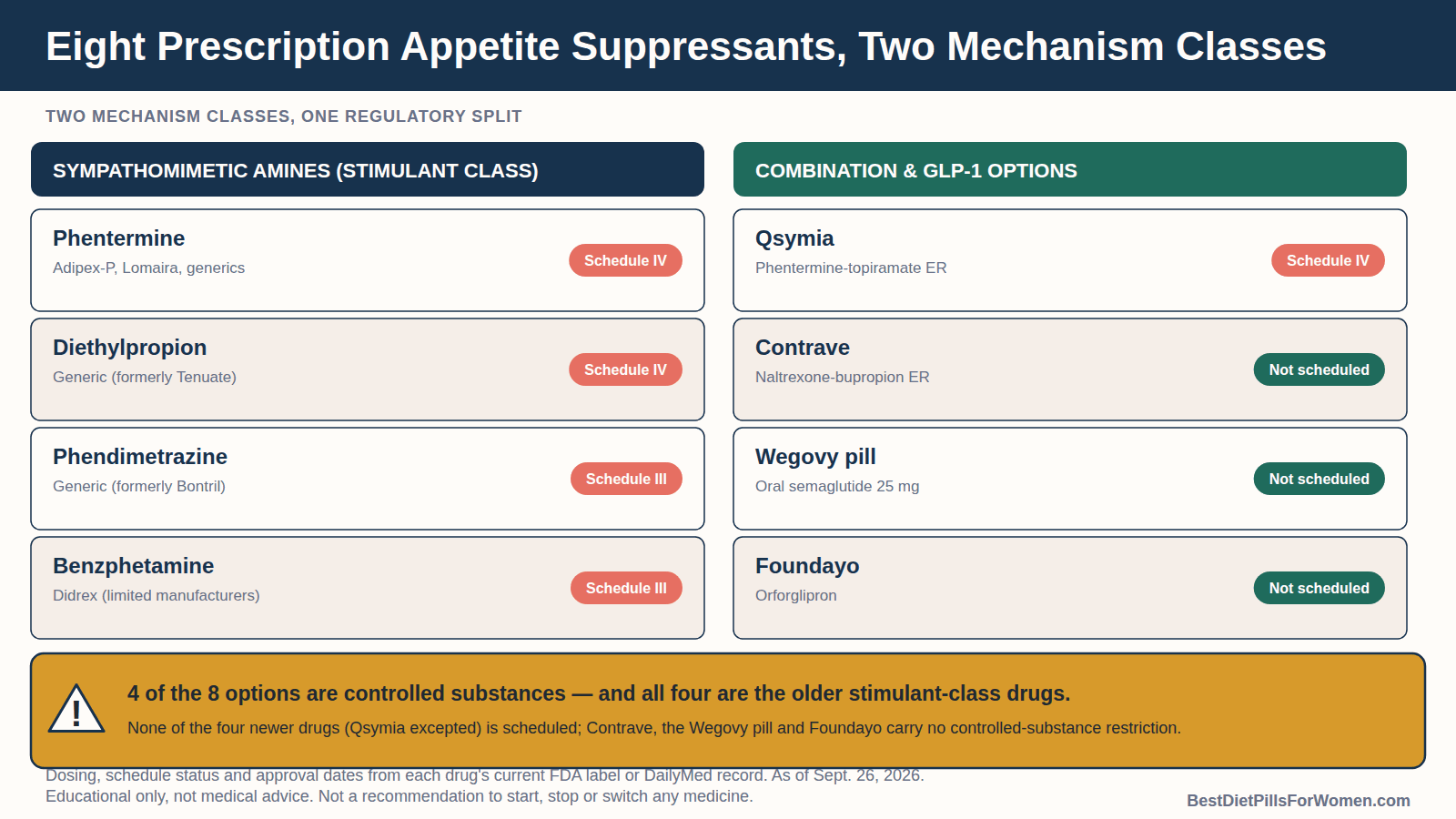
Read down Table 2 and a pattern holds across every row: the newer and better-studied a drug is, the less likely it is to be a controlled substance, and the more monitoring its label actually requires. That’s the opposite of what casual “which pill is strongest” comparisons usually assume.
What the Roster Doesn’t Show You
A table can’t capture individual variation, and this drug class shows more of it than most. Some people lose little to nothing on any of these eight drugs, and the trial averages in Table 3, later in this guide, describe the typical participant, not a guarantee for any one person. Brand availability also shifts over time: diethylpropion’s original brand name, Tenuate, and phendimetrazine’s, Bontril, are largely gone from pharmacy shelves in favor of generic-only versions, and benzphetamine’s original brand, Didrex, is produced by only a small number of manufacturers, which affects how reliably a pharmacy can actually fill the prescription, covered in the cost section below.
How Much Weight Loss the Evidence Actually Shows
Averages from Table 1 and Table 2 only tell part of the story. What the trials actually measured, and how long they ran, changes how much weight those averages should carry.
Short-Term Stimulant Trials
The four older drugs share a defining weakness: none has a modern trial that measured a placebo-subtracted percentage the way every other drug in this guide does.
What Older Phentermine and Combination Trials Found
No randomized controlled trial has tested phentermine alone against placebo using today’s reporting standards; the best available figure is the FDA label’s own description of “only a fraction of a pound a week” more than placebo, and a 2002 meta-analysis discussed in a 2022 Obesity Pillars roundtable found a placebo-corrected loss of less than 4 kg. That roundtable also notes that no cardiovascular outcome trial has been conducted since phentermine’s approval in 1959, which means 65-plus years of clinical use have produced real-world experience but not the kind of dedicated safety trial regulators now expect of a new drug.
Why Most of These Trials Are Short and Small
Diethylpropion, phendimetrazine and benzphetamine are in a weaker evidentiary position than phentermine itself. None has a modern outcome trial in the material we reviewed, and each label’s approval rests on decades-old short-term studies that didn’t report a placebo-subtracted percentage at all. A 2025 network meta-analysis of 56 randomized trials, one of the more rigorous attempts to compare weight-loss drugs statistically, didn’t include any of these three drugs, and it evaluated phentermine only as part of combination therapy, not on its own. That’s not proof the drugs don’t work; it’s an honest description of an evidence gap that’s persisted for more than 60 years.
Longer-Term Modern Trial Data
Move to the four newer drugs, and the evidence looks completely different: large placebo-controlled trials, published percentages, and defined patient populations.
Qsymia’s One-Year Trial Results
Qsymia’s CONQUER trial randomized 2,487 adults with obesity and at least two weight-related conditions, 70% of them women, to 56 weeks of treatment; the mid dose (7.5/46 mg) produced −7.8% weight loss and the top dose (15/92 mg) produced −9.8%, both versus −1.2% on placebo. A follow-up trial, SEQUEL, extended treatment to two years and found the effect held up over that longer period, which is a meaningfully longer track record than any of the four older stimulant-type drugs can claim.
Contrave’s COR Program and Oral Semaglutide’s Results
Contrave’s pooled COR trials, in a population about 83% women, produced −5.4% versus −1.3% on placebo in COR-I and −8.1% versus −4.9% on placebo in COR-BMOD, both over 56 weeks. The two GLP-1 pills outperformed every other drug in this guide: OASIS 4 found −13.6% versus −2.2% on placebo over 64 weeks for the Wegovy pill, in a trial population that was 76% to 79% women, and ATTAIN-1 found −11.1% versus −2.1% on placebo at Foundayo’s top label dose over 72 weeks, in a population 64% women.
Seeing the Whole Class on One Table
Table 3 puts every drug’s best-available result next to its trial’s duration and population, so the strength and the limits of each number are visible at a glance.
The Evidence Table
| Drug | Trial | Design and duration | Population | Result vs. placebo |
|---|---|---|---|---|
| Wegovy pill | OASIS 4 | Randomized, placebo-controlled, 64 weeks | Adults without diabetes; 76%–79% women | −13.6% vs. −2.2% |
| Foundayo | ATTAIN-1 | Randomized, placebo-controlled, 72 weeks | 3,127 adults without diabetes; 64% women | −11.1% vs. −2.1% (top label dose) |
| Qsymia | CONQUER | Randomized, placebo-controlled, 56 weeks | 2,487 adults; 70% women | −7.8% to −9.8% vs. −1.2% |
| Contrave | COR-I / COR-BMOD | Randomized, placebo-controlled, 56 weeks | Pooled trials; ~83% women | −5.4% to −8.1% vs. −1.3% to −4.9% |
| Phentermine | None with a modern placebo-subtracted percentage | Label language and a 2002 meta-analysis (via a 2022 roundtable) | Not reported in the label | “A fraction of a pound a week” more than placebo |
| Diethylpropion, phendimetrazine, benzphetamine | No modern outcome trial identified | Approval based on older short-term studies | Not reported in the labels | No placebo-subtracted figure available |
Table 3 method: figures come from the pivotal trials and FDA labels. Every drug was tested against its own placebo group in a separate trial, so this table shows the size of each result, not a head-to-head ranking.
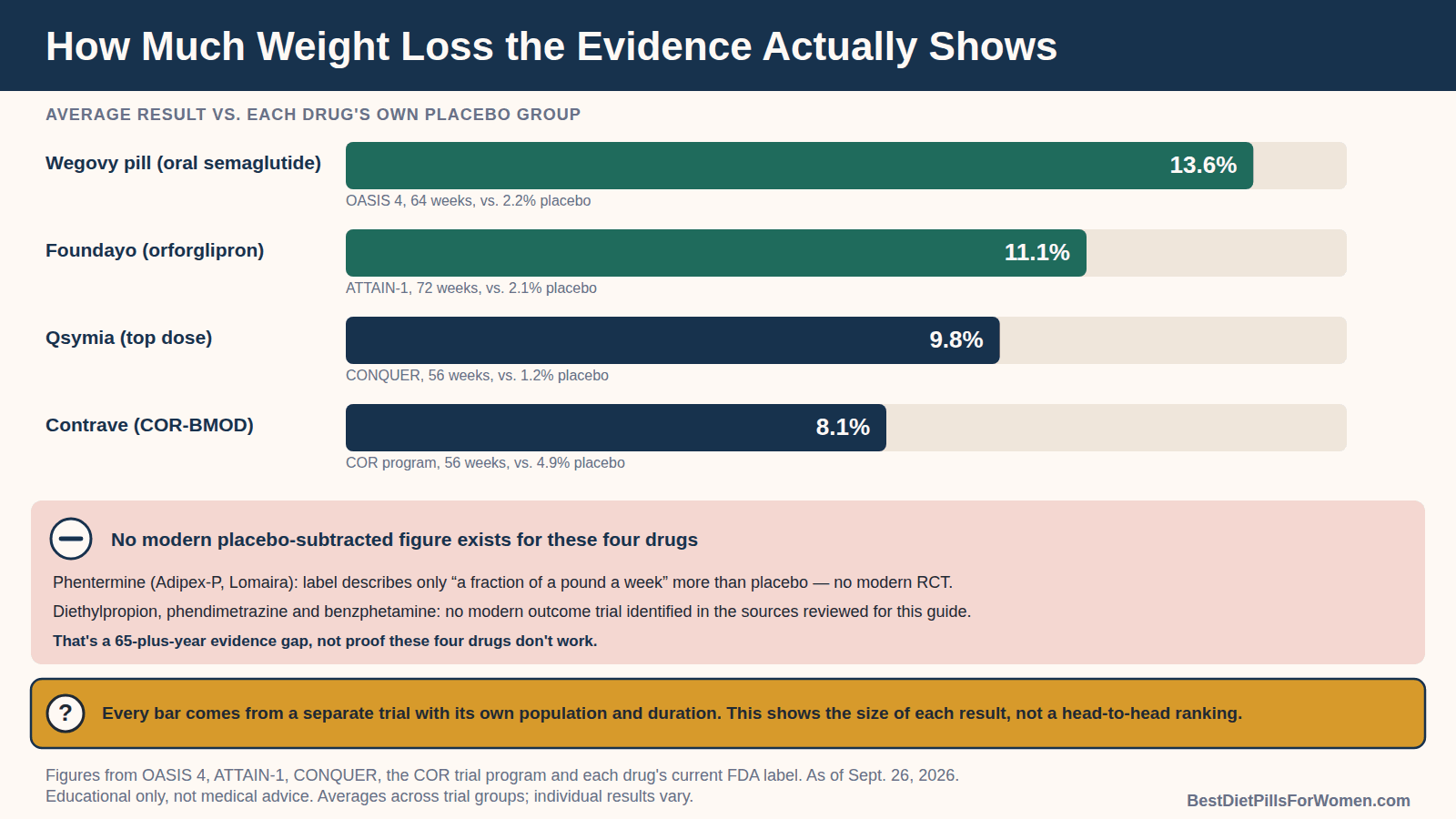
Why None of These Numbers Can Be Read as a Head-to-Head Comparison
Every result in Table 3 comes from a different trial, with a different population, duration and placebo group, so reading “13.6%” next to “a fraction of a pound a week” tells you about the size of the evidence gap between drugs, not which drug would win if the two were tested against each other directly. No trial in this guide put two prescription appetite suppressants in front of the same group of people at the same time. A 2025 network meta-analysis of 56 trials is one of the few tools built specifically to compare drugs statistically across separate trials, and even that comes with real limits on how confidently its results substitute for a genuine head-to-head study.
What an Average Result Hides
Every percentage in Table 3 is a group average, and averages flatten a range of individual outcomes that matters more to a single person than the topline number does.
Why Some People Lose Far More or Far Less Than the Average
In OASIS 4, some participants on the Wegovy pill lost well over 13.6% of their body weight, while others lost little or nothing; the pivotal trials for every drug in this guide report a spread of individual results around the average, not a uniform outcome. Response also varies by dose: Qsymia’s CONQUER trial found a clearly larger effect at its top dose (15/92 mg, −9.8%) than at its mid dose (7.5/46 mg, −7.8%), which is part of why these drugs are typically started low and titrated upward under supervision rather than prescribed at a fixed dose from day one.
What a Non-Response Usually Means
Prescribing guidance for the newer, better-studied drugs in this guide, including Qsymia and the GLP-1 pills, generally calls for reassessing treatment if a person hasn’t lost a clinically meaningful amount of weight after a defined trial period on a given dose, rather than continuing indefinitely on a drug that isn’t working for that individual. For the four older stimulant-class drugs, no comparably defined reassessment point exists in the label itself, which is one more reason a documented conversation with a prescriber about what “working” looks like, and by when, is worth having before you start any of the eight.
Safety: What Every Prescription Appetite Suppressant Requires You to Monitor
Every drug on this list has real trade-offs, and what needs monitoring differs sharply between the stimulant-class drugs and the newer options. This section is general information, not a substitute for a clinician who knows your health history and can weigh a specific drug against it.
Cardiovascular and Blood Pressure Monitoring
The stimulant mechanism that suppresses appetite in four of these eight drugs is the same mechanism that raises heart rate and blood pressure.
Why Stimulant-Class Drugs Carry Heart-Rate and Blood-Pressure Warnings
Phentermine’s label lists palpitations, rapid heart rate, elevated blood pressure, insomnia, tremor and restlessness among its adverse reactions, without giving specific frequencies, and diethylpropion, phendimetrazine and benzphetamine carry parallel warnings tied to the same sympathomimetic mechanism. Qsymia inherits this profile from its phentermine component, though its label also documents a separate concern from topiramate: the drug directs a gradual taper from the top dose because stopping abruptly can trigger seizures, and it warns about acute myopia, angle-closure glaucoma, metabolic acidosis and kidney stones. A longer-term cohort study helps put some of this in perspective for phentermine specifically: in a 2019 analysis of 13,972 phentermine users (84% women) followed up to three years, researchers found only a modest, transient increase in heart rate (up to 1.6 beats per minute at six months) and no significant difference in cardiovascular events or death between short-term and longer-term users. That’s reassuring observational data, not a randomized safety trial, and the study’s authors themselves note the field still lacks the latter.
Who Should Not Take a Stimulant-Class Appetite Suppressant
The contraindication lists for phentermine and its three older cousins overlap heavily: a history of cardiovascular disease, including coronary artery disease, stroke, arrhythmias, heart failure or uncontrolled high blood pressure; hyperthyroidism; glaucoma; agitated states; a history of drug abuse; use of an MAO inhibitor within the past 14 days; and pregnancy or breastfeeding. Benzphetamine’s label contraindicates pregnancy outright, and phendimetrazine’s carries the same caution. Contrave and the two GLP-1 pills don’t share this stimulant-driven cardiovascular profile, though they have their own separate warnings covered below.
Controlled-Substance Status and Dependence Risk
Four of the eight drugs in this guide are federally controlled substances, and that status shapes both their risk profile and how you’re able to get and refill them.
Why Most of These Are Schedule III or IV Controlled Substances
Phentermine and diethylpropion are Schedule IV controlled substances, and phendimetrazine and benzphetamine are Schedule III; Qsymia is Schedule IV because it contains phentermine. Controlled-substance status reflects a recognized potential for abuse and dependence, even at prescribed doses, and it’s a meaningful part of why these four drugs’ labels restrict them to short-term use. Contrave, the Wegovy pill and Foundayo carry no such designation.
What “Short-Term Use Only” Actually Means on the Label
All four stimulant-class labels describe approved use as “a few weeks,” language that dates to trials run in the 1950s and 1960s and hasn’t been updated since. In practice, many prescribers use phentermine longer than that off-label, and the strongest evidence on what happens when they do comes from the 2019 electronic-health-record cohort mentioned above: people who continued phentermine beyond three months lost meaningfully more weight than short-term users, with no significant difference in cardiovascular composite outcomes across exposure groups, though the study’s authors are explicit that no randomized long-term trial exists to confirm this with the same rigor as a modern drug approval. If a clinician suggests longer-term use of any of the four older drugs, it’s a fair question to ask what evidence supports going beyond the label’s own “a few weeks.”
Other Meaningful Risks by Drug
Beyond the class-wide stimulant and controlled-substance issues, each newer combination drug carries its own specific warning worth understanding before you start it.
Topiramate’s Cognitive and Birth-Defect Warnings in Qsymia
Topiramate, Qsymia’s second ingredient, is linked to oral clefts in babies exposed during the first trimester of pregnancy, which is why Qsymia requires enrollment in a REMS program with monthly pregnancy testing and documented contraception for anyone who could become pregnant. The label also lists cognitive effects such as difficulty concentrating and memory problems, along with mood and sleep disturbances, including suicidal thoughts, among its warnings.
Bupropion’s Seizure Risk and Naltrexone’s Opioid Interaction in Contrave
Contrave’s bupropion component is contraindicated in anyone with a seizure disorder, and the label pairs that contraindication with a boxed warning for suicidal thoughts and behaviors, particularly in children, adolescents and young adults. Its naltrexone component blocks opioid receptors, so Contrave is contraindicated in chronic opioid users and can trigger withdrawal in anyone dependent on opioids; the label also lists bulimia and anorexia nervosa as contraindications, since both raise seizure risk in combination with bupropion.
Drug and Supplement Interactions Across the Class
Beyond each drug’s own contraindications, a few interaction patterns apply broadly enough across this category to call out on their own.
Stacking Two Stimulants: Caffeine, OTC Fat Burners and the Sympathomimetic Drugs
Phentermine, diethylpropion, phendimetrazine, benzphetamine and Qsymia all work partly through the same stimulant pathway that caffeine and OTC “fat burner” ingredients use, so combining any of them stacks cardiovascular stimulation rather than meaningfully adding to weight loss. That combination raises the odds of palpitations, elevated blood pressure, tremor and anxiety, and because dietary supplements aren’t reviewed by FDA before sale, some have been found to contain undeclared stimulant drugs on top of their labeled ingredients, adding an unknown quantity to the stack.
MAO Inhibitors, Other Antidepressants and Opioid Medications
All four sympathomimetic-amine drugs and Qsymia are contraindicated within 14 days of an MAO inhibitor, a class of antidepressant that can interact dangerously with stimulant drugs. Contrave’s bupropion component can also interact with other antidepressants and medications that lower the seizure threshold, and its naltrexone component blocks the effect of opioid pain medications entirely, which matters for anyone who might need opioid-based pain control for a planned surgery or procedure while taking it. Any prescriber or pharmacist should see a full, current medication and supplement list before starting any drug in this guide.
Side Effects Across the Class
Table 4 lines up the most common and most important side effects across all eight drugs, so you can see where the real risks concentrate before choosing between them.
The Side-Effect Table
| Drug | Most common side effects | Reported frequency | Serious warning to know |
|---|---|---|---|
| Phentermine, diethylpropion, phendimetrazine, benzphetamine | Palpitations, rapid heart rate, elevated blood pressure, insomnia, tremor | No frequencies given in the labels | Pulmonary hypertension risk rises roughly 23-fold with anorectic-agent use beyond 3 months |
| Qsymia | Tingling, dry mouth, constipation, altered taste | Tingling 20%, dry mouth 19%, constipation 16% at top dose vs. single digits on placebo | Birth defects (oral clefts); requires REMS and monthly pregnancy tests |
| Contrave | Nausea, constipation, headache, dizziness | Nausea 32.5% vs. 6.7%; about 24% discontinued for an adverse event | Boxed warning for suicidal thoughts and behaviors |
| Wegovy pill | Nausea, vomiting, diarrhea, constipation | Any digestive-system event 74.0% vs. 42.2% | Boxed warning for thyroid C-cell tumors (rodent studies) |
| Foundayo | Nausea, vomiting, hair loss | Nausea 26%–35% vs. 10%; hair loss 7% in women vs. 0.9% in men | Boxed warning for thyroid C-cell tumors; gallbladder disease risk |
Table 4 method: frequencies are copied from the FDA labels and trials (drug versus placebo) and aren’t directly comparable across drugs, since trial design and dosing differ. “Serious warning to know” summarizes each label’s most consequential boxed warning or contraindication, not a complete safety profile.
Read Table 4 next to Table 3: the drugs with the strongest evidence also tend to have the most extensively documented side-effect profiles, simply because modern trials collect that data systematically in a way 1960s-era approvals never did. That’s a real trade-off worth naming rather than a reason to assume the older drugs are safer because their labels say less.
Which Side Effects Are Reversible, and Which Warrant a Call
Most of the effects in Table 4, tingling, dry mouth, insomnia, mild nausea, tend to ease with time or resolve once a drug is stopped. A smaller set warrants contacting a clinician promptly rather than waiting it out: chest pain, fainting or a racing heart on any stimulant-class drug; new or worsening depression or thoughts of self-harm on Contrave or Qsymia; a seizure on Contrave; and severe, persistent abdominal pain, which can signal gallbladder disease on either GLP-1 pill. Knowing which category a symptom falls into before you start is easier than trying to sort it out while you’re experiencing it.
Who Can Get a Prescription, and What It Actually Requires
The clinical eligibility bar is largely the same across this drug class, but getting and refilling a prescription looks very different depending on whether the drug is a controlled substance.
Eligibility Criteria
Every drug in this guide is FDA-approved for the same general population, with the same basic weight and health thresholds.
BMI and Health-Condition Thresholds
All eight drugs are indicated for adults with a BMI of 30 or higher, or 27 or higher with a weight-related condition such as high blood pressure, type 2 diabetes or high cholesterol. That threshold is a label requirement, not a personal judgment about who “deserves” treatment, and it’s the same bar used across most FDA-approved weight-management drugs, prescription appetite suppressants included. Meeting the BMI threshold doesn’t guarantee a prescription; a clinician still has to weigh your specific health history against each drug’s contraindications.
Eligibility can carry extra nuance at certain life stages, since some contraindications and risk factors become more common with age or with specific conditions. If any of these apply to you, our guides to prescription and OTC options for women over 40, for menopause, for perimenopause and for PCOS go deeper on how those factors interact with this specific drug class.
Why a Clinician Visit, Often Telehealth, Comes First
Every drug on this list requires a prescription, which means a clinician has to evaluate you, check for contraindications and, for the stimulant-class drugs, confirm you don’t have an excluded cardiovascular or psychiatric condition before writing it. In practice, a large share of these visits now happen by telehealth rather than in person, a shift that matters more for this drug category than for most, because four of the eight options are federally controlled substances.
Getting and Refilling the Prescription
Controlled-substance status changes the mechanics of getting a prescription filled and renewed, sometimes significantly.
Why Controlled-Substance Rules Affect Refills
Because phentermine, diethylpropion, phendimetrazine, benzphetamine and Qsymia are Schedule III or IV controlled substances, pharmacies and prescribers follow federal and state rules around refill limits, prescription validity periods and, in some states, mandatory checks of prescription drug monitoring programs before dispensing. Contrave, the Wegovy pill and Foundayo, none of which is scheduled, don’t carry those same refill restrictions, though they still require an active prescription like any other prescription drug.
Telehealth vs. In-Person Prescribing
As of September 2026, DEA and HHS have extended COVID-era telemedicine flexibilities through December 31, 2026, allowing practitioners to prescribe Schedule II through V controlled substances, including phentermine, diethylpropion, phendimetrazine, benzphetamine and Qsymia, via telehealth without a prior in-person medical evaluation, provided the prescription serves a legitimate medical purpose and the prescriber is properly registered. That’s the fourth temporary extension of a policy that began during the pandemic, and it’s set to expire at the end of this year unless extended again, which makes it one of the more time-sensitive facts in this guide. UnitedHealthcare’s commercial prior-authorization policy, effective September 1, 2026, lists phentermine products among the drugs requiring prior authorization before coverage, regardless of whether the prescription originated by telehealth or in person.
Telehealth access to controlled substances has also drawn regulatory scrutiny. The FTC’s December 2025 final order against telehealth provider NextMed addressed complaints about how some online prescribing services market and dispense medications, a reminder that convenience and legitimacy aren’t automatically the same thing when a website offers to prescribe a controlled substance after a brief questionnaire. A telehealth visit that skips a real medical history, doesn’t check for contraindications, or prescribes a controlled substance without a licensed clinician’s genuine evaluation is a red flag worth walking away from, whichever drug is being offered.
What a Typical Prescribing Visit Involves
Whether it happens in person or by telehealth, a legitimate first visit for any drug in this guide follows a fairly consistent pattern, and knowing that pattern makes it easier to spot a visit that’s cutting corners.
Before the Visit: What to Bring or Prepare
A useful first visit works best with your current height and weight, a list of every medication and supplement you take, your blood pressure history if you track it, and a note of any personal or family history of heart disease, high blood pressure, glaucoma, thyroid problems, seizures, an eating disorder or substance use. For any drug that could affect pregnancy, including all four stimulant-class options and Qsymia, be ready to discuss your current contraception and any pregnancy plans, since that conversation directly affects which drugs are appropriate.
What the Clinician Checks During the Visit
A legitimate visit includes a review of your BMI and weight-related health conditions against the label’s eligibility criteria, a check of your personal and family cardiovascular and psychiatric history against each candidate drug’s contraindications, and, ideally, a current blood pressure reading before a stimulant-class prescription. For Qsymia specifically, expect a pregnancy test and enrollment in the drug’s REMS program at the outset, not as an afterthought. If a service skips all of this and offers a prescription based on a short online form alone, that’s a meaningful gap from how this category is supposed to be prescribed.
What Each Option Costs
Cost varies more within this single drug category than almost anywhere else in weight-loss medicine, from about $10 a month to nearly $300. Every price below was checked on September 26, 2026, and cash prices in particular change often, so treat this section as a dated snapshot rather than a quote.
Generic Stimulant-Class Costs
The four older drugs are, without exception, the cheapest options in this guide, though “cheap” doesn’t mean equally available.
Phentermine and the Other Older Generics
Generic phentermine costs about $9.91 to $23.04 for a 30-tablet supply with pharmacy coupons, versus $40 to $50 without one, making it the least expensive drug in this entire guide by a wide margin. Diethylpropion runs about $33.97 with a GoodRx coupon against an average retail price of $98.82, and phendimetrazine about $17.23 against an average retail price of $47.29. Benzphetamine is the outlier: cash prices for 90 tablets have been reported anywhere from about $70 to $625, and even with a discount card the range runs roughly $70 to $128, reflecting real supply problems discussed below rather than a straightforward pricing pattern.
What Insurance Typically Covers for This Class
Coverage for the older stimulant-class drugs is inconsistent across insurers, and because these are short-term-labeled, inexpensive generics, many people simply pay cash rather than navigating a prior-authorization process. UnitedHealthcare’s commercial policy lists phentermine products among the drugs requiring prior authorization when a plan covers weight-loss medications at all, alongside Qsymia, Contrave and the two GLP-1 pills.
Brand-Name Costs
The four newer drugs cost substantially more, though manufacturer self-pay programs have narrowed the gap between the newest, most effective options and their older competitors.
Qsymia and Contrave Pricing
Qsymia’s manufacturer offers home delivery for $74.99 a month with titration packs included, and Costco members can pay $65.99 in cash; average retail price without those programs runs closer to $258. Contrave costs $99 a month through its manufacturer program, or no more than $199 at a retail pharmacy with a savings card and no insurance; average retail without a discount runs about $742.
Oral Semaglutide Pricing
The Wegovy pill runs $149 a month at the starting 1.5 mg dose, rising to $299 at the 25 mg maintenance dose through NovoCare Pharmacy’s self-pay program, putting its top-dose monthly cost close to Qsymia’s average retail price and well below its own $1,349 former list price. Foundayo follows a similar tiered structure, from $149 at its starting dose to $299 at most higher doses, rising to $349 if a refill isn’t completed within 45 days of the previous one. Our Wegovy pill cost guide breaks down titration-year arithmetic and insurance scenarios for that drug specifically.
The Costs Neither Category Advertises
Sticker prices leave out two costs that add up over a full year of treatment.
Clinician Visits, Labs and Telehealth Fees
None of the cash prices above includes the clinician visit needed to get and renew a prescription, and telehealth platforms often charge separate consultation fees on top of the medication itself. Qsymia’s REMS program requires periodic clinician contact for pregnancy testing, and any controlled-substance prescription may require more frequent visits than a non-controlled one, depending on state law and individual prescriber policy. Budgeting for a drug’s monthly price without budgeting for the visits that keep the prescription active is one of the more common cost surprises in this category.
What a Missed Dose or a Skipped Refill Costs
Because four of these drugs are controlled substances, a lapsed prescription can mean starting the approval and dosing process over rather than simply picking up where you left off, especially if a state’s prescription monitoring program flags a gap. For the GLP-1 pills, manufacturer pricing tiers can penalize a late refill directly: Foundayo’s top-dose price rises from $299 to $349 if a refill isn’t completed within 45 days, an added cost that has nothing to do with the drug’s clinical effect and everything to do with a billing window.
What Each Option Costs Over a Year
Table 5 turns the monthly prices above into a rough annual figure for comparison.
The Cost Table
| Drug | Monthly cash price | Rough 12-month cost | Price source |
|---|---|---|---|
| Phentermine (generic) | $9.91–$23.04 with coupons | About $119–$277 | |
| Phendimetrazine (generic) | About $17.23 with a GoodRx coupon | About $207 | |
| Diethylpropion (generic) | About $33.97 with a GoodRx coupon | About $408 | |
| Benzphetamine (generic) | Roughly $70–$128 for 90 tablets (about a 1- to 3-month supply depending on dose) | Highly variable; supply-dependent | |
| Qsymia | $65.99–$74.99 (manufacturer/Costco) | About $792–$900 | |
| Contrave | $99 (manufacturer) to $199 (retail with card) | $1,188–$2,388 | |
| Wegovy pill | $149–$299 by dose | About $1,788–$3,588 depending on titration pace | |
| Foundayo | $149–$299 (or $349 if refilled late) by dose | About $1,788–$4,188 depending on titration pace and refill timing |
Table 5 method: monthly prices are self-pay or lowest-coupon prices from the manufacturer and price-comparison pages, read September 26, 2026. Twelve-month figures multiply the monthly price by 12 and are simplified estimates; they exclude clinician visits, labs and telehealth fees, and several of the underlying prices are promotional and subject to change.
The gap between the cheapest and most expensive drug in this single category, generic phentermine at around $120 to $280 a year versus a GLP-1 pill at its top dose approaching $4,200, is larger than the gap between many entirely different drug classes elsewhere in weight-loss medicine. Effectiveness and cost move in the same general direction here, which is worth weighing honestly rather than assuming the pricier option is always the better fit for a given person’s health history and budget.
How Titration Timing Changes the First-Year Number
The steady-state monthly prices in Table 5 also don’t capture what the Wegovy pill and Foundayo cost across a full first year, because both drugs start at a lower dose and titrate upward over several months. Following the Wegovy pill’s labeled titration schedule, a first year that spends one month each at $149 and $199 before settling into $299 a month for the remaining ten months comes to about $3,338, noticeably less than 12 straight months at the $299 maintenance price would suggest. The reverse also happens with a faster titration or a slower one: the exact first-year total depends on how many months are spent at each price tier before reaching a maintenance dose, so a titration-schedule estimate is more accurate than simply multiplying the maintenance price by 12.
Where Prescription Appetite Suppressants Fit Among Your Other Options
A prescription appetite suppressant is one option on a longer menu, not the only one. Two comparisons come up most often: against OTC appetite suppressants, and against injectable GLP-1 drugs.
Versus OTC Appetite Suppressants
The regulatory gap between prescription and over-the-counter appetite suppressants is the single biggest factor separating the two.
What a Prescription Adds That an OTC Product Can’t
Every drug in this guide went through FDA review of clinical trial data before it could be sold; almost every OTC “appetite suppressant” is a dietary supplement that reached the shelf without that review, and a systematic review of 315 randomized trials across 14 supplement ingredients found a significant weight difference in under a third of the highest-quality trials. That’s the core trade-off: a prescription requires a clinician’s involvement and, for four of the eight drugs here, controlled-substance rules, but it comes with a much larger and better-documented evidence base than almost any OTC alternative. Our OTC appetite suppressant guide covers that side of the comparison in full, including which supplement ingredients have any meaningful human evidence behind them.
When an OTC Option Might Be Reasonable Instead
For someone who doesn’t meet the BMI threshold for a prescription drug, can’t access a clinician, or wants to try a lower-risk option first, an OTC product with reasonable evidence, such as a viscous-fiber supplement, carries far less risk than a prescription stimulant, even though its likely effect is also far smaller. The honest trade there is small-but-real evidence versus a modest safety cost, not a shortcut to prescription-drug results without a prescription-drug price tag. Our roundup of appetite suppressants for women walks through both prescription and OTC options side by side for readers still deciding which category to start with.
Versus Injectable GLP-1 Medicines
For anyone specifically comparing a pill to an injection, the size of the effect is the first thing to know, but it isn’t the only thing that matters.
Why an Injectable Might Outperform Every Pill on This List
Injectable semaglutide (Wegovy) produced −14.9% weight loss versus −2.4% on placebo over 68 weeks in STEP 1, and injectable tirzepatide (Zepbound) produced −20.9% versus −3.1% on placebo over 72 weeks in SURMOUNT-1, both larger effects than any pill in this guide, including the Wegovy pill and Foundayo. Both injectables carry the same class-wide boxed warning for thyroid C-cell tumors as their pill counterparts, and cash prices for the injections, at roughly $349 to $449 a month once on a maintenance dose, run close to or above the top-dose price of either GLP-1 pill.
Why Some Women Choose a Pill Anyway
A weekly self-injection is a genuine barrier for some people, whether from needle aversion, storage requirements while traveling, or simple preference, and a daily pill removes that barrier entirely. For anyone weighing a stimulant-class pill specifically against an injection, the trade-off is starker: the injections have a far larger evidence base and effect size than phentermine or its three lesser-known relatives, so the pill’s real advantage in that specific comparison is convenience and cost, not comparable results.
Positioning This Category Among the Alternatives
Table 6 places prescription appetite suppressants next to their closest alternatives on the dimensions that matter most for choosing between them.
The Positioning Table
| Option | Typical effect | Regulatory pathway | Main advantage | Main limitation |
|---|---|---|---|---|
| Prescription appetite suppressants (this guide) | “A fraction of a pound a week” to −13.6% depending on drug | FDA-reviewed prescription drugs; 4 of 8 are controlled substances | Widest range of evidence and price points in one category | Older drugs have thin evidence; newer ones cost more |
| OTC appetite suppressants (supplements) | Significant effect in under a third of high-quality trials, mostly under 5 kg | Dietary supplements; no FDA pre-market review | No prescription needed; lower stimulant-class risk from most ingredients | Weak evidence; some products contain undeclared drugs |
| Injectable GLP-1 drugs | −14.9% to −20.9% vs. placebo | FDA-reviewed prescription drugs; not controlled substances | Largest average effect of any weight-loss drug class | Weekly injection; similar or higher cost than pills |
| Prescription orlistat (not an appetite suppressant) | About 2.9 kg more than placebo; a 2025 meta-analysis found no significant advantage at 52 weeks | FDA-reviewed prescription drug | Different mechanism; may suit someone who can’t take a stimulant or GLP-1 drug | Digestive side effects; weakening modern evidence |
Table 6 method: figures are as reported in the trials, labels and systematic reviews. Rows come from different studies with different populations and durations, so this is a map of typical magnitudes, not a head-to-head ranking.
What About Lifestyle Programs and Behavioral Support?
Every guideline we reviewed places diet, activity and behavioral support underneath any medication in this guide, not as a replacement for it, and none of the eight drugs was tested without some form of counseling alongside it. Across 67 studies and more than 22,000 adults, intensive behavioral programs produced 2.39 kg more weight loss than comparison groups at 12 to 18 months, a real but modest effect on its own.
That matters for reading every table in this guide correctly: “the drug’s effect” already includes a baseline level of lifestyle support built into the trial design, not a drug acting entirely on its own against an untreated comparison group.
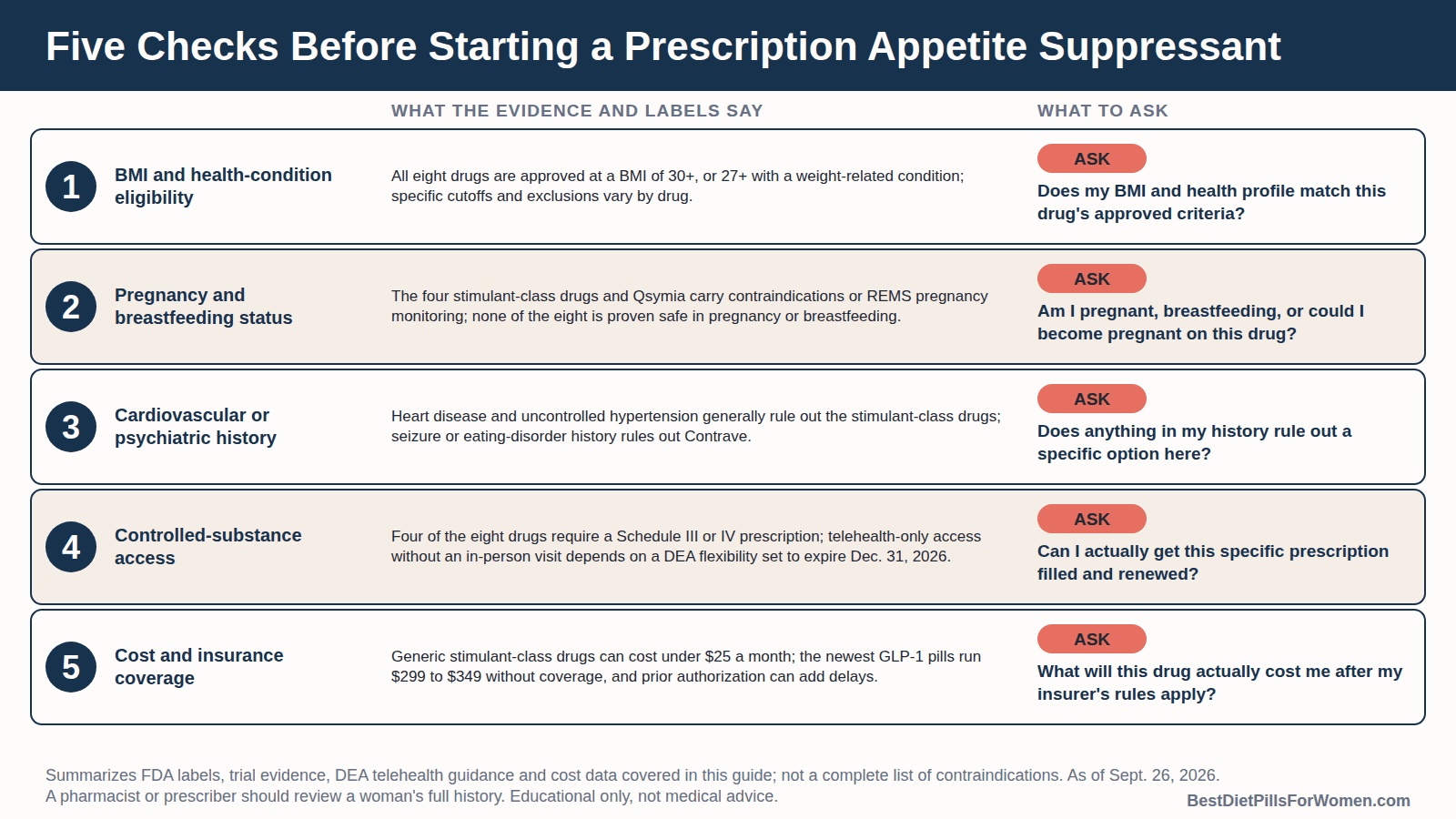
The five checks that most often change the answer for a specific woman deserve a closer look, since they cut across every drug in this guide rather than applying to just one.
The Five Checks Before Starting Any of These Drugs
Three of the five checks apply no matter which of the eight drugs is on the table; the other two depend heavily on which drug you’re actually considering.
The Three Checks Every Drug in This Guide Shares
Eligibility, pregnancy status and cardiovascular or psychiatric history matter for all eight drugs, though the specific cutoffs differ by drug. Every option in this guide is approved for adults with a BMI of 30 or higher, or 27 or higher with a weight-related condition such as high blood pressure or type 2 diabetes, so confirming where you actually fall on that scale is the first real gate. Pregnancy status is the second: the four stimulant-class drugs and Qsymia are contraindicated or carry REMS pregnancy monitoring, and none of the eight drugs has been shown safe during pregnancy or breastfeeding.
Cardiovascular and psychiatric history is the third shared check, and it cuts in different directions depending on the drug. Uncontrolled hypertension, a history of heart disease or hyperthyroidism generally rules out the four stimulant-class drugs and Qsymia, while a seizure disorder or eating disorder rules out Contrave specifically, and a personal or family history of medullary thyroid cancer rules out both GLP-1 pills. Bringing your actual history to that first appointment, rather than assuming any one drug is automatically off the table, is what lets a clinician sort through these overlapping restrictions correctly.
The Two Checks That Depend on Which Drug You’re Considering
The fourth check is access: whether the specific drug is a controlled substance changes how you can legally get a prescription. Four of the eight drugs require a Schedule III or IV prescription, and if you’re hoping to get one through a telehealth visit without ever seeing a clinician in person, that pathway currently depends on a DEA flexibility set to expire December 31, 2026, discussed earlier in this guide. The three lesser-known stimulant-class drugs add a second access wrinkle on top of that: confirming a pharmacy can actually fill the prescription before you commit to a specific one of the three.
The fifth check is cost and coverage, and it varies more across this drug class than almost any other weight-management category. A month of generic phentermine can cost under $25 with a coupon, while a month of either GLP-1 pill at its maintenance dose runs $299 to $349 without insurance, and prior-authorization rules, like the policy taking effect September 1, 2026 discussed in the cost section, can add weeks to getting a newer drug approved even when you’re otherwise eligible. Checking your own plan’s current rules before you and a clinician settle on a specific drug avoids the common scenario of picking an option on clinical grounds alone, only to find it isn’t actually affordable or covered.
Frequently Asked Questions About Prescription Appetite Suppressants
Effectiveness and Evidence
Which Prescription Appetite Suppressant Works Best?
The Wegovy pill (oral semaglutide) produced the largest average effect in this guide, at −13.6% versus −2.2% on placebo over 64 weeks, followed by Foundayo at −11.1% and Qsymia at up to −9.8%. “Best” for a specific person also depends on cost, controlled-substance status, side-effect tolerance and contraindications, so the largest average effect isn’t automatically the right fit for everyone.
A woman with well-controlled health and no budget constraint might reasonably prioritize the largest effect; someone with a seizure history would rule out Contrave regardless of its results, and someone who’s pregnant or could become pregnant soon would rule out Qsymia and the four older stimulant-class drugs outright. “Best” is a question with a different answer for each of those three people, which is exactly why this guide leads with the full roster rather than a single recommendation.
Do Prescription Appetite Suppressants Really Work Long-Term, or Just Short-Term?
It depends entirely on which drug. Qsymia, Contrave, the Wegovy pill and Foundayo are all approved and studied for long-term use, with trials running 56 to 72 weeks and, for Qsymia, a two-year extension study. Phentermine, diethylpropion, phendimetrazine and benzphetamine are labeled for short-term use only (“a few weeks”), though observational data on longer, off-label phentermine use suggests the effect can persist with continued use, even without the randomized long-term trial that would confirm it definitively.
Why Don’t Diethylpropion, Phendimetrazine and Benzphetamine Have Modern Trial Data?
All three were approved in the early 1960s, when FDA’s evidence standards for weight-loss drugs were far less rigorous than they are today, and none has attracted the kind of large, modern randomized trial that newer drugs like Qsymia and the GLP-1 pills have undergone. Limited commercial interest in re-studying decades-old generic drugs, rather than any specific safety finding, appears to be the main reason no such trial exists in the sources we reviewed.
Safety and Eligibility
Can I Take a Prescription Appetite Suppressant While Breastfeeding?
Not without a specific conversation with your clinician, and for several drugs, the answer leans toward no. Contrave’s label states that bupropion, naltrexone and their metabolites are present in breast milk, and Qsymia’s label doesn’t recommend use while breastfeeding because of limited safety data. Phentermine and its three older relatives are contraindicated in nursing mothers on their labels, and the GLP-1 pills’ labels also advise against use while breastfeeding.
None of the eight drugs in this guide has been specifically studied for safety during breastfeeding in a way that would let a label say more than “not recommended” or “insufficient data.” That’s a meaningfully different situation from a drug that’s been studied and found safe, and it’s worth naming that difference plainly rather than assuming “not recommended” and “proven risky” mean the same thing.
Is It Safe to Combine a Prescription Appetite Suppressant With Caffeine or an OTC Fat Burner?
Combining any stimulant-class prescription drug (phentermine, diethylpropion, phendimetrazine, benzphetamine or Qsymia) with caffeine or an OTC stimulant-containing “fat burner” stacks two stimulant effects on the cardiovascular system rather than adding meaningfully to weight loss, and it raises the risk of palpitations, elevated blood pressure and anxiety. Tell any prescriber and pharmacist about every supplement you’re taking, since OTC products aren’t reviewed by FDA before sale and some have contained undeclared stimulant drugs.
What Happens If I Stop Taking a Prescription Appetite Suppressant?
For the four older stimulant-class drugs, the label’s short-term approval means stopping is expected, and any weight lost tends to plateau or reverse once the drug’s appetite-suppressing effect is gone. For Qsymia specifically, stopping abruptly from the top dose can trigger seizures, so the label directs a gradual taper.
For the GLP-1 pills, the pattern mirrors what’s documented for injectable GLP-1 drugs: a 2026 meta-analysis of 37 studies found people regain weight at an average rate of about 0.4 kg a month after stopping any weight-loss medication, with a projected return to baseline around 1.7 years, though the pooled figure blends many different drugs and doesn’t separate out oral pills specifically.
The Bottom Line on Prescription Appetite Suppressants
What the Evidence Means for You
The eight drugs in this guide split cleanly into two evidence tiers, and that split, more than brand names or marketing, should drive most of the thinking about this category.
The Biggest Realistic Advantage
The newer drugs in this category, especially the Wegovy pill and Foundayo, offer the strongest combination of evidence and effect size of any appetite suppressant available by prescription, with Qsymia and Contrave a step behind but still backed by large, modern, placebo-controlled trials. For someone who meets the eligibility criteria and can access one of these four drugs, that’s a genuinely different proposition than anything sold without a prescription, both in how much weight loss to realistically expect and in how well the risks are documented and monitored.
The Biggest Limitation or Safety Concern
The oldest four drugs, phentermine, diethylpropion, phendimetrazine and benzphetamine, carry a real limitation that no amount of clinical experience fully resolves: none has a modern randomized trial reporting a placebo-subtracted result, their labels support only short-term use, and their stimulant mechanism rules them out for anyone with significant cardiovascular disease, uncontrolled hypertension or a history of substance use. Longer, off-label use appears reasonably well tolerated in observational data, but “appears well tolerated in one cohort study” is a meaningfully weaker claim than “proven safe in a randomized long-term trial,” and it’s worth knowing which claim you’re actually relying on before starting any of the four.
The newer drugs aren’t limitation-free either. Qsymia’s REMS requirements and Contrave’s boxed warning demand real, ongoing attention, and both GLP-1 pills carry a class-wide boxed warning and a still-growing safety record, since the Wegovy pill and Foundayo have only been on the market since late 2025 and April 2026 respectively. A shorter track record isn’t the same as a hidden danger, but it does mean less real-world experience exists for the two newest drugs than for options that have been prescribed for years or decades.
A Rational Next Step
Neither drug labels nor this guide can tell you which of these eight options, if any, fits your own health history, budget and goals. A short conversation can narrow the list considerably.
Questions for a Clinician
Bring these questions to a prescriber weighing a prescription appetite suppressant: Which drugs am I actually eligible for, given my BMI, blood pressure, heart history and any psychiatric or eating-disorder history? If you’re recommending one of the four older stimulant-class drugs, is that meant to be short-term per the label, or longer-term off-label, and what’s the evidence for going beyond a few weeks? What would make you switch me to a different drug in this category, or to an injection instead? And what happens to my prescription, and my out-of-pocket cost, if I need to stop or switch?
What to Re-Check Before You Spend Money
Prices, insurance rules and even approval status in this category change quickly. Before committing to a specific drug, re-check its current cash price and any manufacturer savings program, confirm your insurer’s current prior-authorization criteria, and, if you’re considering one of the three lesser-known stimulant-class drugs, call ahead to confirm a pharmacy actually has it in stock, since real-world supply for benzphetamine in particular has been inconsistent even without an official shortage designation. Also confirm the DEA telemedicine flexibility discussed earlier is still active if you’re planning to get a controlled-substance prescription without an in-person visit, since that policy is currently set to expire December 31, 2026.
Related Reading
Sources
These are the main sources behind this guide, chosen because they are the ones to check first for current facts. Labels, prices and research summaries change, so confirm the latest version before you make decisions.
- Teva Pharmaceuticals. Adipex-P (phentermine) prescribing information (revised 03/2024), DailyMed set ID f5b2f9d8-2226-476e-9caf-9d41e6891c46, and KVK-Tech. Lomaira (phentermine 8 mg) prescribing information (December 2023), set ID cde9fb09-e5af-434d-8874-e4f9f974d893 (re-read on September 24, 2026 through a page summary, whose wording of the mechanism sentence differed slightly from an earlier reading, so the article paraphrases it). https://dailymed.nlm.nih.gov/dailymed/drugInfo.cfm?setid=f5b2f9d8-2226-476e-9caf-9d41e6891c46
- DailyMed prescribing information for diethylpropion (set ID dab53f4f-68d4-4477-a2b6-ad44a956332b), benzphetamine (f6d9b369-4b64-4d3f-844d-5d60dd257c55) and phendimetrazine (42ecacde-6859-47c6-ba44-13fb4f3b5448). https://dailymed.nlm.nih.gov/dailymed/drugInfo.cfm?setid=dab53f4f-68d4-4477-a2b6-ad44a956332b
- VIVUS LLC. Qsymia (phentermine and topiramate extended-release) capsules, prescribing information (label revised April 2026), DailyMed set ID 40dd5602-53da-45ac-bb4b-15789aba40f9. https://dailymed.nlm.nih.gov/dailymed/drugInfo.cfm?setid=40dd5602-53da-45ac-bb4b-15789aba40f9
- Nalpropion Pharmaceuticals LLC. Contrave (naltrexone HCl/bupropion HCl extended-release) tablets, prescribing information (DailyMed revision 11/2025), set ID 485ff360-32c8-11df-928b-0002a5d5c51b. https://dailymed.nlm.nih.gov/dailymed/drugInfo.cfm?setid=485ff360-32c8-11df-928b-0002a5d5c51b
- OASIS 4 investigators. Oral semaglutide at a dose of 25 mg in adults with overweight or obesity (OASIS 4). N Engl J Med. 2025 (doi:10.1056/NEJMoa2500969). Figures read via the American College of Cardiology journal scan (https://www.acc.org/latest-in-cardiology/journal-scans/2025/09/24/16/40/oasis-4), Novo Nordisk trial materials and the FDA-approved label; the journal article itself was not accessible.
- Eli Lilly and Company. Foundayo (orforglipron) tablets, prescribing information (label revised 07/2026); FDA NDA 220934 label. https://pi.lilly.com/us/foundayo-uspi.pdf ; https://www.accessdata.fda.gov/drugsatfda_docs/label/2026/220934Orig1s000lbl.pdf
- Lewis KH, Fischer H, Ard J, et al. Safety and effectiveness of longer-term phentermine use: clinical outcomes from an electronic health record cohort. Obesity. 2019;27(4):591-602. https://www.abom.org/wp-content/uploads/2020/05/Safety-and-effectiveness-of-longer-term-phentermine-use_Clinical-Outcomes-from-an-EHR-Cohort.pdf
- Drug Enforcement Administration and U.S. Department of Health and Human Services. Fourth Temporary Extension of COVID-19 Telemedicine Flexibilities for Prescription of Controlled Medications. Federal Register, December 31, 2025. https://www.federalregister.gov/documents/2025/12/31/2025-24123/fourth-temporary-extension-of-covid-19-telemedicine-flexibilities-for-prescription-of-controlled
- McGowan B, et al. Efficacy and safety of weight-management medications: a network meta-analysis of 56 randomized trials (search to January 31, 2025). Nature Medicine. October 2, 2025. https://www.nature.com/articles/s41591-025-03978-z (abstract page read through a page summary; numeric estimates weren’t visible).
- Batsis JA, et al. A systematic review of dietary supplements and alternative therapies for weight loss. Obesity. 2021. doi:10.1002/oby.23110

