Weight loss patches don’t have credible evidence behind them. As of September 24, 2026, we found no published human trial showing that a patch worn on the skin causes weight loss, and the Federal Trade Commission has told consumers the same thing for years: nothing you wear or apply to your skin will make you lose weight.
That answer surprises many women, because patches look plausible. Nicotine patches help people quit smoking, and hormone patches treat menopause symptoms, so why wouldn’t a berberine or “GLP-1” patch do something? Here’s the catch. A skin patch works best for drugs that are small, fat-soluble and potent at tiny doses, and the drugs in approved patches were tested for years before they reached a pharmacy shelf. The ingredients in the weight loss patches we reviewed (berberine, vitamin B12, kelp, cinnamon, glutamine) haven’t been shown to reach the bloodstream from a patch, let alone change body weight. And the 2026 wave of “GLP-1 patches” borrows the name of prescription drugs like semaglutide, a molecule more than eight times larger than the size limit usually cited for skin delivery.
This guide explains what weight loss patches are, how skin absorption works, what research does and doesn’t show, how U.S. regulators treat these products, which safety issues matter, what patches cost, and which options have better evidence. It’s written for women deciding whether a patch is worth trying, and it’s meant to give you better questions for a clinician, not a treatment plan.
Do Weight Loss Patches Work? The Short Answer
The short version is easy to state and worth reading twice before you spend money. The sections that follow show the reasoning, so you can judge the conclusion yourself instead of taking our word for it.
Do Weight Loss Patches Actually Work?
Most readers arrive with this exact question, so it gets a direct answer first and a confidence check second.
The Direct Answer
No good evidence shows that weight loss patches work. We found no published human trial of a weight loss patch, the FTC says nothing worn or applied to the skin causes weight loss, and the FDA has told sellers that patches making fat-burning claims are unapproved drugs. The same ingredients swallowed as pills have small, uncertain effects at best.
How Sure We Are About That Answer
We’re most confident about the legal points, because they come straight from FDA warning letters and FTC actions. We’re also confident about the basic science of skin absorption, since the size, fat-solubility and dose limits are well established in the transdermal literature. We’re least certain about a claim that rests on absence: “no human trial exists” reflects the sources we could read, and one obscure study could be out there. What matters for a shopper is that the 2026 review of 24 patch supplements reported deceptive advertising and missing quality documents.
Quick Answers by Patch Type
Patch products are a grab bag. Sorting them by the story they tell about their ingredients makes the evidence easier to weigh, because each story raises different questions.
The Summary Table
Table 1 puts the main patch types side by side, with an FDA-approved medicated patch as a contrast. Read across each row before reading down a column, because a patch’s claim and its biggest problem usually travel together.
| Patch type | What it claims | Human weight-loss evidence | Biggest limitation | Biggest safety concern |
|---|---|---|---|---|
| Berberine or “natural GLP-1” patch | Mimics or boosts GLP-1, curbs appetite | None found for patches. Swallowed berberine: about −0.9 kg (23 trials) to −2.1 kg (12 trials) | Berberine carries a permanent electrical charge, and no study we found shows a patch moves it into the blood | Skin reactions; unknown contents; berberine can interact with cyclosporine if absorbed |
| Vitamin B12 patch | Boosts energy and metabolism | None found; B12 matters mainly for people who are deficient | Lab work shows low passive skin delivery of B12 | Little direct risk; the main cost is wasted money and delayed care |
| Kelp, thermogenic or keto patch | Burns fat, suppresses appetite | None found for patches | Ingredient amounts are undisclosed or unverified | Excess iodine and thyroid effects (kelp); stimulants; unlisted ingredients |
| Microneedle patch | “Nano” delivery of GLP-1 drugs or fat burners | Mice only (a 2026 semaglutide-rosiglitazone patch); none in people | FDA warned a seller in March 2026 that its patch was an unapproved drug | Skin puncture; unknown drug content |
| For contrast: an FDA-approved nicotine patch | Delivers a set dose (21, 14 or 7 mg per 24 hours) for quitting smoking | Yes, for its approved use (not weight loss) | Works because nicotine is small and potent at low doses | Skin reactions are common with approved patches (20% to 50% of users in one review) |
Table 1 method: berberine figures are pooled results from two meta-analyses of swallowed berberine. “None found” means our reading of NIH pages, regulator documents, Drugs.com’s April 2026 evidence review and the 2026 Annals of Pharmacotherapy abstract turned up no human weight-loss trial of a patch. It doesn’t prove none exists.
What the Evidence Labels Mean
“None found” means the sources we could read reported nothing. “Mice only” means the work was done in animals, which often doesn’t carry over to people, and a mouse’s skin is thinner and different from ours. “Swallowed” figures come from studies of capsules and tablets, not patches, so they give a reference point for what an ingredient might do if a patch delivered it, which we found no evidence of.
How We Evaluated Weight Loss Patches
Reviews in this category can mean many things, from hands-on testing to a summary of a seller’s own website. We’d rather tell you exactly what this guide is.
What We Reviewed
This guide is desk research. We read FDA warning letters and FTC press releases, NIH fact sheets, prescribing labels, a 2026 pharmacy-journal review of patch supplements, studies and reviews on skin delivery and skin reactions, and retailer listings checked on September 24, 2026. We didn’t buy, wear or lab-test any patch, and nothing here describes personal experience with one.
What We Couldn’t Check
Several journal databases blocked automated access during our research, so for some studies we relied on abstracts and official pages, and we say so when it matters. We also couldn’t verify what’s inside any patch: we found no independent laboratory analysis of these products, and retailer pages show what sellers say, not what’s in the package. We didn’t rank brands, because a ranking implies that some patches have evidence and others don’t. None does.
What Weight Loss Patches Are and What They Claim
A weight loss patch is an adhesive pad sold to be worn on the skin, usually on the arm, hip or abdomen, with the promise that ingredients seep through the skin and help you lose weight. Sellers call them slimming patches, diet patches, “GLP-1” patches, metabolism patches or keto patches. What they have in common is a marketing claim, not a shared formula.
Four Types of Weight Loss Patches Shoppers Will See
Retail search results blend several very different products under one heading. These four groups cover most of what we found, and they’re our own sorting, not an official classification.
Berberine and “Natural GLP-1” Patches
This is the fastest-growing group. In the 2026 Annals of Pharmacotherapy review, researchers identified 24 transdermal patch supplements and one gel marketed as “natural GLP-1” alternatives. On average the products listed seven natural ingredients, including berberine, glutamine or glutamate, cinnamon and pomegranate. On September 24, 2026, Walmart’s patch listings included a berberine patch with L-glutamine, chromium, pomegranate and cinnamon in several pack sizes, and a listing titled “GLP-1 Berberine Patches.”
“GLP-1” needs a quick translation. GLP-1 (glucagon-like peptide-1) is a hormone your gut releases after you eat, and it helps regulate blood sugar and appetite. Prescription drugs such as semaglutide mimic it. None of the ingredients in these patches is a GLP-1 drug, and PBS NewsHour has noted that products carrying the “GLP-1” label often contain ingredients such as berberine, glutamine and chromium. The name borrows credibility from the drugs without containing them.
Vitamin B12 and “Energy” or “Metabolism” Patches
A vitamin B12 patch sold as a “weight loss support patch” was on the same Walmart pages at $16.99 for a 30-day supply. Vitamin B12 is an essential nutrient, but the National Institutes of Health says supplements don’t appear to improve athletic performance or endurance in people who already have enough of it. B12 deficiency is a real medical problem, particularly for older adults, vegans and vegetarians, people who take metformin, and people who have had weight-loss surgery. Treating a deficiency is a different job from causing weight loss, and nothing we read links B12 to weight loss in people who aren’t deficient.
Kelp, Thermogenic and Keto Patches
Sea kelp has been the star ingredient of patches since at least the early 2000s. In 2004 the FTC alleged that patch makers had falsely claimed their sea kelp ingredient received FDA approval for weight loss, and in 2005 it announced a proposed settlement with the sellers of two seaweed-based patches. Newer products advertise “fat-burning” blends. The FDA’s March 2026 letter to FormPour describes one such patch as containing a blend of ingredients such as caffeine and green tea extract, and a Walmart listing offered a “Keto BHB Plus” patch as a 12-month supply for $179.00. BHB is beta-hydroxybutyrate, a ketone the body makes when it burns fat for fuel; in supplements it’s usually a salt.
Microneedle Patches
A microneedle patch is covered with tiny needles that pierce the skin’s outer barrier in a minimally invasive way. Researchers have studied the approach for years as a way to deliver larger molecules, including vaccines and insulin. Sellers have started borrowing the term. In March 2026 the FDA issued a warning letter about a product called the “SMGT-GLT-1 Nano Microneedle Patch,” which the agency described as an unapproved new drug marketed for weight loss, type 2 diabetes treatment and cardiovascular protection.
Why Patches Appeal, and Why the Marketing Works
Patches sell because they promise something rare in weight management: results without pills, needles, appointments or side effects. Understanding the appeal helps you spot the pitch.
The Pull of No Pills, No Needles, No Prescription
Women are the core audience for weight loss products. In a 2013 to 2016 national survey, 56.4% of women reported trying to lose weight in the past year, compared with 41.7% of men, and that survey is now a decade old. NIH reports that 21% of women have used a weight loss supplement, versus 10% of men. Prescription GLP-1 drugs have also raised expectations: a late-2025 KFF poll found 15% of women were currently taking one, compared with 9% of men. Those drugs can be expensive, need a prescription, and come as injections or daily pills. A $10 to $20 patch that promises a similar effect sounds like a bargain, until you ask what the evidence says.
The GLP-1 Halo and the Review Problem
Since GLP-1 drugs became famous, marketers have used their name as a halo. A July 2026 Bloomberg Law report described a flood of unverified GLP-1 claims on supplements and foods, and a May 2026 Pharmacy Times article discussed how pharmacists can respond to “GLP-1 booster” marketing. Reviews add to the effect. On September 24, 2026, several berberine patch listings on one major retailer showed 4.0 to 4.3 stars from roughly 50 to 90 ratings. By contrast, the 2026 Annals of Pharmacotherapy authors described poor consumer reviews for these products that pointed to lack of efficacy or adverse events. Star ratings can’t settle the question, because nobody can tell from how they feel whether a patch is doing anything, and fake or incentivized reviews are common enough that the FTC adopted a rule against them in 2024. Only a controlled trial can separate a real effect from expectation, and none exists for these patches.
How Skin Absorption Works and Why It Limits Patches
The idea behind a weight loss patch isn’t silly. Some drugs really do enter the bloodstream through the skin, and a few very successful medicines are sold as patches. The catch is how narrow that list is, and why the ingredients in weight loss patches don’t fit it.
What Real Medicated Patches Do
Understanding how a legitimate patch works makes it easier to see what a weight loss patch would have to accomplish.
How Approved Patches Are Designed
Your skin’s outermost layer, the stratum corneum, is only 10 to 20 micrometers thick, but it’s built like a brick wall: dead, keratin-filled cells (the bricks) held together by layers of fat (the mortar). That structure exists to keep things out, and it’s very good at its job. Even so, a 2008 review counted more than a billion transdermal patches manufactured each year, and the first ones were approved decades ago: scopolamine in 1979, nitroglycerin in 1981, clonidine in 1984, estradiol in 1986, fentanyl in 1990, nicotine in 1991, testosterone in 1993 and lidocaine in 1995. Today’s over-the-counter nicotine patches deliver a stated dose, 21, 14 or 7 milligrams over 24 hours depending on the step, and they earned their place through testing for a specific use.
The Rules of Thumb: Size, Fat-Solubility and Dose
The successful patch drugs share three traits. Their molecules are small (only up to a few hundred daltons, the unit chemists use for molecular weight), they prefer fat to water, and they’re potent enough to work at doses of milligrams per day or less. A frequently cited set of criteria puts the size limit under 500 daltons (the “500 dalton rule”), a fat-versus-water balance (log P) of about 1 to 3, and a dose under 20 milligrams a day. These are guidelines, not laws of physics, and researchers keep pushing past them with special technologies. But a plain adhesive pad, which is what most weight loss patches are, relies on the ingredients meeting the basic rules.
Why Weight Loss Ingredients Struggle to Cross the Skin
Table 2 compares the substances behind patch marketing with the size and solubility guidelines. The point isn’t that every ingredient is impossible. It’s that none of them has the profile of the drugs that succeed as patches, and no study we found shows otherwise.
| Substance | Molecular weight (approx.) | Where it appears | Approved as a patch? | What’s known about skin delivery |
|---|---|---|---|---|
| Nicotine | 162 Da | Smoking-cessation patches | Yes (OTC, 21/14/7 mg per 24 hours) | Small and potent at low doses; designed and tested as a patch |
| L-glutamine | 146 Da | “Natural GLP-1” patch blends | No | Small but water-soluble, the opposite of the fat-loving profile; no patch data found |
| Berberine | 336 Da | Berberine patches | No | Under 500 Da, but a permanently charged molecule; no human patch data found |
| Vitamin B12 (cyanocobalamin) | 1,355 Da | “Energy” and weight loss support patches | No | Above the size guideline; lab work shows low passive delivery, improved by chemical enhancers, microneedles or electric current |
| Semaglutide | 4,114 Da | Wegovy; imitated by “GLP-1” patch names | No | Injection absorbs 89%, tablets about 1% to 2%; no patch exists |
Table 2 method: molecular weights are rounded values calculated from standard molecular formulas (nicotine C10H14N2, L-glutamine C5H10N2O3, berberine cation C20H18NO4+, cyanocobalamin C63H88CoN14O14P). Semaglutide’s figure, 4,113.58 g/mol, comes from the Wegovy label. The 500-dalton guideline is a rule of thumb, not a hard limit.

Berberine, Glutamine and B12 Against the Rules
Berberine clears the size bar at about 336 daltons, but it’s a quaternary cation, a molecule that carries a permanent positive charge, and charged molecules aren’t fat-loving. L-glutamine is even smaller, at about 146 daltons, but it’s an amino acid that dissolves readily in water, which is the wrong profile for crossing a fatty barrier. We found no study that measured berberine or glutamine in a person’s blood after a patch was worn.
Vitamin B12 is the best-studied example, and it shows how hard the task is. In a laboratory study using hairless rat skin, passive delivery of B12 was low, and it took chemical enhancers, electric current (iontophoresis) or microneedles to raise delivery, with microneedles producing about a 13-fold increase and iontophoresis about 17-fold. In a small 2021 study, eight healthy volunteers had B12 pushed through the skin by an electrical device and were tested afterward; the study didn’t test a simple patch, and no passive absorption was documented. Neither study tested a weight loss patch, and neither tested weight.
Why a “GLP-1 Patch” Can’t Be Semaglutide
Semaglutide is a peptide, a chain of amino acids, with a molecular weight of 4,113.58, more than eight times the 500-dalton guideline. Even in the digestive tract, where a drug has an easier path, the Wegovy tablet works only because it’s engineered for absorption and comes with strict rules: take it on an empty stomach with a small amount of water, and wait at least 30 minutes before eating or drinking. The label puts absolute bioavailability, the share of a dose that reaches the bloodstream, at about 1% to 2% for the tablet versus 89% for the injection.
We found no FDA-approved GLP-1 patch. Drugs.com’s April 2026 review concluded that GLP-1 patches sold online for weight loss or blood sugar control have no FDA approval, haven’t been tested in humans and have no proven clinical benefit, and it identified only animal work on microneedle technology. If a patch’s marketing implies it contains or matches semaglutide, treat that as a red flag, not a feature.
What Lab Research on Microneedles Shows, and Doesn’t
Microneedles are the honest scientific answer to “could a patch deliver something bigger?” They’re also the most misused term in the category.
Microneedles in the Lab
Researchers group transdermal technology into three generations. The first is the plain patch. The second uses chemical enhancers, ultrasound or electric current to increase skin permeability. The third, which includes microneedles, deliberately opens pathways through the stratum corneum, and its goal is to deliver larger molecules such as proteins and vaccines. That work is real, and some of it has advanced to clinical trials, but the products involved are engineered devices made for specific drugs. They’re not adhesive pads sold by the 30-count on a retail site.
The 2026 Mouse Study and What It Means for Shoppers
In July 2026, researchers at Tsinghua University and Wuhan University reported in Nano Research a microneedle patch that delivered semaglutide together with a second drug, rosiglitazone, into fat tissue in obese mice. The mice lost fat, improved on metabolic markers and, according to the authors, didn’t regain weight sharply after the treatment stopped. The results come from mice, and translation to human obesity remains to be demonstrated.
Here’s why that matters for shoppers. The mouse patch used a prescription peptide plus a second drug, custom-built for a laboratory experiment. It doesn’t validate the “nano microneedle” patches sold online, and the FDA’s March 2026 letter about one of those describes a blend of fat-burning ingredients such as caffeine and green tea extract and doesn’t mention semaglutide. A promising animal study and a marketing name that sounds similar are two very different things.
What Human Studies Show: We Found No Weight Loss Patch Trials
The gold standard for showing that a product causes weight loss is a randomized controlled trial: people are assigned by chance to the real product or a look-alike placebo, and their weight is measured for weeks or months. We looked for that kind of evidence on patches in the sources we could read and came up empty. Here’s what we found instead, and why the gap matters.
The Search for Human Evidence
A missing trial isn’t proof that a product fails. It does mean nobody can point to evidence that the product works, and it means a buyer is funding the experiment.
What Reviews of Patch Products Found
Drugs.com’s medical answers page, last updated April 30, 2026, concludes that GLP-1 patches sold online have not been tested in humans, and that the only promising work on patch-type delivery comes from animals. The 2026 Annals of Pharmacotherapy review looked at 24 patch supplements and one gel marketed as “natural GLP-1” products and reported deceptive advertising, missing certificates of analysis and missing FDA disclaimers, along with consumer reviews pointing to lack of efficacy or adverse events. The abstract we read describes marketing and quality problems, not clinical results. NIH’s Office of Dietary Supplements, whose weight loss fact sheet was updated in September 2026, describes supplements as capsules, tablets, liquids, powders and bars and doesn’t discuss patches at all.
Why You Can’t Judge a Patch by How It Feels
Even an honest user can be fooled by an ordinary patch. Body weight swings by a few pounds from day to day with salt, water, digestion and hormones, and many people who start a new product also start eating more carefully. Placebo groups show how much of that is real: in the pivotal trials of the two new GLP-1 pills, people taking a placebo while receiving lifestyle counseling lost about 2% of their starting weight on average (2.2% at 64 weeks in OASIS 4, and 2.1% at 72 weeks in ATTAIN-1). A 200-pound woman losing 2% is down about 4 pounds with no active drug. A patch trial would need to beat that, and we found no trial that has tried.
What the Same Ingredients Show When Swallowed
If a patch worked exactly as advertised, the best-case result would be whatever the ingredient does in a capsule. That makes oral research a useful reference point, and it’s a modest one. Table 3 summarizes it for the ingredients that show up most often.
| Ingredient | Swallowed: what research found | Evidence label | Skin-delivery evidence | Safety note |
|---|---|---|---|---|
| Berberine | About −0.9 kg (23 trials, 2025) to −2.1 kg (12 trials, 2020); many trials at high risk of bias | Weak | None found | Digestive effects; interacts with cyclosporine; caution in pregnancy and breastfeeding |
| Chromium | −0.5 kg (95% CI −0.97 to −0.03; 11 studies); NIH describes a minimal effect | Weak | None found | NIH reports no safety concerns at typical supplemental intakes |
| Green tea extract and caffeine | Sources conflict: NIH describes a possible modest effect, mostly with caffeine, while a Cochrane review of green tea alone found no significant effect | Weak to mixed | None found | Extracts linked to liver injury; up to 400 mg/day of caffeine isn’t a concern for healthy adults |
| L-glutamine | 12-trial meta-analysis: lower fasting glucose and CRP, no significant effect on most other cardiometabolic markers; no pooled weight result | Not shown for weight | None found | Not assessed here |
| Kelp or fucoxanthin | NIH: insufficient research (one trial combined it with pomegranate-seed oil) | Insufficient | None found | Seaweed iodine ranges from 16 to 2,984 mcg per gram; adult upper limit is 1,100 mcg per day |
| BHB ketone salts | Small crossover study of 22 women: no difference in appetite or breakfast intake | Not shown | None found | Not assessed here |
| Cinnamon; pomegranate | Not covered by the NIH weight loss fact sheet; we didn’t review trial data | Not assessed | None found | Not assessed here |
| Vitamin B12 | Not a weight-loss ingredient; supplements matter mainly for deficiency | Not applicable | Low passive delivery in the lab; about 13-fold higher with microneedles | Deficiency risk groups include older adults and metformin users |
Table 3 method: pooled figures come from the meta-analyses named in the row. “Evidence label” is our summary of those sources, not an official grade. “None found” for skin delivery means our searches turned up no study measuring the ingredient in human blood after a weight loss patch. “Not assessed here” means we didn’t research that safety question for the ingredient.
Berberine, Chromium and Green Tea
Berberine has the most-cited case. The two meta-analyses we found put its effect at about 2.1 kilograms lost across 12 trials (2020) and about 0.9 kilograms across 23 trials (2025), and the newer, larger analysis found the smaller number. The two reviews probably overlap, so treat the lower figure as the safer planning number. NIH’s National Center for Complementary and Integrative Health says the evidence isn’t conclusive and that many trials had a high risk of bias. Chromium was associated with roughly half a kilogram of weight loss in one meta-analysis, and NIH calls its effect minimal. The evidence for green tea extract is mixed: NIH describes a possible modest effect, mostly when combined with caffeine, while the Cochrane review found no significant effect for green tea alone.
Zoom out and the pattern gets clearer. A 2021 systematic review of 315 randomized trials of 14 supplements and alternative therapies found that only 52 trials (16.5%) had a low risk of bias, and only 16 of those found a significant difference in weight loss. That’s how thin the evidence is for swallowed supplements, and a patch has to get the ingredient into the body first.
Glutamine, Cinnamon, Pomegranate, Ketone Salts and B12
The remaining ingredients have even less behind them. A 2021 meta-analysis of 12 randomized trials with 378 participants found that glutamine lowered fasting blood sugar and a marker of inflammation, but had no significant effect on most other cardiometabolic markers, and it didn’t report a pooled weight result. In a small crossover study of 22 healthy women, a beta-hydroxybutyrate ketone salt raised blood ketones and modestly changed metabolism but didn’t reduce appetite or breakfast calories. NIH’s weight loss fact sheet doesn’t discuss cinnamon, standalone pomegranate, glutamine, ketones or B12 at all, and it calls the research on kelp-derived fucoxanthin insufficient. For those ingredients, “we don’t know” is the honest summary.
Topical Fat-Reduction Creams: The Closest Human Data
The nearest thing to human research on putting a fat-related ingredient on the skin is a small body of studies on aminophylline cream, a prescription medicine originally developed for asthma and related to caffeine. It’s not a patch and it’s not a weight loss study, but it shows what a real test looks like.
What the Aminophylline Review Found
A 2023 systematic review examined five clinical trials with 117 participants in total, mostly women, with 5 to 25 people per trial. Depending on the concentration, treated thighs measured about 0.8 to 3.1 centimeters (roughly 0.3 to 1.2 inches) smaller than untreated ones, and one 12-week study of the waist reported an 11-centimeter reduction in the treated group versus 5 centimeters in the control group. Skin rashes occurred in 9 of 35 patients in one trial, and no theophylline, the active component of aminophylline, was detected in blood samples. The authors called for higher-quality trials, because most studies had an uncertain risk of bias in how people were assigned to treatment.
Why It Doesn’t Rescue Weight Loss Patches
Three gaps keep those results from supporting weight loss patches. First, the trials measured the circumference of a treated body area, not body weight or fat mass, and small circumference changes can reflect measurement error or fluid. Second, the trials were tiny and at uncertain risk of bias, and the product was a cream applied repeatedly, not an adhesive patch. Third, aminophylline is a drug, not an ingredient we found in weight loss patches, and the review’s conclusions apply only to it. The takeaway is about method: a legitimate test reports measurements, controls, side effects and limitations. No weight loss patch has produced anything comparable.
How U.S. Regulators Treat Weight Loss Patches
Many shoppers assume that a product sold by a large retailer must have passed some kind of check. For weight loss patches, the record points the other way. For more than two decades, the FTC has treated weight loss claims on patches as unsupported, and since at least 2018 the FDA has said that a patch can’t be sold as a dietary supplement.
Why a Patch Can’t Be a Dietary Supplement
The legal argument is short, and it explains why patch labels so often look like supplement labels while sitting outside the supplement rules.
What “Intended for Ingestion” Means
The federal definition of a dietary supplement requires that the product be intended for ingestion, meaning swallowed. In a June 2018 warning letter to The Health Management Group of Akron, Ohio, the FDA told the company that its weight control patches couldn’t qualify as dietary supplements because they weren’t intended for ingestion. The authors of the 2026 Annals of Pharmacotherapy review reached the same conclusion about “natural GLP-1” patches, writing that the products violate the Dietary Supplement Health and Education Act, which requires supplements to be swallowed rather than applied to the skin.
That matters for you because supplements already get little review. NIH’s Office of Dietary Supplements states that supplements don’t require premarket review or approval by the FDA, and that makers are responsible for the safety and truthfulness of their labels. A patch sold as a supplement doesn’t even fit into that thin framework.
What Happens When a Patch Claims to Burn Fat
If it isn’t a supplement, what is it? The FDA decides whether a product is a drug by looking at its intended use, which it judges from claims on the labeling and in advertising, from what consumers expect the product to do, and from the ingredients. A product that isn’t a food and is intended to affect the structure or any function of the body is a drug under the law, even if its maker calls it something else. The 2018 letter cited claims that the patches burn fat and suppress appetite, and it treated them as unapproved new drugs, which can’t be sold in interstate commerce without FDA approval. The FDA’s March 2026 letter to FormPour used the same reasoning for a microneedle patch marketed for weight loss, type 2 diabetes treatment and cardiovascular protection.
Warning letters aren’t lawsuits. They give a company a set period to respond (15 working days in the 2026 letter) and warn that failure to correct violations may lead to enforcement action such as seizure or injunction. Nobody at the FDA reviews every listing on a retail site, so the absence of a warning letter says nothing about whether a product complies.
Two Decades of Enforcement
The regulatory record on patches is consistent from 2004 to 2026. Table 4 lists the actions and reviews we found.
| Date | Who | Products | What was alleged or found |
|---|---|---|---|
| Dec. 15, 2004 | FTC complaints against Transdermal Products International Marketing Corp. and SG Institute of Health & Education | LePatch, Revo Patch, Svelt Patch, Z Patch; Revopatch Plus | Alleged false or unsubstantiated claims of substantial weight loss, permanent results, “FDA-approved” sea kelp and supporting research; about 381,000 patches sold to distributors for about $1.75 million (Transdermal); over $1 million since Sept. 2001 (SG) |
| Sept. 15, 2005 | FTC settlement | Hydro-Gel Slim Patch; Slenderstrip | Proposed settlement, subject to court approval: ban on selling dietary supplements, foods, drugs or weight loss products; $150,000 payment, with up to $5.3 million if finances were misrepresented; no admission of wrongdoing |
| June 6, 2018 | FDA warning letter to The Health Management Group Inc. | AM/PM Fat Burning & Appetite Suppressing Weight Control Patches | Unapproved new drug; a patch isn’t “intended for ingestion” and can’t be a dietary supplement |
| Mar. 31, 2026 | FDA warning letter to FormPour | “SMGT-GLT-1 Nano Microneedle Patch” | Unapproved new drug marketed for weight loss, type 2 diabetes treatment and cardiovascular protection; 15 working days to respond |
| 2026 | Journal article (Ann Pharmacother) | 24 “natural GLP-1” patch supplements and 1 gel | Authors conclude the products violate the supplement law’s ingestion requirement; they report missing certificates of analysis, missing FDA disclaimers and deceptive advertising |
Table 4 method: entries are limited to actions and reviews we could read on the agencies’ own pages or in the journal abstract. It isn’t a complete list of enforcement, which the FDA and FTC don’t publish in one place.
FTC Cases in 2004 and 2005
On December 15, 2004, the FTC announced complaints against two companies in a press release headlined that skin patches do not cause weight loss. The agency alleged false and unsubstantiated claims that patches let users lose more than three pounds a week for four or more weeks, that the loss was permanent, that a sea kelp ingredient had received FDA approval for weight loss, and that scientific research demonstrated the patches worked. One company, SG Institute of Health & Education, settled and agreed to stop the claims, and the case against Transdermal Products International Marketing Corp. proceeded. Nine months later, the FTC announced a proposed settlement, subject to court approval, over two seaweed-based products, Hydro-Gel Slim Patch and Slenderstrip. It would bar the defendants from selling dietary supplements, foods, drugs or weight loss products and require them to pay $150,000.
FDA Warning Letters in 2018 and 2026
The two FDA letters, eight years apart, read like variations on a theme. In 2018 the target was a set of patches sold as “fat burning” and “appetite suppressing,” alongside supplements made by the same company. In 2026 the product wore a modern label, “nano microneedle,” and cited a survey claiming 98.6% effectiveness for diabetes treatment, but the legal problem was the same: it was marketed to treat conditions and affect the body, so it was an unapproved drug. A survey result on a seller’s own page isn’t a clinical trial, and regulators treat it that way.
The 2026 “Natural GLP-1” Patch Wave
Patches got a second life when prescription GLP-1 drugs went mainstream, and researchers have started to document what’s on the market.
What the 2026 Annals of Pharmacotherapy Review Found
In their article, published in The Annals of Pharmacotherapy in 2026, C. Michael White, Zeeya Tai and Klaus Nuzi identified 24 transdermal patch dietary supplement products and one transdermal gel marketed as “natural GLP-1” alternatives. Products averaged seven natural ingredients, with berberine, glutamine or glutamate, cinnamon and pomegranate among them. The authors reported quality-control problems, including missing certificates of analysis and missing FDA disclaimers, described advertising as deceptive, and noted consumer reviews that suggested lack of efficacy or adverse events. Their title says the products “violate law and place patients at risk.” We read the abstract, not the full text, so we can’t describe their methods in detail.
What Regulators Haven’t Said Yet
Beyond the FormPour letter, our searches didn’t turn up other public FDA or FTC actions aimed specifically at “natural GLP-1” patches as of September 24, 2026. That’s a statement about what we found, not proof that none exists, and this area moves fast. The FDA’s own page on unapproved GLP-1 drugs deals mainly with compounded, counterfeit and research-use products, not patch supplements. Silence from regulators isn’t approval. It usually means an agency hasn’t gotten to a product yet.
Safety of Weight Loss Patches: Skin Reactions, Unknown Ingredients, and Who Should Be Careful
Patches feel gentler than pills. There’s no swallowing, no upset stomach, and no obvious jitters, and that impression is part of the sales pitch. But “gentle” isn’t a safety finding. For weight loss patches, the honest safety summary has two halves: a few risks we can describe, and a larger set that, as far as we found, nobody has measured. Table 5 collects both.
| Concern | What we know | Who’s most affected | Practical step |
|---|---|---|---|
| Skin irritation | Redness and itching affected 20% to 50% of users of approved patches, mostly mild and temporary | Anyone who wears a patch, especially for long periods | Rotate sites; stop if the skin blisters or a rash spreads |
| Allergic contact dermatitis | Uncommon but real; triggered by the drug, the adhesive or additives, and it can worsen after removal | Anyone; sensitization can develop with repeated use | Stop using the patch; ask a clinician about patch testing |
| Excess iodine (kelp) | Seaweed iodine ranges from 16 to 2,984 mcg per gram; adult upper limit is 1,100 mcg per day; no data on patch delivery | People with thyroid disease; pregnancy and breastfeeding | Ask a clinician before using any kelp, seaweed or iodine product |
| Stimulants | Blends may include caffeine and green tea extract; amounts unknown | People sensitive to caffeine or already using other stimulants | Add up all caffeine sources |
| Unverified contents | Missing certificates of analysis on patch supplements; 82% of 44 swallowed weight loss supplements had inaccurate labels in one study | Everyone | Assume the label can’t be trusted |
| Pregnancy and breastfeeding | We found no safety data for weight loss patches | Anyone pregnant, trying to conceive or breastfeeding | Ask an obstetric clinician first |
| Delayed or displaced care | Money and months spent on a product with no evidence can delay options that work | People with weight-related health conditions | Talk to a clinician about proven options |
| Disordered eating | Diet pill use was linked to later eating disorder diagnoses in a large cohort of young women | Anyone with a current or past eating disorder; teens and young women | Seek support before using any diet product |
Table 5 method: skin-reaction figures come from reviews of approved patches, and the label-accuracy figure comes from an analysis of swallowed supplements sold near U.S. military bases. Neither is a measured rate for weight loss patches, because no safety studies of them exist. “Practical step” is general education, not medical advice.
Skin Reactions and Adhesives
Anything stuck to skin for hours can irritate it, and that’s true of the best-tested patches on the market.
How Common Skin Reactions Are
A 2009 review of approved patches found that redness and itching, sometimes with swelling, occurred in 20% to 50% of users. Most reactions were mild to moderate and faded within days of removal, and 1.7% to 6.8% of people stopped treatment because of them in six-month trials. The authors concluded that most were irritant reactions, driven largely by the occlusion of the patch, with allergic reactions less common. A 2019 clinical update agreed that most reactions are irritant, but noted that true allergy can develop from the drug, the adhesive (rosin and its derivatives are known culprits) or other additives. In one example, 4.3% of people using clonidine patches became sensitized within three weeks, versus none using a cream.
Those figures come from patches with known ingredients and tested adhesives. We found no independent analysis of the adhesives or complete contents of weight loss patches, so we can’t tell you how they compare.
Signs of a Reaction and When to Stop
The usual signs are redness, itching, warmth, small bumps or blisters at the site. An irritant reaction tends to ease within about 48 hours after removal, while an allergic reaction may get worse or last longer. Stop using the patch if the skin blisters, oozes or develops a rash that spreads beyond the patch. Get urgent care for swelling of the face or lips, hives across the body, dizziness or trouble breathing. Don’t place a new patch on irritated skin, and don’t assume a reaction means the product is “working.”
Ingredient Risks You Can’t See or Measure
The biggest safety problem with weight loss patches isn’t a single ingredient. It’s that the amounts and even the identities of ingredients are hard to verify.
Kelp, Iodine and the Thyroid
Kelp is a seaweed, and seaweed is rich in iodine, a mineral your thyroid needs. Adults need 150 micrograms a day, and the recommended amount rises to 220 during pregnancy and 290 while breastfeeding. But iodine content in commercial seaweed varies enormously, from 16 to 2,984 micrograms per gram, and NIH sets the adult upper limit at 1,100 micrograms a day. Too much iodine can cause goiter, raise thyroid-stimulating hormone, and in susceptible people trigger hyperthyroidism or thyroid inflammation. We found no measurement of how much iodine a kelp patch delivers through the skin, and that’s the point: the dose is unknown. If you have thyroid disease, or take thyroid medicine, ask a clinician before using anything containing kelp or seaweed.
Stimulants, Unlisted Ingredients and Missing Testing
The FDA’s 2026 letter describes a “fat-burning” patch containing a blend of ingredients such as caffeine and green tea extract. Caffeine up to 400 milligrams a day doesn’t pose safety concerns for healthy adults, NIH says, but combining it with other stimulants can strengthen adverse effects. With a patch, you don’t know the dose, and you may be drinking coffee too.
Testing is the deeper problem. The 2026 review of patch supplements found missing certificates of analysis, the documents that show what a lab actually measured in a product. For swallowed weight loss supplements, independent testing shows why that matters. In a 2024 analysis of 44 weight loss supplements bought on or near U.S. military bases, 36 (82%) had inaccurate labels and 16 (36%) contained ingredients that weren’t declared. An analysis of FDA warnings from 2007 to 2016 found that weight loss products made up 317 of 776 adulterated supplements (40.9%), and the hidden drug was sibutramine, which the FDA withdrew from the U.S. market in 2010 over heart attack and stroke risk, in 269 of those 317 (84.9%). Those studies looked at pills and powders, not patches. We found no comparable lab analysis of patches, so we can’t say how they’d fare, and the fact that nobody has checked is itself a red flag.
Who Should Be Especially Cautious
No group is a proven safe audience for weight loss patches, because no safety studies exist. Some readers have more reason for care than others.
Pregnancy, Breastfeeding and Trying to Conceive
We found no safety data for weight loss patches in pregnancy or breastfeeding. What we do know points toward caution: patch contents are unverified, iodine needs during pregnancy and breastfeeding are specific, and too much iodine is a concern, not a bonus. NCCIH says oral berberine may be unsafe during pregnancy and breastfeeding and is likely unsafe for infants, and we found no study showing how much berberine, if any, a berberine patch delivers. If you’re pregnant, breastfeeding or trying to conceive, talk with your obstetric clinician before using any weight loss product, patch or not.
Thyroid Disease, Medications, Sensitive Skin and Eating Disorders
Thyroid conditions raise the stakes for kelp, as covered above. On medications, the patch presents a paradox. If it delivers an active ingredient, that ingredient can interact with your medicines just as a capsule would (berberine, for instance, can interact with the immune-suppressing drug cyclosporine). If it doesn’t deliver anything, it can’t help you. Either way, ask your pharmacist before adding it. People with eczema, contact allergies or very sensitive skin may want to skip adhesive products or check with a dermatologist first.
Weight loss products can also feed disordered eating. In the Growing Up Today Study, which followed 10,058 girls and women aged 14 to 36 from 2001 to 2016, 1.8% of those who used diet pills for weight control received a first eating disorder diagnosis over the following one to three years, versus 1.0% of non-users. That’s an association, not proof of cause, and we read the result through press coverage rather than the paper. The National Eating Disorders Association lists warning signs on its website. If you have a current or past eating disorder, or you notice yourself skipping meals or using laxatives or diuretics to control weight, talk to a clinician before you use any weight loss product. Support for that distress is often a more urgent need than a product.
What Weight Loss Patches Cost: A Price Snapshot as of September 24, 2026
Weight loss patches are cheap compared with prescription medicines, and that’s a big part of their appeal. The right question isn’t “what does it cost?” but “what am I buying?” With no human evidence of benefit, a low price only tells you how little you’re risking, not how much you’re getting.
What Sellers Charge for Patches
We checked patch listings on one major retailer’s category pages on September 24, 2026. Table 6 shows the results, with per-patch and per-year arithmetic. Listings change often, and we read the pages through summaries, so confirm any price before relying on it.
What Patches Cost Per Day and Per Year
| Listing (as titled) | Price | Count as listed | Cost per patch or day | One patch a day for a year |
|---|---|---|---|---|
| Berberine patches with L-glutamine, chromium, pomegranate and cinnamon | $9.99 | 30 patches | $0.33 | About $122 |
| “GLP-1” berberine patches with the same ingredients | $15.99 | 60 pieces | $0.27 | About $97 |
| VitaPatch vitamin B12 “weight loss support” patch | $16.99 | 30-day supply | $0.57 | About $207 |
| Kind Patches metabolic balance patches | $15.00 | 30 patches | $0.50 | About $183 |
| Keto BHB Plus patch (PatchAid) | $179.00 | 12-month supply | $0.49 | $179 |
| Body Management Control Patches | $19.99 | 3-pack (patches per pack not stated) | Can’t calculate | Can’t calculate |
Table 6 method: prices and counts are as displayed on the retailer’s category pages on September 24, 2026. Cost per patch is price divided by count; the annual figure multiplies the per-patch cost by 365, which assumes one patch a day and continuous purchases. Listings sold as a “30-day” or “12-month” supply are assumed to contain one patch a day. Listings without a stated patch count can’t be calculated. Shipping, taxes and subscription terms aren’t included.
At $0.27 to $0.57 a day, the yearly bill for one of these patches is roughly $97 to $207. That’s real money for something with no human evidence of benefit, and the listing text we read didn’t state ingredient amounts. The keto patch, sold as a 12-month supply, lands at about the same daily price as the vitamin B12 and metabolic balance patches.
Why Cheap Doesn’t Mean Good Value
Value is benefit divided by cost, and when the benefit is unknown, value can’t be established at any price. A $10 patch that doesn’t work is a $10 loss, plus whatever the delay cost you. And cheap goods aren’t safer goods: we found no independent testing of patch contents, and the 2026 review found missing certificates of analysis. The most useful budgeting question isn’t which patch is cheapest. It’s whether the money is better spent on something with evidence.
Comparing Patch Prices With Options That Have Evidence
Prescription weight management used to mean costs that put it out of reach for many women. Cash prices have dropped, and the comparison with patches is less lopsided than it used to be.
Prescription Pills and Self-Pay Prices
As of September 24, 2026, manufacturer self-pay programs listed the Wegovy pill at $149 a month for the 1.5 mg dose, $199 for 4 mg and $299 for the 9 mg and 25 mg doses. Foundayo ranged from $149 for the lowest dose to $299 for the higher doses, or $349 if refills weren’t made within the program’s window, and some of its prices were temporary reductions. Qsymia was $74.99 a month through the manufacturer’s home-delivery program, Contrave $99 to $199 a month through its manufacturer program, and generic phentermine roughly $10 to $23 for 30 tablets with coupons. Those prices require a prescription and eligibility, and they don’t include visits, lab tests or fees. Our guide to the best weight loss pills for women covers the full price picture, and the planned pages on Wegovy pill cost and Wegovy insurance coverage go deeper on access.
Refunds, Subscriptions and Other Fine Print
We didn’t review refund or subscription terms for any patch, so treat every “guarantee” as unverified. Before you buy, look for automatic-renewal defaults (the “subscribe and save” box that’s already ticked), free-trial offers that convert to paid orders, return windows and whether opened packages can be returned. Check who the seller is, too. On large retail sites, the brand and the seller can be different companies, and a missing brand name is a reason to slow down.
Red Flags: How to Judge a Weight Loss Patch Claim, and What to Do If You’ve Already Used One
Weight loss patch pages tend to repeat a small set of claims. Checking each one against what regulators and researchers have said is the fastest way to protect your money, and it doesn’t require a science degree.
A Claim-by-Claim Audit of Patch Marketing
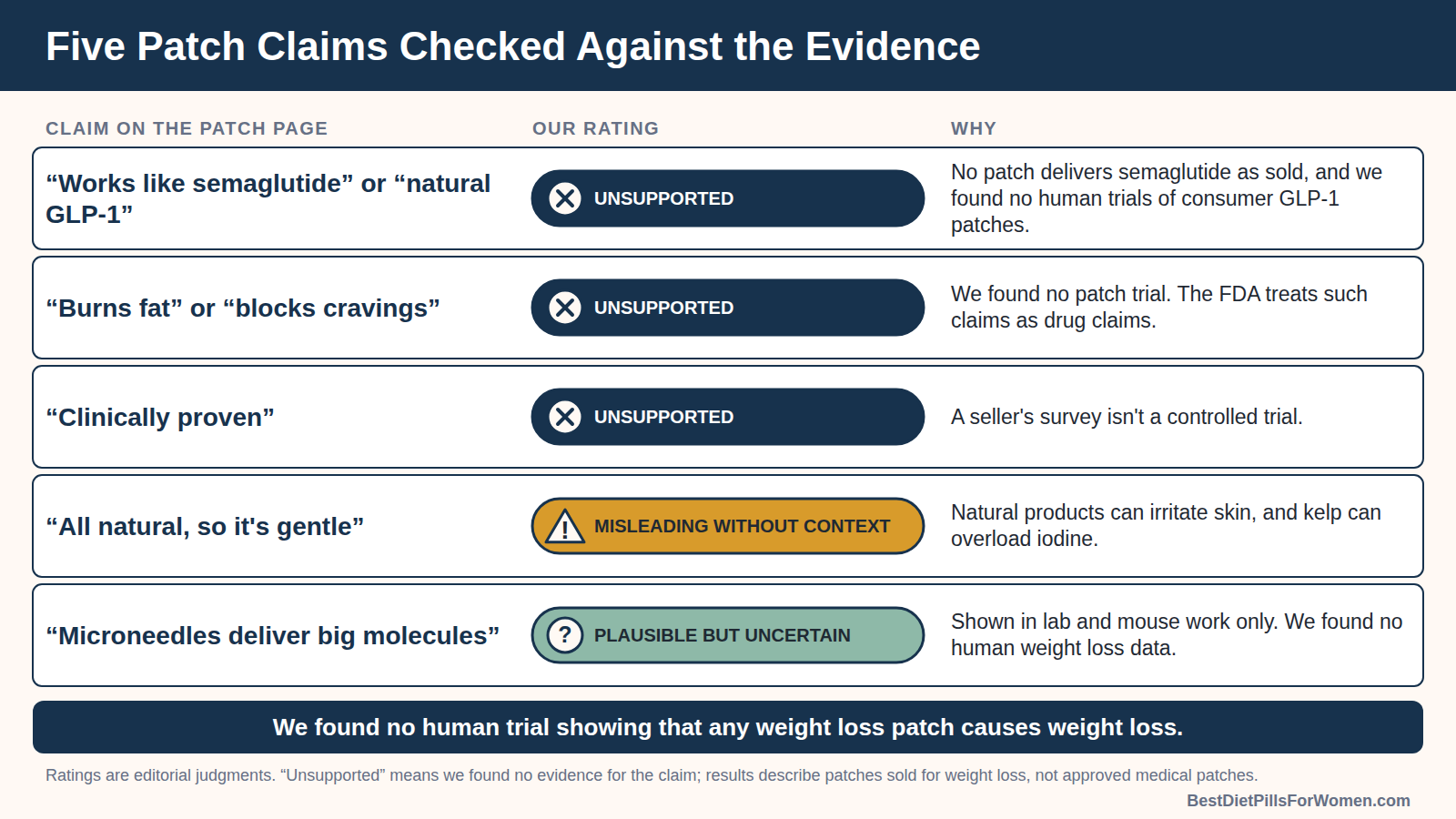
We sorted claims that recur in patch marketing, regulator documents and the 2026 patch review into three groups: unsupported, misleading without context, and plausible but uncertain. Table 7 shows the ratings and the reasons.
| Claim on a patch page | Our rating | Why |
|---|---|---|
| “Works like semaglutide” or “natural GLP-1” | Unsupported | Semaglutide is a 4,113.58-dalton peptide; no patch delivers it as sold, and Drugs.com found no human trials of consumer GLP-1 patches |
| “Burns fat” or “boosts metabolism” while you wear it | Unsupported | No human patch trial; the FDA treats such claims as drug claims |
| “Blocks appetite and cravings” | Unsupported | No patch trial; appetite-suppression claims led to an FDA warning letter in 2018 |
| “Clinically proven” or “98.6% effective” | Unsupported | A seller’s survey isn’t a controlled trial; the FDA’s 2026 letter cited such a survey claim |
| “Lose weight without diet or exercise” | Unsupported | The FTC lists this among claims to distrust |
| “Absorbed better than pills” | Misleading without context | True for some small, low-dose drugs, not shown for these ingredients; lab data for B12 show low passive delivery |
| “All natural, so it’s gentle” | Misleading without context | Natural products can cause skin reactions, and kelp can overload iodine |
| “Thousands of five-star reviews” | Misleading without context | Reviews can’t show that a product works, and researchers who examined patch reviews reported signs of poor efficacy or adverse events |
| “FDA approved” | Unsupported | We found no FDA-approved weight loss patch; the FDA treats patches marketed for weight loss as unapproved drugs, and the FTC alleged in 2004 that an “FDA-approved” kelp claim was false |
| “Microneedles deliver large molecules through skin” | Plausible but uncertain | True in laboratory and animal work; we found no human weight loss data, and the contents of products sold online are unverified |
Table 7 method: ratings are our editorial judgments based on the sources in each row. “Unsupported” means we found no evidence for the claim in the sources we read. “Misleading without context” means the claim is partly true for other products or situations but doesn’t apply to weight loss patches as sold.
Claims That Have No Support
The first group is the easiest. A patch that “works like” a GLP-1 drug, “burns fat,” “blocks cravings” or is “clinically proven” is making claims that, as far as we found, no human trial backs up. Some of them, particularly claims of affecting appetite or fat burning, are exactly the kind of statements that turn a product into an unapproved drug in the FDA’s eyes. The FTC’s consumer advice also lists “lose weight with this patch or cream” among the claims to distrust, alongside promises of weight loss without dieting or exercise, permanent weight loss and dramatic results in a month.
Claims That Are Misleading Without Context
The second group is trickier because each claim contains a grain of truth. Transdermal delivery does work for some drugs, but the ones that work are small, fat-soluble and potent at low doses, and no weight loss patch ingredient has been shown to fit. “Natural” is a marketing word, not a safety guarantee: skin reactions to patches are common, and kelp can deliver more iodine than a thyroid needs. Reviews can be sincere and still tell you nothing about whether a product works, for the reasons covered earlier.
A Checklist Before You Buy Anything Sold as a Diet Product
These questions apply to patches, and to gummies, teas and capsules too. Our planned guides to weight loss gummies and natural appetite suppressants apply the same screen to those products.

Label and Company Checks
Start with the claim itself. If a patch says it helps you lose weight, burn fat or curb appetite, it’s claiming to affect the body, and we found no weight loss patch with FDA approval. Then look for a full ingredient list with amounts per patch, and for a way to see independent testing, such as a certificate of analysis, since missing certificates were a finding of the 2026 patch review. Check that the seller lists a real company name, address and phone number, and search the FDA’s list of tainted weight loss products and its warning letters for the brand.
Listing and Review Checks
Be wary of before-and-after photos, countdown timers, celebrity or “doctor” endorsements with no named doctor, and pre-ticked subscription boxes. Treat a rating average as marketing until you can see individual reviews that describe details, dates and downsides. And read the claim list from the FTC one more time before you click “buy.”
If You’ve Already Used a Patch
Most people who’ve tried a patch have simply wasted money. If you’ve used one, here’s a calm way to handle it.
Stopping, Watching Your Skin and Checking With a Clinician
If you feel fine, you can stop using it. Nothing we found suggests a delayed danger from a short trial in a healthy adult, though the contents are unverified, which limits how much reassurance anyone can offer. Watch the skin where the patch sat, and contact a clinician for a spreading rash, blisters, palpitations, unusual jitteriness or symptoms that could involve your thyroid, such as a racing heart, heat intolerance or unexplained fatigue. Keep the package, the lot number and screenshots of the listing, and bring them to your pharmacist or clinician.
Reporting a Problem and Getting Your Money Back
You can report a reaction or a suspected problem product to the FDA through MedWatch, and supplement-related problems through the FDA’s Safety Reporting Portal. Deceptive marketing can be reported to the FTC at ReportFraud.ftc.gov. If you were billed for a subscription you didn’t intend, contact the seller first and then your card issuer. Reports also help regulators spot patterns; the FDA can’t act on problems it never hears about.
What Works Better Than a Weight Loss Patch
If patches aren’t the answer, what is? The good news is that the options with evidence are better than they were even two years ago, and some no longer require a needle. None of them is easy or universal, and each carries trade-offs, but they’ve been tested in ways that patches haven’t.
Options With Regulator-Reviewed Evidence
Table 8 lines up the main options with evidence next to patches. The results come from different trials, so the comparison is indirect, and none of these numbers is a forecast for any one person.
| Option | Status | Headline trial result | Trial duration and population | Biggest limitation | Cash price snapshot |
|---|---|---|---|---|---|
| Wegovy pill (oral semaglutide) | FDA-approved prescription drug | −13.6% vs −2.2% on placebo | 64 weeks; 307 adults without diabetes (OASIS 4, treatment-policy analysis) | Boxed warning for thyroid C-cell tumors; strict empty-stomach dosing | $149 to $299 a month |
| Foundayo (orforglipron) | FDA-approved prescription drug | −11.1% vs −2.1% on placebo (top label dose) | 72 weeks; 3,127 adults (ATTAIN-1) | Newest pill, little long-term data; boxed warning | $149 to $349 a month |
| Qsymia (phentermine/topiramate) | FDA-approved prescription drug | −7.8% (mid dose) and −9.8% (top dose) vs −1.2% | 56 weeks (CONQUER) | Fetal harm risk; available through a REMS program | $74.99 a month |
| Contrave (naltrexone/bupropion) | FDA-approved prescription drug | −5.4% vs −1.3% | 56 weeks (COR-I) | Boxed warning for suicidal thoughts and behaviors | $99 to $199 a month |
| alli (orlistat 60 mg) | OTC, FDA-approved | About 2.9 kg more than placebo in a 2007 meta-analysis (dose not confirmed as the OTC strength) | Pooled trials; durations vary | Oily stools and urgency; kidney warning added in 2026 | About $1.92 to $2.21 a day |
| Behavioral programs | USPSTF Grade B recommendation for adults with BMI of 30 or more | About one extra person in eight reaches a 5% loss | Mostly 1 to 2 years | Time and effort; results vary | Varies by program |
| Weight loss patches | Not FDA-approved; no human trial found | None found | None | No evidence of benefit; unverified contents | $0.27 to $0.57 per patch |
Table 8 method: results come from different trials with different populations, durations and analysis methods, so rows are indirect comparisons and not a head-to-head test. Prices are manufacturer-program and retailer figures read on September 24, 2026; some are temporary, and the alli per-day range covers a 60-capsule listing at $44.12 (up to $2.21 a day at three capsules) and larger-bottle prices. Patch price per patch is from Table 6.
Prescription Medications
The strongest weight loss results in trials belong to prescription medicines. In OASIS 4, adults without diabetes taking the Wegovy pill lost 13.6% of their body weight on average over 64 weeks, versus 2.2% on placebo, and in ATTAIN-1 the top label dose of Foundayo produced 11.1% versus 2.1% at 72 weeks. Qsymia and Contrave produced smaller averages, roughly 5% to 10%. Those are averages across groups, and some people lose much more and others much less. These medications come with real trade-offs, including boxed warnings, pregnancy restrictions and side effects that need a prescriber’s oversight. Our guide to the best weight loss pills for women covers them in full, and the planned page on prescription versus OTC weight loss pills explains how to think about the categories.
Over-the-Counter Orlistat
The one FDA-approved over-the-counter weight loss drug we identified is alli, orlistat 60 milligrams, which blocks some of the fat you eat from being absorbed. Its effect is modest, with a 2007 meta-analysis putting orlistat about 2.9 kilograms (roughly 6.4 pounds) ahead of placebo, though that analysis didn’t confirm the dose was the OTC strength. Side effects include oily stools and urgency, and in 2026 the FDA approved a label change to warn of kidney stones and kidney injury. It isn’t for use during pregnancy or breastfeeding. If you’re weighing an OTC option, alli has a real label, a real dose and real trial data. That’s more than any patch can say.
Approaches That Don’t Come in a Box
Medication isn’t the only alternative, and for many women it isn’t the first step.
Structured Lifestyle Programs
The U.S. Preventive Services Task Force recommends that clinicians offer or refer adults with a BMI of 30 or higher to intensive, multicomponent behavioral interventions, a Grade B recommendation. Most interventions in its 2018 review lasted one to two years and included at least 12 sessions in the first year. The numbers are humble (about one additional person in eight reached a 5% loss), which is worth knowing before you enroll. They’re also real, delivered by people who can adjust the plan, and they combine well with medication when a clinician recommends both.
Protein, Strength Training and Sleep
Two habits come up repeatedly in guidance for people losing weight: getting enough protein and doing resistance training, both of which help preserve muscle while weight comes off. A May 2025 joint advisory on nutrition for people using GLP-1 medicines recommended 1.2 to 1.6 grams of protein per kilogram of body weight a day during weight reduction (roughly 82 to 109 grams for a 150-pound woman) and resistance training at least three times a week, though anyone with kidney disease should check with a clinician first. Short sleep is associated with higher odds of obesity, though the evidence is largely observational and doesn’t prove that sleeping more causes weight loss. Our planned guides to protein for weight loss and muscle preservation during weight loss cover the practical details.
Women-Specific Situations That Change the Conversation
Women’s bodies change across life stages, and the right question changes with them.
Perimenopause, Menopause and Age
The Study of Women’s Health Across the Nation, which followed 1,246 women for up to 16 years, found that total body weight rose at a similar pace before and during the menopause transition, but fat mass gain nearly doubled during it and lean mass turned from a small gain to a small loss. Those are small changes in absolute terms, and they don’t show that any pill treats menopause-related weight gain specifically. That’s a reason to ask about strength training, protein and sleep, not a reason to buy a patch. Our planned guides to the best weight loss pills for menopause, perimenopause, women over 40 and women over 50 take this up in depth.
PCOS, Pregnancy Plans and Postpartum
Polycystic ovary syndrome, or PCOS, was renamed polyendocrine metabolic ovarian syndrome in a May 2026 Endocrine Society announcement, and most people and most searches still use PCOS. Weight management in PCOS is a medical topic, with its own guideline and its own trade-offs, and our planned guide to the best weight loss pills for PCOS covers the evidence. If you’re pregnant, planning a pregnancy or postpartum and breastfeeding, the safest first step is a conversation with your obstetric clinician, because several prescription weight loss drugs carry pregnancy restrictions and no patch has safety data in pregnancy.
Questions Women Still Ask About Weight Loss Patches
The sections above answer most reader questions in depth. These are the ones that remain, answered briefly, with the detail in the sections you’ve already read.
Questions About How Patches Work
Are GLP-1 Patches Real?
Patches sold as “GLP-1 patches” aren’t GLP-1 drugs. We found no FDA-approved GLP-1 patch, and Drugs.com’s April 2026 review found no human trials of the consumer versions. The “natural GLP-1” products are blends of ingredients such as berberine, glutamine and cinnamon, and semaglutide itself is far too large to cross skin from an ordinary patch.
The only genuine GLP-1 patch research we found is in animals, such as the 2026 mouse study of a custom microneedle patch. That’s a laboratory step, not a product you can buy.
Can a Vitamin B12 Patch Help Me Lose Weight?
There’s no evidence that it can. B12 matters for people who are deficient, but NIH says supplements don’t appear to improve athletic performance or endurance in people who already have enough, and lab studies show that B12 crosses skin poorly without microneedles or an electric current.
If you’re often exhausted, ask a clinician about testing rather than self-treating. Older adults, vegans and vegetarians, people who take metformin, and people who have had weight loss surgery are more likely to be low in B12.
Do Microneedle Weight Loss Patches Work?
Not that we can show. One 2026 microneedle patch delivering two prescription drugs reduced fat and improved metabolic markers in obese mice, but we found no human study of the “nano microneedle” patches sold online. In March 2026 the FDA warned a seller that its patch was an unapproved drug, and the letter described a blend of ingredients such as caffeine and green tea extract and didn’t mention semaglutide.
Questions About Safety and Legality
Are Weight Loss Patches FDA Approved?
No weight loss patch we found has FDA approval. The FDA treats patches marketed to burn fat or suppress appetite as unapproved new drugs, and a patch can’t be sold as a dietary supplement because supplements must be intended for ingestion. Even swallowed supplements don’t get FDA approval before they’re sold.
Are Weight Loss Patches Safe?
We found no safety studies, so nobody can say. Skin irritation is the most predictable problem: 20% to 50% of users of approved patches had redness or itching in one review. Unverified contents are the bigger worry, since we found no independent testing of patches, and kelp raises iodine questions for people with thyroid disease.
Can I Use a Weight Loss Patch With My Medications?
Ask your pharmacist first. If a patch delivers an active ingredient, it can interact with medicines the way a capsule would, and berberine, for example, can interact with the immune-suppressing drug cyclosporine. If it doesn’t deliver anything, it can’t help you. Thyroid disease and thyroid medicines are a specific reason for caution with kelp.
Questions About Buying and Results
Why Do Some People Say Weight Loss Patches Worked for Them?
Usually because of things other than the patch. People who start a new product often eat more carefully, expect results and see normal day-to-day weight swings. Even placebo groups in weight loss trials lose weight (about 2% in the pivotal trials of the two new GLP-1 pills), which is why controlled trials are necessary. That doesn’t mean people are lying. It means a good feeling can’t separate a patch from everything else that changed.
Should I Try a Weight Loss Patch Anyway Because It’s Cheap?
We wouldn’t, and here’s the reasoning. A low price doesn’t reduce the uncertainty about what’s in the patch or whether it does anything, and the yearly cost of a daily patch was roughly $97 to $207 in the listings we checked. If you’re ready to spend on weight management, a visit with a clinician or registered dietitian is likelier to get you something that’s been tested.
The Bottom Line on Weight Loss Patches
Weight loss patches are a good example of a product whose pitch is more persuasive than its evidence. Here’s what the whole picture means, what’s worth taking from it, and what to do next.
What the Total Evidence Means for You
Taken together, the science, the regulators and the products themselves point the same way. The physics of skin delivery favors small, fat-soluble, low-dose drugs, and weight loss patch ingredients don’t fit that profile. We found no human trial that supports weight loss from a patch. The FTC alleged in 2004 that patch weight loss claims were false or unsubstantiated, and the FDA said in 2018 and again in 2026 that patches marketed this way are unapproved drugs. And reviewers of the 2026 “natural GLP-1” market found deception and missing quality documents.
The Biggest Realistic Benefit
The most realistic upside of a weight loss patch is psychological. Some people find that a small daily ritual keeps their goal in mind, and that’s a real human effect. It’s also a benefit you can get from a free habit, such as a daily walk, a weekly weigh-in you choose to do or a reminder on your phone, without paying for a product with unverified contents. The other benefit is a lesson: understanding why patches don’t work makes you harder to fool with the next “GLP-1” product name.
The Biggest Limitation and Safety Concern
The biggest limitation is the missing evidence, and the biggest safety concern is the missing verification. We found no evidence that a weight loss patch delivers its ingredients into the body or changes weight, and no independent confirmation of what’s inside. The most practical harm may be indirect: time and money spent on a product that can’t work while options with evidence go unexplored.
A Rational Next Step
You don’t need a patch to move forward, and you don’t need to figure this out alone.
Questions Worth Bringing to a Clinician
If you’re considering any weight management product, these questions give a clinician something to work with:
- Given my health history and medications, which weight management options with clinical trial evidence fit me?
- Would a prescription medication, an over-the-counter option or a structured program make sense, and what would each cost me?
- Are there conditions, such as thyroid disease or PCOS, that could be contributing to my weight or that change which options are safe?
- Are there any supplements or products I’m already using that I should review with you or my pharmacist?
- How would we judge together whether something is working, and when would we reassess?
What to Re-Check Before You Spend Money
Several facts in this guide have a short shelf life. Before you make a purchase or a decision that depends on them, re-check these:
- Prices and listings: every patch price, pack count and rating in Table 6 was read on September 24, 2026 and changes often, as do the prescription self-pay prices in Table 8, some of which are temporary promotions.
- The seller and the brand: search the FDA’s warning letters and its list of tainted weight loss products for the brand name, and read the seller’s refund and subscription terms.
- New regulator statements: the FDA and FTC may act on “GLP-1” and microneedle patches at any time, and a warning letter after September 24, 2026 wouldn’t be reflected here.
- New research: a search of ClinicalTrials.gov and the medical literature for “transdermal” and “weight loss” would reveal any human trial published after this guide.
- Label and ingredient changes: patch formulas and marketing claims can change without notice, so compare the current label with what you read here.
Sources
These are the main sources behind this guide, chosen because they are the ones to check first for current facts. Regulator pages and retail listings change, so confirm the latest version before you make decisions.
- U.S. Food and Drug Administration. Warning letter to The Health Management Group Inc., MARCS-CMS 547614 (June 6, 2018). https://www.fda.gov/inspections-compliance-enforcement-and-criminal-investigations/warning-letters/health-management-group-inc-547614-06062018
- U.S. Food and Drug Administration. Warning letter to FormPour, MARCS-CMS 722215 (March 31, 2026). https://www.fda.gov/inspections-compliance-enforcement-and-criminal-investigations/warning-letters/formpour-722215-03312026
- Federal Trade Commission. The truth behind weight loss ads (updated December 10, 2025). https://consumer.ftc.gov/articles/truth-behind-weight-loss-ads
- Federal Trade Commission. FTC: skin patches do not cause weight loss (press release, December 15, 2004; complaints against Transdermal Products International Marketing Corp. and SG Institute of Health & Education). https://www.ftc.gov/news-events/news/press-releases/2004/12/ftc-skin-patches-do-not-cause-weight-loss
- White CM, Tai Z, Nuzi K. Transdermal “natural GLP-1” dietary supplements violate law and place patients at risk. Ann Pharmacother. 2026;60(8):813-816. doi:10.1177/10600280251407145 (abstract read via PubMed, PMID 41480958; full text not accessed).
- Prausnitz MR, Langer R. Transdermal drug delivery. Nat Biotechnol. 2008;26(11):1261-1268. doi:10.1038/nbt.1504
- Ale I, Lachapelle JM, Maibach HI. Skin tolerability associated with transdermal drug delivery systems: an overview. Adv Ther. 2009;26:920-935.
- National Institutes of Health, Office of Dietary Supplements. Dietary supplements for weight loss: health professional fact sheet (page modified September 17, 2026). https://ods.od.nih.gov/factsheets/WeightLoss-HealthProfessional/
- National Institutes of Health, Office of Dietary Supplements. Iodine: health professional fact sheet (page dated November 5, 2024). https://ods.od.nih.gov/factsheets/Iodine-HealthProfessional/
- Novo Nordisk. Wegovy (semaglutide) injection and tablets, prescribing information, description and clinical pharmacology sections (molecular weight 4113.58 g/mol; absolute bioavailability 89% subcutaneous and about 1% to 2% for tablets). https://www.novo-pi.com/wegovy.pdf