
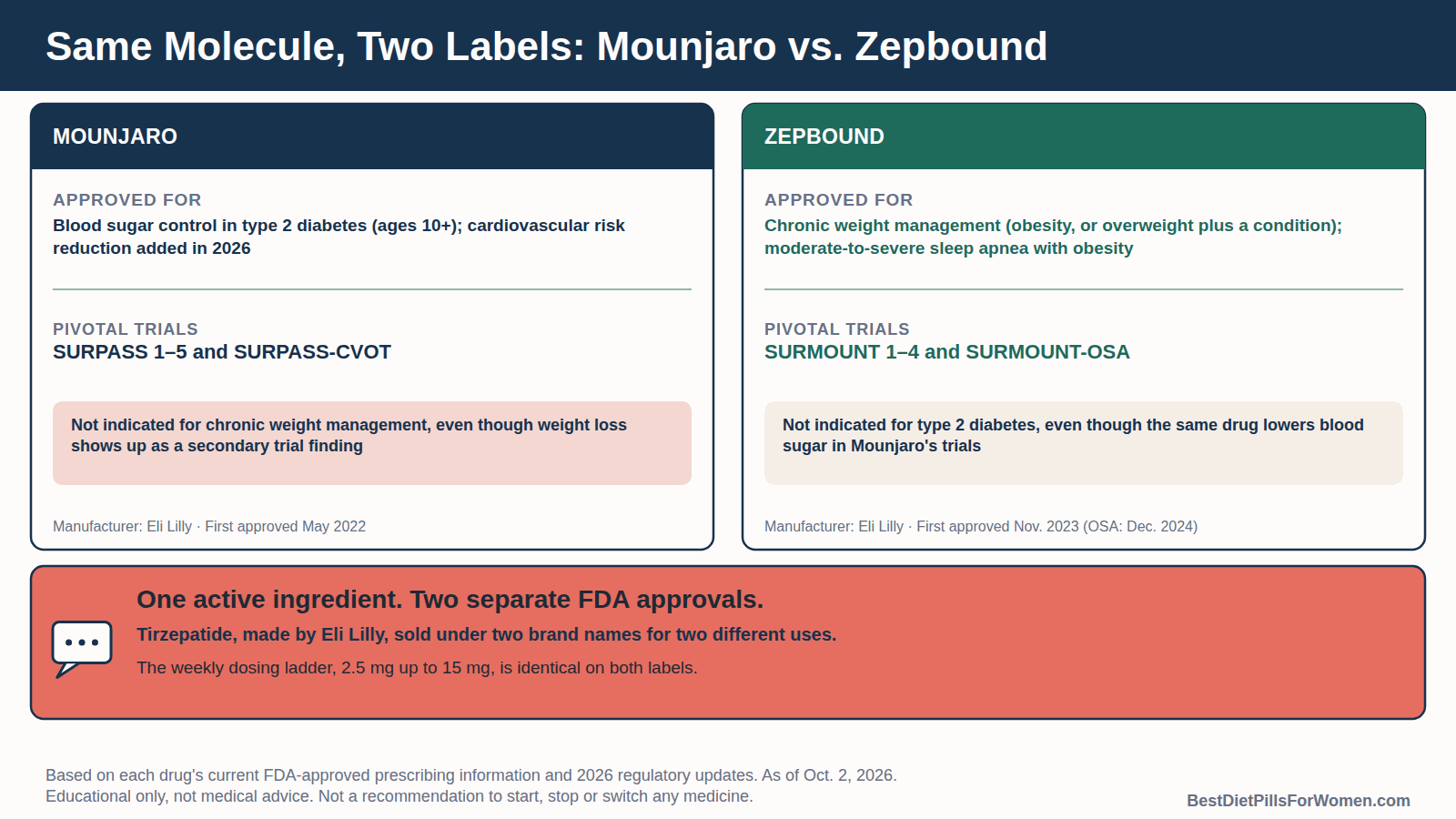
Mounjaro and Zepbound are the same drug, tirzepatide, made by the same company, Eli Lilly, sold under two different brand names for two different FDA-approved uses. Mounjaro is approved to improve blood sugar control in adults and some adolescents with type 2 diabetes, and, as of a 2026 label update, to reduce cardiovascular risk in adults with type 2 diabetes who already have heart disease. Zepbound is approved for chronic weight management in adults with obesity or overweight plus a weight-related condition, and separately for moderate to severe obstructive sleep apnea in adults with obesity.
That single fact, same active ingredient and two separate labels, is the reason this comparison works differently than most “Drug A vs. Drug B” articles on this site. We’re not weighing two different molecules against each other the way we would with, say, semaglutide versus tirzepatide. Mounjaro and Zepbound will behave almost identically in your body at a matched dose, because they are almost identical in the vial. What actually separates them is regulatory: which trials each brand’s FDA approval rests on, which titration and dosing language sits in which label, what each one costs through which channel, and which diagnosis unlocks which insurance coverage.
This guide walks through all of that directly: what each drug’s own pivotal trials actually measured, how the shared boxed warning and side-effect profile plays out in practice, what a prescription for either one actually requires, what each costs in real dollars as of this writing, and the specific, common situation of a clinician prescribing Mounjaro off-label for weight loss instead of Zepbound. Nothing here is personalized medical advice, and nothing in this guide should be read as instructions to start, stop, switch or combine a prescription medication on your own.
Both labels matter to a lot of women reading this site for reasons beyond a single number on a trial chart. Type 2 diabetes and obesity both show up more often around perimenopause and after menopause, and PCOS raises the odds of both conditions years earlier than that; a reader managing any of those overlapping conditions may genuinely have a real, label-appropriate reason to ask about either brand, which is exactly why getting the Mounjaro-versus-Zepbound distinction right, rather than treating them as interchangeable marketing names, actually matters for the conversation you have with your own prescriber.
Mounjaro vs. Zepbound: The Short Answer
Start with the conclusions, then check them against the evidence that backs each one up.
The Direct Answer and Why This Comparison Is Different
Two things are worth separating before anything else: what actually differs between these two products, and why that question isn’t the same kind of question as most drug-comparison articles answer.
What’s Actually Different Between Mounjaro and Zepbound?
The active drug is identical. What differs is the FDA-approved use, the specific dosing language tied to that use, how each is sold and priced, and which diagnosis a prescriber needs to write the prescription in a way insurance will recognize. Mounjaro’s approval rests on diabetes trials that measured blood sugar control (and, most recently, heart-attack-and-stroke risk) as the primary outcomes, with weight loss as a secondary finding. Zepbound’s approval rests on obesity trials that measured body weight as the primary outcome, plus a separate sleep-apnea trial. Both share the same injection schedule, the same starting and maximum doses, and the same boxed warning.
Why This Isn’t a Typical “Drug A vs. Drug B” Comparison
Most comparisons on this site weigh two different compounds, with two different mechanisms and two different bodies of trial evidence, against each other. There’s no version of that question here. Nobody ran a trial of “Mounjaro vs. Zepbound” because that would be a trial of tirzepatide against itself. The honest comparison is between two labels, two sets of trial populations, two access pathways and two price structures built around one molecule. Keep that distinction in mind through the rest of this guide; it changes how you should read every table that follows.
How We Compared Them
A comparison built around a labeling distinction still needs clear, consistent criteria, so we set them out before looking at either brand’s numbers.
The Four Things We Actually Compared
We compared Mounjaro and Zepbound on four dimensions: what each one’s own pivotal trials measured and found, what the shared safety profile looks like in practice, what getting and paying for each one actually requires, and which situations point a reader toward one label over the other. We left out brand loyalty, social media chatter and “which one works better,” because at a matched dose, the honest answer to that last question is that there’s no good reason to expect a difference, since it’s the same drug.
What This Comparison Is and Isn’t
This is a desk-research comparison built from FDA-approved prescribing information, the published pivotal trials behind each approval, Eli Lilly’s own pricing pages, and independent insurance-coverage tracking, not a hands-on test of either product. We didn’t take, inject or personally try either drug, and nothing in this guide describes a personal experience. It’s also not a ranking; there’s no version of this comparison where one brand “wins” on effectiveness, because the effectiveness comes from the molecule, not the label on the box.
The Options at a Glance
Table 1 lines up what actually differs before the rest of this guide unpacks each row.
The Summary Table
| Mounjaro | Zepbound | |
|---|---|---|
| Active ingredient | Tirzepatide | Tirzepatide (same molecule, same manufacturer) |
| Manufacturer | Eli Lilly | Eli Lilly |
| FDA-approved use | Blood sugar control in type 2 diabetes (adults and some adolescents); cardiovascular risk reduction in adults with type 2 diabetes and heart disease, added in 2026 | Chronic weight management in adults with obesity or overweight plus a weight-related condition; moderate to severe obstructive sleep apnea in adults with obesity |
| First approved | May 2022 | November 2023 (weight management); December 2024 (sleep apnea) |
| Dosing ladder | 2.5 mg start, titrate to 5–15 mg weekly | 2.5 mg start, titrate to 5–15 mg weekly (same schedule) |
| Pivotal trial program | SURPASS 1–5 and SURPASS-CVOT | SURMOUNT 1–4 and SURMOUNT-OSA |
| Headline trial result | Up to roughly 2.3% to 2.6% average A1C reduction at the top dose | Up to roughly 22.5% average body weight loss at the top dose over 72 weeks |
| Used for weight loss? | Only off-label; not what its own trials were designed to prove | Yes, this is its on-label purpose |
| Typical path to insurance coverage | Type 2 diabetes diagnosis | Documented obesity/overweight with a qualifying condition, or OSA diagnosis; coverage has been shrinking |
Table 1 method: figures as stated in each drug’s current FDA-approved prescribing information, the pivotal trials, and current regulatory-news coverage of the 2026 label updates, read as of October 2, 2026. Because Mounjaro and Zepbound share one active ingredient, this table compares labels and trial programs, not two different drugs’ effectiveness.
How to Read the Table
Read Table 1 as a map of two regulatory files, not two different medicines. The “headline trial result” row looks dramatic side by side, 2.3% A1C versus 22.5% body weight, but that’s not a head-to-head measurement; it’s two trial programs that measured completely different primary outcomes in completely different populations. The rest of this guide explains what each number actually means, what the shared safety profile looks like, and what each path costs once insurance, savings cards and self-pay pricing all enter the picture.
Same Molecule, Two Labels: What Actually Separates Mounjaro From Zepbound
Understanding why one injection pen says “Mounjaro” and an identical-looking one says “Zepbound” means understanding how FDA’s drug-approval process actually works for a single active ingredient used two different ways.
Two Different New Drug Applications for One Active Ingredient
FDA doesn’t approve a molecule in the abstract. It approves a specific drug, for a specific use, based on a specific set of trials, and a company can file more than one such application for the same compound.
How Mounjaro Got to Market First
Eli Lilly filed tirzepatide’s first New Drug Application for type 2 diabetes, and FDA approved it as Mounjaro in May 2022, based on the SURPASS trial program, five large randomized trials that measured blood sugar control (A1C) as their main outcome. Getting to that approval meant years of earlier laboratory and small-scale human work before the SURPASS trials themselves, which together enrolled thousands of adults with type 2 diabetes across different backgrounds of prior treatment, some already on metformin or insulin, others newly diagnosed, specifically so FDA could evaluate the drug’s effect on blood sugar across a range of real-world diabetes-care scenarios. Weight loss showed up in those same trials as a consistent secondary finding, since tirzepatide affects appetite and energy intake as part of how it works, but the SURPASS trials weren’t designed, powered or run long enough to serve as the primary evidence for a weight-management claim on their own. Mounjaro’s label also now covers adolescents 10 years of age and older with type 2 diabetes, at a lower maximum dose than the adult ceiling.
How Zepbound Followed, Under Its Own Review
Zepbound is tirzepatide’s second New Drug Application, filed specifically for chronic weight management and reviewed against a different trial program, SURMOUNT, in which body weight itself was the primary outcome FDA evaluated. That approval came in November 2023, about a year and a half after Mounjaro, and it required its own full efficacy and safety review even though the drug inside the pen was identical to what Mounjaro already contained. FDA didn’t shortcut that review on the theory that the molecule was already approved under a different name; a weight-management indication needed its own dedicated trial, its own primary endpoint and its own safety analysis in a population that, in SURMOUNT-1, specifically excluded people with diabetes, which is a meaningfully different group than Mounjaro’s own pivotal trials enrolled. A separate sleep-apnea indication followed in December 2024, based on yet another dedicated trial, SURMOUNT-OSA, specifically in people with obesity and moderate to severe obstructive sleep apnea.
What Each Label Actually Says You Can Use It For
The practical difference between these two brands lives almost entirely in this section of each label, the part that states exactly what the drug is indicated for.
Mounjaro’s Approved Uses (and a New One in 2026)
Mounjaro’s FDA-approved indications are glycemic control in type 2 diabetes and, since an August 2026 label expansion, reducing the risk of major cardiovascular events in adults with type 2 diabetes who already have cardiovascular disease. We cover exactly what that second indication does and doesn’t mean later in this guide, because the trial behind it, SURPASS-CVOT, produced a more nuanced result than “approved” might suggest on its own. Nothing in Mounjaro’s label describes chronic weight management as an approved use, even though weight loss is a well-documented effect of the drug.
Zepbound’s Approved Uses, Including Sleep Apnea
Zepbound’s FDA-approved indications are chronic weight management, for adults with obesity or with overweight plus at least one weight-related condition, and moderate to severe obstructive sleep apnea in adults with obesity. Both uses require the drug to be used alongside a reduced-calorie diet and increased physical activity, per the label’s own wording; it’s approved as an adjunct to those changes, not a replacement for them. Zepbound’s label doesn’t cover type 2 diabetes, even though the SURMOUNT trials enrolled some participants who had it and measured blood sugar as a secondary outcome in that subgroup.
Because the same molecule ended up on two different labels through two different regulatory doors, it’s worth seeing that split laid out visually before moving into dosing, results and cost. Infographic 1 below does exactly that.
Dosing and Administration: Nearly Identical, With a Few Real Differences
Because Mounjaro and Zepbound share an active ingredient, it’s not a surprise that they also share almost the entire dosing structure. The differences that do exist are worth knowing before you ever pick up a pen.
The Shared Titration Schedule
Both drugs are dosed on the same weekly schedule, titrated upward on the same timeline, for the same underlying reason: giving the body time to adjust to a GIP/GLP-1 dual agonist before increasing the dose.
Starting Dose, Titration Steps, and Maximum Dose
Both Mounjaro and Zepbound start at 2.5 mg injected once weekly, a dose chosen to help the body adjust rather than to treat anything on its own, and both increase in 2.5 mg steps no sooner than every four weeks, up to a maximum of 15 mg weekly. Maintenance doses for both land at 5 mg, 7.5 mg, 10 mg, 12.5 mg or 15 mg weekly, depending on response and tolerability. Zepbound’s label adds one specific wrinkle for its sleep-apnea indication: that use calls for reaching 10 mg or 15 mg specifically, the two highest maintenance doses, rather than leaving the target dose open-ended the way the weight-management indication does. Mounjaro’s adolescent dosing caps out lower than the adult ceiling.
Why Both Drugs Use the Same Dosing Ladder
The shared titration schedule isn’t a coincidence or a marketing choice; it reflects the same underlying pharmacology and the same strategy for managing the digestive side effects covered later in this guide. Starting low and raising the dose slowly gives the digestive system time to adjust to how tirzepatide slows stomach emptying, and jumping to a higher dose too quickly is one of the more common, avoidable reasons someone experiences worse nausea or vomiting than the trials would predict. Lilly didn’t need to run separate dose-finding studies for Zepbound from scratch, since tirzepatide’s dose-response relationship was already established through the SURPASS program; the SURMOUNT trials largely reused that same ladder and tested it against a different primary outcome. That’s part of why the two labels read as closely related documents rather than two unrelated drugs that happen to share a dosing coincidence. Both labels give the same missed-dose instruction, too: take the dose as soon as possible within 4 days (96 hours) of the missed day, or skip it entirely and resume the normal weekly schedule on the next scheduled day if more than 4 days have passed. Neither label recommends doubling up on a dose to make up for a missed one.
Where the Delivery Options Diverge
The injection schedule is identical. How the drug actually gets packaged and delivered to your refrigerator is where the two brands have started to pull apart.
Pens, Vials, and the New Monthly KwikPen
Both drugs are available as single-dose prefilled pens and as single-dose vials, but Zepbound added something Mounjaro doesn’t appear to have yet: a four-dose KwikPen, approved in February 2026, that holds an entire month of weekly doses in one device. That’s a meaningful convenience difference for someone managing a weekly injection routine for months or years, since it means fewer individual pens to store, track and dispose of. We found no equivalent multi-dose monthly pen for Mounjaro in the sources we reviewed; if Lilly extends that option to the diabetes brand, it would likely follow a similar regulatory path.
What This Means for a Weekly Injection Routine
Whichever device you use, a vial requires drawing up the dose with a syringe, which means an extra step and a slightly steeper learning curve than a prefilled pen, but vials are sometimes priced lower through self-pay channels, a trade-off covered in the Cost section later in this guide. Needles and, for vials, syringes are typically sold separately from the drug itself for both brands, an added cost that’s easy to forget when comparing the sticker price of the medication alone. Table 2 lines up the dosing details side by side.
| Detail | Mounjaro | Zepbound |
|---|---|---|
| Starting dose | 2.5 mg weekly | 2.5 mg weekly |
| Titration step | +2.5 mg, no sooner than every 4 weeks | +2.5 mg, no sooner than every 4 weeks |
| Maintenance doses | 5, 7.5, 10, 12.5 or 15 mg weekly | 5, 7.5, 10, 12.5 or 15 mg weekly |
| Dose required for a specific indication | None specified beyond general titration | 10 mg or 15 mg specifically required for the sleep-apnea indication |
| Pediatric dosing | Yes, ages 10–17 with type 2 diabetes, lower maximum | Not applicable; no pediatric indication |
| Delivery formats | Single-dose prefilled pen; single-dose vial | Single-dose prefilled pen; single-dose vial; 4-dose monthly KwikPen (added 2026) |
| Administration | Subcutaneous injection, once weekly, any time of day, with or without food | Subcutaneous injection, once weekly, any time of day, with or without food |
Table 2 method: figures as stated in each drug’s current FDA-approved prescribing information, read as of October 2, 2026.
How Much Weight Loss Each One Actually Produces
This is the section where the “same drug” framing matters most, because the two brands’ own trials measured weight loss very differently, and neither one directly answers the question “which brand produces more weight loss,” since the molecule is identical.
Zepbound’s Own Weight-Loss Trials
Zepbound’s approval rests on a trial program built specifically to measure body weight, which is exactly why its numbers look so much bigger than anything in Mounjaro’s label.
SURMOUNT-1: The Headline Numbers
In SURMOUNT-1, 2,539 adults with obesity or overweight (without diabetes) lost an average of up to 22.5% of body weight at the highest dose over 72 weeks, compared with about 2.4% on placebo; at the 15 mg dose specifically, participants lost an average of 48 pounds, and a third of people on that dose lost at least a quarter of their body weight. Those are large, randomized, placebo-controlled numbers from thousands of participants, the kind of evidence base that supports a chronic weight management indication on its own. Averages hide range, though: individual results varied widely around that mean, and a smaller share of participants saw far more modest effects even at the highest dose.
SURMOUNT-2: Weight Loss in People Who Also Have Type 2 Diabetes
SURMOUNT-2 tested the same drug in adults who had both obesity or overweight and type 2 diabetes, and found a smaller, though still substantial, average weight loss of up to about 15.7% of body weight, reflecting a pattern seen across GLP-1-class medications, in which weight loss tends to run somewhat smaller in people who also have diabetes. That trial matters for this specific comparison because it’s the closest thing to a bridge between the two brands’ populations: it’s a Zepbound-style weight-focused trial, run in the same kind of patient Mounjaro is actually approved for. The gap between SURMOUNT-1’s roughly 22.5% and SURMOUNT-2’s roughly 15.7% is a real, clinically recognized difference tied to the diabetes diagnosis itself, not a difference in the drug.
What Mounjaro’s Own Trials Show About Weight
Mounjaro’s label doesn’t make a weight-management claim, but its own trials still measured weight as a secondary outcome, and those numbers are worth seeing directly rather than assumed.
SURPASS-2: A1C and Weight Together
In SURPASS-2, a 40-week, head-to-head trial of 1,879 adults with type 2 diabetes, the 15 mg dose of tirzepatide produced an average weight loss of about 11.2 kg (roughly 25 pounds), alongside an A1C reduction of about 2.3 percentage points, both significantly larger than the comparator, semaglutide 1 mg, which produced about 5.7 kg of weight loss and a 1.86-point A1C reduction over the same period. That’s a meaningful weight-loss number in its own right, and it’s evidence that the mechanism behind Mounjaro’s effect on blood sugar and the mechanism behind Zepbound’s effect on body weight are the same mechanism, just measured in different trials with different primary goals.
Why Mounjaro’s Trials Weren’t Designed to Prove Weight-Loss Claims
The SURPASS trials enrolled people specifically because they had type 2 diabetes, measured A1C as the primary endpoint everywhere, and ran for shorter durations than the SURMOUNT weight trials in several cases. That combination means SURPASS data can tell you tirzepatide reliably produces weight loss in people with diabetes, but it can’t stand in for a dedicated weight-management trial the way SURMOUNT-1 can, which is exactly why FDA required Lilly to run SURMOUNT separately before approving Zepbound, rather than simply extending Mounjaro’s existing SURPASS evidence to a new indication.
What Happens Before Treatment Starts, and After It Stops
Two more trials in Zepbound’s own SURMOUNT program answer a different, arguably more practical question than “how much weight comes off”: what happens at the edges of treatment, before someone starts and after someone stops.
SURMOUNT-3: Starting With a Lifestyle Lead-In
SURMOUNT-3 enrolled 806 adults in a 12-week intensive lifestyle-intervention program first, diet and exercise alone, and only randomized the 579 who’d already lost at least 5% of their body weight that way into a tirzepatide-or-placebo comparison for the next 72 weeks. People who continued on tirzepatide lost an additional 21.1% of body weight on top of their lifestyle-phase loss, versus a 3.3% average regain on placebo, for a total loss of about 26.6% from where they started the lifestyle program. That design matters because it tests a scenario a lot of readers actually live through: trying diet and exercise first, succeeding to some degree, and then wondering whether a medication can help hold or extend that result rather than watching it slide back.
SURMOUNT-4: What Happens If You Stop
SURMOUNT-4 gave 783 adults open-label tirzepatide for 36 weeks, during which they lost an average of 21.1% of body weight, then randomized 670 of them to either keep taking tirzepatide or switch to placebo for another 52 weeks. The group that kept taking the drug lost an additional 6.7% on top of their lead-in loss; the group switched to placebo regained an average of 14.8% of body weight over that same year. That’s the single most important practical finding in this entire guide for anyone weighing whether to start: in this trial, stopping tirzepatide led to substantial weight regain within about a year, which is consistent with how most chronic-disease medications behave and is exactly why both labels describe these drugs as treatments for an ongoing condition, not a fixed course with a defined end date. Neither trial tells you what happens if you stop after five years instead of one, or what happens with a slower taper instead of an abrupt switch to placebo; those are reasonable follow-up questions for a prescriber, not something either trial answered. Table 3 puts the trial-level numbers for all four Zepbound trials and Mounjaro’s own SURPASS-2 side by side.
| Trial | Brand/population | Design | Average weight result | Comparator result |
|---|---|---|---|---|
| SURMOUNT-1 | Zepbound; obesity/overweight, no diabetes | Randomized, 72 weeks, 2,539 adults | Up to 22.5% of body weight (15 mg) | About 2.4% (placebo) |
| SURMOUNT-2 | Zepbound; obesity/overweight with type 2 diabetes | Randomized, 72 weeks | Up to about 15.7% of body weight | Placebo arm, smaller loss |
| SURMOUNT-3 | Zepbound; 12-week lifestyle lead-in, then obesity/overweight | Randomized, 72 weeks after lead-in, 579 adults | Additional 21.1% from randomization (26.6% total from study entry) | 3.3% average regain (placebo) |
| SURMOUNT-4 | Zepbound; 36-week open-label lead-in, then withdrawal design | Randomized, 52 weeks after lead-in, 670 adults | Additional 6.7% if continued (26.0% total from study entry) | 14.8% average regain if switched to placebo |
| SURPASS-2 | Mounjaro; type 2 diabetes | Randomized head-to-head, 40 weeks, 1,879 adults | About 11.2 kg (~25 lb) at 15 mg | About 5.7 kg on semaglutide 1 mg |
Table 3 method: figures as reported in each trial’s results, read through the trial publications and Eli Lilly’s own trial summaries as of October 2, 2026. These are five separate trials with different populations, designs, durations and primary outcomes; none of them directly compares the Mounjaro brand against the Zepbound brand, since both deliver the same active ingredient.
Blood Sugar Control: Where Mounjaro Has the Evidence Zepbound Doesn’t
Flip the comparison around, and Mounjaro has a body of evidence Zepbound’s own label doesn’t claim: a trial program specifically built to measure blood sugar control in people with type 2 diabetes.
A1C Results From the SURPASS Program
Five separate SURPASS trials, run in somewhat different diabetes populations and against different comparators, make up the evidence behind Mounjaro’s glycemic-control indication.
How Much A1C Drops, and How Fast
Across the SURPASS program, tirzepatide’s highest dose typically reduced A1C by roughly 2 to 2.6 percentage points, a large effect by the standards of type 2 diabetes drug trials, measured over trial periods generally running 40 weeks or longer. A1C is a blood test that reflects average blood sugar over the prior two to three months, and a reduction of that size is large enough to move many patients from poorly controlled diabetes into a well-controlled range, though exactly where any individual lands depends on their starting point and the rest of their treatment plan. Nothing in this guide should be read as a reason to adjust a diabetes medication regimen without your prescriber’s involvement.
Head-to-Head Against Older Diabetes Drugs
SURPASS-2 is the trial most directly relevant to this comparison because it tested tirzepatide against semaglutide (sold for diabetes as Ozempic), another injectable in the same broader drug class, rather than against a placebo or an older oral medication. Other SURPASS trials compared tirzepatide against insulin degludec and against placebo added to existing diabetes therapy, each measuring the same core outcome, A1C, in a slightly different clinical scenario; together, they cover people newly diagnosed, people already on metformin, and people already on insulin, which is a far broader set of starting points than any single trial could establish on its own. That breadth of comparison, across different backgrounds of prior treatment, is specifically what supports Mounjaro’s diabetes indication and isn’t duplicated anywhere in Zepbound’s own trial program, since Zepbound was never required to prove itself against an active diabetes comparator the way a diabetes-indicated drug has to.
Why Zepbound Isn’t a Diabetes Drug, Even Though It’s the Same Molecule
It would be a reasonable question to ask why, if the drug lowers blood sugar this reliably, Zepbound doesn’t also carry a diabetes indication. The answer is entirely about what its trials were built to measure.
What Zepbound’s Trials Didn’t Measure
The SURMOUNT trials enrolled people mostly without diabetes (SURMOUNT-1) or specifically with it as a defined subgroup (SURMOUNT-2), but neither trial was designed with A1C as its primary endpoint, and SURMOUNT-1 specifically excluded people with type 2 diabetes from its main analysis population. A drug’s FDA label reflects what its trials actually set out to prove, not everything the drug plausibly does; that’s a deliberate, conservative standard, not an oversight.
Why a Diagnosis Still Points Toward Mounjaro
If blood sugar control is the primary clinical goal, Mounjaro is the brand with an FDA-reviewed trial program built around that outcome, and it’s also the brand most insurance plans are structured to cover for a type 2 diabetes diagnosis. Zepbound could plausibly lower blood sugar about as much, since it’s the same drug, but prescribing it off-label for diabetes instead of using the brand actually approved and, in most cases, covered for that purpose would be an unusual and likely more expensive choice with no clinical upside, which helps explain why this kind of off-label use essentially doesn’t happen in practice, unlike the much more common reverse situation covered later in this guide.
The New Cardiovascular Data: What SURPASS-CVOT Actually Found
Mounjaro’s August 2026 label update is new enough, and nuanced enough, that it deserves its own section rather than a single line in the indications summary above.
What the Trial Tested
SURPASS-CVOT set out to answer a specific, carefully framed question about heart risk in people who already had both type 2 diabetes and cardiovascular disease.
The Trial Design and Population
SURPASS-CVOT enrolled 13,299 adults with type 2 diabetes and established atherosclerotic cardiovascular disease across 640 sites in 30 countries, randomizing them to tirzepatide (titrated up to 15 mg or the maximum tolerated dose) or dulaglutide 1.5 mg, another injectable diabetes drug with its own documented cardiovascular benefit, rather than to a placebo. That’s an important design detail: this was a head-to-head trial against an active comparator already linked to heart benefits, not a placebo-controlled trial, and the study was built to test whether tirzepatide was at least as good as dulaglutide at preventing major cardiovascular events, not whether it was definitively better.
The Result, Stated Carefully
Over a median follow-up of about four years, major cardiovascular events occurred in 12.2% of the tirzepatide group versus 13.1% of the dulaglutide group, an 8% lower relative rate that did not reach statistical significance. FDA’s approval of the new label language rests on tirzepatide meeting its pre-specified noninferiority goal against dulaglutide, meaning the trial showed tirzepatide didn’t perform meaningfully worse, not that it was proven to perform better. That’s a genuinely different, more cautious kind of result than semaglutide’s own cardiovascular-outcomes trial, which compared the drug directly against a placebo and reported a statistically significant reduction in cardiovascular events.
What This Means in Practice
A label update is a real regulatory event, but it’s worth being precise about what it does and doesn’t tell a reader weighing these two brands.
Why “Approved” Doesn’t Mean “Proven Superior”
We’d describe SURPASS-CVOT’s finding as reassuring rather than as proof of a cardiovascular advantage: tirzepatide held its own against an already cardiovascular-friendly comparator in a high-risk population, but the trial didn’t show tirzepatide was statistically better than dulaglutide at preventing heart attacks, strokes or cardiovascular death. Marketing language that treats this update as equivalent to a placebo-controlled superiority finding would be overstating what the trial actually demonstrated, and we’d flag that kind of claim as misleading without more context if you encounter it.
Who This New Label Language Actually Applies To
This specific label update applies to Mounjaro, in people with type 2 diabetes who also have established cardiovascular disease, not to Zepbound, and not to tirzepatide use in people without diabetes. Since Zepbound’s own label doesn’t cover diabetes, this new cardiovascular language has no direct bearing on someone taking Zepbound for weight management or sleep apnea, even though it’s the identical molecule; a label claim only applies to the population and use the underlying trial actually studied.
Safety and Side Effects: Nearly Identical, Because It’s the Same Drug
If there’s one section where the “same molecule” framing should give you real confidence about what to expect, it’s this one. Side effects track the drug, not the brand name on the box.
The Shared Boxed Warning
Both labels carry FDA’s most serious warning category, word for word describing the same underlying concern, because the underlying concern comes from the molecule itself.
Thyroid C-Cell Tumors and Who Should Avoid Both Drugs
Both Mounjaro and Zepbound carry an FDA boxed warning stating that tirzepatide causes thyroid C-cell tumors in rats at clinically relevant exposures, that the relevance of this finding to humans hasn’t been determined, and that both drugs are contraindicated in anyone with a personal or family history of medullary thyroid carcinoma or Multiple Endocrine Neoplasia syndrome type 2. This isn’t a difference between the brands to weigh; it’s a shared, absolute contraindication that applies identically regardless of which label is on the pen. Anyone with that personal or family history should discuss alternatives with a prescriber rather than starting either drug.
Other Shared Contraindications and Warnings
Beyond the boxed warning, both labels describe the same other serious risks tied to this drug class: pancreatitis, gallbladder problems, severe gastrointestinal disease, and a risk of low blood sugar when either drug is combined with insulin or a sulfonylurea, a combination more directly relevant to Mounjaro’s diabetes population than to most Zepbound users. Both labels also note a hypersensitivity contraindication for anyone with a known serious allergic reaction to tirzepatide or its inactive ingredients. None of this differs by brand, which is the clearest practical proof that these warnings exist because of the molecule, not the marketing. A reaction to either drug can be reported to FDA through its MedWatch program, by phone or online, whether or not you also tell your prescriber.
Digestive Side Effects, Trial by Trial
The single most common complaint with either brand is gastrointestinal, and the trial-reported rates are close enough between the two brands’ own programs to treat as one shared side-effect profile.
Nausea, Vomiting, Diarrhea, and Constipation Rates
In SURMOUNT-1 and SURMOUNT-2, nausea occurred in roughly 20% to 33% of Zepbound users depending on dose and trial, versus about 6% to 10% on placebo; diarrhea ran about 19% to 23% versus 7% to 9% on placebo; vomiting ran about 8% to 13% versus 2% to 3% on placebo; and constipation ran about 8% to 17% versus 4% to 6% on placebo. In pooled Mounjaro trials, nausea specifically ran about 12% at the 5 mg dose, 15% at 10 mg and 18% at the 15 mg dose, versus about 4% on placebo, broadly the same pattern and a similar order of magnitude as Zepbound’s own numbers. Lilly’s own clinical materials note that most of these digestive symptoms cluster during the dose-escalation period and tend to ease over time.
Why the Numbers Aren’t Perfectly Comparable
These percentages come from different trials, with different follow-up periods, different populations (people with diabetes versus people with obesity alone) and, in some cases, different reporting windows, so a side-by-side read is useful for getting a general sense of frequency, not for claiming one brand causes meaningfully more or less nausea than the other. The honest summary is that both brands produce the same class of digestive side effects, at broadly similar rates, because they deliver the same drug; any difference you notice personally is far more likely to reflect your own dose, titration pace and tolerance than anything brand-specific. Table 4 lines up the available numbers.
| Side effect | Zepbound (SURMOUNT-1/2 range) | Zepbound placebo | Mounjaro (pooled SURPASS) | Mounjaro placebo |
|---|---|---|---|---|
| Nausea | 20%–33% | 6%–10% | 12%–18% (by dose) | About 4% |
| Diarrhea | 19%–23% | 7%–9% | Not reported in the sources we reviewed | — |
| Vomiting | 8%–13% | 2%–3% | Not reported in the sources we reviewed | — |
| Constipation | 8%–17% | 4%–6% | Not reported in the sources we reviewed | — |
Table 4 method: figures as reported in Eli Lilly’s own clinical-data summaries of the SURMOUNT and SURPASS trial programs, read as of October 2, 2026. Rows come from different trials with different populations and durations, so this is a directional comparison, not a head-to-head measurement; rows marked “not reported in the sources we reviewed” reflect a gap in the specific pages we could access, not necessarily an absence of the data in Mounjaro’s full prescribing information.
Pregnancy, Breastfeeding, and Other Interactions Worth Flagging
Beyond the boxed warning and digestive side effects, two more safety topics come up often enough for either brand that they deserve direct answers rather than a passing mention.
Pregnancy, Contraception, and Breastfeeding
Neither drug has been well studied in human pregnancy or breastfeeding, and both labels specifically address how tirzepatide can interact with oral hormonal birth control, because the drug’s effect on digestion, slowing how quickly the stomach empties, can reduce how reliably an oral contraceptive pill is absorbed. For the first four weeks after starting either drug, and again for four weeks after every dose increase, the labeling calls for switching to a non-oral birth control method or adding a barrier method like condoms on top of the pill, specifically because that absorption effect is strongest right after a dose change and eases over time. Animal studies showed some birth-defect signals at doses relevant to human exposure, though whether that translates to human risk isn’t established, and uncontrolled diabetes itself is independently linked to pregnancy complications, which is part of why this is a conversation to have with a prescriber well before trying to conceive rather than after a positive test. Tirzepatide takes roughly a month to clear the body on average, and neither label specifies an exact number of weeks to stop before a planned pregnancy; that timing is a question for your own clinician. Breastfeeding data is similarly limited, and the practical guidance from both manufacturer materials and independent reproductive-health resources is to discuss feeding plans with a prescriber rather than assume either way.
Other Drug Interactions Worth Flagging
The same delayed-gastric-emptying effect behind the contraceptive interaction can, in principle, affect how quickly any oral medication is absorbed, which is why both labels advise monitoring when tirzepatide is started alongside a drug where absorption speed or a narrow therapeutic window matters, such as certain blood thinners. That’s a reason to bring a full, current medication list, prescription and over-the-counter, to any conversation about starting either drug, not a reason to assume a specific interaction applies to you without checking. Combining either brand with insulin or a sulfonylurea specifically raises the risk of hypoglycemia, low blood sugar, which is why a prescriber will often lower the dose of those other medications before or while starting tirzepatide; symptoms like shakiness, sweating, confusion or a fast heartbeat deserve prompt attention and, for anyone on one of those combinations, it’s worth knowing in advance what your prescriber wants you to do if they occur.
Getting Either One: Diagnosis, Insurance, and the Off-Label Question
Evidence and safety explain what to expect from the drug itself. This section covers what actually happens at the pharmacy counter and the insurance portal, and it’s where the two brands diverge the most in practice.
Getting a Mounjaro Prescription
A Mounjaro prescription is built around a type 2 diabetes diagnosis, and that diagnosis is doing more work than it might seem, both clinically and financially.
Who Qualifies on the Label
Mounjaro’s label is written for adults, and adolescents 10 and older, with type 2 diabetes who need additional help with blood sugar control, typically alongside diet, exercise and, often, other diabetes medications. A prescriber confirms the diabetes diagnosis, reviews other medications for interaction risk (particularly insulin and sulfonylureas, because of the low-blood-sugar risk noted above), and screens for the boxed-warning contraindications before writing the prescription. For a diagnosed diabetes patient, this is usually a straightforward addition to an existing care plan rather than a new, separate process.
What Happens When Mounjaro Is Prescribed for Weight Loss Anyway
Prescribing Mounjaro to someone without type 2 diabetes, specifically for weight loss, is legal, common, and entirely off-label, meaning it falls outside what Mounjaro’s own trials and FDA review specifically evaluated. It also creates a real practical problem at the pharmacy: insurance claims are built around diagnosis codes, and a weight-loss-only diagnosis attached to a drug coded for diabetes treatment can trigger a coverage denial, a prior-authorization demand, or, pharmacy benefit managers have warned, an audit risk if a diagnosis code doesn’t match the clinical picture. This is sometimes attempted specifically because insurance is more likely to cover a diabetes-coded drug than a weight-loss-coded one, but it isn’t a reliable workaround, and a pharmacist or insurer can reasonably decline to fill or cover a claim that doesn’t match the prescribed indication.
Getting a Zepbound Prescription
Zepbound’s path starts with a weight or sleep-apnea diagnosis instead, and that path has gotten measurably harder over the past two years, not easier.
Who Qualifies on the Label
Zepbound’s label is written for adults with a BMI of 30 or higher, or 27 or higher with a weight-related condition such as high blood pressure, high cholesterol or type 2 diabetes, for the weight-management indication, or for adults with obesity and a diagnosis of moderate to severe obstructive sleep apnea for that separate indication. A prescriber documents the qualifying BMI and condition, reviews the same contraindications and interaction risks covered in the Safety section, and, for most insured patients, submits a prior-authorization request before the first fill.
Insurance Coverage Has Been Shrinking, Not Growing
Independent tracking of commercial insurance plans found that the share of plans offering no coverage at all for Zepbound rose from 51% in 2025 to 60% in 2026, while unrestricted coverage (no prior authorization or step therapy) fell to just 4% of plans; more than 114 million people now have no coverage for Zepbound through their plan, an increase of roughly 17 million people in a single year. Mounjaro fared somewhat better in the same tracking, since diabetes coverage policy is generally more established, but even there, 78% of plans applied some kind of restriction. Some large employer plans and pharmacy benefit managers have also actively dropped weight-management GLP-1 coverage during this period, while others have reversed course and added it back, which makes “does my plan cover this” a question that genuinely needs to be checked plan by plan rather than assumed from last year’s policy. Table 5 summarizes the trend.
| Coverage category | Zepbound, 2025 | Zepbound, 2026 | Mounjaro/Ozempic (diabetes use), 2026 |
|---|---|---|---|
| Unrestricted coverage | 5% of plans | 4% of plans | Generally more available, but not unrestricted |
| Restricted coverage (prior auth, step therapy, etc.) | 45% of plans | 37% of plans | 78%–89% of plans apply restrictions |
| No coverage at all | 51% of plans | 60% of plans | A minority, but not zero |
| People with no coverage | — | Over 114 million | Smaller, but increasing |
Table 5 method: figures as published in independent commercial-insurance coverage tracking current through July 2026, read as of October 2, 2026. This tracks plan design, not whether any specific person’s claim is approved; an individual plan’s actual coverage can differ from these aggregate figures, and policies continue to change throughout 2026.
Compounded Tirzepatide and Switching Between the Brands
Two practical questions come up constantly around this specific drug, both worth answering directly rather than leaving implied.
What Happened to Compounded Tirzepatide
During a nationwide tirzepatide shortage that ran from 2022 into late 2024, FDA allowed specialty (503A and 503B) pharmacies to compound versions of the drug; once FDA determined the shortage was resolved in December 2024, a determination a federal court later upheld against a legal challenge, that broad compounding allowance largely ended. Compounded tirzepatide hasn’t disappeared entirely, since narrow, patient-specific compounding still has a legal basis in some circumstances, but the mass-production compounding that filled gaps during the shortage is, by design, no longer the routine option it was in 2023 and early 2024. If you’re offered a compounded version of either drug now, that’s a reasonable prompt to ask specifically why, given that both brand-name products are currently available.
Can a Prescriber Switch You From One Brand to the Other?
A prescriber can switch a patient between Mounjaro and Zepbound, since the active drug and dosing ladder are identical, but the switch itself doesn’t change anything about your insurance coverage, which still depends on the diagnosis code attached to whichever brand is prescribed. Moving from Mounjaro to Zepbound, or the reverse, usually means restarting the insurance conversation from scratch rather than carrying over whatever authorization applied to the first brand, since each one is reviewed under its own coverage policy. Nothing in this guide is a recommendation to request a switch; that’s a conversation for you and your prescriber based on your actual diagnosis and goals.
What Each One Costs in 2026
Cost is the area where these two “identical” drugs diverge the most sharply in practice, almost entirely because of how each one is priced and discounted rather than anything about the drug itself.
List Price Versus What People Actually Pay
The sticker price on either drug bears almost no resemblance to what most people actually pay, which makes this section less about one number and more about which discount path applies to you.
Mounjaro’s Price Without Insurance or a Savings Card
Mounjaro’s list price runs roughly $1,069 to $1,112 for a 28-day supply, depending on when the figure was checked, since Lilly has raised list pricing incrementally; that price applies the same way across every dose strength. Lilly’s own savings card can bring that down to as little as $25 a month for commercially insured patients whose plan covers Mounjaro for an FDA-approved use, or to roughly $499 to $600-plus a month for commercially insured patients whose plan specifically denies coverage; neither savings-card tier is available to someone with no insurance at all, due to federal anti-kickback restrictions on cash-pay discount cards for government-adjacent situations. Eli Lilly’s own LillyDirect page separately lists Mounjaro available through its self-pay channel starting around $499 a month, though we found conflicting reports earlier in 2026 about whether that self-pay option was fully live yet; confirm current availability directly on LillyDirect before assuming either figure applies.
Zepbound’s Self-Pay Vial and Pen Pricing
Zepbound’s self-pay pricing through LillyDirect starts at $299 a month for the 2.5 mg starting dose, rising with the titration schedule to roughly $399 at 5 mg and into the $449 to $699 range at the higher maintenance doses, with the lower end of that higher-dose range available specifically to patients who refill within 45 days under Lilly’s “Journey Program.” That’s the vial and pen price for the drug alone; needles, syringes (for vials) and any associated telehealth or clinician fees are separate. Zepbound has no equivalent to Mounjaro’s insurance-tied savings card in the same form, since self-pay and insured-pricing paths are structured differently for the two brands.
The Savings Programs, Compared
Lilly runs genuinely different discount programs for these two brands, reflecting their different regulatory and insurance realities, and the differences are worth understanding rather than assuming they work the same way.
Mounjaro’s Savings Card Tiers
Mounjaro’s savings card is explicitly built around insurance status: it rewards patients who have commercial coverage, even partial coverage, far more than patients who don’t, which makes sense given that the card exists to lower a copay, not to replace insurance altogether. That structure means the uninsured and those on government coverage (Medicaid, Medicare) are the two groups least able to use it, which is a meaningful access gap for exactly the population that might most need a lower price.
Zepbound’s Self-Pay Program and Why Prices Keep Changing
Lilly has changed Zepbound’s self-pay pricing structure at least three times since late 2024: an initial single-dose-vial launch, a flat-pricing update announced in June 2025 that capped the highest doses at $499 a month, and further adjustments into 2026 tied to the new monthly KwikPen. That pattern of repeated changes is itself useful context: it means any specific dollar figure in this guide, or anywhere else, has a real chance of being out of date by the time you read it, and the only way to get a current number is to check LillyDirect directly on the day you’re pricing this out. Table 6 pulls together the clearest current figures we could verify, with that caveat built in.
| Path | Mounjaro | Zepbound |
|---|---|---|
| List price, no insurance, no card | About $1,069–$1,112/month (28-day supply, any dose) | Comparable list pricing; self-pay and savings programs are the realistic path for most uninsured patients |
| Lilly savings card, insured with coverage | As little as $25/month | Not offered in the same insured-copay-card format |
| Lilly savings card, insured without coverage | Roughly $499–$600+/month | Not applicable in the same form |
| LillyDirect self-pay, starting dose | Starting around $499/month per Lilly’s page (availability unconfirmed in some 2026 reporting) | $299/month (2.5 mg) |
| LillyDirect self-pay, top maintenance doses | Not confirmed as a distinct published tier | $449–$699/month depending on dose and refill timing |
| Uninsured/no government coverage | Largely list price; limited discount access | Self-pay vial/pen program is the main discount path |
Table 6 method: figures from Eli Lilly’s own LillyDirect pricing pages and savings-card program details, cross-checked against independent cost-tracking pages, all read as of October 2, 2026; Lilly has changed Zepbound’s self-pay pricing structure multiple times over the past two years and has reportedly begun extending a similar option to Mounjaro, so treat every figure here as a snapshot to reconfirm, not a fixed price.
Costs Beyond the Drug Itself
The numbers above are the medication’s own price. Neither brand’s sticker price is the whole bill, and the gaps run in different directions for each one.
Needles, Visits, and Telehealth Fees
Pen needles for the pens, and needles plus syringes for the vials, are typically sold separately from either drug and add a real, recurring cost that’s easy to leave out of a monthly budget. A clinician visit, whether in person or through telehealth, is a separate line item too, and some telehealth platforms charge a recurring subscription or membership fee layered on top of the medication’s own price, independent of which brand is prescribed. Mounjaro’s diabetes-focused prescribing sometimes comes bundled with other routine diabetes-care costs, A1C testing, foot and eye exams, that aren’t part of this comparison but are worth factoring into a realistic annual diabetes-care budget if that’s your situation.
HSA, FSA, and Tax-Advantaged Accounts
A health savings account or flexible spending account can often be used for a prescription weight-management or diabetes drug, including the self-pay prices covered above, since both are prescribed medications rather than discretionary purchases, but plan rules vary and some accounts specifically exclude weight-loss drugs even when a valid prescription exists. Checking with your plan administrator before assuming either way is a five-minute step that can meaningfully change the real cost of either option.
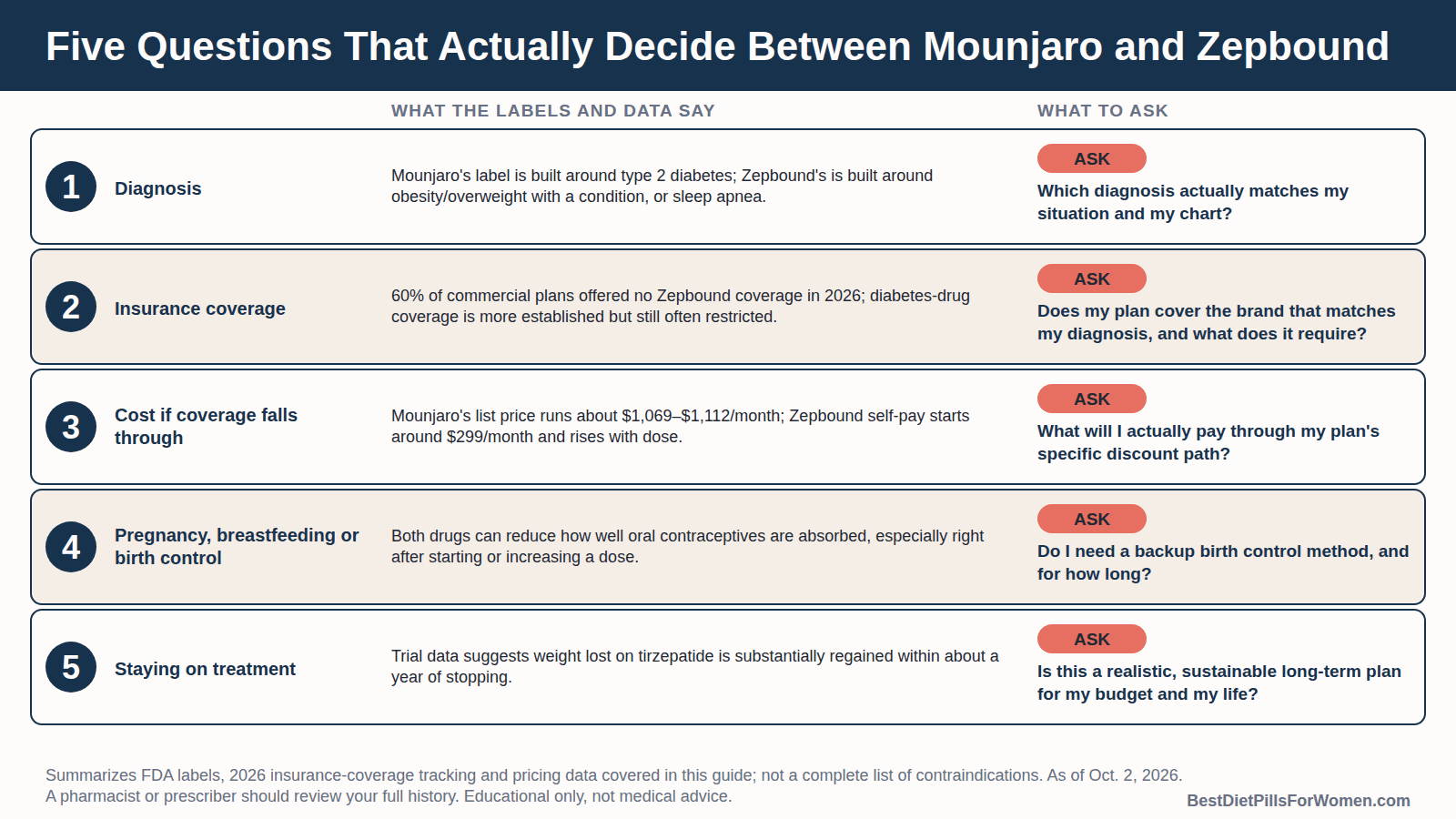
Seeing how differently these two “identical” drugs are priced, despite coming out of the same vial, is a genuinely useful thing to walk through visually before deciding which path fits your own situation. Infographic 2 below does that directly.
Who Actually Fits Each One
Everything above is about the drug and the system around it. This section is about which label, if either, actually matches your own situation.
When Mounjaro Is the Better Fit
Mounjaro was built around a specific clinical population, and that population is the clearest, least complicated fit for the brand.
Type 2 Diabetes, With or Without Cardiovascular Disease
Someone with a type 2 diabetes diagnosis who needs additional help with blood sugar control is the population Mounjaro’s own trials, and most insurance policy, are actually built around. Someone in that group who also has established cardiovascular disease now has an additional, if carefully qualified, reason to discuss Mounjaro specifically with a prescriber, given the 2026 label update, though as covered above, that update reflects a noninferiority finding against another diabetes drug, not a proven superiority claim.
When Insurance Makes the Decision for You
For a lot of women, the realistic deciding factor isn’t which trial result sounds more impressive; it’s which brand a specific insurance plan will actually pay for. Someone with diagnosed type 2 diabetes and employer or marketplace coverage that treats diabetes medications more generously than weight-management drugs may find Mounjaro is simply the financially viable option, independent of which indication best describes their actual goal.
When Zepbound Is the Better Fit
Zepbound’s own trial program and label point toward two more specific populations than “anyone who wants to lose weight.”
Obesity or Overweight With a Related Condition
Someone who meets the BMI and comorbidity thresholds on Zepbound’s label, and whose primary goal is weight management rather than diabetes treatment, is the population its pivotal trials were actually built to evaluate. That’s a meaningfully different starting point than Mounjaro’s diabetes population, even though, again, the drug itself doesn’t know which label it’s sold under.
Moderate to Severe Obstructive Sleep Apnea
Someone with obesity and a diagnosed moderate to severe obstructive sleep apnea has access to an indication Mounjaro’s label simply doesn’t contain, since the SURMOUNT-OSA trial behind that approval tested tirzepatide specifically in that population and outcome. That’s one of the clearest cases in this entire comparison where the choice between brands isn’t really a choice at all; the sleep-apnea indication only exists under the Zepbound name.
When Neither One Might Be the Right Fit Yet
Not every situation points cleanly toward one brand, and a few specific circumstances are worth pausing on before starting either one.
Planning a Pregnancy Soon, or Already Pregnant or Breastfeeding
Given the limited human pregnancy and breastfeeding data and the specific contraceptive-interaction guidance covered in the Safety section above, anyone who’s pregnant, breastfeeding, or planning to conceive in the near future has a concrete reason to talk through timing with a prescriber before starting either drug, rather than starting now and figuring out the timeline later.
When the Realistic Cost Doesn’t Pencil Out
If neither your insurance plan nor either brand’s discount program brings the monthly cost to something you can sustain for the long run, starting either drug is worth reconsidering, not because the evidence is weak, but because the SURMOUNT-4 data above suggests the benefit is tied to staying on treatment. Starting a medication you can only afford for a few months, then stopping because the price becomes unmanageable, risks recreating the regain pattern that trial documented, which is a worse outcome for some readers than never starting at all. A frank conversation with a prescriber or pharmacist about realistic, sustainable cost before the first fill is a more useful first step than assuming a savings card will cover the gap indefinitely.
Frequently Asked Questions About Mounjaro vs. Zepbound
A handful of questions come up constantly once people realize these are the same drug, and they’re worth answering directly.
Switching and Combining
Can I Just Ask My Doctor for Mounjaro Instead of Zepbound to Save Money?
You can ask, but a prescriber writing Mounjaro specifically to treat weight loss, absent a type 2 diabetes diagnosis, is prescribing off-label, and insurance frequently won’t cover it under a weight-loss diagnosis code anyway, which can mean paying list price instead of saving money. Whether this is a reasonable path for your specific situation is a conversation for you, your prescriber and, ideally, your insurer, not something a general guide can decide for you.
Is It Dangerous to Take Both at Once?
There’s no documented clinical scenario, and no plausible medical reason, to take both Mounjaro and Zepbound at the same time, since doing so would simply mean taking two doses of the identical drug. Nothing in either label discusses combined use, because combined use isn’t a real clinical situation; if you’ve been prescribed both, that’s worth clarifying with your prescriber and pharmacist immediately, since it’s far more likely to reflect a records mix-up than an intentional regimen.
What if My Insurance Covers One Brand but Denies the Other?
That’s common enough to plan for, since the two brands are reviewed under different coverage policies even when a single insurer writes both. If you have type 2 diabetes and your plan covers Mounjaro but denies Zepbound, or covers Zepbound for a qualifying weight-related condition but not Mounjaro, the practical path is usually to go with whichever brand your specific diagnosis and plan actually support, rather than requesting the denied one and absorbing a cash price. A prior-authorization appeal is sometimes worth pursuing if your clinical picture genuinely matches the covered brand’s label and the denial seems to be a documentation gap rather than a hard plan exclusion; your prescriber’s office can usually tell you which situation you’re in.
Safety and Evidence
Does One Have Worse Side Effects Than the Other?
No good evidence suggests one brand causes meaningfully different side effects than the other at a matched dose, since they’re the same drug; the side-effect rates reported in each one’s own trials line up in the same general range, covered in the Safety section above. Any difference you personally notice is far more likely to reflect your specific dose, how quickly you titrated, and your own body’s response than anything brand-specific.
Is the Cardiovascular Benefit the Same as Ozempic’s?
No, and the distinction matters. Semaglutide’s cardiovascular-outcomes trial compared the drug against a placebo and found a statistically significant reduction in cardiovascular events. Mounjaro’s SURPASS-CVOT trial compared tirzepatide against another active diabetes drug, dulaglutide, and found a result that met the bar for noninferiority but didn’t reach statistical significance for superiority. Both findings supported a label update, but they’re not the same strength or kind of evidence, and describing them as equivalent would overstate what Mounjaro’s trial showed.
Will Zepbound Ever Be Approved for Diabetes, or Mounjaro for Weight Loss?
We found no FDA filing or announcement indicating either expansion is imminent as of this writing, though given that both brands already share an active ingredient and a dosing ladder, either expansion would be a regulatory and labeling decision for Lilly and FDA rather than one requiring a fundamentally new drug. If either label changes, we’ll treat that as a freshness item worth revisiting in this guide.
The Bottom Line on Mounjaro vs. Zepbound
Ten sections of trial data, pricing tables and regulatory history point toward one underlying idea worth stating plainly.
What the Evidence Means for You
The real decision here was never “which drug works better.” It’s “which FDA-reviewed use, which insurance pathway and which price structure actually matches my own diagnosis and situation.”
The Biggest Realistic Advantage of Each
Mounjaro’s biggest realistic advantage is a trial program built specifically around blood sugar control, now paired with cautiously positive cardiovascular data, in a population, type 2 diabetes, where insurance is generally more willing to pay. Zepbound’s biggest realistic advantage is a trial program built specifically around weight as the primary outcome, a dedicated sleep-apnea indication Mounjaro doesn’t have, and, despite shrinking insurance coverage, a self-pay pricing structure that’s meaningfully more developed and transparent than anything currently offered for Mounjaro.
The Biggest Limitation and Safety Concern
The biggest limitation on the Mounjaro side is that it simply isn’t the reviewed, labeled option for weight management, which matters for anyone whose main goal is weight loss and who wants their treatment to match an FDA-reviewed use for that specific goal. The biggest limitation on the Zepbound side is access: insurance coverage for weight-management drugs has been shrinking, not growing, through 2025 and 2026, which pushes more people toward self-pay pricing that, while more transparent than Mounjaro’s, still runs into the hundreds of dollars a month. The shared safety concern, the thyroid C-cell tumor boxed warning and its related contraindications, applies identically to both, because it’s the same molecule.
A Rational Next Step
None of this is a reason to feel stuck between two confusing options. It’s a reason to bring a specific, well-informed question to the people who can actually answer it for your situation.
Questions for a Clinician or Pharmacist
Ask your prescriber which brand actually matches your diagnosis, since that match is what determines both the label’s relevance and your realistic shot at insurance coverage. Ask your pharmacist or insurer directly whether your specific plan currently covers either brand, given how quickly coverage policy has been changing, and ask whether a prior authorization, step therapy requirement or specific diagnosis code will be needed before a claim is approved.
What to Re-Check Before You Spend Money
Prices, coverage policies and even FDA label language for these two drugs have changed multiple times within the past two years, and nothing in this guide should be treated as fixed. Before committing to either path, re-verify current self-pay pricing directly on LillyDirect, confirm your plan’s current prior-authorization and coverage rules directly with your insurer, and ask your prescriber whether any newer trial data or label update has emerged since this guide was last checked. The underlying molecule is the same either way; the paperwork, the price and the FDA-reviewed use it’s actually tied to are what should drive the decision between these two brand names.
Related Reading
Sources
These are the main sources behind this comparison, chosen because they are the ones to check first for current facts. Labels, prices and coverage policies change, so confirm the latest version before you make decisions.
- Eli Lilly and Company. Mounjaro (tirzepatide) injection, prescribing information (label revised 08/2026). https://pi.lilly.com/us/mounjaro-uspi.pdf
- Eli Lilly and Company. Zepbound (tirzepatide) injection, prescribing information (label revised 08/2026). https://pi.lilly.com/us/zepbound-uspi.pdf
- Jastreboff AM, et al. Tirzepatide Once Weekly for the Treatment of Obesity (SURMOUNT-1). N Engl J Med. 2022;387:205-216. doi:10.1056/NEJMoa2206038; trial-level percentages also summarized in Eli Lilly’s investor announcement, “Lilly’s tirzepatide delivered up to 22.5% weight loss in adults with obesity or overweight in SURMOUNT-1.” https://investor.lilly.com/node/47141
- Frías JP, et al. Tirzepatide versus Semaglutide Once Weekly in Patients with Type 2 Diabetes (SURPASS-2). N Engl J Med. 2021;385:503-515. doi:10.1056/NEJMoa2107519 (trial-arm figures read via a page summary of Lilly’s results announcement; the full journal article wasn’t directly accessible in this research session).
- Garvey WT, et al. Tirzepatide once weekly for the treatment of obesity in people with type 2 diabetes (SURMOUNT-2). Lancet. 2023;402:613-626. doi:10.1016/S0140-6736(23)01200-X (percentage figures read via a page summary; the full journal article wasn’t directly accessible in this research session).
- Pharmacy Times. FDA Approves Tirzepatide to Cut CV Risk in Type 2 Diabetes (August 28, 2026). https://www.pharmacytimes.com/view/fda-approves-tirzepatide-to-cut-cv-risk-in-type-2-diabetes (SURPASS-CVOT results; trial registered as ClinicalTrials.gov NCT04255433).
- Healio. FDA approves Zepbound for moderate to severe OSA, obesity (published February 14, 2025; approval dated December 20, 2024). https://www.healio.com/news/endocrinology/20250214/fda-approves-zepbound-for-moderate-to-severe-osa-obesity
- GoodRx. Tracking insurance coverage for weight loss medications (research page, data through July 2026, read October 2, 2026). https://www.goodrx.com/healthcare-access/research/tracking-insurance-coverage-weight-loss-meds
- Eli Lilly and Company. Mounjaro on LillyDirect, self-pay pricing (page read October 2, 2026). https://www.lilly.com/lillydirect/medicines/mounjaro
- Eli Lilly and Company. Zepbound on LillyDirect, self-pay pricing (page read October 2, 2026). https://www.lilly.com/lillydirect/medicines/zepbound

