
Wegovy cost depends almost entirely on which door you walk through: pay cash through the manufacturer’s own pharmacy and a standard dose runs $349 a month; use a manufacturer copay card with qualifying commercial insurance and it can drop to as little as $25; have no coverage and no card, and the sticker price is close to $1,350 for a 28-day supply, or roughly $16,200 a year.
That range is the whole story in miniature, and it’s why Wegovy cost almost never has a one-number answer. Commercial insurance covers Wegovy for weight loss only about 9% of the time without restrictions, and roughly 14% of commercially insured people have no coverage for it at all, so a lot of people land somewhere between the cash price and the coupon price rather than at either extreme. Medicare has historically excluded weight-loss drugs by law, though a new, time-limited pilot program changes that picture for some beneficiaries starting mid-2026, and Medicaid coverage depends on which state you live in.
This guide walks through every realistic payment path: the manufacturer’s current self-pay price and how it got there, what the commercial copay card actually requires and saves, how prior authorization works when insurance is involved, what Medicare’s new bridge program does and doesn’t cover, where Medicaid and state-level policy stand, how Wegovy’s price compares with competing GLP-1 options, and where the once-popular compounded-semaglutide workaround stands now that FDA’s shortage-based allowances have expired. We checked manufacturer pricing pages, the current Wegovy label, a federal program announcement, a state-legislation tracker and ongoing insurance-coverage research to build it, and we flag every figure that’s likely to move. Nothing here is personalized financial or medical advice, and nothing in this guide should be read as a reason to start, stop or switch a prescription medicine on your own.
Wegovy Cost at a Glance
Start with the short version, then use the rest of this guide to see exactly where each number comes from.
The Direct Answer and How Sure We Are
Two questions matter here: what the numbers actually are, and how much they’re likely to change between now and whenever you fill a prescription.
How Much Does Wegovy Cost?
Wegovy runs about $349 a month through the manufacturer’s self-pay pharmacy, roughly $1,350 for a 28-day supply at full list price without any discount, and as little as $25 a month with a manufacturer copay card if your commercial insurance already covers it. A new, temporary Medicare program brings the price to $50 a month for some beneficiaries starting in mid-2026, while Medicaid coverage varies by state.
None of those numbers is “the” Wegovy price. Which one applies to you depends on your insurance status, your specific plan’s formulary, and, for a growing number of people, a narrow and recently changed set of government rules.
How Confident We Are in These Numbers
We’re highly confident in the self-pay and copay-card figures, since they come directly from the manufacturer’s own current pricing and terms documents. We’re highly confident the Medicare Bridge program exists and charges $50 a month, since that comes from a federal press release, though exact participating plans and clinical eligibility details were still being finalized when the program was announced. We’re less confident about any single reader’s actual out-of-pocket cost with commercial insurance, because coverage decisions happen plan by plan, employer by employer, and sometimes year by year.
How We Priced This Guide
A cost guide is only as good as how recently its numbers were checked, so here’s exactly what we looked at.
What Counted as a Source
We read Novo Nordisk’s current Wegovy price guide and savings-offer terms, the Wegovy prescribing label, a Centers for Medicare & Medicaid Services press release describing the new Bridge program, GoodRx’s ongoing insurance-coverage-tracking research, and a representative health plan’s published prior-authorization policy. We treated manufacturer pages as the right source for prices and program terms, not as proof that Wegovy works; that evidence lives in the clinical trials behind the drug’s approval, which our guide to the best weight loss pills for women and our comparison of weight loss pills and injections cover in more depth.
What This Guide Is and Isn’t
This is a desk-research pricing and coverage guide, not a hands-on test, a financial-planning tool, or a guarantee that any price here will still be current when you read this. We didn’t buy, fill or use Wegovy to write it. Prices, savings-offer terms and government program details all change, sometimes with little notice, so treat every dollar figure below as a snapshot from early October 2026 that needs a quick recheck before you rely on it.
The Numbers Side by Side
Table 1 lines up the main payment paths before the rest of this guide explains each one.
The Summary Table
| Payment path | Typical monthly cost | What it requires | Biggest catch |
|---|---|---|---|
| Full list price, no discount | About $1,350 for a 28-day supply (about $16,200 a year) | Nothing; this is the undiscounted starting point | Almost no one actually pays this; it’s the number insurance negotiates against |
| Manufacturer self-pay (NovoCare Pharmacy) | $349 for standard doses; $199 for the two lowest starter doses for new patients’ first two fills; $399 for the newer high-dose pen | No insurance needed; direct order and home delivery | The $199 introductory price is temporary and applies only to starter doses |
| Commercial insurance with copay card | As low as $25, capped at $100 in manufacturer savings per month | Commercial insurance that already covers Wegovy at least partly; not a government program beneficiary | Doesn’t help at all if your plan excludes Wegovy outright |
| Commercial insurance, no coverage | Full list price or the self-pay price, whichever you choose | N/A | About 14% of commercially insured people have no Wegovy coverage at all |
| Medicare GLP-1 Bridge (new, temporary) | $50 flat, regardless of dose | Enrollment in Medicare Part D; program runs July 1, 2026 through December 31, 2027 | It’s a time-limited pilot, not a permanent benefit, and plan participation details were still rolling out at launch |
| Medicaid | Varies by state; some programs don’t cover it at all | State-specific prior authorization and formulary rules | No single national answer exists; you have to check your own state |
Table 1 method: self-pay and copay-card figures are read directly from Novo Nordisk’s current price guide and savings-offer terms; the list-price figure is GoodRx’s published estimate; the Medicare Bridge figure is from a CMS press release. All figures are as of October 2, 2026 and are subject to change without notice.
How to Read the Table
Read Table 1 as a map of doors, not a single price tag. Most readers will fall into either the self-pay row or the commercial-insurance rows, and which commercial row you land in depends on a prior-authorization decision you usually don’t make yourself. A smaller group of readers, mainly Medicare beneficiaries and people on Medicaid, VA or TRICARE benefits, will land in one of the government-program rows instead, each with its own separate rules that have little in common with how commercial insurance handles this drug.
The rest of this guide walks through why the price varies by dose and pen type, what actually drives the gap between list price and what people pay, what a prior authorization actually checks, how the manufacturer’s copay card works and where it doesn’t help, what the new Medicare program does and doesn’t cover, and how Wegovy’s price compares with other GLP-1 options people often weigh against it.
What Actually Sets Wegovy’s Price
Before comparing payment paths, it helps to understand why Wegovy has a “price” that almost nobody pays and several other prices that most people actually do.
List Price vs. What Anyone Actually Pays
Drug pricing in the U.S. runs on a number most patients never touch and several others that matter far more.
The Official List Price (and Why It’s Almost Never the Real Price)
Wegovy’s list price, also called the wholesale acquisition cost, runs about $1,350 for a 28-day supply, which works out to roughly $16,200 a year if nothing changes month to month. That number exists mainly as a starting point for negotiations between the manufacturer, pharmacy benefit managers and insurers; it’s rarely what a patient at the pharmacy counter is actually charged.
Think of the list price the way you’d think of a car’s sticker price: it’s real, it’s printed, and almost everyone who drives off the lot pays something different from it. For Wegovy, the “something different” is one of three other numbers, depending on your situation.
List prices for brand-name drugs like Wegovy have also tended to climb over time, even as the net price insurers and pharmacy benefit managers actually pay often moves in a different direction because of confidential rebates negotiated behind the scenes. That gap between a rising list price and a separately negotiated net price is a big part of why a single “Wegovy costs $X” headline rarely survives contact with your own specific insurance situation; the number that matters to you was probably never the list price at all.
The Three Prices That Matter More
The price that actually applies to you is almost always one of these: the manufacturer’s direct self-pay price if you have no coverage, a copay-card price if you have qualifying commercial insurance, or a plan-negotiated price your insurer pays that determines your copay or coinsurance. A fourth price, now, applies to some Medicare beneficiaries through a new federal pilot program. The rest of this guide is organized around those four paths, because that’s how the decision actually works in practice.
Dose, Pen Type and Why They (Mostly) Cost the Same
Wegovy comes in several strengths, but the price ladder isn’t one dollar amount per milligram.
The Five Pen Strengths and the Newer HD Pen
The Wegovy injection pen is FDA-approved in five strengths: 0.25 mg, 0.5 mg, 1 mg, 1.7 mg and 2.4 mg, with 2.4 mg as the standard maintenance dose for most adults using it for weight management. A newer, higher-strength “HD” pen at 7.2 mg is also available for some patients who need more than the standard maintenance dose provides. Under the manufacturer’s current self-pay pricing, the 1 mg, 1.7 mg and 2.4 mg pens all cost the same $349 a month; only the two lowest starter doses (0.25 mg and 0.5 mg) and the HD pen sit on a different part of the price ladder.
The Wegovy Tablet’s Separate Price Ladder
Wegovy is also available as an oral tablet, in 1.5 mg, 9 mg and 25 mg strengths, priced separately from the injection pen. The tablet’s self-pay price generally runs lower than the injection’s standard price, which matters if swallowing a pill rather than using an auto-injector is a meaningful factor in your decision. This guide focuses mainly on the injection pen, since that’s what most people searching for “Wegovy cost” are asking about, but Table 2 below includes both forms so you can compare them directly; our Wegovy pill cost guide breaks the tablet’s pricing, savings terms and coverage picture down in much more depth than a guide centered on the injection can.
Paying Cash: Wegovy Without Insurance
If you don’t have insurance that covers Wegovy, or you’d rather skip the prior-authorization process entirely, paying cash through the manufacturer is usually the most straightforward option, and often the cheapest cash option available.
NovoCare Pharmacy’s Direct Self-Pay Price
Novo Nordisk sells Wegovy directly to self-pay patients through its own pharmacy service, with pricing that’s changed more than once in the past two years.
What You Pay Today
As of October 2, 2026, NovoCare Pharmacy’s self-pay price for Wegovy is $349 a month for the standard 1 mg, 1.7 mg and 2.4 mg pens, $399 a month for the newer 7.2 mg HD pen, and $199 to $299 a month for the oral tablet depending on dose. That $349 figure itself is a recent change: the price had been $499 a month since NovoCare Pharmacy launched in early 2025, and Novo Nordisk cut it to $349 in November 2025, ahead of the original planned early-2026 timeline, as part of a broader agreement with the federal government tied to the TrumpRx direct-to-consumer drug platform.
The New-Patient Introductory Offer, and Its Catch
New patients who haven’t redeemed a Wegovy savings offer in the past 365 days can get the two lowest starter doses, 0.25 mg and 0.5 mg, for $199 a month for their first two fills, after which the price returns to the standard $349. The catch is in the name: it’s a starter-dose offer, not a maintenance-dose discount. Since most people titrate up to 1 mg or higher within the first couple of months anyway, the $199 price is more of a short, one-time bridge than a long-term way to keep costs down. The current version of this offer is set to run through the end of 2026 for the injection and through roughly the third quarter of 2026 for the tablet, so the exact dates are worth confirming before you plan around them.
Other Cash-Pay Channels
NovoCare Pharmacy isn’t the only way to pay cash for Wegovy, and the price can differ meaningfully by channel.
GoodRx, Pharmacy Discount Cards and Telehealth Partners
Novo Nordisk has said the $349 self-pay price is also available through partners including GoodRx, WeightWatchers, LifeMD and roughly 70,000 retail pharmacies nationwide, not just through its own direct-to-consumer pharmacy. In practice, discount-card prices at a given pharmacy can run slightly above or below the headline number depending on the specific card and pharmacy, so it’s worth comparing your local price against the manufacturer’s direct price before you commit to a channel.
A related wrinkle applies to telehealth platforms that prescribe and ship Wegovy as part of a broader subscription service. Some of these platforms bundle the drug’s self-pay price together with a separate clinician-visit or membership fee, so the number advertised on a landing page isn’t always directly comparable to NovoCare Pharmacy’s drug-only price. Before assuming a telehealth option is cheaper, it’s worth asking exactly what the advertised monthly figure does and doesn’t include.
Retail and Warehouse-Club Pricing
Retail pharmacies and warehouse clubs that dispense Wegovy without a discount card typically bill closer to the list price unless a coupon or card is applied at checkout, which is part of why so many self-pay patients end up ordering through NovoCare Pharmacy or a partner program rather than walking into a pharmacy cold. Costco’s pharmacy, for example, is one of the retail channels where Novo Nordisk’s discounted self-pay price can apply, but only when the card or program is actually used at checkout rather than assumed automatically. Table 2 summarizes the self-pay numbers that matter most; use it alongside Table 1 to see how the cash-pay path compares with the insurance paths covered later in this guide.
| Form | Dose | Standard self-pay price | Introductory price (new patients) | Notes |
|---|---|---|---|---|
| Injection pen | 0.25 mg, 0.5 mg | $349/month after the intro period | $199/month for the first 2 fills | Starter doses; most patients titrate upward within a few months |
| Injection pen | 1 mg, 1.7 mg, 2.4 mg | $349/month | Not applicable | 2.4 mg is the standard maintenance dose for most adults |
| Injection pen, HD | 7.2 mg | $399/month | Not applicable | A higher-strength option for some patients beyond standard maintenance |
| Tablet | 1.5 mg | $199/month | Same as standard; limited-time pricing | Lower-dose starter tablet |
| Tablet | 9 mg, 25 mg | $299/month | Not applicable | Maintenance-strength tablet doses |
Table 2 method: prices are read directly from Novo Nordisk’s current NovoCare price guide and savings-offer terms and conditions as of October 2, 2026; third-party channels such as GoodRx or retail pharmacies may show somewhat different prices at any given time.
Getting Insurance to Pay: Coverage and Prior Authorization
For a lot of readers, the real question isn’t “what does Wegovy cost,” it’s “will my insurance pay for it at all.” The honest answer is that it depends heavily on your specific plan, and the odds aren’t in most people’s favor. Our comparison of prescription and OTC weight loss pills covers the broader regulatory backdrop behind why insurance treats a prescription drug like Wegovy so differently from an over-the-counter supplement.
How Often Commercial Insurance Actually Covers Wegovy
Insurance coverage for GLP-1 weight-loss drugs has been getting more restrictive, not less, even as the drugs themselves have become more popular.
Unrestricted, Restricted and No Coverage at All
According to GoodRx’s ongoing coverage-tracking research, only about 9% of commercially insured people have unrestricted coverage for Wegovy, meaning their plan covers it without prior authorization or other hurdles, down slightly from about 10% the year before. Roughly 77% have coverage that comes with restrictions such as prior authorization or step therapy, up from about 75%, and about 14%, or an estimated 27 million people, have no commercial coverage for Wegovy at all.
Put differently, if your plan covers Wegovy, there’s a strong chance it doesn’t cover it unconditionally. Across GLP-1 weight-loss medications generally, about 88% of people who have any coverage still face some kind of restriction before a claim gets approved. That’s the reality worth planning around, more than any single advertised price.
Why “Covered” Doesn’t Always Mean Affordable
Even when a plan technically covers Wegovy, your actual copay or coinsurance depends on your plan’s drug tier placement, your deductible status, and whether your employer’s specific benefit design excludes weight-management drugs as a category while still covering the same molecule for a different FDA-approved indication, such as cardiovascular risk reduction. This is why two people with the same insurance company but different employer plans can get completely different answers to the same prior-authorization request.
Much of that variation traces back to who actually designs the benefit. Many larger employers self-fund their health plans, meaning the employer, not the insurance carrier whose logo is on your card, decides which drug categories are covered, often with a pharmacy benefit manager administering the details. Those self-funded plans aren’t bound by most state insurance mandates, including any state law requiring coverage of anti-obesity medications, which is one reason a state-level coverage mandate doesn’t automatically guarantee coverage at every employer in that state. If your plan excludes Wegovy, it’s worth asking your employer’s benefits team, not just your insurance carrier, whether that exclusion is a carrier-wide policy or a choice your specific employer made.
What a Prior Authorization Actually Checks
A prior authorization isn’t a rubber stamp. It’s a specific set of clinical boxes a plan wants checked before it agrees to pay.
The BMI and Comorbidity Thresholds Insurers Use
Wegovy’s FDA label supports use for weight management in adults with obesity, or in adults who are overweight with at least one weight-related comorbid condition such as high blood pressure, type 2 diabetes, high cholesterol, obstructive sleep apnea or cardiovascular disease, used alongside a reduced-calorie diet and increased physical activity. Most insurer prior-authorization policies borrow directly from that framework, typically requiring a BMI at or above 30, or at or above 27 with a qualifying comorbidity, before they’ll approve a weight-management claim.
Some plans go further than the label and exclude weight-management use altogether as a benefit category, even while covering the identical drug for a different approved use. One regional health plan’s published policy, for example, states plainly that “use of Wegovy for the treatment of weight management is a benefit exclusion and will not be authorized,” while still allowing coverage when Wegovy is prescribed for cardiovascular-risk reduction in someone with established heart disease, or for a specific liver condition, each under its own separate criteria. That gap between “covered for this reason” and “not covered for that reason” is one of the most common and most frustrating surprises patients run into.
Step Therapy, Reauthorization and the Weight-Loss Checkpoint
Many plans also require documented participation in a physician-supervised diet and exercise program, often for about six months, before they’ll approve an initial Wegovy authorization, and they typically don’t approve it indefinitely. A common pattern is an initial authorization of around six months, followed by a reauthorization period that requires you to show a minimum amount of weight loss, often around 5% of your starting body weight, to continue coverage. If a reauthorization doesn’t go through because the documentation didn’t satisfy the criteria, coverage can lapse even for someone actively using the medication as prescribed, which is worth planning for rather than discovering partway through treatment.
Some plans add a step-therapy requirement on top of that: documentation that you’ve already tried, and didn’t achieve enough benefit from, a different weight-management approach, such as a specific older prescription option, before they’ll approve a GLP-1 drug like Wegovy. The FDA label itself frames Wegovy as an adjunct to diet and exercise, not a replacement for them, which is part of why so many payer policies build ongoing lifestyle-program documentation into both the initial approval and every renewal that follows.
Table 3 breaks the three realistic coverage scenarios down side by side, so you can see roughly where you’re likely to land before you even submit a prior-authorization request.
| Coverage scenario | Approximate share of commercially insured people | What it typically means in practice | Likely out-of-pocket pattern |
|---|---|---|---|
| Unrestricted coverage | About 9% | Plan covers Wegovy for weight management without prior authorization | Standard drug-tier copay or coinsurance |
| Restricted coverage | About 77% | Prior authorization, step therapy or similar hurdles apply | Copay/coinsurance only after approval; approval isn’t guaranteed |
| No coverage at all | About 14% (roughly 27 million people) | Plan excludes Wegovy for weight management entirely | Self-pay price or the commercial copay card, if otherwise eligible |
Table 3 method: percentages are from GoodRx’s ongoing coverage-tracking research, reviewed July 10, 2026; figures reflect commercial insurance plans broadly and will vary by individual employer and plan.
The Manufacturer Savings Card
If you have commercial insurance that already covers Wegovy in some form, Novo Nordisk’s copay card can bring your out-of-pocket cost down dramatically, but only if you clear a specific set of eligibility hurdles first.
Who Qualifies for the Commercial Copay Card
The card is narrower than its marketing makes it sound, and it’s worth checking every requirement before you count on it.
The Eligibility Checklist
To use the Wegovy savings card, you generally need commercial or private insurance that covers Wegovy, a valid prescription for brand-name Wegovy with your prescriber’s ID, and U.S. residency. The card is meant to reduce a copay your insurance has already agreed to charge you, not to replace insurance or pay for a drug your plan refuses to cover at all.
Getting the card itself is usually the easy part: Novo Nordisk makes it available through the Wegovy and NovoCare websites, and most pharmacies can apply it electronically using the card’s group, BIN and PCN numbers the same way they’d process any other prescription discount card, whether you’re filling at a local retail pharmacy or through mail order. The harder part, as the rest of this section covers, is making sure the underlying insurance claim is actually approved first, since the card only discounts a copay that exists.
What Disqualifies a Patient
You can’t use the commercial copay card if you’re enrolled in Medicare, Medicaid, Medigap, TRICARE, VA benefits or another government health program, even if you also happen to have supplemental commercial coverage. You also can’t use it if your insurance already covers the full cost of the drug, or if you’re filling a compounded version of semaglutide rather than brand-name Wegovy. In practice, the card is built for one specific situation: commercially insured, with some Wegovy coverage, and not on a government plan.
What the Card Actually Saves
The headline “$25” figure is real, but it’s a floor, not a guarantee, and it comes with a ceiling too.
The Dollar Caps, Month by Month
Eligible patients can pay as little as $25 for a one-month supply, with the manufacturer capping its own contribution at $100 per month, $200 for a two-month fill, or $300 for a three-month fill. Your actual copay is whatever your insurance plan sets, minus up to that $100-a-month savings credit; if your plan’s copay is already below $100, the card can bring your cost close to zero, but it can’t turn a $400 copay into $25 on its own.
Where the Card Can’t Help
The card is powerless against the biggest obstacle most people actually face: a plan that doesn’t cover Wegovy for weight management in the first place. If your prior authorization is denied, or your plan has a flat benefit exclusion like the one described in the previous section, the copay card has nothing to apply itself to, since there’s no insurance-approved claim underneath it. For people in that situation, the self-pay price covered earlier in this guide, or one of the government-program paths covered next, is the more realistic lever to pull.
It’s worth checking the card’s terms again each time you refill, too. Savings offers like this one are typically published with an expiration date and a maximum-redemption limit, and manufacturers do revise or replace them; a card that worked at your last fill isn’t guaranteed to carry identical terms at your next one, even if nothing about your own insurance has changed in between.
Medicare, Medicaid, VA and Tricare
Government coverage for Wegovy has been one of the fastest-moving parts of this picture, and as of October 2026 it’s genuinely more complicated than a simple “covered” or “not covered.”
Why Medicare Has Historically Excluded Wegovy
For most of Wegovy’s time on the market, Medicare’s answer to “will you pay for this” has been a flat no, for a specific legal reason.
The Statutory Weight-Loss Exclusion
By federal statute, Medicare Part D has historically excluded drugs used solely for weight loss, a rule that predates Wegovy by decades and applies to anti-obesity medications as a class, not to any one brand. That’s why, for years, a Medicare beneficiary prescribed Wegovy purely to lose weight generally couldn’t get Part D to pay for it, regardless of their BMI or how clearly they met the FDA label’s criteria.
The Cardiovascular and Liver-Disease Exceptions
That changed partially once Wegovy’s FDA label expanded beyond weight management alone. The label now also supports use to reduce the risk of major cardiovascular events, specifically cardiovascular death, non-fatal heart attack or non-fatal stroke, in adults with established cardiovascular disease who have obesity or overweight, and separately supports use for a specific liver condition, metabolic dysfunction-associated steatohepatitis with moderate to advanced fibrosis. Because those are indications beyond weight loss alone, some Medicare plans can cover Wegovy when it’s prescribed for one of them, generally still subject to prior authorization confirming the qualifying diagnosis, not simply a prescription that says “for weight loss.”
The New Medicare GLP-1 Bridge Program
Separately from those label-based exceptions, the federal government launched an entirely new, temporary coverage pathway in 2026.
Who Qualifies and What It Costs
The Centers for Medicare & Medicaid Services announced the Medicare GLP-1 Bridge, a time-limited demonstration program running from July 1, 2026 through December 31, 2027, under which eligible Medicare Part D beneficiaries pay a flat $50 a month for a covered GLP-1 medication, regardless of dose. Participation is voluntary, and CMS described it as something beneficiaries should discuss with their own doctor rather than something that applies automatically to everyone with Part D coverage. Early reporting on the program described BMI-based eligibility criteria and a centralized authorization process run through a CMS contractor, though CMS’s own announcement said further implementation details would follow as the program launched.
Why “Temporary” Matters
“Bridge” is the operative word here. This is a demonstration program with a fixed end date, not a permanent change to Medicare’s weight-loss drug exclusion, and CMS has not said what happens to a beneficiary’s coverage after December 31, 2027. If you’re a Medicare beneficiary considering this path, it’s worth confirming the program’s current status, your specific Part D plan’s participation, and the exact clinical eligibility criteria directly with Medicare or your plan before you count on $50-a-month pricing lasting indefinitely.
A separate, longer-term change is also worth knowing about, even though it doesn’t directly set the Bridge program’s price. Semaglutide, the active ingredient in both Wegovy and Ozempic, was selected for a Medicare drug-price-negotiation round under the federal Inflation Reduction Act program, with a negotiated price of $274 a month set to take effect in 2027, down roughly 71% from a 2024 list-price baseline of about $959 a month. That negotiated price applies within Medicare’s existing drug-price-negotiation framework to the indications Medicare already covers, such as diabetes or the cardiovascular-risk-reduction use described above, not automatically to weight-loss-only prescribing, and it’s a separate mechanism from the Bridge program’s flat $50 copay. The two changes arriving around the same time is part of why Medicare’s Wegovy picture looks so different from one year to the next; our comparison of Ozempic and Wegovy covers how the two brands differ beyond price.
Medicaid, VA and Tricare
Outside Medicare, the remaining government programs each handle Wegovy coverage differently, and none of them has one single national answer.
Medicaid’s State-by-State Patchwork
Medicaid coverage for anti-obesity medications varies significantly from state to state, and the honest number is smaller than many people assume: as of January 2026, only 13 state Medicaid programs covered GLP-1 medications for obesity treatment specifically, according to the National Conference of State Legislatures. That’s a real expansion from where Medicaid GLP-1 coverage stood a few years ago, when national Medicaid GLP-1 prescriptions ran about 1 million a year; by 2024, that had grown to more than 8 million prescriptions and nearly $9 billion in annual spending, driven mostly by diabetes use rather than the smaller weight-management-specific slice. If you’re on Medicaid, whether you’re one of the 13-state minority with obesity-specific coverage, or in a state that covers the same drug only for diabetes, makes all the difference, and that status can change with a single legislative session.
VA and Tricare Rules
The Department of Veterans Affairs may cover Wegovy for eligible veterans who meet BMI and health-condition criteria, often in connection with participation in the VA’s own weight-management support programs. TRICARE may cover it with a valid prescription and documented medical necessity, but TRICARE For Life, the Medicare-wraparound plan used by many retirees age 65 and older, generally follows Medicare’s own coverage rules rather than TRICARE’s standard formulary, which can mean a different answer for an otherwise similar beneficiary. Table 4 lines up all five government pathways, including these two, against each other.
State-by-State Policy Experiments
Beyond Medicaid specifically, individual states have spent the past few years actively legislating around GLP-1 weight-loss drug coverage, in both directions.
States Expanding Access
The National Conference of State Legislatures has tracked roughly 66 bills across 25 states addressing GLP-1 obesity coverage since 2022. Some states have moved to expand access: Colorado passed a law, effective 2027, requiring insurers to offer optional coverage for FDA-approved anti-obesity medications; Illinois added GLP-1 coverage for weight management to its state employee health plan; and Florida has run an ongoing pilot through its own state employee plan since 2022, tracking clinical outcomes alongside coverage. None of these are Medicaid changes specifically, but they show how much of this landscape is being decided state by state rather than through a single federal rule.
States Pulling Back
Other states have moved the opposite direction. Michigan modified its Medicaid pharmacy rules to limit GLP-1 coverage to people with a morbid-obesity diagnosis who’ve already exhausted other weight-loss approaches, and Washington allocated study funding to evaluate whether to cover weight-loss medications at all, rather than committing to coverage outright. If you’re weighing Wegovy’s cost against a state-run benefit, whether that’s Medicaid, a state employee plan, or a state-mandated commercial benefit, it’s worth checking your own state’s current rules directly rather than assuming last year’s answer still holds.
| Program | Coverage for weight loss alone | Typical cost if covered | Key requirement |
|---|---|---|---|
| Medicare Part D (standard rule) | Historically excluded by statute | Not applicable | N/A; doesn’t cover weight loss as the sole reason for use |
| Medicare, cardiovascular or liver-disease indication | Can be covered under a different label indication | Standard Part D cost-sharing, plan-dependent | Documented established cardiovascular disease or qualifying liver condition, not weight loss alone |
| Medicare GLP-1 Bridge (new, temporary) | Covered during the pilot window | $50/month flat | Part D enrollment; program runs July 1, 2026 to December 31, 2027; BMI-based criteria reported |
| Medicaid | Varies by state | Varies by state | Check your specific state’s current preferred drug list |
| VA | Can be covered with eligibility | VA pharmacy benefit cost-sharing | BMI/health criteria, often with weight-management program participation |
| TRICARE (excluding TRICARE For Life) | Can be covered with medical necessity | TRICARE pharmacy cost-sharing | Valid prescription and documented medical necessity |
Table 4 method: Medicare Bridge details are from a CMS press release dated May 6, 2026; other rows summarize general program rules described in federal and manufacturer sources as of October 2, 2026 and may not reflect every individual plan’s current policy.
Seeing all five price tiers lined up side by side, rather than scattered across several sections, makes the real spread easier to judge at a glance. Infographic 1 below does exactly that.

Compounded Semaglutide and Other Cash-Saving Workarounds
For a couple of years, compounded semaglutide was the most talked-about way to get something like Wegovy for a fraction of the price. That landscape has changed substantially, and it’s important to understand why before treating it as a current cost-saving option.
Why Cheap Compounded Semaglutide Mostly Disappeared
The compounded-semaglutide market existed because of a specific, temporary legal condition, and that condition no longer applies the way it did.
What Changed in 2025
While semaglutide was listed on FDA’s drug shortage list, state-licensed compounding pharmacies and larger outsourcing facilities were legally permitted to produce copies of it, which is how a wave of telehealth subscriptions selling “compounded semaglutide” for well under Wegovy’s price became widely available. FDA removed semaglutide from the shortage list in 2025, and a federal appeals court upheld FDA’s shortage-resolution decisions against industry challenges. The wind-down grace periods that followed ended April 24, 2025 for smaller compounding pharmacies and May 22, 2025 for larger outsourcing facilities, closing off the broad legal basis that had supported mass-market compounded copies.
The Narrow Exception That’s Left
A limited exception still exists: a prescriber can document that a specific compounding change, such as a different strength, dosage form, or removing an inactive ingredient a particular patient is allergic to, makes a meaningful clinical difference for that one, identified patient. FDA has said it doesn’t intend to prioritize enforcement against smaller compounding pharmacies filling four or fewer prescriptions of a given compounded product in a calendar month under that specific legal condition. That’s a narrow, patient-specific carve-out for an unusual clinical situation, not a legal basis for a low-cost subscription semaglutide business, and it isn’t something most people should expect to qualify for just to save money.
In practical terms, that means the math that made compounded semaglutide attractive in 2023 and 2024, often a few hundred dollars a month against Wegovy’s then-$499 cash price, no longer holds up the same way now that the manufacturer’s own self-pay price has fallen to $349 and the legal basis for mass compounding has mostly closed. The price gap that originally drove people toward compounded products has narrowed from both directions at once.
Red Flags in Today’s Cash-Savings Market
Some sellers haven’t fully adjusted to the legal change, and a few have drawn direct FDA scrutiny for how they’re marketing themselves.
Claims Worth Doubting
FDA has shifted its enforcement attention toward marketing practices rather than the shortage question itself. A 2026 warning letter to one compounder cited misrepresenting the company’s identity on product labels, claiming its compounded product was equivalent to an FDA-approved drug, and falsely describing itself as “FDA-licensed,” a status that doesn’t actually exist for compounding pharmacies. If a cash-savings offer for “semaglutide” leans on claims like equivalence to Wegovy, FDA licensing, or dramatically lower pricing without explaining the specific, documented clinical reason you’d need to qualify for compounding in the first place, that’s worth treating with real skepticism. Compounded drugs, whatever their price, haven’t been reviewed by FDA for safety, effectiveness or quality before they reach a patient, which is a different kind of risk than price alone captures.
Safer Ways to Cut the Cost
If cost is the main obstacle, the more reliable levers are the ones already covered in this guide: confirming your plan’s actual prior-authorization criteria before assuming denial, checking whether you qualify for the commercial copay card, comparing NovoCare Pharmacy’s self-pay price against GoodRx and other partner channels, and, for Medicare beneficiaries, finding out whether the GLP-1 Bridge program applies to your specific plan. None of those involves the legal and quality uncertainty that comes with an off-label compounded product.
It’s also worth calling NovoCare’s patient support line directly (1-888-809-3942) if you’re uninsured and can’t manage even the self-pay price. Manufacturer support programs for other medications have historically included income-based assistance in some circumstances, and whether a comparable option currently applies to Wegovy specifically, and what its eligibility rules are, is the kind of detail that’s best confirmed directly with the manufacturer rather than assumed from a general sense that “drug companies have assistance programs.” Table 5 puts these legitimate paths into annual dollar terms, so you can see what a full year actually looks like under each one.
| Payment path | Approximate annual cost | How we calculated it |
|---|---|---|
| Full list price, no discount | About $16,200 | GoodRx’s published list-price estimate of about $1,350/month, multiplied by 12 |
| Self-pay, first year (new patient) | About $3,888 | 2 introductory months at $199 plus 10 months at the standard $349 self-pay price |
| Self-pay, ongoing (standard dose, no intro pricing) | About $4,188 | $349/month multiplied by 12 |
| Self-pay, HD pen | About $4,788 | $399/month multiplied by 12 |
| Commercial copay card, minimum scenario | As low as $300 | $25/month multiplied by 12; applies only if your plan’s own copay is at or below the $100/month savings cap |
| Medicare GLP-1 Bridge, full pilot year | About $600 | $50/month multiplied by 12; available only during the program’s July 2026-December 2027 window, to eligible beneficiaries |
Table 5 method: figures are this guide’s own multiplication of the monthly prices verified earlier in this guide; they assume no missed fills, dose changes or mid-year price changes, none of which is guaranteed. Compounded semaglutide is intentionally not included as a cost comparison row, since it is not a reliable, broadly legal low-cost substitute as of October 2026.
How Wegovy’s Cost Compares to Other GLP-1 Options
Wegovy isn’t the only weight-management GLP-1 medication on the market, and its price doesn’t exist in a vacuum. Knowing roughly how it stacks up against the alternatives can change which conversation you have with a prescriber.
Wegovy vs. Zepbound on Price
Zepbound, Eli Lilly’s tirzepatide-based competitor, has followed a strikingly similar pricing path to Wegovy’s over the past year, which makes a direct comparison more useful than it might have been a year ago.
The Cash-Price Gap
Through Lilly’s own direct-to-consumer program, Zepbound’s self-pay price runs $299 a month for starter doses, $399 for mid-tier doses and $449 for the highest doses, effective December 1, 2025, down from $349, $499 and $499 respectively. Lined up against Wegovy’s $349 standard self-pay price and $199 introductory price, the two drugs now sit close enough in cash price that the gap between them is smaller than the gap between either drug’s cash price and its own list price. Both companies cut self-pay prices within weeks of each other in late 2025, tied to the same broader federal pricing agreement, which is part of why the numbers moved almost in lockstep.
The Coverage Gap
Price alone doesn’t decide which drug is more accessible, though. Commercial insurance coverage for Zepbound has moved in a notably worse direction than Wegovy’s: unrestricted coverage fell from about 5% to about 4% of commercially insured people, and the share with no coverage at all rose to about 60%, affecting more than 114 million people, according to the same GoodRx coverage-tracking research cited earlier in this guide. By that measure, Wegovy’s roughly 9% unrestricted-coverage rate and 14% no-coverage rate currently look meaningfully better than Zepbound’s, even though their cash prices are now close to each other. Coverage, not list price, may be the bigger differentiator between the two drugs for most insured readers.
Wegovy vs. Oral Alternatives
Beyond Zepbound, a newer oral GLP-1 option has entered the market with its own, still-developing cost picture.
Foundayo’s Price and Coverage Picture
Foundayo (orforglipron), an oral GLP-1 medication newly approved around April 2026, currently has one of the widest commercial coverage gaps in this category: more than 66 million people have no commercial insurance coverage for it at all, according to GoodRx’s tracking research, reflecting how recently it reached the market relative to Wegovy and Zepbound. Because its coverage picture is still forming, a specific self-pay or copay-card price for Foundayo is more likely to change in the near term than the more established prices covered elsewhere in this guide, so we’re deliberately not quoting one here; check the manufacturer’s current pricing directly if you’re considering it.
That coverage gap is a useful reminder of a broader pattern: a brand-new entrant to a drug class often launches with the thinnest insurance coverage in the category, simply because payers haven’t finished negotiating and reviewing it yet, not necessarily because of anything about the drug itself. Wegovy and Zepbound have both had more time for insurers to build out formal coverage policies, which is part of why their coverage numbers, while still far from universal, look more developed than Foundayo’s does this early in its time on the market.
When a Different Molecule Might Be Worth Discussing
None of this is a reason to switch medications on your own, and a lower advertised price on one drug doesn’t mean it’s the right clinical choice for you. But if your insurance denies Wegovy specifically, or if your own math on self-pay pricing comes out close between two options, it’s a reasonable question to bring to your prescriber: given my coverage and my health history, does a different GLP-1 option change either the clinical picture or the realistic cost picture enough to be worth considering? Our comparison of semaglutide and tirzepatide and our Wegovy versus Zepbound comparison go deeper into the clinical trade-offs than a cost guide like this one is built to cover.
Safety Considerations That Belong in a Cost Decision
This is a pricing guide, not a safety review, but cost and safety aren’t fully separable decisions, so a brief grounding in both belongs here before you commit real money to any payment path.
Common and Serious Risks
Wegovy’s label describes a familiar pattern of common, usually tolerable side effects alongside a shorter list of risks that deserve real attention.
What Shows Up Most Often
The most common side effects reported with semaglutide injections are gastrointestinal: nausea, vomiting, diarrhea, constipation and abdominal pain, especially during dose increases. These effects are usually manageable and often ease over time, but they’re also one of the quieter reasons people’s actual costs run higher than planned, since a difficult dose increase can mean more clinician visits, a slower titration schedule, or, for some people, stopping and restarting a lower dose, each of which has its own cost implications beyond the monthly pen price.
Those extra visits and labs are easy to leave out of a cost comparison built only around the pen’s sticker price, but they’re real: many prescribers want a follow-up visit at each dose increase during the first several months, and some order baseline or periodic lab work, both of which carry their own copays separate from the drug itself. Factoring in two or three such visits during your first year is a more realistic way to estimate your total cost than counting the pen price alone.
Who Should Be Extra Cautious
Wegovy’s label carries a boxed warning about thyroid C-cell tumors seen in rodent studies, and it’s contraindicated for people with a personal or family history of medullary thyroid carcinoma or multiple endocrine neoplasia syndrome type 2. The label also addresses risks including pancreatitis, gallbladder problems, acute kidney injury tied to dehydration from GI side effects, and aspiration risk during procedures requiring anesthesia. Pregnancy and breastfeeding each come with their own specific label guidance. None of this is a reason to self-diagnose; it’s a reason to have a real conversation with a prescriber and pharmacist who know your full medical history before you commit to a payment path, since that conversation can change both the safety picture and, through dose or program eligibility, the price itself.
Why Cost Shouldn’t Be the Only Factor
Chasing the lowest possible monthly price can create its own kind of risk, separate from the drug’s own side-effect profile.
The Cost of Stopping Too Early
Weight regain after stopping a GLP-1 medication is a well-documented pattern, which means a payment path that looks cheap today but is unsustainable in six months, such as a time-limited introductory price or a one-year Medicare pilot program, can end up costing more in frustration and backtracking than a slightly more expensive but stable path would have. Before locking into any price, it’s worth asking whether that price is likely to still exist next year, and what your plan is if it doesn’t.
Questions Worth Asking Before You Commit Financially
Before you commit to a specific payment path, it’s worth asking your prescriber or pharmacist what happens to your price and your treatment plan if your insurance status changes, if a temporary offer or pilot program ends, or if side effects require a different dose than the one your current price is based on. It’s also worth asking what a realistic timeline for dose increases looks like for you specifically, since a faster or slower titration schedule changes how soon you might move off the lowest-cost starter doses and onto the standard maintenance price. Our guide to Wegovy side effects covers the full risk picture in more depth than a cost guide like this one can responsibly summarize.
Is Wegovy’s Cost Worth It? A Practical Framework
There’s no single dollar amount that makes Wegovy “worth it” for everyone, but there is a short list of checks that tend to change the answer for a specific person, and it’s worth working through them before you commit to a payment path.
Five Checks Before You Commit
Most of the surprises people run into with Wegovy’s cost trace back to one of five specific gaps, and almost all of them are checkable in advance.
Checks Rooted in Your Coverage and Finances
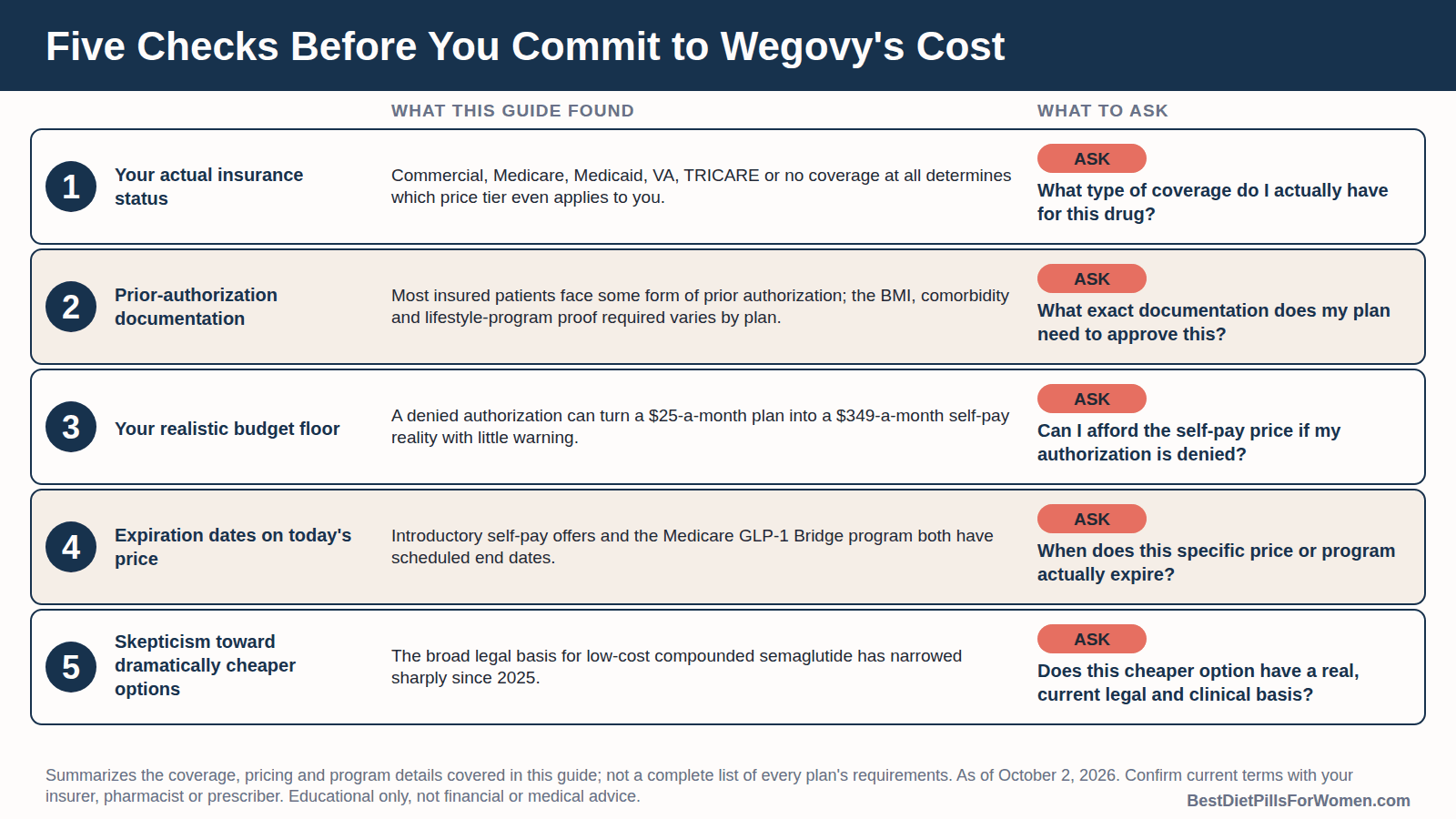
Start with your actual insurance status, not an assumption about it: knowing whether you have commercial insurance, Medicare, Medicaid, VA or TRICARE benefits, or no coverage at all determines which rows of Table 1 even apply to you. From there, check whether your plan requires prior authorization and what specific documentation it wants, since that’s the single biggest determinant of whether you land in the 9% unrestricted-coverage group or the much larger restricted or no-coverage groups. Finally, budget for the self-pay price as your realistic floor, not the copay-card price, since a denied authorization can turn a $25-a-month plan into a $349-a-month reality with little warning.
If you’re considering a telehealth platform rather than a local pharmacy, add one more line item to that budget: ask whether the advertised monthly price covers the drug alone or bundles in a separate clinician-visit or membership fee, and compare that all-in total, not just the headline number, against NovoCare Pharmacy’s direct price.
Checks Rooted in Your Treatment Plan
Two more checks matter once a payment path looks workable on paper. First, find out exactly when any time-limited pricing you’re relying on expires, whether that’s a two-fill introductory offer or the Medicare GLP-1 Bridge program’s scheduled end date, and have a plan for what happens afterward. Second, treat any dramatically cheaper alternative, especially a compounded product marketed as equivalent to Wegovy, with real skepticism rather than relief, since the legal and quality basis for that kind of lower price has narrowed substantially since 2025.
Walking through all five checks at once, with the specific question to ask at each step, is easier to follow as a single visual than as five separate paragraphs. Infographic 2 below lays them out that way.
What Could Change Your Answer
The checks above are a starting point, not a final verdict, because a few specific situations should genuinely change how you weigh the cost.
Signals the Price Picture Is About to Shift
If you’re a Medicare beneficiary watching the GLP-1 Bridge program, if your employer is in an open-enrollment period that could change your plan’s drug formulary, or if you’re approaching the end of an introductory self-pay offer, the price you’re comparing today may not be the price you’re actually paying in three months. In any of those situations, it’s worth timing your decision around the next known change rather than locking in based on today’s number alone.
Open enrollment deserves special attention here. Many employers only let you change your health plan once a year, so if your current plan excludes Wegovy or buries it behind unusually strict prior-authorization criteria, the next open-enrollment window may be your best opportunity to compare plan options before committing to another full year under the same restrictions.
When It’s Worth Asking for a Second Opinion on Cost
If a prior authorization is denied, that’s not necessarily the final word. Many plans have an appeals process, and a prescriber who documents your specific BMI, comorbidities and prior weight-management attempts clearly can sometimes get a denial reversed on appeal. It’s also worth asking your prescriber directly whether a different GLP-1 option, such as the alternatives covered in our comparison of semaglutide and tirzepatide or our Wegovy versus Zepbound comparison, might fit your specific coverage situation better than Wegovy does, since coverage and pricing can differ meaningfully between brands even when the clinical case for either one is similar.
Frequently Asked Questions About Wegovy Cost
A few specific questions come up often enough, and get confused often enough, that they deserve direct answers of their own.
Price and Payment
These three questions cover the mechanics of what you actually pay and why that number keeps changing.
Why Did Wegovy’s Price Drop in Late 2025?
Novo Nordisk cut its self-pay cash price from $499 to $349 a month in November 2025, months ahead of its originally planned early-2026 timeline, as part of a broader agreement with the federal government tied to the TrumpRx direct-to-consumer drug platform. The move was widely reported as an effort to get ahead of that federal pricing initiative rather than wait for it.
That timing matters mainly because it shows this price isn’t fixed; it moved once already in under a year, and policy-driven price changes like this one can happen again with little advance notice to patients.
Is the $199 Starter Price a Scam?
No, but it’s narrower than it sounds: the $199 introductory price applies only to the two lowest starter doses, only for a new patient’s first two fills, and it reverts to the standard $349 price once you move to a higher maintenance dose or use up those two fills. It’s a real, manufacturer-backed offer, not a bait-and-switch, but it was never meant to represent your ongoing monthly cost.
Treat it as a short bridge into treatment, not as the number to build your long-term budget around.
Can I Use the Copay Card and the Medicare Bridge Program Together?
No. The commercial copay card explicitly excludes anyone enrolled in Medicare, Medicaid, TRICARE, VA or another government program, and the Medicare GLP-1 Bridge is itself a government program with its own separate $50 flat price. These are two different paths built for two different insurance situations, not two discounts you can stack.
If you’re a Medicare beneficiary, the Bridge program’s $50 price, where you qualify for it, is generally going to be your most relevant option rather than the commercial card.
Does the Injection Cost the Same as the Pill?
No. The Wegovy tablet’s self-pay price generally runs lower than the injection pen’s, at $199 to $299 a month depending on dose, compared with $349 for the injection’s standard doses and $399 for the newer high-dose pen. The two forms also sit on separate savings-offer timelines, so an introductory price that applies to one form doesn’t necessarily apply to the other.
If swallowing a tablet versus using an auto-injector isn’t a strong preference either way, it’s worth asking your prescriber whether the form with the lower self-pay price is clinically appropriate for your situation.
Will Wegovy’s Price Keep Falling?
It’s genuinely uncertain, but the recent pattern points toward more downward pressure, not less: Novo Nordisk cut its self-pay price once in late 2025 under government pressure, Eli Lilly cut Zepbound’s price around the same time, and a separate Medicare negotiated price for semaglutide is scheduled to take effect in 2027. None of that guarantees any specific future price, and self-pay pricing has also moved in both directions before.
The practical takeaway is to re-check the current price whenever you’re about to commit to a new fill, rather than assuming either last year’s price or this year’s price will still be accurate next year.
Coverage and Access
These three questions cover the bigger structural question of whether, and how, you can get insurance involved at all.
Does Insurance Cover Wegovy for Weight Loss?
Sometimes, but not predictably: only about 9% of commercially insured people have unrestricted coverage, about 77% face restrictions like prior authorization, and about 14%, or roughly 27 million people, have no coverage for Wegovy at all. Whether your specific plan covers it depends on your employer’s benefit design, not just on whether you meet the FDA label’s BMI criteria.
The only way to know for certain is to check your own plan’s formulary and, if needed, ask your prescriber’s office to submit a prior-authorization request on your behalf.
What If My Insurance Denies Wegovy?
A denial isn’t always final: many plans allow an appeal, and a prescriber who documents your BMI, any qualifying comorbidities, and a prior documented attempt at diet and exercise can sometimes get an initial denial reversed. If your plan has a flat benefit exclusion for weight-management drugs specifically, though, an appeal is less likely to succeed than if the denial was about missing documentation.
Either way, it’s worth asking your prescriber’s office directly what their specific appeals success rate looks like with your insurer, since some offices have real experience with this exact process.
Is Compounded Semaglutide a Legitimate Way to Save Money?
Generally, no, not anymore: the broad legal basis that allowed mass-market compounded semaglutide ended with the 2025 shortage resolution, and what’s left is a narrow exception for a documented, patient-specific clinical need, not a general low-cost alternative. Products still marketed as cheap “semaglutide” without that specific clinical justification deserve real skepticism.
If cost is the barrier, the self-pay price, the commercial copay card and, for Medicare beneficiaries, the GLP-1 Bridge program are the more reliable levers covered earlier in this guide.
Why Do Different Pharmacies Quote Different Cash Prices for the Same Drug?
Because cash pricing for a brand-name drug isn’t set by a single national number: NovoCare Pharmacy’s direct price, a GoodRx-negotiated price at a specific retail pharmacy, and a telehealth partner’s bundled price can all differ for the identical product and dose. None of them is necessarily wrong; they’re simply different commercial arrangements layered on top of the same underlying drug.
That’s exactly why comparing the all-in price across two or three channels before you commit, rather than assuming the first price you see is the best one, is worth the extra five minutes.
The Bottom Line on Wegovy Cost
Pull back from the individual numbers, and a few conclusions hold up across almost every scenario in this guide.
What the Price Picture Means for You
Wegovy’s price isn’t one number, and the gap between the best and worst case is enormous.
The Biggest Realistic Advantage
The biggest realistic advantage in Wegovy’s current pricing is how many legitimate ways there now are to pay well below the roughly $16,200-a-year list price: a $349-a-month self-pay option open to anyone regardless of insurance, a copay card that can bring commercially insured patients down to $25 a month, and, for some Medicare beneficiaries through 2027, a $50-a-month federal pilot program. For a drug that cost $499 a month in cash just last year, that’s a meaningfully more accessible landscape than it was, and the direction of recent policy and competitive pressure, from Lilly’s parallel Zepbound price cuts to the 2027 Medicare negotiated price, suggests this isn’t a one-time blip.
The Biggest Limitation or Risk
The biggest limitation is that none of those lower prices is guaranteed to apply to you. Roughly 14% of commercially insured people have no coverage at all, most of the rest face prior-authorization hurdles that aren’t automatic approvals, the Medicare program is a temporary pilot with a hard end date, and the once-popular cheaper compounded workaround has largely closed off since 2025. Planning around the self-pay price as your realistic floor, rather than the best-case coupon price, is the more financially honest starting point for most people.
A Rational Next Step
None of this is a reason to make a decision today. It’s a reason to ask a few specific questions before you do.
Questions for Your Insurer or Pharmacist
Before committing to a payment path, ask your insurer whether Wegovy requires prior authorization under your specific plan and what documentation it wants, ask your pharmacist which self-pay channel, NovoCare Pharmacy or a partner program, currently offers the best price for your dose, and, if you’re on Medicare, ask whether your specific Part D plan participates in the GLP-1 Bridge program.
What to Re-Check Before You Pay
Every price in this guide can change without much notice, so re-check the current self-pay price, the copay card’s eligibility terms, and, if relevant, the Medicare Bridge program’s status directly with NovoCare, your insurer or Medicare before you pay for a fill. Our guide to weight loss medications, our comparison of weight loss pills and injections and our roundup of appetite suppressant options for women are good next stops if you’re still weighing Wegovy against other options.
Related Reading
Sources
These are the main sources behind this guide, chosen because they are the ones to check first for current facts. Prices, savings-offer terms and program rules change often, so confirm the latest version before you make decisions.
- U.S. Food and Drug Administration. WEGOVY (semaglutide) injection, for subcutaneous use — full prescribing information (label version 215256s030, 2026). https://www.accessdata.fda.gov/drugsatfda_docs/label/2026/215256s030lbl.pdf
- Novo Nordisk / NovoCare. Wegovy Price Guide: self-pay pricing by dose for the Wegovy injection pen, Wegovy HD pen and Wegovy tablet (NovoCare Pharmacy, read October 2, 2026). https://www.novocare.com/content/dam/novonordisk/novocare/redesign/pdf/Wegovy_Price_Guide.pdf
- Novo Nordisk / NovoCare. Wegovy Savings Offer: Terms and Conditions of Use (self-pay and limited-time new-patient offer, read October 2, 2026). https://www.novocare.com/content/dam/novocare/wegovy_standard_offer_tcs_2025_savings_offer_retail.pdf
- Centers for Medicare & Medicaid Services. Coming Soon: CMS to Provide $50 Monthly Access to GLP-1 Medications for Medicare Beneficiaries (press release, May 6, 2026). https://www.cms.gov/newsroom/press-releases/coming-soon-cms-provide-50-monthly-access-glp-1-medications-medicare-beneficiaries
- GoodRx Research. Tracking Insurance Coverage for Weight-Loss Medications (ongoing coverage-tracking report, reviewed July 10, 2026). https://goodrx.com/healthcare-access/research/tracking-insurance-coverage-weight-loss-meds
- GoodRx. Wegovy for Weight Loss: Cost and Coverage (read October 2, 2026). https://www.goodrx.com/wegovy/wegovy-for-weight-loss-cost-coverage
- QualChoice. Clinical Pharmacy Policy CP.PMN.295: Wegovy (semaglutide) prior-authorization criteria by indication (read October 2, 2026). https://www.qualchoice.com/media/8662/cppmn295.pdf
- theRxIndex. GLP-1 Compounding Rules After the Shortage Ends: 503A/503B status in 2026 (read October 2, 2026). https://therxindex.com/guides/glp-1-compounding-rules-after-shortage-ends/
- SingleCare. Can You Really Get Wegovy for $25? Copay-card eligibility and exclusions (read October 2, 2026). https://www.singlecare.com/blog/can-you-really-get-wegovy-for-25/
- HLTH. CMS Sets 2027 Medicare Prices for Wegovy, Trelegy and Other High-Spend Drugs (November 28, 2025). https://hlth.com/insights/news/cms-sets-2027-medicare-prices-for-wegovy-trelegy-and-other-high-spend-drugs-2025-11-28

