OTC appetite suppressants don’t have strong evidence behind them. As of September 24, 2026, we found no over-the-counter appetite suppressant with clear, repeatable, meaningful effects on hunger or body weight in good human trials, and the only FDA-approved OTC weight loss aid, alli, works by blocking some fat absorption rather than by quieting hunger.
The phrase “OTC appetite suppressant” has no legal meaning, and that’s where the confusion starts. When FDA reviewed nonprescription weight-control ingredients in 1991, it found none that qualified as generally recognized as safe and effective for that use. What’s on shelves and websites today are dietary supplements, which don’t need FDA approval before they’re sold and may say they “curb appetite” as long as they don’t claim to treat obesity. Some of these products contain fibers that lowered hunger ratings in a few short studies. Others contain stimulants, unproven plant extracts or, in the worst cases, undeclared prescription drugs.
This guide covers how U.S. law treats these products, how appetite works, what the research says about the ingredients you’ll see most often, what the safety picture looks like, how to read a label, what products cost, which marketing claims hold up, and what has better evidence for hunger. It’s written for women deciding whether an OTC appetite suppressant is worth trying, and it’s meant to sharpen your questions for a pharmacist or clinician, not to replace their advice. It’s part of our wider coverage of weight loss pills for women.
Do OTC Appetite Suppressants Work? The Short Answer
The short answer is worth reading first and checking against the rest of the guide. Each conclusion below is tied to a section that shows the reasoning, so you can judge it yourself.
The Direct Answer and How Sure We Are
Two things are worth separating here: what the evidence says, and how much weight we’d put on each part of it.
Do OTC Appetite Suppressants Work?
Not reliably, and not by much. Some ingredients, mostly fibers, have lowered hunger ratings or the next meal’s calories in short studies, but large reviews found small, inconsistent or no effects on body weight, and none of the ingredients we reviewed has clear, consistent human evidence of a meaningful effect on appetite or weight. The only FDA-approved OTC weight loss aid, alli, doesn’t suppress appetite.
How Sure We Are About That Answer
We’re most confident about the legal points, because they come from FDA and FTC documents, though we read most of those pages through summaries. We’re moderately confident about the ingredient evidence: the reviews are consistent, but many individual trials are small, short and funded by the companies that sell the ingredient, and we read most of them only as abstracts or page summaries. We have low confidence about what’s inside any specific product, because we saw no third-party testing seals on the pages we read and didn’t search for independent lab reports, and retailer pages show what sellers say. We rate each answer High, Moderate or Low on that basis.
Quick Answers to the Six Questions Most Shoppers Ask
Most searches for an OTC appetite suppressant boil down to six questions. Table 1 answers each one briefly, with our confidence level and the main limitation on the answer.
The Summary Table
Read across each row before reading down a column, because an answer and its limitation belong together.
| Question | Short answer | Our confidence | Biggest limitation |
|---|---|---|---|
| Is there an FDA-approved OTC appetite suppressant? | No. FDA’s 1991 final monograph found no generally recognized ingredients for OTC weight control. alli is FDA-approved OTC but blocks fat absorption. | High | We read regulator pages through summaries, and we found no final rule for two older proposals (PPA, benzocaine) |
| Can they reduce appetite? | Sometimes, briefly. Fibers such as alginate, guar and oat fiber most often lowered ratings right after a dose; long-term results are less clear. | Moderate | Small studies, many industry-linked; ratings are subjective |
| Do they cause meaningful weight loss? | Not reliably. Glucomannan averaged −0.22 kg (not significant) in one pooled analysis and −1.36 kg (low certainty) in another, and Batsis and colleagues found significant weight differences in fewer than a third of the low-risk-of-bias trials. | Moderate | Trials are short and differ in dose and design |
| Are they safe? | It depends on the ingredient. Bitter orange raised blood pressure in pooled trials, caffeine-heavy blends can raise heart rate, fibers can block the throat without enough water, and some products contain undeclared drugs. | Moderate | Many weight loss supplements haven’t been tested for safety |
| Are they worth the money? | Prices in our snapshot spanned roughly a 13-fold range per day (Table 7), and price didn’t track evidence. | Moderate | Prices and listings change daily and differ by seller |
| What works better for hunger? | Sleep, protein and water-rich foods have modest but real research support, and prescription medicines have far larger average weight results. | Moderate | Prescription options need a clinician, cost more and have their own risks |
Table 1 method: answers summarize the sections that follow, and each row’s sources appear there. “High” means the answer rests on regulator documents; “Moderate” means consistent but limited human evidence; “Low” means we couldn’t verify the answer. The 13-fold cost range compares the lowest and highest per-day figures in Table 7 and is a calculation, not a quoted price.
What Our Ratings Mean
We use three ingredient ratings later in the guide. Limited means some human data suggest an effect on appetite or weight, but the studies are small, short or linked to the seller. Mixed means several human studies point in different directions. No benefit found means the best human evidence we found showed no meaningful effect on appetite or weight. These ratings describe the strength of evidence, not safety, and none of them means an ingredient is proven.
How We Evaluated OTC Appetite Suppressants
Reviews in this category can mean anything from hands-on testing to a summary of a seller’s own website. We’d rather be exact about what this guide is.
What We Reviewed
This guide is desk research. We read FDA, FTC, NIH and HHS Office of Inspector General documents, prescribing labels, systematic reviews and individual trials, and retailer and brand listings checked on September 24, 2026. We didn’t buy, take or lab-test any product, and nothing here describes personal experience with one.
What We Couldn’t Check
Several journal databases blocked automated access during our research, so for some studies we relied on abstracts, official summaries and secondary reports, and we say so when it matters. We also couldn’t verify what’s inside any product: retailer pages show what sellers say, not what’s in the package. Prices and listings are one-day snapshots. And we didn’t rank brands, because a ranking would imply that some OTC appetite suppressants have solid evidence and others don’t.
What “OTC Appetite Suppressant” Really Means Under U.S. Law
The legal picture explains why the shelf looks the way it does. It also shows how much a product label can say without anyone at FDA reviewing the claim first.
Drugs, Supplements and Devices: Three Different Rulebooks
A product that’s meant to reduce hunger can land in any of three regulatory categories, and each one comes with different proof requirements.
Why OTC Drug Status Requires FDA Review
Under the federal Food, Drug, and Cosmetic Act, a product intended to treat or prevent a disease, or to affect the structure or function of the body, is generally a drug. Nonprescription drugs are supposed to follow either an FDA-approved application or an FDA “monograph,” a rulebook listing ingredients that experts have judged generally recognized as safe and effective for a specific use. For OTC weight control, that rulebook came out empty, as the next section explains.
How Dietary Supplements Reach the Shelf Without Approval
Dietary supplements are legally a category of food. They are the exception to the drug rule above: a supplement may describe how an ingredient affects the body’s normal structure or function, as long as the company has evidence that the claim is truthful, notifies FDA of the claim within 30 days of marketing, and carries a disclaimer that FDA hasn’t evaluated it. FDA doesn’t approve supplements before sale, and it can act against adulterated or misbranded products once they reach the market. Nearly every product marketed as an appetite suppressant that we found was a supplement.
Where alli and Plenity Fit
alli (orlistat 60 mg) is a drug, and FDA’s June 2026 page calls it the only FDA-approved OTC weight loss aid. Orlistat is a lipase inhibitor: it binds enzymes that break down dietary fat, so it works in the gut rather than in the brain’s hunger circuits, and the same page announced labeling changes that add warnings about kidney stones and kidney injury. Plenity, an oral hydrogel capsule that swells with water to promote fullness, is a device rather than a drug. FDA cleared it in January 2024, but its availability was unclear on September 24, 2026: a Plenity-branded website said it was not yet available for sale, and we couldn’t confirm who operates that site. Neither product is an OTC appetite suppressant, though alli sits beside true supplements in some retail categories.
What FDA Decided About OTC Weight-Control Ingredients
FDA looked at this question systematically once, in the 1980s and early 1990s, and it has been narrowing the field ever since. Table 2 lays out the key actions in date order.
The 1991 Final Monograph
FDA published its final monograph for OTC weight-control drugs on August 8, 1991, and it named no active ingredients as generally recognized as safe and effective. FDA’s regulation on OTC drug ingredients with inadequate data (21 CFR 310.545) lists weight-control ingredients that lack enough evidence for that use, among them caffeine, guar gum, karaya gum, methylcellulose, plantago seed (psyllium) and kelp, and sets a February 10, 1992 compliance date. We didn’t verify the exact number of ingredients on that list, and the list as we read it doesn’t name glucomannan or green tea. It did not ban any of these substances as foods or supplements. It meant that a company couldn’t sell them as an OTC weight-control drug without FDA approval.
Phenylpropanolamine: The Diet-Pill Stimulant FDA Pulled
Phenylpropanolamine (PPA) was once a common ingredient in OTC diet aids. On November 6, 2000, FDA issued a public health advisory about a risk of hemorrhagic stroke, or bleeding into the brain, and asked companies to stop marketing PPA products. The Yale study behind that advisory found the increased risk among women, both those using PPA for weight control and those using it for nasal decongestion, in the three days after starting. In 2005, FDA proposed formally moving PPA to non-monograph status for both uses, reporting an adjusted odds ratio of 16.58 for women using it in weight-control products. The estimate was imprecise, but even the lower confidence limit for the overall weight-control estimate was 2.04, which still points to a higher risk. We found no final rule for that proposal, and at the time, 13 of 14 members of FDA’s advisory committee had voted that PPA could not be considered generally recognized as safe for OTC weight control.
Guar Gum, Benzocaine and Other Older Actions
FDA clarified in March 1991 that guar gum remained non-monograph, and in 1993 it finalized a choking warning for water-soluble gums, a group whose title in the regulation names glucomannan, guar gum and psyllium. The warning reads, in part, that taking the product without adequate fluid “may cause it to swell and block your throat or esophagus.” We couldn’t verify whether that drug-labeling rule applies to supplements. In 2011, FDA proposed reclassifying benzocaine, an oral numbing agent once offered as a diet aid, as non-monograph for weight control because the data weren’t sufficient; we found no final rule for that proposal either.
| Date | Action | Who | What it means for shoppers |
|---|---|---|---|
| Mar 6, 1991 | Guar gums remain non-monograph | FDA | Guar can’t be sold as an OTC weight-control drug |
| Aug 8, 1991 | Final monograph: no generally recognized ingredients for OTC weight control | FDA | No ingredient qualified for an OTC weight-control monograph; 21 CFR 310.545 lists caffeine, fiber gums and kelp among weight-control ingredients with inadequate data |
| Aug 26, 1993 | Choking warning finalized for water-soluble gums | FDA | Fiber-gum products need adequate fluid; check the label |
| Nov 6, 2000 | Public health advisory on PPA and hemorrhagic stroke | FDA | FDA asked companies to stop marketing PPA products |
| Feb 11, 2004 | Final rule declaring ephedrine-alkaloid supplements adulterated (effective Apr 12, 2004) | FDA | Supplements with ephedrine alkaloids were declared adulterated |
| Dec 21, 2010 | Approval of the prescription drug Meridia (sibutramine) withdrawn | FDA | FDA cited a higher risk of heart attack and stroke; sibutramine now turns up as a hidden drug |
| Mar 9, 2011 | Proposed rule reclassifying benzocaine for weight control | FDA | FDA said the data didn’t support benzocaine for this use; we found no final rule |
| Nov 3, 2011 | Hoodia marketers settle FTC case | FTC | Appetite claims need real evidence |
| Oct 2012 | HHS OIG report on supplement claims | HHS OIG | OIG described “curbs appetite” as an allowed claim and “treats obesity” as a drug claim |
| Dec 20, 2022 | FTC health products compliance guidance | FTC | Human randomized trials are the usual standard of proof |
| Apr 22, 2024 | New York law restricting weight loss supplement sales to under-18s takes effect | New York | Some retailers now check age |
| Dec 10, 2024 | Warning letter to Veronvy over “GLP-1” appetite drops | FDA | GLP-1 framing plus trial claims can turn a supplement into a drug |
| Jun 2026 | FDA announces approved labeling changes for alli adding kidney stone and kidney injury warnings | FDA | FDA’s page calls alli the only FDA-approved OTC weight loss aid, and it now carries kidney warnings |
| Sep 18, 2026 | FDA Health Fraud Product Database updated | FDA | Tainted weight-loss products are still being added |
Table 2 method: dates and actions come from the regulator, legislative and legal-commentary sources cited in this section, read mostly through page summaries, and rows run in date order. The “What it means” column is our interpretation. Where we say we found no final rule, that reflects the sources we could read.
What Supplement Labels Are Allowed to Say About Appetite
The claim on the front of the bottle is where the law gets thin. The line between a permitted appetite claim and an illegal disease claim is narrower than most shoppers assume.
“Curbs Appetite” Versus “Treats Obesity”
An October 2012 HHS Office of Inspector General report drew the line this way: a supplement may claim it “curbs appetite” to help with weight loss, but it may not claim to aid weight loss to treat obesity, because obesity is a disease. That’s the office’s characterization, not an FDA regulation, and we found no FDA rule that explicitly rules on the phrase “appetite suppressant.” The same report found that 20% of the 127 weight loss and immune supplements it sampled had prohibited disease claims, and that FDA could retrieve notification letters for only 21 of the 127.
Where FDA Has Drawn a Harder Line: The Veronvy Letter
In December 2024, FDA warned the maker of Veronvy “Metabolic Boost Drops” that its products were unapproved drugs. The letter cited language saying the drops suppress appetite, a “Science of GLP-1” explanation, a claim of losing up to 52 pounds in three months in clinical trials, and a statement that FDA had approved the product. It isn’t a ruling that “suppresses appetite” alone is illegal, because the letter rested on the whole package of claims. A May 2025 trade report said it was then the only supplement-related GLP-1 warning letter.
What the FTC Requires Marketers to Prove
The Federal Trade Commission separately requires “competent and reliable scientific evidence” for health claims and says randomized, controlled human trials are the most reliable form of it. The FDA disclaimer doesn’t excuse a false claim: the FTC’s 2022 guidance says the supplement disclaimer or similar statements won’t cure an otherwise deceptive ad. In practice, that has meant enforcement after the fact, such as the 2011 hoodia settlement, in which the FTC alleged that marketers claimed their product was “clinically proven to reduce caloric intake by 1,000 to 2,000 calories per day” and that it wasn’t real hoodia.
How Appetite Works and Why a Pill Rarely Moves It
Women use weight loss supplements more often than men do: the NIH fact sheet reports that about 21% of women and 10% of men have used one at some point, though we didn’t identify the survey behind those figures. Understanding why hunger is hard to switch off with a capsule helps explain why the results in the sections that follow are so modest.
What Actually Drives Hunger and Fullness
Appetite is not a single dial. Treating it as one is what makes a pill sound more plausible than it is.
Hunger, Appetite and Satiety Are Three Different Things
Hunger is the physical drive to eat, appetite is the wish for particular foods, and satiety, the feeling of being full, is what ends a meal and delays the next one. Signals from the gut, fat tissue and brain feed all three, along with habit, stress, sleep and the food in front of you. A product that changes one of them, such as stomach fullness right after a meal, may leave the others untouched. That’s one reason a study can report “less hunger” at two hours without any change in weight after 12 weeks.
What a Proposed Mechanism Can and Can’t Tell You
A proposed mechanism is a biological explanation of how an ingredient might work, and it isn’t evidence that it does. A fiber that swells in the stomach is a plausible fullness aid, yet in one pooled analysis of eight glucomannan trials, weight change averaged −0.22 kg and wasn’t statistically significant. Even prescription labels stay cautious. Wegovy’s label says the drug decreases calorie intake and that its effects are “likely mediated by affecting appetite,” and the phentermine label says it hasn’t been established that appetite suppression is the primary way these drugs work in obesity. If even prescription labels hedge like that, an unregulated capsule deserves at least as much caution.
Why Appetite Changes for Women Across the Month and Across Life
Women’s appetite isn’t constant, and several things that shift it have nothing to do with willpower. Table 3 summarizes the factors with the best research behind them.
The Menstrual Cycle and Appetite
A 2025 meta-analysis of 15 datasets covering 330 women (mean age 26, average BMI 22.4) found higher energy intake in the luteal phase, the roughly two weeks after ovulation, than in the follicular phase, with a crude average difference of 168 kcal a day. Another review said the size of the swing isn’t yet clearly quantifiable and probably varies between women and from cycle to cycle, and a small 2026 study of 18 women found no phase differences. The evidence is mixed but leans toward a modest average rise before a period. It doesn’t show that any pill can offset it.
Perimenopause and Menopause
In the MONET cohort of 94 women followed through the menopausal transition (average BMI about 23), hunger and desire to eat rose during the transition and stayed higher afterward, while food-diary intake fell, a mismatch the abstract doesn’t explain. Body composition also shifts: in the SWAN study of 1,246 women, fat gain roughly doubled, from about 0.25 to 0.45 kg a year, and lean mass went from a slight gain to a slight loss. The Menopause Society calls aging the primary driver of midlife weight gain, notes that muscle declines 3% to 8% per decade after 30, and says hormone therapy isn’t a direct weight-loss treatment. We cover this life stage in more detail in our guides to weight loss pills for menopause and for perimenopause.
Polycystic Ovary Syndrome
A small 2019 study compared 30 women with obesity and PCOS to 23 women with obesity and no PCOS. Hunger returned earlier after a test meal in the PCOS group, about 75 minutes versus 135 minutes, and their usual intake was higher (2,309 versus 2,124 kcal a day). Blood insulin and ghrelin, a hunger hormone, weren’t associated with the hunger ratings. The condition’s international guideline says anti-obesity medications may be considered on the same basis as in the general population, and we found no statement about OTC appetite suppressants in PCOS. The condition was renamed polyendocrine metabolic ovarian syndrome (PMOS) in May 2026; our PCOS guide covers it in full.
| Factor | What research found | Size and study context | Main limit |
|---|---|---|---|
| Menstrual cycle | Higher intake in the luteal phase on average | Crude +168 kcal/day; 330 women, mean age 26, BMI 22.4 | Borderline significance (P =.039); one small study found no difference |
| Perimenopause and menopause | Hunger sensations rose while diary intake fell | 94 women, BMI about 23, followed over five years | One cohort; abstract doesn’t explain the mismatch |
| PCOS | Hunger returned earlier after a meal | 30 women with PCOS vs 23 controls, all with obesity | Cross-sectional; hormones didn’t explain it |
| Short sleep | Extending sleep by about 1.2 hours lowered intake by 270 kcal/day (95% CI −393 to −147) | 80 adults aged 21 to 40 with BMI 25 to 29.9; about half men; two weeks | Short trial; not tested in midlife women |
| Sleep loss (lab studies) | Intake rose by 385 kcal (95% CI 252 to 517) | Meta-analysis, 11 studies, 172 participants | Small, short experiments |
| Stress | Small average link with higher intake (Hedges’ g 0.114) | 54 studies, 119,820 participants | Large unexplained variation |
| Ultra-processed food environment | Intake 508 kcal/day higher on an ultra-processed diet; +0.9 kg vs −0.9 kg | 20 adults, two weeks per diet, inpatient | Small and short; abstract read only |
Table 3 method: figures come from the abstracts or summaries of the studies cited in the text (the Tasali, Al Khatib, Hill, Hall, Tucker, Japur and Duval papers were read as abstracts). Effect sizes are as the authors reported them. We did not pool or recalculate results, and the trials differ in population, duration and design, so rows aren’t directly comparable.
Sleep, Stress and Food Environment: The Levers a Pill Doesn’t Pull
Some of the largest appetite effects in the research come from ordinary conditions, and none of them is sold in a bottle.
Sleep and Energy Intake
In a randomized trial, 80 adults with overweight who usually slept under 6.5 hours got counseling that added about 1.2 hours of sleep per night, and their energy intake fell by 270 kcal a day compared with a control group over about two weeks. A meta-analysis of experimental sleep restriction found intake rose by 385 kcal in the short-sleep condition. Both sets of results come from short studies, so they show a direction, not a guaranteed result for a woman whose sleep is disrupted by hot flashes or night waking.
Stress and Ultra-Processed Food
Stress has a real but small average link to eating more: a meta-analysis of 54 studies found a Hedges’ g of 0.114, with a lot of variation between studies. Food environment may matter more. In a 20-person inpatient trial, people ate about 508 kcal a day more on an ultra-processed diet than on an unprocessed one, even though meals were matched for presented calories, energy density, sugar, sodium and fiber, and they gained 0.9 kg on one diet and lost 0.9 kg on the other.
What This Means for Buying a Pill
A supplement has to compete with an appetite that changes with the cycle, sleep, stress, hormones, and what’s in the pantry. Most trials of appetite ingredients last days to weeks and run in controlled settings that remove those factors. That doesn’t mean nothing works. It means a study result from a lab with a set meal shouldn’t be read as a forecast for your evening snacking, and it’s why we treat short-term hunger ratings as weaker evidence than weight change over months.
What Research Shows About Common OTC Appetite Ingredients
Most OTC appetite suppressants are built from a short list of ingredients. Some have appetite studies, some have only weight studies, and a few have neither. We looked for human trials first, then for the reviews that pool them.
Fibers That Swell in the Stomach
Fibers are the one ingredient group with a plausible, well-understood way to affect fullness, and they’re also the group with the most trials. That makes them the fairest place to start.
Glucomannan From Konjac Root
Glucomannan is a viscous fiber that absorbs water and thickens into a gel. Its appetite evidence is thin. In a crossover study of 16 healthy adults, replacing part or all of a starchy noodle meal with low-energy konjac gel cut intake at that meal by 23% to 47%, yet ratings of hunger were 31% higher after full substitution than after the control meal. That’s a food-substitution study, not a capsule trial. In an eight-week trial of 53 overweight adults taking 1.33 g three times a day, weight didn’t differ from placebo, and belching, bloating and stomach fullness were more common on glucomannan. A pooled analysis of eight trials found an average change of −0.22 kg that wasn’t statistically significant, although a later network meta-analysis reported −1.36 kg with low certainty. One 2024 trial of a glucomannan, inulin and psyllium blend reported larger losses over 180 days, but it enrolled only 112 people selected by genotype, used a blend rather than glucomannan alone, and involved the manufacturer. Mixed evidence is the honest summary, with no capsule-based appetite trial we could confirm.
Psyllium, Guar Gum, Alginate and Pectin
A comprehensive review of 136 human studies of extracted fibers (107 acute, 29 chronic) in healthy adults concluded that most fiber types didn’t significantly change appetite ratings or energy intake; alginate, guar gum and oat fiber most often lowered appetite ratings right after a dose. Two crossover trials of psyllium (Metamucil) found lower hunger and higher fullness between meals at doses from 3.4 to 10.2 grams, most consistently at 6.8 grams, but the meals were controlled, the outcome was a rating scale, and Procter & Gamble funded the work. Guar gum has the clearest negative result: 20 randomized trials with 394 participants found no meaningful weight difference (−0.04 kg), and the authors judged the risks to outweigh the benefits. An alginate trial in 96 people on a diet showed no significant difference in the intention-to-treat analysis, while completers lost 6.78 versus 5.04 kg, and the trial was industry-funded. Pectin lowered hunger ratings only about 2%, and the drop in calories seen after one exposure faded with repeated exposure.
Plant Extracts Sold for Appetite Control
Herbal extracts dominate the labels, and they lean on the smallest studies. Several of the trials below were funded by the company that sells the extract, and our guide to natural appetite suppressants covers the wider plant-based category.
Hoodia and Caralluma
Hoodia has one human trial we found, in 49 overweight women over 15 days. Intake and weight didn’t differ from placebo, and the extract caused nausea, vomiting and changes in skin sensation, along with higher blood pressure, pulse and bilirubin. Unilever funded the study. NIH calls it “the one small study” and says little is known about hoodia’s safety. Caralluma has two positive, manufacturer-funded trials, one in 50 adults over 60 days and one in 83 completers over 16 weeks that reported lower calorie intake and a waist that shrank 2.7 cm while the placebo group’s grew 0.3 cm, but a 2021 meta-analysis of seven articles found no significant effect on weight, BMI or appetite, and its authors said they were unlikely to recommend it.
Saffron Extract and 5-HTP
A saffron extract sold as Satiereal was tested in 60 mildly overweight women for eight weeks at 176.5 mg a day. Weight fell more than with placebo and snacking dropped, but the extract’s supplier funded the trial. A 2026 meta-analysis of 28 trials found an average weight difference of −1.09 kg with an interval that barely excluded zero, while a 2022 analysis found −0.12 kg (not significant) and rated most of the evidence very low quality. The 5-HTP evidence is older still: two small studies from one Italian group in 1989 and 1992 (19 and 20 patients) reported less food intake, early fullness and weight loss, at doses of 8 mg per kg a day and 900 mg a day. We found no modern trial confirming them, and 5-HTP can interact with antidepressants.
Stimulants, Minerals, Vinegar and “GLP-1 Boosters”
This group covers the ingredients that show up in fat-burner-style blends and in the newest marketing wave. The evidence is broad, but it’s not deep.
Caffeine, Yerba Mate, Guarana and Bitter Orange
A review of caffeine and appetite concluded that caffeine taken 0.5 to 4 hours before a meal may reduce energy intake at that meal, while effects on appetite perception were equivocal. A small crossover study of 17 women found that a yerba maté, guarana and damiana blend lowered calories at one lunch by about 43 kcal; the supplier donated the product. Bitter orange (synephrine) fares worse: a meta-analysis of 18 trials and 341 participants found blood pressure rose about 6.4 mmHg (systolic) and 4.3 mmHg (diastolic) after roughly eight weeks, with no significant weight loss, and the authors concluded there’s no evidence synephrine facilitates it. Because caffeine and guarana count toward the same daily total, we return to them in the safety section.
Green Tea Extract and Green Coffee
The Cochrane review of green tea found a non-significant loss of −0.04 kg in six studies conducted outside Japan and called the amount too small to matter clinically. The network meta-analysis put green tea at −1.25 kg with low certainty. Neither reported appetite outcomes in the sources we read. Green coffee extract carries a cautionary history. The small trial behind the craze was retracted in October 2014, and in its 2014 and 2015 cases the FTC alleged that the research was seriously flawed, settling for $3.5 million with the extract’s supplier and $9 million in consumer redress with a marketer.
Chromium and Apple Cider Vinegar
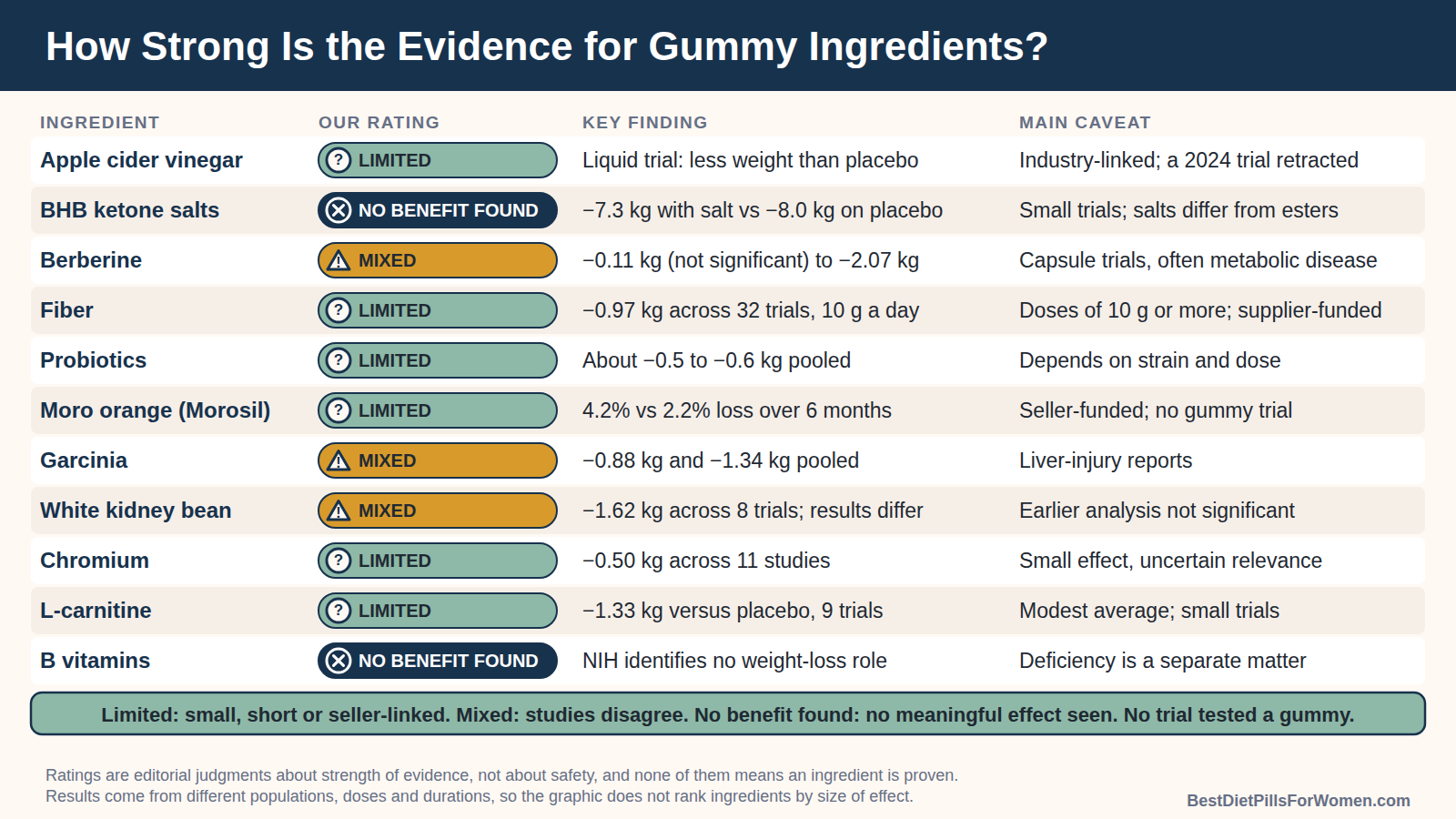
In a trial of 42 women with carbohydrate cravings, 1,000 mcg of chromium picolinate for eight weeks lowered food intake, hunger and fat cravings compared with placebo, while the weight difference didn’t reach significance (P = 0.08). A pooled analysis of 11 trials found an average of −0.50 kg, with a confidence interval that just excluded zero. Vinegar’s story is more tangled. A 2024 trial reporting 6 to 8 kg losses in 12 weeks was retracted in September 2025 for implausible statistics and missing registration, and a 2025 meta-analysis included it, so we don’t quote that pooled figure. A review of vinegar and appetite found four of six short-term studies reported suppressed appetite and none of the long-term studies did, and an earlier crossover study found the appetite effect came with more nausea.
Berberine and Other “GLP-1 Boosters”
Supplements marketed as GLP-1 boosters, with berberine and cinnamon among the ingredients, don’t deliver GLP-1 the way a prescription drug does. A Geisinger obesity physician said in March 2026 that there’s little to no scientific evidence that they raise GLP-1 enough to cause significant weight loss. NIH says the berberine evidence isn’t conclusive, and the Department of Defense’s supplement-safety program notes that a reported 0.84 kg average loss disappears when low-quality studies are excluded. One small 14-day trial of a low-dose berberine formulation reported higher GLP-1 blood levels in 36 people, but it measured no appetite or weight outcomes, it involved the manufacturer, and we read it secondhand. A dihydroberberine trial that will measure appetite was still recruiting, with no published results that we found. Many of these products are sold as chews and gummies, which we cover in our guide to weight loss gummies.
| Ingredient | Appetite or intake evidence | Weight evidence | Our rating | Main caution |
|---|---|---|---|---|
| Glucomannan (konjac) | One noodle-substitution study (hunger higher); one manufacturer-linked blend trial | −0.22 kg (not significant) in one pooled analysis; −1.36 kg (low certainty) in another | Mixed | Choking or blockage without enough fluid |
| Psyllium, guar gum, alginate, pectin | Lower hunger ratings in some short studies; most fiber types showed no significant effect | Guar −0.04 kg across 20 trials; alginate difference only in completers | Mixed | Gas, cramping, blockage without fluid |
| Hoodia | One 15-day trial: no difference in intake | No difference in weight | No benefit found | Nausea, vomiting, higher blood pressure and bilirubin; products may contain little hoodia |
| Caralluma | Two manufacturer-funded trials positive; meta-analysis found no appetite effect | No significant effect on weight or BMI; waist −1.59 cm | Mixed | Human safety data are mostly sponsor-funded |
| Saffron extract | One supplier-funded trial (60 women) reported less snacking | −1.09 kg (borderline) vs −0.12 kg (not significant) in two meta-analyses | Limited | Avoid amounts above food levels in pregnancy |
| 5-HTP | Two small trials from 1989 and 1992 | Weight loss reported in those trials; no modern replication found | Limited | Serotonin syndrome risk with antidepressants and some other drugs |
| Chromium picolinate | 42 women: intake, hunger and cravings lower | −0.50 kg across 11 trials | Limited | Interacts with insulin and levothyroxine |
| Caffeine, guarana, yerba maté | May reduce intake at the next meal; appetite ratings equivocal | Not established as an appetite effect | Mixed | Heart rate, blood pressure, sleep; counts toward a shared daily total |
| Green tea extract (EGCG) | Not measured in the sources we read | −0.04 kg (Cochrane, non-Japan studies) to −1.25 kg (network meta-analysis) | Mixed | Liver injury reports; take with food |
| Bitter orange (synephrine) | No appetite outcome in the summary we read | 0.6 kg, not significant, across 18 trials | No benefit found | Raised blood pressure in pooled trials |
| Apple cider vinegar | Some short-term appetite reductions, often with nausea | Key positive trial retracted | Limited | Tooth enamel and esophagus irritation |
| Berberine and “GLP-1 boosters” | GLP-1 levels rose in one small trial; no appetite outcome | About −0.84 kg, gone when low-quality studies are excluded | Limited | GI effects; interacts with cyclosporine; may be unsafe in pregnancy |
Table 4 method: ratings apply the definitions in the section “What Our Ratings Mean.” Figures are as reported by the reviews or trials, most of which we read as abstracts or through page summaries. The trials differ in population, dose, duration and design, so the table lists them for context and doesn’t rank ingredients by size of effect. “Not measured in the sources we read” is not a finding that no study exists.
What the Big Reviews Conclude
Pooled reviews smooth out the noise of single trials, and on this topic they lean in the same direction.
Reviews of Weight Loss Supplements as a Group
Batsis and colleagues screened 20,504 citations and found 315 randomized trials of 14 supplements or therapies. Of the 52 trials at low risk of bias, 16 (31%) found significant weight differences, ranging from 0.3 to 4.93 kg. An earlier review concluded that none of the reviewed supplements could be recommended for over-the-counter use, and a review of nine systematic reviews found none was supported by sound evidence for clinically relevant weight effects without undue risk. A 2013 review of 14 double-blind trials of plant extracts with appetite-suppressing properties found the evidence mostly inconclusive, with Caralluma and one Garcinia-Gymnema combination the exceptions. And a 2026 review of natural appetite strategies described effects as generally small to modest and short term, supporting “cautious integration rather than stand-alone use.”
Why the Numbers Disagree
The pooled figures don’t line up, and that’s worth understanding. A 2017 meta-analysis of 12 trials of soluble fiber found −2.52 kg but flagged considerable heterogeneity, while a 2020 analysis of 62 trials asking whether viscous fiber works independently of an energy-restricted diet found a small but statistically significant −0.33 kg. The network meta-analysis reported −3.70 kg for psyllium with moderate certainty, yet a 2025 analysis found no benefit for BMI or waist. Differences in who was enrolled, whether people were also dieting, dose, duration and study quality all move the answer. The practical reading is that viscous fibers may shift weight by a small amount on average, and that a small weight effect isn’t the same as an appetite effect: no fiber product has earned the label “appetite suppressant” on its own.
Safety of OTC Appetite Suppressants: Side Effects, Hidden Ingredients and Who Should Be Careful
Natural doesn’t mean harmless, and “over the counter” doesn’t mean tested. NIH says many weight loss supplements, including ones sold as fat burners or appetite suppressants, haven’t been tested for safety. The risks differ by ingredient, so this section takes them in groups. It doesn’t replace advice from a pharmacist or clinician who knows your medications and health history.
Common and Serious Side Effects by Ingredient Type
Most people who have problems with these products notice them within days. A few effects are serious, and those deserve the closest attention.
Fibers: Gas, Cramping and Blockage Risk
Gas, bloating and stomach discomfort are the usual complaints with fiber products. In the glucomannan trial mentioned earlier, belching (13.4% versus 4.1%), bloating (12.7% versus 3.7%) and stomach fullness (11.9% versus 2.4%) were all more common than on placebo. The serious risk is physical blockage. Health Canada warned in 2010 that glucomannan in tablet, capsule or powder form can cause choking or blockage of the throat, esophagus or intestine if taken without at least 8 ounces of fluid, and that it shouldn’t be taken right before bed. FDA’s rule for water-soluble gums in OTC drugs carries a similar warning, although we couldn’t verify whether it applies to supplements. Take fiber products with a full glass of water, and skip them if you have trouble swallowing or a narrowed esophagus, as at least one manufacturer’s label advises.
Stimulants: Heart Rate, Blood Pressure and Sleep
Caffeine is the most common stimulant in “appetite” and “fat burner” blends, often under names such as guarana, yerba maté or green tea extract. FDA has cited 400 mg a day for most adults as an amount not generally associated with negative effects, and it estimates that toxic effects such as seizures can occur with rapid intake of around 1,200 mg. NIH warns that supplements with large amounts of caffeine or caffeine-containing herbs like guarana may raise heart rate and cause abnormal heart rhythms. In FDA’s 2018 guidance, products made of pure or highly concentrated caffeine had been linked to at least two deaths. Bitter orange (synephrine) raised blood pressure in the pooled trials, as covered above. The catch with blends is that caffeine may be spread across several ingredients, so the label total can be hard to see.
Liver, Skin and Other Concerns
Green tea extract is the ingredient with the clearest liver signal. LiverTox rates it “well established” as a cause of clinically apparent liver injury and counts more than 100 reported cases; the European Food Safety Authority found raised liver enzymes at 800 mg or more of EGCG a day and couldn’t identify a safe dose. A U.S. Pharmacopeia review linked case reports to EGCG intakes from 140 to about 1,000 mg a day and recommends taking green tea extract with food. Other reported problems include nausea, vomiting and skin-sensation changes with hoodia, watery stools, headache and vertigo with chromium, and tooth-enamel erosion and esophageal irritation with regular vinegar use. If you have liver disease, don’t use a green tea extract without asking a clinician first.
alli (Orlistat): Bowel Effects, Kidney Warnings and Vitamins
alli isn’t an appetite suppressant, but it’s sold in the same aisle and it’s the one OTC weight loss drug, so its safety information belongs here. Its Drug Facts label tells users to expect bowel changes such as gas, loose stools and more frequent stools, to follow a reduced-calorie, low-fat diet and to take a multivitamin once a day at bedtime. It says not to use alli with cyclosporine or if you’ve been diagnosed with problems absorbing food, and to ask a doctor first if you have gallbladder problems, kidney disease or kidney stones, or pancreatitis. In June 2026, FDA said it had approved labeling changes to warn of kidney stones and kidney injury.
Hidden Drugs and Illegal Ingredients
The most serious risk isn’t on the label at all. Some weight-loss products sold as supplements contain drugs that were never declared.
What FDA Has Found in Weight Loss Products
FDA says it has found weight loss products sold as dietary supplements that contain hidden prescription drugs and other illegal ingredients, including sibutramine, fluoxetine, phenytoin, rimonabant and phenolphthalein. Its Health Fraud Product Database, updated September 18, 2026, was still adding such products: by our count, six entries between June and mid-September 2026 named undeclared sibutramine or phenolphthalein. FDA describes that list as only a small fraction of potentially hazardous products, and says it cannot test every weight loss product on the market. Sibutramine can substantially raise blood pressure or heart rate in some people, and phenolphthalein isn’t an active ingredient in any approved U.S. drug, with studies indicating it may increase the risk of cancer.
Ingredients FDA Treats as Illegal or Unsafe
Sibutramine was sold as the prescription drug Meridia until FDA withdrew its approval in December 2010 because it posed an increased risk of heart attack and stroke. DMAA isn’t a dietary ingredient under FDA’s view, and FDA says DMAA-containing supplements are illegal and can raise blood pressure and lead to cardiovascular problems ranging from shortness of breath to heart attack. FDA considers DMHA an unsafe food additive that doesn’t meet the definition of a dietary ingredient. Ephedra-containing supplements have been declared adulterated since April 2004. If a label lists any of these, or the product claims to work like a prescription drug, treat it as a red flag and don’t buy it.
How to Lower the Odds of Buying a Tainted Product
You can’t eliminate the risk by reading a label, because tainted products often don’t list the drug. But some steps help. Be wary of claims that sound like drug results and of any product that says it’s “FDA approved,” since dietary supplements aren’t. Buy from sellers with a real return address, and check FDA’s health fraud database and warning pages before you order. Look for a third-party quality mark such as USP or NSF, which we cover in the label section; a mark tells you the contents were checked, not that the product works. And ask a pharmacist about interactions with any medications you take.
Who Should Be Especially Careful
Some situations make certain ingredients a poor idea, or at least a reason to ask a professional first.
Pregnancy, Breastfeeding and Trying to Conceive
alli’s label says not to use it if pregnant or breast-feeding, and the prescription weight loss medicines carry similar language, including a label statement that weight loss offers no benefit to a pregnant patient and may cause fetal harm. For supplements, the reliable information is thinner. ACOG says caffeine under 200 mg a day doesn’t appear to be a major contributing factor in miscarriage or preterm birth, and MotherToBaby says most experts suggest pregnant women limit caffeine to 200 mg or less a day. NIH says berberine may be unsafe in pregnancy and breastfeeding, that bitter orange may not be safe, and that little is known about hoodia in pregnancy. Saffron shouldn’t be used above food amounts during pregnancy because it could stimulate the uterus. If you’re pregnant, breastfeeding or trying to conceive, ask your obstetric clinician before taking any appetite supplement.
Eating Disorders and Diet Pill Use
This is a risk that doesn’t appear on any label. In a study that followed 1,015 female adolescents and young adults, those who used diet pills for weight control had 3.58 times the risk (95% CI 1.96 to 6.54) of a first-time eating disorder diagnosis within five years, and laxative users had 2.77 times the risk; the diagnoses were self-reported and the study shows association, not cause. A separate study of young women reported first diagnoses in 1.8% of past-year diet pill users versus 1% of nonusers over the next one to three years. A 2026 study of U.S. women found that higher eating disorder symptoms predicted later use of OTC weight loss supplements, prescription medicines and GLP-1 drugs. If you notice that you’re restricting, bingeing, purging or feeling distressed about food, please talk with a clinician. The ANAD helpline is 1-888-375-7767 (Monday through Friday, 9 a.m. to 9 p.m. Central), the National Alliance for Eating Disorders helpline is 1-866-662-1235 (Monday through Friday, 9 a.m. to 7 p.m. Eastern), and you can call or text 988 in a crisis.
Medications, Heart or Liver Conditions and Buyers Under 18
Several ingredients interact with prescription drugs. 5-HTP can contribute to serotonin syndrome, a dangerous excess of serotonin, when combined with antidepressants or the antibiotic linezolid. Chromium can raise the risk of low blood sugar with insulin and reduce absorption of levothyroxine, and berberine can interact with the transplant drug cyclosporine. Anyone with heart rhythm problems, high blood pressure or liver disease has extra reason to avoid stimulant blends and green tea extract. For minors, New York has prohibited selling OTC diet pills and weight loss supplements to people under 18 since April 22, 2024, with penalties of up to $500 per violation, and the Second Circuit upheld the denial of a preliminary injunction against the law in November 2025. That ruling wasn’t a final judgment on the law, and we didn’t verify age-limit laws in other states.
Table 5 pulls the ingredient-level cautions from this section into one place, so you can look up a product’s main ingredients at a glance.
| Ingredient or product type | Common effects | Serious concerns | Who should be extra careful |
|---|---|---|---|
| Fiber gels (glucomannan, psyllium, guar) | Gas, bloating, belching, stomach fullness | Choking or blockage of throat, esophagus or intestine without enough fluid | People with swallowing difficulty or esophageal narrowing |
| Caffeine, guarana, yerba maté blends | Jitteriness, faster heartbeat, sleep loss | Abnormal heart rhythms; seizures at very high intake | Anyone with heart rhythm problems; pregnancy and breastfeeding |
| Bitter orange (synephrine) | Higher blood pressure in pooled trials | Adverse cardiovascular reports in multi-ingredient products | People with high blood pressure; pregnancy |
| Green tea extract (EGCG) | Stomach upset | Liver injury (more than 100 cases reported) | People with liver disease; take with food |
| Hoodia | Nausea, vomiting, skin-sensation changes | Higher blood pressure, pulse and bilirubin in one trial | Pregnancy (safety unknown) |
| 5-HTP | Nausea, diarrhea | Serotonin syndrome with antidepressants or linezolid | Anyone taking antidepressants |
| Chromium picolinate | Watery stools, headache, vertigo | Low blood sugar with insulin; lower levothyroxine absorption | People using insulin or thyroid hormone |
| Apple cider vinegar (liquid, tablets, gummies) | Nausea; tooth-enamel wear | Esophageal ulceration, low potassium | Regular users of concentrated vinegar |
| Berberine | Nausea, abdominal pain, diarrhea, constipation | Cyclosporine interaction; likely unsafe for infants, and possibly unsafe in pregnancy and breastfeeding | Transplant patients; pregnancy and breastfeeding |
| alli (orlistat), a fat-absorption blocker | Gas, loose or more frequent stools | Kidney stones and kidney injury warnings | People with gallbladder, kidney or pancreas problems or absorption disorders; those taking cyclosporine; pregnancy and breastfeeding |
| Tainted “weight loss” products | Unpredictable | Sibutramine: higher blood pressure and heart rate, heart attack and stroke risk; phenolphthalein: possible cancer risk | Everyone; the drug isn’t on the label |
Table 5 method: effects and warnings are taken from the regulator, NIH, trial and review sources, and each row summarizes what those sources report rather than a full drug-interaction check. “Common effects” are those named in the sources, not measured frequencies. A missing effect doesn’t mean it can’t occur.
Warning Signs and How to Report a Problem
Knowing when to stop and who to tell is part of using any supplement responsibly.
Symptoms That Need Prompt Medical Care
Stop the product and get medical help quickly for chest pain, a racing or irregular heartbeat, fainting, severe headache, trouble swallowing or breathing, vomiting that won’t stop, or severe abdominal pain. With green tea extract, the USP labeling language also calls for stopping and seeking advice with symptoms of liver trouble such as abdominal pain, dark urine or yellowing of the skin or eyes. This list isn’t exhaustive, and it isn’t a substitute for emergency care. If something feels wrong after starting a product, the safest move is to stop and ask.
Reporting Adverse Reactions and Suspicious Products
FDA takes voluntary reports of problems with dietary supplements, including through its MedWatch program, and uses them to spot patterns. Reports help even if you’re not sure the product caused the problem. Keep the bottle, the lot number and the seller’s details, and tell your clinician what you took, including the dose and how long.
How to Read an OTC Appetite Suppressant Label
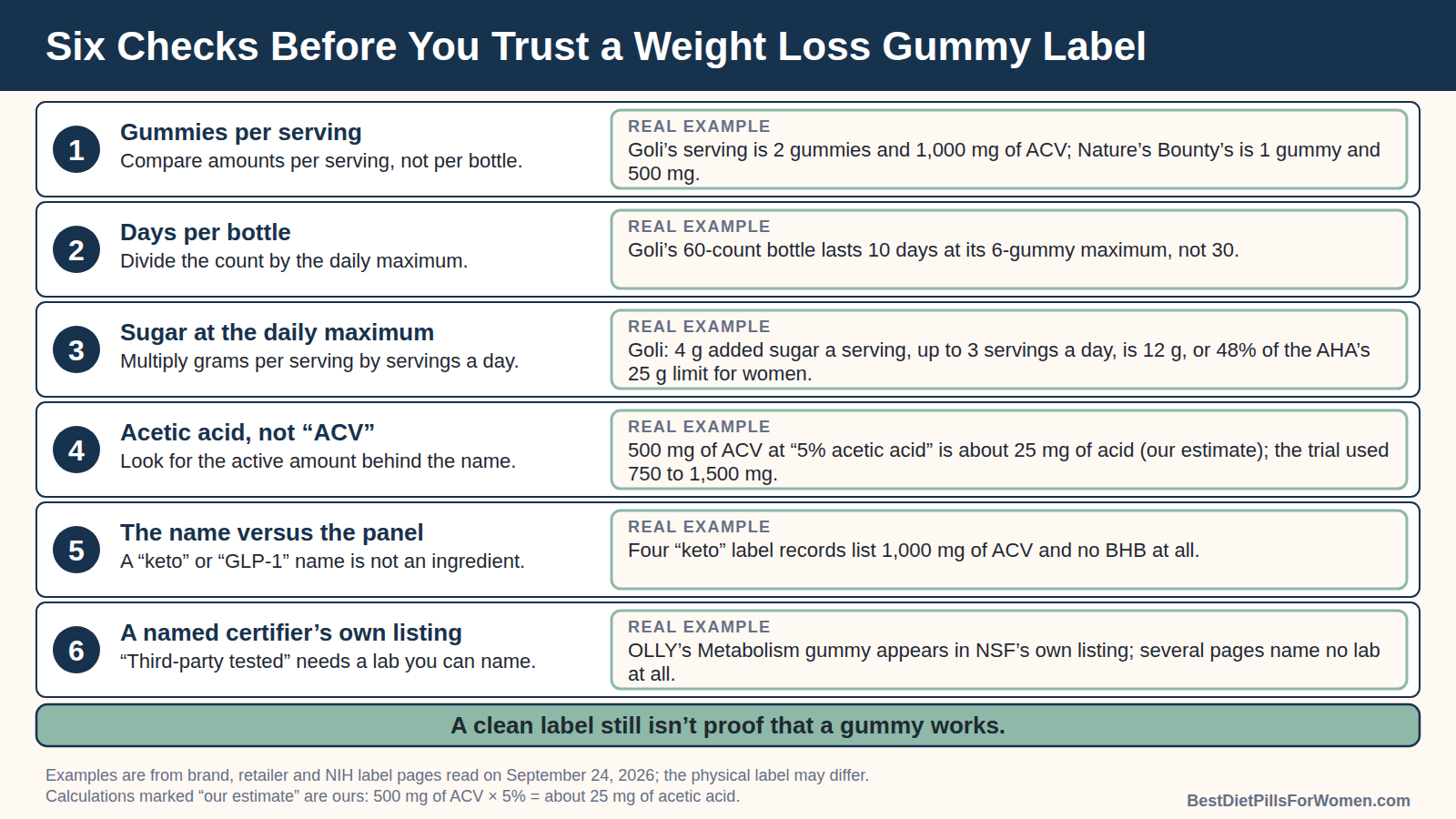
A label won’t tell you whether a product works, but it will tell you whether you can even judge the question. The real examples below come from listings we read on September 24, 2026.
The Supplement Facts Panel: What It Shows and What It Hides
The panel is the most useful part of the package, and it’s the part that’s easiest to misread. Three habits catch most of the problems.
Serving Size Versus Daily Dose
The amount printed on the panel is per serving, and a serving is often several capsules. NOW Foods’ glucomannan lists 1,725 mg per serving, but a serving is three 575 mg capsules, and the directions say to take one to two servings a day, so the daily amount is 1.7 to 3.45 g. alli works the other way: its Drug Facts label says to take one capsule with each meal containing fat, up to three capsules a day. Count capsules per day, not per bottle, and multiply before you compare a product with a study dose.
Proprietary Blends and Stimulant Totals
A proprietary blend lists ingredients under one combined weight, which hides how much of each you’re getting. Zantrex Black’s panel shows a “Proprietary Blend” of 1,160 mg per two softgels that names 13 extracts, including caffeine, and doesn’t itemize any of them; the brand’s page says the product contains a xanthine mixture of caffeine and caffeine-like stimulants of about 300 mg per serving. With a label maximum of six softgels in 24 hours, that’s three servings, or about 900 mg of the mixture, a figure we calculated because the page doesn’t state a daily total. GNC’s Appetrex Control lists an herbal blend of 522.5 mg that includes black tea, green tea, green coffee bean and yerba maté, with no caffeine line on the panel we read, and we could read an amount for only some of the individual components. By contrast, EVL Lean Mode itemizes five ingredients (green tea, green coffee, CLA and acetyl-L-carnitine at 500 mg each, and garcinia at 250 mg per three capsules), and Lemme Curb lists per-chew amounts for most of its ingredients. Itemizing doesn’t make a formula effective. It does let you check the dose.
Caffeine That Isn’t Labeled as Caffeine
Caffeine hides under other names: guarana, yerba maté, kola, green tea and green coffee extracts, trimethylxanthine, and “xanthine mixture.” Dexatrim Max Complex 7’s retailer text lists 150 mg of caffeine per serving with a maximum of four capsules, or two servings, in 24 hours, which we calculate as 300 mg. PhenQ’s brand page names caffeine among its ingredients and says not to take it after 3 p.m., but the page text we read gave no amount; a 2024 third-party review reported 150 mg per serving. “Stimulant-free” on the front of a bottle doesn’t guarantee zero caffeine when green tea or green coffee extracts appear in the panel. Adding the totals across everything you take, including coffee, is the only way to compare against FDA’s 400 mg figure.
Does the Label Dose Match the Study Dose?
A trial result belongs to the dose, the extract and the population that were studied. A product that names the same ingredient at a different dose has borrowed the reputation, not the evidence.
Doses That Are Higher or Lower Than the Research
Several popular products sit far from the doses in the studies. NOW’s 5-HTP capsules contain 100 mg or 200 mg and carry mood-support and relaxation-and-sleep labeling rather than an appetite claim, while the 1992 appetite trial gave 900 mg a day, which is 4.5 times the 200 mg capsule and 9 times the 100 mg one. One Life Extension page lists 78 mg of saffron extract per capsule, taken twice a day, or 156 mg, while two retailer listings of the same product showed 88.25 to 88.5 mg per capsule, about 177 mg a day; we couldn’t tell which matches the current label, and the 2010 trial used 176.5 mg a day. NIH says chromium-only supplements commonly provide 200 to 500 mcg, some up to 1,000 mcg, and the 2008 trial used 1,000 mcg; Lemme Curb’s 1,000 mcg per chew matches that dose. For green tea, NOW’s capsule contains 200 mg of EGCG, one-quarter of the 800 mg daily level at which EFSA reported raised liver enzymes, though EFSA also said it couldn’t identify a safe dose. Matching a trial dose isn’t a virtue in itself, because some study doses raise safety questions.
Why “Clinically Studied” Rarely Means This Exact Product
When a label says “clinically studied,” look for the branded extract. Trials of saffron and caralluma used specific, sometimes patented extracts supplied by the company that sells them, and a generic capsule with the same plant name may not match. Marketing statistics deserve the same scrutiny. Hydroxycut Hunger Control’s “reduced hunger by 74% at 2.5 hours” traces to a footnote describing a single study in healthy normal-weight adults who took 3 g of SlimBiome, a patented prebiotic and fiber blend, with hunger scores of 28 mm versus 7.3 mm on a visual analogue scale at 150 minutes after a carbohydrate-rich drink, not a weight-loss result. GNC’s “nearly 10%” calorie reduction comes from a one-week crossover in 30 healthy adults. Those are the sellers’ own descriptions, and we didn’t evaluate the underlying studies.
Seals, Testing Claims and Company Transparency
Trust signals on a supplement fall into different categories, and only one of them tells you what’s in the bottle.
What USP and NSF Marks Mean
A USP Verified or NSF Certified mark means an independent organization checked that the product contains what the label says, in the stated amounts, and screened for certain contaminants. ConsumerLab runs its own testing program. On the pages we read, we saw none of these marks, though summaries are lossy and a seal shown only as an image could have been missed. NOW’s pages list an Intertek GMP certification, a manufacturing-practices credential, and PhenQ says it’s made in “GMP-approved facilities.” One caralluma listing says “third-party lab tested” without naming the lab. Good manufacturing practice is worth having. It isn’t the same as a lab confirming the contents.
Seller, Company and Contact Details
Check who is actually selling. On Walmart’s site, the Dexatrim Max listing we read was sold by a third-party seller and fulfilled by Walmart, and the GNC Appetrex Control listing was sold by a marketplace seller rather than GNC. Look-alike domains are another problem: when we searched for Leanbean, the.com address we looked up didn’t resolve, the hyphenated domain was a “launching soon” placeholder, and other sites called themselves official, so we couldn’t tell which, if any, belonged to the manufacturer and we’ve made no claims about the product. A real company lists a physical address, a phone or email for complaints, and the same product details wherever it sells.
Table 6 gathers the label features from this section, with a real example of each from the listings we read.
| Label feature | Example from a listing we read | What to check | Why it matters |
|---|---|---|---|
| Serving versus daily dose | NOW Glucomannan 575 mg: serving = 3 capsules = 1,725 mg; 1 to 2 servings a day | Capsules per day, then mg per day | Daily amount is 1.7 to 3.45 g, not 575 mg |
| Itemized ingredients | EVL Lean Mode: five ingredients at 500, 500, 500, 500 and 250 mg per 3 capsules | Each dose against the research | You can compare doses, though itemizing doesn’t prove benefit |
| Blend with mostly a total | GNC Appetrex Control: 522.5 mg herbal blend; amounts readable for only some components; no caffeine line | Whether each ingredient’s amount appears | You can’t tell how much of each ingredient you get |
| Stimulant total, not itemized | Zantrex Black: blend of 1,160 mg; xanthine mixture about 300 mg per serving; max 6 softgels | Total stimulant at the label maximum | About 900 mg of stimulant mixture at the maximum (our calculation) |
| Caffeine stated | Dexatrim Max Complex 7 (retailer text): 150 mg per serving; max 4 capsules | Whether the current label matches the retailer text | 300 mg at the maximum (our calculation) |
| Caffeine named but not measured | PhenQ brand page: caffeine listed, no amount in text; “not after 3 p.m.” | Amount on the physical label | Can’t add it to your daily total |
| Claim versus label purpose | NOW 5-HTP 100 mg: mood claim only; bedtime | Whether the label makes an appetite claim | Trial doses were 4.5 to 9 times higher |
| Study footnote | Hydroxycut Hunger Control: “74% at 2.5 hours” traced to a single study of healthy normal-weight adults | Who was studied and what was measured | A short-term hunger rating isn’t weight loss |
| Seals and testing | No USP or NSF mark seen; NOW lists an Intertek GMP certification | Named third-party mark | GMP isn’t content verification |
| Age and pregnancy warnings | GNC Appetrex Control: under-18 purchase prohibited, adult signature and ID at delivery | Warnings for pregnancy, nursing, medications | Some sellers restrict sales by age |
Table 6 method: examples are from brand and retailer pages read on September 24, 2026 through page summaries, and label text may differ from the physical package. Daily-total figures marked “our calculation” multiply a per-serving amount by the label’s maximum servings per 24 hours (Zantrex: 3 servings x about 300 mg; Dexatrim: 2 servings x 150 mg). The 5-HTP ratios divide the 900 mg trial dose by the 200 mg and 100 mg capsule strengths.

What OTC Appetite Suppressants Cost: A Price Snapshot as of September 24, 2026
Price is where a marketing claim meets your wallet, and it’s also the easiest thing to get wrong when the numbers are printed per bottle instead of per day. We converted the prices we could read clearly into a cost per day, using the label’s own directions.
Cost per Day Across 13 Products
The snapshot covers 13 products, mostly ones that make appetite, craving or “hunger control” claims or sit in retailers’ appetite categories, plus alli, which blocks fat absorption, and a 5-HTP capsule with a mood-support label, which we included because 5-HTP has been studied for appetite. It’s a sample of what we could read on one day, not a ranking and not a recommendation.
How We Calculated Cost per Day
We divided the displayed price by the number of servings in the container, then multiplied by the number of servings the label directions call for each day. Where the directions give a range, such as one to two servings, we show both ends. Where the directions state a maximum, we used that as the top of the range. A few labels didn’t give clear directions or servings, and we say which assumption we used in the table note. Prices are one-day snapshots from brand and retailer pages, and Amazon couldn’t be read at all, so prices there may differ.
What the Snapshot Shows
Across the products in Table 7, cost per day ran from $0.28 to $3.57, roughly a 13-fold range. The low end is glucomannan bought from iHerb and NOW’s 5-HTP capsules, which carries a mood-support label rather than an appetite claim. The high end is Hydroxycut Hunger Control at its label maximum of two sachets a day. Over 30 days that spans about $8 to $107, and the difference comes from both the price per serving and how many servings the directions call for, which is why a “cheap” bottle isn’t always a cheap month.
| Product | Price as displayed and container | Label directions used | Cost per serving | Cost per day |
|---|---|---|---|---|
| NOW Glucomannan 575 mg | $26.99 at NOW; $16.52 at iHerb; 180 capsules = 60 servings | 3 capsules, 1 to 2 times a day | $0.45 (NOW); $0.28 (iHerb) | $0.45 to $0.90 (NOW); $0.28 to $0.55 (iHerb) |
| NOW 5-HTP 100 mg | $16.99; 60 capsules | 1 capsule at bedtime (mood-support label) | $0.28 | $0.28 |
| EVL Lean Mode | $15.76 on Walmart.com; 150 capsules = 50 servings | 3 capsules, 1 to 2 times daily | $0.32 | $0.32 to $0.63 |
| Dexatrim Max Complex 7 | $15.99 from a third-party seller on Walmart.com; 60 capsules listed as 30 servings | 2 capsules; maximum 4 in 24 hours | $0.53 | $0.53 to $1.07 |
| Zantrex Black, brand site | $29.99; 84 softgels = 42 servings | 2 softgels before main meals; maximum 6 in 24 hours | $0.71 | $0.71 to $2.14 |
| Zantrex Black, Walmart.com | $20.24; 84 softgels | Same as brand site | $0.48 | $0.48 to $1.45 |
| Life Extension Body Trim and Appetite Control | $24.00 ($21.50 with AutoShip); 30 capsules | 1 capsule daily | $0.80 ($0.72) | $0.80 ($0.72) |
| Life Extension Optimized Saffron | $27.00 to $29.09 at two retailers; 60 capsules | 1 capsule twice daily | $0.45 to $0.48 per capsule | $0.90 to $0.97 |
| Lemme Curb chews | $30 ($26 with subscription); 30 chews | 1 chew daily | $1.00 ($0.87) | $1.00 ($0.87) |
| GNC Appetrex Control | $39.99; 60 tablets = 30 servings | 2 tablets once daily | $1.33 | $1.33 |
| Primal Queen PQ7 | $58 ($44 with AutoShip); sold as a 30-day supply | Page states a 30-day supply | Not stated | $1.93 ($1.47) |
| PhenQ | $69.99 sale price ($79.99 retail); 60 pills | 1 pill with breakfast and 1 with lunch | $2.33 ($2.67) per 2 pills | $2.33 ($2.67) |
| Hydroxycut Hunger Control | $24.99 on the brand site, listed as out of stock; 14 sachets | 1 sachet; maximum 2 in 24 hours | $1.79 | $1.79 to $3.57 |
| alli 60 mg (orlistat), a fat-absorption blocker | $44.12 to $47.99 for 60 capsules; $64.99 to $79.99 for 120 capsules | 1 capsule with each fat-containing meal; maximum 3 a day | $0.54 to $0.80 per capsule | $0.54 to $0.80 at 1 capsule; $1.62 to $2.40 at 3 capsules |
Table 7 method: cost per serving = displayed price divided by servings per container; cost per day = cost per serving multiplied by servings a day in the label directions we read, rounded to the nearest cent. Assumptions: Zantrex on Walmart.com uses the brand site’s 42 servings, because Walmart’s pages gave different serving counts; Dexatrim uses the listing’s “30 servings”; Primal Queen and PhenQ use their pages’ stated 30-day supply (Primal Queen’s directions were inconsistent on the page, so we relied on the 30-day statement, and PhenQ’s two pills a day match its 60-pill bottle); Hydroxycut uses the 14-sachet count from the retail listing title. The 13-fold range compares the lowest ($0.28) and highest ($3.57) figures in the last column, about 12.8 times. Products differ in purpose and label claims, so the table compares cost, not value. Amazon, and Costco’s alli price, could not be read.
Same-Day Price Differences and Who Is Actually Selling
The price on the package or the first search result isn’t the only price. On the day we checked, the same product often had several.
Same Product, Different Prices
The 120-capsule alli refill pack ranged from $64.99 at one online store to $79.99 at Walgreens, a $15.00 spread, with Target at $65.99 and two Walmart.com pages showing $76.99 and $79.97. Walmart’s own pages showed three different prices for the 60-capsule alli pack that day, from $44.12 to $47.99. NOW’s glucomannan cost $26.99 on the manufacturer’s site and $16.52 at iHerb, which means the brand site was about 63% higher. Nutrex Lipo-6 Black in what appeared to be a 120-capsule size was $44.99 on the brand’s site and $29.99 on Walmart.com, a $15.00 gap, though we couldn’t confirm the two listings were the identical formula. Zantrex Black’s 84-softgel bottle was $29.99 on the brand site and $18.18, $20.24 and $28.50 on different Walmart pages. Sales, loyalty pricing, different sellers and cached pages all play a part, and we can’t tell which applied where.
Marketplace Sellers, Stock Problems and Category Labels
Who sells the product matters as much as the price. The Dexatrim Max listing on Walmart.com was sold by a third-party seller and fulfilled by Walmart, and the Appetrex Control listing there was sold by a marketplace seller rather than GNC, while Lipozene’s Walmart listing named Obesity Research Institute, not Walmart, as the seller. Hydroxycut’s own store showed all six products as out of stock during our check, which could be a site-wide condition, and Walmart’s listing for the 14-count box didn’t show a price we could read. Category labels can mislead too. Walmart’s broad appetite-suppressant category pages mixed in apple cider vinegar gummies, water pills, MCT oil and testosterone-support gummies, and alli appeared in the “Appetite Control” best sellers even though it doesn’t act on hunger. A retailer category isn’t a scientific classification.
Subscriptions, Guarantees and Fine Print
Several products are cheapest only if you agree to something. Read those terms before you enter a card number.
Subscriptions and Continuity Offers
Discounts for subscribing were common. The pages advertised 20% for Zantrex Black, 15% for Lemme Curb, 10% for Life Extension AutoShip and 30% for Primal Queen, whose page also bundles extras such as a glass jar and a pill case, although the displayed prices in Table 7 work out to about 13% off for Lemme Curb ($30 to $26) and 24% for Primal Queen ($58 to $44). The Zantrex and Lemme pages say you can pause, skip or cancel from your account. Lipozene’s brand page is the most restrictive we read: its offers appear tied to a continuity subscription, and the “30-day money-back guarantee applies only to the first 30 days of a continuity subscription.” Its Walmart listing carried a separate set of seller terms that included binding arbitration and a waiver of the right to a jury trial. Those are the seller’s terms, and it’s worth reading them before you buy.
Money-Back Guarantees
Guarantees vary a great deal in length and conditions. PhenQ offers 60 days, but its page says you must return unopened products in their original container along with the used ones, and the refund excludes shipping and subtracts a 5% handling fee. Nutrex advertises 60 days, Primal Queen 365 days and Hydroxycut a 30-day return policy, and a caralluma listing on Walmart.com offered a two-week trial. Zotrim’s 100-day guarantee appears on a UK storefront that prices in pounds, and we couldn’t confirm U.S. terms. A refund policy protects your money, not your health, and none of these guarantees says anything about whether a product works.
Does a Higher Price Buy Better Evidence?
Price often signals quality in other categories. Here it mostly signals marketing.
Price Versus Evidence in the Snapshot
The ingredient ratings in Table 4 don’t rise with cost. Chromium at 1,000 mcg, the dose used in the 2008 trial, is in a chew at $0.87 to $1.00 a day, while green tea, green coffee and caffeine-type ingredients, all rated Mixed, appear in products from $0.32 to $2.33 a day. At its label maximum, the most expensive product per day in the snapshot, Hydroxycut Hunger Control, traces its headline number to a footnote about a single study of hunger ratings in healthy normal-weight adults. A cheaper fiber capsule with a Mixed rating and a label that lets you check the dose is easier to evaluate than a pricier proprietary blend where you can’t. We wouldn’t call any of them a bargain on evidence.
Prescription Cash Prices for Context
Prescription options sit in a different price range, and they come with prescribing criteria, monitoring and risks of their own. As of September 24, 2026, the manufacturer pages we read showed the Wegovy pill at $149 a month for the 1.5 mg dose, $199 for 4 mg and $299 for the 9 mg and 25 mg doses, and Foundayo starting at $149 to $299 a month depending on dose, with some prices temporarily reduced through December 31, 2026. Zepbound vials started at $299 a month for the lowest dose and reached $449 at higher doses when refilled on schedule, and Contrave on GoodRx listed as low as $199.20 for 120 tablets. Generic phentermine, the older prescription appetite drug, appeared on GoodRx from as low as $10.70, though the page didn’t make clear which strength and quantity that price covered. The $149 starting price of the brand-name GLP-1 pills is above the top of the OTC range in Table 7 (about $107 a month), and it applies only to the lowest doses, while generic phentermine’s lowest listed price, $10.70, falls near the low end of that range, although the page didn’t confirm the strength or quantity. Our guide to Wegovy pill costs covers how those prices, insurance and savings offers work.
Marketing Claims on OTC Appetite Suppressants: What Holds Up and What Doesn’t
Ingredients get studied, but the sentences on the front of the bottle get read. This section takes real claims from the listings we read on September 24, 2026 and asks the same questions of each: who was studied, for how long, compared with what, and does the number describe the product you’d actually buy?
How We Graded Each Claim
A grade is only useful if you know what it means and where the claim came from. We kept both simple.
The Four Grades We Used
Reasonably supported would mean consistent human evidence for what the claim actually says. No claim in our sample earned that grade. Plausible but uncertain means something real sits behind the claim, but it’s small, short or unreplicated. Unsupported means we found no human evidence for the claim in the sources we read, which isn’t the same as proof that none exists. Misleading without context means the wording may be traceable to something real, yet it invites a bigger conclusion than the evidence allows. One claim, from an FDA-approved drug’s labeling, is marked Not rated, because we didn’t review the trials behind it.
Where the Claims Came From
Every quotation below appeared on a brand or retailer page we read on September 24, 2026, mostly through page summaries, so wording on the package or on the live page may differ. The claims are the sellers’ own. We didn’t evaluate the underlying studies that sellers cite, apart from what the footnotes on those pages describe, and a footnote is a seller’s description of a study, not the study.
Claim-by-Claim Audit of Real Examples
The most common pattern is a precise-looking number with no denominator. Table 8 lists thirteen examples; the paragraphs below explain the two groups that come up most.
Hunger and Calorie Numbers That Sound Larger Than They Are
Hydroxycut Hunger Control’s page says the product “reduced hunger by 74% at 2.5 hours.” The footnote says the figure comes from one study of healthy normal-weight adults who took 3 g of SlimBiome with a carbohydrate-rich drink, and the page’s own numbers are 28 mm versus 7.3 mm on a visual analogue scale. The 74% appears to be the relative gap between those two ratings 150 minutes after one drink, though the footnote words it as a change from baseline compared with placebo. It says nothing about hunger over a day, about people with overweight, or about weight. GNC’s Appetrex Control says its calorie intake result was “nearly 10%,” and the footnote describes a one-week crossover in 30 healthy adults, with the result tied to intake at the start of a diet. That’s a real measurement, but it isn’t a 10% cut in a woman’s daily calories. Life Extension’s Body Trim page says “over 85%” of participants reported a weight reduction and that they “averaged over 12 pounds lost in 3 months,” without naming a comparison group, and its saffron retail copy says “100% reduction in the desire to snack.” We couldn’t trace that 100% figure to the trial results we read, which reported less snacking in a supplier-funded study. Percentages like these are easy to print and hard to verify.
Fat-Burning, “Clinically Tested” and Comparison Claims
Zantrex Black says its ingredients “have been clinically tested to target appetite control” and other effects, which is a statement about ingredients, not about the 13-extract blend in the bottle, whose individual amounts aren’t listed. Dexatrim Max’s retailer copy says “Block hunger. Burn body fat.” and “Lose 3x more weight” with “80% of weight loss from stored body fat,” and the text we read gives no comparator, time frame or study. Lipozene’s Walmart page says “78% of each pound lost was pure body fat,” which describes the makeup of weight lost, not how much was lost, and one pooled glucomannan analysis averaged −0.22 kg, with another reporting −1.36 kg at low certainty. A multiple such as “3x” applied to a very small amount is still small. As for burning body fat, none of the ingredient reviews in Table 4 found more than small average weight differences, and we didn’t review 7-Keto, one of Dexatrim’s named ingredients.
| Product and claim as worded | Our grade | Why |
|---|---|---|
| Hydroxycut Hunger Control: “reduced hunger by 74% at 2.5 hours” | Misleading without context | One study of healthy normal-weight adults; a hunger rating 150 minutes after a carbohydrate-rich drink; 28 mm versus 7.3 mm; not a weight result |
| GNC Appetrex Control: “shown to reduce calorie intake,” “nearly 10%” | Plausible but uncertain | One-week crossover in 30 healthy adults; a blend whose ingredient amounts we couldn’t fully read; no weight outcome |
| Life Extension Body Trim: “over 85% report a weight reduction,” “averaged over 12 pounds lost in 3 months” | Misleading without context | No comparison group or study details in the wording; “a weight reduction” counts any loss |
| Life Extension saffron: “100% reduction in the desire to snack” | Misleading without context | We couldn’t trace the figure to the trial results we read; supplier-funded study |
| Zantrex Black: ingredients “clinically tested to target appetite control” | Misleading without context | Refers to ingredients, not the finished blend; individual amounts not itemized |
| Zantrex Black (Walmart): “helps decrease ghrelin,” “supports natural GLP-1 production” | Unsupported | We found no human trial showing this product changes either hormone; a clinician said in 2026 there’s little to no evidence GLP-1 supplements raise GLP-1 enough for significant weight loss |
| Dexatrim Max: “Block hunger. Burn body fat.” | Misleading without context | Caffeine may lower next-meal intake in some studies, but nothing we read shows this capsule blocks hunger or burns body fat; Table 4 ingredient results were small |
| Dexatrim Max: “Lose 3x more weight,” “80% of weight loss from stored body fat” | Misleading without context | No comparator, duration or study named in the text we read |
| Lipozene: “78% of each pound lost was pure body fat” | Misleading without context | Describes what the lost weight was made of, not how much was lost; unnamed “double-blind study” |
| Primal Queen PQ7: “natural GLP-1 alternative for weight loss” | Unsupported | Prescription GLP-1 trials in Table 9 reported average losses of about 11% to 21%; no ingredient result in Table 4 approaches that |
| EVL Lean Mode: “stimulant-free” | Misleading without context | Panel lists green tea and green coffee bean extracts at 500 mg each, which can contain caffeine; the pages we read didn’t say whether they’re decaffeinated |
| Caralluma and PhenQ: “third-party lab tested,” “GMP-approved facilities” | Plausible but uncertain | GMP is a manufacturing standard; no lab is named, and neither phrase shows what’s in the bottle |
| alli: “50% more weight than dieting alone,” “2 to 3 more pounds for every 5 you lose” | Not rated | FDA-approved drug labeling; we didn’t review the trials. The two statements agree (2 to 3 divided by 5 is 40% to 60%), and both are relative to dieting, not an appetite effect |
Table 8 method: claims are quoted from brand and retailer pages read on September 24, 2026 through page summaries. Grades apply the definitions in the section “The Four Grades We Used” to the claim as worded, using the evidence summarized in Tables 4 and 9 and in the sources named in this guide. “Unsupported” means we found no human evidence in the sources we read. The 11% to 21% range gives the lowest and highest average losses reported in the four GLP-1 trials in Table 9 (STEP 1, OASIS 4, SURMOUNT-1 and ATTAIN-1), which differ in drug, dose and duration. We didn’t review the studies sellers cite.
Trust Words: “Stimulant-Free,” “Clinically Studied” and “GLP-1”
Some phrases work as shortcuts for trust. A few are accurate, and most need a follow-up question.
Words That Sound Like Proof
“Stimulant-free” can be true of a fiber or a mineral, but it needs checking on a blend. EVL Lean Mode carries the phrase while listing 500 mg each of green tea leaf extract and green coffee bean extract. “GMP” describes how a factory is run. “Clinically studied” and “clinically tested” often mean that a single ingredient was tested, sometimes at a different dose, as we saw in the label section. None of them tells you that this bottle, at this dose, changed appetite or weight in people like you.
The “GLP-1” Label Problem
GLP-1 is a hormone your body makes, and a supplement isn’t a GLP-1 medicine. Walmart.com’s “Best Sellers In GLP-1 For Weight Loss” page listed 88 items, and the 39 we could read were all dietary supplements, from fiber blends to probiotics and gummies, and a separate listing for a psyllium fiber capsule carries “GLP-1 Friendly Fiber” in its title. The same list included a berberine patch, a format we cover in our guide to weight loss patches. Zantrex Black’s listing says “with GLP-1 Extracts,” and Primal Queen calls its product a “natural GLP-1 alternative.” FDA’s December 2024 warning letter to Veronvy shows one place the agency drew the line: it cited a bundle of claims, including a GLP-1 explanation, weight loss “in clinical trials” and a statement that FDA had approved the product, and a trade report in May 2025 called it the only supplement-related GLP-1 warning letter at that time. We didn’t verify whether others followed. For you, the practical point is simpler: a “GLP-1” word on a supplement label isn’t evidence of GLP-1-drug results.
Spotting Red Flags Yourself
You don’t need a lab to catch most of the problems. Two short tools cover a lot of ground.
The FTC’s Seven Red-Flag Claims
The Federal Trade Commission’s 2014 “Gut Check” guide lists seven kinds of weight loss claims it flags as false: two pounds or more a week for a month or more without dieting or exercise; substantial loss no matter what or how much you eat; permanent loss after you stop using the product; blocking fat or calorie absorption for substantial loss; more than three pounds a week for more than four weeks safely; substantial loss for all users; and loss from wearing or rubbing a product on the skin. We didn’t see any page we read make one of these claims in those words, which fits the pattern of sellers using softer language such as “supports” and “helps.” The risk with softer wording is different, as Table 8 shows: precise numbers that have no context.
Five Questions for Any Appetite Claim
Ask these of any number or phrase on a label or ad.
- Who was studied? Healthy normal-weight adults tell you little about a woman with overweight in perimenopause.
- For how long? Hours or days of hunger ratings aren’t months of weight change.
- Compared with what? A figure such as a 74% reduction or “3x more” needs a control group and a starting number.
- What was measured? A hunger rating, calories at one meal and pounds lost are different outcomes.
- Was it this product? Look for the same ingredient, the same dose and the same extract.
If a page can’t answer at least three of the five, treat the claim as marketing.
What Has Better Evidence for Hunger Than an OTC Appetite Suppressant
If the shelf products are weak, what isn’t? The honest answer has two parts: everyday strategies with modest but real research behind them, and prescription medicines with much larger average results and much more baggage. Neither is a stand-in for a clinician’s judgment, and this section describes the evidence rather than telling you what to do.
Everyday Strategies With Research Behind Them
None of these is glamorous, and none comes in a bottle. Several have been tested in randomized trials, though usually with small effects and short follow-up.
Protein, Fiber-Rich Foods and Low-Energy-Density Eating
A review of protein research found a modest satiety effect, meaning greater fullness after higher-protein meals, but it didn’t support an effect on how much people ate at the next meal. Longer studies gave limited and conflicting results, and the authors pointed to adherence as the main reason. Their summary range was 1.2 to 1.6 grams of protein per kilogram of body weight a day, with at least about 25 to 30 grams per meal. For a woman who weighs 150 pounds (68 kg), that works out to roughly 82 to 109 grams a day. Our guide to protein for weight loss covers the practical side.
Food choices matter, too. In a classic lab study, people ate 240-calorie portions of 38 foods and rated fullness for two hours. Boiled potatoes scored 323% on a scale where white bread is 100%, and croissants scored 47%; scores rose with a food’s weight, protein, fiber and water content and fell with fat content. Those were small groups eating single portions. A year-long trial in 97 women with obesity compared advice to cut fat with advice to cut fat and eat more water-rich foods such as fruit and vegetables. Among the 71 who finished, the second group lost 7.9 kg and the first lost 6.4 kg, and the fruit-and-vegetable group reported less hunger (P = 0.003). Both groups lost weight, and about a quarter of the women didn’t finish. The evidence for fiber isn’t uniform either: a 12-week placebo-controlled trial of fiber-enriched foods found no effect on satiety.
Sleep, Eating Pace, Water and Movement
Sleep, covered earlier, had one of the clearer effects on intake: about 270 fewer calories a day after adults with short sleep added roughly 1.2 hours. Eating more slowly lowered intake in a meta-analysis of 22 studies (standardized difference 0.45), although it made no significant difference to reported hunger, and the studies were mostly short experiments at single meals. In a 12-week trial of 48 adults aged 55 to 75 on a reduced-calorie diet, drinking 500 mL of water before each meal was followed by about 2 kg more weight loss, though the difference in intake at a test meal at week 12 wasn’t statistically significant (P = 0.069). A review of exercise research concluded that single bouts of exercise create a short-term energy deficit without triggering compensatory increases in appetite, that responses vary a lot between people and that men’s and women’s appetite responses were similar. Meal timing isn’t a proven appetite tool: in a 12-month trial that added a time-restricted eating window to calorie restriction, the extra loss was 1.8 kg and didn’t reach statistical significance (P = 0.11).
Structured Programs and Mindful Eating
A structured program combines several of those habits with feedback, which is why it’s the approach guidelines start from.
Behavioral Weight Loss Programs
The U.S. Preventive Services Task Force gave a Grade B recommendation in 2018 for clinicians to offer or refer adults with a BMI of 30 or higher to intensive, multicomponent behavioral interventions. Across 67 studies and 22,065 people, participants lost 2.39 kg (about 5.3 pounds) more than controls at 12 to 18 months, and about one in eight more people reached a loss of at least 5% (relative risk 1.94; number needed to treat 8). The topic was marked as being updated when we checked. The CDC says people who lose weight at a gradual pace of about 1 to 2 pounds a week are more likely to keep it off, and that a 5% loss for a 200-pound person is 10 pounds, an amount linked to lower risk of some chronic conditions. NIDDK suggests an initial goal of 5% to 10% of starting weight within six months, and lists “lose weight without diet or exercise” among the false promises to avoid.
Mindfulness, Meal Timing and What They Can’t Do
Programs that teach mindful eating may help with the eating patterns that drive some overeating, though not necessarily with the scale. A meta-analysis of randomized trials found mindfulness-based programs reduced binge-eating symptoms and increased mindfulness more than control conditions, but didn’t reduce body mass more than controls did. That’s useful if binge eating is part of the picture, and it’s another reason to mention hunger and eating patterns to a clinician instead of managing them alone. None of the strategies in this section removes hunger, and each takes effort and repetition, which is exactly what a capsule promises to spare you.
Prescription Medicines That Act on Appetite
Prescription weight-management medicines are the only appetite-related products with large, consistent trial results. They also require a prescription, screening and follow-up, so this is background for a conversation, not a suggestion to start one. Our comparison of prescription versus OTC weight loss pills covers the difference in more depth.
How They Work and Who They’re Approved For
Wegovy, Foundayo and Zepbound belong to the GLP-1 class (Zepbound also acts on a second hormone, GIP), and their labels say the drugs decrease food or calorie intake, an effect the labels describe as likely mediated through appetite. Contrave’s 2014 label says the exact brain effects behind its weight loss aren’t fully understood, and phentermine is an older stimulant-type appetite suppressant approved for short-term use of a few weeks. NIDDK says prescription medicine may be an option for adults with a BMI of 30 or higher, or 27 or higher with weight-related health problems, and that some weight is likely to return after stopping. Those are labels and criteria for a clinician to apply, not a self-diagnosis tool.
What the Trials Reported and What They Cost in Side Effects
Table 9 sets prescription trial results beside the non-pill strategies and the pooled OTC results. Read it as an indirect comparison: the figures come from different trials, populations, durations and units, and nobody ran these against each other. For a woman who weighs 200 pounds, an average loss of 14.9% is about 30 pounds and 2.4% is about 5 pounds.
| Option | Source | Who and how long | Average result reported | What it doesn’t show |
|---|---|---|---|---|
| OTC ingredients (pooled results in Table 4) | Reviews cited in Table 4 | Adults, mostly short trials | Individual ingredients: about −0.04 to −1.4 kg versus placebo, several not significant or borderline; fiber analyses range from −0.33 to −3.70 kg and disagree | Individual results; many trials are small and linked to the seller |
| Behavioral weight loss programs | USPSTF 2018, 67 studies | 22,065 adults; 12 to 18 months | −2.39 kg versus controls; 5% or more loss: relative risk 1.94 | Effect on hunger; who keeps the loss off |
| Water before meals | Dennis 2010 | 48 adults aged 55 to 75; 12 weeks, reduced-calorie diet | About 2 kg more loss than diet alone | Small trial; intake effect at week 12 not significant |
| Lower-energy-density eating | Ello-Martin 2007 | 97 women with obesity; 1 year; 71 finished | 7.9 kg versus 6.4 kg lost; less hunger (P = 0.003) | Both groups lost weight; about a quarter didn’t finish |
| Wegovy injection | STEP 1 | 1,961 adults; 68 weeks; 74% women | −14.9% versus −2.4% with placebo | Side effects, cost, regain after stopping |
| Wegovy pill (oral semaglutide 25 mg) | OASIS 4 | 307 adults; 64 weeks | −13.6% versus −2.2% (regardless of adherence); nausea 46.6% versus 18.6% | Read through trial summaries, not the journal article |
| Zepbound (tirzepatide) | SURMOUNT-1 | 2,539 adults; 72 weeks; 68% women | −15.0%, −19.5% and −20.9% (5, 10, 15 mg) versus −3.1% | Results depend on dose; injection |
| Foundayo (orforglipron) | ATTAIN-1 | Adults; 72 weeks; 64% women | −11.1% (17.2 mg) versus −2.1% | Results at other doses; long-term outcomes |
| Contrave (naltrexone/bupropion) | COR-I, FDA 2014 label | Adults; 56 weeks; pooled trials 83% women | −5.4% versus −1.3%; label reports nausea 32.5% versus 6.7% | Newer data; contraindicated in bulimia and anorexia nervosa |
| Qsymia (phentermine/topiramate) | CONQUER | 2,487 adults; 56 weeks; 70% women | −7.81% (lower dose) and −9.84% (higher dose) versus −1.24% | Pregnancy risk; available through a limited REMS program |
| Phentermine | Adipex-P label | Short-term use, a few weeks | Label says added loss over placebo is only a fraction of a pound a week | Long-term results; controlled substance with cardiovascular cautions |
Table 9 method: figures are as reported in the trials, labels and reviews, mostly read through abstracts, label pages and trial summaries. Prescription trials report percent of body weight, the other rows report kilograms, and the trials differ in drug, dose, population, duration and analysis (for OASIS 4 we show the analysis regardless of adherence). This is an indirect comparison, not head-to-head evidence. The pooled OTC range summarizes the ingredient figures in Table 4. The pound examples in the text multiply the reported percentages by 200 pounds.
Large average results come with real trade-offs. In OASIS 4, nausea affected 46.6% of people on oral semaglutide versus 18.6% on placebo, and Contrave’s original 2014 label reports nausea of 32.5% versus 6.7% and discontinuation for side effects of 24% versus 12%. These medicines are also for use under supervision. Our guides to prescription appetite suppressants, weight loss medications and weight loss pills versus injections go into how they compare.
What Women Should Raise With a Clinician
Some label details matter more if you’re a woman of childbearing age, in perimenopause or trying to protect muscle.
Pregnancy, Contraception and Eating Disorders
The Wegovy label says to stop the drug at least two months before a planned pregnancy, and phentermine is contraindicated in pregnancy. Qsymia’s label recommends a negative pregnancy test before starting and monthly during treatment, and says it’s available through a limited program under a Risk Evaluation and Mitigation Strategy. Zepbound’s label says women using oral hormonal contraceptives should switch to a non-oral method or add a barrier method for four weeks after starting and after each dose increase, and Foundayo’s label gives the same advice for 30 days. Contrave is contraindicated in bulimia and anorexia nervosa, so eating-disorder history is a screening question. Mention it, even if it feels awkward, because it changes which options are safe.
Muscle and What Happens After You Stop
Weight loss can include some lean tissue, and midlife women are already losing muscle as they age (the Menopause Society cites 3% to 8% a decade after 30), which makes protein and strength work worth discussing whichever route you choose. Our guide to muscle preservation during weight loss covers this in detail. And because NIDDK notes that some weight is likely to come back after stopping a medicine, ask up front what the plan is for maintenance, cost and coverage over the long term.
Questions Women Ask Before Trying an OTC Appetite Suppressant
These are the questions readers most often raise that the sections above answer only in part. Each answer is short, with a pointer to where the evidence sits.
Health Conditions, Medications and Pregnancy
Life stage and health history change the risk more than the brand does. These three questions come up most.
Can an OTC Appetite Suppressant Help With Menopause or PCOS Weight Gain?
We found no evidence that any OTC appetite suppressant helps with weight gain linked to menopause or PCOS, and we found no recommendation for one in the guidance we read. The Menopause Society calls aging the main driver of midlife weight gain, and the international PCOS guideline says weight-management medicines may be considered on the same basis as for the general population.
The factors with the best research behind them, such as sleep, protein, strength training and a structured program, appear in Table 3 and Table 9. If hunger has changed noticeably, that’s worth telling a clinician, because appetite has causes, such as sleep and stress, that a capsule won’t touch. Our guide to the best appetite suppressants for women looks at how women’s circumstances change the picture.
Can I Take an OTC Appetite Suppressant With Prescription Medicines?
Ask a pharmacist first, because some ingredients interact with common medicines. alli’s label says to ask a doctor or pharmacist before use if you take anticoagulants, amiodarone, diabetes, thyroid or seizure medicine, antiretrovirals or other weight loss products.
Other examples from the safety section: 5-HTP with antidepressants can contribute to serotonin syndrome, chromium can interact with insulin and levothyroxine, and berberine can interact with cyclosporine. Stimulant blends and prescription stimulant-type appetite drugs such as phentermine can both raise heart rate and blood pressure, which is a reason to tell your prescriber about everything you take. We haven’t run a full interaction check for every product, so treat these as examples, not a complete list.
Is It Safe to Take an OTC Appetite Suppressant While Pregnant or Breastfeeding?
Safety hasn’t been established, and several labels say not to use these products. alli’s label says not to use it if pregnant or breast-feeding, and the Zantrex Black, Dexatrim Max and PhenQ pages we read carry the same kind of warning.
Caffeine adds a second concern: ACOG says intake under 200 mg a day doesn’t appear to be a major contributor to miscarriage or preterm birth, and it doesn’t call any amount proven safe. Plant extracts such as berberine, saffron and bitter orange have their own cautions, listed in the safety section. If you’re pregnant, breastfeeding or trying to conceive, ask your obstetric clinician before taking any appetite supplement.
Labels, Categories and Rules
The vocabulary around these products is loose. A few practical questions come up when you’re standing in the aisle or at an online checkout.
What’s the Difference Between an Appetite Suppressant and a Fat Burner?
There isn’t a legal or scientific line between them, and we found no FDA definition of either term. Marketers use “appetite suppressant” for products said to reduce hunger and “fat burner” for products said to raise calorie burning, and many products claim both.
Retail listings show the overlap. Walmart.com titles we read pair “Appetite Suppressant” with “Fat Burner,” “Thermogenic” and “Metabolism Booster” in the same product name. In our claim audit, the “burn body fat” claim we checked had no support in the sources we read, and the evidence for the hunger claims was small and short-term. A product using either phrase deserves the same five questions from the claims section.
Why Was I Asked for ID When I Ordered a Weight Loss Supplement?
New York has prohibited selling OTC diet pills and weight loss supplements to anyone under 18 since April 22, 2024, and some sellers state age limits and adult-signature delivery on their product pages. GNC’s Appetrex Control page, for example, prohibits purchases by people under 18 and requires an adult’s signature and valid ID on delivery.
The New York law survived a preliminary court challenge in 2025, but that wasn’t a final ruling, and we didn’t verify age-limit laws in other states. A seller’s ID check is a policy, and it isn’t evidence about the product’s safety or effectiveness.
How Can I Check Whether a Product Has Been Flagged by FDA?
Search FDA’s Health Fraud Product Database and its weight loss product notifications for the product name and brand before you buy. Neither list is complete, because FDA says it can’t test every weight loss product on the market, so a clean search isn’t proof that a product is safe.
Also look for a physical company address and a phone number or email for complaints, and note the lot number on the bottle. If you have a reaction, FDA takes voluntary reports through MedWatch.
The Bottom Line on OTC Appetite Suppressants
The category is easier to understand once you separate the pitch from the proof. Here’s what the whole picture means, what’s worth taking from it, and what to do next.
What the Total Evidence Means for You
Taken together, the regulators, the research and the products point the same way. FDA reviewed nonprescription weight-control ingredients in 1991 and found none it could recognize as safe and effective, and the one OTC weight loss drug approved since then works on fat absorption, not hunger. The ingredient reviews we read show small, short-term or inconsistent effects, and none of the ingredients we reviewed has clear, consistent human evidence of a meaningful effect on appetite or weight. The labels often make the evidence impossible to check, with blends, missing caffeine amounts and doses that don’t match the studies. And none of the claims in our audit earned a “reasonably supported” grade. Behavioral programs, sleep, protein and water-rich foods have more research behind them, and prescription medicines have far larger average results, with trade-offs that need a clinician.
The Biggest Realistic Benefit
The most realistic upside is small and short-term. Some fibers, such as alginate, guar and oat fiber, lowered hunger ratings soon after a dose in short studies, and a single-ingredient fiber capsule with a visible dose and a full glass of water is the easiest kind of product to evaluate. There’s also a knowledge benefit: once you know how to read a label and interrogate a claim, you’re much harder to sell to. Neither benefit is a reason to expect a meaningful change in weight.
The Biggest Limitation and Safety Concern
The biggest limitation is the missing evidence, and the biggest safety concern is the missing verification. We found no OTC appetite suppressant with clear, repeatable, meaningful effects on hunger or weight, and we saw no third-party testing seals on the pages we read. The riskiest products aren’t necessarily the ones with the boldest claims, because undeclared drugs such as sibutramine turn up in tainted “weight loss” products, and stimulant blends and fiber products carry their own risks. Diet pill use has also been linked to a later first eating disorder diagnosis in one study of young women, a risk that doesn’t appear on any label.
A Rational Next Step
You don’t need to buy anything to move forward, and you don’t need to sort this out alone. A pharmacist can check a product against your medicines, and a clinician can talk through the options that have evidence.
Questions Worth Bringing to a Clinician or Pharmacist
If you’re considering any appetite product or weight management option, these questions give a professional something to work with:
- Given my health history, medications and any plans for pregnancy, which options with clinical trial evidence fit me, and which should I avoid?
- Would a structured program, a prescription medicine or an OTC product make sense, and what would each cost me over a year?
- Are there conditions, such as thyroid disease, PCOS, perimenopause or sleep problems, that could be affecting my hunger or weight?
- Are any supplements I already take, including caffeine-containing ones, worth reviewing against my prescriptions?
- If I’ve had disordered eating, how should that shape which options are safe for me?
- How would we judge whether something is working, and when would we reassess?
What to Re-Check Before You Spend Money
Several facts in this guide have a short shelf life. Before you make a purchase or a decision that depends on them, re-check these:
- Prices and listings: every price, pack count and category listing in Table 7 was read on September 24, 2026 and changes often, as do the prescription self-pay prices, some of which are temporary promotions.
- The seller and the brand: search FDA’s Health Fraud Product Database and its weight loss product notifications for the brand name, and read the seller’s refund and subscription terms.
- New regulator statements: FDA and FTC actions, alli labeling, and state age-limit laws can change at any time, and anything after September 24, 2026 isn’t reflected here.
- New research: a search of ClinicalTrials.gov and the medical literature for the ingredient name and “appetite” would reveal trials published after this guide.
- Label and ingredient changes: formulas and marketing claims can change without notice, so compare the current package with what you read here.
Sources
These are the main sources behind this guide, chosen because they are the ones to check first for current facts. Regulator pages and retail listings change, so confirm the latest version before you make decisions.
- U.S. Food and Drug Administration. Rulemaking history for OTC weight control drug products (final monograph 1991: no generally recognized as safe and effective active ingredients). https://www.fda.gov/drugs/historical-status-otc-rulemakings/rulemaking-history-otc-weight-control-drug-products
- U.S. Government Publishing Office / National Archives. 21 CFR 310.545: Drug products containing certain active ingredients offered over-the-counter (OTC) for certain uses (weight control drug products). https://www.ecfr.gov/current/title-21/section-310.545
- U.S. Food and Drug Administration. FDA approves labeling changes for over-the-counter (OTC) weight loss drug alli (orlistat) to warn of risk of kidney stones and kidney injury (June 2026). https://www.fda.gov/safety/medical-product-safety-information/fda-approves-labeling-changes-over-counter-otc-weight-loss-drug-alli-orlistat-warn-risk-kidney
- U.S. Department of Health and Human Services, Office of Inspector General. Dietary supplements: structure/function claims fail to meet federal requirements (OEI-01-11-00210, October 2012). https://oig.hhs.gov/oei/reports/oei-01-11-00210.pdf
- Federal Trade Commission. Health products compliance guidance (December 20, 2022). https://www.ftc.gov/business-guidance/resources/health-products-compliance-guidance
- Batsis JA, et al. A systematic review of dietary supplements and alternative therapies for weight loss. Obesity. 2021. doi:10.1002/oby.23110
- National Institutes of Health, Office of Dietary Supplements. Dietary supplements for weight loss: health professional fact sheet (page modified September 17, 2026). https://ods.od.nih.gov/factsheets/WeightLoss-HealthProfessional/
- Mah E, Liska DJ, Goltz S, Chu Y. The effect of extracted and isolated fibers on appetite and energy intake: a comprehensive review of human intervention studies. Appetite. doi:10.1016/j.appet.2022.106340
- U.S. Food and Drug Administration. Health Fraud Product Database (page updated September 18, 2026). https://www.fda.gov/consumers/health-fraud-scams/health-fraud-product-database
- Haleon US Holdings LLC. alli (orlistat 60 mg) capsules, Drug Facts label (DailyMed, effective March 18, 2026), set ID a2d3bd73-f3af-4ea5-a57c-66b0004cfe4f. https://dailymed.nlm.nih.gov/dailymed/drugInfo.cfm?setid=a2d3bd73-f3af-4ea5-a57c-66b0004cfe4f