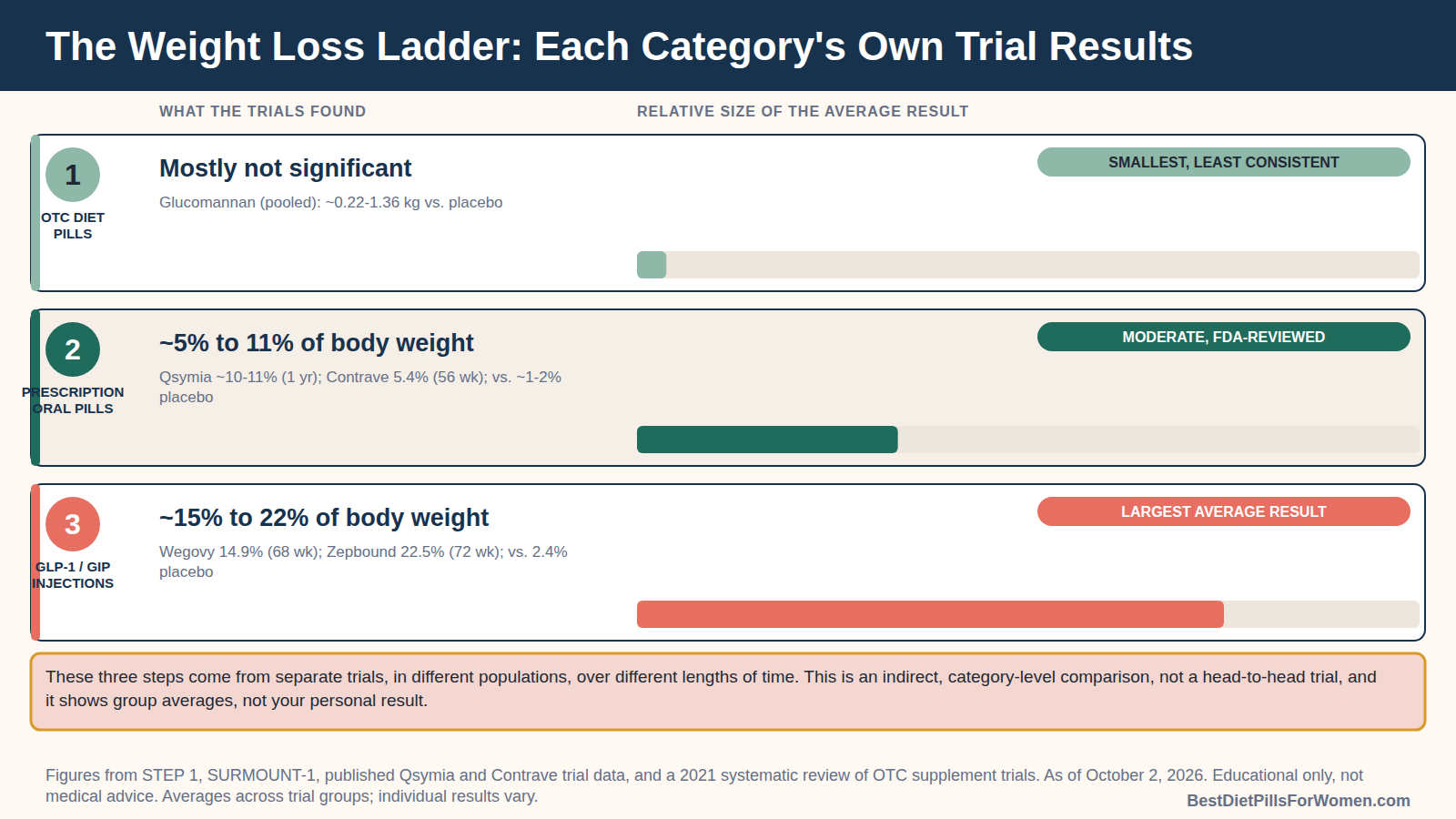
Weighing weight loss pills vs. GLP-1 injections comes down to one clear pattern in the trial data, with a lot of important fine print underneath it. In their own pivotal trials, GLP-1 and dual GIP/GLP-1 injections such as Wegovy (semaglutide) and Zepbound (tirzepatide) produced average losses of roughly 15% to 22% of body weight, prescription oral pills such as Qsymia and Contrave produced roughly 5% to 11%, and over-the-counter diet pills showed the smallest and least consistent results of the three groups.
That doesn’t make the choice simple, though. Those numbers come from different trials, run in different populations over different lengths of time, so lining them up side by side is useful for orientation, not a scorecard you can subtract to get a precise answer. A pill and an injection also ask something different of you day to day: one is usually a capsule you swallow, the other is a weekly shot, and the two categories differ sharply in cost, insurance coverage, side-effect profile and what happens to your weight if you stop.
This guide walks through what actually separates “weight loss pills,” a category that spans over-the-counter supplements and prescription oral medications, from GLP-1 and GIP/GLP-1 injections. We’ll look at what the human evidence shows for each group, how their safety profiles and serious warnings compare, how each option fits into an actual week, what each one actually costs without insurance, and what tends to happen after you stop. By the end, you should have a clearer sense of where each category’s strengths and limits actually sit, instead of just a bigger or smaller number on a chart. Nothing here is personalized medical advice, and nothing in this guide is a substitute for a conversation with a prescriber who knows your health history, your other medications and your goals.
Weight Loss Pills vs. GLP-1 Injections: The Short Answer
Start with the conclusions, then check them against the evidence that backs each one up.
The Direct Answer and How Sure We Are
Two separate questions are worth answering up front: what the trials actually show, and how much confidence that evidence deserves.
Which Works Better, Pills or GLP-1 Injections?
In their own separate trials, GLP-1 and GIP/GLP-1 injections produced larger average weight loss, roughly 15% to 22% of body weight, than prescription pills, which averaged roughly 5% to 11%, or OTC diet pills, which showed smaller, less consistent results. That gap doesn’t make an injection automatically right for you; it reflects group averages from different studies, and the categories differ just as much on safety, cost and convenience as they do on the scale.
Nobody can predict exactly how much weight a specific person will lose on any of these options; trial averages describe groups, not individuals.
How Sure We Are About That Answer
We’re highly confident about each drug’s own trial results, since those come from randomized, placebo-controlled trials published in peer-reviewed journals or reported in FDA-approved prescribing information. We’re less confident about how directly those numbers compare with each other, because no large trial has randomized people to an OTC pill, a prescription pill and a GLP-1 injection at the same time. We’re also less confident about the OTC category specifically; a 2021 systematic review of 315 supplement trials found only 52 at low risk of bias, and just 16 of those showed a statistically significant difference from placebo.
How We Compared Two Very Different Categories
A fair comparison needs ground rules that don’t quietly favor one side, so we set them out before looking at any results.
The Three Groups We’re Comparing
We split “weight loss pills” into two groups and compared both against injectable GLP-1/GIP medications. Group one is over-the-counter diet pills: fiber and glucomannan products, caffeine-based “fat burners,” and multi-ingredient supplements sold without a prescription. Group two is prescription oral weight-loss medications: phentermine, phentermine-topiramate (Qsymia), naltrexone-bupropion (Contrave) and orlistat (Xenical). Group three is the injectable GLP-1 receptor agonist semaglutide (Wegovy) and the dual GIP/GLP-1 receptor agonist tirzepatide (Zepbound). We left out brand loyalty, social-media testimonials and anecdotal “this one worked for me” claims, none of which substitute for trial evidence.
What This Comparison Is and Isn’t
This is a desk-research comparison built from FDA prescribing information, published pivotal trials, a 2021 systematic review of OTC supplement trials, and current manufacturer and retail pricing pages, not a hands-on test of any product in any of these three groups. We didn’t take, prescribe or lab-test anything described here, and nothing in this guide is personal experience. It also isn’t a verdict that one category is simply “better” for every reader. A bigger average result across a few hundred trial participants doesn’t tell you which option you’ll tolerate best, afford most easily or stay on long enough to see results from, and it isn’t a substitute for reading a specific medication’s full prescribing information, which covers details, like dosing adjustments for kidney or liver impairment, that a comparison guide can’t responsibly condense into a few sentences.
The Options at a Glance
Table 1 lines up the three groups side by side before the rest of this guide unpacks each comparison in depth.
The Summary Table
| Category | OTC Diet Pills | Prescription Oral Pills | GLP-1/GIP Injections |
|---|---|---|---|
| Examples | Glucomannan, caffeine blends, multi-ingredient “fat burners” | Phentermine, Qsymia, Contrave, orlistat (Xenical) | Wegovy (semaglutide), Zepbound (tirzepatide) |
| FDA review before sale | None for most ingredients; not reviewed for effectiveness | Yes, each is an FDA-approved prescription drug | Yes, each is an FDA-approved prescription drug |
| Typical trial result | Mostly not significant; a few ingredients show small, inconsistent effects | About 5% to 11% of body weight at 1 year, depending on the drug | About 15% to 22% of body weight over 68 to 72 weeks, depending on the drug and dose |
| How it’s taken | Capsule or tablet, usually once to several times a day | Capsule or tablet, once or twice a day | Subcutaneous injection, once a week |
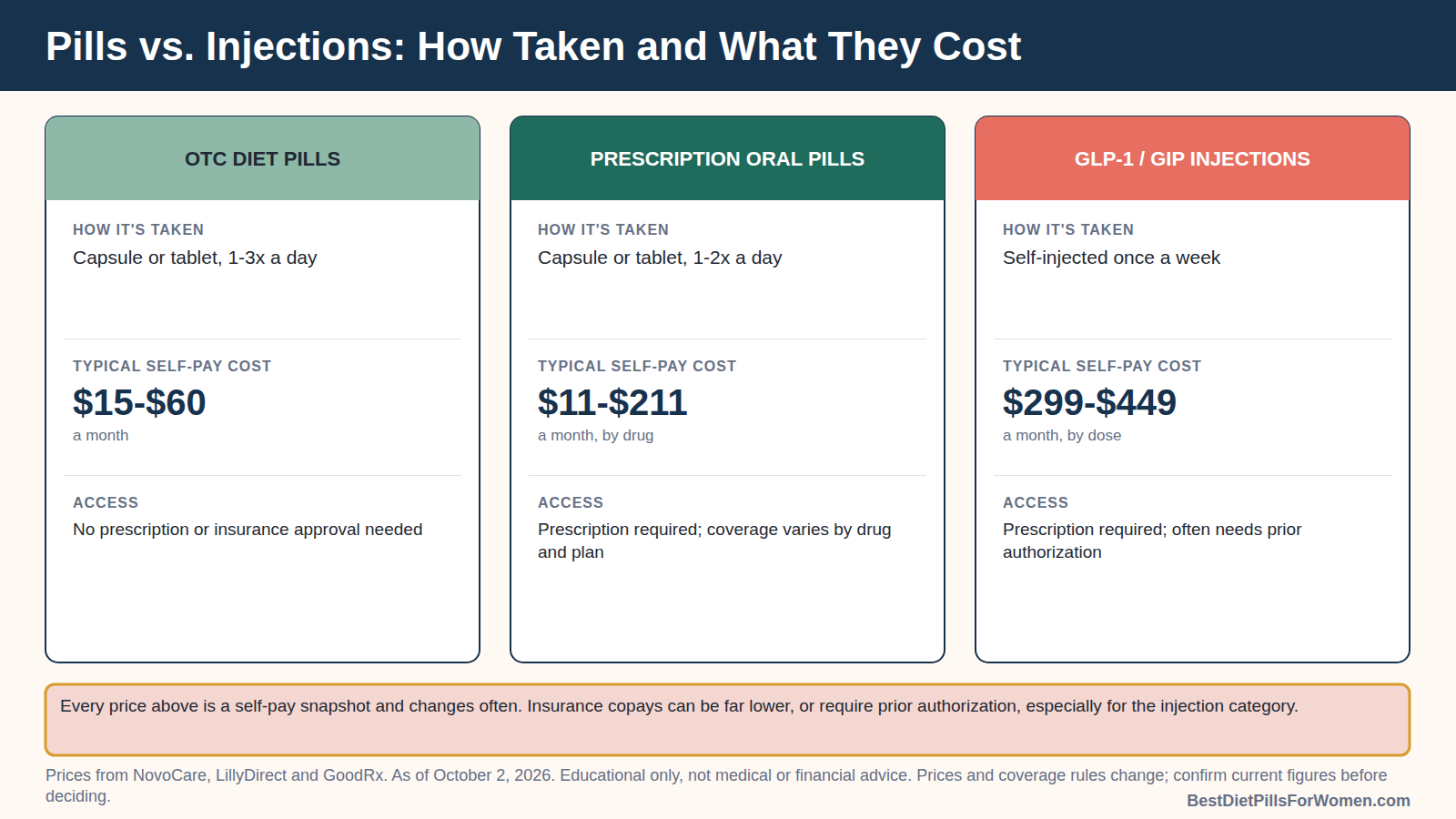
| Typical self-pay cost | Roughly $15 to $60 a month, varies widely by product | Roughly $11 to $260 a month depending on the drug and pharmacy | Roughly $299 to $449 a month, by drug and dose |
| Serious warning to know | No FDA-reviewed boxed warning; quality and purity aren’t guaranteed | Boxed warning for Contrave and Qsymia; stimulant risks for phentermine | Boxed warning for thyroid C-cell tumor risk |
Table 1 method: figures summarize the sections that follow, where each row’s sources appear. The trial-result row compares each category’s own separate studies; it is not a head-to-head trial and the three groups were not tested against each other in the same study. Cost figures are self-pay snapshots as of October 2, 2026, and change without notice.
How to Read the Numbers Without Overreading Them
Treat Table 1 as an orientation map, not a verdict. Every number in the “typical trial result” row comes from a separate study with its own population, dose and duration, so this is an indirect, category-level comparison rather than evidence that any one product would outperform another in a head-to-head test. The rest of this guide explains where each number comes from, what each category’s safety label actually says, what getting and paying for each option really involves, and which situations tend to favor one category over another.
It’s also worth saying plainly that “weight loss pills” isn’t a single product with one agreed-upon formula; it’s a label that covers a fiber supplement, a stimulant blend, and four chemically unrelated prescription drugs, each with its own mechanism, approval history and safety profile. Treating all of that as one undifferentiated alternative to a GLP-1 injection would flatten real, important differences inside the pill category itself, which is exactly why the next section maps that landscape out before any comparison continues.
What Counts as a “Weight Loss Pill”? Mapping the OTC and Prescription Landscape
“Weight loss pills” is a marketing category, not a medical one, and it covers two groups of products that work under completely different rules.
Over-the-Counter Diet Pills
Nobody has to prove an over-the-counter diet pill works before it reaches a store shelf, which matters more than most shoppers realize.
Fiber and Glucomannan Products
Glucomannan, a soluble fiber from the konjac root, is one of the more studied OTC ingredients because it swells in the stomach and is thought to promote fullness. Even so, the evidence is mixed: a pooled analysis found an average difference of only about 0.22 kg compared with placebo, which wasn’t statistically significant, while other, smaller pooled analyses have reported larger reductions. Our companion guide on OTC appetite suppressants breaks down fiber-based ingredients, psyllium and similar products in more depth.
Caffeine-Based and Multi-Ingredient “Fat Burners”
Many OTC diet pills combine caffeine, green tea extract, green coffee extract and other stimulants into a single capsule, sold under names that promise to “boost metabolism” or “burn fat.” As a class, dietary supplements are foods under federal law, not drugs, and a product doesn’t need FDA review for safety or effectiveness before it’s sold, as long as the label doesn’t claim to treat, cure or prevent a disease such as obesity. That legal distinction, not a lack of marketing confidence, is why most OTC labels say a product “supports” weight management rather than claiming it causes weight loss.
Many multi-ingredient products also list their stimulants inside a “proprietary blend,” a single combined weight for several ingredients rather than a per-ingredient amount, which makes it hard to know how much caffeine, in particular, you’re actually taking once you add in your coffee, tea or energy drinks for the day. A third-party seal, such as USP Verified or NSF Certified, means an outside lab checked that the bottle contains what the label says and screened for contaminants; a seal’s absence doesn’t prove a problem, but its presence is one of the few independent checks available in a category that otherwise relies entirely on the manufacturer’s own word.
Prescription Oral Weight-Loss Medications
Prescription pills sit in a different regulatory world: each one went through FDA review of both safety and effectiveness before it could be sold, and a doctor’s prescription is required by law.
Phentermine (and Other Older Appetite Suppressants)
Phentermine is a stimulant-type appetite suppressant that the FDA first approved in 1959, decades before today’s obesity drugs, and its original labeling describes “short-term” use, generally a few weeks, rather than the open-ended, long-term treatment doctors now expect from newer options. It’s still commonly prescribed, often off-label for longer stretches, mainly because generic phentermine is inexpensive, with cash prices as low as roughly $11 to $18 for a 30-day supply at some pharmacies with a discount coupon. Its own long-term trial data is thinner than that of newer medications, in part because it predates modern placebo-controlled obesity-trial standards.
Phentermine-Topiramate (Qsymia), Naltrexone-Bupropion (Contrave) and Orlistat (Xenical)
Qsymia, FDA-approved in 2012, combines phentermine with topiramate, an anti-seizure medication that also seems to reduce appetite, and it’s approved for chronic weight management in adults and in adolescents 12 and older with obesity. Contrave, FDA-approved in 2014, combines naltrexone, used for addiction treatment, with bupropion, an antidepressant, and targets both hunger signals and food-reward pathways in the brain. Orlistat, approved decades earlier and sold by prescription as Xenical at 120 mg and over the counter as Alli at 60 mg since 2007, works differently from the other two: instead of suppressing appetite, it blocks roughly a quarter to a third of the fat in a meal from being absorbed in the gut. All three are meant for chronic, ongoing use rather than the short-term course phentermine’s original label describes, which is one of the clearer dividing lines inside the pill category itself. We cover each of these three medications’ trial results and safety profiles in detail later in this guide, and in more depth in our dedicated reviews of Qsymia, Contrave and prescription appetite suppressants.
What Are GLP-1 and GIP/GLP-1 Injections?
The newest and, in trials, most effective category of weight-loss medication works on gut hormones rather than on the brain’s hunger centers directly.
How Semaglutide (Wegovy) and Tirzepatide (Zepbound) Work
Both drugs are weekly injections that mimic natural hormones released after eating, but they don’t target the exact same receptors.
One Hormone or Two? The Mechanism Difference
Wegovy’s active ingredient, semaglutide, is a GLP-1 receptor agonist: it mimics glucagon-like peptide-1, a gut hormone that slows stomach emptying and signals fullness to the brain. Zepbound’s active ingredient, tirzepatide, activates receptors for both GLP-1 and a second gut hormone called GIP (glucose-dependent insulinotropic polypeptide), a dual mechanism researchers propose as the reason tirzepatide has produced larger average trial results than semaglutide. That proposed mechanism is a biologically plausible explanation, not proof by itself; the actual size of the difference between the two drugs comes from the clinical trial evidence covered later in this guide, not from the mechanism alone.
Dosing and Titration Schedules
Both drugs start at a low dose and increase gradually, a process called titration, to reduce nausea and other gastrointestinal side effects. Wegovy’s maintenance doses run from 0.25 mg up to 2.4 mg weekly, with a 7.2 mg “HD” option available for appropriate patients, while Zepbound’s doses run from 2.5 mg up to 15 mg weekly. Reaching a full maintenance dose typically takes a matter of months, not weeks, and most people stay on a stable maintenance dose indefinitely rather than stopping once a goal weight is reached.
FDA Approval Status and Who They’re Approved For
Beyond weight management, each drug carries its own distinct set of FDA-approved uses that the other doesn’t share.
Wegovy’s Approved Uses
Wegovy is FDA-approved for chronic weight management in adults and adolescents 12 and older with obesity, or with overweight plus at least one weight-related condition, alongside a reduced-calorie diet and increased physical activity. It also carries FDA approval for reducing the risk of major cardiovascular events, such as heart attack and stroke, in adults with established heart disease and either obesity or overweight, and for a liver condition called MASH (metabolic dysfunction-associated steatohepatitis).
Zepbound’s Approved Uses
Zepbound is FDA-approved for chronic weight management in adults with obesity, or overweight plus a weight-related condition, and it also carries an FDA approval Wegovy doesn’t have: treating moderate-to-severe obstructive sleep apnea in adults with obesity. As of this guide’s October 2026 check, Zepbound didn’t carry Wegovy’s cardiovascular-risk-reduction indication; confirm this hasn’t changed before relying on it, since drug labels in this category have updated frequently.
How Much Weight Each Category Actually Produces in Trials
Here’s where the real gap between these categories shows up, and also where it’s easiest to overread the numbers.
What OTC Pills Show in Human Studies
The honest answer for most OTC diet pills is that the human evidence is thin, inconsistent, or both.
Fiber/Glucomannan Trial Results
Glucomannan is one of the better-studied OTC ingredients, and even its results are modest: one pooled analysis found an average of about 0.22 kg more weight loss than placebo, a difference that wasn’t statistically significant, while a separate, smaller pooled analysis reported a larger reduction of roughly 1.36 kg. Researchers describe the overall evidence for fiber-based appetite products as mixed rather than settled, and a result that size is roughly half a pound to three pounds, not a number that would meaningfully change most people’s clothing size on its own.
Why the OTC Evidence Base Is Weak
The clearest statement on OTC weight-loss supplements as a group comes from a 2021 systematic review that screened 315 clinical trials of dietary supplements and alternative therapies for weight loss. Only 52 of those trials were judged to be at low risk of bias, and of those 52, just 16 showed a statistically significant difference from placebo, with effect sizes ranging from about 0.3 kg to 4.93 kg. In plain terms: most of the research behind OTC diet pills isn’t rigorous enough to draw firm conclusions from, and even the minority of better-designed trials mostly found small effects. A product that isn’t FDA-reviewed before sale also hasn’t had its exact dose, purity or manufacturing consistency independently verified the way a prescription drug has. None of this means every OTC ingredient is worthless; it means the typical OTC diet pill hasn’t cleared the kind of evidence bar that would let anyone confidently predict how much weight, if any, a given person would lose by taking it.
What Prescription Oral Pills Show in Their Pivotal Trials
Prescription pills cleared a higher bar before approval, and their trial results reflect that.
Qsymia, Contrave and Orlistat Results
In Qsymia’s pivotal EQUIP and CONQUER trials, people taking the top dose (15 mg/92 mg) for about a year lost an average of roughly 10% to 11% of body weight, compared with roughly 1% to 2% on placebo, and 62% to 70% of top-dose participants lost at least 5% of body weight, versus 17% to 21% on placebo. Contrave’s three COR trials told a more modest story: the COR-I trial found average weight loss of 5.4% versus 1.3% on placebo at 56 weeks, with 42% of Contrave users losing at least 5% of body weight versus 17% on placebo; results were somewhat larger (8.1% versus 4.9%) in the COR-BMOD trial, which paired the drug with an intensive behavioral program, and somewhat smaller (3.7% versus 1.7%) in the COR-Diabetes trial, which enrolled people with type 2 diabetes. Orlistat’s own FDA-reviewed labeling points to a one-year trial in which people combining the drug with a reduced-calorie, lower-fat diet lost about 50% more weight than people following the same diet without the drug, roughly 3 pounds for every 2 pounds lost through diet alone.
Phentermine’s Shorter, Older Evidence Base
Phentermine’s own supporting trials are older and mostly short-term, generally a few weeks to a few months, which is consistent with its original “short-term use” labeling. Where longer-term weight loss data exists for phentermine, it mostly comes from combining it with topiramate, which is exactly what Qsymia does; used by itself for an extended period, phentermine has a thinner long-term evidence base than the newer combination pills or the GLP-1 injections covered next. That gap in long-term, standalone phentermine data isn’t the same thing as evidence that it doesn’t work; it mainly reflects when the drug was studied and how obesity-trial standards have changed since 1959.
What GLP-1/GIP Injections Show in Their Pivotal Trials
This is the category with the largest average results, and also the newest, most heavily studied one.
Wegovy’s STEP Program Results
In the STEP 1 trial, adults with obesity or overweight who took semaglutide 2.4 mg weekly for 68 weeks lost an average of 14.9% of body weight, compared with 2.4% on placebo, alongside a reduced-calorie diet and increased physical activity. That’s a placebo-adjusted difference of roughly 12.5 percentage points, among the largest effects ever documented for a weight-loss medication at the time of the trial’s publication.
Zepbound’s SURMOUNT-1 Results
In the SURMOUNT-1 trial, adults with obesity or overweight who took tirzepatide at its top studied dose (15 mg weekly) for 72 weeks lost an average of 22.5% of body weight, compared with 2.4% on placebo. A separate trial that put both drugs head-to-head, SURMOUNT-5, found that tirzepatide produced significantly more weight loss than semaglutide over 72 weeks, 20.2% versus 13.7%, a roughly 47% larger relative result in that specific comparison. Our dedicated Wegovy vs. Zepbound comparison covers that head-to-head trial, and everything else that separates those two specific drugs, in far more depth than this broader guide can.
Why You Can’t Just Subtract These Numbers From Each Other
Every number above is real, but lining them up the way Table 2 does is a convenience, not proof that one option would beat another in a direct test.
Different Populations, Different Durations
These trials enrolled different groups of people (some with diabetes, some without; some with heart disease, some without), ran for different lengths of time (a few weeks for older phentermine studies, more than a year for some obesity trials), and measured results in different ways. A result from a 56-week Contrave trial and a 72-week Zepbound trial both describe real, measured outcomes, but they aren’t the same experiment, and a reader’s own result depends on factors a trial average can’t capture: starting weight, adherence, diet, activity level and individual biology among them. Contrave’s own three COR trials make the point well on their own: the same drug produced noticeably different average results, 5.4%, 8.1% and 3.7%, depending on whether participants also had an intensive behavioral program (COR-BMOD) or type 2 diabetes (COR-Diabetes), which shows how much the surrounding population and support, not just the pill itself, can move the number.
Indirect Comparison, Not Head-to-Head Evidence
With one narrow exception, SURMOUNT-5’s head-to-head comparison of semaglutide and tirzepatide, every number in Table 2 comes from a separate trial that compared a single drug against placebo, not against another weight-loss category. That makes this whole guide an indirect, category-level comparison. Treat the size differences as a general pattern worth knowing, highest average results from GLP-1/GIP injections, moderate average results from prescription pills, least consistent and generally smallest results from OTC pills, rather than as a guarantee of what you personally would experience on any specific option.
| Category | Example | Trial | Duration | Average Result | Placebo Result |
|---|---|---|---|---|---|
| OTC pill (fiber) | Glucomannan | Pooled analysis of multiple trials | Varies by trial | About 0.22 to 1.36 kg more than placebo, inconsistent across reviews | n/a (already placebo-adjusted) |
| Rx oral pill | Orlistat (Xenical/Alli) | 1-year trial cited in FDA-reviewed labeling | 1 year | About 50% more weight lost than diet alone (about 3 lb for every 2 lb) | Diet-alone comparator |
| Rx oral pill | Qsymia, top dose | CONQUER/EQUIP | About 1 year | 10% to 11% of body weight | 1% to 2% of body weight |
| Rx oral pill | Contrave | COR-I | 56 weeks | 5.4% of body weight | 1.3% of body weight |
| GLP-1 injection | Wegovy (semaglutide 2.4 mg) | STEP 1 | 68 weeks | 14.9% of body weight | 2.4% of body weight |
| GIP/GLP-1 injection | Zepbound (tirzepatide 15 mg) | SURMOUNT-1 | 72 weeks | 22.5% of body weight | 2.4% of body weight |
| Head-to-head | Zepbound vs. Wegovy | SURMOUNT-5 (direct comparison) | 72 weeks | Tirzepatide 20.2% vs. semaglutide 13.7% | n/a (active comparator, not placebo) |
Table 2 method: figures are as reported in each cited trial or in the drug’s current FDA-approved prescribing information, read mostly through trial summaries and label-content summaries rather than full original journal articles. Every row except SURMOUNT-5 compares a single treatment with its own trial’s placebo group; none of these rows is a head-to-head comparison between categories, so the gaps between rows describe different studies, not a controlled experiment.
Safety and Side Effects: Pills vs. Injections
Every option in this guide can cause side effects, and the two main categories tend to cause different ones.
Common Side Effects by Category
The most frequent complaints differ enough that they’re worth knowing before you start anything, not after.
OTC and Prescription Pill Side Effects
OTC fiber-based pills most often cause gas, bloating and cramping, and products containing glucomannan or similar fibers carry a documented choking and blockage risk if they aren’t taken with enough fluid. Caffeine-containing OTC pills can raise heart rate and blood pressure and disrupt sleep, effects that scale with how much caffeine a person already consumes from coffee, tea or energy drinks. Among prescription pills, phentermine and Qsymia commonly cause dry mouth, insomnia, constipation and an elevated heart rate, Qsymia’s labeling specifically documents a 24-hour average heart-rate increase of 3.6 beats per minute versus placebo, along with reported insomnia (8% to 11%), anxiety (5% to 8%) and depression (4% to 8%) in trial participants. Contrave’s most common side effects are nausea, constipation, headache and insomnia, and orlistat’s defining side effects are digestive: oily stool, gas with discharge and more frequent bowel movements, especially after a high-fat meal, since the drug works by blocking fat absorption in the gut.
GLP-1/GIP Injection Side Effects
Wegovy and Zepbound share a very similar side-effect profile, dominated by gastrointestinal symptoms: nausea, diarrhea, vomiting and constipation are all common, especially during the early dose-increase period, and tend to ease somewhat as the body adjusts to a stable dose. These effects are usually described as the trade-off for a mechanism that slows digestion, and they’re the most common reason people reduce their dose or stop treatment altogether in both drugs’ trials.
Serious Risks and Boxed Warnings
A boxed warning is the FDA’s strongest label warning, reserved for risks serious enough that prescribers and patients need to see them before anything else.
Pill-Category Warnings (Qsymia, Contrave, Phentermine, Orlistat)
Qsymia carries a boxed warning for fetal harm: topiramate exposure during the first trimester of pregnancy is associated with an increased risk of major birth defects, including cleft lip and palate, so the label requires a negative pregnancy test before starting treatment and monthly during treatment, along with effective contraception for anyone who could become pregnant. Contrave carries a boxed warning for increased risk of suicidal thinking and behavior, inherited from its bupropion component’s psychiatric warnings, and the drug is contraindicated in uncontrolled hypertension, seizure disorders, eating disorders such as anorexia or bulimia, and recent abrupt discontinuation of alcohol, benzodiazepines or anti-seizure medications. Phentermine, a stimulant, isn’t recommended for people with heart disease, uncontrolled high blood pressure, hyperthyroidism or a history of drug misuse, and it’s a federally controlled substance because of its potential for dependence. Orlistat’s main serious concerns are reduced absorption of fat-soluble vitamins (A, D, E and K) and, following a June 2026 FDA-approved labeling update for Alli, a new warning about rare reports of kidney stones and acute kidney injury.
Injection-Category Warnings (Thyroid C-Cell Tumor Risk)
Both Wegovy and Zepbound carry the same boxed warning: in rodent studies, drugs in this class caused thyroid C-cell tumors, and both drugs are contraindicated in anyone with a personal or family history of medullary thyroid carcinoma or Multiple Endocrine Neoplasia syndrome type 2. Whether this risk translates to humans at the doses used for weight management hasn’t been established, and both labels note this directly rather than claiming certainty either way.
Who Needs Extra Caution With Either Category
Some situations call for a more careful conversation with a clinician before starting any option in this guide, not just the one with the bigger average result.
Pregnancy, Breastfeeding and Trying to Conceive
None of the medications discussed in this guide, pill or injection, is recommended during pregnancy, and Qsymia’s boxed warning makes the fetal-risk concern explicit. Wegovy and Zepbound’s labels advise stopping the medication at least two months before a planned pregnancy, given how long the drugs remain active in the body, and OTC supplements generally lack any pregnancy safety data at all, which is a reason for caution rather than reassurance.
Heart, Mental Health, Eating Disorder and Other Conditions
Stimulant-containing options, phentermine, Qsymia and most caffeine-based OTC pills, call for extra caution in anyone with heart disease, arrhythmia, uncontrolled high blood pressure or anxiety disorders. Contrave’s contraindications rule it out for anyone with a seizure disorder or an active eating disorder. GLP-1 and GIP/GLP-1 injections slow digestion, so they call for caution in anyone with a history of gastroparesis, severe gastrointestinal disease or gallbladder problems, and anyone with a personal or family history of medullary thyroid cancer shouldn’t use them at all. Table 3 summarizes these warnings by category.
| Category | Example | Common Side Effects | Serious Warning | Who Needs Extra Caution |
|---|---|---|---|---|
| OTC pill | Fiber/glucomannan | Gas, bloating, cramping | Choking/blockage risk without enough fluid | People with swallowing difficulty or bowel narrowing |
| OTC pill | Caffeine-based | Jitteriness, elevated heart rate, insomnia | No FDA-reviewed boxed warning; purity not independently verified | People with heart arrhythmia, anxiety or high caffeine intake already |
| Rx oral pill | Qsymia | Dry mouth, insomnia, tingling, elevated heart rate | Boxed warning: fetal harm (birth defects) | Pregnancy, glaucoma, hyperthyroidism |
| Rx oral pill | Contrave | Nausea, constipation, headache, insomnia | Boxed warning: suicidal thinking/behavior | Seizure disorders, uncontrolled hypertension, eating disorders |
| Rx oral pill | Phentermine | Dry mouth, insomnia, elevated heart rate | No boxed warning; controlled substance (dependence potential) | Heart disease, hyperthyroidism, history of substance misuse |
| Rx oral pill | Orlistat | Oily stool, gas with discharge, frequent bowel movements | Vitamin malabsorption; kidney stone/injury warning (2026) | Chronic malabsorption conditions, kidney stone history |
| GLP-1/GIP injection | Wegovy, Zepbound | Nausea, diarrhea, vomiting, constipation | Boxed warning: thyroid C-cell tumor risk | Personal/family history of medullary thyroid cancer or MEN 2 |
Table 3 method: warnings and common side effects are drawn from each drug’s current FDA-approved prescribing information where one exists, read mostly through label-content summaries, and from the systematic review cited for the OTC rows. This table doesn’t rank categories by overall safety; it lists what each category’s own labeling or best-available evidence identifies as its most notable risks.
Convenience, Administration and Day-to-Day Use
How a medication fits into an actual week matters as much as what it does on paper.
Daily Pill vs. Weekly Injection
The basic mechanics of using each category are genuinely different, and that difference affects adherence for a lot of people.
What Taking Each One Actually Involves
Most OTC and prescription pills are swallowed once, twice or up to three times a day, often timed around meals, which means remembering a dose multiple times every day for as long as you’re using the product. Orlistat adds an extra wrinkle: its label calls for taking it with each fat-containing meal, so skipping a meal or eating fat-free means skipping that dose too, which makes it a less predictable daily routine than a pill taken on a fixed schedule. GLP-1 and GIP/GLP-1 injections are self-administered once a week with a prefilled pen or, for Zepbound, a single-dose vial, which some people find easier to remember but which also requires comfort with giving yourself an injection, even with an auto-injector pen designed to make that simple.
Missed Doses, Travel and Storage
A missed pill dose is usually a minor, same-day fix. A missed weekly injection has its own set of rules, each drug’s label specifies a window for taking a late dose before skipping it and waiting for the next scheduled week, which adds a layer of planning that daily pills don’t require. GLP-1 and GIP/GLP-1 pens also need refrigeration before first use (with limited room-temperature windows once in use), while most pills can be kept at room temperature, which matters for travel, especially longer trips without reliable refrigeration.
Who Tends to Be a Candidate for Each Category
Eligibility isn’t just about which option works best on paper; it’s about who actually qualifies for and can reasonably access each one.
Typical Candidate for OTC or Prescription Pills
OTC pills are, by definition, available to any adult without a prescription, which makes them accessible but also means no clinician is screening for interactions or contraindications before purchase, unless the buyer brings it up themselves. Prescription pills generally require a BMI of 30 or higher, or 27 or higher with a weight-related condition such as high blood pressure or type 2 diabetes, similar to the threshold used for GLP-1 injections, and a prescriber who’s comfortable managing a stimulant (phentermine, Qsymia) or psychiatric-adjacent medication (Contrave) given each drug’s specific contraindications.
Typical Candidate for GLP-1/GIP Injections
GLP-1 and GIP/GLP-1 injections use similar BMI thresholds to prescription pills, but they tend to be prescribed more often for people who haven’t reached their goals with pills or lifestyle changes alone, who have a weight-related condition like type 2 diabetes or sleep apnea that the specific drug is also approved to treat, or who want to avoid stimulant-type side effects entirely. They also require more comfort with self-injection and, in practice, more willingness to navigate insurance prior authorization, which we cover in the cost section below.
None of this is a strict rulebook, and plenty of people move between categories over time rather than picking one for life. A woman who starts with an OTC fiber product, moves to phentermine if a clinician agrees it’s appropriate, and later considers a GLP-1 injection if a weight-related health condition develops isn’t doing anything unusual; it’s a common, gradual path through this landscape rather than a single irreversible choice. Life stage matters here too: our guides on weight management during menopause and with PCOS go into more detail on how hormonal factors specific to those situations can affect which category, and which specific medication, a clinician might suggest first.
Cost and Access: Pills vs. Injections
Price is often the single biggest practical factor separating these three categories, and the gap is large.
What Each Category Costs Without Insurance
Self-pay prices for every option in this guide change often, so treat the figures below as a snapshot rather than a permanent number.
OTC and Prescription Pill Costs
OTC diet pills vary enormously in price, roughly $15 to $60 a month depending on the brand, dose and whether it’s a single ingredient or a multi-ingredient blend; our OTC appetite suppressant cost breakdown covers specific products in more detail. Among prescription pills, generic phentermine is the least expensive by a wide margin, with coupon prices as low as roughly $11 to $18 for a 30-day supply at some pharmacies, against an average retail price of about $37 to $40 before a discount. Qsymia runs higher, around $75 a month with a manufacturer or pharmacy discount program, against an average retail price of roughly $258, and pricing varies by dose. Contrave’s lowest widely available cash price was about $199 to $200 for a 30-day supply at several major pharmacy chains, with other pharmacies charging closer to $209 to $211. Orlistat, as Alli, runs roughly $80 to $113 for a bottle depending on the retailer, which (at the label’s three-times-daily dosing) works out to a meaningfully lower cost per day than Qsymia or Contrave, though still well above the cheapest generic phentermine option.
GLP-1/GIP Injection Self-Pay Costs
Self-pay pricing for the injectable category sits well above every pill option. As of October 2026, Novo Nordisk’s NovoCare pharmacy listed Wegovy at a self-pay price of $349 a month across its standard doses, down from a prior $499, with an introductory $199-a-month offer for the lowest two doses. Eli Lilly’s LillyDirect pricing for Zepbound’s single-dose vials ran from $299 a month at the lowest (2.5 mg) dose, to $399 at the next (5 mg) dose, up to $449 a month at the four highest doses (7.5 mg through 15 mg), provided a refill happens within 45 days of the previous one; outside that window, the higher-dose tiers reset to $499. Both companies have cut self-pay prices more than once over the past two years as competition between the drugs has intensified, and Novo Nordisk has separately announced a wholesale list-price reduction to $675 a month for Wegovy, effective January 1, 2027, a change that mainly affects insurers’ negotiated prices rather than most people’s self-pay cost.
Annualized, that gap is substantial: a full year of self-pay Wegovy at $349 a month runs about $4,188, and a year of Zepbound at its lower tiers runs roughly $3,588 to $4,788, before counting any dose increases. By comparison, a year of self-pay Contrave at around $200 a month runs roughly $2,400, and a year of coupon-priced generic phentermine can run under $200 total. None of that means the cheaper option is the better value; it means cost and trial-average effectiveness don’t move together in a simple, predictable way, and a realistic budget has to be part of the decision alongside the evidence.
Some readers also ask about compounded semaglutide or tirzepatide, versions mixed by a compounding pharmacy rather than Novo Nordisk’s or Eli Lilly’s own FDA-approved product, often marketed at a lower price through online telehealth clinics. The FDA allowed broader compounding of both drugs during officially declared shortages, but once each shortage was resolved, the agency clarified that mass compounding should generally stop except for specific, individualized medical need, and it has separately warned about dosing errors and quality-control problems in some compounded products. A compounded product isn’t the FDA-approved drug, hasn’t been through the same review, and is a meaningfully different purchase from the brand-name options priced in this section.
| Category | Example | Typical Self-Pay Price | Notes |
|---|---|---|---|
| OTC pill | Various fiber/caffeine products | About $15 to $60 a month | Varies widely by brand and ingredient count; no insurance coverage |
| Rx oral pill | Generic phentermine | About $11 to $18 a month (with coupon) | Least expensive option in this guide; average retail about $37 to $40 |
| Rx oral pill | Qsymia | About $75 a month (with discount program) | Average retail around $258; varies by dose |
| Rx oral pill | Contrave | About $199 to $211 for a 30-day supply | Price varies by pharmacy chain |
| Rx oral pill | Orlistat (Alli, OTC) | About $80 to $113 a bottle | No prescription needed at the 60 mg OTC dose |
| GLP-1 injection | Wegovy | $349 a month (most doses); $199/mo introductory offer on lowest doses | Price cut from $499 in late 2025 |
| GIP/GLP-1 injection | Zepbound | $299 to $449 a month, by dose | Lower tier requires refilling within a 45-day window |
Table 4 method: prices are self-pay figures from manufacturer pharmacy pages and GoodRx, read as of October 2, 2026, and don’t reflect insurance copays, which can be far lower or, for the injectable category especially, require prior authorization. Prices for all seven rows change frequently and should be re-checked before relying on them for a purchase decision.
Insurance Coverage Differences
Sticker price is only part of the cost picture; whether insurance pays for an option at all often matters more.
Why Pills Are Often Easier to Get Covered
Generic phentermine, in particular, is inexpensive enough and has been on the market long enough that many insurance plans cover it with a low copay, or it’s cheap enough in cash that coverage barely matters. Qsymia and Contrave see more mixed coverage decisions from insurers, and some plans place them behind a step-therapy requirement, meaning a patient has to try a cheaper option first, or exclude weight-loss medications from coverage entirely, treating them as a lifestyle rather than a medical benefit.
Why Injections Often Need Prior Authorization
Wegovy and Zepbound are more likely to require prior authorization, a process where the prescriber submits documentation showing the patient meets specific criteria (BMI, weight-related conditions, sometimes a documented attempt at lifestyle changes) before insurance will approve coverage. Some employer health plans exclude GLP-1 medications for weight management specifically, even when the same drug would be covered for type 2 diabetes under a different brand name, and coverage policies have been shifting as more employers try to manage the cost of a rapidly growing drug category. A compounded version of either drug also isn’t the insurer’s covered product, so it’s generally paid for entirely out of pocket, on top of whatever its lower listed price might suggest. Anyone considering either injectable drug should call their insurer directly and ask about weight-management-specific coverage, since a plan’s general prescription benefit doesn’t always apply the same way to this drug class.
Stopping Treatment: Discontinuation and Weight Regain
What happens after you stop matters just as much as what happens while you’re taking something, and the two categories differ here too.
What Happens When You Stop a Pill
Pills were never designed with the same assumption of indefinite, lifelong use, which shows up in how their labels are written.
Pills Approved for Short-Term vs. Long-Term Use
Phentermine’s original FDA approval frames it for short-term use, generally a matter of weeks, which is part of why many prescribers eventually taper or stop it even when a patient is tolerating it well. Qsymia, Contrave and orlistat, by contrast, are approved for chronic weight management, meaning long-term, ongoing use is part of their intended design, similar to how the GLP-1 injections are meant to be used.
Weight Trajectory After Stopping an Oral Medication
Across this category, the general pattern researchers describe is that stopping any weight-loss medication, pill or injection, tends to lead to at least some weight regain, because the biological and behavioral drivers of excess weight that existed before treatment generally haven’t disappeared. Specific long-term, post-discontinuation data for Qsymia, Contrave and orlistat is less extensively published than the discontinuation data now available for the newer GLP-1 injections, which is a gap worth being aware of rather than assuming the pills are somehow exempt from this pattern. For phentermine specifically, the short-term nature of its original approval means many people cycle on and off it over time rather than following a single, long, continuous course, which makes a clean “what happens after stopping” answer harder to pin down from the published evidence than it is for drugs meant for indefinite use.
What Happens When You Stop a GLP-1/GIP Injection
This is one of the more actively studied questions in the GLP-1 category right now, and the answer depends partly on how you look at it.
Trial Evidence on Regain After Stopping
In a published extension of the STEP 1 trial, participants who switched from semaglutide to placebo at week 68 regained a substantial share of their lost weight, roughly two-thirds of it, by about a year after stopping. The SURMOUNT-4 trial, which specifically studied tirzepatide discontinuation, found that people who continued tirzepatide maintained their weight loss through week 88, while those randomized to switch to placebo at week 36 regained a meaningful share of the weight they’d lost, though they still ended up better off than if they’d never taken the drug at all. Both trials point the same direction: stopping either drug, at least in a controlled trial setting, tends to lead to significant regain over the following year.
Real-World Data Looks Different
A separate real-world cohort study, tracking people who stopped a GLP-1 medication outside a clinical trial, found much smaller average regain after a year, about 0.5% of body weight among those being treated for obesity. The likely explanation is that real-world patients often don’t simply stop and do nothing: in that same dataset, 27% switched to a different obesity medication, 20% restarted their original drug, and 14% pursued other interventions like working with a dietitian, none of which describes someone who stopped treatment and made no other changes. The honest takeaway is that regain after stopping a GLP-1 medication is common and can be substantial, but how much regain happens to any individual depends heavily on what, if anything, replaces the medication.
Questions Women Often Ask About Pills vs. GLP-1 Injections
A few questions come up often enough that they deserve a direct answer of their own.
Effectiveness and Candidacy Questions
These two questions get at whether the category gap in Table 2 is as absolute as it looks.
Is a Pill Ever as Effective as a GLP-1 Injection?
For some people, yes, though it’s the exception rather than the trial average. Individual results vary widely within every category in this guide, and some people taking a prescription pill like Qsymia lose as much or more weight than the average person in a GLP-1 trial, while some people on a GLP-1 injection lose less than the average pill user. Trial averages describe a typical range across a group, not a ceiling or floor for any one person.
What drives that variation isn’t fully understood, but adherence, starting weight, diet quality, activity level and individual metabolic and genetic factors all plausibly play a role. That’s also part of why a clinician who knows your history, not a general comparison article, is best positioned to estimate what a realistic result might look like for you on any specific option.
Can I Switch From a Pill to a GLP-1 Injection Later?
Yes, switching between categories is common and medically straightforward in most cases, though it requires a new prescription and, often, a new prior-authorization process with insurance. Many people start with a less expensive or more familiar pill option and move to a GLP-1 injection later if results plateau, side effects become intolerable, or a weight-related condition the injection specifically treats, such as sleep apnea for Zepbound, develops or worsens.
Safety and Practical Questions
These two questions come up because “over-the-counter” and “prescription” don’t map cleanly onto “safer” and “riskier.”
Are OTC Diet Pills Safer Than Prescription Options?
Not necessarily, and in some ways they carry more uncertainty, not less. A prescription medication went through FDA review of safety and effectiveness data before approval and carries a detailed, legally required label listing its known risks. Most OTC diet pills skipped that review entirely, which means there’s often less rigorous safety data behind them, not more, even though they don’t require a doctor’s involvement to buy.
The FDA maintains a public database of weight loss products it has found to contain undisclosed drug ingredients or banned stimulants, a risk that’s specific to the unregulated end of the OTC market and doesn’t apply to a properly labeled prescription pill. That doesn’t mean every OTC product is hiding something, but it’s a real reason the FDA-reviewed label on a prescription drug is a form of safety information, not just a bureaucratic hurdle.
Does Insurance Ever Cover Both?
Rarely at the same time; coverage rules differ sharply between the two categories. OTC pills are essentially never covered by standard health insurance, though some flexible spending or health savings accounts allow them as an eligible expense. Prescription pills and GLP-1 injections can both be covered, but approval criteria and prior-authorization rules vary by plan and change often, so the reliable way to know your coverage is to call your insurer about the exact drug and dose your prescriber wants.
The Bottom Line on Weight Loss Pills vs. GLP-1 Injections
Pull the threads of this guide together into something you can actually use, rather than leaving the comparison as a pile of separate facts.
Weight loss pills vs. GLP-1 injections isn’t really a single contest with one winner; it’s three categories with three different risk, cost and commitment profiles, and the right starting point depends heavily on your own health history, budget and tolerance for side effects. A reader who hasn’t tried anything yet and has no major contraindications might reasonably start with the lower-cost, lower-commitment end of the spectrum and escalate if results don’t materialize, while a reader with a weight-related condition a specific drug is approved to treat, or who has already tried pills without success, might reasonably start further along.
What the Evidence Means for You
The honest summary has to hold two things at once: a clear pattern in the averages, and real uncertainty about what that pattern means for any one person.
The Biggest Realistic Advantage of Each Category
GLP-1 and GIP/GLP-1 injections offer the largest average weight loss documented in modern obesity trials, roughly 15% to 22% of body weight, along with FDA approval for related conditions like cardiovascular risk reduction (Wegovy) or obstructive sleep apnea (Zepbound) that go beyond the number on the scale. Prescription oral pills offer a middle ground: real, FDA-reviewed evidence of effectiveness, a longer history on the market in some cases, and a meaningfully lower price than the injections, with generic phentermine as the least expensive prescription option by a wide margin. OTC pills offer accessibility and low commitment, no prescription, no injection, often a lower price point, but that advantage comes with the weakest and most inconsistent evidence of the three groups.
The Biggest Limitation or Safety Concern of Each Category
GLP-1 and GIP/GLP-1 injections carry a thyroid-tumor boxed warning, common gastrointestinal side effects that can be hard to tolerate during dose increases, and some of the highest self-pay prices in all of weight management, along with evidence that stopping the drug often leads to significant weight regain within a year. Prescription pills carry their own serious warnings, Qsymia’s fetal-risk boxed warning and Contrave’s suicidality boxed warning chief among them, and their average effectiveness, while real, falls well short of the injectable category. OTC pills carry the least certainty of all: a 2021 systematic review found that the large majority of supplement trials weren’t rigorous enough to support firm conclusions, and products in this category aren’t independently verified for purity or dose before they reach a shelf.
A Rational Next Step
None of this is a reason to freeze up, but it is a reason to ask a few specific questions before spending money or starting anything.
Questions Worth Bringing to a Clinician
Worth raising with a doctor or pharmacist: which category’s contraindications and warnings apply to your specific health history, including any heart, thyroid, mental health or digestive conditions; whether your insurance covers any option under consideration, and what documentation prior authorization would require; and what a realistic timeline and realistic expected result looks like for you specifically, not the trial average. If you’ve already tried an OTC or prescription pill without the result you wanted, that’s relevant information for a clinician deciding whether a GLP-1 injection, or a different pill, makes more sense next.
What to Re-Check Before You Decide
Prices, coverage rules and even FDA-approved indications in this category have changed multiple times over the past two years, so re-verify current self-pay pricing for any specific drug you’re considering, confirm your insurance plan’s current prior-authorization criteria, and check each drug’s current FDA label for any new warnings before making a final decision. If you’re weighing an OTC product specifically, check whether it carries a third-party testing seal and look it up against FDA’s tainted-products database before buying, since that’s one of the few independent checks available in that part of the market. A guide like this one is a starting point for that conversation, not a replacement for the specific, current information a prescriber and pharmacist can give you about your own situation. For a broader look at the full range of options beyond the two categories covered here, our complete guide to weight loss pills for women and our overview of weight loss medications are good places to continue.
Related Reading
Sources
These are the main sources behind this guide, chosen because they are the ones to check first for current facts. Labels, prices and trial summaries change, so confirm the latest version before you make decisions.
- National Institute of Diabetes and Digestive and Kidney Diseases (NIDDK). Prescription Medications to Treat Overweight & Obesity (page accessed 2026). https://www.niddk.nih.gov/health-information/weight-management/prescription-medications-treat-overweight-obesity (read through a page summary generated in this research session).
- U.S. Food and Drug Administration. WEGOVY (semaglutide) injection and tablets, full prescribing information, label revision dated 2026 (application 218316, supplement 007). https://www.accessdata.fda.gov/drugsatfda_docs/label/2026/218316s007lbl.pdf (read through a label-content summary generated in this research session; the full PDF text was not read directly).
- U.S. Food and Drug Administration. ZEPBOUND (tirzepatide) injection, full prescribing information, label revision dated 2026 (application 217806, supplement 042). https://www.accessdata.fda.gov/drugsatfda_docs/label/2026/217806s042lbl.pdf (read through a label-content summary generated in this research session; the full PDF text was not read directly).
- U.S. Food and Drug Administration. CONTRAVE (naltrexone HCl and bupropion HCl) extended-release tablets, full prescribing information (application 200063). https://www.accessdata.fda.gov/drugsatfda_docs/label/2014/200063s000lbl.pdf (read through a label-content summary generated in this research session, including the COR-I, COR-BMOD and COR-Diabetes trial results and the boxed warning; the full PDF text was not read directly, and a newer label revision may exist).
- Wilding JPH, Batterham RL, Calanna S, et al. Once-Weekly Semaglutide in Adults with Overweight or Obesity (STEP 1). N Engl J Med. 2021;384(11):989-1002. doi:10.1056/NEJMoa2032183 (trial results and the published withdrawal/extension data on weight regain read through peer-reviewed trial summaries; the full journal texts were not read directly in this research session).
- Jastreboff AM, Aronne LJ, Ahmad NN, et al. Tirzepatide Once Weekly for the Treatment of Obesity (SURMOUNT-1). N Engl J Med. 2022;387(3):205-216. doi:10.1056/NEJMoa2206038 (figures read through a secondary clinical-trial summary; the full journal text was not read directly in this research session).
- Aronne LJ, Horn DB, le Roux CW, et al. Tirzepatide as Compared with Semaglutide for the Treatment of Obesity (SURMOUNT-5). N Engl J Med. 2025;393(1):26-36. doi:10.1056/NEJMoa2416394 (figures read through a manufacturer investor announcement of the trial results and secondary clinical-news summaries; the full journal text was not read directly in this research session).
- Novo Nordisk, NovoCare. Wegovy Price Guide (self-pay and savings-card pricing, PDF, accessed 2026). https://www.novocare.com/content/dam/novonordisk/novocare/redesign/pdf/Wegovy_Price_Guide.pdf (price figures cross-checked through a secondary news report; page accessed as of October 2, 2026).
- Drugs.com. Alli (orlistat) FDA Approval History, including the February 7, 2007 original OTC approval and a June 10, 2026 labeling update on kidney stone and acute kidney injury warnings (page accessed 2026). https://www.drugs.com/history/alli.html (read through a page summary generated in this research session).
- Batsis JA, et al. A Systematic Review of Dietary Supplements and Alternative Therapies for Weight Loss. Obesity. 2021;29(7):1102-1113. doi:10.1002/oby.23110 (read through a university press-release summary of the published review; the full journal article, including the complete author list, was not read directly in this research session).