Weighing prescription vs. OTC weight loss pills comes down to one fact before any other: a prescription pill can’t be sold until a company proves to FDA that it works and is reasonably safe, while an over-the-counter “diet pill” is almost always a dietary supplement that can reach a shelf without FDA ever reviewing it first.
That single fact explains most of what follows. It’s why the largest average results in this guide, by a wide margin, belong to prescription pills. It’s why exactly one over-the-counter product, alli, can legally call itself an FDA-approved weight loss drug, and why almost everything else sold as an OTC diet pill is a supplement instead. It’s also why the safety conversation looks so different in each column: one category has boxed warnings, monitored side effects and a pharmacist checking your other medications; the other has a label FDA didn’t review before it went on sale, and, in the worst cases, pills secretly spiked with drugs that were pulled from the market for good reason.
This guide compares the two categories directly: how much weight loss each one actually produces, how the underlying evidence differs, what “safety” means in a world with almost no pre-market review, what a prescription actually requires versus what buying OTC requires, and what each path costs once you add it all up. We focus on pills you swallow, not injections; our guide to weight loss pills vs. injections covers that separate comparison, and our guide to the best weight loss pills for women covers the full prescription lineup in more depth. Nothing here is personalized medical advice, and nothing in either category is a substitute for a conversation with a clinician who knows your own health history.
Prescription vs. OTC Weight Loss Pills: The Short Answer
Start with the conclusions, then check them against the sections that back each one up.
The Direct Answer and How Sure We Are
Two separate questions are worth answering up front: what the evidence shows, and how confident we are in that evidence.
What’s the Real Difference Between Prescription and OTC Weight Loss Pills?
Prescription weight loss pills go through FDA review of clinical trial data before they can be sold and produce the largest, most consistent average results in this guide; over-the-counter weight loss pills are almost all dietary supplements that reach shelves without that review and produce small, inconsistent results at best. The one exception is alli (orlistat 60 mg), the single OTC product FDA has approved as a nonprescription drug.
Neither category is risk-free, and neither is a shortcut around diet, activity or, for many people, a longer-term relationship with a prescriber.
How Sure We Are About That Answer
We’re highly confident about the regulatory distinction, since it comes directly from FDA’s own description of its drug-review and dietary-supplement authorities. We’re highly confident about the direction of the effectiveness gap, since it’s consistent across every major review we read, including one that screened over 20,000 citations before finding only 315 randomized trials of 14 supplements worth pooling. We’re less confident about exact numbers for any single OTC product, because most haven’t been tested against each other, doses in blends are often proprietary, and we can’t verify what’s actually inside a bottle beyond what the label says.
How We Compared the Two Categories
A fair comparison needs criteria that don’t quietly favor one side, so we set them out before looking at any results.
The Four Criteria We Used
We compared prescription and OTC options on four dimensions: the regulatory pathway each one followed before reaching a customer, the quality and size of the human evidence behind it, the realistic safety picture including how each category is monitored after approval, and the practical trade-offs of cost, access and convenience. We deliberately left out brand reputation, customer reviews and social media buzz, none of which reflects clinical evidence.
What This Comparison Is and Isn’t
This is a desk-research comparison built from FDA and FTC documents, prescribing labels, systematic reviews, individual trials, and manufacturer and retailer pricing pages, not a hands-on test of any product. We didn’t buy, take or lab-test anything described here, and nothing in this guide is personal experience. It’s also not a ranking of individual brands within the OTC category; a ranking would wrongly imply some unregulated products have solid evidence and others merely have less, when the honest summary is that almost none of them do.
The Options at a Glance
Table 1 lines up the main categories side by side before the rest of this guide goes through each one in depth.
The Summary Table
| Category | Example pills | Main evidence | Typical average result | Regulatory status |
|---|---|---|---|---|
| Prescription GLP-1 pills | Wegovy pill (oral semaglutide), Foundayo (orforglipron) | Pivotal trials OASIS 4 and ATTAIN-1 | 11.1% to 13.6% of body weight vs. about 2% on placebo | FDA-approved; reviewed under a New Drug Application |
| Older prescription pills | Qsymia, Contrave, phentermine | CONQUER, SEQUEL and COR trials; product labeling | About 5% to 10% (Qsymia, Contrave); phentermine’s own label says only “a fraction of a pound a week” over placebo, for short-term use | FDA-approved prescription drugs |
| Prescription-strength orlistat | Xenical (orlistat 120 mg) | 2007 meta-analysis of 30 randomized trials | About 2.9 kg more than placebo; a 2025 network meta-analysis found no significant advantage at 52 weeks | FDA-approved prescription drug |
| The one OTC drug | alli (orlistat 60 mg) | Same molecule as Xenical, at half the dose | Smaller than Xenical’s already modest and increasingly disputed effect | FDA-approved OTC drug, cleared through an Rx-to-OTC switch |
| OTC dietary supplements | Fiber blends, caffeine-based “fat burners,” plant extracts, “GLP-1 booster” chews | One review pooled 315 randomized trials of 14 supplements | Significant weight difference in under a third of the low-risk-of-bias trials, mostly well under 5 kg | Not reviewed by FDA before sale; sold under dietary-supplement law |
| For context: injections | Wegovy injection, Zepbound | STEP 1, SURMOUNT-1 | About 15% to 21% vs. 2% to 3% on placebo | FDA-approved prescription drugs; not pills, covered in our pills vs. injections guide |
Table 1 method: effect sizes and trial counts are as reported in the trials, labels and meta-analyses, read through full texts, labels and page summaries as of September 25, 2026; no result was recalculated. Figures for different rows come from different trials, populations and durations, so this table is an indirect comparison, not a head-to-head study.
How to Read the Table
Read Table 1 as a starting map, not a verdict. Every effect size in it comes from a different trial with a different population, duration and comparator, so the gap between, say, 13.6% and “under a third of trials found a significant difference at all” is the honest picture, not a rounding error. The rest of this guide unpacks each row: why the regulatory column looks the way it does, what “average result” is actually hiding, and what that means for your safety, your wallet and your time.
What Actually Makes a Pill “Prescription” or “OTC”
The prescription-or-OTC label isn’t about strength, safety or how “natural” an ingredient sounds. It comes down to which federal law a product is sold under, and that choice is made by the manufacturer, not by how the pill works in your body.
Two Different Federal Approval Pathways
A prescription weight loss drug and an OTC dietary supplement travel through almost entirely separate systems before either one reaches a customer.
How a Prescription Weight Loss Drug Gets Approved
A prescription weight loss drug can’t be sold until its manufacturer files a New Drug Application and FDA reviews the clinical trial data behind it, a process that typically takes FDA about 10 months for a standard review or 6 months for a priority review after a complete application is submitted. Getting to that filing usually means years of laboratory work followed by three phases of human trials: small studies checking safety and dosing, then mid-sized studies checking whether the drug works, then large, often multi-year randomized trials like OASIS 4 (4,838 adults) or SURMOUNT-1, run specifically to measure effectiveness and safety in thousands of people before anyone can buy the drug at a pharmacy. FDA also inspects the manufacturing facility and reviews the proposed label’s every claim before approval, and it can require a Risk Evaluation and Mitigation Strategy, the program behind Qsymia’s monthly pregnancy testing, when a drug’s risks call for extra safeguards.
How an OTC “Diet Pill” Reaches the Shelf
Almost every OTC “diet pill” is legally a dietary supplement, and a dietary supplement can be sold without FDA reviewing it, approving it or even being notified before it ships, as long as the manufacturer doesn’t claim it treats or cures a disease. Under the Dietary Supplement Health and Education Act of 1994, the manufacturer alone is responsible for making sure a product is safe and its label is truthful before it goes to market; FDA’s role is almost entirely reactive, stepping in after a product is already for sale if it turns out to be adulterated, mislabeled or dangerous. Manufacturing has to follow current good manufacturing practice rules for supplements, which cover things like identity testing and clean facilities, but that regulation is about how a product is made, not whether the ingredients inside it actually cause weight loss. That’s the whole difference in one sentence: a prescription pill proves it works and is reasonably safe before day one on the market; an OTC diet pill mostly just has to not lie about what’s in the bottle.
The One Exception: alli
One product breaks this clean split, and it’s worth understanding exactly how, because it’s the closest thing to a controlled experiment this comparison has.
What Makes alli Different From Every Other OTC Product?
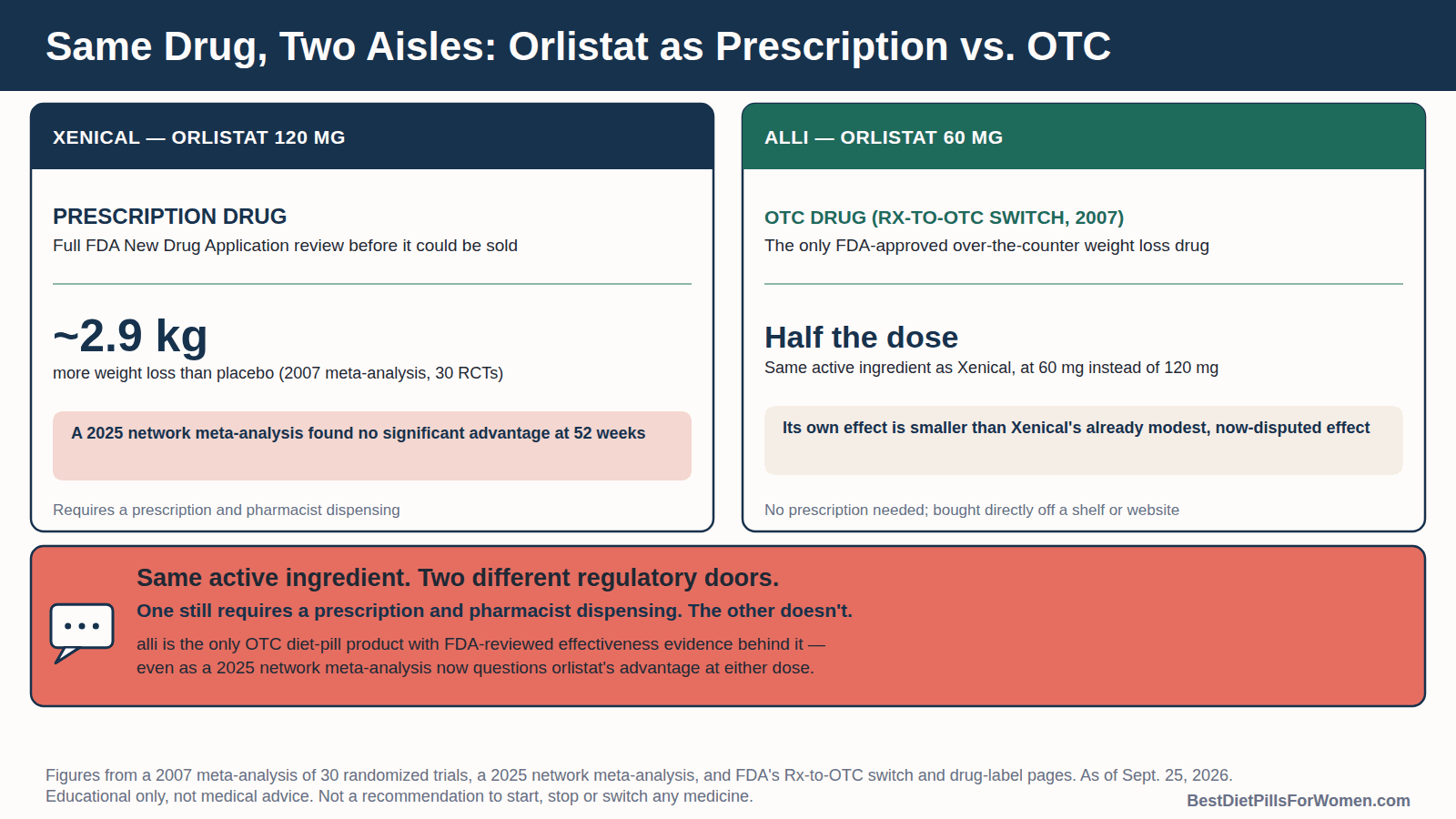
alli (orlistat 60 mg) is the only weight loss product sold over the counter in the United States that FDA has approved as a nonprescription drug, meaning it went through the same kind of clinical-evidence review as a prescription drug before switching to the OTC shelf. It’s also literally the same molecule as the prescription drug Xenical, just at half the dose, 60 mg instead of 120 mg per capsule.
FDA’s Rx-to-OTC switch pathway exists for drugs with a long safety track record at the prescription level and a use that a consumer can manage without a clinician’s diagnosis, and orlistat qualified based on years of prescription use as Xenical before alli’s 2007 approval. Every other product on an OTC diet-pill shelf, from fiber blends to “thermogenic” fat burners to inositol powders, is a dietary supplement instead, meaning it skipped this entire review.
Why FDA’s 1991 Monograph Still Matters Today
The reason almost nothing else has followed alli’s path traces back to FDA’s 1991 over-the-counter drug monograph for weight-control products, which found the evidence for most other OTC weight-loss ingredients insufficient to support an OTC drug claim and effectively closed that route for new entrants. Companies responded by selling the same kinds of ingredients as dietary supplements instead, a legal category that doesn’t require proving effectiveness at all, which is exactly why the OTC diet-pill aisle today is overwhelmingly supplements with one lone approved drug sitting alongside them. That single fact is the most useful thing to know before reading a bottle: seeing “orlistat” on an OTC label means FDA-reviewed drug evidence; seeing almost anything else there means a supplement that never had to clear that bar. That gap has held for more than three decades now, and nothing in current FDA policy signals it’s about to close for a second ingredient any time soon.
Because alli and Xenical are literally the same active ingredient sold through two different regulatory doors, they make an unusually clean worked example of what this whole guide is about. Infographic 1 below walks through that comparison directly.
How Much Weight Loss Each Category Actually Produces
Numbers are where the two categories separate most sharply, so it’s worth seeing the trials side by side rather than a single blended average.
Prescription Results, Trial by Trial
Every major prescription weight loss pill has at least one large randomized trial behind its approval, which is exactly what OTC products mostly lack.
GLP-1 Pills Produce the Biggest Numbers in This Comparison
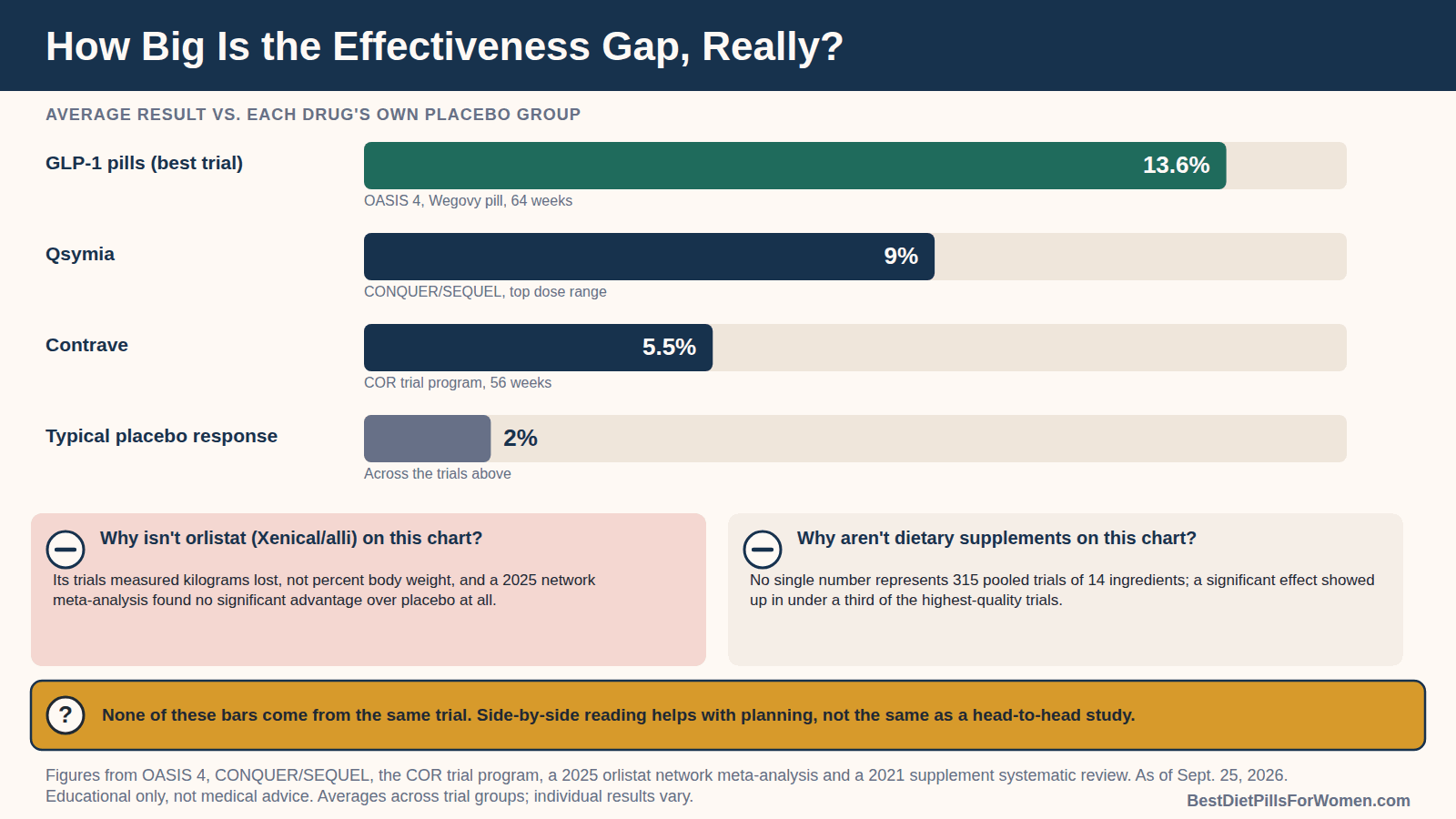
In OASIS 4, adults without diabetes taking the Wegovy pill (oral semaglutide) lost 13.6% of body weight on average over 64 weeks, versus 2.2% on placebo; in ATTAIN-1, the top label dose of Foundayo (orforglipron) produced 11.1% versus 2.1% at 72 weeks. Those are the largest average effects anywhere in this guide, prescription or OTC, and they come from randomized, placebo-controlled trials involving thousands of adults, the same design used to evaluate most modern prescription drugs. Averages hide range, though: some trial participants lost far more, others far less, and a small percentage of people don’t respond meaningfully to either drug. Choosing between the two newer GLP-1 pills, or between a pill and an injection of the same class, is its own separate question; our semaglutide vs. tirzepatide comparison and pills vs. injections guide go deeper on that specific choice.
Older Prescription Pills: Smaller, Still Real Effects
Qsymia produced roughly 8% to 10% average loss over placebo in its pivotal CONQUER and SEQUEL trials, and Contrave produced roughly 5% to 6% in its COR trial program, both meaningfully smaller than the newer GLP-1 pills but still well above the 2% to 3% typically seen on placebo alone. Phentermine sits at the modest end of the prescription lineup: its own FDA label describes only a small placebo-adjusted advantage over a few weeks of short-term use, a far cry from the double-digit percentages above, though it remains the least expensive prescription option in this guide by a wide margin. None of these older pills is obsolete simply because a newer drug produced a bigger trial number; cost, tolerability and a woman’s own health history can make a smaller, cheaper, longer-track-record option the more sensible choice even where a larger average result exists elsewhere in this guide.
OTC Results: Supplements and the One OTC Drug
The OTC side looks completely different once you leave alli, because almost nothing else has been tested with the same rigor.
What a Review of 315 Randomized Trials Actually Found
A 2021 systematic review and meta-analysis screened more than 20,000 citations, pooling 315 randomized trials of 14 dietary supplement ingredients marketed for weight loss, and found a statistically significant weight difference versus placebo in fewer than a third of the trials rated at low risk of bias. Where an effect did show up, it was almost always small, well under the kind of double-digit percentage losses seen with GLP-1 pills above. Individual ingredient reviews tell a similar story: a pooled analysis of glucomannan trials found a non-significant −0.22 kg in one analysis and a low-certainty −1.36 kg in another; green tea extract ranged from a non-significant −0.04 kg in a Cochrane review to −1.25 kg with low certainty elsewhere; and chromium picolinate averaged −0.50 kg across 11 trials, with a confidence interval that just barely excluded zero. Our OTC appetite suppressants guide covers each ingredient’s evidence in far more depth than fits here, and our broader best appetite suppressants for women guide compares them against prescription appetite-focused options.
Why alli’s Modest Effect Is Now Being Questioned Too
alli’s own effect was never as large as the GLP-1 pills to begin with, and the newest evidence suggests it may be smaller than once thought. The 2007 meta-analysis behind Xenical’s prescription-strength evidence found about 2.9 kg more weight loss than placebo across 30 randomized trials, but a 2025 network meta-analysis comparing orlistat against other options found no statistically significant advantage for orlistat at 52 weeks. Since alli is the same molecule at half that dose, its own real-world effect is smaller still, and reasonably should be read in light of that same declining-evidence picture rather than in isolation. Table 2 and Table 3 lay out the trial-level numbers behind everything in this section.
| Pill | Trial | Design | Average result | Placebo/comparator result |
|---|---|---|---|---|
| Wegovy pill (oral semaglutide) | OASIS 4 | Randomized, 64 weeks, 307 adults without diabetes | 13.6% body weight loss | 2.2% |
| Foundayo (orforglipron) | ATTAIN-1 | Randomized, 72 weeks, 3,127 adults | 11.1% (top label dose) | 2.1% |
| Qsymia | CONQUER/SEQUEL | Randomized, up to 108 weeks | About 8% to 10% | About 1% to 2% |
| Contrave | COR program | Randomized, 56 weeks | About 5% to 6% | About 1% to 2% |
| Xenical (orlistat 120 mg) | 2007 meta-analysis of 30 RCTs | Meta-analysis | 2.9 kg more than placebo | — |
| Phentermine | FDA label summary | Short-term use, per label | Small placebo-adjusted advantage per label | — |
Table 2 method: figures as reported in the trials, meta-analysis and FDA labels, read through full texts and labels as of September 25, 2026; rows use different populations, durations and designs, so comparisons across rows are indirect, not head-to-head.
| Product/ingredient class | Evidence base | Typical result | Evidence strength |
|---|---|---|---|
| alli (orlistat 60 mg) | Same molecule as Xenical, half the dose | Smaller than Xenical’s already modest effect | Weakening, per 2025 network meta-analysis |
| All supplements pooled (14 ingredients, 315 RCTs) | 2021 systematic review | Significant difference in under a third of low-bias trials | Mixed to weak |
| Glucomannan | Two meta-analyses | −0.22 kg (not significant) to −1.36 kg (low certainty) | Weak |
| Green tea extract (EGCG) | Cochrane review; network meta-analysis | −0.04 kg to −1.25 kg | Weak |
| Chromium picolinate | Pooled analysis of 11 RCTs | −0.50 kg (CI barely excludes zero) | Weak |
| Caffeine (general) | Dose-response meta-analysis | May modestly reduce short-term intake; weight effect not well established | Weak, mechanism-only for weight |
Table 3 method: figures as reported in the reviews and meta-analyses, read through full texts as of September 25, 2026; see our OTC appetite suppressants guide for a full ingredient-by-ingredient audit.
Seeing every category’s average result on one scale makes the size of the gap easier to judge than reading the tables above one at a time. Infographic 2 below does exactly that.
Why the Evidence Quality Differs So Much Between Categories
The size of a result matters, but so does how much you can trust it, and that’s where prescription and OTC evidence diverge just as sharply as the numbers do.
What Makes Evidence “High Quality” in This Comparison
Not all randomized trials are equal, and the gap between a strong trial and a weak one explains a lot of what looks confusing about this category.
Trial Size, Duration and Blinding
The prescription trials behind this guide’s biggest numbers, OASIS 4, ATTAIN-1 and SURMOUNT-1, each enrolled hundreds to thousands of adults, ran a year or longer, and used randomization with a placebo comparator, the combination that gives a result the most weight in evidence-based medicine. By contrast, the 2021 review of OTC supplements found most of its 315 trials were smaller, shorter and often didn’t meet the same low-risk-of-bias standard; the review’s authors explicitly noted that only a minority of trials met that bar at all, which is part of why “significant in under a third of low-bias trials” is the honest summary rather than a single clean number. A trial can be randomized and still be too small, too short or too poorly blinded to tell you much with confidence, and that describes a meaningful share of the OTC evidence base.
Direct Head-to-Head vs. Indirect Cross-Trial Comparisons
Almost none of the numbers in Table 2 and Table 3 come from a single trial that tested two of these options against each other directly. OASIS 4 tested the Wegovy pill against placebo; ATTAIN-1 tested Foundayo against placebo; the Batsis 2021 review pooled dozens of separate supplement trials, each with its own placebo arm. That means every comparison across categories in this guide, prescription versus OTC, GLP-1 versus older prescription pill, drug versus supplement, is an indirect, cross-trial comparison, not a head-to-head study. A 2025 network meta-analysis is one of the few sources here that statistically models several drugs’ evidence together, and even that comes with real limits on how confidently its results can be compared to a single head-to-head trial. Reading “13.6%” next to “significant in under a third of trials” side by side is useful for planning, but it isn’t the same as a study that put both options in front of the same group of people at the same time.
What “Low Risk of Bias” Actually Means
“Low risk of bias” is a specific methodological judgment, not a vague compliment: it means a trial’s randomization, blinding, outcome reporting and dropout handling were done well enough that its result is unlikely to be an artifact of how the study was run, rather than a real effect of the product tested. The 2021 supplement review used a standard bias-assessment tool to sort its 315 trials into higher- and lower-quality groups, and its headline finding, a significant difference in fewer than a third of trials, specifically describes the higher-quality subset, not every trial that was pooled. That’s a meaningfully more cautious finding than “under a third of all trials,” and it’s part of why a single average across an entire supplement category can understate just how thin the best evidence for any one ingredient actually is. The pivotal prescription trials in this guide, by contrast, were large enough and were run under regulatory scrutiny specifically because FDA required that level of rigor before approval, which is a structural reason, not a coincidence, that their results carry more weight.
A Claim-by-Claim Audit
Marketing language often outruns what a study actually measured, and it’s worth checking the most common claims against the evidence directly.
Common Marketing Claims, Checked Against the Evidence
Table 4 works through five claims that show up constantly across both categories, prescription and OTC, and rates each one against the specific evidence behind it rather than against how confidently it’s advertised.
| Marketing claim | Our assessment | Why |
|---|---|---|
| “Prescription weight loss pills are guaranteed to work” | Unsupported as stated | Trial averages hide individual variation; some people don’t respond meaningfully even to the strongest options |
| “This supplement works like Ozempic, but natural” | Misleading without context | No supplement in the reviewed evidence base approaches GLP-1 trial effect sizes; mechanism claims aren’t outcome data (our berberine for weight loss guide audits this specific claim in depth) |
| “alli is clinically proven, just like the prescription version” | Partially supported, weakening | Same molecule as Xenical, but a 2025 network meta-analysis found no significant orlistat advantage at 52 weeks |
| “This diet pill is FDA-approved” | False for almost every OTC product | Only alli holds FDA nonprescription drug approval; virtually everything else is an unreviewed supplement |
| “Natural ingredients mean it’s safer than a prescription drug” | Unsupported as a blanket claim | Natural sourcing says nothing about pre-market safety review, dose accuracy or contamination risk, covered next in Safety |
Table 4 method: claims are composites of language commonly seen in prescription and OTC weight-loss marketing, not quotes from a single named product; assessments reflect the specific evidence cited in this guide as of September 25, 2026, not a judgment on every brand or formulation.
Where Mechanism Gets Confused With Proof
A proposed mechanism, GLP-1 receptor activation, appetite-hormone signaling, thermogenesis, is a biologically plausible explanation for why a pill might work, not evidence that it does work in people at a meaningful, reliable magnitude. That distinction matters most on the OTC side, where a supplement’s marketing can describe a real, published mechanism study, often done in cells or animals, right next to a weight-loss claim that no human trial actually supports at that scale. It matters on the prescription side too, just differently: a large trial demonstrates clinical effectiveness in the population studied, but it doesn’t guarantee any one reader will see the same 13.6% or 11.1%, which is exactly why we describe these as average results rather than individual promises anywhere in this guide.
Safety: What Each Category Actually Monitors
Regulatory status doesn’t just decide who reviews a product before it’s sold. It decides what happens to it afterward too, and that gap is arguably the most consequential difference in this whole comparison.
How Prescription Drugs Are Monitored After Approval
Approval isn’t the end of FDA’s involvement with a prescription weight loss drug; it’s closer to the beginning of a formal, ongoing monitoring relationship.
Boxed Warnings, REMS and Post-Market Surveillance
Every prescription weight loss pill in this guide carries FDA-mandated labeling that spells out its serious risks, and several require structured monitoring programs that go well beyond a one-time prescription. Qsymia operates under a Risk Evaluation and Mitigation Strategy requiring a negative pregnancy test before starting and monthly during use, because of a birth-defect risk tied to its topiramate component. Contrave’s label carries a boxed warning about suicidal thoughts and behaviors, tied to its bupropion component, and is contraindicated in uncontrolled hypertension and several other conditions. GLP-1 pills carry their own boxed warnings about thyroid C-cell tumors seen in rodent studies, with unknown relevance to humans, and ongoing FDA post-market surveillance tracks adverse events reported after approval across the entire prescribing population, not just the trial participants.
What a Prescriber Actually Checks Before and During Treatment
A prescriber is expected to review a patient’s full medical history, current medications and contraindications before writing any of these prescriptions, and to follow up during treatment, checking blood pressure on stimulant-containing options, confirming pregnancy status where relevant, and watching for the specific side effects each label calls out. That oversight is built into the prescription system itself; it isn’t an optional add-on a particularly careful patient seeks out, it’s the structure the FDA-approval process assumes will exist.
How OTC Products Are Monitored (or Aren’t)
The OTC side has real safety infrastructure too, but it’s narrower, slower and depends far more on the product not lying about what’s inside it.
The Adverse-Event Reporting Gap
Dietary supplement manufacturers are legally required to report serious adverse events to FDA within 15 business days of learning about them, but that requirement only covers serious events that are actually reported, and FDA has repeatedly said it can’t test or verify the contents of every weight loss product on the market. There’s no equivalent of a pivotal trial’s built-in safety monitoring here; a supplement can be sold to thousands of people with no systematic tracking of side effects at all unless something serious enough gets reported voluntarily. alli is a partial exception, since as an approved OTC drug it does have an FDA-reviewed label describing its known gastrointestinal side effects and a documented, though rare, kidney-injury signal that led FDA to add a warning to orlistat’s labeling.
When “Natural” Diet Pills Turn Out to Contain Hidden Drugs
The most serious documented risk in the entire OTC category isn’t a known ingredient’s side effect; it’s what isn’t on the label at all. FDA says it has repeatedly found weight loss products sold as dietary supplements that secretly contain undeclared prescription drugs and other illegal ingredients, including sibutramine, fluoxetine, phenytoin, rimonabant and phenolphthalein. Sibutramine, once sold as the prescription drug Meridia, was pulled from the U.S. market entirely in December 2010 because it raised the risk of heart attack and stroke, yet it keeps turning up hidden in supplements years later; FDA’s own Health Fraud Product Database, updated as recently as September 18, 2026, continues adding new entries. FDA has been explicit that its published list represents only a small fraction of potentially hazardous products, because it cannot test every weight loss product on the market before or after it’s sold. That’s the practical meaning of “no pre-market review” at its worst: it isn’t just weaker evidence for effectiveness, it’s a real possibility that a bottle marketed as “all natural” contains a withdrawn prescription drug that nobody put on the label. Table 5 summarizes the categories of risk on both sides.
| Category | Pre-market review | Post-market monitoring | Documented serious risk |
|---|---|---|---|
| Prescription GLP-1 pills | Full NDA review, years of trials | Boxed warnings; FDA post-market surveillance | Thyroid C-cell tumor signal in rodents (human relevance unknown) |
| Qsymia | Full NDA review | REMS: monthly pregnancy testing | Birth-defect risk if used in pregnancy |
| Contrave | Full NDA review | Boxed warning monitoring | Suicidal thoughts/behaviors boxed warning |
| alli (OTC orlistat) | Rx-to-OTC switch review | FDA-reviewed label; rare kidney-injury warning added | GI side effects; rare kidney injury |
| OTC dietary supplements | None required before sale | Mandatory serious-AE reporting only | Hidden undeclared drugs including sibutramine, phenolphthalein |
Table 5 method: figures and risk descriptions as stated in the FDA guidance, drug labels and FDA’s health fraud pages, read as of September 25, 2026; this table summarizes documented categories of risk and does not list every contraindication for every product.
None of this means every OTC supplement is dangerous or every prescription drug is risk-free; most supplement users never encounter a contaminated product, and every prescription drug here has its own real side effects, covered in more depth later in this guide. It means the two categories carry structurally different kinds of safety uncertainty, and that difference is worth knowing before you buy either one.
When to Get Medical Help, Whichever Category You Choose
Regulatory status changes how a product is reviewed and monitored. It doesn’t change what a genuine medical emergency looks like once a pill, prescription or OTC, is already in your system.
Symptoms That Need Immediate Care
Get medical help right away for a fast or irregular heartbeat, chest pain, severe abdominal pain, signs of pancreatitis, vision changes, thoughts of self-harm, or a severe allergic reaction, no matter which category the product came from. Severe abdominal pain after a fatty meal on orlistat, sudden upper-right abdominal pain with nausea or fever on a GLP-1 pill, and any new mood change or suicidal thought on Contrave all warrant a call to a clinician or a trip to urgent care rather than waiting to see if the symptom passes on its own. For any other side effect that feels wrong or doesn’t improve within a reasonable time, call the prescriber, or a pharmacist for an OTC product, before deciding on your own to stop or change a dose.
How to Report a Problem With Either Category
A reaction to a prescription drug can be reported to FDA through its MedWatch program, by phone or online, whether or not you also tell your prescriber. A suspected problem with a dietary supplement, including one that turns out to contain an undeclared ingredient, goes through FDA’s Safety Reporting Portal instead, and deceptive marketing for either category can be reported to the FTC. Reporting matters beyond your own situation: FDA has been explicit that it can’t test every weight loss product on the market, so the reports it does receive are part of how a genuinely dangerous product eventually gets flagged for other buyers.
Getting Access: What Each Path Actually Requires
Evidence and safety explain why the two categories differ; access explains why so many people still choose the OTC path anyway, even knowing the evidence gap.
Getting a Prescription
A prescription pill is never just a purchase. It’s a relationship with a prescriber that starts before the first pill and, for several options, continues throughout treatment.
The Visit, the Diagnosis Code and the Prior Authorization
Starting a prescription weight loss pill normally means a clinician visit, a review of your medical history and current medications, and, for insurance coverage, a diagnosis code and often a prior authorization that insurers can and do deny. Our weight loss medications guide covers the full prescription lineup and how each one is typically prescribed in more depth than fits here. Telehealth has made that first visit faster and more accessible for many women, particularly for metformin-style options and some GLP-1 prescribing, but it doesn’t remove the need for a real clinical assessment; a reputable telehealth practice still has to screen for the same contraindications an in-person visit would. Coverage for weight-loss-specific prescribing remains inconsistent across private insurance plans and depends heavily on the diagnosis code used, so two women with similar goals can face very different costs depending on how their prescription gets coded and which plan they carry.
REMS Programs and Ongoing Monitoring Visits
Some prescription options add real ongoing logistics on top of the initial visit. Qsymia’s REMS program requires a monthly pregnancy test while a patient of reproductive potential is on the drug, meaning repeat visits or at-home tests plus documentation, not a one-time prescription and done. Other prescription options require periodic follow-up to monitor blood pressure, heart rate or other side effects covered in the Safety section above, which is part of the trade-off for the larger, better-documented results this category produces.
Buying OTC
The OTC path removes almost every one of those steps, which is precisely its appeal and, just as precisely, why the safety net looks so different.
What You Can Buy Without Talking to Anyone
Every OTC option in this guide, including alli, can be purchased directly off a shelf or website with no clinician visit, no diagnosis, no prior authorization and no insurance approval required. That’s a genuine, meaningful advantage for someone who wants to start today, can’t get a timely appointment, or doesn’t have insurance that will cover a prescription option at all. It’s also exactly why the responsibility for checking interactions, reading the label carefully and watching for side effects shifts almost entirely onto the buyer; there’s no pharmacist counseling session built into an online checkout the way there is, at least in principle, into filling a new prescription.
The Extra Risk of Buying From Third-Party Online Marketplaces
Buying alli or a supplement from the manufacturer’s own site or a major pharmacy chain is a meaningfully different transaction than buying the same product name from a third-party seller on a general marketplace, where a listing can be counterfeited, diverted from another market, or expired without a buyer easily knowing. FDA’s tainted-product notifications don’t specify sales channel in every case, but the same lack of pre-market content verification that makes an unregulated supplement risky in the first place also makes it harder to be confident a specific online listing actually contains what its label claims. Buying from the manufacturer directly, a known pharmacy chain, or a retailer that stands behind its own supply chain is a simple, practical way to reduce that added layer of uncertainty, on top of everything else covered in the Safety section above.
The Access Trade-Off: Convenience vs. Oversight
The honest way to frame this trade-off isn’t “prescription good, OTC bad.” It’s that convenience and oversight move in opposite directions across these two categories, and a reasonable decision means being clear-eyed about which one matters more for your own situation, budget and how comfortable you are managing the added responsibility that comes with skipping a clinician’s involvement. For some people, particularly those with a straightforward goal, no complicating health conditions and a tight budget, the OTC path’s lower evidence bar may still be an acceptable trade against its convenience. For others, especially anyone with a cardiovascular condition, a pregnancy consideration or a BMI and health profile that would benefit from the larger, better-documented prescription results, the extra steps of the prescription path are the more defensible choice, a point Table 8 later in this guide returns to directly.
What Each Category Costs
Cost is where “OTC is cheaper” turns out to be only sometimes true, and where the honest comparison has to look at cost per pound lost, not just price per bottle.
Prescription Costs
Prescription weight loss pills span an enormous price range, from nearly free to among the most expensive medications a woman might take regularly.
GLP-1s vs. Older Prescription Pills
| Option | Monthly self-pay price | Estimated annual cost |
|---|---|---|
| Wegovy pill (1.5 mg to 25 mg) | $149 to $299 | $1,788 to $3,588 |
| Foundayo (0.8 mg to 17.2 mg) | $149 to $299 | $1,788 to $3,588 |
| Zepbound single-dose vials | $299 to $449 | $3,588 to $5,388 |
| Metformin (generic, for comparison) | About $0 to $20 | About $0 to $240 |
| Contrave | About $199 | About $2,388 |
| Qsymia (plus monthly pregnancy testing) | About $75 | About $900 |
| Phentermine | About $16 | About $192 |
| Xenical (prescription orlistat 120 mg) | About $431 | About $5,172 |
| Alli (OTC orlistat 60 mg) | About $88 | About $1,056 |
| Myo-inositol powder (branded example) | About $23 to $31 | About $276 to $372 |
| Berberine capsules (branded example) | About $30 to $45 | About $360 to $540 |
Table 6 method: monthly figures are self-pay or lowest-listed prices from manufacturer cost pages, retail price aggregators and branded supplement product pages, read through page summaries on September 25, 2026, and annualized by multiplying by 12; totals exclude clinician visits, lab tests, telehealth fees, shipping and needles, and assume no missed fills or manufacturer savings cards. Our Wegovy pill cost guide breaks that single option’s pricing and savings-card terms down in more detail.
Why Metformin-Style Pricing Doesn’t Apply Here
Metformin’s near-zero cost is the exception across the entire prescription lineup, not the rule, and it’s tempting to assume every prescription option costs that little. It doesn’t: the GLP-1 pills, at $149 to $449 a month depending on dose and drug, and prescription-strength Xenical, at roughly $431 a month, sit at the opposite end of the price range from metformin, and none of the higher-priced options in Table 6 has anything close to metformin’s decades-long generic pricing. Manufacturer savings cards can meaningfully lower some of these self-pay prices for eligible patients, and insurance coverage, where it exists for weight-loss-specific prescribing, changes the calculation considerably, but sticker price alone puts several prescription options well above every OTC alternative in this guide.
OTC Costs
alli and dietary supplements cost real money too, and comparing sticker price without comparing what that price buys tells only half the story.
alli and Dietary Supplement Pricing
alli runs about $88 a month, or roughly $1,056 a year, cheaper than every prescription option in Table 6 except metformin and phentermine, but its own effect size is smaller than prescription-strength Xenical’s already modest and increasingly disputed one. Dietary supplements marketed for weight loss vary enormously in price: a myo-inositol product runs roughly $276 to $372 a year and a berberine product roughly $360 to $540 a year, both entirely out of pocket since supplements aren’t covered by prescription insurance. Neither of those approaches metformin’s price floor, and neither comes with metformin’s stronger evidence base either.
The Real Cost-Per-Pound Comparison
The number that actually matters for a budget-conscious comparison isn’t monthly price, it’s rough cost relative to expected result. A GLP-1 pill at roughly $150 to $300 a month producing an 11% to 14% average loss is expensive in absolute terms but, per percentage point of body weight, isn’t obviously worse value than an $88-a-month OTC drug whose own evidence is now being questioned, or a supplement in the $25-to-$45-a-month range with a significant effect in under a third of low-bias trials. We aren’t calculating a precise dollars-per-pound figure here, because the trials behind these numbers used different populations, doses and durations that don’t support that kind of arithmetic without overstating precision; the honest takeaway is that a lower sticker price doesn’t automatically mean better value once you weigh it against how much, or how little, a category actually moves the needle in controlled trials.
The Costs Neither Category Advertises
Table 6’s monthly figures are real starting points, but they aren’t the whole bill for either category, and the gaps run in different directions.
Clinician Visits, Labs and Telehealth Fees
A prescription option’s true annual cost usually includes more than the pharmacy price: an initial visit, follow-up appointments, and for several drugs, specific lab work or pregnancy testing that Table 6 doesn’t capture. Qsymia’s monthly pregnancy testing, in particular, adds a recurring cost or time commitment beyond the drug itself, on top of whatever the visit or telehealth platform charges for that follow-up. A telehealth subscription can lower the friction of getting an initial prescription, but it’s still a separate line item from the drug’s own price, and it’s worth asking upfront whether a given platform charges a recurring membership fee on top of the medication cost.
What a Missed Dose or a Skipped Refill Costs
OTC products carry a quieter version of the same problem: a product bought once and used inconsistently, or replaced with a different brand every few months while chasing a better marketing claim, adds up in wasted spending without ever producing a fair test of any single ingredient’s actual effect. Because most OTC ingredients in this guide have, at best, a small average effect measured over many weeks of consistent use, inconsistent use is likely to underperform even the modest results in Table 3, making the effective cost per unit of benefit considerably worse than the sticker price suggests. Sticking with one option long enough to fairly judge it, prescription or OTC, is itself a cost-effectiveness decision worth making deliberately rather than by accident.
Side Effects: How the Categories Compare
Side effects are one place where “prescription” doesn’t automatically mean “harder to tolerate” and “OTC” doesn’t automatically mean “gentler.” The pattern is more specific than that.
Prescription Side Effects
The prescription category’s side effects are extensively documented, precisely because the trials behind approval were designed to capture them.
What Shows Up in Large Trials
Digestive symptoms dominate the newer prescription pills: in OASIS 4, 74.0% of Wegovy pill users had a digestive-system adverse event versus 42.2% on placebo, and Foundayo’s label reports nausea in 26% to 35% of users by dose versus 10% on placebo, with vomiting, diarrhea and constipation all following the same pattern. Contrave’s most common complaint is nausea, at 32.5% versus 6.7% on placebo, alongside insomnia, dizziness and headache each running roughly two to three times more common than on placebo. Qsymia’s top dose brings a different symptom profile entirely: tingling sensations in 20% of users versus 2% on placebo, dry mouth in 19% versus 3%, and constipation in 16% versus 6%. Overall discontinuation because of side effects ranged from about 7% for Wegovy pill to 24% for Contrave in their respective trials, a meaningful spread across drugs that are often lumped together as “the prescription options.”
Boxed Warnings and Who Should Avoid Certain Drugs
Beyond common side effects, several prescription pills carry FDA boxed warnings or firm contraindications covered in the Safety section above: Contrave’s suicidal-thoughts warning and its contraindication in uncontrolled hypertension and seizure disorders, Qsymia’s birth-defect risk and REMS requirement, and the GLP-1 pills’ thyroid C-cell tumor warning and contraindication in a personal or family history of medullary thyroid cancer. These aren’t minor label fine print; they’re reasons a prescriber might rule out a specific drug for a specific person entirely, which is exactly the kind of individualized screening the OTC category mostly skips.
OTC Side Effects
alli’s side effects are unusually well documented for an OTC product, precisely because it’s the one drug in that aisle. Everything else is a much murkier picture.
alli’s GI Effects and What They Mean
Orlistat’s characteristic side effects are digestive and directly tied to how much fat is in a given meal: in prescription-strength trials, oily spotting affected 26.6% of users versus 1.3% on placebo, fecal urgency 22.1% versus 6.7%, and fecal incontinence 7.7% versus 0.9%. alli’s own Drug Facts label lists the same categories of effect at its lower 60 mg dose, though we didn’t find dose-specific frequencies for that strength in the sources we read, so treat the Xenical numbers as directionally informative rather than an exact match for alli. Orlistat also reduces absorption of fat-soluble vitamins A, D, E and K, which is why a multivitamin taken a few hours apart from a dose is commonly recommended.
Supplement Side Effects Nobody’s Tracking Systematically
Individual supplement ingredients carry their own documented risks, but nobody is running a large, controlled trial to measure how often they occur across the general population the way FDA requires for a prescription drug. Chromium can interact with insulin and levothyroxine; glucomannan carries a choking or blockage risk if it isn’t taken with enough fluid, since it’s designed to absorb water and expand; and caffeine-containing blends add to a person’s total daily caffeine intake in ways that aren’t always obvious from a label, with effects on heart rate, blood pressure and sleep. The biggest supplement-specific risk, though, isn’t any single ingredient’s known side effect; it’s the possibility, covered in the Safety section above, that an OTC product doesn’t disclose everything it contains at all. Table 7 lines up what’s actually documented for each option, and what to watch for.
| Option | Most common side effects | Frequency (drug vs. placebo/comparator) |
|---|---|---|
| Wegovy pill | Digestive-system events overall | 74.0% vs. 42.2% |
| Foundayo | Nausea, vomiting, diarrhea, constipation | Nausea 26–35% vs. 10% |
| Contrave | Nausea, insomnia, dizziness, headache | Nausea 32.5% vs. 6.7% |
| Qsymia (top dose) | Tingling, dry mouth, constipation | Tingling 20% vs. 2% |
| Xenical (orlistat 120 mg) | Oily spotting, fecal urgency | Oily spotting 26.6% vs. 1.3% |
| alli (orlistat 60 mg) | Same categories as Xenical, at half the dose | Dose-specific frequency not found in sources reviewed |
| OTC supplements (general) | Varies by ingredient; GI upset common | Not systematically tracked; see individual ingredient reviews |
Table 7 method: figures as reported in the prescribing information and trial data, read as of September 25, 2026; alli’s exact 60 mg frequencies weren’t confirmed in the sources reviewed, so its row uses the same-molecule Xenical data as a directional comparison only, not a claim that the two doses produce identical rates.
Interactions and Combinations Worth Flagging
Side effects from a single product are only part of the picture. What a woman is already taking, prescription or OTC, changes the calculus for anything new she adds.
Combining a Prescription Pill With Caffeine or Stimulant Supplements
Stacking a prescription weight loss pill with a caffeine-heavy OTC “fat burner” or an energy supplement isn’t something any label in this guide recommends, and it deserves specific caution rather than an assumption that more is simply better. Phentermine and the phentermine component of Qsymia are themselves mild stimulants, and adding caffeine, yerba mate, guarana or a similar ingredient on top can compound effects on heart rate, blood pressure and sleep in ways no trial in this guide specifically measured. Because caffeine content in blended supplements isn’t always transparent on the label, a woman on any stimulant-containing prescription pill has a specific reason to check total daily caffeine intake across everything she takes, not just her coffee.
What to Tell a Pharmacist Before Starting Either Option
A pharmacist can check a proposed new prescription or OTC product against a woman’s full medication list far more reliably than a general guide like this one can, but only if she brings the complete list, including supplements she may not think to mention because they aren’t “real medicine.” Chromium’s interaction with insulin and thyroid medication, orlistat’s interaction with fat-soluble vitamins and thyroid hormone timing, and Contrave’s and Qsymia’s specific psychiatric and cardiovascular contraindications are exactly the kind of detail a pharmacist review is designed to catch before a new pill causes a problem rather than after. That conversation costs nothing beyond a few minutes at the counter, and it’s one of the few safety steps available to someone considering either category.
Who Actually Fits Each Category
Everything above is about the categories in the abstract. This section is about which one, if either, tends to make more sense for a specific kind of situation.
When Prescription Makes More Sense
Prescription weight loss pills were studied in, and approved for, a fairly specific population, and that population is the clearest fit for the category.
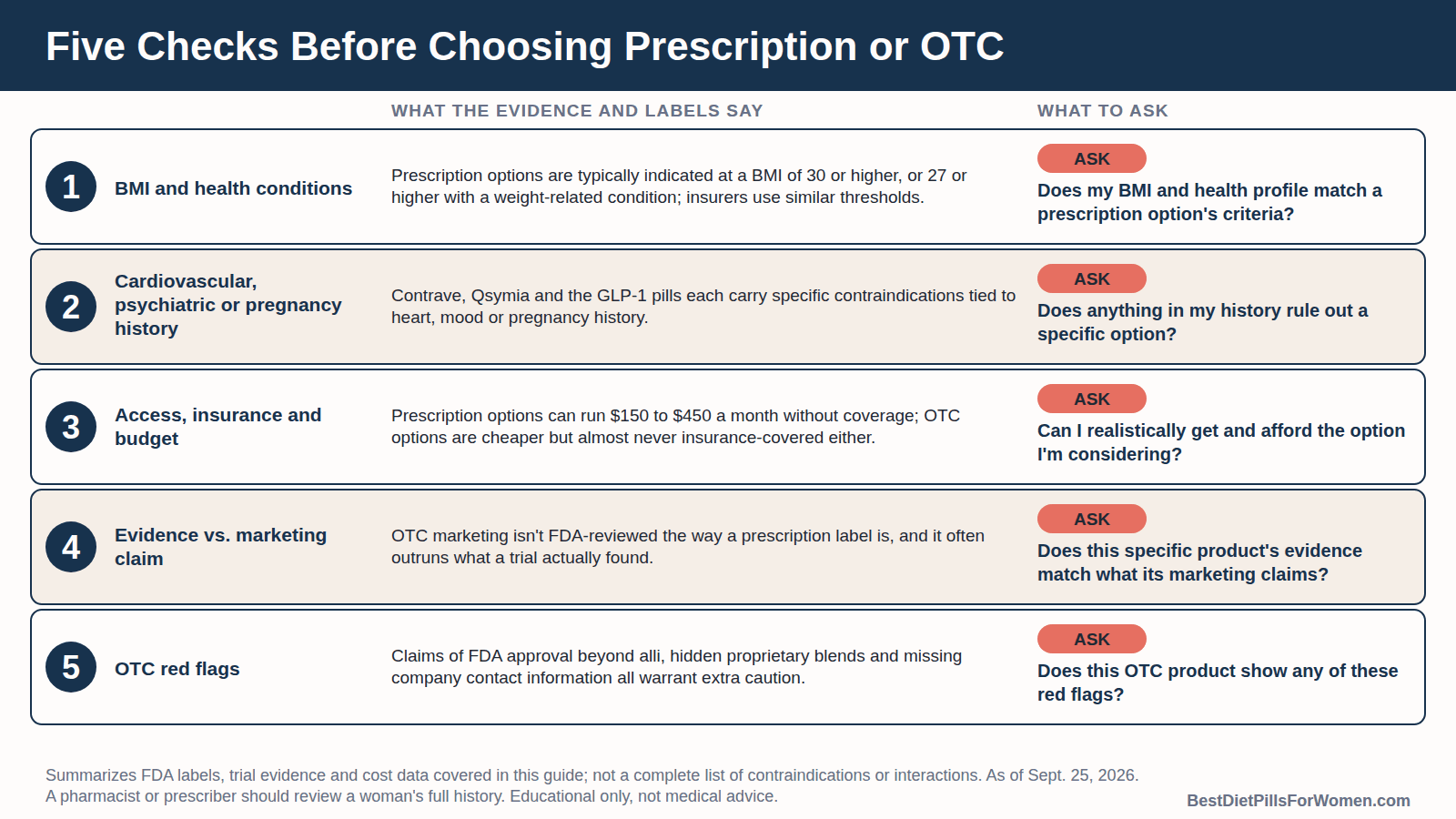
BMI, Comorbidities and Insurance Coverage
Prescription weight loss drugs are typically indicated for adults with a BMI of 30 or higher, or 27 or higher with a weight-related condition such as high blood pressure, high cholesterol, type 2 diabetes or sleep apnea, the same threshold insurers commonly use for initial prior authorization. Someone in that group, especially with a comorbidity that a 5% to 10% or larger weight loss could meaningfully improve, is the population the strongest trial evidence in this guide actually describes. Insurance coverage remains the practical gatekeeper for many women in this category: continuation typically requires hitting a minimum loss threshold, commonly 3% for Qsymia and 5% for the newer GLP-1 pills, within a set number of months, and a plan without weight-loss-specific coverage can make even a well-matched prescription option prohibitively expensive.
When a Clinician Conversation Is the Right First Step
Anyone with a cardiovascular condition, a seizure disorder, a personal or family history of thyroid cancer, an active or recent eating disorder, or a current or planned pregnancy has a specific, documented reason in this guide’s Safety section to have that conversation before choosing any prescription option, since several are contraindicated outright for one or more of those situations. A clinician conversation is also the right starting point for anyone whose main goal is the largest, most consistent result this guide covers; nothing in the OTC category comes close to a GLP-1 pill’s trial-documented average effect. Life stage adds its own layer to this decision too: our guides to the best weight loss pills for menopause, perimenopause, women over 40 and PCOS each cover condition- or stage-specific evidence and safety questions that this general comparison doesn’t have room for.
When OTC Might Be Reasonable
The OTC path isn’t automatically the wrong choice, but the situations where it holds up reasonably well are narrower than its marketing suggests.
Realistic Expectations for the OTC Path
OTC options fit best for someone who understands, going in, that the realistic average effect is small, that the evidence behind most individual ingredients is weak to mixed, and that alli is the one product in that aisle with an FDA-reviewed effectiveness record, even if that record is now being questioned too. That describes someone without access to a prescriber right now, someone who wants a lower-cost or lower-commitment starting point before considering a bigger step, or someone whose goal is modest enough that a small, uncertain effect is an acceptable trade for the convenience of skipping a clinician visit entirely.
Red Flags That Should Rule Out a Specific OTC Product
A handful of warning signs should push a specific OTC product off the list regardless of anything else about it: marketing language claiming FDA approval for anything other than alli, a claimed effect that sounds close to a prescription GLP-1 pill’s trial results, a proprietary blend that hides individual ingredient doses, or a lack of any real company contact information on the label. Any of those should be read as a reason for extra caution, checked against FDA’s health fraud pages before buying, not as a detail to overlook because the rest of the label sounds reasonable. None of these red flags requires special expertise to spot; they’re checkable from the label and a few minutes on FDA’s own site, which makes them a genuinely useful filter even for someone who has already decided the OTC path is right for their situation. Table 8 pulls this section’s threshold-based logic into one place.
| Situation | Better fit | Why |
|---|---|---|
| BMI ≥30, or ≥27 with a weight-related condition, wanting the largest average result | Prescription | Matches FDA-reviewed trial populations and insurer coverage thresholds |
| Cardiovascular condition, seizure disorder, thyroid cancer history or pregnancy plans | Neither without a clinician first | Multiple contraindications across prescription options; supplements carry unverified content risk |
| No current access to a prescriber, modest goal, comfortable with uncertainty | OTC (alli, cautiously) | Only OTC option with FDA-reviewed effectiveness evidence, though it’s weakening |
| Drawn to a specific supplement’s marketing claim | Check Table 4’s claim audit first | Most individual-ingredient evidence is weak; claims often outrun data |
| Tight budget, no insurance coverage for weight-loss prescribing | Metformin (if applicable) or OTC | Metformin’s price floor and evidence base beat most OTC options where clinically appropriate |
Table 8 method: this table summarizes the threshold-based logic developed across this guide’s Access, Cost and Safety sections as of September 25, 2026; it isn’t a substitute for an individualized clinical assessment.
The five checks that most often change the answer for a specific woman deserve a closer look on their own; Infographic 3 below walks through them directly.
Frequently Asked Questions About Prescription vs. OTC Weight Loss Pills
A few questions come up so often in this comparison that they’re worth answering directly, even where the answer repeats a point made earlier in more depth.
Effectiveness and Access
Is a Prescription Weight Loss Pill Always More Effective Than an OTC One?
On average, yes, across the trials in this guide, but “always” is too strong a word for any individual person. GLP-1 pills and older prescription pills produced the largest, most consistent average results reviewed here, while OTC supplements showed a significant effect in under a third of low-bias trials and alli’s own evidence is weakening. Individual responses vary within every category, and a small share of people see little benefit even from the strongest prescription options.
Can I Just Ask My Doctor for a Prescription Without Trying OTC First?
Yes. Nothing in FDA’s approval of any prescription weight loss drug requires trying an OTC option first, and a clinician can prescribe based on your BMI, health history and goals directly. Some insurance plans do require documentation of prior weight-loss attempts for prior authorization, which is a coverage policy, not a medical requirement, and it varies by plan.
Why Do OTC Diet Pills Advertise Results That Sound Like Prescription-Level Weight Loss?
Because dietary supplement marketing isn’t required to be reviewed by FDA before it’s published, unlike a prescription drug’s label, which goes through FDA review as part of approval. That gap is exactly why Table 4’s claim audit exists earlier in this guide: a marketing claim and a clinical trial result are not the same thing, and the honest evidence behind most OTC products doesn’t support prescription-level language.
Safety and Regulation
If a Supplement Is “Natural,” Is It Automatically Safer Than a Prescription Drug?
No. Natural sourcing says nothing about whether a product went through pre-market safety review, whether its dose is accurate, or whether it’s contaminated with an undeclared ingredient, the specific risk covered in this guide’s Safety section. Some natural ingredients are well tolerated; others, like ephedra, have been banned outright because they weren’t safe at the doses once sold.
How Do I Know If an OTC Weight Loss Product Might Be Tainted?
You can’t tell from the label alone, since tainted products typically don’t disclose what they actually contain. Checking FDA’s health fraud product database before buying, being skeptical of any OTC product claiming prescription-level results, and avoiding products that claim to be “FDA-approved” when they aren’t alli specifically are the most practical steps available to a consumer.
Does Insurance Cover Either Category?
Prescription weight loss drugs may be covered depending on your plan, diagnosis code and whether you meet continuation criteria; OTC products, including alli and all dietary supplements, are essentially never covered by prescription insurance and are paid out of pocket. A health savings account or flexible spending account can sometimes be used for prescription medications in this guide; confirming that with a benefits administrator is worth doing before assuming either way.
Choosing Between the Two
Is It Ever Reasonable to Use an OTC Product While Waiting for a Prescription Appointment?
That’s a question for a pharmacist or prescriber given your specific health history, since it depends on what else you take and any conditions you have; this guide can’t make that call for you. If you do go that route, alli is the one OTC product with FDA-reviewed effectiveness and safety data behind it, which is a meaningfully different starting point than an unregulated supplement blend.
Can I Combine a Prescription Pill With an OTC Supplement?
Combining any prescription weight loss drug with an OTC supplement, especially anything containing caffeine or other stimulants, should be discussed with a pharmacist or prescriber first, since interactions aren’t systematically studied and several supplement ingredients affect the same systems, heart rate, blood pressure, GI function, that prescription options already affect. This isn’t a recommendation to combine them; it’s a reason to ask before doing so.
What Should I Ask Before Choosing Between Prescription and OTC?
Bring your BMI and any weight-related health conditions, your insurance’s prior-authorization and continuation rules if you’re considering a prescription option, and, if you’re drawn to a specific OTC product, its exact ingredient list and dosing rather than just its marketing claims. A pharmacist or prescriber can check all of that against your own health history in a way no general guide can.
Is It Reasonable to Switch Categories If One Isn’t Working?
Yes, and it’s a common, sensible path rather than a sign either choice was wrong to begin with. A prescription option that isn’t producing the expected result, or that causes side effects a person can’t tolerate, is worth revisiting with the prescriber who wrote it, since dose adjustments or a different drug in the same guide may fit better.
Someone who has given an OTC product a fair, consistent trial without the modest result the evidence predicted has a reasonable case for asking a clinician about the prescription options this guide covers instead, and bringing the specific product tried, and for how long, makes that conversation more useful.
The Bottom Line on Prescription vs. OTC Weight Loss Pills
Nine sections of trial data, pricing tables and regulatory history all point toward the same underlying answer, worth stating plainly before you decide anything.
What the Total Evidence Means for You
The regulatory gap between these two categories isn’t a technicality. It’s the single fact that best predicts everything else in this guide, from average result size to how confidently anyone can describe a product’s risks.
The Biggest Realistic Benefit
The biggest realistic benefit of choosing a prescription option, when you qualify and can access one, is the largest and most consistently documented weight loss in this entire comparison, backed by trials FDA reviewed before the drug ever reached a pharmacy. GLP-1 pills in particular produced average results, 11% to 14% of body weight, that no OTC product in this guide’s evidence base approaches. That benefit comes with real structure behind it too: a prescriber who screens for contraindications, a label FDA has reviewed line by line, and, for several options, a formal monitoring program that catches problems before they become serious. The biggest realistic benefit of the OTC path is access: no appointment, no diagnosis code, no prior authorization, available today for anyone who can walk into a store or place an order, at a price point that, for alli specifically, sits below most of the prescription lineup.
The Biggest Limitation and Safety Concern
The biggest limitation on the prescription side is cost and access, since several of the strongest options run $150 to $450 a month without coverage, and insurance approval depends on diagnosis codes and continuation thresholds that don’t guarantee coverage for every woman who might benefit. The biggest safety concern on the OTC side isn’t any single ingredient’s known side effect; it’s that almost nothing in that aisle went through pre-market review, and FDA has repeatedly found weight loss products secretly contaminated with drugs pulled from the market for serious safety reasons. Put the two limitations side by side and a pattern emerges: the prescription category’s biggest weakness is a barrier to entry, while the OTC category’s biggest weakness is a lack of a barrier at all, and neither problem is solved by pretending the other category doesn’t have one too.
A Rational Next Step
None of this is a reason to panic about either category, or to assume one is simply right and the other simply wrong. It’s a reason to be specific about what you’re actually choosing between.
Questions for a Clinician
If a prescription option is on the table, ask what result the specific trial behind that drug found in a population similar to you, what the plan’s coverage and continuation requirements actually are, and which of the contraindications covered in this guide’s Safety section might apply to your own history. If you’re leaning OTC, ask a pharmacist whether the specific product’s ingredients interact with anything else you take, and whether alli’s evidence, while modest and weakening, is a more defensible starting point than an unregulated supplement blend for your situation.
What to Re-Check Before You Spend Money
Prices, insurance prior-authorization rules, and FDA safety notices for both drugs and supplements can all change within weeks of when this guide was checked. Before spending money on either path, re-verify current pricing directly with the manufacturer or pharmacy, confirm your plan’s current coverage rules, and check FDA’s health fraud pages for any new warnings about a specific OTC product you’re considering. The category with the strongest evidence and the tightest regulation isn’t automatically the right choice for every person or every budget, and the category with the easiest access isn’t automatically the wrong one either. The honest answer, for almost everyone reading this, is that the choice deserves the same specific, evidence-based questions this guide just walked through, not a blanket rule in either direction.
Related Reading
Sources
These are the main sources behind this guide, chosen because they are the ones to check first for current facts. Labels, prices and research summaries change, so confirm the latest version before you make decisions.
- U.S. Food and Drug Administration. The FDA’s Drug Review Process: Ensuring Drugs Are Safe and Effective (page updated November 24, 2017). https://www.fda.gov/drugs/information-consumers-and-patients-drugs/fdas-drug-review-process-ensuring-drugs-are-safe-and-effective
- U.S. Food and Drug Administration. Information for Consumers on Using Dietary Supplements (page updated October 21, 2022). https://www.fda.gov/food/dietary-supplements/information-consumers-using-dietary-supplements
- U.S. Food and Drug Administration. FDA approves labeling changes for over-the-counter (OTC) weight loss drug alli (orlistat) to warn of risk of kidney stones and kidney injury (2026; the June 10, 2026 date shown on the page may be an update date). https://www.fda.gov/safety/medical-product-safety-information/fda-approves-labeling-changes-over-counter-otc-weight-loss-drug-alli-orlistat-warn-risk-kidney
- U.S. Food and Drug Administration. Prescription to Nonprescription (Rx-to-OTC) Switches (content current as of May 21, 2026). https://www.fda.gov/drugs/drug-application-process-nonprescription-drugs/prescription-nonprescription-rx-otc-switches
- U.S. Food and Drug Administration. Questions and answers about FDA’s initiative against contaminated weight loss products (August 18, 2021). https://www.fda.gov/drugs/frequently-asked-questions-popular-topics/questions-and-answers-about-fdas-initiative-against-contaminated-weight-loss-products
- U.S. Food and Drug Administration. Guidance for Industry: Questions and Answers Regarding Adverse Event Reporting and Recordkeeping for Dietary Supplements as Required by the Dietary Supplement and Nonprescription Drug Consumer Protection Act (page summary). https://www.fda.gov/regulatory-information/search-fda-guidance-documents/guidance-industry-questions-and-answers-regarding-adverse-event-reporting-and-recordkeeping-dietary
- Batsis JA, et al. A systematic review of dietary supplements and alternative therapies for weight loss. Obesity. 2021. doi:10.1002/oby.23110
- OASIS 4 investigators. Oral semaglutide at a dose of 25 mg in adults with overweight or obesity (OASIS 4). N Engl J Med. 2025 (doi:10.1056/NEJMoa2500969). Figures read via the American College of Cardiology journal scan (https://www.acc.org/latest-in-cardiology/journal-scans/2025/09/24/16/40/oasis-4), Novo Nordisk trial materials and the FDA-approved label; the journal article itself was not accessible.
- McGowan B, et al. Efficacy and safety of weight-management medications: a network meta-analysis of 56 randomized trials (search to January 31, 2025). Nature Medicine. October 2, 2025. https://www.nature.com/articles/s41591-025-03978-z (abstract page read through a page summary; numeric estimates weren’t visible).
- U.S. Government Publishing Office / National Archives. 21 CFR Part 111: Current Good Manufacturing Practice in Manufacturing, Packaging, Labeling, or Holding Operations for Dietary Supplements (eCFR, current version, read through a page summary). https://www.ecfr.gov/current/title-21/chapter-I/subchapter-B/part-111