
The best weight loss pills for perimenopause, judged by the strength of the evidence, are the same GLP-1 medicines that lead the field at other life stages: semaglutide (Wegovy pill and injection), tirzepatide (Zepbound) and orforglipron (Foundayo). Three separate 2026 post hoc analyses broke their trial results down by menopausal status, and each found weight loss in perimenopausal women that was broadly similar to premenopausal and postmenopausal women in the same trial. What perimenopause adds isn’t a different set of effective drugs; it’s a different set of questions a woman and her clinician need to work through before choosing one, starting with a question that simply doesn’t apply after menopause: is pregnancy still on the table.
Here’s the catch: perimenopause isn’t a steady, one-way slide toward lower hormone levels the way postmenopause is. Estrogen and progesterone fluctuate, sometimes sharply, from cycle to cycle, which is why symptoms can feel unpredictable and why a single blood test rarely settles the question of “where am I in this transition.” That fluctuation also means ovulation can still happen, sometimes on a normal schedule and sometimes not, which keeps pregnancy a real possibility even when periods have become irregular. That single fact reshapes several safety conversations in this guide, from the pregnancy-testing requirement built into one prescription pill’s label to the choice some clinicians make between a low-dose birth control pill and menopausal hormone therapy for symptom relief.
This guide checks what the 2026 menopause-stage trial evidence shows specifically for the perimenopausal subgroup, works through the pregnancy, contraception and hormone-therapy questions that make this life stage genuinely different from menopause, and lays out the safety, interaction and cost information that matters most while cycles are still active. It’s part of our wider coverage of the best weight loss pills for women, our menopause-specific guide, which has the full three-analysis breakdown this page draws from, and our guide for women over 40, and it’s meant to sharpen the questions you bring to a clinician, not to tell you to start or stop anything.
Best Weight Loss Pills for Perimenopause: The Short Answer
Start with the conclusions, then check them against the sections that follow. Each answer says how sure we are and what limits it.
The Direct Answer and How Sure We Are
What Are the Best Weight Loss Pills for Perimenopause?
The GLP-1 medicines, semaglutide (Wegovy pill and injection), tirzepatide (Zepbound) and orforglipron (Foundayo), have both the largest average effects and the most menopause-stage-specific evidence of any option covered here, including a perimenopausal subgroup that performed in line with the other groups in each analysis. Three 2026 post hoc analyses, one per drug, each broke trial results down by menopausal status and reported perimenopausal results within a few percentage points of the premenopausal and postmenopausal groups.
That’s a more specific answer than “these drugs work in adults,” but it still comes from post hoc analyses that weren’t designed around menopausal status from the start, and perimenopausal women were typically the smallest of the three subgroups in each analysis, a limit worth keeping in view through the rest of this guide.
How Sure We Are About That Answer
We’re most confident about the size of the average effect, since it’s been measured in large randomized trials and cross-checked, at least loosely, by menopausal status. We’re less confident about how any one woman will respond, since perimenopause itself varies enormously between individuals, and about a handful of questions unique to this stage, contraception interactions, fertility planning and the newest bone-and-muscle research, that simply haven’t been studied with perimenopausal women as the specific focus.
How We Judged “Best”
No independent lab tested these products side by side. “Best” here means best-supported by the evidence available, not a taste test or a ranked countdown.
The Four Criteria We Used
We weighed four things for every option: the size and quality of the human evidence, including whether a perimenopausal subgroup was examined specifically; the safety and interaction profile most relevant to a woman who may still be ovulating, bleeding irregularly, or using contraception; practical access, including cost and prescription requirements; and how honestly the marketing around a product matches what trials actually show. No option scored perfectly on all four; our guide to the best appetite suppressant for women applies a similar framework to that narrower category specifically.
What This Assessment Is and Isn’t
This is a synthesis of labels, trial data and post hoc analyses, not a clinical recommendation, a product test or firsthand use of any drug or supplement discussed. Nothing here tells a reader to start, stop or change a medicine, a contraceptive method or hormone therapy; that decision belongs to a woman and her clinician.
The Options at a Glance
Table 1 puts the main options next to each other before the rest of this guide goes deeper on each one.
The Summary Table
| Option | Main trial or analysis | Average weight change, drug vs placebo | Biggest consideration during perimenopause |
|---|---|---|---|
| Wegovy pill (semaglutide, daily; prescription) | OASIS 4 | −13.6% vs −2.4% | Discontinue at least 2 months before a planned pregnancy |
| Wegovy injection (semaglutide, weekly; prescription) | STEP UP by menopausal stage | −22.6% (premenopausal), −19.7% (perimenopausal), −19.8% (postmenopausal) | Same 2-month pregnancy-planning window applies |
| Zepbound (tirzepatide, weekly; prescription) | SURMOUNT-1 by reproductive stage | −26% (premenopausal), −23% (perimenopausal), −23% (postmenopausal) vs −2% to −3% | Largest average effect here; same 2-month pregnancy-planning window |
| Foundayo (orforglipron, daily; prescription) | ATTAIN-1/ATTAIN-2 pooled by menopause stage | Up to −14% vs placebo, reported as uniform across all three menopausal groups | Newest pill on the market; least long-term data of any option here |
| Contrave (naltrexone-bupropion, daily; prescription) | Pooled trials | −5.4% vs −1.3% (first trial) | Boxed warning for suicidal thoughts; contraindicated in pregnancy |
| Qsymia (phentermine-topiramate, daily; prescription) | CONQUER | −7.81% and −9.84% vs −1.24% | Label requires a negative pregnancy test before starting and monthly during use, plus effective contraception |
| Phentermine (short-term; prescription) | Not in the label | A fraction of a pound a week over placebo (label) | Contraindicated in pregnancy; short-term use only |
| Orlistat (alli 60 mg OTC; Xenical 120 mg prescription) | Pooled analysis | About 2.9 kg (6.4 lb) more than placebo | Different mechanism (blocks fat absorption); no pregnancy restriction, but reduces fat-soluble vitamin absorption |
| Combined oral contraceptive (low-dose estrogen-progestin pill) | Not a weight loss treatment; discussed for context | No consistent weight-loss effect | Sometimes chosen over hormone therapy during perimenopause for contraception and cycle control |
Table 1 method: mean ages, menopausal-status breakdowns and weight figures are as reported in the labels, trial abstracts and post hoc analyses, read through abstracts, label mirrors and page summaries as of September 25, 2026, and no result was recalculated. The menopause-stage analyses come from separate, manufacturer-run post hoc studies of three different drugs, not a single head-to-head trial, so the rows are an indirect comparison, not a ranking.
How to Read the Table
Read the third column as reported results from separate studies with different designs, populations and dosing, not as a head-to-head contest. A bigger average number doesn’t automatically mean a better fit for one particular woman, and the combined oral contraceptive’s inclusion here is intentional: it belongs in this conversation because clinicians sometimes recommend it during perimenopause for reasons that get confused with weight loss, not because it works the same way as the prescription weight loss medicines above it.
The fourth column is where perimenopause actually changes the calculus for a given woman, more than the second and third columns do. A woman who still has periods, even irregular ones, faces a pregnancy-planning and contraception conversation that a postmenopausal woman simply doesn’t, and that difference touches nearly every option in this table, from a restricted-distribution program’s testing requirement to a drug label’s discontinuation window. The sections that follow work through each row’s fourth-column consideration in more depth, starting with what actually makes perimenopause biologically different from menopause in the first place.
What Makes Perimenopause Different From Menopause for Weight
Perimenopause and menopause get lumped together constantly in searches and in casual conversation, but the underlying hormone pattern isn’t the same, and that difference matters for how a woman reads her own symptoms and how a clinician reads a drug trial.
Fluctuating Hormones, Not a Steady Decline
Menopause, defined as 12 consecutive months without a period, marks a relatively stable, low-estrogen state. Perimenopause is the unstable stretch beforehand.
Why Perimenopause Hormones Swing Instead of Falling Steadily
During perimenopause, estrogen and progesterone rise and fall unpredictably from one cycle to the next rather than declining in a straight line, a pattern Cleveland Clinic describes as closer to a rollercoaster than a gradual descent. Perimenopause typically starts in a woman’s mid-40s, roughly eight to ten years before her final period, and lasts an average of about four years, though it can run as long as eight. The National Institute on Aging similarly notes that menopause-transition symptoms can last between two and eight years, with most women beginning the transition somewhere between ages 45 and 55.
That variability is the reason two women in perimenopause can describe completely different experiences in the same conversation. One might have several months of heavier, closer-together periods followed by a stretch of nothing for ten weeks; another might barely notice a change in her cycle before hot flashes start. Both patterns are consistent with perimenopause, because the ovaries aren’t shutting down evenly, they’re sputtering, with unpredictable surges and dips in hormone output along the way.
What This Means for Weight and for Reading Trial Data
The fluctuation itself doesn’t have great direct evidence tying it to weight the way, say, sleep disruption from hot flashes does; most of the research on menopause-related weight gain and fat redistribution actually comes from studies that followed women across the whole transition, including into early postmenopause, rather than isolating perimenopause specifically. That’s a genuine limitation worth naming plainly: this guide, like the trial evidence it’s drawing on, sometimes has to describe “the menopause transition” as a whole before it can say what’s specific to the perimenopausal piece of it.
What the fluctuation does change is how to interpret a single measurement. A hormone level drawn on one day during perimenopause may look completely different a few weeks later, which is part of why major medical organizations generally don’t recommend routine hormone blood tests to diagnose perimenopause in women with a typical symptom pattern; timing and symptoms tell the more reliable story. That same logic applies to weight and appetite day to day: a woman who feels hungrier or more bloated in one part of a cycle and not another during perimenopause isn’t necessarily seeing a drug or a supplement working or failing, she may be seeing the underlying hormonal noise that defines this stage.
The Practical Differences That Change the Safety Conversation
Two consequences of that fluctuating pattern show up repeatedly in the rest of this guide, and neither one applies once a woman has reached menopause.
Pregnancy Is Still Possible During Perimenopause
Pregnancy remains possible throughout perimenopause as long as menstruation continues, even when periods have become irregular, because ovulation can still occur on an unpredictable schedule. This single fact is the biggest practical difference between this guide and a menopause-focused one, and it’s why a restricted-distribution weight loss pill’s monthly pregnancy-testing requirement, a GLP-1 drug’s pregnancy-planning discontinuation window, and a clinician’s contraception conversation all belong here in ways they simply don’t for a woman who’s already reached her final period.
A woman shouldn’t assume irregular or infrequent periods mean pregnancy risk has dropped to zero, and she shouldn’t assume the reverse either, that regular-feeling cycles guarantee ongoing fertility. The only way to know where a given woman stands is a conversation with a clinician about her specific cycle history and, when it’s relevant to a medicine or contraceptive choice, an on-the-day pregnancy test rather than an assumption based on age or cycle pattern alone.
Irregular Bleeding, Sleep and Mood Add Their Own Noise
Beyond pregnancy, perimenopause brings a cluster of symptoms, irregular or skipped periods, heavier or lighter bleeding than usual, hot flashes, night sweats, vaginal dryness, more frequent urination, mood changes and disrupted sleep, that can make it genuinely hard to tell whether a new symptom after starting a weight loss medicine came from the drug, from perimenopause itself, or from both at once. Heavier or unpredictable bleeding in particular can complicate the picture for a woman starting a GLP-1 medicine, since both heavy bleeding and a new medicine’s gastrointestinal side effects can independently affect appetite, energy and how a woman feels day to day, and disentangling the two isn’t always straightforward without tracking symptoms over time.
None of this changes which drugs work, but it does mean a perimenopausal woman and her clinician often have more moving pieces to sort through before attributing any single change to any single cause. The next section turns to what the evidence actually shows about weight gain during this specific transition, including a staging system that gives some structure to an otherwise unpredictable stretch of years.
Does Perimenopause Itself Cause Weight Gain?
Weight gain is one of the most commonly reported perimenopause symptoms, but the honest answer to “does perimenopause cause it” is more layered than a yes or no.
What the Evidence Shows About Weight During the Transition
Age, lifestyle and the hormonal transition all overlap in a woman’s 40s and early 50s, which makes isolating perimenopause’s specific contribution genuinely difficult.
How Much Weight Gain Is Typical, and When It Starts
The Study of Women’s Health Across the Nation, a long-running federal cohort study, found that the rate of fat gain roughly doubled starting about two years before a woman’s final menstrual period, a window that falls within late perimenopause, and that lean mass began declining around the same point. Both trends continued for about two years after the final period before leveling off, which means the steepest part of this pattern brackets the perimenopause-to-menopause boundary rather than sitting neatly on one side of it.
That timing matters for how a woman interprets her own experience. A woman in early perimenopause, still years from her final period, is less likely to be in the accelerated part of this curve than a woman in late perimenopause, even though both are, technically, “in perimenopause.” Age-related weight gain that would happen anyway, roughly a pound or so a year through midlife regardless of menopausal status, continues on top of whatever the transition itself adds, which is part of why researchers have had a hard time cleanly separating “menopause weight gain” from “midlife weight gain” in general.
Fat Redistribution: Why the Number on the Scale Isn’t the Whole Story
Even when total weight doesn’t change much, where fat is stored often does. Falling and fluctuating estrogen is linked to a shift in fat storage away from the hips and thighs and toward the abdomen, a pattern that shows up on imaging studies even in women whose scale weight is stable. This redistribution is one reason clothes can fit differently, and a waist measurement can climb, even when a bathroom scale barely moves, and it’s a genuine physiological shift, not simply a woman “noticing more” as she gets older.
This is also why body mass index alone is a limited yardstick during perimenopause. Two women with an identical BMI, one still premenopausal and one in late perimenopause, may be carrying that weight very differently, and a BMI-based eligibility cutoff for a prescription weight loss medicine, discussed later in this guide, doesn’t account for where the fat is stored or what stage of the transition a woman is in.
Two Stages, Two Different Pictures (STRAW+10)
Researchers use a staging framework called STRAW+10 to bring some structure to what otherwise feels like an unpredictable, years-long stretch.
Early vs Late Perimenopause: What the Staging Criteria Actually Measure
STRAW+10 defines early perimenopause by a persistent difference of seven days or more in the length of consecutive menstrual cycles, and late perimenopause by at least one stretch of 60 or more days without a period, typically alongside a follicle-stimulating hormone (FSH) level above 25 IU/L. The framework treats bleeding patterns, not lab values, as the primary evidence for staging, with hormone levels serving only as supporting information, largely because FSH itself fluctuates so much during this window that a single reading can be misleading.
Late perimenopause, under this system, typically lasts one to three years and sits closest to the accelerated fat-gain and lean-mass-loss window the SWAN data describes. Early perimenopause, by contrast, can stretch on for years with far more day-to-day hormonal noise than dramatic average change.
Why Knowing Your Stage Can Change the Conversation
None of the weight loss pills in this guide are prescribed differently based on a STRAW+10 stage; eligibility still runs on BMI and weight-related health conditions, covered in the next section. Where staging is genuinely useful is in setting expectations and framing the right questions. A woman in early perimenopause with fairly regular, if slightly variable, cycles is a different conversation, for pregnancy planning, for contraception, and for how urgently to address bone and muscle protection, than a woman who has gone 70 days without a period and is edging toward her final one.
Staging also helps make sense of trial data. The three 2026 menopausal-status analyses covered in the next section grouped women into premenopausal, perimenopausal and postmenopausal categories, not into STRAW+10’s finer early-versus-late distinction, so it’s worth remembering that “perimenopausal” in a trial result is a broader, less precise label than the biological reality most women actually experience.
It’s also worth ruling out a common look-alike before assuming irregular cycles and weight gain in your 40s are perimenopause specifically. Polycystic ovary syndrome (PCOS) can cause similar irregular bleeding and weight-related symptoms at a similar age, but it’s a distinct condition with its own diagnostic criteria and its own evidence base for weight loss treatment, covered in our separate guide to weight loss pills for PCOS. A clinician, not a symptom checklist, is the right way to tell the two apart when the picture isn’t clear.
Do GLP-1 Weight Loss Pills Work During Perimenopause?
GLP-1 medicines dominate this category by average effect size, and 2026 brought the first wave of evidence looking specifically at whether menopausal status changes that picture.
What the Menopausal-Stage Subgroup Data Shows for Perimenopausal Women
Three separate manufacturer-run post hoc analyses in 2026 each split trial participants by menopausal status and reported a perimenopausal subgroup result alongside the premenopausal and postmenopausal ones.
The Three 2026 Analyses, Focused on the Perimenopausal Subgroup
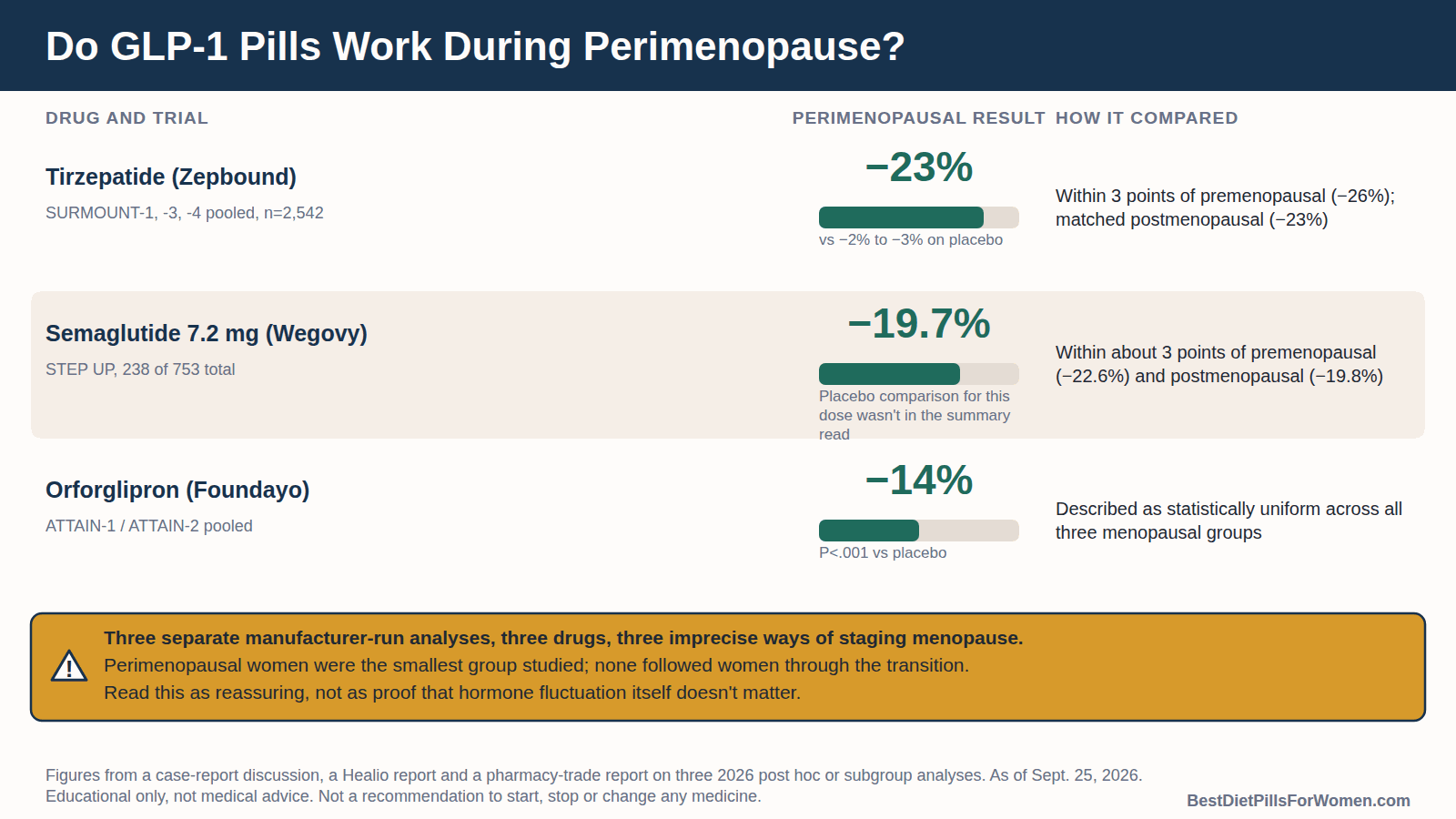
Across all three 2026 analyses, perimenopausal women lost weight in line with the premenopausal and postmenopausal groups in the same trial, though the perimenopausal subgroup was consistently the smallest of the three. Table 2 isolates what each analysis found for perimenopausal participants specifically; our menopause-specific guide has the full three-way breakdown across all menopausal stages for readers who want the complete comparison.
| Drug and analysis | Perimenopausal subgroup size | Perimenopausal result | How it compared to the other two groups |
|---|---|---|---|
| Tirzepatide (Zepbound), SURMOUNT-1, -3 and -4 pooled | Part of a 2,542-woman pooled analysis (subgroup size not separately reported in the summary read) | −23% vs −2% to −3% on placebo | Within 3 percentage points of the premenopausal group (−26%) and matched the postmenopausal group (−23%) |
| Semaglutide 7.2 mg (Wegovy), STEP UP | 238 of 753 total participants | −19.7% (placebo comparison for this dose wasn’t given in the summary read) | Within about 3 points of premenopausal (−22.6%) and close to postmenopausal (−19.8%) |
| Orforglipron (Foundayo), ATTAIN-1/ATTAIN-2 pooled | Not separately reported in the summary read | Up to −14% vs placebo, P<.001 | Described as statistically uniform across all three menopausal groups |
Table 2 method: figures are as reported in a case-report discussion citing the SURMOUNT pooled data, a Healio report of a European Congress on Obesity presentation, and a pharmacy-trade report on the ATTAIN pooled analysis, read through page summaries as of September 25, 2026; none of the three original conference presentations or resulting peer-reviewed papers was read directly, and this is three separate studies of three different drugs, not a single head-to-head comparison.
What These Analyses Can’t Tell Us Yet
Each of the three studies classified menopausal status differently, using some combination of self-report, menstrual history and age, none of which is the STRAW+10 staging system described earlier in this guide, so a woman classified as “perimenopausal” in one of these trials may not map cleanly onto her own STRAW+10 stage. None of the three analyses was the trial’s original, pre-specified purpose, and perimenopausal women were the smallest subgroup in the two trials that reported subgroup sizes, which means the perimenopausal-specific finding rests on fewer participants than the overall trial result.
It’s also worth noting plainly what these analyses don’t cover: none followed women prospectively through the transition from perimenopause into menopause while on the drug, and none specifically tested whether hormone fluctuation itself, rather than just menopausal status as a category, affects how well a GLP-1 medicine works cycle to cycle. That’s a genuine open question, not something this guide can answer from the evidence available.
Unique Considerations for GLP-1 Use During Perimenopause
Beyond the weight-loss numbers, a 2025 RAND Corporation commentary flagged several research gaps that apply specifically to perimenopausal GLP-1 use, separate from the menopausal-stage weight results above.
Muscle and Bone: Why Timing Matters More Here
GLP-1 medicines reduce both fat and muscle mass, and because perimenopausal women are already experiencing natural declines in muscle mass and bone density as the transition progresses, layering a drug-driven reduction in lean mass onto that existing decline is a combination that hasn’t been specifically studied for long-term bone health. The commentary notes this gap explicitly rather than claiming a proven harm, but it’s a reasonable reason for a perimenopausal woman to raise muscle and bone protection with a prescriber earlier rather than later, a topic this guide returns to in more depth below.
Usage data cited in the same commentary shows GLP-1 use is already common at this life stage: about 20% of women aged 50 to 64 report current or past use, and women aged 30 to 49 are more than twice as likely as men the same age to report using one. That widespread use is exactly why the unanswered questions matter; a lot of perimenopausal women are already taking these drugs before the research has caught up to their specific life stage.
Sleep Apnea, Discontinuation and the Emotional Side of Weight Regain
Sleep apnea risk rises sharply during perimenopause, moving toward rates seen in men, and GLP-1 medicines are notably the first class of drug FDA-approved specifically to treat obstructive sleep apnea, though the RAND commentary points out that their effectiveness for sleep apnea driven specifically by the perimenopausal transition hasn’t been separately studied. It’s a plausible overlap worth asking a prescriber about, not an established, perimenopause-specific benefit.
The same commentary cites discontinuation rates of 54% within one year and 72% within two years across GLP-1 users generally, and notes that weight regained after stopping tends to be regained mostly as fat rather than in the same proportion of fat and lean tissue lost, producing a less favorable body composition than before starting. Weight regain is also linked to shame, hopelessness and worsening anxiety, depression or disordered eating in some patients, concerns that can compound the mood and sleep symptoms many women are already managing during perimenopause on their own. None of this is a reason to avoid these medicines; it’s a reason to plan for the possibility of stopping, not just the plan for starting. Infographic 1 below summarizes the perimenopausal subgroup data alongside these open questions.
Pregnancy, Contraception and Weight Loss Pills During Perimenopause
This section doesn’t have an equivalent in a menopause-focused guide, because once a woman has gone twelve months without a period, the question it covers simply stops applying.
Why This Question Doesn’t Come Up After Menopause
Every drug label discussed in this guide includes pregnancy-related language, but perimenopause is the only life stage covered in our menopause cluster where that language is actively relevant rather than a formality.
How Long Contraception May Still Be Needed
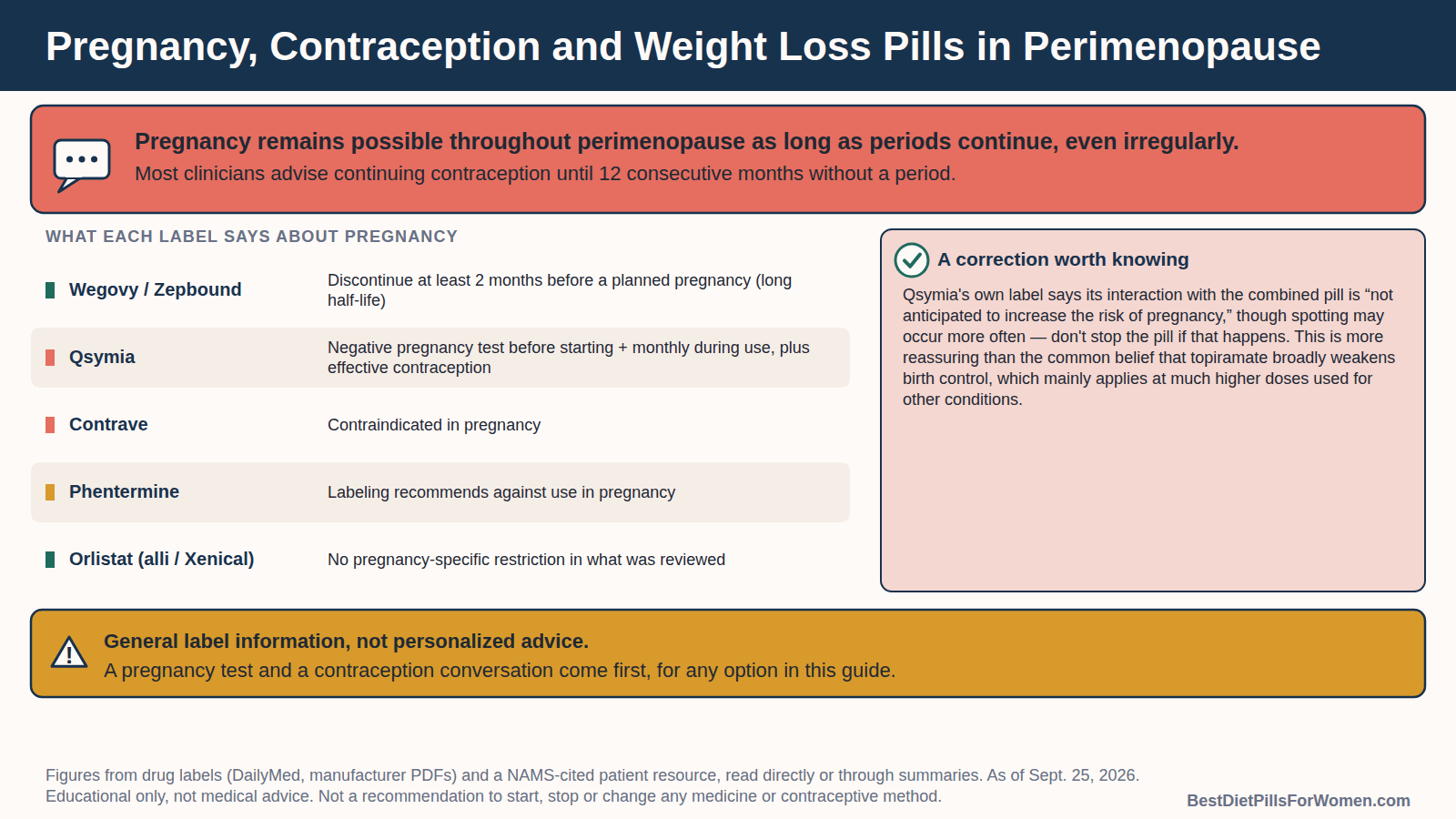
Most U.S. clinicians and menopause specialists advise continuing effective contraception until a woman has gone a full 12 consecutive months without a period, the same interval used to define menopause itself, regardless of how old she is when that happens. There’s no earlier point during perimenopause when pregnancy can be reliably ruled out based on age, cycle length or symptoms alone, since ovulation can resume unpredictably even after a long gap between periods.
This matters directly for anyone considering a weight loss pill during perimenopause, because “I haven’t had a period in months” isn’t the same as “I’ve reached menopause,” and several of the medicines in this guide are contraindicated, or carry specific warnings, in pregnancy. A woman who isn’t sure which side of that 12-month line she’s on is a woman who should raise contraception explicitly with a prescriber before starting a new medicine, not assume the question has already resolved itself.
What GLP-1 Labels Say About Pregnancy Planning
Both Wegovy (semaglutide) and Zepbound (tirzepatide) carry the same instruction: discontinue the medicine at least two months before a planned pregnancy, to allow the drug to clear the body given its long half-life. Semaglutide’s elimination half-life is about one week, meaning it stays in circulation for roughly five to seven weeks after the last dose, which is the basis for the two-month planning window.
Neither drug’s label requires a specific contraceptive method or routine pregnancy testing during treatment the way Qsymia’s does, covered next, but both labels are written around the assumption that a patient of reproductive potential may become pregnant, and both direct patients trying to conceive, or who become pregnant while taking the drug, to talk with a prescriber promptly. Foundayo (orforglipron), the newest GLP-1 pill, is expected to carry similar reproductive-potential labeling given its class, though this guide did not independently verify Foundayo’s specific pregnancy-planning language against its own label text.
Qsymia, Topiramate and Hormonal Birth Control
Qsymia is the one option in this guide with a formal, ongoing pregnancy-testing requirement built into its label, which makes it worth a closer look for anyone who could become pregnant.
The Pregnancy-Testing and Contraception Requirement, Explained
Qsymia’s current prescribing information requires a negative pregnancy test before starting the medicine and a repeat test every month during treatment, and it advises patients who can become pregnant to use effective contraception for as long as they’re taking it. This is a more hands-on requirement than anything else in this guide, and it exists because one of Qsymia’s two active ingredients, topiramate, is associated with an increased risk of birth defects, including cleft lip and palate, when taken during pregnancy.
For a perimenopausal woman who is still cycling, even irregularly, that monthly testing requirement is a real, recurring part of taking this medicine, not a one-time hurdle at the start of treatment. It’s a meaningfully different commitment than starting a GLP-1 pill, and it’s worth weighing alongside the average-effectiveness numbers in Table 1 when the two categories are being compared.
What the Label Actually Says About Topiramate and the Pill
Contrary to a common assumption, Qsymia’s own label states that its interaction with a combined oral contraceptive is not expected to raise pregnancy risk, though it can cause more frequent spotting, and it specifically instructs patients not to stop their birth control pill if spotting occurs. In a studied combination, Qsymia’s 15 mg/92 mg dose reduced the contraceptive’s estrogen exposure by 16% and increased its progestin exposure by 22%, changes the label frames as clinically manageable rather than as a reason to switch contraceptive methods.
This is a genuinely important correction to make plainly: topiramate at much higher doses, generally 200 mg a day or more, used for conditions like epilepsy, has been linked to reduced hormonal contraceptive effectiveness in some research, and that broader association is where the common “topiramate can make the pill less effective” advice comes from. Qsymia’s approved doses top out well below that range, and its own label draws a specific, more reassuring conclusion for the doses actually used to treat weight. A woman on Qsymia and a combined oral contraceptive together doesn’t need to assume her contraception has stopped working, but new or heavier-than-usual spotting is still worth mentioning to a prescriber to rule out any other cause. Infographic 2 below summarizes the pregnancy and contraception facts from this section in one place.
Combined Oral Contraceptives vs. Hormone Therapy vs. Weight Loss Pills During Perimenopause
Perimenopause is the one life stage where a woman might reasonably be discussing three different categories of pill, a contraceptive, a symptom treatment and a weight loss medicine, in the same appointment, and it’s easy to blur what each one actually does.
Why Some Clinicians Prefer Low-Dose Birth Control Pills First
For symptom relief specifically, some clinicians reach for a low-dose combined oral contraceptive before menopausal hormone therapy during the perimenopausal years, for reasons that have nothing to do with weight.
What the Combined Pill Does That Hormone Therapy Doesn’t
A low-dose combined oral contraceptive provides reliable contraception, something menopausal hormone therapy does not, while also regulating irregular or heavy perimenopausal bleeding and modestly reducing the long-term risk of endometrial, colorectal and ovarian cancers. Hormone therapy is dosed and formulated to relieve hot flashes, night sweats and related symptoms in women who are closer to or past menopause, and it isn’t intended or approved as a contraceptive method.
Table 3 lines up the three categories side by side on the dimensions that matter most for a perimenopausal decision. None of the three is a substitute for either of the others, which is exactly the point of comparing them directly rather than letting the categories blur together.
| Dimension | Combined oral contraceptive | Menopausal hormone therapy | Prescription weight loss pill (GLP-1 or older) |
|---|---|---|---|
| Primary purpose | Pregnancy prevention; cycle regulation | Relief of hot flashes, night sweats and related menopause symptoms | Weight loss in adults meeting BMI-based criteria |
| Effect on body weight | No consistent weight-loss effect | No significant effect on body weight (Cochrane review, 28 trials, 28,559 women) | Ranges from about −5% (Contrave) to over −20% (Zepbound) of starting weight vs placebo |
| Contraceptive effect | Yes, when taken as directed | No | No (and several options carry pregnancy-related warnings or requirements) |
| Typical timing in perimenopause | Often used earlier in perimenopause, while contraception is still needed | Often introduced closer to menopause or after, sometimes replacing the contraceptive pill around age 50 | Eligibility runs on BMI and health conditions, not reproductive stage, at any point in perimenopause |
| Key caution | Obesity and smoking both raise clotting-related risk categories, detailed in Table 4 | Individualized to symptoms, age and personal/family history; not a weight treatment | Varies by drug; several are contraindicated or restricted in pregnancy |
Table 3 method: purpose, mechanism and timing information is drawn from a Medical News Today clinical summary and a 2026 Cochrane-review-based clinical review of hormone therapy and weight, both read through page summaries as of September 25, 2026; weight-change figures are drawn from the same drug labels and trials cited in Table 1. This is a conceptual comparison of three different drug categories, not a head-to-head trial.
When Clinicians Typically Switch to Hormone Therapy
Clinicians who start with a combined oral contraceptive for perimenopausal symptom control typically plan to transition to menopausal hormone therapy around age 50 or at menopause itself, though some extend contraceptive-pill use longer when ongoing pregnancy risk remains a real consideration for that individual patient. That handoff point is a decision made with a clinician based on age, symptoms, cardiovascular risk factors and personal preference, not a fixed rule that applies the same way to every woman.
Who Should Be Cautious With Combined Hormonal Contraceptives
Combined hormonal contraceptives carry their own risk profile, and two factors relevant to many readers of this guide, body weight and smoking, change how that risk is classified.
The CDC’s Risk Categories for Obesity and Smoking
The CDC’s U.S. Medical Eligibility Criteria classify combined hormonal contraceptives as Category 2 (advantages generally outweigh risks) for a body mass index of 30 kg/m² or higher on its own, but combined-pill users with obesity have a relative risk for venous thromboembolism, a blood clot condition, of 5 to 8 times that of nonusers with obesity, even though no increased heart attack or stroke risk was found compared with nonusers who also had obesity. Table 4 lays out how these categories work for the two risk factors most relevant to readers of this guide.
| Risk factor | CDC category | What the category means |
|---|---|---|
| BMI 30 kg/m² or higher, no other risk factors | Category 2 | Advantages generally outweigh theoretical or proven risks; a relative VTE risk of 5 to 8 times that of nonusers with obesity is still reported for pill users with obesity specifically |
| Age 40 or older, smoking fewer than 15 cigarettes a day | Category 3 | Theoretical or proven risks usually outweigh the advantages of the method |
| Any age, smoking 15 or more cigarettes a day | Category 4 | An unacceptable health risk; combined hormonal contraceptives should not be used |
Table 4 method: categories and figures are drawn directly from the CDC’s published U.S. Medical Eligibility Criteria for Contraceptive Use page for combined hormonal contraceptives, read September 25, 2026. This table doesn’t cover every risk factor the CDC classifies, only the two most relevant to readers researching weight loss pills during perimenopause.
Why Risk Factors Don’t Simply Add Up
The CDC explicitly cautions that these categories aren’t meant to be added together mechanically when a woman has more than one risk factor at once, such as obesity and smoking together; instead, that combination calls for individualized clinical judgment rather than an automatic escalation to the next category. That distinction matters directly for a perimenopausal reader of this guide who has obesity, since it means a BMI of 30 or higher doesn’t automatically rule out a combined hormonal contraceptive on its own, but it’s also not something to self-assess; a clinician weighing a full history, including smoking status, blood pressure and personal or family clotting history, is the only one positioned to apply these categories correctly to an individual patient considering both a contraceptive and a weight loss medicine at the same time.
Older Prescription Pills and OTC Options During Perimenopause
The GLP-1 medicines get most of the attention, but the older prescription pills and the over-the-counter category both come with their own perimenopause-specific wrinkles.
Phentermine, Contrave and Qsymia: What Changes at This Life Stage
All three of these options predate the GLP-1 era, and all three carry pregnancy-related warnings that matter more here than in a menopause-only guide.
Why Pregnancy Risk Raises the Stakes for These Options
Contrave is contraindicated in pregnancy, with labeling citing animal studies showing fetal harm and the reasoning that intentional weight loss offers no benefit to a pregnant patient and may itself cause harm; product labeling for phentermine similarly recommends against use during pregnancy, and Qsymia’s monthly pregnancy-testing requirement, covered in the previous section, exists for the same underlying reason. Because ongoing pregnancy is a real possibility throughout perimenopause, these three warnings aren’t abstract label boilerplate for a perimenopausal reader the way they might read to a postmenopausal one.
This doesn’t mean a perimenopausal woman can’t use these medicines; it means the contraception conversation from the previous section isn’t optional background information here, it’s a precondition a prescriber needs to confirm before writing any of these three prescriptions for someone who could become pregnant.
Blood Pressure, Mood and the Perimenopause Overlap
Beyond pregnancy, phentermine and Qsymia are contraindicated with uncontrolled high blood pressure and cardiovascular disease, and Contrave carries a boxed warning for suicidal thoughts and behaviors. Mood changes and sleep disruption are already common during perimenopause on their own, covered earlier in this guide, which makes Contrave’s boxed warning worth discussing candidly with a prescriber rather than assuming a new mood symptom is simply “perimenopause” and unrelated to a new medicine.
Blood pressure is worth checking specifically before starting phentermine or Qsymia, since uncontrolled hypertension becomes more common through a woman’s 40s and 50s regardless of menopausal status, and a stimulant-type medicine is a poor fit for someone whose blood pressure isn’t already under control. Our comparison of prescription and over-the-counter weight loss pills covers how these older options stack up against both the GLP-1 drugs and OTC choices in more general terms.
Do “Hormone Balance” or Perimenopause-Marketed Supplements Work?
Supplement marketing has caught up to the search term “perimenopause,” and the claims deserve the same scrutiny as any other life-stage-targeted pitch.
What the Claim Audit Shows
There’s no good evidence that an over-the-counter “hormone balance,” “cycle support” or perimenopause-specific weight loss pill produces meaningful weight loss. Table 5 audits the marketing claims most common in this category against what the cited evidence actually shows.
| Claim | Audit | Why |
|---|---|---|
| “Balances fluctuating hormones for weight loss” | Unsupported | No cited trial shows a supplement corrects perimenopausal hormone fluctuation in a way that produces meaningful weight loss |
| “Formulated for perimenopause, not just menopause” | Marketing distinction, not an evidence distinction | We found no supplement trial that separately studied a perimenopausal subgroup the way the 2026 GLP-1 analyses in this guide did |
| “Supports cycles and curbs cravings” | Unsupported for weight | Cycle-related craving claims aren’t backed by the ingredient evidence reviewed for this guide, and none of it was menopause-transition-specific |
| “Clinically studied ingredients for hot flashes and weight” | Misleading without context | Black cohosh and soy isoflavones have weak, inconsistent evidence for hot flashes and no cited evidence for weight |
| “All-natural and safe while you’re still cycling” | Misleading | Black cohosh carries documented liver-injury case reports, and being plant-derived says nothing about pregnancy safety, which is the more pressing question during perimenopause |
| “Works like the pill or hormone therapy, without the risks” | Unsupported | Combined oral contraceptives and hormone therapy are regulated drugs with their own trial evidence and risk profiles, covered earlier in this guide; a supplement claiming to match either one’s effect, on weight or otherwise, isn’t supported by the evidence we reviewed |
Table 5 method: claims are composites of language commonly seen in this product category, not quotes from one specific brand, audited against the regulatory and evidence sources.
FDA has also repeatedly found weight loss products sold as dietary supplements that secretly contain active pharmaceutical ingredients, including prescription stimulants, a risk that applies to any life-stage-targeted marketing, not just this one. Our guide to over-the-counter appetite suppressants covers this broader category in more depth.
Ingredients With Some Evidence for Symptoms, Not Weight
Black cohosh remains the most commonly marketed ingredient in this space, typically pitched for hot flashes rather than weight directly; a 2012 Cochrane review of 16 trials in 2,027 women found insufficient evidence to support or oppose it for hot flashes, and both ACOG and The Menopause Society consider it unlikely to meaningfully help. Soy isoflavones show modest, inconsistent evidence for hot flash frequency but no evidence for weight change in what we reviewed, and they carry a genuine interaction risk with MAO inhibitor antidepressants. Neither ingredient has evidence specific to perimenopause as distinct from the broader menopause transition, and neither has been shown to affect weight, which is the claim this guide is evaluating.
Many “perimenopause support” blends also bundle ingredients into a single proprietary-blend weight on the label, making it impossible to check any individual ingredient against the amount actually used in a cited trial. A product built around a genuinely studied ingredient still can’t be evaluated fairly when its label won’t say how much of that ingredient is actually inside.
Safety of Weight Loss Pills During Perimenopause: Side Effects, Warnings and When to Get Help
The safety information on a drug’s label doesn’t change for perimenopause specifically, but a few side effects and warnings deserve extra attention when they overlap with symptoms a woman may already be managing, or with the pregnancy possibility covered earlier in this guide.
Common and Serious Side Effects
Gastrointestinal side effects dominate the GLP-1 pills; psychiatric, cardiovascular and pregnancy-related warnings dominate the older prescription pills.
Side Effects by Option
Nausea, constipation, diarrhea and vomiting are the most common complaints across every GLP-1 option in this guide, and they’re also the leading reason people stop taking them. Table 6 compares how often people discontinued each drug because of side effects, against how often people on placebo did the same.
| Option | Stopped due to side effects (drug) | Stopped due to side effects (placebo) | Difference |
|---|---|---|---|
| Wegovy injection | 6.8% | 3.2% | 3.6 points |
| Wegovy pill | 6.9% | 5.9% | 1.0 point |
| Zepbound | 6.7% | 3.4% | 3.3 points |
| Foundayo | 10% | 3% | 7 points |
| Contrave | 24% | 12% | 12 points |
Table 6 method: figures are as reported in each drug’s prescribing information, read through label mirrors, and reflect discontinuation due to adverse reactions in the pivotal trials; they aren’t directly comparable across drugs because the trials differ in length, dose and population, and none was specific to perimenopausal women.
Boxed Warnings and Contraindications That Matter Most Here
Contrave’s boxed warning for suicidal thoughts and behaviors, and its contraindications in pregnancy, uncontrolled high blood pressure, seizure disorders and current or recent eating disorders, were covered in the previous section. The GLP-1 drugs carry a contraindication unrelated to menopausal status: a personal or family history of medullary thyroid cancer or multiple endocrine neoplasia type 2, worth confirming with a prescriber regardless of reproductive stage.
The GLP-1 drug labels also list gallbladder problems, including gallstones and inflammation of the gallbladder, as a risk associated with rapid or substantial weight loss, not something specific to any one drug in this class. Sudden, severe pain in the upper right abdomen, especially after eating fatty food, along with nausea or fever, is worth reporting promptly rather than assuming it’s a routine digestive side effect.
Extra Caution Points Specific to Perimenopause
Two things deserve plain, direct attention because they layer onto symptoms and uncertainties many perimenopausal women are already navigating.
Mood, Bleeding Changes and Sleep
Mood changes, irritability and sleep disruption are already common during perimenopause on their own, which can make it genuinely hard to tell whether a new symptom after starting a weight loss pill is from the drug, from the transition itself, or from both together. Contrave’s boxed warning for suicidal thoughts makes this distinction especially important for that drug, and any new or worsening mood symptom after starting any weight loss medicine is worth reporting to a prescriber promptly rather than assuming it’s simply perimenopause.
Irregular or heavier bleeding, already common during perimenopause on its own, adds a second layer of noise that doesn’t come up in a menopause-only conversation: a woman starting a GLP-1 medicine who also notices a change in her bleeding pattern has two independent, plausible explanations to sort through rather than one, and tracking which symptom started before or after a medicine change, in a simple note or app, can help a clinician sort out cause from coincidence at a follow-up visit. New or unusually heavy bleeding is always worth mentioning to a clinician on its own merits, regardless of any medicine being considered, since it isn’t automatically explained away by either perimenopause or a new prescription.
When to Get Medical Help
Get medical help right away for a fast or irregular heartbeat, chest pain, severe abdominal pain, signs of pancreatitis, vision changes, thoughts of self-harm, heavy or prolonged vaginal bleeding, or a severe allergic reaction, whichever drug is involved. For any other side effect that feels wrong or doesn’t improve, call the prescriber before deciding on your own to stop or change a dose. A pregnancy test is also the right first step, not an afterthought, for any perimenopausal woman who develops new symptoms after a missed period while taking one of the medicines in this guide. Side effects and product problems, including anything involving a supplement marketed for perimenopause, can also be reported directly to the FDA through its MedWatch program.
None of the safety information above is specific to perimenopause in the sense of being caused by it; it’s the same label information that applies to any adult taking these medicines. What perimenopause adds is context and an extra variable, ongoing fertility, that a woman navigating mood changes, bleeding changes and sleep disruption on their own has to weigh alongside whatever a new medicine’s own side effects turn out to be.
Protecting Fertility Plans, Bone and Muscle While Losing Weight During Perimenopause
Two protective conversations are worth starting earlier during perimenopause than a woman might expect, one about pregnancy planning and one about bone.
If You’re Not Trying to Conceive Right Now
Most readers of this guide are not trying to become pregnant, but “not trying” and “not possible” aren’t the same thing during perimenopause.
Contraception Planning Alongside a Weight Loss Medicine
A woman who isn’t trying to conceive but is still cycling, even irregularly, needs an active contraception plan alongside any weight loss medicine discussed in this guide, not an assumption that reduced fertility means no fertility. This is a conversation worth having explicitly with a prescriber when starting Qsymia, given its monthly testing requirement, and it’s equally worth having when starting a GLP-1 medicine, even though those labels don’t mandate a specific contraceptive method the way Qsymia’s does.
Combined oral contraceptives, covered in detail earlier in this guide, are one option some women already use through this stage; barrier methods, an intrauterine device or other options are others, and the right choice depends on personal risk factors like smoking and cardiovascular history, not on which weight loss medicine a woman is taking.
What to Do If You Become Pregnant While Taking One of These Drugs
Contact a prescriber promptly and stop the medicine, rather than waiting for a routine follow-up appointment, if you become pregnant while taking any weight loss pill in this guide. Wegovy and Zepbound’s labels both direct patients who become pregnant to report it, and manufacturers maintain pregnancy exposure registries specifically to gather more data on outcomes, since large randomized trials of these drugs excluded pregnant women. This guide isn’t the place to resolve what happens next in any individual pregnancy; that’s a conversation for an obstetric provider who knows the specific drug, dose and timing involved.
Muscle and Bone: Starting the Conversation Earlier
The bone-loss research in this cluster has generally focused on menopause itself, but the timing evidence actually points to perimenopause as the more relevant starting point.
Why Perimenopause Is an Earlier Window Than Menopause
A SWAN study fact sheet reports that a period of fast bone loss begins about one year before a woman’s final menstrual period, meaning it starts during late perimenopause, not after menopause; that accelerated window lasts about three years and averages roughly 2% bone density loss per year, for a cumulative loss of about 10% across the full transition, with greater declines in the spine than the hip. Women who lost more bone density during this window went on to have more fractures after menopause, which makes this a genuinely time-sensitive finding rather than a distant, future concern for a perimenopausal reader.
That timing lines up closely with the accelerated fat-gain and lean-mass-loss window described earlier in this guide, which also begins around two years before the final menstrual period. Put together, the SWAN data suggests late perimenopause, not postmenopause, is when body composition and bone density both start changing most quickly, which is a meaningfully earlier point to start a protective plan than “wait until menopause” implies.
A Practical Plan
Table 7 lays out the practical steps most consistently mentioned across the sources reviewed for this guide, alongside a note on where the evidence for each one actually stands.
| Step | What it involves | Evidence note |
|---|---|---|
| Protein intake | 1.2 to 1.6 g per kg of body weight a day (about 82 to 109 g for a 150 lb woman) | General nutrition guidance for preserving lean mass during weight loss; not perimenopause-specific |
| Resistance training | At least 2 to 3 days a week | Supports muscle and bone; no cited trial tested this specifically against perimenopausal bone loss on a GLP-1 medicine |
| Calcium and vitamin D | Calcium around 1,000 to 1,200 mg and vitamin D around 600 to 800 IU a day, individualized by a clinician | Standard bone-health guidance; not a substitute for the resistance-training or protein steps |
| A baseline bone density (DXA) conversation | Discussed with a clinician, especially given the SWAN timing data above | Routine osteoporosis screening under USPSTF guidance starts at 65, well after this window; a baseline scan earlier is a personal, clinician-guided decision, not a universal recommendation |
| Tracking bleeding and cycle changes | A simple log of period timing and flow | Helps a clinician judge STRAW+10 staging and rule out unrelated causes of fatigue or symptoms that could be mistaken for a medicine’s side effects |
Table 7 method: steps are compiled from general nutrition and bone-health guidance and the SWAN and STRAW+10 sources cited elsewhere in this guide; no single cited trial tested this specific combination of steps against perimenopausal bone or lean-mass loss on a weight loss medicine.
None of the medicines in this guide have been tested specifically for their effect on bone density during the perimenopausal window the SWAN data describes, which is exactly the research gap the RAND commentary flagged earlier. That gap is a reason to raise the topic proactively with a prescriber, not a reason to avoid a medicine that may otherwise be a good fit. Our separate guide to muscle preservation during weight loss goes deeper on the resistance-training and protein strategies summarized in Table 7.
What Weight Loss Pills Cost During Perimenopause and How to Get a Prescription
Most women going through perimenopause are well over a decade away from Medicare eligibility at 65, which makes insurance and manufacturer savings programs, rather than any federal program, the main cost lever for nearly every reader of this guide.
What a Year Costs Without Insurance
List prices and manufacturer self-pay programs both move often, so treat Table 8 as a snapshot, not a guarantee.
The Cost Table
| Option | Monthly self-pay price | Estimated annual cost |
|---|---|---|
| Wegovy pill (1.5 mg to 25 mg) | $149 to $299 | $1,788 to $3,588 |
| Wegovy injection, standard doses | $349 ($399 for the 7.2 mg dose) | $4,188 ($4,788 for 7.2 mg) |
| Zepbound single-dose vials | $299 to $449 | $3,588 to $5,388 |
| Foundayo (0.8 mg to 17.2 mg) | $149 to $299 | $1,788 to $3,588 |
| Contrave | About $199 | About $2,388 |
| Qsymia (plus a monthly pregnancy test) | About $75 | About $900 |
| Phentermine | About $16 | About $192 |
| Alli (OTC orlistat 60 mg) | About $88 | About $1,056 |
| Xenical (prescription orlistat 120 mg) | About $431 | About $5,172 |
| Combined oral contraceptive (generic, for comparison only) | $18 to $248 (about $35 for generic norethindrone) | $216 to $2,976 (about $420 for generic norethindrone) |
Table 8 method: monthly figures are self-pay or lowest-listed prices from manufacturer cost pages, an investor press release and retail price aggregators, read through page summaries on September 25, 2026, and annualized by multiplying by 12; totals exclude clinician visits, lab tests, telehealth fees, shipping and needles, and assume no missed fills. The contraceptive row is included for cost comparison only, since it isn’t a weight loss treatment; nearly 77% of birth control pill users had no out-of-pocket cost in 2024 under Affordable Care Act preventive-care coverage, a coverage rate not shared by any of the weight loss options above it.
How Women Get a Prescription
A prescription for any drug in this guide starts with a clinician visit, in person or through telehealth, where BMI, related conditions, current medicines and, given everything covered earlier in this guide, cycle history and contraception status are all reviewed. The federal telehealth flexibility that lets many prescribers issue controlled-substance prescriptions, which covers phentermine and Qsymia, remotely without an in-person exam first is currently set to run through December 31, 2026, though that date has moved before. Our Wegovy pill cost guide and Wegovy insurance coverage guide go deeper on one option’s pricing and paperwork specifically.
Insurance and What Else May Change Soon
Coverage for these drugs when prescribed for weight loss alone remains inconsistent across private insurance plans, and perimenopause itself doesn’t change an insurer’s coverage rules.
Does Insurance Cover Weight Loss Pills for Perimenopause?
Reproductive stage has no bearing on insurance coverage for these drugs; coverage depends on the specific insurance plan, the diagnosis code used, and whether the plan covers anti-obesity medicine at all, which varies widely by employer and by state. Medicare’s GLP-1 Bridge program, which offers a $50 monthly copay for certain GLP-1 drugs through December 31, 2027, is relevant to relatively few readers of this guide, since perimenopause typically ends well before age 65.
For most perimenopausal women, the more relevant coverage questions are whether an employer’s plan includes an anti-obesity medicine benefit, whether a diagnosis like type 2 diabetes or sleep apnea, rather than obesity alone, changes coverage, and whether a manufacturer savings card can bridge the gap regardless of insurance status. A flexible spending account or health savings account can also help regardless of what a plan covers, since the IRS treats a prescribed weight loss medicine as an eligible medical expense the same way it treats other prescription drugs, which is worth confirming with a benefits administrator before assuming a drug is unaffordable.
What Else May Change Soon
A few developments could shift this cost picture before this guide is next updated. Novo Nordisk filed for FDA approval of CagriSema, a combined GLP-1 and amylin drug, in December 2025, with a decision expected sometime in 2026; it isn’t approved as this guide is written. Every manufacturer savings program listed in Table 8, along with the DEA telehealth flexibility, has its own end date that can move. None of that changes what a woman should do today, but it’s a reason to re-check prices and coverage close to any actual purchase or prescription.
How to Choose: A Decision Guide for Perimenopause
There’s no single best answer here, but there is a better and worse way to work through the decision, starting with matching the option to a woman’s actual situation, including where she is in the perimenopausal transition, rather than to whichever drug is most talked about.
Questions to Work Through Before Choosing a Pill
Table 9 groups common situations during perimenopause with what the evidence and labels in this guide say about them.
The Situation Guide
| Your situation | What matters most | Worth raising with a clinician |
|---|---|---|
| Periods still fairly regular (early perimenopause) | Pregnancy is possible; cycle-length variability of 7 or more days is the STRAW+10 marker for this stage | Whether contraception needs are already being met |
| Periods increasingly irregular, 60+ days without one at times (late perimenopause) | This is also the window when bone loss and lean-mass loss both begin accelerating, per SWAN data | Whether a baseline bone density conversation makes sense now |
| Not trying to conceive, using no contraception currently | Contraception generally needs to continue until 12 months without a period | Which contraceptive method fits alongside a weight loss medicine |
| Already using a combined oral contraceptive | CDC risk categories for obesity and smoking apply to that method independent of any weight loss pill | Whether your specific risk factors change your contraceptive category |
| Considering Qsymia specifically | Requires a negative pregnancy test before starting and monthly during use, plus effective contraception | Whether the monthly testing requirement fits your routine |
| High blood pressure or heart disease | Phentermine, Qsymia and Contrave are contraindicated with uncontrolled blood pressure; the SELECT trial supports a heart benefit for semaglutide | Whether your blood pressure needs monitoring after starting a GLP-1 drug |
| New mood changes or heavier bleeding after starting a medicine | Both perimenopause and several medicines in this guide can independently cause these symptoms | Whether to track symptoms before attributing them to either cause |
| Weighing a combined pill vs. hormone therapy for symptoms | The combined pill adds contraception and cycle regulation; hormone therapy doesn’t | Timing of any eventual switch to hormone therapy |
Table 9 method: this table groups the guidance already cited throughout this article by situation rather than by drug; it’s a starting point for a conversation, not a set of eligibility rules, and it doesn’t cover every possible health situation.
Non-Pill Options With Evidence
Pills aren’t the only options with real evidence behind them at this life stage. Structured lifestyle programs combining diet changes, activity and behavioral support have outperformed usual care in trials for decades, and resistance training has evidence independent of any pill for preserving muscle and bone, covered in detail earlier in this guide. Combined oral contraceptives and menopausal hormone therapy both have real evidence for symptom relief, separate from any weight-related decision, covered in Table 3 earlier in this guide.
Tracking cycle length and bleeding patterns, the same information STRAW+10 uses for formal staging, is itself a low-cost, evidence-grounded tool a woman can start using before any appointment. It won’t replace a clinical conversation, but it gives a clinician real data to work with rather than an approximate memory of “it’s been irregular for a while,” which can meaningfully sharpen a discussion about contraception, bone-density timing or which weight loss option makes sense for a specific point in the transition.
Five Checks and Other Paths to Consider
Five questions come up in almost every row of Table 9, worth turning into a short checklist before any appointment.
The Five Checks Before Choosing
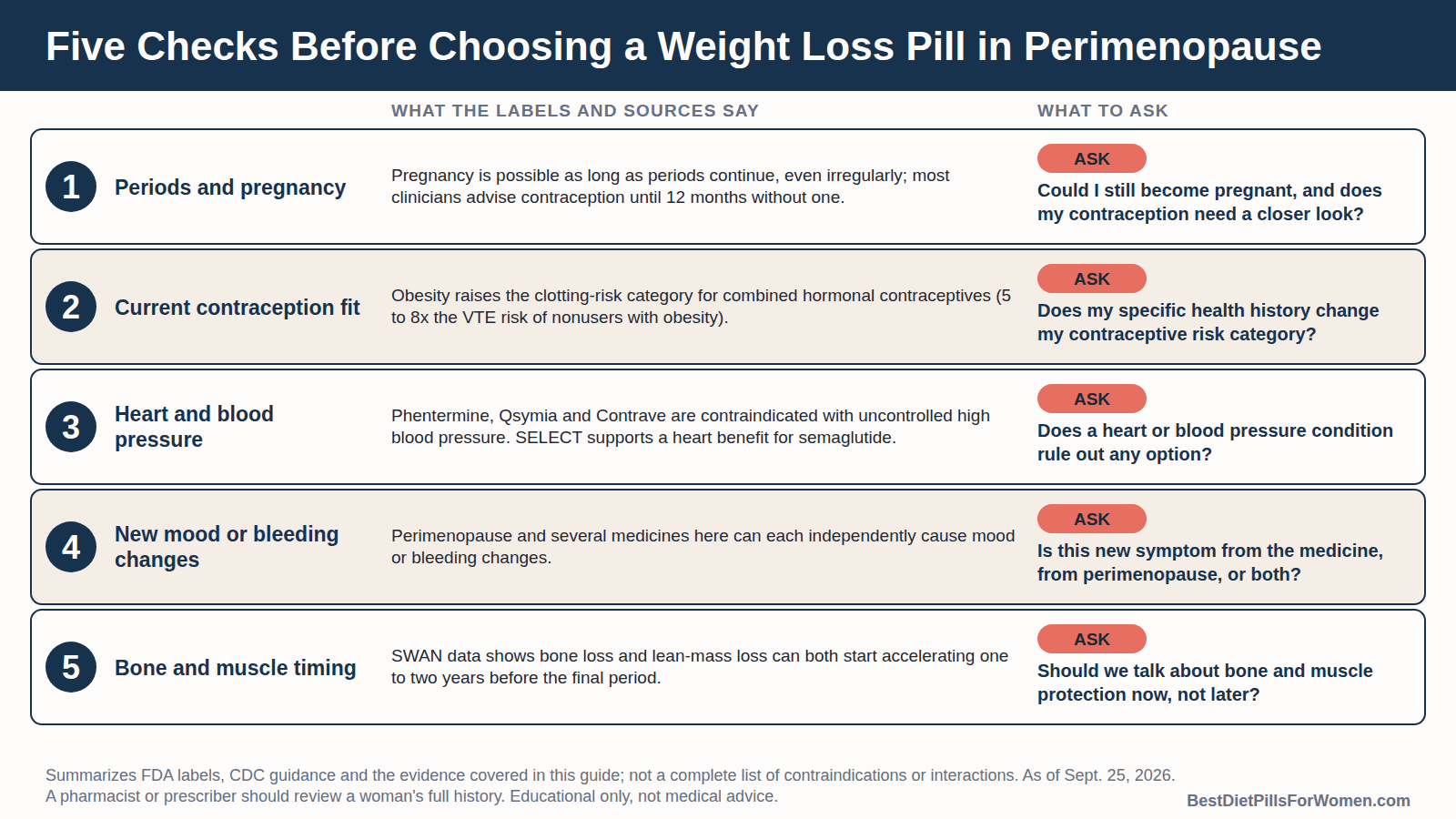
The checks are: whether periods still occur and pregnancy remains a factor; whether current contraception, if any, is a good fit alongside a weight loss medicine; whether a heart or blood pressure condition rules any option out; whether new mood or bleeding changes need tracking to sort out their cause; and whether bone density and muscle protection are being discussed now, during perimenopause, rather than deferred until menopause. Infographic 3 below turns these into a short list with the specific facts behind each one.
Surgery and Other Medical Routes
The American Society for Metabolic and Bariatric Surgery and the International Federation for the Surgery of Obesity have recommended surgery starting at a BMI of 35 or higher regardless of other conditions, and for consideration at 30 to 34.9 when a condition like diabetes is present. NIDDK reports that many people who have weight loss surgery lose 15% to 30% of their starting weight on average, a larger and generally more durable result than most pills achieve, though it’s major surgery with its own risks and lifelong nutrition monitoring, including for the same calcium, vitamin D and protein concerns raised earlier in this guide. ACOG guidance recommends waiting 12 to 24 months after bariatric surgery before conceiving, so a pregnancy isn’t affected by rapid maternal weight loss and so a patient can reach her weight-loss goals first, which is one more reason the contraception conversation in this guide applies to a surgical route as much as it does to any pill. Whether surgery, a GLP-1 drug, an older pill, a combined contraceptive, hormone therapy or a structured lifestyle program fits best is a conversation for a surgeon, an obesity-medicine specialist or a primary care clinician who knows a woman’s full history, not a conclusion this guide can reach for anyone. Our overview of weight loss medications puts the drug options in a wider context.
Frequently Asked Questions About Weight Loss Pills for Perimenopause
These questions come up repeatedly in perimenopause-related searches and weren’t fully answered by the sections above.
Effectiveness and Expectations
Three questions here are really the same question asked three different ways: does perimenopause change the math.
Do Weight Loss Pills Work as Well During Perimenopause as at Other Life Stages?
Based on the three 2026 menopause-stage analyses covered earlier in this guide, yes: the perimenopausal subgroup in each analysis lost weight broadly in line with the premenopausal and postmenopausal groups in the same trial. Perimenopausal women were the smallest subgroup in the two analyses that reported subgroup sizes, so treat the finding as reassuring rather than definitive.
How Much Weight Can I Realistically Expect to Lose?
Trial averages in this guide range from about 5% (Contrave) to over 20% (Zepbound) of starting weight, but averages describe groups, not individuals, and the perimenopausal subgroup in the 2026 analyses landed within a few percentage points of the other menopausal-status groups. Adherence, dose, diet and activity all affect where any individual woman lands relative to a trial average, and hormone fluctuation itself hasn’t been separately tested as a factor in response.
What Happens If I Stop Taking a Weight Loss Pill?
Weight regain is common after stopping a GLP-1 medicine, since these drugs work by affecting appetite and metabolism while they’re in the body, not by producing a permanent change, and a 2025 commentary notes that regained weight tends to come back mostly as fat rather than in the same fat-to-muscle ratio that was lost. None of the menopause-stage analyses in this guide followed women after they stopped their medicine, so this guide can’t say whether regain differs specifically by perimenopausal status.
Pregnancy, Contraception and Safety
These three questions come up specifically because periods, and the possibility of pregnancy, are still part of the picture for many readers.
Can I Take a Weight Loss Pill If I’m Not Sure Whether I’m Still Ovulating?
Yes, but pregnancy status should be confirmed, not assumed, before starting any option in this guide, since ovulation can resume unpredictably during perimenopause even after irregular or infrequent periods. Qsymia’s label formally requires a pregnancy test before starting and monthly afterward; the other options don’t mandate testing the same way, but a conversation about current contraception is still a reasonable step before starting any of them.
Will a Weight Loss Pill Affect My Birth Control Pill?
Qsymia’s own label states that its interaction with a combined oral contraceptive is not expected to raise pregnancy risk, though it can cause more frequent spotting, and instructs patients not to stop their pill if spotting occurs. The GLP-1 medicines slow stomach emptying generally, which can theoretically change how other oral medicines, including a contraceptive pill, are absorbed; a pharmacist review of a full medicine list is the most reliable way to check this for an individual situation.
Is It Safe to Combine a Weight Loss Pill With a Contraceptive Pill or Hormone Therapy?
No established drug-drug interaction was found between a combined oral contraceptive or hormone therapy and either the GLP-1 medicines or the older prescription pills, though each category carries its own separate cardiovascular or clotting warnings worth reviewing together with a clinician. Obesity itself raises the clotting-risk category for combined hormonal contraceptives specifically, covered in Table 4 earlier in this guide, which is a reason to have that conversation even independent of any weight loss medicine.
Hormones, Cost and Next Steps
These last three questions are about sequencing the decision, not about any single drug’s evidence.
Should I Try a Birth Control Pill Instead of a Weight Loss Pill?
Not if weight loss is the goal: a low-dose combined oral contraceptive has no consistent weight-loss effect, though it may help with cycle regulation, heavy bleeding and contraception, which are separate benefits worth weighing on their own terms. Many women reasonably use a contraceptive pill for cycle and symptom control and a separate medicine, or none, for weight.
Does Medicare Help With the Cost of Weight Loss Pills for Perimenopause?
Almost never directly: Medicare’s GLP-1 Bridge program, a $50 monthly copay for certain drugs, is relevant to relatively few readers of this guide, since perimenopause typically ends well before age 65. Manufacturer savings cards, covered in the cost section above, are usually the more relevant option for most perimenopausal women, alongside whatever an employer’s specific insurance plan covers.
What Should I Ask My Doctor Before Starting?
Ask about your BMI and weight-related health conditions, your current cycle pattern and contraception needs, your blood pressure and heart history, any medicine you already take, and whether a baseline bone density conversation makes sense given how early the SWAN data suggests bone loss can start. Bring your full medicine and supplement list to that conversation, including anything marketed specifically for perimenopause and any contraceptive method you’re currently using.
The Bottom Line on the Best Weight Loss Pills for Perimenopause
Pulling the evidence in this guide together into a single, honest conclusion.
What the Total Evidence Means for You
Perimenopause changes the questions worth asking more than it changes which pill works, based on what the evidence in this guide shows.
The Biggest Realistic Benefit
The genuinely new, useful finding here is twofold: the same GLP-1 medicines that lead this category elsewhere showed perimenopausal results in line with premenopausal and postmenopausal women in three separate 2026 analyses, and the biological research on timing, when fat gain, lean-mass loss and bone loss all start accelerating, points specifically to late perimenopause, not menopause itself, as the window that matters most. That’s a more specific, more actionable answer than “these drugs work in adults broadly,” and it’s a genuinely different emphasis than our menopause-specific guide, which this page is meant to complement rather than duplicate.
The Biggest Limitation and Safety Concern
The biggest limitation is that perimenopausal women were consistently the smallest subgroup in the 2026 analyses, and none of the three studies was purpose-built around menopausal status from the start. The biggest safety concern is specific to this life stage in a way it isn’t for menopause: ongoing pregnancy possibility touches nearly every option in this guide, from Qsymia’s monthly testing requirement to a GLP-1 drug’s two-month pregnancy-planning window, and getting the contraception conversation right matters as much as choosing which weight loss medicine to try.
Hormone therapy and combined oral contraceptives both deserve one more mention here because they’re so easily confused with weight loss treatments in this category. Nothing in this guide should be read as encouragement to start, stop or substitute a contraceptive method or hormone therapy for a weight loss medicine, or the reverse; each treats a different problem, backed by different evidence, and a woman can reasonably use any combination of them depending on her own symptoms, fertility plans and goals.
A Rational Next Step
The goal of this guide was never to pick a winner; it was to sharpen the conversation a woman has with her own clinician, particularly around the pregnancy and contraception questions that make this life stage genuinely different.
Questions for a Clinician
Bring the specifics: your BMI and any weight-related health conditions, your current cycle pattern and whether pregnancy is a realistic possibility right now, your contraception method if you have one, your blood pressure and cardiovascular history, and whether a baseline bone density conversation makes sense given the SWAN timing data covered in this guide. A clinician who has all of that can make a recommendation this guide deliberately doesn’t.
What to Re-Check Before You Spend Money
Prices, manufacturer savings terms, drug labels and the Medicare GLP-1 Bridge program’s rules all change. Re-check Table 8’s prices, confirm any manufacturer offer’s current end date, and confirm current label language, especially Qsymia’s pregnancy-testing and contraception requirements, for any drug you’re considering before spending money based on anything in this guide, which reflects information gathered as of September 25, 2026.
Related Reading
Sources
These are the main sources behind this guide, chosen because they are the ones to check first for current facts. Labels, prices, coverage rules and regulator pages change, so confirm the latest version before you make decisions.
- Novo Nordisk. Wegovy (semaglutide) injection and tablets, prescribing information (revised June 2026). https://www.novo-pi.com/wegovy.pdf
- Eli Lilly and Company. Zepbound (tirzepatide) prescribing information (revised August 2026). https://pi.lilly.com/us/zepbound-uspi.pdf
- Prescribing information for the older prescription pills, on DailyMed: Adipex-P (phentermine, Teva; https://dailymed.nlm.nih.gov/dailymed/drugInfo.cfm?setid=f5b2f9d8-2226-476e-9caf-9d41e6891c46) and Contrave (naltrexone and bupropion; https://dailymed.nlm.nih.gov/dailymed/drugInfo.cfm?setid=485ff360-32c8-11df-928b-0002a5d5c51b).
- Qsymia (phentermine and topiramate extended-release) prescribing information, current version. https://qsymia.com/patient/include/media/pdf/prescribing-information.pdf
- Cleveland Clinic. Perimenopause. https://my.clevelandclinic.org/health/diseases/21608-perimenopause
- Harlow SD, et al. Executive summary of the Stages of Reproductive Aging Workshop + 10 (STRAW+10). 2012. https://pmc.ncbi.nlm.nih.gov/articles/PMC3580996
- Study of Women’s Health Across the Nation (SWAN). Bone health over the menopause transition, fact sheet. https://www.swanstudy.org/wps/wp-content/uploads/2023/04/SWAN-Fact-Sheets-Bone.pdf
- Medical News Today. HRT or the pill for perimenopause? https://www.medicalnewstoday.com/articles/hrt-or-the-pill-for-perimenopause
- Centers for Disease Control and Prevention. U.S. Medical Eligibility Criteria for Contraceptive Use: combined hormonal contraceptives. https://www.cdc.gov/contraception/hcp/usmec/combined-hormonal-contraceptives.html
- RAND Corporation. GLP-1 Agonists in Perimenopause: Unique Risks and Potential. https://www.rand.org/pubs/commentary/2025/08/glp-1-agonists-in-perimenopause-unique-risks-and-potential.html