
In Ozempic’s own clinical trials, people with type 2 diabetes lost an average of roughly 3 to 7 kilograms, or somewhere in the neighborhood of 4 to 7 percent of body weight, over 30 to 56 weeks. That’s meaningfully smaller than the number most people have in their head when they search for “Ozempic weight loss results,” which is closer to the 15 percent average seen in semaglutide’s dedicated weight-management trials.
Here’s the catch: those are two different research programs, run in two different groups of people, at two different doses of the same drug. Ozempic was tested and approved for blood sugar control in type 2 diabetes, not weight loss, and its own trials reflect that. The bigger numbers people share online mostly come from Wegovy’s trials, which used a higher dose in people who, for the most part, didn’t have diabetes.
This article pulls apart those two evidence bases rather than blending them into one tidy figure. We’ll walk through what Ozempic’s own SUSTAIN-program trials actually found, why diabetes status changes the number so much, what a realistic timeline looks like, what the research says about plateaus and weight regain after stopping, and where the real safety concerns sit. Our review is based on Ozempic’s current FDA-approved prescribing information, the published semaglutide trial literature, federal regulatory sources, and real-world outcomes data — not hands-on product testing.
How Much Weight Can You Lose on Ozempic? The Short Answer
If you have type 2 diabetes and take Ozempic at its approved doses, clinical trials suggest an average loss of roughly 4 to 7 percent of body weight over several months to a year. If you’re thinking of the 10 to 15 percent-plus numbers associated with semaglutide for weight loss, you’re likely thinking of Wegovy’s trials, which used a higher dose in a different population. Individual results vary widely in both groups.
Two Different Evidence Bases Behind One Search Term
People type “Ozempic weight loss results” into a search bar for a lot of different reasons, but the data that actually answers the question splits cleanly into two buckets. Keeping them separate matters more than almost anything else in this topic, because mixing them up is where most of the confusion — and most of the disappointment — starts.
The FDA approved Ozempic in December 2017, strictly for type 2 diabetes. Wegovy, approved in 2021, uses the same active ingredient, semaglutide, at a higher dose and carries a separate approval specifically for chronic weight management. Both drugs share a generic name, both get prescribed by the same specialists, and off-label prescribing further blurs the line between them — so it’s easy to see a weight-loss statistic somewhere online and assume it describes whichever brand you happen to have heard of or been prescribed, even when it doesn’t.
Ozempic’s Own Clinical Trials (SUSTAIN Program, Type 2 Diabetes)
Ozempic (semaglutide injection) was studied and approved through Novo Nordisk’s SUSTAIN trial program, a series of studies in adults with type 2 diabetes. Weight change was tracked in nearly all of these trials, but as a secondary outcome — the main goal was glycemic control, measured through HbA1c. Doses tested topped out at 2 mg, the highest dose Ozempic’s label currently supports. The program eventually grew to encompass ten or more individual trials run over several years, each testing semaglutide against a different comparator or in a different diabetes-treatment scenario, which is part of why the weight figures you’ll see cited for “Ozempic” vary depending on which specific trial someone is quoting.
The Trials Most “Ozempic Results” Online Actually Reflect (STEP Program)
Wegovy, a separate brand name for the same active ingredient at a higher 2.4 mg dose, was studied in the STEP trial program. STEP 1 enrolled adults with obesity or overweight who, for the most part, did not have diabetes, and made body weight the primary endpoint. The STEP program eventually grew well beyond that first trial — later studies tested semaglutide 2.4 mg against other weight-loss medications, alongside structured behavioral support, and in people who stopped and restarted treatment — but STEP 1 remains the single most-cited reference point whenever someone says “semaglutide can produce 15% weight loss.” STEP 1 alone enrolled nearly 2,000 participants, and its findings have since been reinforced by several additional STEP trials and independent systematic reviews, which is part of why researchers generally describe the evidence for semaglutide’s weight-loss effect in people without diabetes as strong rather than preliminary. When someone shares a before-and-after photo or a “lost 15% of my body weight” headline tied to semaglutide, it’s almost always STEP-program-style data, not Ozempic’s own SUSTAIN results — even when the person posting it was prescribed Ozempic off-label.
What a Realistic Range Looks Like in Each Group
Averages hide a lot of spread. A useful way to think about this is as two overlapping ranges rather than one number, with your own result depending heavily on which population you actually resemble and which dose you’re taking.
Expected Range If You Have Type 2 Diabetes
Across Ozempic’s own SUSTAIN trials, average weight loss at approved doses generally landed between about 3 and 7 kilograms over roughly 30 to 56 weeks, depending on the trial, the dose, and what Ozempic was being compared against. A 2025 systematic review and meta-analysis pooling semaglutide 2.4 mg trials found that people with type 2 diabetes lost an average of 6.34% of body weight, versus 11.57% in people without diabetes on the identical dose — a gap of roughly 5 percentage points that shows up even when the dose is held constant.
Expected Range If You Don’t Have Diabetes (Off-Label Use)
If you’re taking Ozempic off-label and don’t have diabetes, your biology more closely resembles the people studied in Wegovy’s STEP trials than the people in Ozempic’s own SUSTAIN trials — even though you’re using the Ozempic brand and its lower dose ceiling of 2 mg rather than Wegovy’s 2.4 mg. That combination (non-diabetic biology, but a lower maximum dose) tends to land many off-label Ozempic users somewhere between the SUSTAIN and STEP numbers, rather than cleanly matching either one. Later sections unpack why dose and diabetes status each move the number independently.
Ozempic’s Own Weight-Loss Data: Inside the SUSTAIN Program
The SUSTAIN trials are the actual evidence behind Ozempic’s FDA approval, so they’re worth understanding on their own terms before comparing them to anything else. Our guide to how Ozempic works for weight loss covers the mechanism and approval history in more depth; this section sticks to the numbers.
What the SUSTAIN Trials Were Designed to Measure
Every SUSTAIN trial was built around a single question: does weekly semaglutide injection lower blood sugar better than a comparator, in adults with type 2 diabetes? Weight was along for the ride.
Why Weight Was a Secondary Endpoint, Not the Primary One
The FDA approved Ozempic for three specific uses: improving glycemic control alongside diet and exercise, reducing major cardiovascular events in people with type 2 diabetes and existing heart disease, and reducing the risk of kidney decline in type 2 diabetes. Weight management is not among them. Because the trials were designed and powered around HbA1c, not body weight, researchers reported weight change honestly, but it was never the thing the studies were built to detect with maximum precision. That said, because weight was consistently measured the same way across a large, randomized, multi-trial program, the overall evidence for Ozempic’s modest weight effect in people with diabetes is reasonably solid — it’s just evidence about a secondary question, not the question the trials were designed to answer with the most statistical confidence.
Who Was Enrolled and How Long the Trials Ran
SUSTAIN trial durations ranged from 30 to 56 weeks, shorter than the 68-week window used in most STEP trials. Participants had established type 2 diabetes and were often already on other glucose-lowering medications — metformin, sulfonylureas, basal insulin, or a combination — which matters, because several of those drugs independently push body weight in one direction or another.
One trial in the program, SUSTAIN 6, took a different approach: it enrolled 3,297 adults with type 2 diabetes who already had cardiovascular disease or were at high risk for it, and followed them for about two years, far longer than the dose-finding trials. SUSTAIN 6 is the trial behind Ozempic’s cardiovascular-risk-reduction indication, and it’s a useful illustration of the bigger point — the SUSTAIN program was built to answer questions about blood sugar and heart health, with weight data collected along the way rather than as the focus.
Weight Results Trial by Trial
Table 1 pulls the body-weight figures directly from Ozempic’s prescribing information so you can see the range across the individual trials, rather than a single blended average that hides how much the comparator and starting point shifted the result.
SUSTAIN 1 Through 5: The Original Dose-Finding Trials
Across SUSTAIN 1 through 5, average weight loss at the 1 mg dose ranged from about 4.7 kg to 6.0 kg, and at 0.5 mg from about 3.2 kg to 4.2 kg, over 30 to 56 weeks. Comparator arms sometimes lost weight too (sitagliptin, exenatide extended-release) and sometimes gained it (insulin glargine gained 0.9 kg on average), which is a reminder that the “placebo” or comparator isn’t always weight-neutral in diabetes trials.
SUSTAIN FORTE: What Happened at the Higher 2 mg Dose
SUSTAIN FORTE specifically tested whether doubling the dose from 1 mg to 2 mg — Ozempic’s current maximum — improved results in type 2 diabetes. Over 40 weeks, the 2 mg dose produced an average loss of about 6.9 kg versus 6.0 kg at 1 mg, with 59.2% of the higher-dose group losing at least 5% of body weight compared with 51.3% at 1 mg. That’s a real improvement, but it’s still a fraction of what shows up in Wegovy’s trials at 2.4 mg — because the SUSTAIN FORTE population had diabetes and Wegovy’s primary trial population mostly didn’t.
| Trial | Population & Comparator | Duration | Semaglutide Dose | Average Weight Change |
|---|---|---|---|---|
| SUSTAIN 1 | Type 2 diabetes, diet/exercise only, vs. placebo | 30 weeks | 0.5 mg / 1 mg | −3.8 kg / −4.7 kg (placebo −1.2 kg) |
| SUSTAIN 2 | Type 2 diabetes on metformin ± a TZD, vs. sitagliptin | 56 weeks | 0.5 mg / 1 mg | −4.2 kg / −5.5 kg (sitagliptin −1.7 kg) |
| SUSTAIN 3 | Type 2 diabetes, vs. extended-release exenatide | 56 weeks | 1 mg | −4.8 kg (exenatide ER −2.0 kg) |
| SUSTAIN 4 | Type 2 diabetes, vs. insulin glargine | 30 weeks | 0.5 mg / 1 mg | −3.2 kg / −4.7 kg (insulin glargine +0.9 kg) |
| SUSTAIN 5 | Type 2 diabetes on basal insulin, vs. placebo | 30 weeks | 0.5 mg / 1 mg | −3.5 kg / −6.0 kg (placebo −1.2 kg) |
| SUSTAIN FORTE | Type 2 diabetes on metformin ± a sulfonylurea, dose-comparison | 40 weeks | 1 mg / 2 mg | −6.0 kg / −6.9 kg |
Table 1 method note: SUSTAIN 1 through 5 figures come from the Clinical Studies section of Ozempic’s current FDA-approved prescribing information. SUSTAIN FORTE figures come from published trial coverage of Frías et al.; editor to verify the exact kilogram figures against the primary Lancet Diabetes & Endocrinology publication before relying on them for a direct quote. Comparator weight changes are shown to illustrate that some diabetes medications used as comparators are weight-neutral or weight-gaining, not because the comparators themselves are being evaluated here.
These figures are reported in kilograms rather than percentages because that’s how Ozempic’s own label presents them. Converting cleanly to a percentage would require knowing each trial’s exact average starting weight, which isn’t published for every SUSTAIN trial; separate estimates of typical baseline body weight in this population put most of these results in the same rough 4 to 7 percent range already mentioned at the start of this article, which is why we’ve used that range as the headline figure rather than the raw kilogram numbers alone.
Why People Without Diabetes Tend to Lose More Weight on the Same Drug
This is the part of the story that search results rarely spell out, and it’s the single biggest reason Ozempic’s own numbers look smaller than what circulates online.
Semaglutide belongs to a class of medications called GLP-1 receptor agonists. It mimics glucagon-like peptide-1, a hormone the gut releases after eating, which slows stomach emptying, prompts the pancreas to release insulin when blood sugar is high, and signals fullness to appetite centers in the brain. That appetite-suppressing signal is the main mechanism behind the weight loss seen in both the SUSTAIN and STEP trial programs. It’s a well-documented biological effect, not a marketing claim — but how strongly it translates into pounds or kilograms lost depends heavily on the metabolic state of the person taking it, which is exactly where diabetes status starts to matter.
The Biology Behind the Gap
Semaglutide works the same way regardless of who takes it: it mimics a gut hormone called GLP-1, slows stomach emptying, and acts on brain appetite centers to reduce hunger and food intake. But type 2 diabetes changes the metabolic environment the drug is acting on.
Insulin Resistance, Hyperinsulinemia, and Fat Storage
People with established type 2 diabetes often have significant insulin resistance and higher circulating insulin levels. Because insulin promotes fat storage and suppresses the breakdown of fat for energy, that hormonal backdrop can blunt how much weight comes off even when appetite is well controlled. Fat tissue that has adapted to a high-insulin environment tends to hold onto stored fat more stubbornly, even once appetite drops, which is a plausible piece of why the same calorie deficit produces a smaller result. Researchers studying this gap have also pointed to possible differences in GLP-1 receptor responsiveness after years of diabetes, and to the weight-promoting effects of some diabetes medications people are already taking.
“Glycemic Buffering” and Other Proposed Mechanisms
One proposed mechanism is sometimes called glycemic buffering: as semaglutide improves blood sugar control, less glucose is lost through urine, which removes a small but real source of calorie loss that was happening before treatment, partially offsetting the drug’s appetite-suppressing calorie deficit. Researchers have also raised the possibility that people with longstanding type 2 diabetes have been through multiple prior weight-loss attempts, which may leave less “easy” response left to capture compared with someone trying appetite suppression for the first time. None of this is settled science — these are plausible explanations for an observed pattern, not a fully proven mechanism, and researchers describe them as contributing factors among several rather than the whole story.
What This Means for the Number You Read Online
Once you separate dose from diabetes status, the picture gets clearer: both variables push the number around, and they stack.
Why Wegovy’s Results Aren’t Automatically Ozempic’s Results
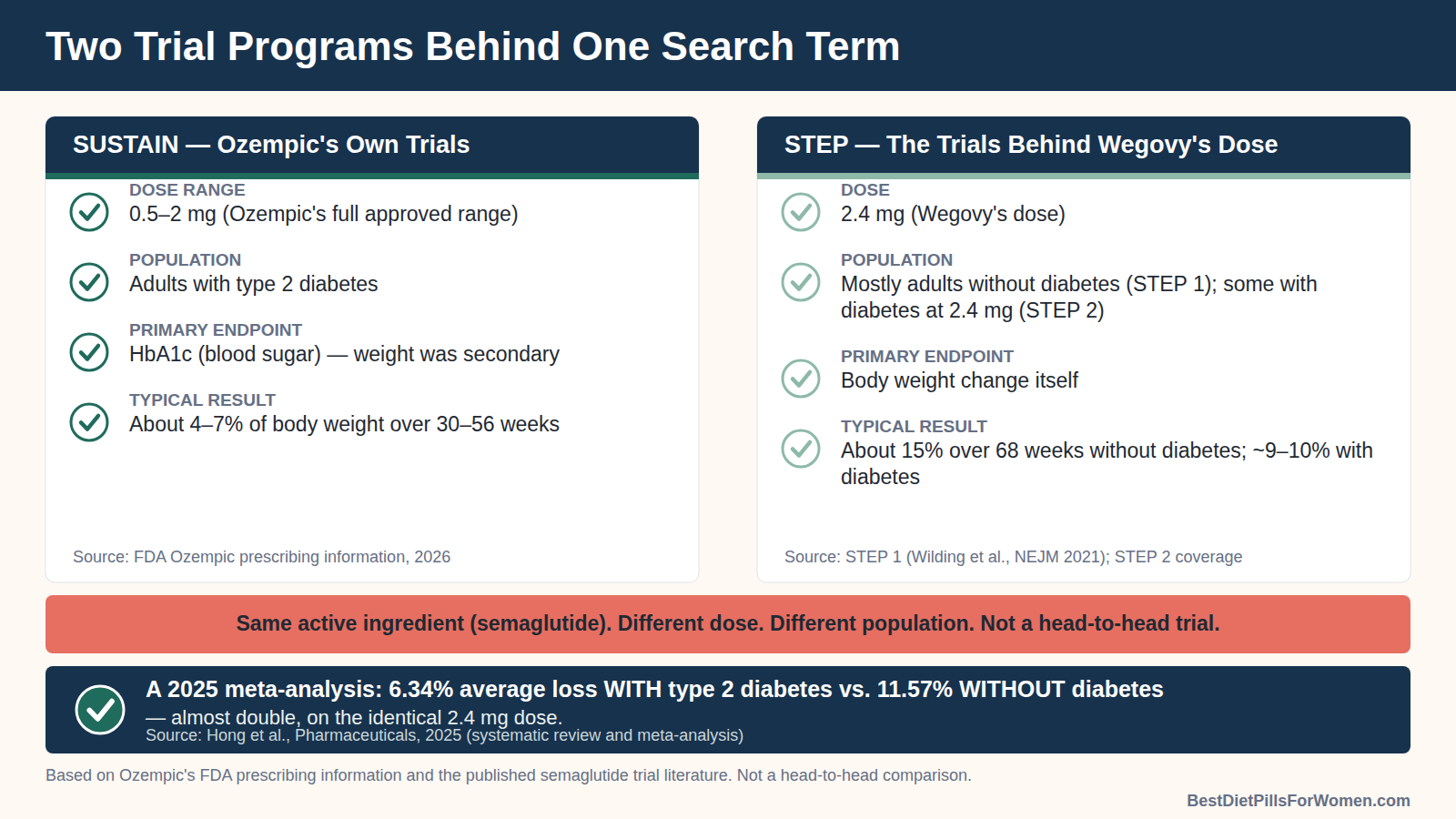
A 2025 systematic review and meta-analysis that pooled trials of semaglutide 2.4 mg specifically found a 6.34% average loss in people with type 2 diabetes versus 11.57% in people without it — almost double, on the identical dose. Ozempic doesn’t even go up to 2.4 mg; its ceiling is 2 mg. So an Ozempic user with diabetes is working against both a lower dose ceiling and a biology that responds less dramatically. That combination is the real explanation for why “Ozempic results” and “Wegovy results” read so differently online, even though it’s the same molecule.
STEP 2, which tested that same 2.4 mg dose specifically in people with type 2 diabetes, offers a useful bridge between the two programs. Participants in the 2.4 mg arm lost close to 10 kg on average, with roughly two-thirds reaching at least a 5% loss and more than a quarter losing over 15% of their starting body weight — noticeably more than Ozempic’s own SUSTAIN FORTE trial found at its lower 2 mg dose, in a comparably diabetic population. That particular gap comes down to dose rather than biology, since both trials studied people with type 2 diabetes; it’s the Hong et al. comparison above that isolates the separate effect of diabetes status itself.
Why Off-Label Ozempic Users May See STEP-Like Numbers
The flip side matters too. Someone without diabetes who is prescribed Ozempic off-label is working with biology much closer to the STEP trial population, just capped at a lower maximum dose than Wegovy uses. Many off-label users land somewhere between the SUSTAIN averages and the STEP averages — generally better than Ozempic’s own diabetes-trial numbers, but typically short of Wegovy’s full-dose results, since 2 mg is still less than 2.4 mg. Our Ozempic vs. Wegovy comparison walks through how the two brands’ approved doses and indications differ in more detail.
| Dimension | Ozempic’s Own Trials (SUSTAIN) | The Trials Many Searchers Actually Mean (STEP) |
|---|---|---|
| Dose studied | Semaglutide 0.5 mg–2 mg (Ozempic’s approved range) | Semaglutide 2.4 mg (Wegovy’s dose) |
| Population | Adults with type 2 diabetes | Mostly adults without diabetes (STEP 1); some with diabetes at the same 2.4 mg dose (STEP 2) |
| FDA-approved use studied | Blood sugar control; cardiovascular and kidney risk reduction in type 2 diabetes | Chronic weight management |
| Primary trial endpoint | HbA1c change; body weight was secondary | Body weight change was the primary endpoint |
| Typical reported average | Roughly 3–7 kg, or about 4–7%, over 30–56 weeks | About 15% of body weight over 68 weeks without diabetes; about 9–10% with diabetes at 2.4 mg |
| Is this a head-to-head trial? | No. These are separate trial programs with different populations, doses, and trial lengths — the comparison is indirect, not a randomized head-to-head test. |
Table 2 method note: “Typical reported average” rows summarize ranges described in this article’s Sources section, not a single pooled statistic; see the SUSTAIN and STEP sections above for trial-specific figures and the populations they came from.
The Ozempic/Semaglutide Weight-Loss Timeline: What to Expect and When
Results don’t show up all at once, and the shape of the curve matters almost as much as the final number.

The First Few Months: Dose Escalation and Early Changes
Semaglutide is always started at a low dose and increased gradually. That schedule exists to manage gastrointestinal side effects, not to control the pace of weight loss, but it does shape what you’ll notice in the early weeks. This stepwise pattern is common to GLP-1 medications generally, not unique to Ozempic, and it’s one reason patience in the first month or two matters more than it might seem.
Weeks 1-8: Starting Low and Titrating Up
The starting dose is intentionally sub-therapeutic for weight purposes — Ozempic’s lowest dose, 0.25 mg, exists mainly to let the digestive system adjust before moving higher. Most people notice little meaningful weight change in the first four weeks, and dose increases typically happen roughly every four weeks from there, with the exact schedule set by a prescriber. Our guide to the Ozempic dosing schedule breaks down the specific titration steps in detail.
Weeks 8-20: When Appetite Changes Usually Become Noticeable
As the dose climbs, many people start noticing reduced hunger, smaller portions feeling satisfying, and less interest in snacking between meals. This is also the window where gastrointestinal side effects are most common, since the body is still adjusting to each new dose step.
Longer-Term Trajectory and the Weight-Loss Plateau
Weight loss on semaglutide isn’t linear. It tends to be fastest in the middle stretch of treatment and then gradually slows, which tracks with how the body defends a given weight once it settles there for a while — sometimes loosely called a set point, though the biology behind it is more complicated than a single thermostat setting.
Weeks 20-68: Continued Loss and Where It Tends to Level Off
In STEP 1, the -14.9% average loss was measured at week 68, after a full course of dose escalation and roughly a year of treatment at the target dose. SUSTAIN trials, which ran shorter (30 to 56 weeks) and used lower doses, captured an earlier snapshot of a smaller overall effect. Neither trial length tells you exactly when your personal curve will flatten, but both point to the same general shape: most of the loss happens over several months, not a few weeks.
Why a Plateau Happens (and Why It’s Not Failure)
A plateau is a predictable part of how weight regulation works, not a sign the medication has “stopped working.” As body weight drops, the body needs fewer calories to maintain itself, appetite-regulating hormones adjust, and the same dose produces a smaller further deficit than it did at a higher starting weight. A leveling-off curve matches what energy-balance physiology predicts — it is not evidence of treatment failure, though it’s worth discussing with a prescriber if weight loss stops much earlier than expected or reverses while still on treatment.
| Timeframe | Typical Dose Stage | What Trial Data Suggest | What’s Happening |
|---|---|---|---|
| Weeks 1–4 | Starting dose | Little to no measurable weight change yet | Low dose is meant to ease GI adjustment, not drive weight loss |
| Weeks 4–8 | First dose increase(s) | Appetite changes often become noticeable | Titration continues; GI side effects are most common in this window |
| Weeks 8–20 | Mid-range doses | Weight loss becomes more consistent | Many reach or approach their eventual maintenance dose |
| Weeks 20–68 | Maintenance-range dose | Continued, gradually slowing loss | This is the window where STEP 1’s −14.9% average and SUSTAIN’s smaller averages were measured |
| Around week 68 onward | Maintenance | Loss tends to plateau | Energy intake and expenditure settle at a new, lower-weight equilibrium |
| After stopping | None | Regain is common, often substantial within a year | Appetite-suppressing effect fades as the drug clears the body |
Table 3 method note: Timeframes are generalized from the dosing and assessment windows used in the SUSTAIN and STEP trial programs; individual titration schedules are set by a prescriber and can differ from trial protocols.
What Happens If You Stop Taking Ozempic
Whether weight loss holds up after treatment ends is one of the most consequential — and most under-discussed — parts of this picture.
Weight Regain After Discontinuation
The honest answer is that regain is common, and it starts relatively quickly once the drug is out of your system. That’s worth planning around before you start, not discovering afterward — weight regain after stopping a medication isn’t the same thing as the medication having failed; it’s a predictable consequence of removing an appetite-suppressing signal that your body had adjusted around.
What the STEP 1 Extension Study Found
A follow-up to the STEP 1 trial tracked participants for a full year after they stopped semaglutide. On average, they regained about two-thirds of the weight they had lost, with blood pressure drifting back toward baseline and some improvements in blood sugar and cholesterol fading, though not disappearing entirely. Even so, about 48% of that group still had at least a 5% loss from their original starting weight a year after stopping — a smaller win than at the trial’s peak, but not nothing.
What a Larger Pooled Analysis Adds
A 2025 systematic review and meta-analysis from University of Cambridge researchers, looking across dozens of studies, estimated that people typically regain around 60% of lost weight within a year of stopping a GLP-1 medication, with regain eventually leveling off near 75% of the original loss in longer follow-up. That same analysis described regain as having a “half-life” of roughly 23 weeks — meaning about half of the eventual rebound tends to happen in the first several months off treatment, rather than spreading out evenly across the full year. The pattern lines up with what the STEP 1 extension found on its own: most of the benefit fades without continued treatment, but not literally all of it.
Real-World Persistence and Why Many People Stop Early
Clinical trials tell you what happens under close monitoring and a fixed protocol. Real life is messier, and the data on actual prescribing patterns reflects that. Cost is a recurring theme here: without insurance coverage, GLP-1 medications are expensive enough that a lapse in coverage or a formulary change can force someone off treatment regardless of how well it was working, which is a different kind of “discontinuation” than someone choosing to stop because of side effects.
Why People Discontinue GLP-1 Treatment
People stop semaglutide for a mix of reasons that have nothing to do with whether it’s “working”: persistent nausea or other GI side effects, cost and insurance coverage changes, supply interruptions, or simply deciding the trade-offs no longer make sense for them. None of these reasons are a judgment on the person — they’re common, practical barriers that show up across weight-loss treatments generally.
What Real-World Data Show About Results and Discontinuation
A 2025 Cleveland Clinic study of nearly 7,900 adults with obesity found that people who stayed on GLP-1 treatment for a year lost an average of 11.9% of body weight, compared with 3.6% among those who stopped within three months and 6.8% among those who stopped between three and twelve months. Interestingly, that same real-world dataset did not show the sharp, fast rebound seen in the tightly monitored STEP 1 extension — weight tended to stay relatively stable after stopping, at least in that one-year window, a reminder that discontinuation patterns outside a trial setting don’t always mirror what controlled studies find.
| Scenario | Data Source | Average Result |
|---|---|---|
| Continued treatment, real-world (1 year) | Cleveland Clinic EHR study, ~7,900 adults, 2025 | 11.9% average loss among those who stayed on treatment |
| Early real-world discontinuation (within 3 months) | Same study | 3.6% average loss |
| Later real-world discontinuation (3–12 months) | Same study | 6.8% average loss |
| Clinical-trial discontinuation, 1 year off-drug | STEP 1 extension, Wilding et al., 2022 | Regained about two-thirds of weight lost; a net 5.6% loss from baseline remained |
| Pooled estimate across GLP-1 discontinuation studies | University of Cambridge systematic review/meta-analysis, 2025 | Roughly 60% of lost weight regained within a year; leveling off near 75% longer-term |
Table 4 method note: Real-world and clinical-trial figures are not directly comparable — they come from different populations, monitoring intensity, and follow-up lengths, which likely explains why the Cleveland Clinic data show a gentler post-discontinuation pattern than the controlled STEP 1 extension.
Factors That Change How Much Weight You’re Likely to Lose
Averages describe groups. Your own result depends on a shorter list of variables that are worth naming directly, and they roughly sort into three buckets: the pharmacology of the dose you’re actually taking, the medical context you’re taking it in, and the behavior and lifestyle choices that run alongside it.
Dose, Diabetes Status, and Medication Factors
Some of the biggest swings in outcome come down to factors that have nothing to do with willpower or effort.
Why the Ozempic Dose Ceiling Matters
Ozempic’s label tops out at 2 mg. Wegovy’s tops out at 2.4 mg, and a newer higher-dose semaglutide product has since been approved specifically for weight management at an even higher ceiling. Within the SUSTAIN program itself, moving from 1 mg to 2 mg improved average results, which tells you dose matters even before diabetes status enters the picture. If your prescriber is using Ozempic off-label and keeping you at a lower dose for cost or insurance reasons, that alone can explain a gap between your results and numbers you’ve read about Wegovy.
Other Medications That Can Blunt or Help Results
Insulin and sulfonylureas, common companions to a type 2 diabetes diagnosis, tend to promote weight gain on their own, which can work against semaglutide’s effect in the SUSTAIN trials’ population. Someone not on those medications doesn’t face that same headwind. This is one more reason the SUSTAIN population, as a group, was set up to show a smaller number than a non-diabetic population taking the same drug. Other common prescriptions — including some antidepressants, antipsychotics, and corticosteroids — are separately associated with weight gain, and if you’re taking one of those alongside semaglutide, it’s reasonable to expect your personal result to land below the published trial averages, since none of the major SUSTAIN or STEP trials specifically controlled for that combination.
Lifestyle, Adherence, and Individual Variability
Biology and dose explain a lot, but they don’t explain everything, and the trial data is clear that behavior still plays a measurable role.
Diet, Activity, and Behavioral Support
Every major semaglutide weight trial, including SUSTAIN and STEP, paired the drug with some level of diet and lifestyle counseling rather than testing it in isolation. In STEP 1, for example, participants received ongoing counseling aimed at a reduced-calorie diet and increased physical activity throughout the trial, delivered alongside the medication rather than compared against it. That design can’t fully separate how much of the result came from the drug alone versus the counseling, but it does mean the published averages already assume some baseline lifestyle support was in place. The drug does meaningful work on appetite, but it was never studied as a stand-alone intervention, and it is not a substitute for basic nutrition and activity habits — those habits appear to matter for how well the appetite-reduction translates into sustained weight loss.
Individual Variation: Why Averages Aren’t Guarantees
A reported average, whether it’s SUSTAIN’s 4-7% or STEP’s 15%, describes the middle of a distribution, not a promise to any one person. Some people lose much more than the average; others lose far less or don’t respond meaningfully at all, for reasons researchers don’t fully understand yet. One open question the major trials didn’t specifically break out is whether hormonal life stages like perimenopause and menopause shift how someone responds — the big semaglutide trials weren’t designed or reported to answer that directly, so it’s a reasonable thing to raise with a clinician rather than something this evidence base can settle on its own.
It’s also worth knowing that rapid weight loss on any GLP-1 medication can include some loss of lean muscle mass alongside fat, which is part of why many clinicians recommend adequate protein intake and resistance exercise during treatment. Our guide to muscle loss on Wegovy looks at this concern in more depth; the underlying biology applies to semaglutide generally, not only to Wegovy’s specific dose, so the same practical precautions are worth considering on Ozempic as well.
Ozempic Weight-Loss Safety: Side Effects and Who Should Be Cautious
None of these results matter much without an honest look at what the drug can cost you in side effects and risk. Several side-effect rates in Ozempic’s label shift with dose — some rise, some don’t move much — which is relevant here because off-label weight-loss use sometimes involves staying longer at higher doses than a diabetes-focused treatment plan might otherwise call for.
Common Side Effects
Most people who take semaglutide experience some gastrointestinal discomfort, particularly while the dose is being increased.
Gastrointestinal Effects and Dose Escalation
Nausea, vomiting, diarrhea, constipation, and abdominal pain are each reported in at least 5% of patients taking Ozempic, making them the most common adverse reactions associated with the drug. These effects cluster around dose increases and often ease somewhat once a person has been on a stable dose for a while, though some people never fully adjust and discontinue treatment because of them.
Other Frequently Reported Effects
Beyond the GI symptoms, people sometimes notice fatigue, mild dizziness tied to reduced food intake, or changes in how their skin looks as they lose weight relatively quickly — the loose-skin and facial-volume changes sometimes nicknamed “Ozempic face” online are a plausible consequence of rapid weight loss generally, not a distinct drug side effect with its own listed frequency in the label. Some people also report noticeable hair thinning while losing weight quickly; this is a recognized pattern tied to rapid weight loss and calorie restriction in general — not a pharmacological effect specific to semaglutide or listed in its prescribing information.
Serious Risks and Who Needs Extra Caution
A handful of risks are uncommon but serious enough to shape who should avoid this medication altogether.
Thyroid C-Cell Tumor Warning and Contraindications
Ozempic carries a boxed warning — the FDA’s strongest safety label — about thyroid C-cell tumors seen in rodent studies; whether this risk translates to humans remains unknown. Because of that uncertainty, Ozempic is contraindicated for anyone with a personal or family history of medullary thyroid carcinoma or Multiple Endocrine Neoplasia syndrome type 2, and it should be discussed carefully with a clinician by anyone unsure of their family history.
Pancreatitis, Gallbladder Disease, and Other Warnings
The label also warns about acute pancreatitis, gallbladder disease (cholelithiasis occurred in roughly 1.5% of patients at the 0.5 mg dose and 0.4% at 1 mg in trials), diabetic retinopathy complications, acute kidney injury related to dehydration from GI symptoms, and a risk of pulmonary aspiration during anesthesia or deep sedation. The retinopathy warning traces back largely to SUSTAIN 6, where people with existing diabetic eye disease saw a higher rate of retinopathy complications; this pattern has also shown up with other treatments that improve blood sugar quickly, and it’s thought to reflect the pace of glucose improvement itself rather than something unique to semaglutide. Severe hypoglycemia is uncommon on semaglutide alone but becomes more likely when it’s combined with insulin or sulfonylureas, which is relevant mainly to people also managing diabetes with those drugs. Semaglutide should be discontinued at least two months before a planned pregnancy because of its long washout period, and it should be used in pregnancy only if the potential benefit clearly outweighs the risk, per the current label.
| Effect | How Often It’s Reported | Practical Note |
|---|---|---|
| Nausea, vomiting, diarrhea, constipation, abdominal pain | Each in ≥5% of patients (the most common adverse reactions) | Most frequent during dose increases; often eases with time |
| Gallstones (cholelithiasis) | About 1.5% at the 0.5 mg dose; about 0.4% at 1 mg in trials | Reported more often than with placebo |
| Severe GI adverse reactions | About 0.4%–0.8%, depending on dose | Can require medical attention; report persistent vomiting |
| Hypoglycemia (low blood sugar) | Severe hypoglycemia in under 1.5% overall; higher with insulin or sulfonylureas | Mainly relevant if also using other diabetes medications |
| Thyroid C-cell tumors (boxed warning) | Seen in rodent studies; human risk unknown | Contraindicated with personal/family history of MTC or MEN 2 |
| Acute pancreatitis | Uncommon but serious | Watch for severe, persistent abdominal pain |
Table 5 method note: Figures are drawn from Ozempic’s current FDA-approved prescribing information and the manufacturer’s published healthcare-provider safety summary; percentages vary by dose and trial and are approximate.
Off-Label Use, Access, and Safer Alternatives to Consider
A lot of real-world Ozempic weight-loss use happens outside the drug’s approved purpose, which raises its own set of practical questions.
The Off-Label and Compounded-Semaglutide Landscape
Off-label prescribing is legal and common in medicine, but it comes with trade-offs that are worth understanding before you go that route. Off-label semaglutide use for weight loss became especially widespread during a period when demand for Wegovy outpaced supply, and it has stayed common even as manufacturing has generally caught up, partly because insurance coverage for weight-management-specific drugs remains inconsistent.
Why Ozempic Is Prescribed Off-Label for Weight Loss
Because Ozempic and Wegovy share the same active ingredient, some clinicians prescribe Ozempic for weight management in patients without diabetes, often when Wegovy isn’t covered by insurance or isn’t available. This is off-label use — it isn’t illegal, but it means you’re being treated based on a lower approved dose ceiling and a safety and efficacy record built in a different population than the one you may belong to.
FDA Warnings About Compounded and Counterfeit Semaglutide
The FDA has separately warned about compounded and counterfeit semaglutide products, which are not FDA-reviewed for safety, effectiveness, or quality the way an approved drug is. The agency has reported adverse events, including hospitalizations, linked to dosing errors in compounded injectable semaglutide, warned that multi-dose vials carry a contamination risk after 28 days of use, flagged complaints about products arriving warm or without adequate ice packs during shipping, and identified counterfeit Ozempic products and fraudulent compounded products listing compounding pharmacies that don’t actually exist. The agency’s practical advice is to get semaglutide only through a licensed prescriber and a state-licensed pharmacy, use a new sterile needle and syringe for every dose, discard multi-dose vials 28 days after first use even if product remains, and report any suspected problem through its MedWatch program. If cost is pushing you toward an unregulated source, that’s a conversation worth having directly with a prescriber or pharmacist rather than a decision to make alone — our guide to Ozempic insurance coverage and our guide to current Ozempic pricing cover the legitimate-access side of that trade-off in more depth.
Realistic Alternatives Worth Discussing With a Clinician
Ozempic and Wegovy aren’t the only medications in this conversation, and for some people they may not even be the best-fit option.
FDA-Approved Options for Weight Management
Wegovy and a newer, higher-dose semaglutide product are FDA-approved specifically for chronic weight management, as is tirzepatide under the Zepbound brand name, along with older options like liraglutide (Saxenda), phentermine-topiramate, naltrexone-bupropion, and orlistat. Our semaglutide vs. tirzepatide comparison and our broader GLP-1 weight loss guide cover how these options stack up against each other on evidence, side effects, and cost. Insurance coverage for these weight-management-specific drugs varies a great deal by plan and has shifted more than once in recent years, which is a practical reason some clinicians and patients land on an off-label option in the meantime rather than a reflection of which drug the evidence favors.
Non-Drug Approaches That Still Matter
Structured behavioral weight-management programs, registered-dietitian-guided nutrition changes, and, for appropriate candidates, bariatric surgery all have their own evidence base and remain reasonable options on their own or alongside medication. These programs typically combine regular check-ins, specific calorie and activity targets, and skills training around things like meal planning and managing triggers for eating — the same kind of counseling that ran alongside the drug in the SUSTAIN and STEP trials themselves. None of this is an argument against medication for people who need it — it’s a reminder that a prescription is one tool among several, and the right mix depends on your own health history, which is a conversation for a clinician, not a search engine.
Frequently Asked Questions About Ozempic Weight-Loss Results
Questions About Expected Results
How much weight will I lose in the first month on Ozempic?
Typically very little. The starting dose is intentionally low to limit GI side effects, and most meaningful weight change in the major trials showed up after several dose increases, generally a few months in rather than a few weeks. If the scale barely moves in month one, that’s consistent with how the trials played out, not a sign something is wrong.
Is it normal to lose less weight than people report with Wegovy?
Yes, and it’s common for two separate reasons: Ozempic’s maximum approved dose (2 mg) is lower than Wegovy’s (2.4 mg), and if you have type 2 diabetes, trial data suggests your biology may respond less dramatically to the same dose than someone without diabetes would.
Can women expect different Ozempic weight-loss results than men?
The major semaglutide trials enrolled large numbers of women — about 73% of STEP 1’s participants were women — but the published results aren’t broken out by sex in a way that supports a confident “yes” or “no” here. If you’re wondering how factors like menopause might affect your own response, that’s a good question for your own clinician rather than one the current published trial data directly answers.
Questions About Safety, Access, and Alternatives
Is it safe to use Ozempic off-label for weight loss?
Off-label use itself is a legal, common medical practice, and a licensed clinician can prescribe Ozempic this way. The bigger safety question is usually about how the drug is obtained: a legitimately prescribed, pharmacy-dispensed Ozempic carries the same safety profile described in its label, while unregulated or counterfeit sources carry the separate risks the FDA has specifically warned about. Off-label use also means you’re relying on a dose ceiling and a safety record established in people with diabetes, which is worth factoring into the decision even when the prescription itself is entirely legitimate.
What’s the difference between compounded semaglutide and Ozempic?
Ozempic is an FDA-approved, manufactured drug product. Compounded semaglutide is prepared by a compounding pharmacy and is not FDA-reviewed for safety, effectiveness, or quality, which is why the FDA has flagged dosing errors, contamination risk, and counterfeit or fraudulently labeled products in this category.
What should I ask my doctor before starting Ozempic for weight loss?
Reasonable questions include whether Ozempic is being prescribed on- or off-label in your case, what dose ceiling you can expect to reach, whether a weight-management-specific drug might be a better fit, what the realistic timeline and plateau look like for someone in your situation, and what the plan is if you need or choose to stop. It’s also worth asking how your other health conditions and current medications might change any of those answers, since the trial averages in this article describe groups, not your specific medical history.
The Bottom Line on Ozempic for Weight Loss
Pulling this all together: the honest answer to “how much weight will Ozempic help me lose” depends almost entirely on which evidence base actually applies to you. The clearest benefit is real and well-documented; the clearest limitation is that it’s smaller, slower, and less durable than the headline numbers suggest once you account for dose, diabetes status, and what happens after treatment stops. The rational next step for most readers is a direct conversation with a prescriber about which evidence base actually describes their own situation, rather than anchoring on a single statistic from either trial program.
What the Evidence Supports and Where It’s Limited
The clinical record is solid on the broad strokes, but it leaves real gaps once you ask about your specific situation.
The Clearest Takeaway
Ozempic’s own trials, in people with type 2 diabetes, show average weight loss in the range of roughly 4 to 7 percent — real, but modest, and secondary to the drug’s actual approved purpose of blood sugar control. The much larger numbers associated with semaglutide online come from a different trial program, a different population, and a higher dose.
The Biggest Open Question
The biggest unresolved question for most readers isn’t whether semaglutide can produce meaningful weight loss — it clearly can, in both evidence bases — it’s what happens when you stop. Regain is common and often substantial, and the current evidence doesn’t yet offer a reliable way to predict, for any one person, how much of their progress will hold. That makes treatment duration, not just treatment choice, a question worth deciding on purpose rather than by default.
Practical Next Steps
Evidence can only take you so far; the rest is a conversation with someone who knows your health history.
Questions Worth Bringing to a Clinician
Before starting or continuing Ozempic for weight-related goals, it’s worth directly asking whether you’re a better match for the SUSTAIN evidence base or the STEP evidence base, whether a higher-dose, weight-management-approved option makes more sense for your situation, and what a realistic, individualized timeline looks like given your health history and any other medications you take.
When Off-Label Use Deserves a Second Look
If cost or access is the main reason you’re on Ozempic rather than a weight-management-approved drug, that’s worth revisiting periodically — insurance coverage, product availability, and pricing all shift over time, and what made sense a year ago may not be the best option today. No single number from a clinical trial — SUSTAIN’s or STEP’s — is a promise about what will happen in your own body, and that’s exactly why the conversation belongs with a clinician who can weigh your specific history against the evidence, not with a headline.
Related Reading
Sources
These are the main sources behind this guide, chosen because they are the ones to check first for current facts. Labels, regulatory pages, and trial coverage change, so confirm the latest version before you make decisions.
- Food and Drug Administration. Ozempic (semaglutide) injection, for subcutaneous use — full prescribing information, 2026 revision. https://www.accessdata.fda.gov/drugsatfda_docs/label/2026/209637s038lbl.pdf
- Food and Drug Administration. Medications Containing Semaglutide Marketed for Type 2 Diabetes or Weight Loss. Content current as of October 1, 2026. https://www.fda.gov/drugs/postmarket-drug-safety-information-patients-and-providers/medications-containing-semaglutide-marketed-type-2-diabetes-or-weight-loss
- Food and Drug Administration. FDA’s Concerns with Unapproved GLP-1 Drugs Used for Weight Loss. October 1, 2026. https://www.fda.gov/drugs/drug-alerts-and-statements/fdas-concerns-unapproved-glp-1-drugs-used-weight-loss
- American College of Cardiology. Semaglutide Treatment Effect in People With Obesity — STEP 1 trial summary, reporting Wilding JPH, et al., N Engl J Med. 2021;384(11):989-1002. https://www.acc.org/Latest-in-Cardiology/Clinical-Trials/2021/02/18/19/23/STEP-1
- Wilding JPH, Batterham RL, Davies M, et al. Weight regain and cardiometabolic effects after withdrawal of semaglutide: the STEP 1 trial extension. Diabetes Obes Metab. 2022;24(8):1553-1564. https://discovery.ucl.ac.uk/id/eprint/10149199/1/Diabetes%20Obesity%20Metabolism%20-%202022%20-%20Wilding%20-%20Weight%20regain%20and%20cardiometabolic%20effects%20after%20withdrawal%20of%20semaglutide%20.pdf
- Hong B, Kim H, Lee D, Kim K. Weight Loss Effects of Once-Weekly Semaglutide 2.4 mg in Adults With and Without Type 2 Diabetes: A Systematic Review and Meta-Analysis. Pharmaceuticals (Basel). 2025. https://pmc.ncbi.nlm.nih.gov/articles/PMC12300051
- Cleveland Clinic Newsroom. Cleveland Clinic Research Finds Injectable Medications for Obesity Produce Smaller Weight Loss in a Real-World Setting Compared to Randomized Clinical Trials, reporting Gasoyan H, et al., Obesity. 2025. https://newsroom.clevelandclinic.org/2025/06/10/cleveland-clinic-research-finds-injectable-medications-for-obesity-produce-smaller-weight-loss-in-a-real-world-setting-compared-to-randomized-clinical-trials
- U.S. Pharmacist. Weight Regain Common After Stopping GLP-1 Drugs, reporting a University of Cambridge systematic review and meta-analysis published in eClinicalMedicine, 2025. https://www.uspharmacist.com/article/weight-regain-common-after-stopping-glp1-drugs
- HCPLive. Increased 2.0 mg Dose of Semaglutide Proves Superiority for Glycemic Control, Weight Loss in SUSTAIN FORTE, reporting Frías JP, et al., Lancet Diabetes & Endocrinology, 2021 . https://www.hcplive.com/view/increased-2-0-mg-dose-of-semaglutide-proves-superiority-for-glycemic-control-weight-loss-in-sustain-forte
- Novo Nordisk NovoMedLink. Safety profile for once-weekly Ozempic (semaglutide) injection [healthcare-provider manufacturer page, used only to supplement adverse-reaction frequency figures already reflected in the FDA label]. https://www.novomedlink.com/diabetes/products/treatments/ozempic/efficacy-safety/safety-profile.html

