
Ozempic cost runs roughly $1,000 to $1,050 a month at the sticker price, without insurance, but almost nobody who’s actually covered pays that number, and almost nobody who’s using it off-label for weight loss gets insurance to touch it at all. What you actually pay depends less on the drug itself than on three questions: does your insurance plan cover it, does your prescription match what Ozempic is FDA-approved to treat, and do you qualify for the manufacturer’s savings programs.
Here’s the complication marketing pages gloss over: Ozempic is FDA-approved to treat type 2 diabetes, not obesity or weight loss. Its sister drug, Wegovy, carries the same active ingredient (semaglutide) at a higher maximum dose and is the one actually approved for chronic weight management. A lot of women are prescribed Ozempic for weight loss anyway, off-label, and that single fact changes almost everything else in this guide: whether insurance pays, whether the manufacturer’s savings card applies, and whether a denial is likely.
This guide walks through what Ozempic actually costs at every stage, from the list price down to what people with commercial insurance, Medicare or Medicaid typically pay, where the savings card and patient assistance program fit in, and why using it specifically for weight loss tends to cost more than using it for diabetes. It’s part of our broader coverage of weight loss medications, alongside our guide to the best weight loss pills for women. We pulled the figures from Novo Nordisk’s own pricing pages, FDA’s prescribing information, CMS’s Medicare documents, and recent coverage surveys, not from a hands-on purchase or a single pharmacy’s quote. Nothing here is personalized insurance or medical advice, and your own plan’s rules are what settle your final price, not any number printed in this guide.
Ozempic Cost at a Glance
Start with the headline numbers, then look at how confident we are in each one and how we arrived at it.
The Direct Answer and How Sure We Are
Two different questions matter here: what does Ozempic cost, and how solid is that answer given how fast prices and coverage rules move.
What Does Ozempic Actually Cost?
Without insurance, Ozempic’s cash price runs about $1,000 to $1,050 for a one-month pen supply; with commercial insurance that covers it, many patients pay a $25 to $100 copay through the manufacturer’s savings card; and people using it off-label purely for weight loss often get no insurance help at all. Medicare and Medicaid cover Ozempic for its approved diabetes use far more consistently than for off-label weight loss, and a 2027 list-price cut from Novo Nordisk won’t change what most insured patients already pay out of pocket.
None of these figures are guarantees. Pharmacy cash prices vary by location, insurance terms change yearly, and savings-card offers come with fine print that can disqualify you without warning.
How Confident We Are, and Why Prices Keep Moving
We’re highly confident about the cash and list-price figures, since they come directly from Novo Nordisk’s own savings pages, FDA’s drug label, and an independent pharmacy price guide that we checked in October 2026. We’re less confident about any single reader’s actual copay, because commercial insurance benefit design varies enormously by employer and plan, and because Novo Nordisk explicitly reserves the right to change its savings-card terms at any time. Treat every dollar figure in this guide as a snapshot, not a quote, and confirm it against your own plan and the manufacturer’s current terms before you budget around it.
Why Is Ozempic So Expensive in the First Place?
A weekly injectable biologic like semaglutide is costly to develop, trial at scale and manufacture, and Ozempic is still under U.S. patent protection, which keeps lower-cost generic competition off the market. Novo Nordisk, not any pharmacy or insurer, sets the list price, and that figure reflects commercial strategy as much as production cost. A list-price cut, like the 2027 one described later in this guide, is a business decision the company can make on its own, not proof the drug suddenly costs less to make.
How We Researched This Guide
A cost guide is only as good as where its numbers came from, so here’s exactly what we did and didn’t do.
Sources We Relied On
This guide is built from desk research: Ozempic’s and Wegovy’s current FDA prescribing information, Novo Nordisk’s own savings and pricing pages, Centers for Medicare & Medicaid Services (CMS) documents on Medicare Part D and the Medicare drug price negotiation program, a KFF issue brief on Medicaid coverage of GLP-1 drugs, an employer benefits survey on commercial coverage patterns, and an independent pharmacy pricing reference. We read primary sources wherever we could and flagged anywhere we had to rely on a secondary summary.
What This Guide Is and Isn’t
This is a pricing and coverage guide, not a hands-on test and not a substitute for calling your own insurer, pharmacy or prescriber. We didn’t buy, fill or use Ozempic for this piece, and nothing here reflects personal experience. It’s also not an argument for or against using Ozempic for weight loss; that’s a conversation for you and a clinician who knows your health history, not something a pricing guide can settle. We wrote it with women specifically in mind because the off-label weight-loss use that drives so much of the cost and coverage confusion in this guide is widely discussed in women’s health and weight-management contexts, even though Ozempic’s own label doesn’t support that use.
The Numbers at a Glance
Table 1 lines up the main payment scenarios before the rest of this guide unpacks each one.
The Summary Table
| Payment scenario | What you might pay | Who it typically applies to | Key caveat |
|---|---|---|---|
| Cash price, no insurance or discount | About $1,000-$1,050 for a one-month pen supply | Uninsured patients, or anyone paying full price at a retail pharmacy | Prices vary by pharmacy and location; this is a snapshot, not a guarantee |
| Manufacturer savings card, commercially insured | As little as $25 for up to a 3-month supply, described elsewhere as up to $100 off per month for up to 48 months | Patients with commercial (non-government) insurance that covers Ozempic | Government beneficiaries (Medicare, Medicaid, TRICARE, etc.) are excluded |
| NovoCare Pharmacy self-pay, new patient | $199 a month for the first 2 months | Uninsured or underinsured patients willing to pay cash through Novo Nordisk’s own pharmacy channel | Introductory price only; it rises after the second month |
| NovoCare Pharmacy self-pay, ongoing | $349 a month (0.25-1 mg doses) or $499 a month (2 mg dose) | Existing self-pay patients after the introductory period | Doesn’t include a clinician visit, labs or shipping in some cases |
| Patient Assistance Program | $0 (free medication) | Uninsured patients, or Medicare patients with no other drug coverage, at or below 200% of the federal poverty level | Patients with commercial insurance, Medicaid or Part D coverage don’t qualify |
| Medicare Part D, diabetes diagnosis | Varies by plan; subject to the $2,100 annual out-of-pocket cap for 2026 | Medicare beneficiaries prescribed Ozempic for type 2 diabetes | Coverage for off-label weight-loss use is far less consistent |
| Medicaid, diabetes diagnosis | Usually a small copay or none, depending on the state | Medicaid enrollees prescribed Ozempic for type 2 diabetes | Coverage is federally required for the diabetes indication; weight-loss-only coverage is state-optional and much rarer |
Table 1 method: figures are as stated on Novo Nordisk’s current pricing and savings pages, FDA’s Ozempic label, CMS’s Part D program documents and a KFF Medicaid issue brief, read in October 2026. Dollar figures are snapshots, not live quotes; confirm current terms directly with the manufacturer, your plan or your pharmacy before budgeting around any number here.
How to Read the Table
Treat Table 1 as a map of the territory, not a prediction of your own bill. The biggest swing factor isn’t the drug’s price at all: it’s whether your prescription is coded for diabetes, which most insurance recognizes, or for weight loss, which many plans either exclude outright or review far more skeptically. The rest of this guide walks through why that distinction exists and what it means for every payment path above.
What Ozempic Is — and Why That Shapes Its Price
Before the cost breakdown goes any further, it helps to understand exactly what Ozempic is approved to do, because that approval is the hinge almost every pricing and coverage rule in this guide swings on.
Ozempic’s FDA-Approved Use
Ozempic and its better-known weight-loss cousin share an active ingredient, but they aren’t interchangeable on a label, a formulary or an insurance claim.
What Ozempic Is Actually Approved to Treat
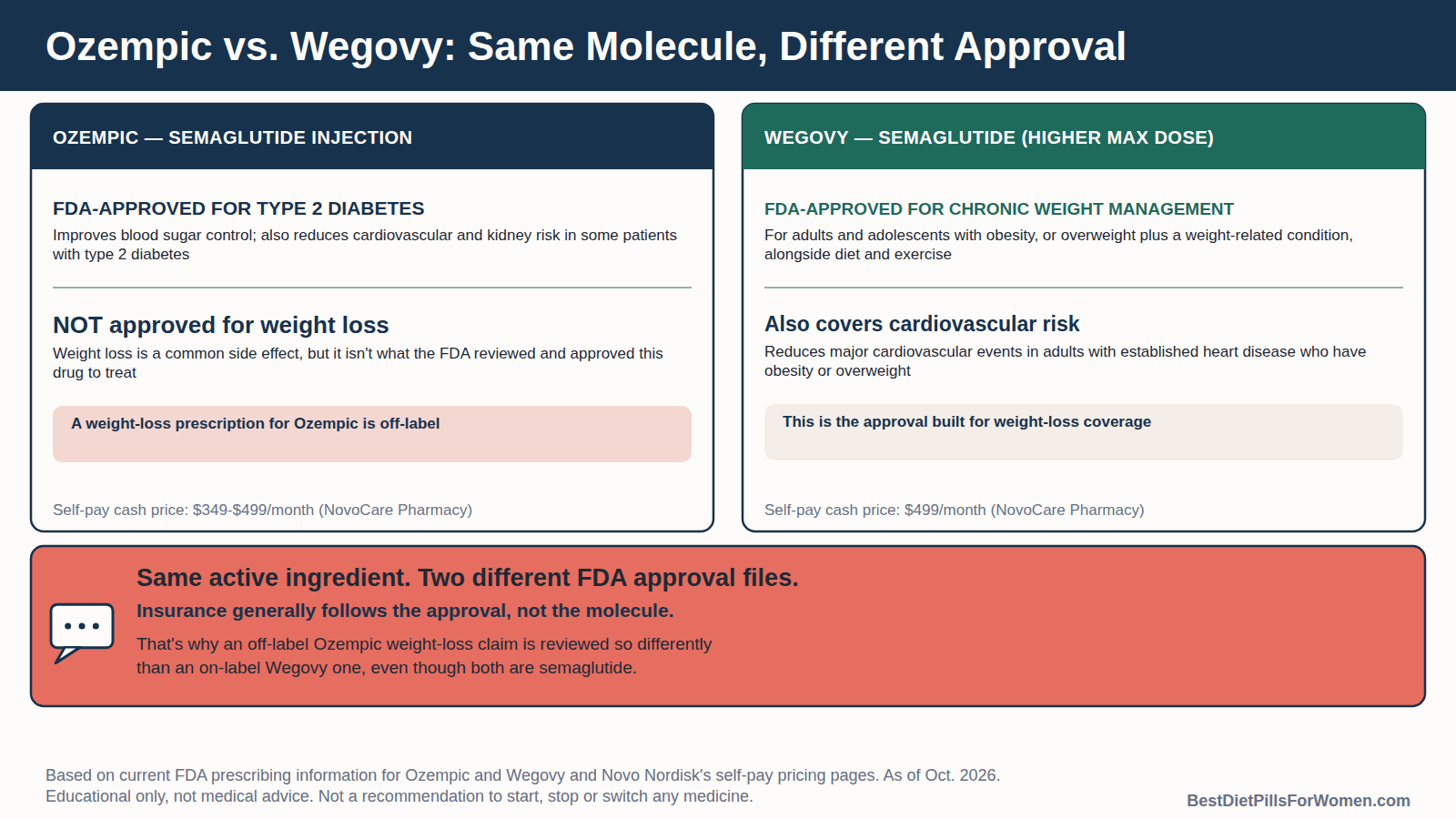
Ozempic (semaglutide) is FDA-approved as an adjunct to diet and exercise to improve blood sugar control in adults with type 2 diabetes, along with reducing cardiovascular and kidney risk in some of those same patients. It isn’t FDA-approved for weight loss or obesity. The drug does cause weight loss as a side effect for most people who take it, which is exactly why so many prescriptions for it have nothing to do with diabetes.
Why Ozempic Isn’t the Same Approval as Wegovy
Wegovy, approved separately, uses the same molecule (semaglutide) at a higher maximum maintenance dose and carries its own FDA approval for chronic weight management in adults and adolescents with obesity, or with overweight plus a weight-related health condition, used alongside a reduced-calorie diet and more physical activity. Wegovy also carries an added approval for reducing major cardiovascular events in adults with established heart disease who have obesity or overweight, and a newer approval for a liver condition called MASH in some patients. Ozempic has none of those weight-management or MASH approvals on its own label. Same manufacturer, same core ingredient, two different regulatory files, and that difference is the reason this entire cost guide exists. Our Wegovy cost guide and our semaglutide vs. tirzepatide comparison go deeper into each drug’s own pricing and clinical trade-offs than this guide does.
Both drugs work the same basic way: semaglutide mimics a gut hormone called GLP-1, which slows digestion, increases insulin release when blood sugar is high and reduces appetite. That mechanism is also why both drugs are injected once a week rather than taken daily, a convenience factor that doesn’t show up on the price tag but does affect how many pens, needles and refill trips a given month actually involves.
Off-Label Use for Weight Loss
“Off-label” isn’t a technical footnote here. It’s the single biggest reason an Ozempic prescription that works perfectly well medically can still get denied, delayed or priced very differently.
What “Off-Label” Means for Your Wallet
Prescribing a drug off-label (for a use the FDA hasn’t approved) is legal and common in American medicine, but insurance companies generally only have to cover a drug for its approved indication or for an accepted off-label use backed by strong clinical guidelines. When a clinician prescribes Ozempic specifically for weight loss in someone without type 2 diabetes, that claim often doesn’t match what the insurer’s formulary rules recognize as covered, and the claim can be denied even though the exact same pen would have been approved for a diabetes diagnosis.
This is also why so much of the online conversation about Ozempic’s cost is confusing: one person’s $25 copay story and another person’s full-price denial can both be accurate, honest accounts of the same drug, because they’re describing two different insurance pathways tied to two different diagnoses. If you’ve seen a low price quoted somewhere and your own quote looks nothing like it, the diagnosis behind the prescription, not a pharmacy error, is the most likely explanation.
Why Many Insurers Treat the Two Uses Differently
An insurer that covers GLP-1 drugs for diabetes is following a decades-old, well-established category of coverage; a plan that also covers them for weight loss is choosing to pay for a newer, pricier category of use that most employers and government programs have historically excluded by default. Budget pressure is a real part of this story too: a single employer or state program covering an entire weight-loss-eligible population at GLP-1 prices is a materially bigger line item than covering the smaller group of patients who already had a diabetes diagnosis, which is part of why some plans that once covered weight-loss use have since pulled back. That’s why, later in this guide, you’ll see coverage rates for diabetes running far higher than coverage rates for weight loss specifically, even though the pill bottle, the pharmacy and sometimes the exact drug are identical.
Ozempic’s List Price and What Drives It
The number most people picture when they hear “Ozempic cost” is the list price, and it’s also the number that misleads the most people, since almost nobody actually pays it.
Understanding the List Price (WAC)
A drug’s list price is a specific, defined figure, not a marketing number, and it isn’t the same thing as what a pharmacy charges you at the counter.
What Ozempic’s List Price Is Right Now
The wholesale acquisition cost (WAC), commonly called the list price, is what a manufacturer sets as the benchmark price before any rebates, discounts or insurance negotiation. Novo Nordisk itself has framed its upcoming 2027 price change as about a 35% cut for Ozempic, which puts the current list price in the neighborhood of $1,000 to $1,050 a month; an independent pharmacy price reference put a one-month, 3 mL supply at $1,011.57 in October 2026. List price matters even if you never pay it directly, because it’s often the starting point insurers use to calculate coinsurance, deductible credit and your share of the cost before you hit any out-of-pocket cap.
The 2027 List-Price Cut, Explained
Novo Nordisk has announced it will lower the U.S. list price of Ozempic, Wegovy and Rybelsus to $675 a month, effective January 1, 2027, a move the company frames as easing the burden for patients with high-deductible health plans or coinsurance designs where the bill is tied to list price rather than a flat copay. The company has explicitly said this list-price change “does not have an impact on direct-to-patient, self-pay prices,” meaning the NovoCare Pharmacy cash prices described later in this guide stay where they are regardless of the WAC cut. If you’re on a flat-copay commercial plan or already using the savings card, this change likely won’t move your bill much either; it mainly helps people whose out-of-pocket cost is calculated as a percentage of list price.
List Price vs. What People Actually Pay
List price, cash price and your actual bill are three different numbers, and conflating them is where a lot of sticker shock comes from.
Why List Price Rarely Equals Your Price
Pharmacy benefit managers negotiate rebates and discounts off list price for insurers, manufacturers run their own direct cash-pay programs that undercut list price substantially, and government programs negotiate their own separate rates. The practical result: a commercially insured patient with coverage might pay a $25 to $100 copay, a self-pay patient through Novo Nordisk’s own pharmacy might pay $349 to $499 a month, and a retail pharmacy without any discount might bill close to the full $1,000-plus list price. Three very different numbers, same drug, same month.
This is also why a single “average Ozempic price” headline in a news article or a social media post rarely tells you much about your own situation. The figure might reflect the list price, a specific insurer’s negotiated rate, a savings-card-adjusted copay, or an aggregate across all of those, without saying which one. When you see a price quoted anywhere outside your own insurer’s portal or a manufacturer’s own page, it’s worth asking which of these categories it actually represents before comparing it to your own bill.
Cash Price at a Retail Pharmacy
Table 2 breaks down what “cash price” actually means across the main channels people use to buy Ozempic without relying on insurance.
| Channel | Approximate monthly price | Notes |
|---|---|---|
| Retail pharmacy, no discount, one-month 3 mL pen supply | About $1,011-$1,050 | Independent price-guide figure; actual pharmacy counter price varies by location and dose |
| NovoCare Pharmacy, new self-pay patient | $199 for the first 2 months | Introductory price only, regardless of dose strength |
| NovoCare Pharmacy, existing self-pay patient, 0.25-1 mg doses | $349 a month ($4,188 a year) | Applies after the introductory period ends |
| NovoCare Pharmacy, existing self-pay patient, 2 mg dose | $499 a month ($5,988 a year) | The highest standard maintenance dose costs more even at the self-pay cash rate |
Table 2 method: NovoCare Pharmacy figures are stated self-pay prices from Novo Nordisk’s own savings page; the retail figure is from an independent pharmacy price guide. Both are read as of October 2026 and annualized by multiplying the monthly figure by 12 where shown; totals don’t include clinician visits, lab work or shipping fees.
Why List Price Doesn’t Reflect What Insurers Actually Pay
Behind the scenes, a layer of middlemen negotiates prices that never show up on a pharmacy receipt, and understanding that gap explains why two people with “the same insurance” can still end up with different bills.
Rebates, Spread Pricing and the Supply Chain
Pharmacy benefit managers (PBMs), the companies insurers hire to negotiate drug prices and manage formularies, typically extract rebates from manufacturers in exchange for favorable formulary placement. Those rebates are calculated off the list price, which is part of why a drugmaker lowering its list price doesn’t automatically translate into a lower price for every patient; it can actually shrink the rebate dollars flowing back through the supply chain unless contracts are renegotiated. None of this complexity is something you can see or control directly as a patient, but it’s worth knowing it exists before assuming a published price cut, like the one Novo Nordisk has announced for 2027, automatically lowers your specific copay.
Why That Complexity Doesn’t Usually Help You Directly
For a typical commercially insured patient, the practical, controllable levers are narrower than the full supply chain: your plan’s formulary tier, whether prior authorization is approved, whether you’re commercially insured at all (as opposed to on Medicare or Medicaid), and whether you qualify for the manufacturer’s savings card. Everything upstream of those four things, including rebate negotiations and list-price changes, happens between the manufacturer, the PBM and your insurer, largely out of view and mostly out of your control. That’s exactly why the rest of this guide focuses on the levers you can actually pull, rather than on list price alone.
Commercial Insurance: Coverage and Prior Authorization
Most working-age women with Ozempic prescriptions have commercial insurance, and that’s where the diabetes-versus-weight-loss distinction does the most damage to a budget if it isn’t sorted out up front.
How Often Commercial Plans Cover Ozempic
Coverage isn’t all-or-nothing. It splits sharply along the same line this guide keeps returning to.
Diabetes Coverage vs. Weight-Loss Coverage
In a 2026 survey of employer benefit plans, 60% covered GLP-1 drugs for diabetes only, while 36% covered them for both diabetes and weight loss, and just 3% didn’t cover the drug class at all. That means roughly three in five commercially insured women whose employer offers this benefit will find an Ozempic prescription covered if it’s tied to a type 2 diabetes diagnosis, but potentially excluded, or subject to a much tougher review, if it’s prescribed for weight loss alone without that diagnosis on the claim.
What Prior Authorization Usually Checks
Among employers that use utilization management for these drugs, 95% require prior authorization, meaning your prescriber’s office has to submit documentation before the pharmacy claim will go through, and 33% require reauthorization just to keep the refills coming. A typical prior-authorization review checks the diagnosis code on the claim, recent lab values (especially A1C for diabetes approvals), documentation that lower-cost options were tried first in some plans, and sometimes evidence of ongoing weight loss or lifestyle-program participation for weight-management approvals.
BMI Rules, Step Therapy, and Reauthorization
When a plan does cover weight-loss use, it usually isn’t a blank check; it comes with thresholds that can shift year to year.
How BMI Thresholds Are Typically Set
Among employers that apply a minimum BMI requirement for weight-loss coverage, 37% set the threshold below 30, 38% set it at exactly 30, and 25% require a BMI above 30. In practice, that means some plans will approve coverage for a BMI in the high 20s if there’s a weight-related condition like high blood pressure, while others hold a hard line at a BMI of 30 or require an even higher number before they’ll pay.
What Can Trigger a Denial or a Lapse in Coverage
A diagnosis code that doesn’t clearly support the drug’s approved use, a missing or outdated A1C or BMI value, a lapse in the reauthorization paperwork at renewal time, or a plan year change that drops weight-loss coverage entirely can each interrupt what looked like settled coverage. Because 33% of employers using utilization management require reauthorization for continued refills, a prescription that was approved in January can still lapse without fresh documentation later in the year. If your coverage depends on a specific diagnosis or BMI number, ask your prescriber’s office how often that documentation needs to be resubmitted, not just whether the first fill went through.
A first denial isn’t necessarily the final word. Most commercial plans have a formal internal appeal process, and some states also allow an external, independent review after internal appeals are exhausted. An appeal that includes updated labs, a clearer diagnosis statement or documentation of a weight-related condition sometimes succeeds where the original request didn’t, especially if the initial paperwork was incomplete rather than genuinely outside the plan’s covered categories.
Self-Funded vs. Fully Insured Employer Plans
One more wrinkle explains why two coworkers at different companies, both with “good insurance,” can get different answers about the exact same drug.
Why Your Employer’s Plan Type Matters
Many large employers “self-fund” their health plan, meaning the employer itself pays claims and only hires an insurance company to administer the benefit. Under federal law (ERISA), self-funded plans are largely exempt from state insurance mandates, including any state law that might otherwise require GLP-1 weight-loss coverage. A fully insured plan purchased from a commercial carrier, by contrast, generally has to follow the mandates of the state where it’s written. Two plans that look similar on a benefits card can land on opposite sides of a state mandate for exactly this reason.
How to Find Out Which Type You Have
Your plan’s Summary Plan Description, available from your employer’s HR or benefits team, states whether the plan is self-funded or fully insured, and it’s worth asking directly if the document isn’t easy to parse. If weight-loss coverage is a priority and your current employer’s plan excludes it, this is also a detail worth understanding before assuming a state’s new GLP-1 coverage mandate, if one exists, automatically applies to you.
Medicare and Medicaid: Different Rules, Different Costs
Government insurance plays by a different rulebook than an employer plan, and for Ozempic specifically, that rulebook has been shifting fast. Both programs are large enough, and politically visible enough, that policy changes here tend to ripple into how commercial insurers behave too, which is one reason it’s worth understanding even if you’re not currently on Medicare or Medicaid yourself.
Medicare Part D and Ozempic
Medicare’s coverage of Ozempic is more predictable than its coverage of weight-loss-only GLP-1 drugs, mostly because Ozempic’s core approval lines up with a condition Medicare has covered medication for all along.
When Medicare Covers Ozempic
Medicare Part D plans generally cover Ozempic when it’s prescribed for its FDA-approved use, type 2 diabetes, though the specific copay, tier placement and any prior-authorization rules still vary by plan. Medicare has historically excluded drugs used purely for weight loss from Part D coverage by statute, and that exclusion is exactly why Wegovy’s separate cardiovascular-risk indication, not a general weight-loss indication, is what opened a narrow Part D coverage path for that specific drug in patients with established heart disease. Ozempic doesn’t carry that same cardiovascular-in-overweight-without-diabetes indication, so a Medicare beneficiary using it off-label purely to lose weight is on much shakier coverage ground than one using it for diagnosed type 2 diabetes.
Medicare’s Negotiated Price and What It Means for You
Under the Medicare Drug Price Negotiation Program created by the Inflation Reduction Act, CMS has set a Maximum Fair Price of $274 a month for Ozempic, Wegovy and Rybelsus (grouped together as semaglutide products), effective for Medicare’s 2027 negotiated-price year. That figure is what Medicare and its plans pay toward the drug, not necessarily your copay; your actual out-of-pocket cost still depends on your specific plan’s design and where you are in the benefit year. For context, CMS has set the overall Medicare Part D annual out-of-pocket cap at $2,100 for 2026, up from $2,000 in 2025, meaning once your own covered drug costs for the year reach that threshold, your plan picks up 100% of the rest for the remainder of the year. Confirm the negotiated price’s exact starting date and your own plan’s specific Ozempic copay directly with Medicare or your Part D plan, since this program is still being phased in and rules can shift.
Beneficiaries with limited income and resources may also qualify for Extra Help (the Part D Low-Income Subsidy), which further reduces premiums, deductibles and copays for covered drugs, including Ozempic when it’s prescribed for diabetes. If your income is modest, it’s worth asking Medicare or your State Health Insurance Assistance Program whether you qualify, since that subsidy can matter more to your actual bill than the headline negotiated price does.
Medicaid Coverage Varies by State
Medicaid splits the same way employer plans do, diabetes versus weight loss, but with a legal wrinkle that makes the gap even starker.
Why Diabetes Coverage Is Required but Weight-Loss Coverage Isn’t
Under the Medicaid Drug Rebate Program, states are generally required to cover drugs approved for treating diabetes, which is why Ozempic prescribed for type 2 diabetes is covered nearly everywhere Medicaid operates. Coverage for obesity treatment specifically is a different story: as of January 2026, only about 13 states (roughly a quarter) covered GLP-1 drugs for a weight-loss indication under Medicaid, and that number has actually been shrinking, with a handful of states recently dropping the benefit over budget concerns. The legal reason is simple: diabetes coverage is a federal mandate, while obesity-drug coverage falls under an optional category states can choose to fund or not.
How to Check Your State’s Rules
Medicaid formularies and prior-authorization criteria are set state by state and change on their own schedules, so a figure that was accurate last year, or even last quarter, may not hold today. Some states that cover weight-loss GLP-1s still layer on their own BMI minimums, documented participation in a weight-management program, or a requirement that other options were tried first, similar in spirit to what commercial plans do. Your state Medicaid agency’s preferred drug list, or a call to your managed care plan’s member services line, is the only reliable way to confirm current Ozempic coverage, prior-authorization criteria, and whether your specific diagnosis qualifies before you count on it.
The Ozempic Savings Card and Other Ways to Cut the Price
Even with solid insurance, Novo Nordisk’s own discount programs are often the difference between a reasonable copay and a four-figure monthly bill, but they come with eligibility rules worth reading closely.
The Manufacturer Savings Card
The savings card is the first thing most commercially insured patients should ask their pharmacist about, and the first thing most government-insured patients will find they can’t use.
Who Actually Qualifies
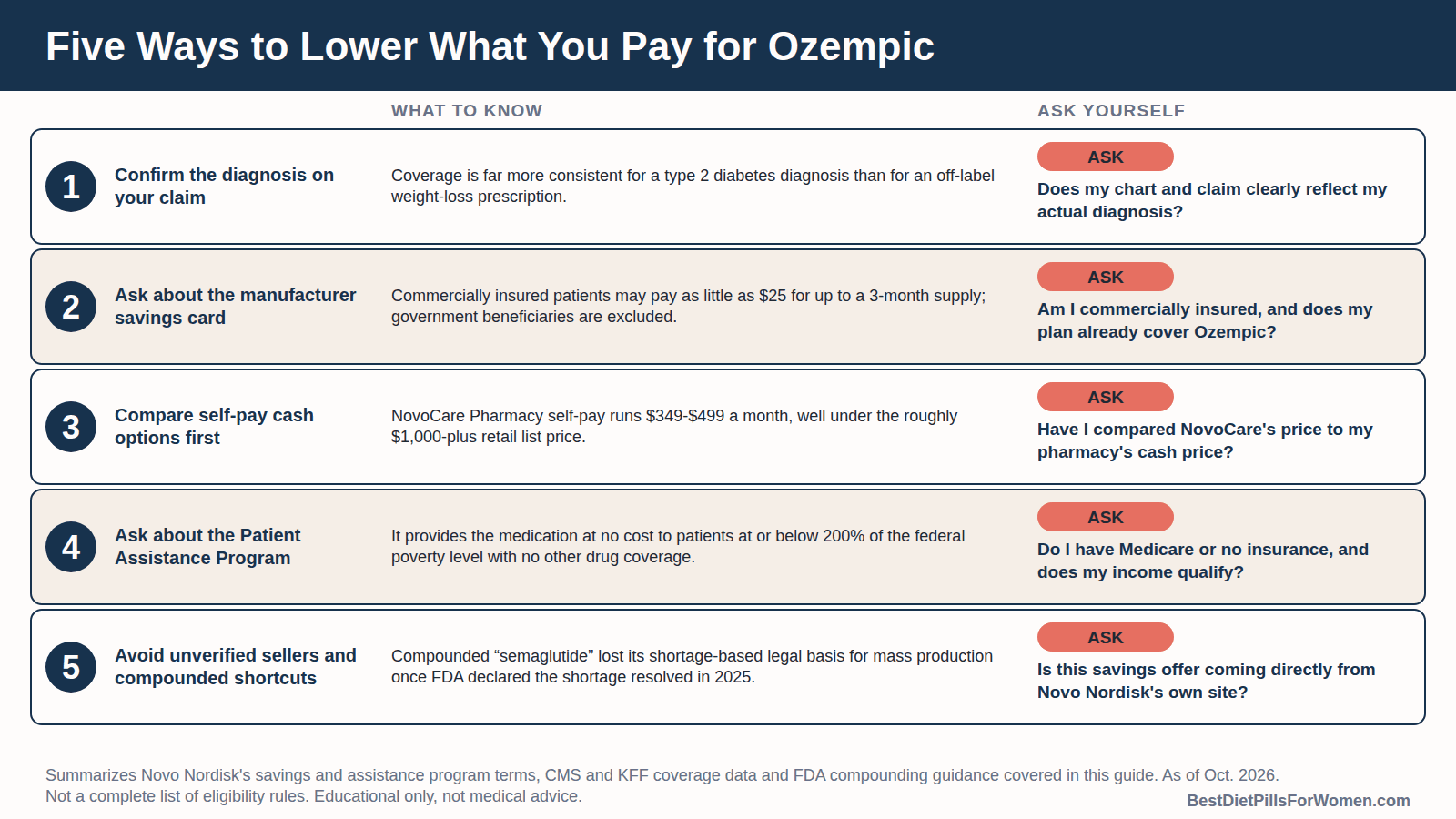
To use Ozempic’s manufacturer savings card, you need commercial (private, non-government) insurance that already covers Ozempic; the card itself states that “government beneficiaries” are excluded. In practice, that rules out Medicare, Medicaid, TRICARE and similar federal or state programs entirely, no matter how low your income or how much you’d benefit from the discount otherwise. Novo Nordisk’s own materials describe eligible patients paying as little as $25 for any dose of the Ozempic pen for up to a 3-month prescription, with other program language describing the benefit as up to $100 off each month for as long as 48 months.
What It Doesn’t Cover
The card doesn’t help if you’re uninsured, if your insurer doesn’t cover Ozempic at all for your diagnosis, or if you’re on Medicare or Medicaid. It also isn’t a substitute for actual insurance coverage approval: if your plan denies the claim outright (a common outcome for off-label weight-loss prescriptions), the savings card has nothing to discount, since it reduces a covered copay rather than paying for an uncovered drug. Novo Nordisk “reserves the right to modify or cancel this program at any time,” so treat the exact discount amount as something to reconfirm at the pharmacy rather than a fixed promise.
Using the card is usually simple on the pharmacy side: your prescriber or pharmacist enters the savings-card group and ID numbers (available on ozempic.com) alongside your regular insurance information, and the discount applies automatically at checkout. The card doesn’t require a separate mailed application the way the Patient Assistance Program does, which is one reason it’s worth asking about before you assume you can’t afford a covered prescription.
Cash-Pay and Patient Assistance Options
For people without useful insurance coverage, two very different paths exist: pay Novo Nordisk’s own discounted cash price, or qualify for free medication through its assistance program.
Self-Pay Pricing Through NovoCare Pharmacy
Novo Nordisk’s own direct pharmacy channel, NovoCare Pharmacy, offers new self-pay patients an introductory rate of $199 a month for the first two months, after which existing self-pay patients pay $349 a month for the 0.25-1 mg doses or $499 a month for the 2 mg dose. This bypasses insurance entirely and bypasses a retail pharmacy’s full cash price, which independent price guides put closer to $1,000 to $1,050 a month. It’s a meaningfully cheaper path for the uninsured, but it’s still a real, recurring expense most households have to plan around.
Patient Assistance for the Uninsured
Novo Nordisk’s Patient Assistance Program (PAP) provides Ozempic at no cost to patients who have Medicare or no insurance at all, aren’t enrolled in Medicaid or similar programs, and whose total household income is at or below 200% of the federal poverty level. Commercially insured patients and most Medicaid enrollees don’t qualify, since the program exists specifically to fill the gap for people with no other coverage option. Approved patients typically apply with help from their prescriber’s office, since the program requires a prescription and some income documentation, and medication ships directly to the patient rather than through a standard retail pharmacy fill. One detail worth flagging for Medicare beneficiaries: Novo Nordisk’s own program materials note that most Medicare prescription drug plans already cover Ozempic, so enrolling in Part D coverage can end PAP eligibility going forward, even if the plan’s own copay ends up higher than $0. Table 3 lays out how the major cost-reduction paths compare side by side.
| Option | Who qualifies | Approximate monthly cost | Main limitation |
|---|---|---|---|
| Manufacturer savings card | Commercially insured patients whose plan covers Ozempic | As little as $25, per stated card terms | Excludes all government beneficiaries; doesn’t help if your plan denies the claim |
| NovoCare Pharmacy self-pay | Anyone willing to pay cash, insured or not | $199 (intro, first 2 months), then $349-$499 | Still a meaningful recurring cost; no insurance billing involved |
| Patient Assistance Program | Uninsured, or Medicare with no other drug coverage, at or below 200% of the federal poverty level | $0 | Commercially insured and most Medicaid patients don’t qualify |
| Medicaid (diabetes diagnosis) | Medicaid enrollees with type 2 diabetes | Usually low or no copay | Coverage for weight-loss-only use is state-optional and far less common |
| Medicare Part D (diabetes diagnosis) | Medicare beneficiaries with type 2 diabetes | Varies by plan, capped by the annual OOP maximum | Off-label weight-loss use has a much weaker coverage path |
Table 3 method: figures are the stated terms from Novo Nordisk’s savings and patient-assistance pages, a KFF Medicaid issue brief and CMS Part D program documents, read in October 2026. Eligibility rules are summarized; read each program’s full terms before assuming you qualify.
Stacking Discounts, HSA Funds and Mid-Year Changes
A few practical questions come up once you’re actually trying to use these programs together, rather than just reading about them.
Can You Combine the Savings Card With an HSA or FSA?
Yes, generally. A health savings account (HSA) or flexible spending account (FSA) can typically be used to pay the reduced, after-discount amount a pharmacy charges once the manufacturer savings card is applied, since the card lowers your out-of-pocket cost rather than changing whether the expense qualifies as a medical expense. It’s worth confirming with your HSA or FSA administrator if you’re unsure, since rules occasionally vary by plan administrator.
What Happens If You Switch Insurance Mid-Year?
Switching jobs, losing coverage or moving to a new plan mid-year can interrupt an approved prior authorization, since the new insurer typically has to review the request fresh rather than honoring the old plan’s approval. If you know a coverage change is coming, ask your prescriber’s office to start the new prior-authorization paperwork early, and ask whether a short bridge supply through the NovoCare Pharmacy self-pay option or a manufacturer sample makes sense to avoid a treatment gap while the new request is processed.
Why Using Ozempic for Weight Loss Changes the Cost Math
Everything in the last two sections points to the same conclusion: the diagnosis on your claim, not the pharmacy you use, is usually the biggest single factor in what you’ll actually pay.
The Off-Label Cost Trap
It’s worth walking through exactly how an off-label weight-loss prescription turns into an unexpected bill, because the mechanics are more mundane than they sound.
What Happens When a Claim Is Coded for Weight Loss
When a pharmacy submits an insurance claim, it includes a diagnosis code tied to the prescription. A claim coded for type 2 diabetes generally matches what most commercial, Medicare and Medicaid formularies already recognize as a covered use for Ozempic. A claim coded for obesity or weight management, without a diabetes diagnosis behind it, runs into the narrower slice of coverage this guide has already quantified: roughly a third of surveyed employers cover it, a minority of state Medicaid programs cover it, and Medicare’s path for a drug without a weight-related indication is essentially closed. Same drug, same pharmacy, a different diagnosis code, and a very different bill.
This isn’t a loophole to exploit by coding around the system. Insurers routinely audit prior authorizations against chart notes and lab results, and a diagnosis that doesn’t match the clinical picture can trigger a clawback, a fraud referral, or a dropped prescriber relationship with that insurer. The honest version of this section is simpler: if your actual clinical picture includes type 2 diabetes or prediabetes, make sure your chart reflects that; if it doesn’t, expect to navigate the weight-loss-specific coverage path, with its narrower approval odds, rather than trying to shortcut it.
Why a Prescriber’s Documentation Matters
A prior-authorization reviewer is reading a chart, not making assumptions, so what your prescriber documents (diagnosis, relevant labs, prior treatments tried) determines whether a claim gets approved on the first pass or denied and appealed. If you genuinely have type 2 diabetes or prediabetes alongside a weight concern, make sure that diagnosis is clearly reflected in your chart and on the claim, since it’s the detail most likely to open a cleaner coverage path than a weight-loss-only prescription would.
Red Flags Worth Watching For
Price pressure pushes some people toward sources that look like a bargain and turn out to be a safety and legal problem instead.
Compounded “Semaglutide” and Gray-Market Sellers
During the national semaglutide shortage, compounding pharmacies were temporarily allowed to produce versions of the drug under specific FDA rules. FDA removed semaglutide from its drug shortage list in February 2025, and the temporary compounding allowances built around that shortage have since been wound down, meaning mass-produced compounded “semaglutide” products are on much shakier legal and quality footing than they were during the shortage years. A compounded product also hasn’t gone through the FDA review process that Ozempic’s own approved formulation has, so its purity, dosing accuracy and sterility aren’t backed by the same evidence. Our guide to compounded semaglutide safety risks covers this gap in more depth.
Coupons, Resellers, and Other Warning Signs
A “coupon” or online seller offering Ozempic far below even the self-pay cash price, a site that doesn’t require a prescription, pressure to pay by wire transfer or gift card, or packaging that doesn’t match what Novo Nordisk’s own product pages show are all signs worth stopping over. The only savings programs with verifiable, current terms are the ones run directly by Novo Nordisk through its own ozempic.com and novocare.com pages, and even those are worth re-checking at the pharmacy counter, since the company explicitly reserves the right to change them.
A legitimate online pharmacy in the United States should be licensed in your state and should ask for a valid prescription before dispensing a prescription drug; a pharmacy accreditation seal (such as the National Association of Boards of Pharmacy’s verification programs) is one quick way to sanity-check a site you haven’t used before. None of that guarantees a specific seller is trustworthy, but the absence of basic licensing and prescription requirements is a reliable sign to walk away.
Safety Considerations That Affect the Real Cost of Treatment
Cost isn’t only the sticker price. Side effects, monitoring and the rare serious risk all carry a cost of their own, in time, co-pays for extra visits, and sometimes a switched or stopped medication. A cheap prescription that causes a problem requiring an ER visit or a specialist referral isn’t actually the cheap option once that bill arrives, so this section belongs in a cost guide as much as a clinical one.
Common Side Effects and What They Can Cost
The most common Ozempic side effects are gastrointestinal, and dose titration exists partly to manage them.
GI Side Effects and Dose Titration
In Ozempic’s clinical trials, nausea affected about 16-20% of patients (depending on dose), compared with about 6% on placebo; vomiting, diarrhea, abdominal pain and constipation were also reported more often than with placebo, generally in the mid-single-digit-to-low-double-digit percentage range. These effects tend to be worse during the first weeks at a new dose, which is exactly why prescribers start at a low dose and increase it gradually: the label describes starting at 0.25 mg, a dose meant to help the body adjust rather than to treat diabetes on its own, before stepping up to 0.5 mg, 1 mg and, for some patients, 2 mg over a period of weeks. If side effects are significant enough to need an extra clinic visit, a change in dose, or an anti-nausea medication, that adds a real, if often smaller, cost on top of the drug itself. It’s also a practical reason the first month or two on Ozempic can feel more expensive in time and hassle than later months, even before the price of the pen itself is factored in.
When a Side Effect Means a Clinic Visit
Mild nausea or loose stools in the first few weeks are common enough that many prescribers manage them by phone or through a dose adjustment at the next visit. Severe, persistent vomiting, signs of dehydration, or pain that doesn’t fit the usual pattern are reasons to contact your prescriber’s office rather than wait it out, since they can also signal a less common but more serious problem covered next.
Serious Risks, Interactions, and Who Should Be Cautious
A short list of risks is serious enough that they shape who should avoid Ozempic altogether, independent of what it costs.
The Boxed Warning and Who Should Avoid Ozempic
Ozempic’s label carries a boxed warning: in rodent studies, semaglutide caused thyroid C-cell tumors, and whether it causes the human cancer medullary thyroid carcinoma (MTC) is unknown. The drug is contraindicated in anyone with a personal or family history of MTC or with Multiple Endocrine Neoplasia syndrome type 2 (MEN 2), and in anyone with a serious hypersensitivity reaction to semaglutide or its other ingredients. The label also notes a higher rate of diabetic retinopathy complications in people who already had retinopathy (about 3.0% versus 1.8% on placebo in trials) and a higher rate of gallbladder disease (cholelithiasis) than placebo. Acute pancreatitis has also been reported with this drug class, and Ozempic should be discontinued if it’s suspected.
Pregnancy, Other Medications, and Monitoring Costs
Ozempic’s label states it should be used during pregnancy only if the potential benefit justifies the potential risk to the fetus, which in practice means this is a conversation to have with a clinician well before conception, not something to decide alone. If you take insulin or a sulfonylurea alongside Ozempic, your prescriber may need to adjust those doses to avoid low blood sugar, which can mean more frequent monitoring, more test strips, and more visits, each with its own cost. The label also notes that semaglutide delays gastric emptying, which can affect how well other oral medications are absorbed, even though the clinical trials behind the label didn’t find a clinically meaningful interaction with the specific oral drugs that were tested. None of this is a reason to self-diagnose or self-adjust; it’s a reason to tell every prescriber and pharmacist about every medication you’re taking, every time, including over-the-counter drugs and supplements.
Signs That Need Immediate Medical Attention
Severe, persistent abdominal pain that may radiate to the back, especially with vomiting, can signal pancreatitis and warrants prompt medical evaluation rather than a wait-and-see approach. A neck lump, hoarseness, trouble swallowing or shortness of breath are the symptoms FDA’s labeling associates with the thyroid-tumor boxed warning, and sudden vision changes in anyone with existing diabetic eye disease deserve a prompt call to an eye doctor or prescriber as well. None of this is a complete list of every possible reaction, and it isn’t a substitute for your prescriber’s own guidance about your specific health history. Our full breakdown of Ozempic’s side effects goes into each of these in more detail.
How Ozempic’s Cost Compares to the Alternatives
Ozempic isn’t the only option, whether you’re treating diabetes or weighing a weight-loss medication, and the alternatives sit at very different price points. Our broader overview of GLP-1 medications for weight loss covers this full category in more depth than a single cost guide can.
Other Semaglutide and GLP-1 Options
The semaglutide family alone has three different products at three different price structures, and tirzepatide adds a fourth option entirely.
Wegovy, Rybelsus, and Compounded Semaglutide
Wegovy, the FDA-approved weight-management version of semaglutide, has its own direct-to-consumer cash price of $499 a month through Novo Nordisk’s self-pay channel, matching Ozempic’s own top-dose self-pay price. Rybelsus, an oral semaglutide tablet approved for type 2 diabetes (not weight loss), runs considerably higher at retail: an independent price guide listed a 30-tablet, starting-dose supply at roughly $1,240 without a discount, or about $1,010 to $1,012 with a common pharmacy discount card. Compounded “semaglutide” from a compounding pharmacy may look cheaper on paper, but it isn’t FDA-approved, wasn’t legally justified for mass production once the national shortage ended in February 2025, and carries quality and dosing-accuracy risks that a brand-name, FDA-approved product doesn’t.
Tirzepatide (Mounjaro and Zepbound)
Tirzepatide is a different GLP-1/GIP combination medicine from a different manufacturer (Eli Lilly), sold as Mounjaro for type 2 diabetes and Zepbound for weight management. Eli Lilly’s own direct self-pay vial program lists starting prices from $299 a month at the lowest dose up to roughly $449 a month at higher Zepbound doses, with a loyalty program’s on-time-refill requirement affecting which price tier applies, and higher list prices for anyone who doesn’t use that direct channel. Our separate Zepbound cost guide covers that program’s full tier structure. Comparing milligram doses across Ozempic, Wegovy and Zepbound isn’t meaningful on its own, since the three products use different molecules and different dosing scales; the useful comparison is each product’s own price tier and its own approved use, not a side-by-side of the numbers printed on the pen. Table 4 lines these options up directly.
| Option | FDA-approved for weight loss? | Typical self-pay cash price (per month) | Insurance pattern |
|---|---|---|---|
| Ozempic (semaglutide) | No (approved for type 2 diabetes) | $349-$499 (NovoCare self-pay) | Covered for diabetes far more consistently than for off-label weight loss |
| Wegovy (semaglutide) | Yes | $499 (NovoCare self-pay) | Covered by about a third of surveyed employer plans; Medicaid coverage limited to about a quarter of states |
| Rybelsus (oral semaglutide) | No (approved for type 2 diabetes) | About $1,010-$1,240 (retail, with or without a discount card) | Follows the same diabetes-focused coverage pattern as Ozempic |
| Zepbound (tirzepatide) | Yes | $299-$449 (Lilly self-pay vials, dose-dependent) | Coverage patterns resemble Wegovy’s; check your plan’s specific tirzepatide policy |
| Compounded “semaglutide” | No (not an FDA-approved product) | Often lower, but highly variable | Not insurance-reimbursable as a covered drug; quality and legal standing are uncertain since the 2025 shortage ended |
Table 4 method: self-pay figures are each manufacturer’s current stated direct-to-consumer cash price or an independent pharmacy price-guide figure, read in October 2026. Coverage descriptions summarize patterns discussed elsewhere in this guide and aren’t a guarantee for any individual plan.
Non-GLP-1 Alternatives
GLP-1 drugs aren’t the only medically supported path, and for some women, an older or less expensive option is the more realistic fit.
Older Prescription Options
Older FDA-approved weight-management drugs, such as phentermine-topiramate or naltrexone-bupropion, generally produce smaller average weight-loss results than semaglutide or tirzepatide in population comparisons, but they’re also older, generic in some cases, and tend to cost dramatically less in cash terms, with a much longer real-world track record behind them. Orlistat, available both by prescription and over the counter at a lower dose, is another lower-cost, lower-effect option some clinicians discuss as a starting point, particularly for someone who wants to avoid an injectable medication altogether. None of these is a drop-in replacement for Ozempic’s specific effects on blood sugar or appetite; the right choice depends on your diagnosis, your health history, your goals and a clinician’s assessment, not on price comparison alone. A lower-cost pill that doesn’t address your actual clinical picture isn’t a bargain, whatever it costs per month.
When a Clinician Conversation Beats Price-Shopping Alone
Comparing sticker prices is useful, but it skips the parts that actually matter clinically: whether a drug fits your diagnosis, your other medications and your risk factors. A cheaper option that isn’t appropriate for your situation isn’t actually cheaper once you account for a treatment that doesn’t work or causes a problem. Bring your full cost picture, including what you can realistically sustain long-term, into the same conversation where you’re discussing which medication makes sense, rather than treating the two decisions separately.
Where Lifestyle and Behavioral Support Fit In
Medication isn’t the only lever, and for some women it isn’t the first one worth pulling, especially given what any of these drugs cost over a year or more.
Nutrition Counseling and Structured Programs
A registered dietitian, a structured behavioral weight-management program, or a diabetes self-management education program can cost far less than a year of any GLP-1 medication, and many are at least partly covered by commercial insurance, Medicare or Medicaid as a standalone, non-drug benefit. These approaches won’t produce the same average results that clinical trials report for semaglutide or tirzepatide, but they’re not nothing, and for some women they’re a reasonable first or parallel step rather than an afterthought.
Combining Medication With Lower-Cost Support
None of this is an either-or choice in practice. Pairing a GLP-1 medication with nutrition counseling, a structured activity plan or a behavioral program is consistent with how these drugs were actually studied, since most major trials paired the medication with diet and exercise counseling rather than testing the drug alone. If cost is forcing a choice between the medication and the support services, that’s worth raising directly with your care team, since some programs offer sliding-scale fees or are bundled into a comprehensive weight-management benefit your plan may already include.
Practical Steps to Lower What You Actually Pay
Cost isn’t fixed once a prescription is written. A handful of concrete steps, mostly done before you ever reach the pharmacy counter, can meaningfully change your bill.
Before You Fill the Prescription
The most effective cost-saving moves happen before the pharmacy ever runs your insurance.
Questions to Ask Your Insurer
Before you fill a new Ozempic prescription, call your plan (or check its member portal) and ask: is Ozempic on my formulary, and at what tier; does my plan require prior authorization, and if so, what documentation does it need; does my plan cover this drug for the diagnosis on my prescription; and what’s my specific copay or coinsurance once prior authorization is approved. Write down who you spoke with and the date, since benefits representatives occasionally give inconsistent answers, and having a record helps if you need to appeal later. Getting clear answers to these four questions before the first fill avoids most of the surprise denials and sticker-shock bills described earlier in this guide.
Questions to Ask Your Prescriber’s Office
Ask whether your chart documents a diagnosis that matches a covered use, whether the office has experience submitting prior authorizations for this drug and insurer, and what the plan is if the first request is denied (many plans allow an appeal with additional documentation). A prescriber’s office that routinely handles GLP-1 prior authorizations often knows your specific insurer’s quirks better than a general pharmacy benefits line does.
At the Pharmacy and Beyond
A few habits at the pharmacy counter and in the months after your first fill can keep costs from creeping up.
Pharmacy Shopping and 90-Day Fills
Cash prices for the same drug can vary meaningfully between pharmacies in the same city, so if you’re paying out of pocket, it’s worth calling two or three options, including the NovoCare Pharmacy self-pay channel described earlier, before settling on one. If your plan allows a 90-day fill instead of a 30-day fill, that can sometimes reduce your total copays across a year, though it depends entirely on your specific plan’s cost-sharing structure.
What to Re-Check Every Few Months
Insurance formularies, prior-authorization criteria, manufacturer savings-card terms and even FDA-approved indications can all change during a single year of treatment. Build a habit of re-confirming your coverage at renewal time, whenever your plan sends a formulary update notice, and whenever Novo Nordisk updates its savings program terms, rather than assuming this year’s price will automatically hold next year.
The Risk of Buying From Outside the U.S.
Importing prescription semaglutide from an overseas pharmacy or an unverified international seller to save money skips FDA’s oversight of that specific product’s manufacturing and labeling, and it can also run into customs and legal complications depending on quantity and sourcing. The savings can look significant on a spreadsheet, but so can the downside if the product turns out to be mishandled, mislabeled or not what it claims to be. The cost-lowering options detailed earlier in this guide, the savings card, NovoCare Pharmacy self-pay pricing and the Patient Assistance Program, all come with a verifiable manufacturer standing behind them; an unfamiliar importer doesn’t.
Frequently Asked Questions About Ozempic Cost
These are the questions that tend to come up after the main cost breakdown, once a reader is thinking through their own specific situation rather than the general rules covered above. Some repeat ground this guide has already covered in more depth, but they’re worth a short, standalone answer since they’re often exactly what someone searches for first.
Price and Coverage
A few pricing questions come up often enough to answer directly, even though most are covered in more depth earlier in this guide.
Is Ozempic Cheaper Than Wegovy?
At the self-pay cash price through Novo Nordisk’s own channel, Ozempic’s top dose and Wegovy cost about the same, $499 a month, though Ozempic’s lower doses run cheaper at $349 a month. Insurance coverage, not the sticker price, is usually the bigger factor: Wegovy is FDA-approved for weight loss and has a clearer (if still inconsistent) coverage path for that use, while an off-label Ozempic weight-loss prescription often has a weaker one.
Will My Insurance Cover Ozempic If I Don’t Have Diabetes?
It’s possible but far less reliable than coverage for a diabetes diagnosis; about a third of surveyed employers cover GLP-1 drugs for weight loss, and most state Medicaid programs and Medicare don’t, absent a qualifying diagnosis. Call your specific plan before assuming either way, since policies vary enough that a general statistic won’t tell you your own answer.
Does the Savings Card Work With Medicare?
No. Novo Nordisk’s Ozempic savings card explicitly excludes government beneficiaries, which includes Medicare, Medicaid and similar programs. Medicare enrollees who need financial help should look instead at their Part D plan’s own cost-sharing rules, the Patient Assistance Program if they have no other drug coverage and meet the income threshold, or their plan’s formulary exceptions process.
Safety and Practical Use
A couple of safety-adjacent cost questions deserve a direct answer too, since the cheapest option on paper isn’t always the safest one.
Is It Safe to Use a Compounded Version to Save Money?
We found no FDA approval behind mass-produced compounded “semaglutide” products, and the temporary rules that allowed compounding during the national shortage largely ended once FDA declared the shortage resolved in February 2025. A lower price doesn’t offset the uncertainty around a compounded product’s purity, exact dose or sterility. This is a decision to make with a prescriber who understands both the cost pressure and the trade-offs, not a decision to make from a price comparison alone.
Can I Switch to a Cheaper Alternative Without Talking to My Prescriber?
No, and this isn’t just a legal formality. Switching between semaglutide, tirzepatide, an older medication or stopping treatment altogether can change your blood sugar control, your side-effect pattern and, for anyone on insulin or a sulfonylurea, your risk of a dangerous blood sugar drop. Any medication change, including one made purely to save money, belongs in a conversation with the prescriber managing your treatment.
What Should I Do If My Coverage Is Denied?
Most plans have a formal appeals process, and a denial for an off-label weight-loss prescription is often appealable with additional documentation, such as a clearer diagnosis, lab values or notes on prior treatments tried. Ask your prescriber’s office whether they’ll submit an appeal, ask your insurer for the specific reason behind the denial in writing, and compare the self-pay and patient-assistance options covered earlier in this guide while the appeal is pending, so a denial doesn’t mean an immediate gap in treatment.
How Much Does Ozempic Cost Per Year?
Annualized, NovoCare’s self-pay cash price works out to about $4,188 a year at the 0.25-1 mg doses or $5,988 a year at the 2 mg dose; a commercially insured patient using the savings card could pay far less, while a retail cash price with no discount at all could top $12,000 a year. That enormous range is exactly why this guide treats “what does Ozempic cost” as a question with several different honest answers rather than one number.
Can Ozempic’s Price Change During My Plan Year?
Yes, in more than one way. Your insurer’s formulary tier or prior-authorization rules can change at renewal, Novo Nordisk can modify or end its savings-card terms at any time, and even your own dose can change as your prescriber titrates you upward, which shifts which self-pay price tier applies. Treat the price you’re quoted today as current for today, and re-confirm it at your next refill rather than assuming it’s locked in for the year.
The Bottom Line on Ozempic Cost
Pulling every section above together, here’s what actually matters once you’re deciding what to do next.
What the Total Evidence Means for Your Wallet
The honest summary and the realistic trade-offs, side by side.
The Biggest Realistic Advantage
If your prescription matches Ozempic’s FDA-approved use, type 2 diabetes, you have the most coverage options and the clearest path to a manageable bill: commercial insurance covers it more often than not, Medicare and Medicaid both generally cover it for that diagnosis, and the manufacturer’s savings card can bring a commercially insured copay down to as little as $25. Even without any coverage at all, Novo Nordisk’s own self-pay channel keeps the price well under the roughly $1,000-plus list price.
The Biggest Limitation and Safety Concern
The biggest limitation is the gap between how Ozempic is actually prescribed and what it’s actually approved for. A substantial share of real-world Ozempic prescriptions are written off-label for weight loss, and that single fact is what drives denials, unpredictable bills and a push toward riskier shortcuts like unverified compounded products. On the medical side, the boxed warning around thyroid C-cell tumors, the contraindication in anyone with a personal or family MTC or MEN 2 history, and the common GI side effects are real considerations independent of cost, and they deserve the same weight in your decision that the price tag does. A guide like this one can map the price ranges and the coverage patterns, but it can’t tell you which category your own prescription falls into, and it shouldn’t try to.
A Rational Next Step
Two concrete things to do before you spend another dollar on this decision. Neither requires waiting for a perfect answer; both are things you can start this week.
Questions for Your Care Team
Ask your prescriber whether your diagnosis and chart documentation support the use you’re seeking coverage for, ask your insurer exactly what your plan requires for prior authorization and what your copay would be if approved, and ask about Wegovy specifically if weight loss, not diabetes, is your actual goal, since it carries the FDA approval and coverage pathway built for that purpose.
What to Re-Check Before You Spend Money
Before committing to any payment path in this guide, re-verify the current price directly on Novo Nordisk’s own pages, confirm your plan’s current formulary status and prior-authorization rules for this plan year, and confirm whether any coupon, discount card or online seller you’re considering is one of Novo Nordisk’s own programs or an unverified third party. Prices, coverage rules and even FDA-approved uses shift over time, and the numbers in this guide are a snapshot from October 2026, not a permanent quote.
Related Reading
Sources
These are the main sources behind this guide, chosen because they are the ones to check first for current facts. Prices, coverage rules and program terms change, so confirm the latest version before you make decisions.
- U.S. Food and Drug Administration. Highlights of Prescribing Information: OZEMPIC (semaglutide) injection, for subcutaneous use (label, NDA 209-637, supplement 025, 2025). https://www.accessdata.fda.gov/drugsatfda_docs/label/2025/209637s025lbl.pdf
- U.S. Food and Drug Administration. Highlights of Prescribing Information: WEGOVY (semaglutide) injection, for subcutaneous use (label, NDA 215-256, supplement 026, 2025). https://www.accessdata.fda.gov/drugsatfda_docs/label/2025/215256s026lbl.pdf
- Novo Nordisk. Ozempic Supply Information: Save on Ozempic (savings card terms and self-pay pricing, Ozempic.com, read October 2026). https://www.ozempic.com/savings-and-resources/save-on-ozempic.html
- Novo Nordisk. Novo Nordisk announces significant reduction in US list price for Wegovy, Ozempic and Rybelsus, building on continued efforts to expand access (press release, 2026). https://www.novonordisk.com/news-and-media/news-and-ir-materials/news-details.html?id=916504
- National Community Pharmacists Association, summarizing CMS. CMS Announces Maximum Fair Prices for 15 Drugs to Be Added to the Medicare Drug Price Negotiation Program in 2027 (December 2, 2025). https://ncpa.org/newsroom/qam/2025/12/02/cms-announces-mfps-15-drugs-be-added-medicare-drug-price-negotiation
- Centers for Medicare & Medicaid Services. Final CY 2026 Part D Redesign Program Instructions (fact sheet). https://www.cms.gov/newsroom/fact-sheets/final-cy-2026-part-d-redesign-program-instructions
- KFF. Medicaid Coverage of and Spending on GLP-1s (issue brief, January 16, 2026). https://www.kff.org/medicaid/issue-brief/medicaid-coverage-of-and-spending-on-glp-1s/
- Becker’s Payer Issues, reporting survey findings from the International Foundation of Employee Benefit Plans (fielded June 2-12, 2026). Employer Coverage of GLP-1s for Diabetes, Weight Loss Remains Steady at 36%. https://www.beckerspayer.com/research-analysis/employer-coverage-of-glp-1s-for-diabetes-weight-loss-remains-steady-at-36-survey/
- Novo Nordisk. Patient Assistance Program, 2026 Eligibility (NovoCare.com, read October 2026). https://www.novocare.com/diabetes/help-with-costs/pap/2026-eligibility.html
- Drugs.com. Ozempic Prices, Coupons and Patient Assistance Programs (price guide, read October 2026). https://www.drugs.com/price-guide/ozempic

