
The Wegovy pill is a real, FDA-approved tablet, not a rumor or a mix-up with another drug: regulators cleared a once-daily 25 mg oral semaglutide tablet under the Wegovy name in December 2025, and it’s meant to treat the same thing the Wegovy injection treats. In the tablet’s own pivotal trial, it produced weight loss in roughly the same range as the injection’s pivotal trial, though the two were never tested against each other head-to-head, used somewhat different populations, and the tablet comes with a strict empty-stomach routine the injection doesn’t require.
That’s the short version, and it’s more reassuring than a lot of what shows up in search results on this topic. For years, “Wegovy pill” searches mostly led confused readers to Rybelsus, a different oral semaglutide product approved only for type 2 diabetes, or to vague speculation about a pill that didn’t exist yet. The real oral Wegovy tablet changes that, but it also raises a more useful question than “does it exist”: is it actually a fair substitute for the injection, or a different trade-off dressed up in the same brand name?
This guide compares the two FDA-approved Wegovy formulations on the dimensions that matter for an actual decision: what each one’s own trial found, how administration and daily routine differ, how their safety profiles compare, and what each one costs. Readers who haven’t yet settled on semaglutide at all may want to start with our broader guide to weight-loss medications and diet pills for women, which covers the wider landscape, including the difference between prescription and over-the-counter weight-loss options, before narrowing in on this specific comparison. It’s built from current FDA prescribing information, the trial data behind each formulation, and manufacturer pricing pages, not from a hands-on test of either product. Nothing here is personalized medical advice, and nothing in this guide is a reason to start, stop or switch a prescription medicine without a clinician who knows your health history.
Wegovy Pill vs. Wegovy Injection: The Short Answer
Start with the conclusions, then check them against the sections that back each one up.
The Direct Answer and How Sure We Are
Two separate questions are worth answering up front: what the evidence shows, and how confident we are in it.
What’s the Real Difference Between the Wegovy Pill and the Wegovy Injection?
Both are semaglutide, both carry the Wegovy brand name, and both are FDA-approved for the same weight-management and cardiovascular-risk-reduction indications; the real differences are in the route, the daily routine, and how each one’s own trial was designed. The tablet is taken once daily on an empty stomach with a strict 30-minute food-and-drink wait; the injection is given once weekly, at any time, with no food restrictions. Each formulation’s own pivotal trial found broadly similar average weight loss, though the two have never been compared head-to-head.
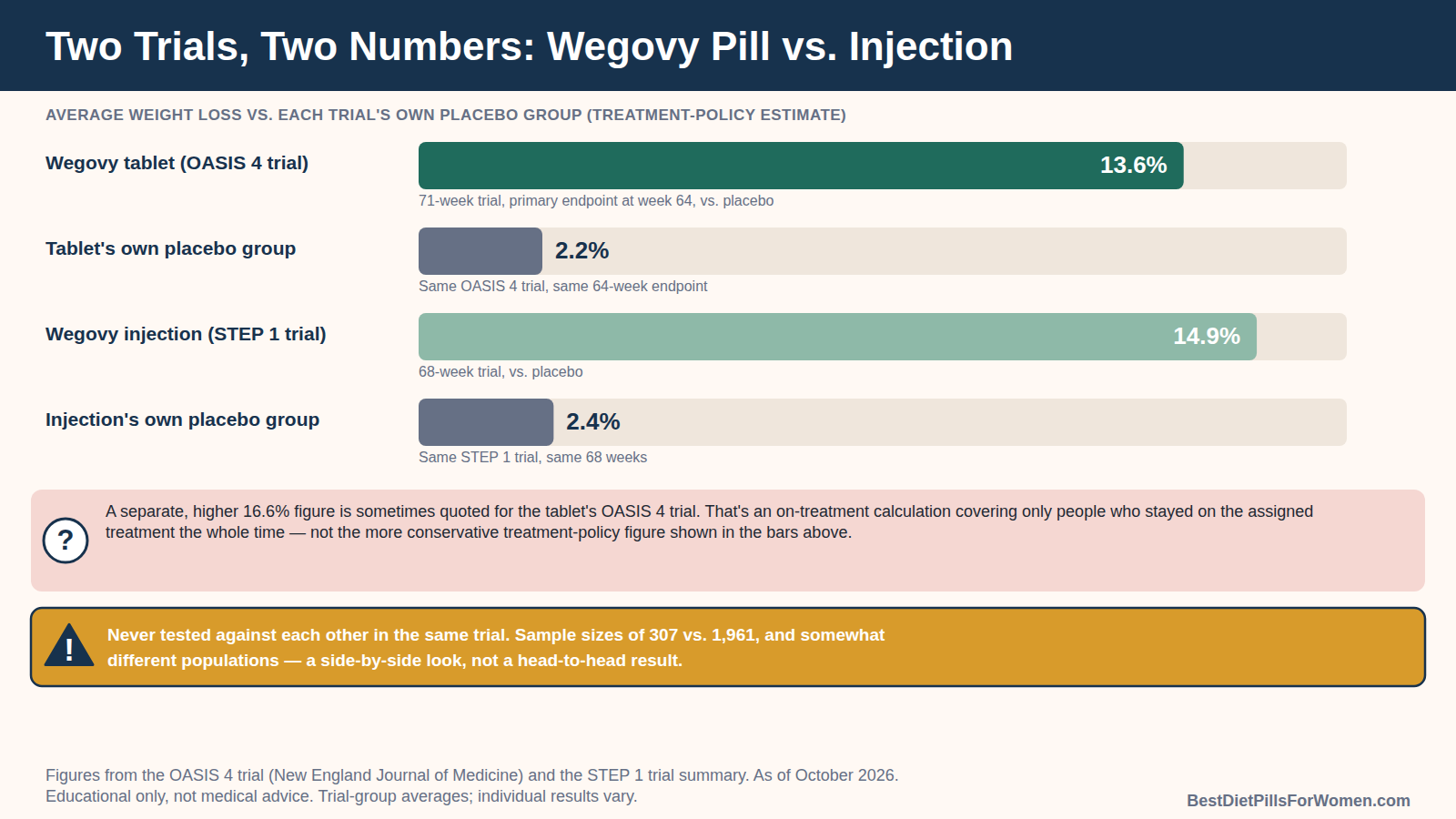
In its own 71-week trial, the tablet produced an average 13.6% body-weight loss against 2.2% on placebo; in the injection’s 68-week pivotal trial, the result was 14.9% against 2.4% on placebo. Those numbers look close, and they probably are in practical terms, but they come from two different trials in two different groups of people, not one study that compared the Wegovy pill against the Wegovy injection head-to-head. Neither formulation is a stand-in for an ongoing relationship with a prescriber who can adjust the plan, and switching between them isn’t as simple as swapping a pill for a pen, a point covered in detail later in this guide.
How Sure We Are About That Answer
We’re highly confident that the oral Wegovy tablet is a genuine, FDA-approved, separately studied product rather than a repackaged version of Rybelsus, because the approval, the dose, and the trial program are all distinct and independently documented. We’re reasonably confident the two formulations produce broadly similar average weight loss, since both pivotal trials landed in a comparable range, but we’re less confident about exactly how similar, because no trial has randomized the same group of people to one formulation or the other and followed them under identical conditions. We’re also working with a shorter track record for the tablet specifically: it launched in U.S. pharmacies in early January 2026, which means real-world safety and adherence data are still accumulating, while the injection has been on the market since 2021.
Readers who found their way here through a cost question rather than an effectiveness question may get more direct value from our full breakdown of Wegovy pill cost, coverage and savings programs, which goes deeper into pricing and insurance than the cost section later in this guide.
Clearing Up the Wegovy Pill vs. Rybelsus (Now Ozempic) Confusion
Before the real Wegovy tablet existed, “Wegovy pill” was already a common search, and it’s worth explaining why.
Why So Many “Wegovy Pill” Searches Used to Lead Somewhere Else
For years, the only oral semaglutide product on the market was Rybelsus, approved in 2019 strictly for type 2 diabetes, not weight loss, and dosed differently from Wegovy. Because Rybelsus and Wegovy both contain semaglutide, a lot of people searching for “the Wegovy pill” landed on Rybelsus pages instead, sometimes bought it off-label hoping for Wegovy-like weight loss, and sometimes got talked out of it by a pharmacist explaining that the two drugs aren’t interchangeable. In early 2026, Novo Nordisk rebranded Rybelsus under the Ozempic name instead, aligning it with the injectable Ozempic brand the way the injectable and oral Wegovy products now share a name; the change was a brand update to an existing, already-approved drug, not a new molecule, and it’s still approved only for type 2 diabetes. That rebrand is itself a moving target worth double-checking directly before you rely on it, since the exact dose strengths reported for the renamed product varied across the sources we reviewed; see this guide’s editor notes for specifics.
What’s Actually on the Market Now, in Plain Terms
As of this writing, there are two genuinely different kinds of oral semaglutide on the U.S. market, and only one of them is a weight-loss drug. The Wegovy tablet (25 mg once daily, titrated up from 1.5 mg) is approved for chronic weight management and cardiovascular-risk reduction, the same jobs as the injection. The oral product now branded as Ozempic, formerly Rybelsus, is approved only to help manage blood sugar in type 2 diabetes; it isn’t reviewed or labeled for weight loss, even though some people lose weight on it as a side effect of better glucose control. If a “cheap Wegovy pill” offer online is actually a diabetes-only product sold off-label, that’s a mismatch worth catching before you pay for it, not a bargain. A different oral weight-loss pill, Foundayo (orforglipron), also exists and is covered briefly later in this guide; it isn’t semaglutide at all, and isn’t branded Wegovy.
The Numbers at a Glance
A single table can’t replace the detail later in this guide, but it’s a useful map of where that detail is headed.
The Quick-Comparison Table
| Dimension | Wegovy tablet (oral) | Wegovy injection (subcutaneous) |
|---|---|---|
| Active ingredient | Semaglutide, 25 mg once daily (maintenance) | Semaglutide, 2.4 mg once weekly (standard maintenance); a 7.2 mg “Wegovy HD” option also exists |
| FDA approval | December 22, 2025 | 2021 |
| FDA-approved for | Chronic weight management; cardiovascular-risk reduction in adults with established heart disease and obesity or overweight | Same two indications, plus noncirrhotic MASH with moderate-to-advanced liver fibrosis (injection only) |
| Administration | Once daily, on an empty stomach, with up to 4 oz of water, then a 30-minute wait before food or drink | Once weekly, by injection into the abdomen, thigh or upper arm, with no food-timing restrictions |
| Time to reach maintenance dose | About 90 days (1.5 mg, 4 mg, 9 mg, then 25 mg) | About 16 weeks (0.25, 0.5, 1, 1.7, then 2.4 mg) |
| Key trial behind the weight numbers in this guide | OASIS 4, 71 weeks, 307 adults without diabetes | STEP 1, 68 weeks, 1,961 adults without diabetes |
| Average body-weight loss in that trial | 13.6% vs. 2.2% on placebo (treatment-policy estimate) | 14.9% vs. 2.4% on placebo (treatment-policy estimate) |
| Reported GI adverse-event rate | 74.0% vs. 42.2% on placebo (composite GI adverse events, OASIS 4) | Nausea 44%, diarrhea 30%, vomiting 24%, constipation 24% (labeled rates, injection) |
| Typical self-pay price (checked October 2026) | Roughly $149 to $299 a month, depending on dose and current offers | $199 a month introductory (new patients, limited time), then $349 standard; $399 for the 7.2 mg HD option |
Table 1 method: figures are as reported in the FDA label, trial publications and manufacturer pricing pages, read as of October 2026. The two trial rows come from separate studies with different populations and slightly different durations, so this table is a side-by-side summary, not a head-to-head study result.
How to Read These Numbers Without Overinterpreting Them
The closeness of 13.6% and 14.9% is genuinely informative, but it doesn’t mean the two formulations are interchangeable or that any individual woman would get an identical result on either one. Trial averages describe groups, not individuals, and the GI side-effect figures in the table use different definitions (a composite “any GI adverse event” rate for the tablet’s trial versus specific, individually labeled symptoms for the injection), so they aren’t directly stackable against each other either. The rest of this guide unpacks each row in enough detail to use them responsibly rather than just quoting them.
What Each Wegovy Formulation Actually Is
Before comparing results, it helps to be clear about what each product actually is and what, specifically, FDA reviewed and approved.
Wegovy Injection: The Original, Longer-Tracked Formulation
The injection is the formulation most of Wegovy’s public reputation, and its longest track record, is built on.
What It’s Approved For
The Wegovy injection is FDA-approved, alongside a reduced-calorie diet and increased physical activity, to reduce excess body weight in adults with obesity, or overweight plus a weight-related condition, and separately to reduce the risk of major adverse cardiovascular events in adults with established cardiovascular disease and obesity or overweight. It also carries an approval for adolescents 12 and older with obesity, and, uniquely among the two formulations, an accelerated approval for noncirrhotic metabolism-associated steatohepatitis (MASH) with moderate-to-advanced liver fibrosis. No diabetes diagnosis is required to qualify for any of these; body weight, BMI and the relevant comorbidities are the basis for the prescription.
How It’s Dosed and Given
The injection is a once-weekly subcutaneous dose delivered with a prefilled pen into the abdomen, thigh or upper arm, and it can be taken at any time of day, with or without food. Dosing starts at 0.25 mg weekly and steps up roughly every four weeks, through 0.5 mg, 1 mg and 1.7 mg, to the 2.4 mg maintenance dose used in the pivotal trial discussed later in this guide, a process that takes about 16 weeks before someone reaches full maintenance dosing. A higher-dose option, marketed as Wegovy HD at 7.2 mg weekly, is also available for people whose response has plateaued at the standard maintenance dose.
Wegovy Tablet: The Newer Oral Option
The tablet had to solve a problem the injection never faced: getting a protein-based drug through the stomach intact.
The Absorption Technology That Makes a Protein Pill Possible
Semaglutide is a peptide, a type of molecule that stomach acid and digestive enzymes normally break down before it can reach the bloodstream, which is why most GLP-1 medicines have historically been injected. The Wegovy tablet uses an absorption-enhancing excipient, the same general approach used in Rybelsus/Ozempic’s oral tablet, to protect a portion of the dose as it moves through the stomach lining. Even so, only an estimated 1% to 2% of the swallowed dose actually reaches circulation, which is precisely why the empty-stomach-and-minimal-water instructions covered later in this guide aren’t a minor suggestion. It also explains why the tablet’s milligram doses look so much larger than the injection’s: 25 mg orally and 2.4 mg by injection are aiming for a comparable amount of active drug in the bloodstream, not a stronger dose.
Once it reaches circulation, the drug itself works the same way no matter which formulation delivered it. Semaglutide is a GLP-1 receptor agonist: it mimics a naturally occurring gut hormone and activates its receptors in the hypothalamus and brainstem, the brain regions most involved in regulating hunger and fullness, while also slowing how quickly food leaves the stomach. That combination, less hunger signaling plus a longer-lasting feeling of fullness after meals, is the mechanism behind the weight loss covered in the next section, and it’s also the same mechanism behind the gastrointestinal side effects covered later in this guide’s Safety section. A clear, biologically plausible mechanism like this one explains why a weight effect is reasonable to expect; it doesn’t, on its own, tell you how large that effect will be in real people, which is exactly why the trial evidence in the next section carries more weight than the mechanism alone.
What It’s Approved For, and Where the Label Still Differs from the Injection
The Wegovy tablet is FDA-approved for the same two core indications as the injection: chronic weight management alongside diet and activity, and cardiovascular-risk reduction in adults with established heart disease and obesity or overweight. As of this writing, the tablet’s approval doesn’t extend to the MASH indication the injection carries, and whether it has been studied or approved for adolescents the way the injection has is a detail this guide could not confirm with full confidence from the sources available; treat that specific point as needing a direct label check before it’s repeated to a reader. Breastfeeding guidance also differs slightly: the tablet’s label specifically advises against breastfeeding during treatment because of the absorption-enhancing ingredient’s metabolites appearing in breast milk, a consideration that doesn’t apply to the injection in the same way.
Does the Wegovy Pill Work as Well as the Wegovy Injection?
This is the question most readers actually came here for, and it deserves a careful answer rather than a single borrowed number.
What the Pill’s Own Trial (OASIS 4) Found
The tablet’s efficacy case rests mainly on one placebo-controlled trial published in a peer-reviewed journal.
Study Design, Population, and Duration
OASIS 4 randomized 307 adults without diabetes, with a BMI of 30 or higher, or 27 or higher plus a weight-related condition such as high blood pressure or sleep apnea, to either 25 mg oral semaglutide or placebo in a 2-to-1 ratio, across 22 sites in four countries. The trial ran 71 weeks overall, with its primary efficacy measurement taken at week 64, the point at which participants had been on (or assigned to) their randomized treatment for that full stretch. This was a double-blind, placebo-controlled design, the same basic structure used for the injection’s pivotal trials, which makes the comparison that follows more meaningful than it would be against an open-label or uncontrolled study.
Weight-Loss Results, and Why Two Different Numbers Get Quoted for the Same Trial
The estimated mean change in body weight from baseline to week 64 was −13.6% in the semaglutide group and −2.2% in the placebo group, a treatment difference of 11.4 percentage points. Significantly more people on semaglutide reached the 5%, 10%, 15% and 20% weight-loss thresholds than on placebo, though the exact percentage reaching each specific threshold wasn’t reported in the sources available for this guide. You may also see a different, higher figure, 16.6%, attributed to this same trial; that number reflects an “on-treatment” or “trial product” calculation, describing only people who actually stayed on the assigned treatment as planned, while the 13.6% figure is the more conservative “treatment policy” calculation that counts everyone as randomized, including anyone who stopped early. Neither number is wrong; they’re answering slightly different questions, and this guide leads with the more conservative one because it better reflects what a typical new patient, including anyone who doesn’t stay on treatment the whole time, might actually experience.
OASIS 4 also tracked outcomes beyond the scale. Participants on the oral tablet showed a significantly greater reduction in waist circumference, a meaningfully improved systolic blood pressure, and a significantly better score on a validated physical-function quality-of-life measure (the IWQOL-Lite-CT) compared with placebo. None of those secondary findings changes the headline weight-loss number, but they’re a useful reminder that a GLP-1 medicine’s value, for the women who respond well to it, isn’t only about the number on the scale.
What the Injection’s Pivotal Trial (STEP 1) Found
The injection’s case for efficacy was built on a considerably larger trial, run several years earlier.
Study Design, Population, and Duration
STEP 1 randomized 1,961 adults with obesity or overweight plus a weight-related condition, with diabetes excluded, to semaglutide 2.4 mg weekly or placebo, both alongside lifestyle counseling, for 68 weeks. The population skewed female (73%) with a mean age of 46, and about 45% had prediabetes at enrollment, a notably different, non-diabetic-but-at-risk population from OASIS 4’s broader non-diabetic group. The much larger sample size (1,961 versus 307) gives STEP 1’s point estimates tighter statistical precision, a difference worth keeping in mind whenever the two trials’ percentages are placed side by side.
Weight-Loss Results and How Many People Reached Meaningful Thresholds
The semaglutide group lost an average of 14.9% of body weight, compared with 2.4% on placebo, and 86.4% of the semaglutide group lost at least 5% of their starting weight, versus 31.5% on placebo. Overall adverse-event rates were similar between groups (89.7% versus 86.4%), while serious adverse events were somewhat more common on semaglutide (9.8% versus 6.4%), and 4.5% of the semaglutide group stopped treatment specifically because of gastrointestinal side effects, compared with 0.8% on placebo. As with OASIS 4, the 14.9% figure is this trial’s treatment-policy estimate, the number most comparable to the tablet’s 13.6%.
Why This Is an Indirect Comparison, Not a Head-to-Head Trial
Neither formulation has ever been tested against the other inside the same study, and that matters more than the raw percentages suggest.
Different Populations, Different Follow-Up Windows
| Feature | OASIS 4 (tablet) | STEP 1 (injection) |
|---|---|---|
| Sample size | 307 | 1,961 |
| Randomization ratio | 2:1 (semaglutide:placebo) | 2:1 (semaglutide:placebo) |
| Trial duration | 71 weeks (primary endpoint at week 64) | 68 weeks |
| Population | Adults without diabetes; BMI ≥30, or ≥27 with a weight-related condition | Adults without diabetes; obesity or overweight with a weight-related condition; ~45% prediabetes |
| Treatment-policy weight loss | −13.6% vs. −2.2% placebo | −14.9% vs. −2.4% placebo |
| Composite GI adverse events | 74.0% vs. 42.2% placebo | Not reported in this format; see individually labeled rates in Table 1 |
| Head-to-head design? | No; never compared directly to the injection in the same trial | No; never compared directly to the tablet in the same trial |
Table 2 method: figures are as reported in the OASIS 4 publication and the STEP 1 trial summary cited in this guide’s sources. The two trials used different sample sizes, slightly different enrollment windows and somewhat different populations, so differences between the rows reflect trial design as much as, or more than, any true difference between the formulations.
What a Reasonable Reader Should (and Shouldn’t) Conclude
A fair reading of these two trials is that both formulations of Wegovy produce weight loss in a broadly similar range, roughly 13% to 15% on average by the treatment-policy measure, with the injection’s figure sitting a little higher in its own trial. It would be overreaching to claim the injection works better, since a 1.3-percentage-point gap between two different trials, in two different populations, with a four-fold difference in sample size, isn’t the same thing as a statistically validated head-to-head advantage. It’s equally overreaching to claim the two are demonstrated to be identical. The honest answer is that both are reasonable, evidence-backed options for the same job, and the choice between them more often comes down to administration, tolerability and cost than to a meaningful, demonstrated efficacy gap.
We found no registered or published trial directly randomizing patients to the Wegovy tablet versus the Wegovy injection at the time this guide was researched. If one is eventually run, it would settle the comparison far more precisely than stacking two separate trials ever could; until then, the indirect comparison in this section is the best available evidence, not a placeholder for something more definitive that’s known to be coming.
How Taking the Pill Differs from Using the Injection
Whatever the trial numbers say, day-to-day life on each formulation looks genuinely different, and that’s often what actually drives a woman’s preference.
Taking the Wegovy Tablet Correctly
The tablet’s low oral bioavailability means the instructions aren’t optional details; they’re the difference between a working dose and a wasted one.
The Empty-Stomach-and-Water Rule, and Why It Exists
The label directs patients to take one tablet each morning on an empty stomach, with up to 4 ounces of plain water, swallow it whole without splitting, crushing, chewing or dissolving it, and then wait at least 30 minutes before eating, drinking anything other than plain water, or taking other oral medications. That window exists because food, other liquids and even too much water can interfere with the small absorption-enhancing effect the tablet depends on, and because only 1% to 2% of the dose reaches circulation under ideal conditions, there isn’t much margin to lose before the dose becomes meaningfully weaker.
What Happens If You Don’t Follow the Instructions
Taking the tablet with breakfast, washing it down with coffee, or taking a thyroid medication or vitamin at the same moment doesn’t cause an acute safety problem the way a drug interaction sometimes does; the more likely consequence is simply absorbing less of the dose than intended, which could translate into a weaker effect over time rather than a dramatic single-day change. For a medicine where consistency plausibly affects outcomes, an inconsistent routine is a real, practical downside worth weighing honestly against the injection’s far more forgiving schedule, discussed next.
Storage is a minor but real part of the daily-routine difference, too. The tablet is kept at room temperature, generally 68°F to 77°F, in its original bottle with the cap closed, away from moisture, and it doesn’t need refrigeration at any point. The injection pen typically needs refrigeration before its first use, then can usually be kept at room temperature for a limited window once it’s in use, which means a bit more planning around travel, power outages, or a hotel mini-fridge than the tablet requires.
A Note on Other Oral Medications and Birth Control
Because the tablet’s absorption depends on an empty stomach and a strict post-dose waiting period, timing other daily oral medications, including hormonal birth control, around it deserves specific attention. The label’s general instruction is to wait at least 30 minutes after the tablet before taking any other oral medication, and a pharmacist is the right person to confirm whether any specific prescription you take needs a different spacing or additional precaution, since this guide isn’t a substitute for that individualized check. The injection carries no equivalent timing requirement for other oral medications, since nothing about a once-weekly injection interferes with a separate pill’s absorption the same way.
Using the Wegovy Injection
The injection asks for a different kind of discipline: a once-a-week appointment with yourself rather than a daily ritual.
The Weekly Pen, Injection Sites, and Timing Flexibility
The injection is given once a week with a prefilled, single-dose pen, typically into the abdomen, the front of the thigh, or the back of the upper arm, rotating sites to reduce irritation at any one spot. It can be taken at any time of day, with or without food, and missing the usual day by a day or two generally isn’t treated as a crisis the way missing a daily pill’s routine might feel; the label gives specific guidance for how late a dose can be given before skipping to the next scheduled week instead.
Titration Schedules Side by Side
| Week / day range | Wegovy tablet dose | Wegovy injection dose |
|---|---|---|
| Days 1-30 / Weeks 1-4 | 1.5 mg once daily | 0.25 mg once weekly |
| Days 31-60 / Weeks 5-8 | 4 mg once daily | 0.5 mg once weekly |
| Days 61-90 / Weeks 9-12 | 9 mg once daily | 1 mg once weekly |
| Weeks 13-16 | 25 mg once daily (maintenance reached around day 91) | 1.7 mg once weekly |
| Week 17 onward | 25 mg once daily (maintenance) | 2.4 mg once weekly (maintenance) |
Table 3 method: figures are drawn from the current FDA-approved dosing and administration sections of the combined Wegovy label. The tablet reaches its labeled maintenance dose about three to four weeks sooner than the injection, though a prescriber may extend either schedule if side effects warrant a slower pace.
Safety and Side Effects: How the Two Formulations Compare
Semaglutide’s safety profile is, for the most part, a property of the drug, not the delivery method, but there are a few places where the formulations genuinely part ways.
Risks That Come with the Drug Itself, Not the Delivery Method
Start with what applies no matter which version of Wegovy is being discussed, because this is the part that matters most for who should avoid it entirely.
The Boxed Warning and Who Should Avoid Semaglutide Entirely
Both formulations carry the same boxed warning: in rodent studies, semaglutide caused thyroid C-cell tumors, and although it isn’t known whether this happens in humans, Wegovy is contraindicated in anyone with a personal or family history of medullary thyroid carcinoma (MTC) or Multiple Endocrine Neoplasia syndrome type 2 (MEN 2). Both are also contraindicated in anyone with a known hypersensitivity to semaglutide or to excipients in either formulation, including a history of serious reactions such as anaphylaxis or angioedema. This is a drug-level warning, not a formulation-specific one, and it applies with equal force whether someone is considering the tablet or the injection.
Pancreatitis, Gallbladder Disease, and Other Shared Precautions
Beyond the boxed warning, the label lists a shared set of warnings and precautions for both formulations: acute pancreatitis, acute gallbladder disease including gallstones and cholecystitis, hypoglycemia risk when combined with insulin or certain other diabetes medicines, acute kidney injury from dehydration tied to severe GI side effects, serious hypersensitivity reactions, worsening of diabetic retinopathy in people with type 2 diabetes who experience rapid blood-sugar improvement, a modest increase in resting heart rate, and a risk of pulmonary aspiration during procedures requiring anesthesia or sedation, related to how both formulations slow stomach emptying. Anyone with a personal history of pancreatitis, gallbladder disease or significant kidney issues has a real reason to raise this specifically with a prescriber before starting either version, not just the tablet or just the injection. Older adults, and anyone with reduced kidney function, generally don’t need a different starting dose of either formulation on the label itself, but the kidney-injury warning tied to dehydration from GI side effects is a reason this group, specifically, benefits from closer monitoring and a lower threshold for calling a prescriber if vomiting or diarrhea becomes hard to manage.
Gastrointestinal Side Effects by Formulation
This is where most people’s actual day-to-day experience with Wegovy lives, whichever formulation they’re on.
Reported Rates in Each Pivotal Trial
In STEP 1, the injection’s pivotal trial, the most commonly reported adverse reactions were nausea (44%), diarrhea (30%), vomiting (24%), constipation (24%), abdominal pain (20%), headache (14%) and fatigue (11%). OASIS 4, the tablet’s pivotal trial, reported gastrointestinal adverse events as a single composite figure rather than breaking out each symptom individually: 74.0% of the semaglutide group experienced at least one GI adverse event, compared with 42.2% on placebo. Those two figures aren’t directly comparable, since one is a composite “any GI event” rate and the other lists individual symptoms, but both point the same direction: GI side effects are common with semaglutide, meaningfully more common than on placebo, and not unique to either formulation. For practical strategies on managing these symptoms day to day, our guide to GLP-1 medicine side effects goes deeper than this comparison has room for.
Why GI Side Effects Are the Main Reason People Stop Either Version
In STEP 1, 4.5% of the semaglutide group stopped treatment specifically because of gastrointestinal side effects, versus 0.8% on placebo, making GI tolerability the single biggest reason people discontinued the injection in its pivotal trial. The tablet’s trial didn’t report a directly comparable discontinuation breakdown in the sources available for this guide, but given its similarly elevated composite GI adverse-event rate, there’s no good reason to assume tolerability is a clear advantage for one formulation over the other; if anything, some clinicians have noted that a daily dose, rather than a once-weekly one, means GI side effects can be a more constant background presence for some patients on the tablet, though this is a clinical observation rather than a finding either trial specifically measured.
Where the Two Formulations’ Safety Pictures Genuinely Differ
A few points are worth calling out specifically because they aren’t simply shared, drug-level facts.
Swallowing, GI Motility, and a Tablet-Specific Absorption Question
Semaglutide, in either formulation, slows how quickly food leaves the stomach, which is part of the mechanism behind its appetite effects and also the reason it’s generally used cautiously, or avoided, in people with severe, pre-existing gastroparesis or other significant gastrointestinal motility disorders. For someone who already has swallowing difficulty or significantly delayed gastric emptying, that’s a drug-class concern regardless of formulation, but it raises an additional, more formulation-specific question for the tablet: because its already-thin absorption window depends on predictable, fast movement through the stomach, a motility problem could plausibly affect how reliably the tablet dose gets absorbed in the first place. No trial we reviewed has specifically tested this question, so treat it as a plausible, mechanism-based concern worth raising directly with a prescriber, not a demonstrated difference in risk between the two formulations.
Pregnancy, Breastfeeding, and a Tablet-Specific Label Difference
Both formulations may cause fetal harm based on animal data showing effects including pregnancy loss, structural abnormalities and altered growth, and the label recommends discontinuing either one when pregnancy is recognized, for the weight-management indication specifically. Breastfeeding guidance is where the two labels diverge: the tablet’s label specifically advises against breastfeeding during treatment, because of the absorption-enhancing excipient’s metabolites appearing in breast milk, a caution that isn’t described the same way for the injection. Anyone pregnant, breastfeeding or planning a pregnancy should raise both the shared pregnancy guidance and this tablet-specific breastfeeding point directly with a clinician before starting either formulation.
Who Tends to Prefer the Pill, and Who Tends to Prefer the Injection
Once the effectiveness and safety pictures look this similar, the deciding factor for a lot of women is simply which routine fits their life better.
Practical Reasons Some Women Choose the Tablet
A pill isn’t automatically the easier option, but it solves specific problems for specific people.
Needle Aversion and a Daily-Routine Preference
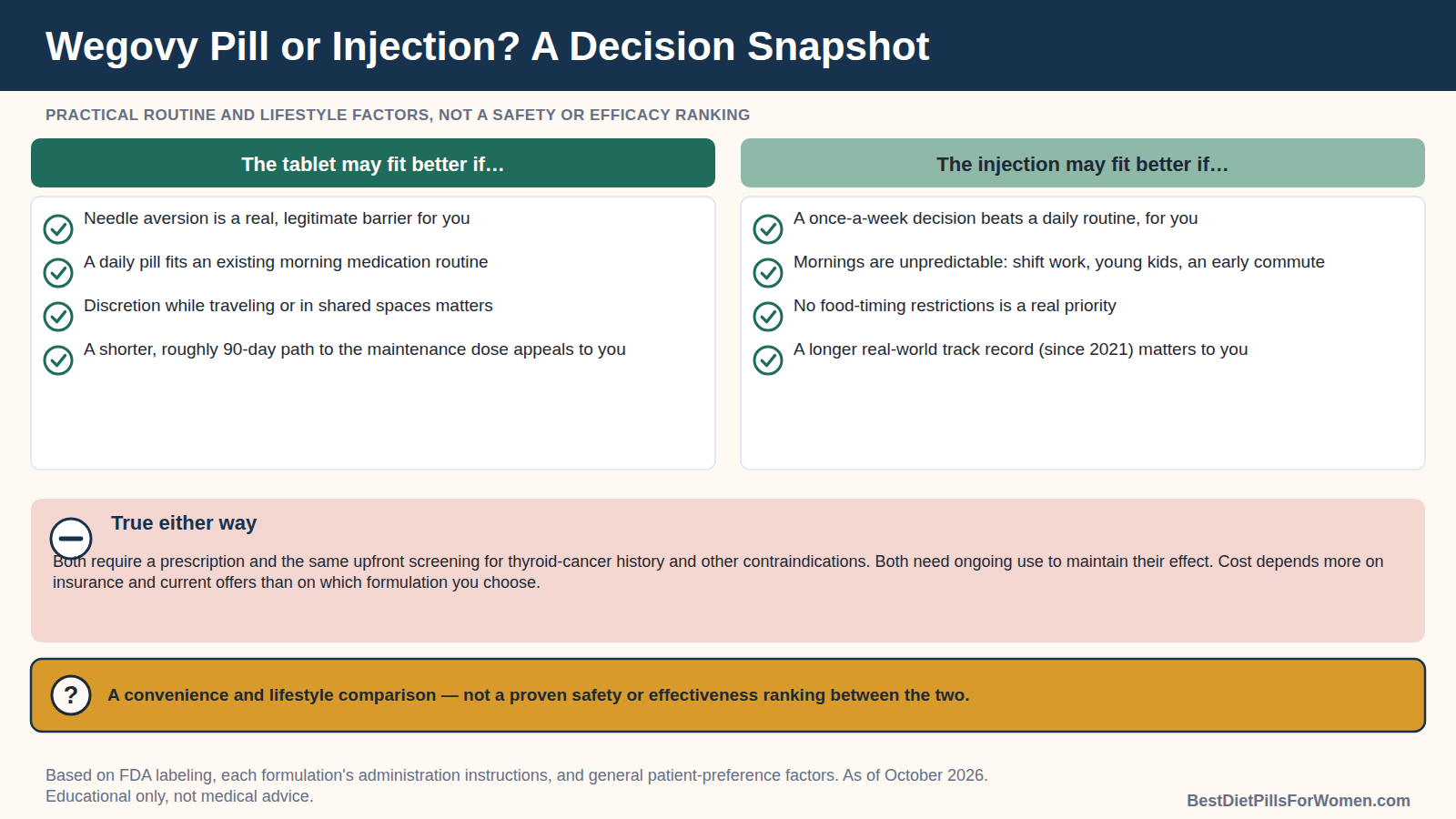
Some women have a strong, straightforward aversion to needles, and for them, a tablet removes a real psychological barrier that no amount of reassurance about pen design fully resolves. Others simply find it easier to fold one more pill into an existing morning routine of medications and supplements than to remember a once-a-week injection, especially in the first few months before a weekly habit feels automatic.
Travel, Storage, and Discretion
Tablets travel more easily than an injection pen that may need temperature-controlled handling, and taking a pill draws far less attention in a shared bathroom, an office, or a trip through airport security than drawing up or administering an injection. For women managing this medication without disclosing it to a partner, roommate, or coworkers, that discretion is a genuinely practical, not merely cosmetic, advantage.
Practical Reasons Some Women Choose the Injection
For other women, the math runs the opposite way: fewer total decisions per week beats a perfect daily ritual.
Once-a-Week Simplicity vs. Daily Discipline
A once-weekly injection means making one decision, on one day, rather than remembering a precise morning sequence seven days a week; for someone with an unpredictable schedule, frequent travel across time zones, or a history of struggling with daily medication adherence, fewer total opportunities to miss a dose can be the more realistic choice. The injection’s flexible timing, any time of day, with or without food, also removes a layer of daily planning the tablet specifically requires.
No Food-Timing Restrictions
Because the injection doesn’t depend on fragile oral absorption, there’s no need to protect a 30-minute window before coffee, breakfast or a morning vitamin, which matters more than it might sound for anyone whose mornings are genuinely not their own, including parents of young children, shift workers, and women juggling an early commute. That single difference, more than any gap in the trial data, is often what tips a real-world decision in one direction or the other, a pattern we’ve also seen play out in how women over 40 weigh weight-loss medication options against the realities of an already-packed morning.
Cost Comparison: Wegovy Pill vs. Wegovy Injection
Cost deserves its own honest look here, though a full breakdown of coverage and savings-program details lives in a dedicated guide linked below.
List Price, Self-Pay Price, and Insured Price, Side by Side
The sticker price, the cash price and the price after insurance are three different numbers, and mixing them up is one of the easiest ways to misjudge either formulation’s affordability.
What Each Formulation Costs Without Insurance
The manufacturer’s own direct-to-patient pricing materials put the tablet’s self-pay cost at roughly $149 to $299 a month depending on dose, and the injection’s self-pay cost at $199 a month introductory, then $349 standard, with a $399 tier for the higher-dose HD option. A separate, independently maintained pricing tracker described a somewhat different breakdown of which tablet dose maps to which price tier; see this table’s method note and the editor checklist for that discrepancy.
| Formulation | Typical self-pay price | Notes |
|---|---|---|
| Wegovy tablet | Roughly $149 to $299 a month, depending on dose and current manufacturer offers | Manufacturer pricing documents reviewed for this guide didn’t agree on exactly which dose maps to which price tier; confirm the current tier structure directly before relying on a specific number |
| Wegovy injection, standard | $349 a month | Introductory pricing of $199 a month is available for a limited time for eligible new patients |
| Wegovy injection, HD (7.2 mg) | $399 a month | For patients who’ve plateaued on the standard 2.4 mg maintenance dose |
| Either formulation, list price (WAC) | About $1,349 a month currently | Announced to fall to about $675 a month effective January 1, 2027; this change had not taken effect as of this guide’s October 2026 check date |
Table 4 method: figures are drawn from the manufacturer’s own self-pay pricing materials and trade-press reporting on the announced 2027 list-price change, both read in October 2026. A separate pricing tracker read for this guide described a different dose-to-price mapping for the tablet’s titration tiers than the manufacturer’s own guide did; this table states only the overall range for that reason. List price (WAC) is a wholesale benchmark almost nobody actually pays directly; it mainly affects what insurers are billed, not most self-pay patients.
Where a Deeper Cost-and-Coverage Breakdown Lives
This guide focuses on comparing the two formulations’ cost side by side rather than walking through insurance coverage, manufacturer savings cards, Medicare and Medicaid specifics, or how these prices compare to Rybelsus/Ozempic and Foundayo in detail. Our full breakdown of Wegovy pill cost, coverage and savings programs covers all of that in depth, including the manufacturer’s commercial savings card, which can bring an eligible, commercially insured patient’s cost down to as little as $25 a month, excluding government beneficiaries.
What’s Driving the Announced 2027 Price Change
A meaningful price change is coming, but it affects a different number than the one most self-pay patients actually see.
The Announced WAC Reduction and What It Does (and Doesn’t) Affect
Novo Nordisk has announced a reduction in the wholesale acquisition cost, or list price, for Wegovy, Ozempic and the renamed oral Ozempic product, from roughly $1,349 a month to about $675 a month, a cut of close to 50%, effective January 1, 2027. This change applies to the list price billed to insurers and used as a benchmark for rebate negotiations; trade-press reporting on the announcement specifically notes that it does not directly change the self-pay, direct-to-patient prices discussed above. As of this guide’s October 2026 check date, the cut hadn’t taken effect yet.
Why Self-Pay Price Matters More Than List Price for Most Readers
For a reader without insurance coverage for either formulation, or choosing to pay cash rather than go through insurance, the self-pay prices in Table 4 are the numbers that actually apply, not the list price. For a reader with insurance, what matters most is the plan’s own formulary placement, prior-authorization requirements and copay structure, which the list-price cut may influence indirectly over time through rebate negotiations, but won’t change on its own in a way most patients will notice directly on January 1, 2027. Over a longer horizon, a lower list price can make it easier for insurers and pharmacy-benefit managers to justify broader formulary coverage, since rebate calculations and coverage decisions are often built around that benchmark number, but that’s a slow, indirect effect on access rather than an immediate change to any individual patient’s copay.
How the Two Wegovy Formulations Compare to Other Oral GLP-1 Options
The Wegovy tablet isn’t the only oral weight-management drug on the market, and it’s useful to know, briefly, where it sits next to the others.
Wegovy Tablet vs. the Rebranded Oral Semaglutide for Diabetes
The most common point of confusion deserves one more direct pass, framed specifically against the Wegovy tablet.
Why a Diabetes-Only Pill Isn’t a Weight-Loss Substitute
The oral semaglutide product now sold under the Ozempic name (formerly Rybelsus) and the Wegovy tablet share an active ingredient but not an approved purpose: one is reviewed and labeled for type 2 diabetes, the other for weight management and cardiovascular-risk reduction. A lower price on the diabetes-only product isn’t a bargain if it isn’t the product actually indicated, or dosed, for weight loss; it’s a mismatch that a pharmacist should catch, but one worth understanding before you’re the one asking the question at the counter.
Dose and Label Differences Worth Knowing
The rebranded oral diabetes product and the Wegovy tablet use different dosing schedules and different maximum doses, reflecting their different approved jobs; sources describing the renamed diabetes product’s exact current dose strengths weren’t fully consistent in this guide’s research, so a specific milligram-for-milligram comparison isn’t included here, and this is flagged for direct verification against the current label in the editor notes for this article. The practical point that matters more than the exact numbers: these are two differently dosed, differently approved oral semaglutide products, and neither one is a cheaper, interchangeable version of the other.
Wegovy Tablet vs. Foundayo (Orforglipron)
A genuinely different oral option exists, and it’s worth a one-paragraph mention for context.
A Different Molecule, a Similar Idea
Foundayo (orforglipron) is a different oral GLP-1 medicine, made by a different manufacturer, approved for weight management in 2026; unlike the Wegovy tablet, it isn’t semaglutide and isn’t a peptide at all, which is part of why it doesn’t need the same strict empty-stomach-and-water administration rule the Wegovy tablet requires. Because it’s a small-molecule drug rather than a peptide that has to survive the stomach intact, Foundayo is generally described as able to be taken with or without regard to food, a meaningfully simpler routine than the Wegovy tablet’s 30-minute fasting window, even though both are swallowed once a day. Self-pay pricing for Foundayo has generally landed in a broadly similar range to the Wegovy tablet’s, though specific tier-by-tier figures shift often enough that they’re worth checking directly rather than relying on a snapshot here.
That administration difference is worth sitting with for a moment, because it reframes what the Wegovy tablet is actually competing against. The tablet’s main advantage over the injection is avoiding a needle; its main inconvenience, relative to a needle-free oral alternative like Foundayo, is the fasting routine that comes from being a peptide drug rather than a small molecule. Neither trade-off makes one option universally better, but it’s a more honest way to think about the tablet’s place in the broader oral-GLP-1 landscape than treating “it’s a pill” as the only relevant fact.
Where a Full Comparison Lives
This guide doesn’t attempt a full efficacy, safety and cost comparison between the Wegovy tablet and Foundayo, since that’s a distinct question deserving its own dedicated treatment; readers weighing that specific choice, comparing semaglutide to tirzepatide-based options more broadly, or wondering how either Wegovy formulation stacks up against a far cheaper off-label option, may find our comparison of semaglutide and tirzepatide, our Wegovy pill cost guide, which also covers Foundayo pricing, and our metformin vs. Wegovy comparison more directly useful than anything this guide could add here. Women specifically weighing this decision around a PCOS diagnosis may also want our guide to weight-loss medications for PCOS.
Switching Between the Pill and the Injection
A fair number of readers aren’t choosing a starting point; they’re already on one formulation and wondering about the other.
Why There’s No Official Dose-Conversion Chart
The math that would let someone translate a tablet dose into an equivalent injection dose, or back, doesn’t exist in a validated, FDA-sanctioned form.
Different Pharmacokinetics, Different Math
The tablet and the injection get an active drug into the bloodstream through fundamentally different routes, with the tablet’s roughly 1% to 2% oral bioavailability standing in stark contrast to the injection’s direct subcutaneous delivery. Because of that, a milligram of oral semaglutide and a milligram of injected semaglutide aren’t equivalent doses, and there’s no simple multiplication that reliably converts one into the other; we found no FDA-approved dose-conversion table for switching between the two formulations in the sources reviewed for this guide.
What Prescribers Typically Do Instead
In the absence of an official conversion chart, prescribers generally manage a switch the same cautious way they’d start someone on either formulation from scratch: beginning at a low titration dose on the new formulation and working upward on a similar schedule, rather than attempting to calculate an equivalent starting point from the prior dose. This is standard, conservative prescribing judgment for this drug class rather than a formally studied switching protocol, which is exactly why it’s a conversation to have directly with the prescriber managing the switch, not a do-it-yourself calculation.
What to Expect in the First Few Weeks After Switching
Switching formulations can feel, briefly, like starting over, and it’s worth being prepared for that.
Possible Changes in Side Effects
Because a switch typically restarts titration at a low dose, some people notice their GI side effects temporarily ease up after switching, simply because they’re back at an earlier point on the titration curve, not because the new formulation is inherently gentler. Others notice new or different side effects simply from adjusting to a new route of administration, a new daily or weekly rhythm, or, for someone switching to the tablet, the new empty-stomach routine itself.
When to Check Back In with Your Prescriber
Anyone switching formulations should expect a follow-up check-in, typically within the first month or two, to confirm the new titration schedule is being tolerated and that the switch hasn’t disrupted whatever insurance authorization or pharmacy logistics were in place for the prior formulation. If GI side effects after a switch are severe, persistent, or come with signs of dehydration, severe abdominal pain, or vomiting that won’t stop, that’s a reason to contact a prescriber promptly rather than waiting for a scheduled follow-up.
Frequently Asked Questions About the Wegovy Pill vs. Wegovy Injection
These are questions this guide’s earlier sections already answer in detail; here they’re restated briefly for anyone skimming.
Effectiveness and Switching
Two of the most common direct questions, answered as plainly as the evidence allows.
Does the Wegovy Pill Work As Well As the Injection?
Based on separate trials in separate populations, the tablet’s own trial found 13.6% average weight loss versus 2.2% on placebo, and the injection’s trial found 14.9% versus 2.4% on placebo, a close but not identical result. The two have never been compared in the same head-to-head study, so “as well as” is better read as “in a broadly similar range” rather than a proven tie or a proven advantage for either one.
Can I Switch From the Injection to the Pill Whenever I Want?
Not on your own; switching formulations should go through the prescriber managing your treatment, since there’s no official dose-conversion chart and a switch typically means restarting titration at a low dose on the new formulation. Insurance coverage, prior authorization and pharmacy logistics may also need to be re-arranged for the new formulation, which is easier to handle with your prescriber’s office involved from the start.
Safety, Cost, and Confusion with Other Drugs
The remaining two questions tend to come from readers trying to sort real options from mixed-up branding.
Is the Wegovy Pill the Same As Rybelsus or Ozempic?
No. The Wegovy pill is semaglutide approved for weight management; Rybelsus, now rebranded as an oral Ozempic product, is a different-dosed semaglutide tablet approved only for type 2 diabetes, not weight loss. They share an active ingredient, not an approved purpose or a dosing schedule, and substituting one for the other isn’t a safe or supported shortcut.
Is the Wegovy Pill Safer Than the Injection?
No clear safety advantage has been demonstrated for either formulation over the other; both carry the same boxed warning, the same core contraindications, and broadly similar, if differently reported, rates of gastrointestinal side effects. The tablet’s absorption depends on a stricter routine, and its real-world track record is shorter, simply because it reached the market more recently than the injection.
Does Insurance Cover the Wegovy Pill the Same Way It Covers the Injection?
Not necessarily, and coverage details for either formulation are beyond what this guide covers in depth. Insurance plans, prior-authorization rules and savings-card terms can and do treat the two formulations differently, so our dedicated guide to Wegovy pill cost and coverage is the better resource for that specific question than this comparison’s summary-level cost section.
The Bottom Line on Wegovy Pill vs. Wegovy Injection
Pull the threads of this guide together into something you can actually use.
What the Evidence Means for You
Two formulations of the same drug, aimed at the same goal, with two separate but reassuringly similar trial results behind them.
The Biggest Realistic Advantage of Each Option
The tablet’s biggest realistic advantage is convenience for people who specifically want to avoid needles or prefer a daily pill to a weekly injection, with a shorter time to reach its maintenance dose. The injection’s biggest realistic advantage is flexibility: no food-timing rules, dosing at any time of day, and a far longer real-world track record to draw on, since it’s been available since 2021 against the tablet’s early-2026 launch.
The Biggest Limitation or Uncertainty
The tablet’s biggest limitation is its unforgiving absorption window; getting the routine wrong doesn’t cause a dangerous reaction, but it can plausibly mean absorbing less of the dose than intended, in a way the injection simply doesn’t risk. The biggest shared uncertainty is that no trial has ever compared the two formulations directly, so every efficacy comparison in this guide, including the close 13.6%-versus-14.9% result, is an indirect read across two different studies, not a confirmed, head-to-head finding.
A Rational Next Step
The most useful thing this guide can hand off isn’t a verdict; it’s a short list of better questions.
Questions Worth Bringing to Your Prescriber
Worth asking directly: which formulation does your specific insurance plan cover more favorably, and under what prior-authorization terms; whether your personal or family medical history includes anything on the shared contraindication list; and, if you’re switching from one formulation to the other, what titration schedule your prescriber plans to use and how they’ll track your response in the first month or two. It’s also worth asking, plainly, which formulation your prescriber and pharmacist have more real-world experience managing, since the injection’s longer track record may translate into more accumulated, practical troubleshooting knowledge on their end, even where the trial evidence for both options looks comparably solid on paper.
What to Re-Verify Before You Commit
Prices, savings-card terms, and insurance coverage details all move faster than trial data does, so re-check the current self-pay price for whichever formulation you’re considering, confirm whether the announced list-price change has taken effect if you’re reading this after January 2027, and verify your own plan’s current coverage terms directly with your insurer or pharmacist before assuming either formulation’s cost in this guide still applies exactly as written.
Related Reading
Sources
These are the main sources behind this guide, chosen because they are the ones to check first for current facts. Labels, trial reports and prices change, so confirm the latest version before you make decisions.
- U.S. Food and Drug Administration. WEGOVY (semaglutide) injection and tablets — full prescribing information, combined label posting 215256s031/218316s003 (2026). https://www.accessdata.fda.gov/drugsatfda_docs/label/2026/215256s031lbl218316s003lbl.pdf
- Novo Nordisk. FDA approves Wegovy® oral tablet for chronic weight management and to reduce cardiovascular risk (news release, December 22, 2025). https://www.novonordisk.com/news-and-media/news-and-ir-materials/news-details.html?id=916472
- Novo Nordisk. OASIS 4 trial results for oral semaglutide 25 mg in adults with overweight or obesity (news release). https://www.novonordisk.com/news-and-media/news-and-ir-materials/news-details.html?id=916428
- Oral Semaglutide at a Dose of 25 mg in Adults with Overweight or Obesity (OASIS 4 trial), The New England Journal of Medicine, 2025 (abstract read via PubMed, PMID 40934115; DOI 10.1056/NEJMoa2500969). https://pubmed.ncbi.nlm.nih.gov/40934115/
- American College of Cardiology. Clinical Trial Summary: STEP 1 — Semaglutide Treatment Effect in People With Obesity, summarizing results originally reported in the New England Journal of Medicine (2021). https://www.acc.org/Latest-in-Cardiology/Clinical-Trials/2021/02/18/19/23/STEP-1
- HCPLive. Novo Nordisk Rebrands Rybelsus as Ozempic to Increase Patient Awareness (February 2026). https://www.hcplive.com/view/novo-nordisk-rebrands-rybelsus-as-ozempic-to-increase-patient-awareness
- Novo Nordisk / NovoCare. Wegovy Price Guide: self-pay prices for Wegovy injection pens and Wegovy oral tablets, and savings-card terms (document dated April 2026, read October 2026). https://www.novocare.com/content/dam/novonordisk/novocare/redesign/pdf/Wegovy_Price_Guide.pdf
- ReachMD / trade press. Novo Nordisk lowers semaglutide WAC (list price) for Wegovy, Ozempic and the oral Ozempic product to $675 a month, effective January 1, 2027. https://reachmd.com/news/novo-nordisk-lowes-semaglutide-wac-to-675-effective-jan-1-2027/2485809/
- Drug Topics. Wegovy Pill Receives FDA Approval as First Oral Weight Loss Drug (December 23, 2025). https://www.drugtopics.com/view/wegovy-pill-receives-fda-approval-as-first-oral-weight-loss-drug
- GoodRx. Wegovy Pills vs. Injection: How They Compare. https://goodrx.com/wegovy/pills-vs-injection

