
Wegovy Dosage at a Glance: The Short Answer
The Direct Answer and What the Label Actually Says
What’s the Standard Wegovy Dosing Schedule?
Wegovy dosage starts low and increases on a fixed schedule: 0.25 mg once weekly for four weeks, then 0.5 mg, then 1 mg, then 1.7 mg, each held for four weeks, before reaching the standard 2.4 mg once-weekly maintenance dose at week 17. That step-up pattern, called dose escalation or titration, is written directly into the current FDA prescribing information for Wegovy (semaglutide) injection, and it isn’t optional or a suggestion; it’s the labeled way the drug is meant to be started.
A newer, higher 7.2 mg dose, often called Wegovy HD in press coverage, exists for people who have already tolerated 2.4 mg for at least four weeks and whose prescriber decides more weight loss is clinically appropriate. It isn’t a default next step for everyone on the standard schedule. This guide walks through every step on the label, explains why the schedule is built this way, and is explicit about where the label’s instructions end and a prescriber’s individual judgment begins; it sits alongside this site’s broader guide to prescription and OTC weight-loss medications for women, which covers where Wegovy fits among the options as a category.
Who Actually Decides Your Dose — and Why This Guide Doesn’t
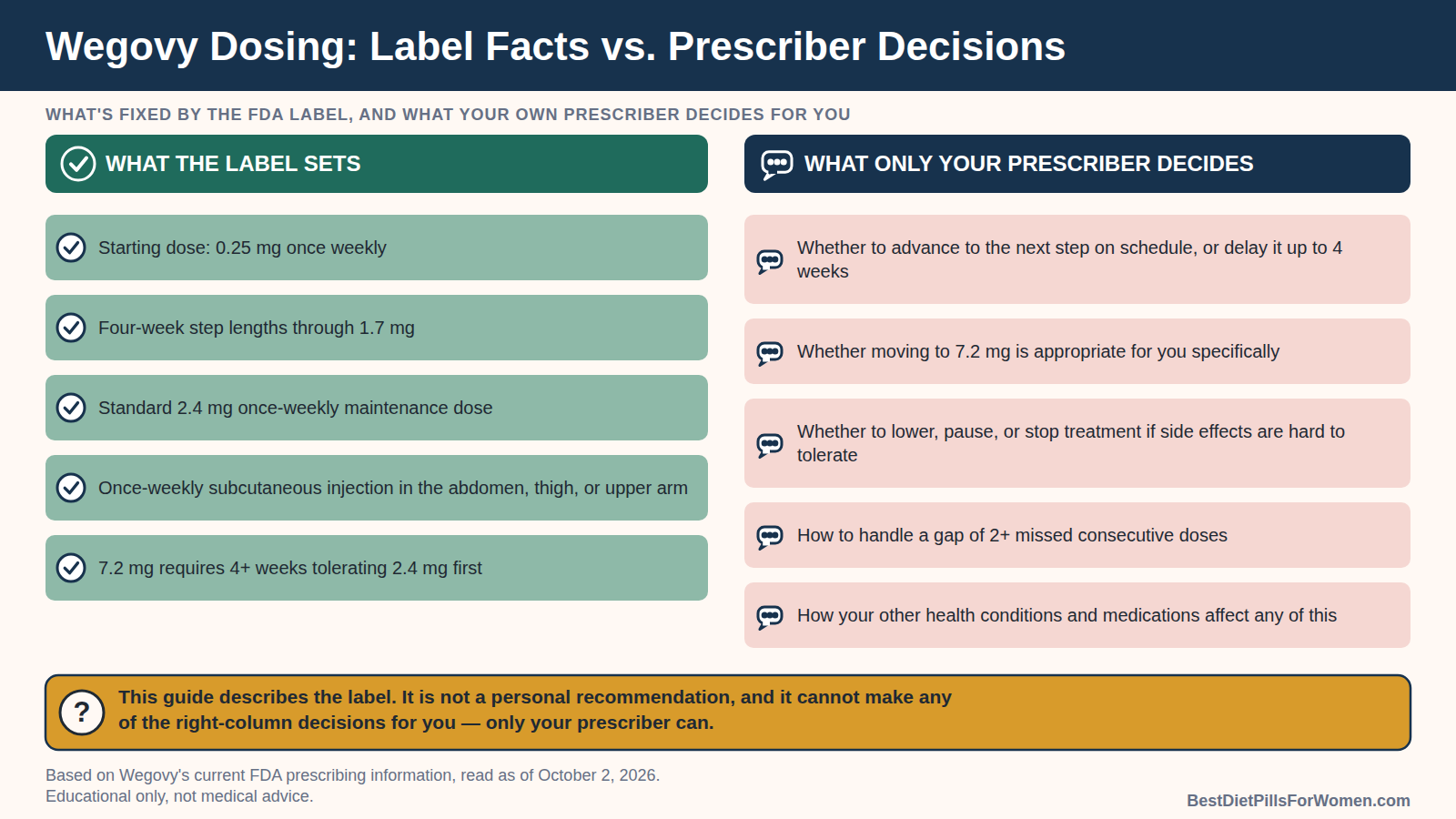
This guide describes what Wegovy’s FDA-approved label says about starting dose, dose increases, the maintenance dose, and the newer high-dose tier. It does not tell any individual reader what dose to take, when to move to the next step, or what to do if a dose feels hard to tolerate. Those are decisions a prescriber makes with a specific patient, using information this article doesn’t have, such as that person’s full medical history, other medications, lab results, and how they’re actually responding week to week.
Nothing in this guide is personalized dosing advice, and nothing here should be used to start, stop, skip, speed up, or adjust a Wegovy dose on your own. If a step in the schedule is uncomfortable, or if you’re unsure whether to move forward, the right next step is a conversation with the prescriber who wrote the prescription, not a decision made from an article. Table 1 below gives a one-glance summary of the schedule as a reference point for that conversation.
Think of this guide as the kind of background reading that makes a prescriber appointment more productive, not as a replacement for that appointment. A reader who understands the standard schedule, why it’s built the way it is, and which specific things are genuinely open to a prescriber’s judgment is better positioned to ask a sharp, specific question, and to notice if something she’s being told doesn’t match the label at all. That’s a meaningfully different goal than trying to self-manage a prescription medication from an article, and the two shouldn’t be confused with each other.
How This Guide Was Put Together
Sources Used for the Dosing Information
The dosing figures in this guide come from Wegovy’s current FDA-approved prescribing information, read directly in its full-text form, cross-checked against the manufacturer’s own hosted copy of the same document. Administration details such as injection sites, storage, and missed-dose handling are checked against that label together with MedlinePlus, a consumer drug reference maintained by the U.S. National Library of Medicine, and Cleveland Clinic’s patient education page on injectable semaglutide. Details on the newer 7.2 mg dose and its March 2026 approval are checked against trade and clinical news coverage of the FDA action, in addition to the label itself.
Every mg figure, week count, and percentage in this guide reflects what those sources stated as of early October 2026. Drug labels get updated, sometimes with changes to exact numbers, warnings, or approved uses, so the editor checklist that accompanies this guide flags every dosing figure for a final check against the live label immediately before publication.
Two of this guide’s figures, specifically the two differing summaries of the STEP UP trial’s headline weight-loss percentage for the 7.2 mg dose, came from secondary news coverage of the FDA approval rather than from a primary trial publication, because the primary publication wasn’t available to read directly in this research session. This guide names that gap rather than quietly picking whichever number sounded more favorable, and flags it for confirmation against the primary source before publication, consistent with how this site handles any figure it can’t fully verify firsthand.
What This Guide Is Not
This is a label-based and administration-based reference, not a substitute for the printed Medication Guide that comes with every Wegovy prescription, and not a treatment plan. It doesn’t cover Wegovy’s cost or insurance coverage in depth (that’s a separate guide), and it doesn’t walk through the full clinical-trial evidence on weight-loss outcomes for every dose (also covered elsewhere on this site). What it does cover, in detail, is the actual schedule: which dose, for how long, administered how, and who is actually authorized to change any of it.
| Question | Short answer |
|---|---|
| Starting dose | 0.25 mg once weekly |
| Titration length (standard schedule) | 16 weeks, in four 4-week steps |
| Standard maintenance dose | 2.4 mg once weekly |
| Higher-dose tier | 7.2 mg once weekly (“Wegovy HD”), only after tolerating 2.4 mg for 4+ weeks and only if a prescriber decides it’s appropriate |
| Who sets your actual dose and timing | Your prescriber, based on your label, your response, and your health history |
| Biggest safety reminder | Never speed up, skip, or restart the schedule on your own; call your prescriber if a dose is hard to tolerate |
Table 1 method: figures are as stated in Wegovy’s current FDA prescribing information, read as of October 2, 2026. This table is a quick-reference summary; the full schedule, including every intermediate step, appears in Table 2.
Understanding the Wegovy Dose-Escalation (Titration) Schedule
The Standard Starting Dose and Step-Up Schedule
Wegovy’s injectable form follows a four-step climb to its standard maintenance dose, and every step is spelled out in the label by week number rather than left to guesswork. Weeks 1 through 4 use 0.25 mg once weekly, a dose that’s below what’s needed for meaningful weight-loss effect on its own and exists mainly to let the body adjust. Weeks 5 through 8 move to 0.5 mg, weeks 9 through 12 move to 1 mg, and weeks 13 through 16 move to 1.7 mg, each one held for a full four weeks before the next increase.
That’s four full months from the first injection to the standard maintenance dose, which is longer than many people expect going in. It’s worth saying plainly: during those first several weeks, a person is not yet on a dose shown to produce the degree of weight loss documented in Wegovy’s clinical trials. The titration period is a necessary on-ramp, not a preview of the drug not working.
The Four-Week Steps From 0.25 mg to the Maintenance Dose
Each step uses a single-dose prefilled pen matched to that week’s exact dose, injected once a week, on the same day each week, with or without food. A person moving through the schedule as labeled will use four different pen strengths in sequence (0.25 mg, 0.5 mg, 1 mg, and 1.7 mg) before ever touching the 2.4 mg maintenance pen. That’s a deliberate design choice: because each pen is pre-filled at a single fixed strength, there’s no step where a patient is expected to measure or split a dose themselves.
The label also addresses what happens if a particular step doesn’t go smoothly: “If patients do not tolerate a dose during dosage escalation, consider delaying dosage escalation for 4 weeks”. That instruction is written for the prescriber, not the patient. It means a prescriber has the option to keep someone at their current dose for an extra month rather than pushing forward on schedule, and later sections of this guide return to exactly how that decision gets made.
The 2.4 mg Maintenance Dose for Chronic Weight Management
At week 17, assuming each prior step was tolerated, the schedule reaches 2.4 mg once weekly, the maintenance dose associated with Wegovy’s core chronic weight-management indication and the dose used in its original pivotal weight-loss trials. The same 2.4 mg dose is also the recommended maintenance level for Wegovy’s separate cardiovascular-risk-reduction indication, with 1.7 mg listed as an alternative maintenance option for that specific use if 2.4 mg isn’t appropriate for a given patient. That alternative exists for the same general reason the whole schedule climbs slowly in the first place: some patients tolerate 1.7 mg better than 2.4 mg, and for the cardiovascular-risk indication specifically, the label allows a prescriber to settle on that lower maintenance level rather than treating 2.4 mg as the only acceptable long-term dose for that particular use.
This is the dose meant to be continued long-term for chronic weight management, not a temporary peak. Wegovy’s own trials followed people on the maintenance dose for well over a year to measure durable weight-management outcomes, which reflects how this medicine is actually meant to be used, as an ongoing treatment rather than a short course with a defined end date. Table 2 lays out every step from the first injection through this maintenance dose, side by side, as a single reference a reader can bring into a conversation with a prescriber or pharmacist.
| Step | Weeks on this step | Dose | What this step is for |
|---|---|---|---|
| 1 | Weeks 1–4 | 0.25 mg once weekly | Starting dose; allows the body to adjust before any dose expected to produce meaningful weight loss |
| 2 | Weeks 5–8 | 0.5 mg once weekly | First increase |
| 3 | Weeks 9–12 | 1 mg once weekly | Second increase |
| 4 | Weeks 13–16 | 1.7 mg once weekly | Third increase; also a maintenance option for the cardiovascular-risk-reduction use |
| 5 | Week 17 onward | 2.4 mg once weekly | Standard long-term maintenance dose for chronic weight management; recommended maintenance dose for cardiovascular risk reduction |
Table 2 method: figures are as stated in Wegovy’s current FDA prescribing information (Dosage and Administration, Table 1 of the label), read as of October 2, 2026. A prescriber may extend any step beyond four weeks if it isn’t tolerated; this table shows the standard schedule, not a fixed timeline that applies the same way to every patient.
Why Titration Exists in the First Place
Minimizing GI Side Effects While Reaching an Effective Dose
The entire reason Wegovy climbs gradually instead of starting at its effective dose on day one comes down to gastrointestinal tolerability. Semaglutide is a GLP-1 receptor agonist, meaning it mimics a hormone the gut normally releases after eating, and it acts on receptors in the brainstem and hypothalamus that influence appetite and fullness, while separately slowing how quickly food moves out of the stomach. Both of those mechanisms can produce nausea, vomiting, diarrhea, or constipation, especially right after a dose increase, because the body is adjusting to a stronger version of the same signal at each new level. Starting low and stepping up slowly gives the digestive system room to adjust at each level before the next increase, which is the main reason the label builds in a four-week hold at every step rather than a faster ramp.
This isn’t a feature unique to Wegovy. Every GLP-1 medicine approved for weight management uses some version of gradual dose escalation for the same reason, because the side-effect pattern is a drug-class effect tied to how these medicines work, not a quirk of one product. The specific week counts and dose amounts differ from drug to drug, but the underlying logic, climb slowly enough that the gut has time to adapt before the next step, is shared across the category.
Clinicians who prescribe GLP-1 medicines commonly suggest general, non-drug measures alongside the schedule to make early weeks more comfortable: eating smaller, more frequent meals instead of large ones, favoring lower-fat foods during a step that’s causing nausea, eating slowly, stopping before feeling overly full, and staying ahead of hydration, especially if diarrhea or vomiting occurs. Those are general comfort measures, not medical advice tailored to any individual, and they don’t replace calling a prescriber if a symptom is severe, persistent, or worsening. A prescriber or pharmacist is also the right person to ask whether an over-the-counter remedy for nausea or constipation is appropriate to use alongside Wegovy specifically.
What the Clinical Trials Showed About Starting Low
The titration schedule used today reflects what Wegovy’s development trials found about dosing and tolerability: participants who started at an effective dose without a run-up experienced substantially more gastrointestinal side effects and higher drop-out rates than those titrated gradually. That trial experience is why the FDA-approved label locks in a specific week-by-week schedule rather than leaving starting dose and escalation pace open to case-by-case improvisation from the first injection.
It’s a useful thing to know going in: feeling queasy in week 2 on the starting dose doesn’t mean Wegovy “isn’t working” or that something has gone wrong. At 0.25 mg, the drug generally isn’t expected to be producing its full weight-management effect yet anyway. The titration period is about tolerability first, with the weight-management effect building as the dose climbs toward the maintenance level over the following months.
Wegovy HD (7.2 mg): The Higher-Dose Tier
What Wegovy HD Is and Who It’s For
FDA Approval and the STEP UP Trial Evidence
The FDA approved a 7.2 mg once-weekly dose of Wegovy, widely referred to in press coverage as Wegovy HD, on March 19, 2026. It was reviewed under the FDA Commissioner’s National Priority Voucher pilot program, a newer accelerated-review pathway intended to shorten review timelines for certain priority drug applications; this particular approval was reported to have moved through review in about 54 days, compared with the roughly 10-month timeline a standard review typically takes, and it became the fourth product cleared through that pilot program. A faster review pathway changes how quickly a drug reaches pharmacies; it doesn’t change how thoroughly the underlying trial data was required to support the approval, and the same safety and efficacy evidence bar applies regardless of which review track a given application uses.
The approval was built on the STEP UP trial, in which people already being treated with semaglutide for obesity were randomized to continue at the standard 2.4 mg maintenance dose or move up to 7.2 mg, with outcomes tracked over 72 weeks. A separate related trial, described in press coverage as STEP UP T2D, looked at the same dose comparison specifically in people with type 2 diabetes, reporting roughly 13.2% weight loss at 7.2 mg versus about 3.9% on placebo; this guide doesn’t develop that diabetes-specific sub-study further, since the core weight-management titration schedule is the same regardless of which specific trial population a reader falls into.
Reported results from that trial put average weight loss at roughly 18.7% of body weight on the 7.2 mg dose over 72 weeks, compared with roughly 15.6% on 2.4 mg and 3.9% on placebo. One trade-press summary of the same program cited a higher 20.7% average and noted that 89% of people on the 7.2 mg dose achieved at least 5% body weight loss, versus 38% on placebo. The gap between those two figures (18.7% versus 20.7%) most likely reflects a difference in which patients were counted or which statistical method was used, a common source of divergent-looking numbers from the same trial program, rather than two genuinely different results; this guide flags that discrepancy rather than picking whichever number looks more impressive, and it should be confirmed against Novo Nordisk’s primary trial publication before this figure is republished elsewhere.
How a Prescriber Decides Whether to Move to 7.2 mg
The label’s rule for reaching 7.2 mg is specific: a patient must have tolerated the 2.4 mg dose for at least four weeks, and “additional weight reduction” must be “clinically indicated” before the dose is increased to the 7.2 mg maximum. Unlike the climb from 0.25 mg to 2.4 mg, the label doesn’t describe an intermediate step between 2.4 mg and 7.2 mg; the increase, when a prescriber decides it’s appropriate, goes directly from the maintenance dose to the higher one.
That’s a meaningfully different kind of decision than the earlier titration steps. The climb to 2.4 mg is the default path for essentially everyone starting Wegovy. The move to 7.2 mg is an individualized choice a prescriber makes only for a patient who has already shown they tolerate the standard maintenance dose and for whom more weight loss is a clinically appropriate goal, not an automatic next chapter for every patient who reaches week 17.
“Clinically indicated” is doing real work in that label sentence. It means a prescriber has looked at where a specific patient’s weight-management goals stand after months on the standard maintenance dose and has concluded, for that patient, that the documented additional weight-loss benefit of the higher dose is likely to outweigh its documented additional side-effect burden. It is not a box a patient checks for herself by deciding she’d simply like to lose more weight faster.
What’s Different About the Higher Dose
Added Weight-Loss Benefit Shown in Trials
The clinical case for 7.2 mg is a larger average weight-loss effect than 2.4 mg produces on its own, which is the entire point of offering a higher-dose option in the first place. The STEP UP results above describe that gap in general terms: a meaningfully larger average percentage of body weight lost at the higher dose compared with the standard maintenance dose, measured in the same trial and the same population, which makes this one of the more directly comparable figures in this guide rather than a cross-trial estimate.
That added benefit comes with a trade-off worth understanding before assuming “more milligrams always means a better result for every person.” A larger average effect in a trial population doesn’t guarantee a larger benefit, or a tolerable experience, for any one individual, and the next section covers exactly what that trade-off looks like in side-effect terms.
The Side-Effect Trade-Off at the Higher Dose
Side effects were also more frequent on 7.2 mg than on 2.4 mg in the trial data behind this approval, and one reaction in particular stood out as a new, dose-related finding: dysesthesia, an abnormal skin sensation such as tingling, burning, or numbness, was reported in roughly 22% of people on 7.2 mg, compared with about 6% on 2.4 mg and under 1% on placebo in that trial. Nausea and vomiting were also somewhat more common at the higher dose. Table 3, later in this guide’s safety section, lays those figures out dose by dose alongside the standard-dose adverse-reaction data from the label.

How Wegovy Injections Are Administered
Injection Basics: Sites, Schedule, and Technique
Where and How Often Wegovy Is Injected
Wegovy is injected subcutaneously, meaning just under the skin rather than into muscle, in the abdomen, the thigh, or the upper arm. It’s a once-weekly injection, taken on the same day each week, at any time of day, with or without meals, which makes it easier to build into a consistent routine than a medicine that needs to be timed around food or taken multiple times a day.
Rotating the injection site, meaning not using the exact same spot week after week, helps reduce local skin irritation at the injection area, and that guidance applies whether a person is cycling between the abdomen, thigh, and upper arm or staying within one general area but moving the exact spot each time. The label doesn’t specify a single required rotation pattern; it specifies the three approved general injection areas and leaves spot-to-spot rotation within those areas as routine self-injection practice.
Using the Single-Dose Pen Correctly
Each Wegovy dose strength comes in its own single-dose prefilled pen, meaning the 0.25 mg pen, the 0.5 mg pen, and so on through 2.4 mg and 7.2 mg are physically different pens rather than one adjustable device. That design removes the step where a patient would need to dial or measure a dose themselves; using the pen labeled for the current step delivers the correct, fixed amount. Before injecting, the solution should look clear and colorless, without visible particles, and needles should never be reused or shared between people, even within the same household.
A pharmacist or prescriber’s office typically walks a new patient through the pen the first time it’s used, covering how to remove the cap, how the injection button works, how long to hold the pen in place after pressing it, and how to confirm a full dose was delivered. That first hands-on walkthrough is worth asking for if it isn’t offered automatically, rather than relying only on a package insert’s diagrams, especially for a first injection of any kind. The printed patient Instructions for Use that comes with every Wegovy pen is the authoritative, step-by-step reference for the device itself, and it’s worth keeping even after the first few doses feel routine.
| Aspect | What the current label and patient guidance say |
|---|---|
| Injection sites | Abdomen, thigh, or upper arm; rotate the exact spot used each week |
| Frequency | Once weekly, same day each week, any time of day, with or without food |
| Device | Single-dose prefilled pen; each dose strength has its own dedicated pen |
| Before injecting | Check that the solution is clear, colorless, and free of visible particles |
| Needle reuse | Never reuse or share needles or pens, even with household members |
| Sharps disposal | Use a puncture-resistant sharps container; ask a pharmacist about local disposal rules |
Table 4 method: figures are as stated in Wegovy’s current FDA prescribing information and in MedlinePlus’s consumer semaglutide-injection guidance, read as of October 2, 2026.
Storing Wegovy and Handling Missed Doses
Refrigeration, Room-Temperature Storage, and Expiration
Unopened Wegovy pens are meant to be stored in a refrigerator, between about 36°F and 46°F (2°C to 8°C), and should never be frozen; a pen that has been frozen should be thrown away. Once a pen is in use, injectable semaglutide products are generally approved for a limited period at room temperature, protected from light, before any unused medication in that pen should be discarded, a detail worth confirming on the specific pen’s own label or patient leaflet rather than assuming a universal number, since room-temperature storage windows can differ slightly by product and by pen design.
A pen that’s been dropped, damaged, or left somewhere hot, such as a car on a warm day, shouldn’t be used even if it still looks fine; cloudy or discolored solution, or visible particles, are both reasons to check with a pharmacist before injecting rather than proceeding anyway. Traveling with Wegovy raises the same storage questions in a more time-pressured setting: a small insulated travel case with a cold pack helps keep pens within their refrigerated range on a long trip, and it’s worth checking a pen’s own expiration and room-temperature-use window before leaving rather than discovering a problem mid-trip, far from the pharmacy that filled the prescription.
What the Label Says About a Missed Dose
Wegovy’s missed-dose guidance depends on how close the next scheduled dose is. If a dose is missed and the next regularly scheduled dose is more than two days away, the missed dose should be taken as soon as possible; if the next scheduled dose is less than two days away, the missed one is skipped entirely and the regular weekly schedule continues from there, without doubling up. Doubling a dose to “catch up” is explicitly not the guidance here.
Missing two or more consecutive doses is treated differently: the label indicates that after that kind of longer gap, a patient may need to resume dosing on the originally scheduled day going forward, or may need to restart at an earlier point in the escalation schedule, depending on how long the gap was and where in the schedule the gap occurred. That’s a decision for a prescriber to make, not a rule a patient should apply to themselves by guesswork if more than one dose has been missed; the safest move after missing two or more weeks in a row is a call to the prescribing office before the next injection, not a best guess at which step to resume on.
Does the Dose Differ by Indication, Age, or Health Status?
Different Approved Uses, Different Recommended Doses
Chronic Weight Management vs. Cardiovascular Risk Reduction
Wegovy’s injectable form carries more than one FDA-approved use, and the recommended maintenance dose isn’t identical across all of them. For chronic weight management, the maintenance target is 2.4 mg, with the option to escalate further to 7.2 mg under the conditions described earlier in this guide. For reducing the risk of major cardiovascular events in adults with established cardiovascular disease and obesity or overweight, the label lists 2.4 mg as the recommended maintenance dose, with 1.7 mg as an alternative maintenance dose for that specific indication if 2.4 mg isn’t suitable for a given patient.
The starting dose and the escalation steps leading up to maintenance are the same regardless of which approved use a person is being treated for; what can differ is the maintenance target their prescriber settles on, which is one more reason the specific dose on any individual’s prescription reflects a conversation about that person’s particular health picture, not a single one-size answer this guide could supply.
MASH and Adolescent Dosing Considerations
Wegovy’s label also covers use in metabolic dysfunction-associated steatohepatitis (MASH), a liver condition formerly often called nonalcoholic steatohepatitis, in which fat buildup in the liver progresses to inflammation and scarring; it’s strongly linked to obesity and insulin resistance, which is part of why a weight-management GLP-1 medicine has a role here at all. The recommended MASH dosing is 2.4 mg injected subcutaneously once weekly, reached through the same escalation schedule used for the weight-management indication. For adolescents 12 years and older who meet the labeled criteria for pediatric use, the recommended maintenance dosing options are 2.4 mg or 1.7 mg once weekly, again reached through the standard escalation steps. Pediatric prescribing adds considerations around growth, development, and longer-term monitoring that go beyond the dosing schedule itself, which is one more reason this guide treats adolescent use as a distinct clinical context rather than folding it into general adult guidance.
This guide is written with adult readers in mind and doesn’t attempt to cover the full pediatric dosing and safety picture; a prescriber managing an adolescent patient works from pediatric-specific label sections and growth and development considerations that fall outside this guide’s scope.
The Oral Wegovy Tablet: A Separate Schedule Under the Same Brand
How the Tablet’s Titration Differs From the Injection
Confusingly for anyone searching “Wegovy dosage,” the Wegovy brand now also covers an oral tablet, approved separately from the original injection, with its own titration schedule measured in days rather than weeks. The tablet schedule starts at 1.5 mg once daily for the first 30 days, increases to 4 mg once daily for the next 30 days, increases again to 9 mg once daily for the following 30 days, and reaches a 25 mg once-daily maintenance dose after that, roughly 90 days in. It’s taken on an empty stomach in the morning with a small amount of water, with a wait of at least 30 minutes before eating, drinking, or taking other oral medications.
Those numbers don’t overlap at all with the injection’s 0.25 mg-to-2.4 mg schedule, and that’s the clearest way to tell which Wegovy product a given dosing chart or price quote is actually describing. A milligram figure in the single digits with a daily (not weekly) frequency describes the tablet; a milligram figure under 3 taken once a week describes the injection.
Why This Guide Focuses on the Injectable Form
This guide focuses on the original injectable form because it’s what “Wegovy dosage” most commonly refers to in search behavior and in clinical use today, and because the injection’s dosing, administration, and side-effect pattern are different enough from the tablet’s that covering both in equal depth in one guide would blur more than it would clarify. A reader specifically researching the oral tablet’s dosing, cost, or evidence base is better served by this site’s dedicated guide to Wegovy pill cost and access, which covers that product on its own terms.
What Happens When a Dose Step Is Hard to Tolerate
What the Label Says a Prescriber May Do
Extending Time at a Dose Instead of Pushing Forward
The label’s own language for a tolerability problem during escalation is narrow and specific: “consider delaying dosage escalation for 4 weeks”. In plain terms, that means a prescriber has the option to keep a patient at their current dose for an additional month, rather than moving them up to the next step on the usual four-week clock, if side effects at that step haven’t settled down yet. It’s a pause-and-reassess option, not an instruction to push through discomfort, and not an instruction to drop back down a step either; the label describes delaying the next increase, not reducing the current one.
This is one of the clearest places in the entire schedule where the label hands a judgment call to the prescriber rather than spelling out a single fixed rule for every patient. Two people on the exact same step, with similar side effects, might reasonably end up on different timelines from here, because the decision also weighs how the rest of their treatment and health picture is going.
When a Prescriber Might Lower, Pause, or Stop Treatment
Beyond a four-week delay, a prescriber has further options the label doesn’t spell out as a numbered checklist, because they depend on clinical judgment applied to a specific patient: stepping back down to a previously tolerated dose, pausing treatment altogether for a period, or stopping Wegovy and considering a different approach entirely. Severe or persistent gastrointestinal symptoms, signs of a serious reaction such as pancreatitis symptoms (severe abdominal pain, sometimes with vomiting), gallbladder problems, or any symptom that feels alarming are all reasons to contact a prescriber promptly rather than waiting for a scheduled follow-up appointment.
None of those decisions, lowering a dose, pausing treatment, or stopping altogether, are decisions this guide can make for a reader, and none of them should be made unilaterally by a patient without looping in the prescriber first, because the right call depends on specifics (which symptom, how severe, how long, what else is going on medically) that only a clinician reviewing the full picture is positioned to weigh.
Why This Isn’t a Decision for the Reader to Make Alone
The Risk of Self-Adjusting Dose or Skipping Steps
Speeding through the schedule faster than labeled, skipping a step, or jumping straight to a higher dose without medical guidance removes the exact safety margin the titration schedule was built to provide. The gradual climb exists specifically because starting at an effective dose without a run-up produced more gastrointestinal side effects and higher drop-out in development trials; working around that schedule reintroduces the same risk the schedule was designed to avoid.
The reverse mistake, quietly dropping back a step or stretching out the timeline well beyond what a prescriber actually recommended, carries its own downside: it can mean staying longer than necessary at a dose that isn’t yet producing the drug’s intended effect, for no medical reason, based on a decision nobody with the full clinical picture ever signed off on.
Questions Worth Raising With a Prescriber or Pharmacist
A more useful use of this information is turning it into specific questions for the next appointment or pharmacy call: Is it normal to still feel nauseated at this step, or does that warrant an earlier check-in? Is there a reason to extend time at the current dose rather than moving up on schedule? If the plan eventually includes considering 7.2 mg, what would need to be true first? What symptoms would mean calling the office right away instead of waiting? Bringing a specific, concrete question built from the actual schedule tends to get a more useful answer than a general “is this normal?”
It’s worth remembering, too, that a prescriber can’t adjust what they don’t know about. Side effects that go unreported between scheduled visits, because they seem minor or because a patient assumes nothing can be done about them anyway, remove information a prescriber would otherwise use to decide whether to hold at the current dose. Flagging a symptom early, even a mild one, gives the person managing the schedule more to work with than finding out well after the fact that several weeks were harder than they needed to be.
Safety Considerations Tied to Dosing
Common Side Effects Across the Dosing Schedule
Gastrointestinal Effects at Each Step
Gastrointestinal side effects are the most common adverse reactions reported at Wegovy’s standard 2.4 mg maintenance dose: in the trial data behind the current label, nausea was reported in about 44% of people on Wegovy versus about 16% on placebo, vomiting in about 24% versus 6%, diarrhea in about 30% versus 16%, constipation in about 24% versus 11%, and abdominal pain in about 20% versus 10%. These figures describe the standard maintenance dose compared with placebo in the trial population studied for that dose; they aren’t a prediction of what any one person will experience, and they tend to cluster most heavily around dose increases rather than staying constant throughout treatment.
At the higher 7.2 mg dose, a separate trial reported nausea in about 39% of people on that dose compared with about 35% on 2.4 mg and about 13% on placebo, and vomiting in about 22% compared with about 16% and about 6%. Those placebo rates differ somewhat from the 2.4 mg trial’s own placebo rate (13% versus 16%), a reminder that these numbers come from two different trial programs rather than one continuous head-to-head study, so Table 3 presents them side by side without blending them into a single misleading percentage.
Less Common but Notable Reactions
One reaction stood out as disproportionately more common at the higher dose: dysesthesia, meaning an abnormal skin sensation such as tingling, burning, prickling, or numbness, which was reported in about 22% of people on 7.2 mg compared with about 6% on 2.4 mg and under 1% on placebo in that same trial. That’s a large enough gap that it’s treated as a distinguishing safety feature of the higher dose specifically, not just “more of the same” GI pattern scaled up.
Headache was also reported more often on Wegovy than placebo at the standard dose, about 14% versus 10%. None of the figures in this subsection are a complete list of every possible side effect; they’re the most frequently reported reactions in the trial data this guide could verify, and this site’s full breakdown of Wegovy side effects is the more complete reference for anyone weighing the full side-effect picture rather than the dosing-specific pattern covered here.
| Side effect | 2.4 mg vs. placebo (STEP 1 trial data in the current label) | 7.2 mg “Wegovy HD” vs. 2.4 mg vs. placebo (STEP UP trial data) |
|---|---|---|
| Nausea | 44% vs. 16% | 39% vs. 35% vs. 13% |
| Vomiting | 24% vs. 6% | 22% vs. 16% vs. 6% |
| Diarrhea | 30% vs. 16% | Not separately reported in the source read for this guide |
| Constipation | 24% vs. 11% | Not separately reported in the source read for this guide |
| Abdominal pain | 20% vs. 10% | Not separately reported in the source read for this guide |
| Dysesthesia (abnormal skin sensation) | Not separately reported in the source read for this guide | 22% vs. 6% vs. 0% |
Table 3 method: 2.4 mg figures are as stated in Wegovy’s current FDA prescribing information’s adverse-reactions table; 7.2 mg figures are as reported in trade coverage of the STEP UP trial. These are two different trial programs with different placebo rates, not a single head-to-head study, so the two columns shouldn’t be subtracted from each other directly.
Serious Risks and Who Needs Extra Caution
The Boxed Warning and Who Should Avoid Wegovy Entirely
Wegovy carries a boxed warning, the FDA’s strongest label warning category, about thyroid C-cell tumors seen in rodent studies at clinically relevant exposures; whether semaglutide causes thyroid C-cell tumors, including a rare cancer called medullary thyroid carcinoma, in humans hasn’t been determined. Because of that warning, Wegovy is contraindicated, meaning it shouldn’t be used at all, in anyone with a personal or family history of medullary thyroid carcinoma or Multiple Endocrine Neoplasia syndrome type 2, and in anyone with a known serious hypersensitivity to semaglutide or any of the pen’s other ingredients.
Beyond that boxed warning, the label describes other serious risks that apply at any dose on the schedule, not just at higher doses: pancreatitis, gallbladder problems such as gallstones, acute kidney injury (often related to dehydration from GI side effects), a worsening of diabetic retinopathy in people with type 2 diabetes, and increased heart rate. None of these are reasons for a reader to self-diagnose from a list; they’re reasons that unusual or severe new symptoms during treatment deserve a prompt call to a prescriber.
Severe, persistent abdominal pain, sometimes radiating to the back and sometimes with vomiting, is the symptom pattern most associated with pancreatitis and is generally treated as urgent rather than something to wait out until a scheduled visit. Similarly, pain in the upper right abdomen, fever, or yellowing of the skin or eyes can point to a gallbladder problem and warrants prompt medical attention rather than a wait-and-see approach. A prescriber decides how closely to monitor someone for these risks, often through periodic check-ins rather than routine lab testing for every single one, and that monitoring plan is itself part of the individualized judgment this guide keeps pointing back to.
Pregnancy, Breastfeeding, and Other Cautions
Wegovy’s label states that the drug may cause fetal harm and that it should be discontinued when pregnancy is recognized, for the weight-reduction use. Breastfeeding isn’t recommended during treatment, per the same labeling. Anyone who is pregnant, trying to become pregnant, or breastfeeding, or who might be in any of those situations, needs to raise it with a prescriber before starting or continuing Wegovy at any dose, rather than making an assumption either way.
There’s a related point specific to women using hormonal birth control: because semaglutide slows how quickly the stomach empties, it can also slow how quickly some oral medications are absorbed, and the oral Wegovy tablet’s own labeling specifically flags this for other oral drugs taken around the same time. Anyone using an oral contraceptive alongside any form of semaglutide is a good candidate for a direct conversation with a prescriber or pharmacist about timing and whether a backup method is worth discussing, rather than assuming absorption is unaffected.
People with a history of pancreatitis, gallbladder disease, severe gastrointestinal disease, or diabetic eye disease, along with anyone taking insulin or a sulfonylurea (both of which carry a higher hypoglycemia risk when combined with a GLP-1 medicine), should expect extra monitoring conversations with their prescriber regardless of which step of the schedule they’re on; this site’s guide to GLP-1 medication interactions and who needs extra caution goes into that drug-class picture in more depth. This guide cannot determine who, specifically, needs extra caution; only a clinician reviewing a complete medical history can make that call, and that call isn’t tied to a particular dose step so much as to the person’s overall health picture.
Frequently Asked Questions About Wegovy Dosing
Starting and Adjusting Dose
Can I Speed Up or Slow Down My Own Titration?
No. The dose-escalation schedule is set by the FDA-approved label and managed by a prescriber, and deviating from it on your own, in either direction, works against the exact safety and tolerability purpose the schedule was built for. If a step feels difficult, the right move is contacting the prescriber, who has the option to delay the next increase; it isn’t a decision to make independently by slowing down, speeding up, or skipping a step.
What If the Starting Dose Doesn’t Seem to Be Working Yet?
That’s expected, not a sign of a problem. The 0.25 mg starting dose exists mainly to build tolerability and generally isn’t considered a dose that produces Wegovy’s full weight-management effect on its own. The effect builds as the dose climbs toward the 2.4 mg maintenance level over the following months, which is one reason the full titration period runs a full four months before maintenance dosing even begins.
Can I Switch Back to a Lower Dose If Side Effects Are Too Much?
That’s a decision for a prescriber, not a reader working from this guide. The label gives a prescriber the option to delay the next scheduled increase by up to four weeks if a dose isn’t tolerated well; whether to go further and step back down to an earlier dose, pause treatment, or stop altogether depends on the specific symptoms and the full clinical picture, which is exactly why that call belongs to the person who prescribed it.
How Soon After Reaching the Maintenance Dose Will I See Results?
This guide doesn’t make individual predictions, but it’s worth knowing that Wegovy’s pivotal trials measured results over many months to more than a year at the 2.4 mg maintenance dose, not over the first few weeks after reaching it. Weight change at the maintenance dose tends to continue gradually over time rather than appearing all at once right after the four-month titration period ends, which is one reason the trials behind this medicine’s approval ran well beyond a year.
Practical and Cost-Related Questions
Does a Higher Dose Cost More?
Generally, yes, different dose strengths are priced differently, and the 7.2 mg tier in particular has its own pricing separate from the standard 2.4 mg maintenance dose. This guide doesn’t cover cost and insurance details in depth; this site’s dedicated Wegovy cost guide walks through list price, manufacturer savings programs, and insurance coverage considerations at each dose tier.
What Happens If I Stop Wegovy and Want to Restart?
That depends on how long someone has been off the medication and is a question for a prescriber, not a self-directed restart. Resuming after a long gap may call for restarting at an earlier point in the escalation schedule rather than picking back up at a previous maintenance dose, similar in spirit to how the label treats a gap of two or more missed consecutive weekly doses. Anyone considering a restart after stopping for any meaningful length of time should have that conversation with a prescriber before resuming injections.
Is the Wegovy Dose the Same as the Ozempic Dose?
No, even though both are semaglutide injections from the same manufacturer. Ozempic is approved for type 2 diabetes and uses its own dosing schedule and maximum doses, which differ from Wegovy’s weight-management schedule; the two products aren’t interchangeable, and a dose written for one shouldn’t be assumed to apply to the other. This site’s full comparison of Ozempic and Wegovy covers how the two differ in more detail.
Does My Dose Change If I’m Older or Have Kidney or Liver Issues?
That’s a question for a prescriber to answer based on an individual’s specific lab results and health history, not a general rule this guide can supply. Age by itself isn’t a reason the standard titration schedule would change, but kidney function, liver function, and overall health context are exactly the kind of factors a prescriber weighs when deciding how closely to monitor someone through the schedule, and when deciding whether a dose beyond the standard maintenance level is appropriate at all.
The Bottom Line on Wegovy Dosing
What the Label-Based Evidence Means for You
The Biggest Practical Advantage of the Titration Design
The step-by-step schedule is, itself, a safety feature, not an obstacle standing between a patient and the “real” dose. Building in four weeks at each level before increasing again is what let Wegovy’s trials achieve substantial weight-loss results while keeping gastrointestinal side effects and treatment drop-out at more manageable levels than an immediate full-dose start would have produced. Understanding that going in can make the first few weeks, when side effects are often most noticeable and the dose is still sub-therapeutic, easier to sit with rather than second-guess.
That same logic extends to the newer 7.2 mg tier: it exists as an additional option layered on top of an already-established maintenance dose, for a specific subset of patients, rather than as a replacement for the standard schedule or a sign that 2.4 mg is somehow an inadequate dose for most people who use it. The existence of a higher tier doesn’t change what the standard schedule is for, or make the four-month climb to 2.4 mg any less central to how this medicine is meant to be used by the great majority of people prescribed it.
The Biggest Limitation or Safety Concern
The clearest limitation in this entire guide is also the most important one: every number here describes a trial population or a labeled rule, not a guarantee about any individual’s experience or a shortcut around clinical judgment. The newer 7.2 mg dose, in particular, comes with a documented increase in side effects, including a distinctive abnormal-skin-sensation reaction, alongside its larger average weight-loss effect, and that trade-off is exactly the kind of judgment call that belongs to a prescriber weighing one patient’s full picture, not to a one-size global recommendation.
A Rational Next Step
Questions for Your Prescriber Before Your Next Refill
A short, specific list travels better into an appointment than a vague “is this normal?” Worth asking: Which week and dose am I on right now, and when is the next scheduled increase? Is there a reason to extend the current dose rather than moving up on schedule? If 7.2 mg is ever on the table, what would need to be true first, and what side-effect trade-off should I expect? What missed-dose situation would mean calling the office before my next injection instead of guessing? Is anything about my other medications, including hormonal birth control, worth adjusting around my injection schedule?
Bringing a written note with the current week and dose, rather than relying on memory, also helps if an appointment happens with a different clinician than the one who started the prescription, which is common in busy practices and telehealth settings alike.
What to Re-Check Before You Rely on This Guide
Drug labels change. Before treating any figure in this guide as current, especially the exact milligram amounts, the week ranges, and the adverse-reaction percentages, check it against Wegovy’s current printed Medication Guide or ask a pharmacist to confirm it against the label on file at the time you’re reading this. This guide is a research-based summary of a specific label and a specific set of trial reports read as of October 2, 2026; it is not the label itself, and it is not a substitute for the prescriber who actually knows your situation.
Related Reading
Sources
These are the main sources behind this guide, chosen because they are the ones to check first for current facts. Drug labels and dosing schedules change, so confirm the latest version before you make decisions.
- U.S. Food and Drug Administration. WEGOVY (semaglutide) injection, for subcutaneous use, and WEGOVY (semaglutide) tablets, for oral use — current combined prescribing information, label archive version 215256s031/218316s003 (2026 posting), accessed October 2, 2026. https://www.accessdata.fda.gov/drugsatfda_docs/label/2026/215256s031lbl218316s003lbl.pdf
- Novo Nordisk. WEGOVY full Prescribing Information, manufacturer-hosted current copy, accessed October 2, 2026. https://www.novo-pi.com/wegovy.pdf
- University of Minnesota College of Pharmacy. FDA Approves New Higher-Dose Version of Wegovy Shots (March 2026). https://www.pharmacy.umn.edu/fda-approves-new-higher-dose-version-wegovyr-shots
- ConsultantLive (HCPLive). FDA Approves Higher-Dose Semaglutide, Wegovy HD Injection (7.2 mg), for Obesity (March 19, 2026). https://www.consultantlive.com/view/fda-approves-higher-dose-semaglutide-wegovy-hd-injection-7-2-mg-for-obesity
- MedlinePlus (U.S. National Library of Medicine, National Institutes of Health). Semaglutide Injection. https://medlineplus.gov/druginfo/meds/a618008.html
- Cleveland Clinic. Semaglutide Injection for Weight Management. https://my.clevelandclinic.org/health/drugs/23611-semaglutide-injection-weight-management

