
In the weight loss pills vs injections comparison, weekly injections still show the largest average results in clinical trials, roughly 15% to 21% of body weight for Wegovy and Zepbound, against about 7% to 14% for the two new daily GLP-1 pills and about 5% to 10% for older prescription pills. But as of September 24, 2026, we found no randomized trial in adults with obesity that put a pill head to head against an injection, so every one of those comparisons is indirect.
That caveat matters more than it sounds. The trials differ in length, dose, population and the way missing data were handled, and the one randomized head-to-head trial of the leading drugs compared two injections, not a pill and a shot. The word “pill” also covers three very different things: over-the-counter supplements with little evidence, older prescription pills with modest results, and new GLP-1 pills that produce much larger average losses. Lumping them together makes pills look either far weaker or far stronger than they are.
This guide compares the two routes on the questions that decide real choices: how much weight people lost, who responds, what happens after stopping, side effects and warnings, what’s different for women, daily routine, and what each costs. It’s part of our wider coverage of weight loss pills for women, and it’s meant to give you better questions for a clinician, not a recommendation to start or stop anything.
Weight Loss Pills vs Injections: The Short Answer
Start with the conclusions, then check them against the sections that follow. Each answer names how sure we are and what limits it.
The Direct Answer and How Sure We Are
Two things need separating here: what the evidence says, and how much weight we put on each part of it.
Which Works Better for Weight Loss, Pills or Injections?
Injections have the larger average results, but the comparison is indirect. In the pivotal trials, weekly injections averaged about 15% to 21% weight loss and the newer daily GLP-1 pills about 7% to 14%, while older prescription pills averaged about 5% to 10%. No randomized trial has compared a pill with an injection in adults with obesity.
How Sure We Are About That Answer
We’re most confident about what the labels say, because the average results, warnings and dosing instructions come from FDA-approved prescribing information, though we read those labels through summaries and label mirrors. We’re moderately confident about the size of the differences between pills and injections, because they come from separate trials. We have low confidence about how the new pills perform over years, because they reached the market in 2026 and we found no long-term or real-world weight data for them. We rate each answer below High, Moderate or Low on that basis.
Six Questions Most Readers Ask, Answered Briefly
Most searches for this topic come down to six questions. Table 1 answers each one, with our confidence level and the main limitation on the answer.
The Summary Table
Read across each row before reading down a column, because an answer and its limitation belong together.
| Question | Short answer | Our confidence | Biggest limitation |
|---|---|---|---|
| Which produces more weight loss? | The weekly injections: Wegovy −14.9% and Zepbound −15.0% to −20.9% in their main trials. The daily GLP-1 pills averaged −13.6% (Wegovy pill) and −7.4% to −11.1% (Foundayo). | Moderate | Each figure comes from a different trial, so the gaps aren’t proven |
| Has any trial compared a pill with an injection? | Not in adults with obesity, as far as we could find. The randomized head-to-head trials we found compared injection with injection (SURMOUNT-5) or pill with pill in type 2 diabetes (ACHIEVE-3). | Moderate | We couldn’t search ClinicalTrials.gov, so an unpublished trial could exist |
| Do the side effects differ? | The two new GLP-1 pills and the injections share the same pattern of nausea, vomiting, diarrhea and constipation. Label rates of stopping because of side effects were 6.9% for the Wegovy pill and 6% to 10% for Foundayo (by dose), against 6.7% to 9.8% for the injections. | Moderate | Placebo nausea rates differ about twofold between trials, so cross-trial side-effect comparisons are unreliable |
| Does the route change anything for women who could become pregnant? | Yes, in the details. Zepbound’s label advises a barrier or non-oral contraceptive for 4 weeks after each start and increase, Foundayo’s says 30 days, and Wegovy’s has no such advice. | High | Labels differ in how they were written, and Foundayo’s advice is precautionary |
| What do they cost a cash payer? | For 12 fills at a maintenance dose: $3,588 for the Wegovy pill, $3,588 to $4,188 for Foundayo, $4,188 for the Wegovy pen and $4,788 to $5,388 for Zepbound, before needles (Table 11). | Moderate | Prices and promotions change, and several end on December 31, 2026 |
| What happens after you stop? | Weight tends to come back after stopping the injections, and we found no trial of stopping the new pills (Table 6). | Moderate for injections, Low for pills | The pills are new, and the switching study we found had no arm that continued the injection |
Table 1 method: answers summarize the sections that follow, and each row’s sources appear there. Percentages are mean weight change from baseline as reported on labels or in trials. “High” means the answer rests on FDA-approved labeling; “Moderate” means consistent but indirect or limited evidence; “Low” means we couldn’t find the data we’d want. The cost row uses the 12-fill totals calculated in Table 11.
What “Indirect” Means in This Guide
An indirect comparison sets the results of two separate trials side by side. It’s a fair way to see the rough size of an effect, and an unreliable way to say which drug is better. People in one trial may have been heavier, younger, more motivated or treated for a different length of time. If a pill trial ran 64 weeks and an injection trial ran 72, some of the gap is just time. We flag every indirect comparison, and we don’t declare a winner from one.
How We Evaluated the Comparison
Comparison pages can mean anything from hands-on use to a summary of a seller’s own site. We’d rather be exact about what this one is.
What We Reviewed
This guide is desk research. We read FDA-approved labels, trial abstracts and label tables, professional-society statements, FDA and Medicare pages, and manufacturer price pages checked on September 24, 2026. We didn’t buy, take or inject any product, and nothing here describes personal experience with one.
What We Couldn’t Check
PubMed, PubMed Central, the New England Journal of Medicine, The Lancet and several other sites blocked automated access, so we read many trials through abstracts, label tables and press releases, and we say so when it matters. Most of the trials we cite were paid for by the company that makes the drug, and the head-to-head analyses we found were funded by the maker of one of the drugs compared. Prices are one-day snapshots from manufacturer pages. And we didn’t rank products, because the evidence doesn’t support one ranking for every woman.
What Counts as a Weight Loss Pill and What Counts as an Injection
The comparison only makes sense once the categories are clear. “Pill” and “injection” are routes of taking a medicine, and behind each route sit products with very different evidence, rules and risks.
The Three Kinds of Weight Loss Pills
Search results treat every capsule and tablet as one thing. In practice they fall into three groups, and the gap between the first and third is wider than the gap between any pill and any injection.
Over-the-Counter Supplements and Fat Burners
These are sold as dietary supplements, which don’t need FDA approval before they reach shelves, and they include “fat burners,” “metabolism boosters,” appetite formulas and the newer “GLP-1 support” products. FDA reviewed nonprescription weight-control ingredients in 1991 and found none it could recognize as safe and effective, and the one OTC weight loss drug approved since then, orlistat 60 mg (sold as alli), works by blocking some fat absorption, not by reducing hunger. A large review of 315 randomized trials of 14 supplements or therapies found that, among the 52 trials at low risk of bias, 16 (31%) reported significant weight differences, ranging from 0.3 to 4.93 kg. Our guides to OTC appetite suppressants and weight loss gummies go through that evidence in detail.
Older Prescription Pills
Phentermine (Adipex-P, Lomaira and generics) was first approved in 1959 and is labeled for short-term use, “a few weeks,” with the label itself saying the extra weight loss over placebo is “only a fraction of a pound a week.” Qsymia combines phentermine with topiramate and is available through a restricted program because of the risk of fetal harm, and Contrave combines naltrexone with bupropion and carries a boxed warning about suicidal thoughts and behaviors. Prescription orlistat (Xenical) blocks fat absorption, like its OTC cousin, at a higher dose. These drugs have been around for years, and their trial results are modest compared with the newer GLP-1 drugs.
The New Oral GLP-1 Medicines
GLP-1 stands for glucagon-like peptide-1, a gut hormone that helps regulate appetite and blood sugar, and GLP-1 medicines mimic its action; the labels say these drugs decrease food or calorie intake. Two daily tablets now exist for weight loss. The Wegovy pill (oral semaglutide 25 mg) was approved on December 22, 2025 and launched on January 5, 2026, and Foundayo (orforglipron) was approved on April 1, 2026. Both are prescription drugs for adults with obesity, or with overweight and at least one weight-related condition, and both carry a boxed warning about thyroid C-cell tumors seen in rodents. Our guide to weight loss medications covers the whole prescription landscape.
The Injectable Medicines
Three prescription brands make up most of the injection side. All are given under the skin, and all belong to the GLP-1 class (Zepbound also acts on a second gut hormone, GIP).
Wegovy and Wegovy HD (Semaglutide)
Wegovy is a once-weekly injection that starts at 0.25 mg and rises in steps to a 2.4 mg maintenance dose from week 17, and its label also covers reducing cardiovascular risk in adults with heart disease and obesity or overweight. A higher 7.2 mg version, Wegovy HD, was approved on March 19, 2026 for people who tolerate 2.4 mg and need additional weight reduction. Semaglutide is also the active drug in the Wegovy pill, so this pair is the closest pill-and-injection match on the market, and we compare them directly in our guide to the Wegovy pill versus the Wegovy injection.
Zepbound (Tirzepatide)
Zepbound is a once-weekly injection that starts at 2.5 mg, rises in 2.5 mg steps at least four weeks apart, and settles at 5, 10 or 15 mg. It comes as single-dose pens, single-dose vials, multi-dose vials and a multi-dose KwikPen, and its label also covers moderate to severe obstructive sleep apnea in adults with obesity. Our comparison of Wegovy and Zepbound and our guide to semaglutide versus tirzepatide look at the two injections against each other.
Saxenda and Generic Liraglutide
Saxenda (liraglutide 3 mg) is the older option, injected daily, and its label says to stop it if a patient hasn’t lost at least 4% of body weight after 16 weeks at the full dose. A generic liraglutide for weight management launched in the United States in August 2025, according to its maker, Teva. Liraglutide’s average results are lower than semaglutide’s and tirzepatide’s, which is one reason it appears in comparisons less often.
How Each Group Is Regulated
Regulation is the quiet dividing line under the whole topic, and it affects what you can trust a label to mean.
Approved Drugs vs Dietary Supplements
Prescription pills and injections were reviewed by FDA for safety and effectiveness before sale, and their labels carry standardized warnings and trial data. Dietary supplements weren’t, and compounded drugs, which pharmacies mix outside the approval process, are also not reviewed by FDA for safety, effectiveness or quality before they’re marketed. One more product sits on the border: Plenity is an FDA-cleared capsule device, not a drug, cleared in January 2024 for adults with a BMI of 25 to 40, and its maker’s own site said on September 24, 2026 that it was not yet available for sale.
Why “GLP-1 Support” Pills Aren’t GLP-1 Medicines
A supplement labeled “GLP-1 support” doesn’t contain semaglutide, tirzepatide or orforglipron, and experts we read say the phrase can mislead shoppers into expecting a medicine-like effect. FDA sent a warning letter in December 2024 to a company selling “GLP-1” drops, and as of July 2026 Bloomberg Law reported that the agency was aware of the wave of GLP-1 claims but hadn’t announced further action.
The Groups at a Glance
Table 2 lays out the groups side by side, so you can see where each product sits before we compare results.
The Group Table
The rows aren’t ranked. They run from products sold without a prescription to the prescription injections, and they end with compounded products, which sit outside FDA approval.
| Group | Examples | How it’s taken | Regulatory status |
|---|---|---|---|
| OTC supplements and fat burners | Capsules, powders and gummies sold as “fat burners,” appetite formulas or “GLP-1 support” | Daily, per each label | Dietary supplements, not FDA-approved before sale |
| OTC orlistat | alli 60 mg | One capsule with each fat-containing meal, up to three a day | FDA-approved OTC drug |
| Older prescription pills | Phentermine, Qsymia, Contrave, Xenical | Daily; Contrave and Xenical several times a day | FDA-approved prescription drugs |
| New oral GLP-1 pills | Wegovy pill, Foundayo | One tablet daily | FDA-approved prescription drugs (December 2025 and April 2026) |
| Weekly GLP-1-class injections | Wegovy, Wegovy HD, Zepbound | Once a week under the skin | FDA-approved prescription drugs |
| Daily injection | Saxenda and generic liraglutide | Once a day under the skin | FDA-approved prescription drugs |
| Compounded GLP-1 injections | Semaglutide or tirzepatide products mixed by compounding pharmacies | Vials or syringes, varies | Not FDA-approved; not reviewed for safety, effectiveness or quality |
Table 2 method: groups and examples come from FDA-approved labels, FDA pages and manufacturer pages read through summaries. Examples are illustrations, not a complete or ranked list, and no product here is endorsed. The alli row reflects its Drug Facts label, and the older prescription pills are grouped for space although their dosing schedules differ.
How to Read the Groups
Two lines run through the table. The first is regulatory: the FDA-approved drugs, from OTC orlistat through the prescription pills and injections, went through FDA review, while the supplements and the compounded products didn’t. The second is evidence: the trials in the next section exist only for the approved drugs, and that’s why the OTC supplement row has no average-loss figure in Table 3 beyond a pooled review.
How Much Weight Pills and Injections Help People Lose
Average weight loss is the number every comparison leads with, and it’s also the number most often misread. This section sets out the results side by side, explains why they can’t be lined up like a leaderboard, and turns percentages into something a person can picture.
Average Results in the Main Trials
Table 3 gathers the main trial for each product that has one. Every figure is a group average, so it describes what happened across hundreds or thousands of people, and not what will happen to any one woman.
The Cross-Trial Table
Read the last column with the caveat in mind: each row comes from a separate trial, so the rows are indirect comparisons.
| Product and route | Main trial and length | Who was studied | Mean weight change, drug vs placebo | Difference from placebo |
|---|---|---|---|---|
| OTC supplements (capsules, gummies, powders) | Pooled review of 52 low-risk-of-bias trials, varied lengths | Adults, varied | Not reported as a percent | 16 of 52 trials (31%) found a significant difference, 0.3 to 4.93 kg |
| Orlistat (capsule, OTC and Rx) | Meta-analysis of 16 orlistat trials (BMJ, 2007), 1 to 4 years | Adults, 10,631 in total | Not reported as a percent | 2.9 kg more than placebo (95% CI 2.5 to 3.2) |
| Phentermine (tablet) | Label; short-term use | Not given in the label | Not reported | “Only a fraction of a pound a week” more than placebo |
| Contrave (tablet) | COR-I, 56 weeks | Adults; pooled COR trials 83% women | −5.4% vs −1.3% | 4.1 points |
| Qsymia (capsule) | CONQUER, 56 weeks, n = 2,487 | Adults; 70% women | −7.81% (7.5/46 mg) and −9.84% (15/92 mg) vs −1.24% | 6.6 and 8.6 points |
| Foundayo (tablet, daily) | ATTAIN-1, 72 weeks, n = 3,127 | Adults without diabetes; 64% women | −7.4%, −8.3%, −11.1% (5.5, 9, 17.2 mg) vs −2.1% | 5.3, 6.2 and 9.0 points |
| Wegovy pill (tablet, daily) | OASIS 4, 64 weeks, n = 307 | Adults without diabetes; 76% to 79% women | −13.6% vs −2.4% | 11.2 points (reported) |
| Saxenda (injection, daily) | SCALE, 56 weeks, n = 3,731 | Adults without diabetes; 79% women | −7.4% vs −3.0% | 4.5 points (reported) |
| Wegovy (injection, weekly) | STEP 1, 68 weeks, n = 1,961 | Adults without diabetes; 74% women | −14.9% vs −2.4% | 12.4 points (reported) |
| Wegovy HD (injection, weekly, 7.2 mg) | STEP UP, 72 weeks, n = 1,407 | Adults with obesity; 74% women | −18.8% vs −3.9% | 14.9 points (reported) |
| Zepbound (injection, weekly) | SURMOUNT-1, 72 weeks, n = 2,539 | Adults without diabetes; 68% women | −15.0%, −19.5%, −20.9% (5, 10, 15 mg) vs −3.1% | 11.9, 16.4 and 17.8 points |
Table 3 method: percentages are mean change in body weight from baseline as reported in FDA labels or trial papers; the label figure is used where a label was available. “Difference from placebo” is the reported figure where the source gave one, and our subtraction of the two rounded means where it didn’t, so a reported difference can differ from the subtraction by a tenth of a point. Orlistat and supplement results are in kilograms because the source reported them that way. Trials differ in length, population, dose, and how missing data were handled, so no row is a head-to-head result. We read most of these trials through label tables and abstracts, not full papers.
How to Read the Table
Four differences make the rows hard to compare. The first is time. The trials ran from 56 weeks (Contrave, Qsymia and Saxenda) to 72 weeks (Foundayo, Wegovy HD and Zepbound), with the Wegovy pill at 64 weeks and STEP 1 at 68, and a longer trial gives a drug more time to work. The second is size. OASIS 4 enrolled 307 people, and ATTAIN-1 enrolled 3,127, so the smaller trial carries a wider margin of error.
The third is dose. Zepbound and Foundayo each had three dose arms, and the range in Table 3 spans them, while Wegovy’s figure is for one dose and Wegovy HD’s is for the 7.2 mg dose, which the label reserves for people who tolerate 2.4 mg and need additional weight reduction. The fourth is the way trials count people who stopped treatment. Some figures include everyone who was randomized whether or not they stayed on the drug, and others count only the time on treatment. The second kind usually runs higher, and press releases lean on it: Lilly’s efficacy-estimand result for the top Foundayo dose was −12.4% against −0.9% on placebo, compared with −11.1% against −2.1% in the label. Neither is wrong, but they answer different questions.
One benchmark helps with scale. FDA’s draft guidance for weight-reduction drugs describes an average difference from placebo of at least 5 percentage points after a year at the maintenance dose as the efficacy bar. By that yardstick, the newer GLP-1 drugs clear it by a wide margin, and the older pills clear it more narrowly. The OTC supplement evidence, a gap of 0.3 to 4.93 kilograms in the minority of trials that found any difference at all, sits well below it for most products, and our guide to OTC appetite suppressants covers why.
What the Numbers Mean for a Real Person
Percentages are hard to picture, and the trial participants were heavier than most readers of a weight loss article expect. Their average starting weights were about 103 to 106 kilograms, or roughly 225 to 235 pounds.
Percent Versus Pounds
A percentage of body weight scales with the starting weight, so the pounds depend on where someone begins. Using a 200-pound example, purely as arithmetic and not a prediction, the Wegovy result of 14.9% is about 30 pounds and the placebo result of 2.4% is about 5 pounds. The top Zepbound result of 20.9% is about 42 pounds, the top Foundayo result of 11.1% is about 22 pounds, and the Wegovy pill’s 13.6% is about 27 pounds. Contrave’s 5.4% is about 11 pounds, and Saxenda’s 7.4% is about 15 pounds.
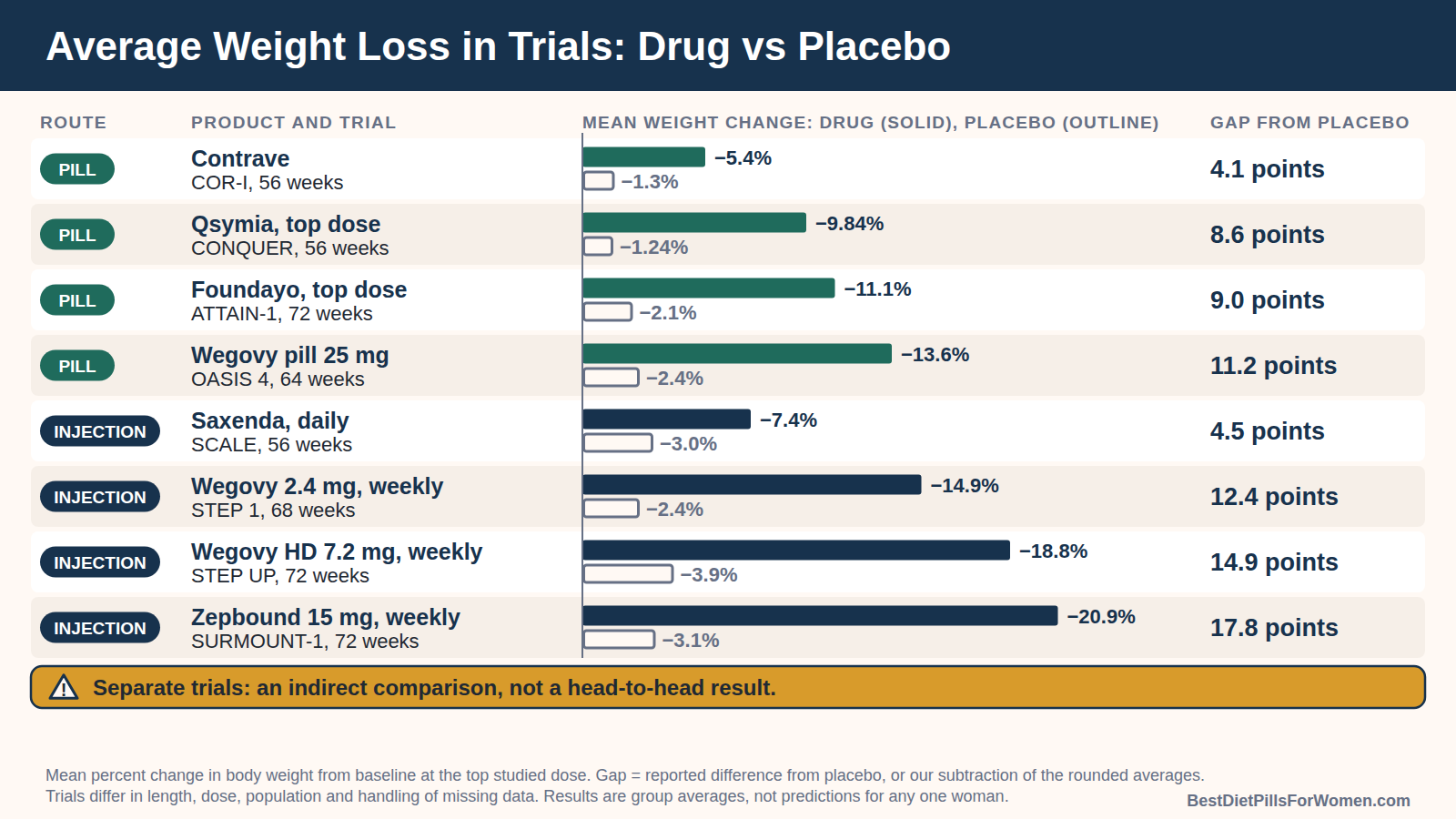
The gap that matters is the one from placebo. The Wegovy difference of 12.4 points is about 25 pounds on a 200-pound frame, and the placebo group’s own 5 pounds came from the diet and activity counseling that both groups received. Infographic 1 lays the drug and placebo averages next to each other, and marks them as an indirect comparison.
Why Placebo-Subtracted Numbers Matter
People assigned to placebo lose weight too, because joining a trial usually comes with counseling, tracking and attention. In these trials the placebo groups lost 1.2% to 3.9% of body weight on average, and the drug is credited only with the difference. A pill that shows “7% weight loss” in a marketing line may have produced about 5% more than placebo, and the ad has no reason to say so.
This is also why a single average hides a lot. It says nothing about the spread between the woman who lost 25% and the one who lost 3%, and the next section turns to that spread.
Head-to-Head Evidence: What Direct and Indirect Comparisons Show
Table 3 puts separate trials side by side. A head-to-head trial does something different: it randomly assigns people to two treatments in the same study, so the groups start out alike and are followed for the same length of time. That’s the only design that can say one treatment beat another, and it’s the design the pill-versus-injection question is missing.
The Randomized Trials That Compared Drugs Directly
Three randomized head-to-head trials of weight-loss drugs matter here, and none of them pits a pill against an injection in adults with obesity. They still teach a lot about how much of the gap between drugs is real.
Injection Against Injection: SURMOUNT-5 and STEP 8
SURMOUNT-5 randomly assigned 751 adults with obesity, without diabetes, to Zepbound or Wegovy for 72 weeks, and each person took the highest dose they could tolerate. Zepbound users lost an average of 20.2% of body weight and Wegovy users 13.7%, a difference of 6.5 percentage points (95% CI 4.9 to 8.1). Lilly, which makes Zepbound, paid for the trial, and it was open-label, meaning participants and doctors knew which drug was being used. The share of people who lost at least 20% of their weight was 48.4% on Zepbound and 27.3% on Wegovy.
STEP 8 was smaller. It compared weekly Wegovy with daily liraglutide 3 mg (the dose in Saxenda) in 338 adults over 68 weeks and found a mean loss of 15.8% on Wegovy and 6.4% on liraglutide, a difference of 9.4 points. We read STEP 8 through a secondary summary, and it didn’t state who funded the trial. Together the two trials show that “injection” is not one level of results: the gap between the best and the weakest injection is about as wide as the gap between the strongest injection and a good pill.
Pill Against Pill: ACHIEVE-3
ACHIEVE-3 randomly assigned 1,698 adults with type 2 diabetes to Foundayo’s active ingredient, orforglipron, or to oral semaglutide at 7 mg or 14 mg, the doses used to treat diabetes, for 52 weeks. Lilly reported that orforglipron lowered blood sugar and weight more, with weight changes of −6.7% and −9.2% on two orforglipron doses and −3.7% and −5.3% on the two semaglutide doses. More people stopped orforglipron because of side effects (8.7% and 9.7%) than stopped oral semaglutide (4.5% and 4.9%).
The trial can’t rank Foundayo against the Wegovy pill. The comparator was oral semaglutide at doses far below the 25 mg in the Wegovy pill, and the participants had diabetes, who lose less weight on these drugs than people without it.
The Direct-Comparison Table
Table 4 collects every randomized head-to-head trial we found that touches the pill-versus-injection question, including the diabetes trial with an oral and an injectable arm.
| Trial | What was compared | Who and how long | Main result | What it can’t show |
|---|---|---|---|---|
| SURMOUNT-5 | Zepbound vs Wegovy, both weekly injections | 751 adults with obesity, no diabetes; 72 weeks; open-label; Lilly-funded | −20.2% vs −13.7% (difference −6.5 points) | Anything about pills |
| STEP 8 | Wegovy weekly vs liraglutide 3 mg daily, both injections | 338 adults without diabetes; 68 weeks; funder not stated in our source | −15.8% vs −6.4% (difference −9.4 points) | Anything about pills |
| ACHIEVE-3 | Orforglipron vs oral semaglutide 7 mg and 14 mg, both pills | 1,698 adults with type 2 diabetes; 52 weeks; open-label; Lilly-funded | Weight −6.7% and −9.2% vs −3.7% and −5.3% (efficacy estimand) | Foundayo vs the 25 mg Wegovy pill, or a pill vs an injection |
| PIONEER 4 | Oral semaglutide 14 mg vs liraglutide 1.8 mg injection | Adults with type 2 diabetes; 52 weeks | About 1.3 kg more weight loss on the oral drug at week 52 | Obesity dosing; diabetes doses of both drugs |
Table 4 method: trials were found through literature and press searches on September 24, 2026, and read through abstracts, press releases and secondary summaries because PubMed, NEJM, The Lancet and other sites blocked access. ClinicalTrials.gov could not be searched, so an unpublished trial could exist. Percentages are mean weight change; ACHIEVE-3 figures are Lilly’s efficacy estimand, which counts time on treatment only.
Has Anyone Tested a Pill Against an Injection?
The natural experiment would randomly assign women with obesity to a daily tablet or a weekly injection and follow them for a year or more. We looked for one and didn’t find it.
Has Any Trial Compared a Weight Loss Pill With an Injection Directly?
Not in adults with obesity, as far as we could find as of September 24, 2026. The randomized head-to-head trials we found compared an injection with an injection (SURMOUNT-5, STEP 8) or a pill with a pill in type 2 diabetes (ACHIEVE-3). We couldn’t search ClinicalTrials.gov, so an unpublished or ongoing trial could exist, and we can’t say none is planned.
What Comes Closest: Diabetes Trials and Switching Studies
Two kinds of evidence sit near the question. PIONEER 4 randomly assigned adults with type 2 diabetes to oral semaglutide 14 mg or liraglutide 1.8 mg by injection, and the oral drug produced about 1.3 kilograms more weight loss at week 52, but those are diabetes doses in a diabetes population and the comparison isn’t relevant to a Wegovy pill user.
The second is a switching study. ATTAIN-MAINTAIN followed 376 adults who had lost weight on Zepbound or Wegovy and then randomly moved to orforglipron or to placebo for 52 weeks, and it had no group that kept using the injection. Outside experts made that point themselves, saying the trial “does not yet demonstrate” that the pill is superior to continuing the injection. We return to its results with the other after-stopping data in Table 6.
Indirect and Modeled Comparisons, and Who Paid for Them
With no randomized trial, the manufacturers have commissioned analyses that estimate the answer. They are worth knowing about and worth reading with the funder’s name in view.
Novo Nordisk’s Wegovy Pill vs Foundayo Analysis
A population-adjusted indirect comparison, funded by Novo Nordisk and written by authors who include Novo employees, estimated that the Wegovy pill 25 mg produced 3.2 percentage points more weight loss than the highest orforglipron dose (95% CI 0.4 to 5.9, treatment-regimen estimand). It also estimated higher odds of stopping because of side effects with orforglipron (odds ratio 4.1, 95% CI 1.3 to 13.0). The authors wrote that they did this “in the absence of head-to-head clinical trials.” The intervals are wide, and the analysis rests on OASIS 4, with 307 participants, matched to ATTAIN-1, which had 3,127.
Lilly’s Tirzepatide vs Oral Semaglutide Analysis
Lilly funded a network meta-regression comparing tirzepatide with oral semaglutide, using SURMOUNT-1 and an oral semaglutide trial called OASIS 1. It concluded that tirzepatide 10 and 15 mg were associated with statistically greater weight reduction. We could read only the abstract, which gave the conclusions in words and no numbers, and it didn’t state the oral semaglutide dose, so we can’t tell whether it matches the 25 mg in the Wegovy pill.
A Modeling Study of the Wegovy Pill vs the Wegovy Injection
A third analysis, also funded by Novo Nordisk, modeled drug exposure, meaning how much semaglutide is in the blood. It found that 82.2% of the Wegovy pill’s OASIS 4 participants had exposure within the range of people taking the 2.4 mg injection in STEP 1, and it concluded that exposure and efficacy were similar. That’s suggestive, because the analysis links exposure to weight loss, but it isn’t a comparison of patients, and about 18% of pill users fell outside the injection range.
What We Can Say and What We Can’t
The honest summary is a short list of what’s established and a longer list of what isn’t.
Known and Unknown at a Glance
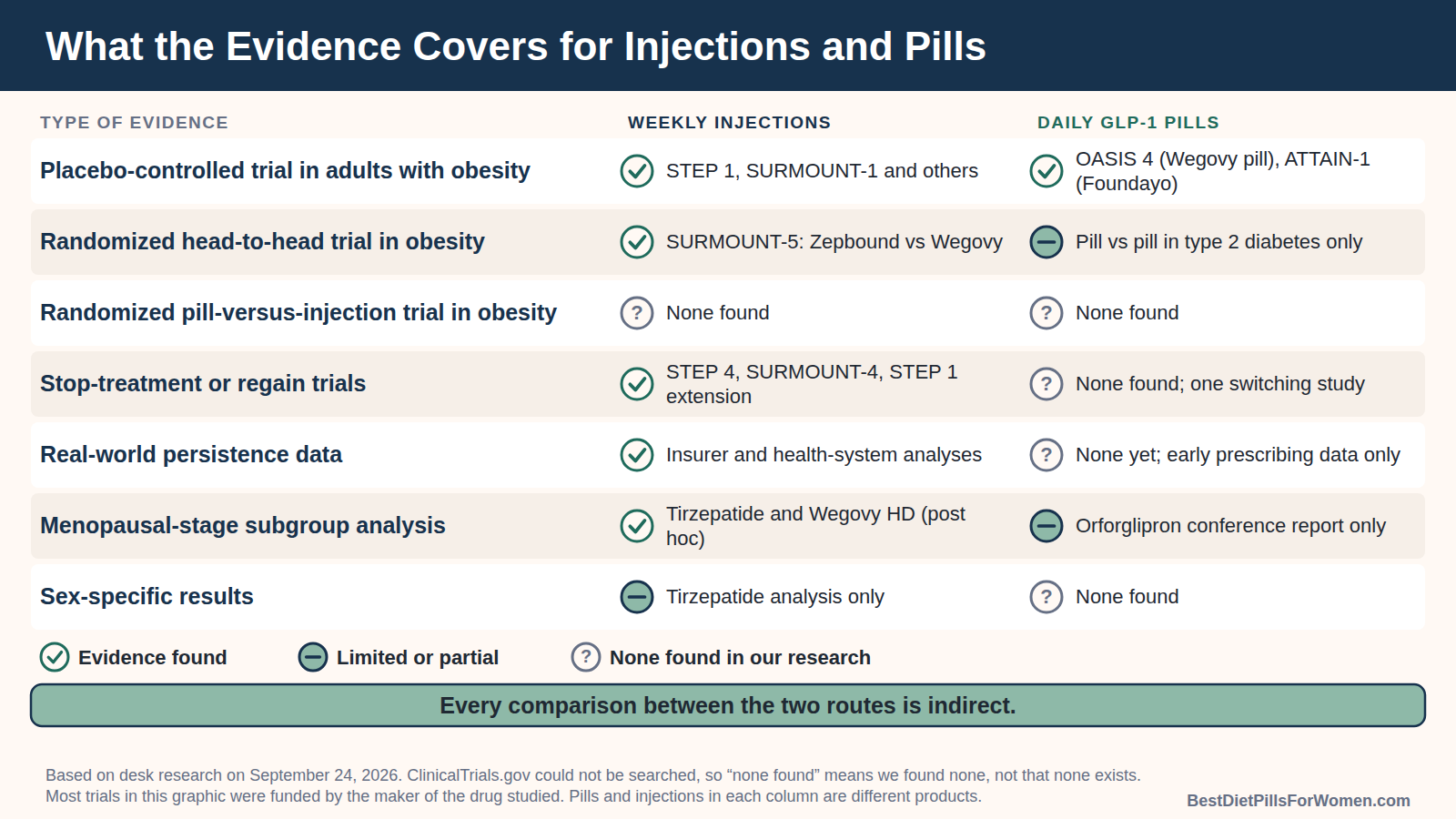
For the injections, we have placebo-controlled trials, a randomized head-to-head between the two leading drugs, and several stop-treatment trials. For the two new pills, we have one placebo-controlled program each, a switching study for one of them, and analyses paid for by the manufacturers. Infographic 2 shows which evidence exists for each route.
How to Weigh Manufacturer-Funded Comparisons
Every comparison in this section whose funder we could identify was paid for by the maker of one of the drugs being compared, and each maker’s analysis favored its own product. That doesn’t make the numbers wrong, and drug companies run many of the best trials. It means the size of the gap deserves more caution than its direction, and an independent trial would be the real test. Until one exists, treat any claim that one route “beats” the other as an estimate and not a finding.
Results Beyond the Average: Who Responds and What Happens After
An average can hide the two things a reader most wants to know: how many people got a result worth having, and whether they kept it. The trials answer both, though not equally well for pills and injections.
How Many People Reach 5%, 10%, 15% and 20% Weight Loss
Trials report the share of participants who reached fixed thresholds, and those shares say more about the spread of results than a mean can.
The Responder Table
Table 5 gives the share of people reaching each threshold, with the placebo share in parentheses. The rows are separate trials, so the comparison is indirect.
| Trial and dose | At least 5% | At least 10% | At least 15% | At least 20% |
|---|---|---|---|---|
| Wegovy 2.4 mg, STEP 1, 68 weeks | 83.5% (31.1%) | 66.1% (12.0%) | 47.9% (4.8%) | 30.2% (1.7%) |
| Wegovy HD 7.2 mg, STEP UP, 72 weeks | 88.7% (38.3%) | 79.8% (20.3%) | 63.8% (7.5%) | 45.5% (2.8%) |
| Zepbound 5 mg, SURMOUNT-1, 72 weeks | 85.1% (34.5%) | 68.5% (18.8%) | 48.0% (8.8%) | 30.0% (3.1%) |
| Zepbound 15 mg, SURMOUNT-1, 72 weeks | 90.9% (34.5%) | 83.5% (18.8%) | 70.6% (8.8%) | 56.7% (3.1%) |
| Wegovy pill 25 mg, OASIS 4, 64 weeks | 76.3% (31.3%) | 59.8% (14.4%) | 47.0% (5.5%) | 27.9% (3.1%) |
| Foundayo 5.5 mg, ATTAIN-1, 72 weeks | 59.6% (26.8%) | 32.5% (13.0%) | 14.3% (6.0%) | 5.9% (2.9%) |
| Foundayo 17.2 mg, ATTAIN-1, 72 weeks | 71.5% (26.8%) | 54.5% (13.0%) | 35.9% (6.0%) | 18.4% (2.9%) |
Table 5 method: figures are the percentage of randomized participants reaching each threshold, from the Wegovy, Zepbound and Foundayo prescribing information (Section 14), which handle missing data by imputation. Each trial’s placebo group is shown in parentheses. Trials differ in length, population, dose and size, so no row is a head-to-head result.
What the Responder Numbers Show and Don’t Show
Three patterns stand out. The first is that a large majority of people on the top doses lost at least 5% of their weight, the level at which many guidelines say health benefits begin: 71.5% on the top Foundayo dose, 76.3% on the Wegovy pill, 83.5% on Wegovy and 90.9% on the highest Zepbound dose. The second is that the gap between routes opens up at the higher thresholds. About 28% of Wegovy pill users and 18.4% of top-dose Foundayo users reached 20%, against 30.2% on Wegovy and 56.7% on the top Zepbound dose.
The third is that not everyone responds. Even on the injections, 16.5% of Wegovy users and 9.1% of top-dose Zepbound users fell short of 5%, and on the top Foundayo dose 28.5% did. Placebo groups also produce “responders”: between 26.8% and 38.3% lost at least 5% on placebo alone, again with diet and activity counseling in the mix. So a person who doesn’t respond to one drug hasn’t failed, and the label for Saxenda builds that idea in by telling prescribers to stop it if a patient hasn’t lost at least 4% by week 16.
What Happens After Weight Loss Stops or Levels Off
Weight loss with these drugs has a well-documented shadow: the weight tends to come back when treatment ends. This is the part of the pill-versus-injection question where the two routes have the most uneven evidence.
Regain After Stopping Injections
Several randomized trials followed people after they stopped an injection, and they agree. In STEP 4, people who moved to placebo after 20 weeks on Wegovy regained weight (+6.9%) while those who kept going kept losing (−7.9%). In SURMOUNT-4, people who switched from Zepbound to placebo after 36 weeks regained 14.0% of their body weight, while those who continued lost another 5.5%. A 2026 meta-analysis of stopping trials estimated that people stopping the newer incretin drugs regained about 0.8 kilograms a month, or roughly 9.9 kilograms in the first year, from an average starting loss of 14.7 kilograms. The 2026 joint TOS, OMA and OAC guidance for U.S. adults gives a strong recommendation to continue obesity medication during weight maintenance.
What We Know and Don’t Know About Stopping the Pills
We found no stop-treatment trial for the Wegovy pill or Foundayo. The closest data are from ATTAIN-MAINTAIN, and they cut two ways. After 72 weeks on Zepbound or Wegovy, people who switched to orforglipron kept 74.7% (Zepbound group) and 79.3% (Wegovy group) of their prior weight loss over 52 weeks, against 49.2% and 37.6% on placebo. So the pill held most of the loss, but not all of it, and the trial had no group that stayed on the injection. Lilly funded it, and it enrolled a select group of people who had already tolerated an injection and plateaued.
The After-Stopping Table
Table 6 lines up the studies. Each answers a different question, so read the “what it shows” column before the numbers.
| Study | Design | Result | What it shows |
|---|---|---|---|
| STEP 1 extension | 327 people stopped Wegovy and the lifestyle program after 68 weeks | Regained 11.6 points of the 17.3% they had lost, about two-thirds | Regain after stopping the drug and the program together |
| STEP 4 | 20 weeks of Wegovy, then continue vs placebo for 48 weeks | −7.9% vs +6.9% from week 20 to week 68 | Continuing works better than stopping |
| SURMOUNT-4 | 36 weeks of Zepbound, then continue vs placebo | −5.5% vs +14.0% from week 36 to week 88; 89.5% vs 16.6% kept at least 80% of the loss | Same finding with tirzepatide |
| SURMOUNT-MAINTAIN | 60 weeks of Zepbound, then full dose vs 5 mg vs placebo for 52 weeks | −21.9%, −16.6%, −9.9% at week 112; regained at least half: 8%, 25%, 67% | A lower dose kept much of the loss |
| ATTAIN-MAINTAIN | After 72 weeks of Zepbound or Wegovy, orforglipron vs placebo for 52 weeks | Kept 74.7% vs 49.2% (Zepbound group) and 79.3% vs 37.6% (Wegovy group) of prior loss | A pill kept most of the loss; no injection comparison arm |
| Stopping a pill, any trial | None found | Not applicable | The pills’ regain rate is unknown |
Table 6 method: figures come from the trials and reviews, read through label tables, abstracts, a journal scan (SURMOUNT-MAINTAIN, whose paper we didn’t access) and a Lilly press release. Weight-change figures are means from baseline or from the start of the stated phase; the STEP 1 extension used a subset of participants, so its 17.3% differs from the 14.9% in Table 3. The SURMOUNT-MAINTAIN means differ slightly between the journal summary and congress coverage.
How Many People Actually Stay on Treatment
Trials keep participants on a schedule with regular visits. Outside a trial, many people stop.
Real-World Persistence With Injections
Real-world studies of the injections show high rates of stopping, though the numbers vary with era and definition. A report from the pharmacy benefit manager Prime Therapeutics, based on commercial insurance claims, found that one-year persistence with Wegovy for weight loss was 33.2% among people who started in 2021 and 62.7% among those who started in the first quarter of 2024, and it reported three-year persistence of 8.1%. A JAMA Network Open analysis of 125,474 adults with overweight or obesity found that 64.8% of those without diabetes stopped within 12 months, and a Cleveland Clinic study found that more than half stopped by 12 months, with those who stopped early losing 3.6% of body weight against 11.9% for those who never stopped.
We wouldn’t average those figures. They cover different years, insurance situations and definitions of “stopped,” and some people counted as stopping may have switched to a compounded product or begun paying cash. The direction is clear, though, and it matters for a comparison: a route’s average trial result is worth little if many people don’t stay on it.
No Persistence Data Yet for the Pills
We found no persistence or discontinuation data for the Wegovy pill or Foundayo outside the trials. The earliest real-world glimpse is a preliminary Truveta analysis of 8,762 people who received a Wegovy pill prescription in the first six weeks after approval, 73.3% of them women. Among those with a prior-year record, 36.1% were new to GLP-1 medicines, 33.2% had previously used injectable semaglutide for obesity and 24.5% had used tirzepatide. It says who tried the pill first, and nothing yet about who stayed.
Safety, Side Effects and Warnings: Pills Compared With Injections
The safety profile of the two new GLP-1 pills looks a lot like the profile of the GLP-1 injections, because they work on the same hormone system. The bigger safety differences run between the GLP-1 drugs as a group and the older prescription pills and over-the-counter products, each of which has its own problems. This section covers the side effects most people notice, the warnings on the labels, and the newer questions regulators have been sorting out. It isn’t medical advice, and the current prescribing information and a pharmacist are the places to check for your own situation.
Common Side Effects Side by Side
For every GLP-1 product, the common side effects are digestive: nausea, vomiting, diarrhea and constipation. They tend to be worst while the dose is being raised.
The Side-Effect Table
Table 7 puts the label percentages next to each other, with the placebo rate in parentheses. The rows come from different trials, so the table is an indirect comparison and the placebo columns matter as much as the drug columns.
| Product and route | Nausea | Vomiting | Diarrhea | Constipation | Stopped because of side effects |
|---|---|---|---|---|---|
| Wegovy injection 2.4 mg, weekly | 44 (16) | 24 (6) | 30 (16) | 24 (11) | 6.8 (3.2) |
| Zepbound injection 15 mg, weekly | 28 (8) | 13 (2) | 23 (8) | 11 (5) | 6.7 (3.4) |
| Saxenda injection 3 mg, daily | 39.3 (13.8) | 15.7 (3.9) | 20.9 (9.9) | 19.4 (8.5) | 9.8 (4.3) |
| Wegovy pill 25 mg, daily | 46.6 (18.6) | 30.9 (5.9) | Not tabulated in the label | Not tabulated in the label | 6.9 (5.9) |
| Foundayo pill 17.2 mg, daily | 35 (10) | 24 (4) | 25 (11) | 24 (9) | 10 (3) |
| Contrave pill, daily | 32.5 (6.7) | 10.7 (2.9) | 7.1 (5.2) | 19.2 (7.2) | 24 (12) |
Table 7 method: figures are from the prescribing information (pooled label tables) for Wegovy, Zepbound, Saxenda, Foundayo and Contrave. The Wegovy pill’s label doesn’t tabulate individual symptoms and says they were similar to the injection’s table, so its nausea and vomiting rates come from secondary reports of the OASIS 4 trial and are not label figures. Placebo rates are in parentheses. Populations, dose schedules, trial lengths and the way events were collected differ, so the table isn’t a ranking.
How to Read the Side-Effect Numbers
The first thing to notice is the placebo column. Nausea on placebo ran from 8% in the pooled Zepbound trials to 10% in Foundayo’s, 16% in Wegovy’s and 18.6% in the Wegovy pill’s trial, so the same drug effect would look different in each program. The Wegovy pill’s nausea and vomiting rates look higher than the injection’s, but the trials differ and the pill’s label calls the two sets of side effects similar, so we wouldn’t read the gap as proof that the pill is harder on the stomach.
The second is that stopping is more informative than the symptom rates. Subtracting the placebo figures, the extra share of people who quit because of side effects was about 3.6 points on Wegovy, 3.3 on Zepbound 15 mg, 5.5 on Saxenda, 1.0 on the Wegovy pill and 7 on the top Foundayo dose. The Wegovy pill’s small excess comes from a trial with only 205 people on the drug, so it’s imprecise. The one randomized comparison of two of these drugs, SURMOUNT-5, found that 6.1% of people stopped Zepbound because of side effects and 8.0% stopped Wegovy. The ATTAIN-1 trial report describes orforglipron’s digestive effects as mostly mild to moderate and appearing mainly during dose escalation.
Boxed Warnings and Shared Class Warnings
A boxed warning is the strongest warning FDA puts on a label. The GLP-1 products share several warnings, and the labels differ in a few details that matter for a pill-versus-injection choice.
The Warning Comparison
Table 8 sets out the main warnings across the GLP-1 injections, the Wegovy pill and Foundayo.
| Warning topic | GLP-1 injections (Wegovy, Zepbound, Saxenda) | Wegovy pill | Foundayo |
|---|---|---|---|
| Boxed warning | Risk of thyroid C-cell tumors, seen in rodents | Same boxed warning | Same boxed warning, but the label says orforglipron was inactive in rodents and human relevance is not determined |
| Contraindications | Personal or family history of medullary thyroid carcinoma or multiple endocrine neoplasia type 2; serious hypersensitivity | Same | Same |
| Pancreatitis | Warning on each label; Zepbound cites 0.2% adjudicated | Same as the Wegovy label | 6 confirmed events in treated patients (0.14 per 100 patient-years) vs 2 events in 1 placebo patient |
| Gallbladder disease | Wegovy 1.6% gallstones vs 0.7%; Zepbound 1.1% vs 1% | 2.5% vs 1% | 1% vs 0.7% |
| Heart rate | Increase of 1 to 4 bpm (Wegovy), 1 to 3 (Zepbound), 2 to 3 (Saxenda) | Not separately stated in what we read | Increase of 4 to 5 bpm from baseline vs 0.5 on placebo |
| Injection-site reactions | Wegovy 1.4% vs 1%; Zepbound 6% to 8% vs 2%; Saxenda 13.9% vs 10.5% | Not applicable | Not applicable |
| Other oral medicines | Delayed stomach emptying is noted; Zepbound has contraceptive advice | Levothyroxine exposure rose 33%; wait 30 minutes before other oral medicines | Label says delayed emptying may affect absorption of oral medicines |
| Suicidality | FDA asked in January 2026 to remove the warning from Saxenda, Wegovy and Zepbound | Same Wegovy label | No such heading in the warnings we read |
Table 8 method: entries come from the prescribing information for each product and from FDA’s January 13, 2026 drug safety communication. We read labels and label mirrors through summaries, so a warning we didn’t see could exist. Incidence figures come from different trials and aren’t directly comparable.
Where the Routes Differ
Most of Table 8 is the same across routes, and the differences are small and specific. Foundayo’s boxed warning rests on a different basis: its label says orforglipron doesn’t act on rodent receptors and didn’t produce tumors in rodents, and that whether the human GLP-1 receptor could cause the same tumors hasn’t been determined. Foundayo’s stated heart rate rise of 4 to 5 beats a minute is the largest on the list, though it’s measured from baseline and the injection figures are measured against placebo.
Skin sensitivity is another difference. Dysesthesia, an unusual skin sensation such as tingling or discomfort to the touch, was reported by 5% of people on the Wegovy pill against 0% on placebo, and by 22% on Wegovy HD against 6% on the 2.4 mg dose and 0.3% on placebo. And because a swallowed drug meets the stomach, the pills carry more advice about timing and other medicines, a topic we take up in the daily-routine section.
Older Prescription Pills and Their Own Risks
Many readers who ask about pills mean these drugs, and their risks are different from the GLP-1 class.
Contrave and Qsymia
Contrave carries a boxed warning about suicidal thoughts and behaviors, which is standard for drugs containing an antidepressant ingredient, and its label lists contraindications that include uncontrolled high blood pressure, a seizure disorder, bulimia or anorexia nervosa, and chronic opioid use. Qsymia has no boxed warning, but it’s sold under a restricted program because topiramate can harm a developing fetus, and its common side effects at the top dose include tingling or numbness (20% vs 2% on placebo), dry mouth (19% vs 3%) and constipation (16% vs 6%). Qsymia’s contraindications and warnings were revised in March 2026, and we couldn’t see what changed, so the current label is the place to check.
Phentermine, Orlistat and OTC Supplements
Phentermine’s label lists contraindications that include cardiovascular disease, uncontrolled high blood pressure, an overactive thyroid, glaucoma, agitated states, a history of drug abuse, use of an MAOI and pregnancy, and it gives no side-effect frequencies. Orlistat mainly affects the gut: in the year-one Xenical data, oily spotting occurred in 26.6% of users against 1.3% on placebo. FDA approved labeling changes for the OTC version, alli, to warn of kidney stones and kidney injury.
Supplements are a separate matter. FDA doesn’t review them for safety or effectiveness before sale, and it keeps a running list of weight loss products it has found to contain hidden or unlisted drug ingredients. “Natural” on a bottle isn’t a safety claim.
Newer Safety Questions and Regulatory Changes
Several safety questions have moved in the past two years, and a few remain open.
The Suicidality Warning That Was Removed
In January 2026, FDA asked to remove the suicidal behavior and ideation warning from the labels of Saxenda, Wegovy and Zepbound. It cited a meta-analysis of 91 placebo-controlled trials with 107,910 patients that showed no increased risk, and a retrospective cohort of 2.2 million users that found no increased risk of intentional self-harm. FDA still tells patients to report new or worsening depression, suicidal thoughts or unusual changes in mood or behavior. Contrave’s boxed warning and Qsymia’s warning on the topic remain.
Anesthesia, Surgery and Other Open Questions
All four GLP-1 labels we read warn that delayed stomach emptying has led to rare reports of pulmonary aspiration, meaning stomach contents entering the lungs, during anesthesia or deep sedation, and none gives a fixed interval for stopping the drug beforehand. A multisociety guidance from October 2024 said most patients should continue GLP-1 medicines before elective surgery, with extra precautions for people in dose escalation or with digestive symptoms, and it predates the pills. The practical step is to tell the team before any procedure.
A rare eye condition is a second open question. In 2025, the European Medicines Agency’s safety committee concluded that non-arteritic anterior ischemic optic neuropathy, a sudden loss of vision, is a very rare side effect of semaglutide medicines, affecting up to 1 in 10,000 people. The U.S. labels we read didn’t mention it, and we found no FDA safety communication or comparable assessment for tirzepatide or orforglipron.
Symptoms Worth a Call to a Clinician or Pharmacist
These drugs’ labels and regulators name a few situations where waiting isn’t a good idea.
Severe Abdominal Pain and Dehydration
Persistent or severe abdominal pain, sometimes radiating to the back, with or without nausea or vomiting, is the label’s description of possible pancreatitis. Vomiting and diarrhea can also lead to dehydration, and the labels warn of acute kidney injury from volume depletion, sometimes requiring dialysis. Those are reasons to contact a clinician promptly, not to wait it out.
Mood Changes and Signs the Labels Mention
FDA continues to advise reporting new or worsening depression or unusual mood changes on GLP-1 drugs, and the Contrave label makes the same point more strongly. The labels also tell prescribers to counsel patients about the symptoms of thyroid tumors, which is one more reason to tell your prescriber about a personal or family history of thyroid cancer before starting.
Women’s Health Considerations: Pregnancy, Menopause, PCOS and Body Changes
The main trials in this guide enrolled mostly women, between 64% and 79% of participants, yet very few report results by sex or by life stage. The label-level differences between pills and injections are small and don’t point clearly to either route. What differs is the fine print about pregnancy, contraception and breastfeeding, and how much is known about women in menopause or with PCOS.
Pregnancy, Contraception and Breastfeeding
The Zepbound and Foundayo labels say weight loss offers no benefit to a pregnant patient and may cause fetal harm, and every GLP-1 label we read says to discontinue the drug when pregnancy is recognized. The instructions around that aren’t the same from label to label, and the route doesn’t predict them.
What Each Label Says About Pregnancy, Contraception and Breastfeeding
Table 9 gathers the label language for the main products, so you can compare them in one place.
| Product | Before a planned pregnancy | If pregnancy occurs | Breastfeeding | Oral contraceptive advice |
|---|---|---|---|---|
| Wegovy (injection and pill) | Stop at least 2 months before | Discontinue | Pill: not recommended (an absorption-enhancer ingredient reaches milk); injection: no data | No switch advice; a tablet study found no clinically significant change for ethinyl estradiol or levonorgestrel |
| Zepbound (injection) | No interval stated | Discontinue when recognized | A single-dose study found undetectable or low levels in milk; effects on the infant unknown | Switch to a non-oral method or add a barrier method for 4 weeks after starting and after each dose increase; blood levels of the hormones fell in a measured study |
| Foundayo (pill) | No interval stated | Discontinue | Not recommended for nursing women | Switch to a non-oral method or add a barrier method for 30 days after starting and after each dose increase; the label says the effect was not evaluated in a clinical trial |
| Saxenda (injection) | Not found in what we read | Discontinue when recognized | No data | Not found in what we read |
| Qsymia (capsule) | Restricted program: pregnancy test before starting and monthly | Contraindicated | Not recommended | Contraceptive hormone levels change; irregular bleeding is possible |
| Phentermine (tablet) | Not applicable; pregnancy is a contraindication | Contraindicated | Label says to decide between stopping nursing and stopping the drug | Not addressed in what we read |
Table 9 method: entries are drawn from the prescribing information for each product, read through summaries and label mirrors. Only Wegovy’s label gives a stop-before-pregnancy interval; the ADA and Obesity Association’s 2026 Standards of Care, as summarized by a trade publication, advise at least 2 months for all obesity medicines, which is broader than the labels. This is not medical advice; any decision about stopping or starting a drug belongs with a prescriber.
The route doesn’t sort the products neatly. The injection with the most specific measured effect on birth control, Zepbound, asks for a backup method for four weeks after each start and increase, while the Wegovy pill’s label has no switch advice at all, and Foundayo’s asks for 30 days on the basis of precaution. If you use an oral contraceptive, the label for your specific medicine is the source to follow.
What Studies Say About Pregnancy and Fertility
Human data on these drugs in pregnancy are observational. A Massachusetts General Brigham cohort published in JAMA in 2025 found that people who stopped a GLP-1 medicine before or early in pregnancy gained more weight in pregnancy (13.7 kilograms vs 10.5) and had more preterm births (17% vs 13%), gestational diabetes (20% vs 15%) and hypertensive disorders (46% vs 36%) than matched people who hadn’t used one. It can’t separate the effect of stopping from the underlying obesity. A separate 2026 Annals of Internal Medicine study of 3,572 pregnancies found no definitive increase in risk for most outcomes when the medicine was continued into early pregnancy, though its estimates for rare outcomes such as major malformations were imprecise. Neither study is an endorsement of use in pregnancy, and the labels say to stop.
The widely repeated idea that these drugs raise fertility is a hypothesis. We found no randomized trial with pregnancy as its main outcome, and the PCOS trials reviewed in a 2026 meta-analysis reported no pregnancy outcomes.
Menopause, PCOS and Sex Differences in Response
These are the questions our readers ask most often. The honest answer to each is that the evidence is mostly post hoc, which means the analysis was done after the trial to look at a subgroup it wasn’t designed to test.
Menopausal Stage and Weight Loss Results
Three post hoc analyses suggest that women lose weight on these drugs at every menopausal stage. In a post hoc analysis of three SURMOUNT trials covering 2,542 women, the SURMOUNT-1 women taking tirzepatide at 15 mg or the highest tolerated dose lost an average of 26% of body weight if premenopausal, 23% if perimenopausal and 23% if postmenopausal, against 2% to 3% on placebo. A Novo Nordisk analysis of 753 women in STEP UP found losses of 22.6%, 19.7% and 19.8% at the same three stages on Wegovy HD. A conference report on orforglipron in ATTAIN-1 and ATTAIN-2 said the placebo-adjusted loss reached about 14% at every stage but gave no stage-specific numbers. We found no menopausal-stage analysis of the Wegovy pill. The subgroup figures aren’t directly comparable with the all-participant averages in Table 3, since they cover women only and come from post hoc methods.
It also helps to put midlife weight in context. In the long-running SWAN study of 1,246 women, fat mass gain roughly doubled around the menopause transition while the overall rate of weight gain didn’t change and average lean mass loss was small, about 0.2 kilograms. Our guide to weight loss pills for menopause goes further into that stage.
PCOS, Now Also Called PMOS
Polycystic ovary syndrome was renamed polyendocrine metabolic ovarian syndrome (PMOS) in May 2026, with a three-year transition, and most readers still search for PCOS. The international guideline says anti-obesity medicines may be considered using general-population guidance, balancing benefits and side effects. The trials specific to PCOS are small and short. A systematic review that informed that guideline found 11 randomized trials of 12 to 32 weeks and called the data “very limited,” and a 2026 meta-analysis of GLP-1 trials in PCOS included 11 randomized trials, none of them of semaglutide or tirzepatide, with a small average drop in body mass index of 1.38 points and low-certainty evidence. A 2025 meta-analysis that did include a small semaglutide sample reported a body-weight difference of about 3.6 kilograms against controls, most of whom took metformin. A UK observational study of tirzepatide found that women with self-reported PCOS lost about as much as women without it at six months. We found no PCOS-specific data on the Wegovy pill or Foundayo, and our guide to weight loss pills for PCOS looks at the wider picture.
Whether Women Lose More Than Men
Women appear to lose a larger percentage of body weight on tirzepatide. A post hoc analysis by Lilly-affiliated authors of 4,677 people in SURMOUNT-1 to -4 reported weight reductions of 11.5% to 27.6% in women and 8.8% to 18.9% in men across the trial arms. Men were under-represented in the semaglutide trials: 74% of STEP 1 participants were women. We found no sex-specific analysis for any of the pills, and the Wegovy and Zepbound labels say only that weight loss occurred regardless of sex.
Hair Loss, Muscle and Bone
Two side effects come up often in women’s questions about these drugs, and both track weight loss more than the route.
Hair Loss: A Pattern Across Routes
Hair loss was reported far more often by women than by men on every GLP-1 label we read. Zepbound’s label gives 7.1% of women vs 0.5% of men, and Foundayo’s gives 7% vs 0.9%, against 1.3% and 3% of women on placebo. Wegovy’s 7.2 mg dose showed 8.4% of women vs 0.2% of men, while the 2.4 mg dose showed about 3% overall against 1% on placebo. Foundayo’s label states that hair loss was associated with weight reduction. The pattern holds for the pill and the injections alike, which suggests the amount of weight lost matters more than the route.
Muscle and Bone: What the Studies Found
Some of the weight lost on these drugs is lean mass, which includes muscle. In X-ray body-composition substudies, lean mass made up about 25% of the weight lost on tirzepatide (SURMOUNT-1, and the same share in the placebo group), about 27% on orforglipron (ATTAIN-1), and about 38% in a semaglutide substudy, and we found no such data for the Wegovy pill. A 2026 meta-analysis of seven trials put the average lean-mass loss at 1.74 kilograms. A joint advisory from four nutrition and obesity societies recommends protein of 1.2 to 1.6 grams per kilogram of body weight a day during weight reduction, plus resistance training at least three times a week, and our guides to preserving muscle during weight loss and protein for weight loss cover the practical side.
Bone data are thinner. In the SELECT trial described in Wegovy’s label, which enrolled adults with heart disease, hip or pelvis fractures occurred in 1% of women on Wegovy and 0.2% on placebo, and we found no comparable data for the pills.
Daily Routine, Convenience and Practical Differences
For many women the deciding factor isn’t the average percentage in a trial. It’s whether a routine fits into a life with work, kids, travel and other medicines. The labels spell out those routines in detail, and they’re more different than “a pill a day vs a shot a week” suggests.
How Each Product Is Taken
The two GLP-1 pills don’t share one routine, and neither do the injections. What follows comes from each product’s prescribing information and from manufacturer instructions for the pens.
The Practical Comparison
Table 10 lines up the daily routine for the two GLP-1 pills, the two weekly injections and the older daily injection, Saxenda.
| Product | How often and when | If you miss a dose | Needles and supplies | Storage |
|---|---|---|---|---|
| Wegovy pill (daily tablet) | One tablet each morning on an empty stomach with up to 4 ounces of plain water; swallow whole; wait at least 30 minutes before food, other drinks or other oral medicines | Skip it and take the next dose the following day | None | 68°F to 77°F in the original bottle, with brief excursions between 59°F and 86°F allowed |
| Foundayo (daily tablet) | One tablet a day, with or without food; swallow whole | Take it as soon as possible, and don’t double up; after 7 or more missed doses in a row, restart the dose escalation at a lower dose | None | Not found in what we read |
| Wegovy pen (weekly injection) | Once a week on the same day, any time of day, with or without meals; abdomen, thigh or upper arm | If the next dose is more than 2 days away, take it as soon as possible; if it’s less than 2 days away, skip it | Needle is built in, with no priming or attaching; the injection takes about 5 to 10 seconds; four single-dose pens make up a 28-day fill | Refrigerator, 36°F to 46°F; the pen can be kept at 46°F to 86°F for up to 28 days |
| Zepbound (weekly injection) | Once a week under the skin of the abdomen, thigh or upper arm | Take it as soon as possible within 4 days (96 hours) of the missed dose | Vials need a new syringe and needle for every dose; KwikPen needles are bought separately; both are sold apart from the drug | Refrigerator, 36°F to 46°F; single-dose pens and vials can stay unrefrigerated up to 86°F for 21 days in total, and multi-dose vials and KwikPens for 30 days |
| Saxenda (daily injection) | Once a day at any time, regardless of meals | Resume with the next scheduled dose | Needles are separate; remove and discard the needle after each injection | Refrigerator before first use; after first use, 30 days at 59°F to 86°F or in the refrigerator |
Table 10 method: routine, missed-dose and needle entries come from the prescribing information for each product, read through summaries, plus Novo Nordisk’s Wegovy pen page and Lilly’s and Novo’s price pages for what is sold separately. Storage for the Wegovy pen comes from a Novo Nordisk Medical page, and Zepbound’s comes from a label mirror carrying an April 2026 revision code that may be older than the current label, because Section 16 of those labels wasn’t visible in what we read. We didn’t find Foundayo’s storage instructions. Check the medication guide that comes with your product before relying on any row.
Three things stand out. The Wegovy pill has the strictest routine: it has to be taken first thing, on an empty stomach, with only plain water, and the 30-minute wait applies to other pills too. That matters for anyone who already takes a daily medicine with its own timing rules, and the label notes that levothyroxine exposure rose 33% when the two were taken together. Foundayo’s label has no food or timing restriction, which makes it the loosest routine on the list. And the weekly injections trade a daily task for a weekly one that involves a device and cold storage.
Missed Doses and Restarting
Missed-dose rules differ enough that they can’t be swapped between products. The Wegovy pill says to skip a missed dose, Foundayo says to take it as soon as you can, and the Wegovy pen has a two-day cutoff that Zepbound stretches to four days. Foundayo’s label also has a restart rule: after seven or more missed doses in a row, escalation begins again at a lower dose to limit stomach side effects. We found no equivalent rule in the injection labels we read.
A daily tablet asks for seven correct doses a week and a weekly injection asks for one. Whether that difference changes how consistently people take these products hasn’t been tested in a randomized comparison, and the real-world persistence data earlier in this guide don’t settle it either. If you miss doses often, that’s worth mentioning to your prescriber or pharmacist.
Needles, Storage and Supplies
The logistics of an injection go beyond the needle itself, and some of them cost money and effort that never show up in a trial.
Needles and Sharps Disposal
The Wegovy pen is the simplest injection on the list: the manufacturer says the needle is built in and hidden, no priming is needed, and the injection takes about 5 to 10 seconds. Zepbound vials need a separate syringe and needle for each dose, and KwikPen needles are bought separately too, in one retailer’s case for a prescription of their own. The added cost is small. One retailer listed a 50-count box of pen needles at a starting price of $7.97, about 16 cents a needle, which works out to roughly $8 for 52 weekly injections. It’s a small amount next to the drug’s price, but it’s one more thing to buy and to remember.
Used needles need a proper container. FDA’s guidance, on a page dated August 10, 2023, says to use a sharps disposal container, keep it away from children and pets, and follow local rules when it’s about three-quarters full, and it adds that disposal programs vary by community. Options on that page include drop-off sites at pharmacies, hospitals and clinics and mail-back programs, which typically charge a fee. A pill has none of this.
Storage and Travel
Refrigeration is the other injection burden. Both weekly injections are kept cold, but the labels and manufacturer pages allow days to weeks at room temperature: up to 28 days for the Wegovy pen and 21 to 30 days for Zepbound, depending on the format. That gives some room for a trip, and it’s a ceiling for planning, not something to stretch. The Wegovy pill can be stored at room temperature in its bottle, and we couldn’t find Foundayo’s storage instructions. We also didn’t find airline or security rules for carrying injections, so anyone traveling with pens should check with the airline and their pharmacist.
What Patients Say They Prefer
Surveys on preference are the only direct evidence we have on convenience, and they’re thin.
The VOICE Preference Study
A U.S. study called VOICE asked 351 adults with obesity or overweight and related conditions, 68.4% of them women, to choose between hypothetical treatments that differed only in route and routine. The route (a daily pill or a weekly injection) accounted for 62.7% of what drove choices, food and water restrictions for 21.2% and storage for 16.1%, and the daily pill was significantly preferred to the weekly injection. About one in four participants, 25.4%, said they were unwilling to use weekly injections. The study held effectiveness and side effects equal by design and didn’t evaluate cost, and we couldn’t capture who funded it.
An Australian study of 193 patients found a different pattern. Stomach side effects were the most influential attribute, at about 30%, and patients preferred an oral drug and a disposable pen with a hidden needle about equally, ahead of a pen with a replaceable needle. It isn’t a U.S. sample, but it hints that the needle experience matters more than the word “injection.”
What Preference Studies Can’t Tell You
Stated preferences are a poor guide to what a person will do. In these studies everything but route is held constant, and in a pharmacy nothing is: the pills lose less weight on average in the trials we have, the prices differ, and insurance may cover one route and not another. A physician quoted by the Association of American Medical Colleges said the pill may appeal to people who are averse to needles, have trouble injecting themselves, or travel without easy access to refrigeration, and that view is a clinician’s opinion and not survey data.
We also found no preference data specific to women, no survey of people who’ve used both routes, and no data on how preference relates to staying on treatment. The practical takeaway is modest. If a routine is one you can keep up, it’s worth weighing next to the average results, and if either route is a deal-breaker for you, that’s a fair thing to tell a clinician at the start.
What Weight Loss Pills and Injections Cost
Cost is where the pill-versus-injection comparison changes most in a single year. The price a person pays depends on who’s paying, which product and dose, and whether a promotion is running, and every price in this section is a snapshot from September 24, 2026 that a manufacturer can change. We kept it to prices we could read on manufacturer pages, and we left cost per pound lost out on purpose, because the trial results in Table 3 are averages from different studies and dividing a price by them would suggest a precision the evidence doesn’t have.
What a Cash Payer Pays in a Year
Both Novo Nordisk and Eli Lilly now sell directly to people paying without insurance, at monthly prices that rise with the dose. That makes a rough annual comparison possible for the four main GLP-1 products.
The 12-Fill Cost Table
Table 11 multiplies each self-pay price by 12 fills at a maintenance dose, and for the weekly injections it adds a 13-fill column, for a reason explained just below.
| Product and dose | Price per fill | Conditions | 12 fills | 13 fills (weekly injections) |
|---|---|---|---|---|
| Wegovy pill 25 mg (30 tablets) | $299 | Self-pay price on NovoCare; no end date shown | $3,588 | Not applicable |
| Foundayo 14.5 or 17.2 mg (30 tablets) | $299 | Only if each refill is bought within 45 days of the previous one | $3,588 | Not applicable |
| Foundayo 14.5 or 17.2 mg, refill window missed | $349 | Regular price | $4,188 | Not applicable |
| Wegovy pen 2.4 mg (4 pens) | $349 | Standard self-pay price | $4,188 | $4,537 |
| Wegovy HD pen 7.2 mg (4 pens) | $399 | Standard self-pay price | $4,788 | $5,187 |
| Zepbound 5 mg (vial or KwikPen) | $399 | Needles and syringes extra | $4,788 | $5,187 |
| Zepbound 7.5 to 15 mg (vial or KwikPen) | $449 | Only with refills within 45 days; needles and syringes extra | $5,388 | $5,837 |
| Zepbound 10 to 15 mg, refill window missed | $699 | Regular price | $8,388 | $9,087 |
Table 11 method: prices are the monthly self-pay prices on the manufacturers’ direct-purchase pages, read through page summaries on September 24, 2026, and each total is price per fill multiplied by 12 or 13. A fill is 30 tablets for the pills and four weekly doses (28 days) for the injections. Totals exclude needles, syringes, clinician visits, lab tests, telehealth fees and shipping, assume no missed fills, and don’t imply equal weight loss at these doses. The Zepbound single-dose pen has no self-pay price on the page we read, so it isn’t in the table.
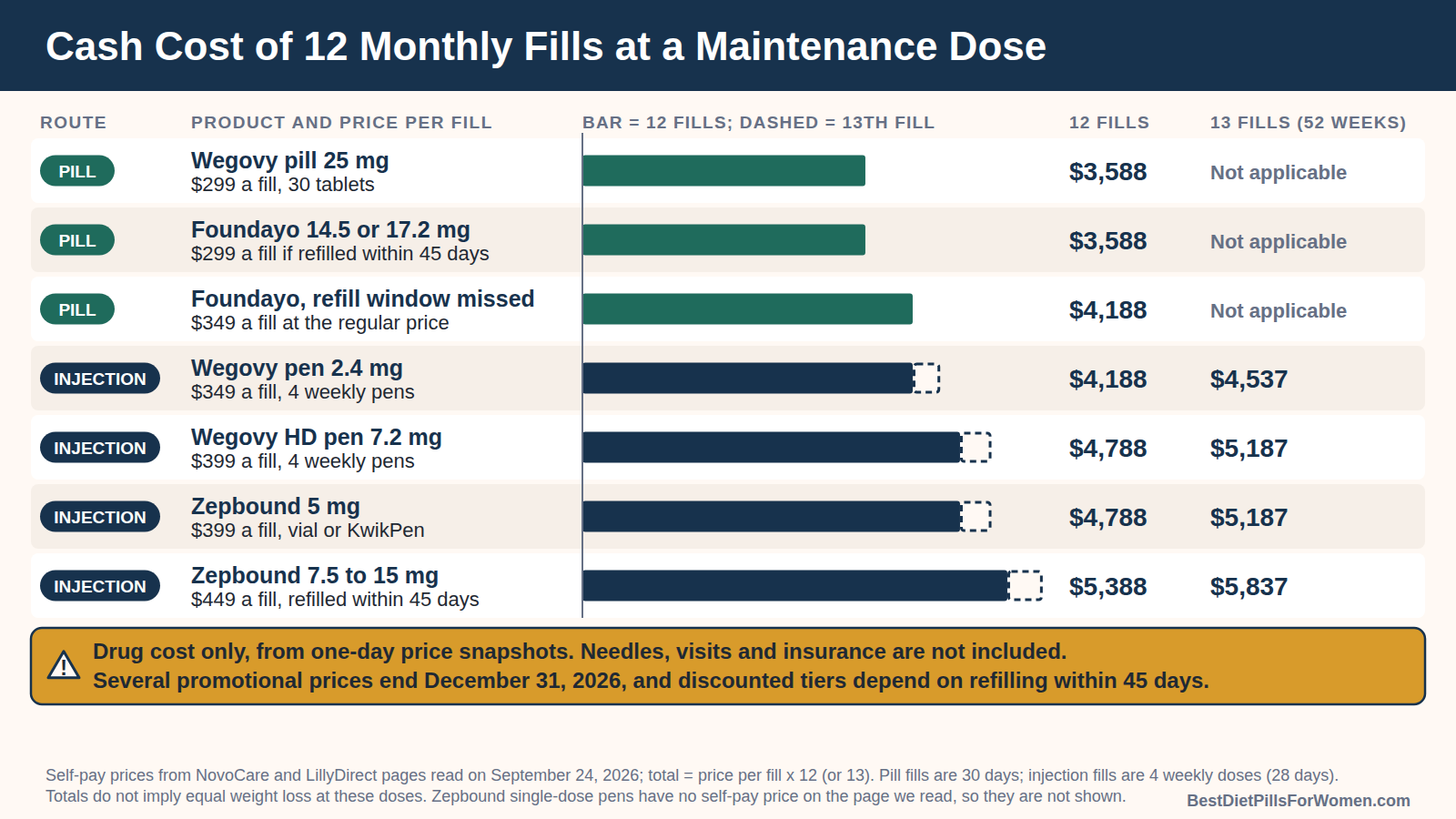
At maintenance doses the two pills come out lowest, at $3,588 a year for the Wegovy pill and for Foundayo bought on schedule, which is $600 less than the Wegovy pen’s $4,188 (about 14% lower). The difference from the top Zepbound tier is $1,800. Missing Foundayo’s 45-day refill window raises its total to $4,188, and Zepbound’s regular price for the 10 to 15 mg strengths is $699 a fill, $250 more than the discounted price, so timing matters as much as the product. Infographic 3 shows the 12-fill totals side by side.
Why 12 Fills Isn’t a Full Year for Injections
The pills come in 30-day fills, so 12 of them cover 360 days. The weekly injections come in boxes of four doses, or 28 days, so 12 fills cover 48 weeks, and a full 52 weeks takes 13. That’s why Table 11 shows both totals for the injections. Comparing 12 fills of each product understates the injections’ yearly cost by one fill, about $349 to $449, and even the 13-fill figures leave out needles, visits and lab work.
First-Year Costs, List Prices and Extras
Steady-state prices leave out the first year, when the dose is stepped up and some promotions apply.
First-Year Costs While the Dose Is Being Raised
Every product starts at a low dose and moves up, and the lower doses cost less. Following each label’s dose steps at the self-pay prices, 12 fills come to about $3,338 for the Wegovy pill and $3,888 for the Wegovy pen, which includes a $199 introductory price for the first two fills that ends December 31, 2026. Foundayo comes to about $3,188 at current temporary prices for the 2.5 mg and 5.5 mg doses, and to $3,338 at regular prices, on the slowest label path with on-time refills. Zepbound comes to about $5,188 for a person who moves up to 15 mg and $4,688 for one who stays at 5 mg. Add one more fill for the injections to cover 52 weeks: $4,237 for the Wegovy pen, $5,637 for Zepbound at 15 mg and $5,087 for Zepbound at 5 mg. These are our own calculations from listed prices, and a person who moves up faster or slower, or who stops, would pay a different total.
List Prices, Needles and Costs Outside the Price Tag
The self-pay price isn’t the list price. The federal government’s TrumpRx drug-price site shows an original price of $1,349.02 a month for Wegovy, and Zepbound’s list price appeared as $1,060 to $1,088 in the sources we saw, which conflict, while we couldn’t find one for Foundayo. A trade-press report said Novo Nordisk plans to cut Wegovy’s list price by about half on January 1, 2027 and that self-pay prices would be unaffected. List prices matter mostly to people with high-deductible insurance, whose cost can follow the list price, and not to cash payers.
Supplies add a little. At one retailer’s listing, needles for a weekly injection cost about $8 a year, and Lilly sells Zepbound vials and KwikPens without needles or syringes. Clinician visits, blood tests and any telehealth membership fee aren’t in these numbers, and none of the manufacturer pages we read gave them.
Saxenda’s picture is murkier. Novo lists it at $1,349.02 a month and its pharmacy program doesn’t offer a self-pay price for it that we could find, and although Teva launched a generic in August 2025, we couldn’t confirm a current cash price from a primary page. The listings we came across ranged from about $372 to about $1,700 a month, and we couldn’t tell which were for the generic.
Insurance, Medicare and Employer Coverage
With coverage, the picture changes more than it does with any difference between a pill and an injection.
Medicare, Medicaid and Employer Plans
A temporary program called the Medicare GLP-1 Bridge charges eligible Medicare beneficiaries a $50 copay from July 1, 2026, through December 31, 2027. It covers the Wegovy injection and tablets, Foundayo and the Zepbound KwikPen, and it excludes Zepbound vials and single-dose pens and doesn’t cover pen needles. Eligibility runs by body mass index and health conditions: a BMI of at least 35, or a lower BMI with specific conditions such as prediabetes, a prior heart attack or stroke, or uncontrolled high blood pressure, along with ongoing lifestyle changes. Prior authorization decisions are due within 72 hours.
Medicaid is patchy. KFF counted 13 state Medicaid programs covering GLP-1s for obesity in January 2026, down from 16 in October 2025. Employers vary too. A June 2026 survey by the International Foundation of Employee Benefit Plans found that 36% of employers covered these drugs for both diabetes and weight loss, and a Business Group on Health survey of 105 large employers found 67% covering them for weight management, with 72% of those likely to continue. The two surveys sampled different groups, so the numbers don’t conflict, and neither tells you whether your own plan covers a specific drug.
How Coverage Rules Can Outweigh the Route
Insurance can flip the cost comparison. A plan might cover an injection and not a pill, or one brand and not the other, and under the Medicare Bridge the Zepbound KwikPen is covered while the vials and single-dose pens aren’t. Manufacturer savings cards promise costs as low as $25 a month for commercially insured patients, with a maximum savings of $100 a month on Wegovy, and they exclude government beneficiaries, and Lilly’s cards for Foundayo and Zepbound expire December 31, 2026. For someone with coverage, the plan’s formulary and prior-authorization rules can matter more than the route. Our guides to Wegovy pill costs and Wegovy insurance coverage go into the plan details, and a pharmacist or benefits office can say what your own plan does.
Older and Over-the-Counter Pills as the Low-Cost End
The cheapest pills aren’t the GLP-1 tablets. They’re the older drugs and the supplements, at very different levels of evidence.
Older Prescription Pills
Generic phentermine ran about $10 to $23 for 30 tablets in the coupon prices we read, or roughly $120 to $280 a year if used continuously, though its label limits it to short-term use. Qsymia was $74.99 a month through the manufacturer’s home-delivery program, about $900 a year, and Contrave was $99 a month through the manufacturer’s program, about $1,188 a year, or up to $199 a month at a retail pharmacy without insurance. One surprise: generic prescription orlistat 120 mg listed at roughly $554 to $688 a month, which is more than the cash price of the GLP-1 pills.
Over-the-Counter Supplements and alli
Over-the-counter products cost the least. Retail listings for supplements ran from about $8 to about $107 per 30 days in our September 2026 snapshot, or roughly $100 to $1,300 a year, and alli, the OTC orlistat, cost about $58 to $64 per 30 days at three capsules a day. A low price isn’t a sign of value. The supplement trials in Table 3 found small and inconsistent differences, and FDA has found some weight loss products to contain hidden drug ingredients. The question worth asking of any price is what evidence sits behind it.
Compounded Injections, Drops and “GLP-1 Support” Products: The Unapproved Middle
Searches for weight loss pills vs injections also surface products that are neither an approved pill nor an approved injection. They fall into two groups: compounded copies of semaglutide and tirzepatide, and supplements marketed with GLP-1 language. Neither group has the trials, labels or FDA review behind the products in Tables 3 through 11, so this section is about how to recognize them, not how to compare them.
Compounded Semaglutide and Tirzepatide
Compounding is when a pharmacy mixes a medicine for an individual patient or in bulk, and it was widespread during the GLP-1 shortages. The rules have tightened since.
Where the Rules Stand Now
FDA removed tirzepatide from its shortage list on December 19, 2024 and semaglutide on February 21, 2025, which ended the flexibility FDA had allowed compounders while the drugs were scarce. On August 27, 2026, the Fifth Circuit affirmed FDA’s semaglutide shortage-list decision in a case brought by an outsourcing-facility trade group. FDA also proposed on April 30, 2026 to exclude semaglutide, tirzepatide and liraglutide from the bulk-substance list that outsourcing facilities use, but that was a proposal, and we found no final decision. On March 3, 2026, FDA warned 30 telehealth companies over marketing that implied compounded products were equivalent to approved drugs. Whether a particular pharmacy’s product is lawful is a question we can’t answer for you, and it isn’t one that a brand’s website settles.
What FDA Says About Their Safety
FDA’s position, on a page current as of September 1, 2026, is that compounded drugs aren’t FDA-approved, so the agency doesn’t review them for safety, effectiveness or quality before they’re marketed. It reported 990 adverse-event reports for compounded semaglutide and more than 730 for compounded tirzepatide as of May 31, 2026, and it described dosing errors in which patients or health professionals measured or calculated the wrong dose. The page also notes that semaglutide sodium and semaglutide acetate are different active ingredients from those in the approved drugs. The American Diabetes Association and Obesity Association’s 2026 standards say that non-FDA-approved compounded products aren’t recommended. Adverse-event reports can’t give a rate, because we don’t know how many people used the products, but the dosing-error pattern is a concrete reason for caution. We didn’t collect prices or vendor names for compounded products, on purpose.
Oral Drops, Sublingual Products and “GLP-1 Support” Supplements
Many readers asking about pills have seen ads for drops, sprays or capsules that promise GLP-1 effects without a prescription.
Compounded Oral and Sublingual Semaglutide
FDA’s page on unapproved GLP-1 drugs addresses injectable products, and we found no FDA page on compounded oral or sublingual (under-the-tongue) semaglutide. That’s an absence of a statement, not a sign that the products are safe. A Stanford Medicine pharmacist said in July 2026, “Nobody legitimate makes sublingual semaglutide,” and the same article said such formulations haven’t been studied in clinical trials. The oral semaglutide approved for weight loss is the Wegovy pill, and it’s a swallowed tablet taken on an empty stomach with a specific routine, as Table 10 shows.
“GLP-1 Support” Supplements
A supplement labeled “GLP-1 support” doesn’t contain a GLP-1 drug, and experts we read say the phrase can lead shoppers to expect an effect the product can’t deliver. FDA sent a warning letter in December 2024 to a company selling “GLP-1” drops over claims about weight loss and a false FDA-approval claim, and in July 2026 Bloomberg Law reported that the acting FDA commissioner was aware of the issues but had announced no further action. We also found no 2026 FTC action on a GLP-1 pill supplement in a limited check. That leaves buyers to judge the claims themselves. Our guides to weight loss patches and weight loss gummies apply the same evidence tests to the other formats that use this language.
Red Flags in Products That Claim to Work Like GLP-1 Medicines
Some warning signs are easy to check before you spend anything.
Signs a Product May Be Unapproved or Misleading
FDA lists several signs for injectable GLP-1 products: an unfamiliar pharmacy, a sale with no prescription, damaged packaging, misspelled labels, unrealistic pricing, and a label saying “for research purposes” or “not for human consumption.” It also says not to use an injectable GLP-1 drug that arrives warm or without enough refrigeration. For supplements, a claim that a capsule works like a prescription drug is a red flag on its own. FDA keeps a public list of weight loss products it has found to contain hidden drug ingredients, and a “natural” label is no defense against that.
Checking a Product Before You Buy It
Two questions do most of the work. Is the product an FDA-approved drug, with a prescribing label you can read, or is it a supplement or a compounded preparation? And who is accountable for it: a licensed prescriber and a pharmacy you can verify, or a website with no named clinician? A pharmacist can confirm whether a product is FDA-approved. If the answer to either question is unclear, that tells you something, and an unclear answer is reason enough to talk to a clinician or pharmacist before going further.
How to Weigh the Trade-Offs: Factors to Discuss With a Clinician
No trial, label or price table can pick a route for you. What they can do is show which factors carry weight, and which ones people tend to overlook. This section sorts those factors into what a prescriber can help with and what you’re best placed to judge, and it doesn’t recommend starting, stopping or switching anything.
Questions That Matter More Than the Route
Before pill or injection, two questions come first: what result you’re aiming for, and whether your health history or current medicines change what’s appropriate.
The Result You’re Aiming For and What the Trials Suggest
The trial averages in Table 3 describe groups, and Table 5 shows how wide the spread inside those groups was. The National Institute of Diabetes and Digestive and Kidney Diseases says adults on prescription weight management medicines typically lose 3% to 12% more of their starting weight over a year than people in a lifestyle program without medicine, and that a loss of 5% to 10% may improve health. Its page was last reviewed in June 2024, before the newest drugs, so treat that range as background. A person aiming for 5% to 10% and a person aiming for 20% are asking different questions, and the average results for a pill or an injection answer them differently. A clinician can help you set a goal that fits your health, and it’s fair to ask what the plan would be if you’re one of the people who doesn’t respond, as 9.1% to 28.5% of people on the top doses in Table 5 didn’t reach a 5% loss.
Your Health History and the Other Medicines You Take
The labels name specific situations that matter for a choice between products, and they’re worth raising before a prescription is written. The GLP-1 labels we read carry a boxed warning about thyroid C-cell tumors seen in rodents and list a personal or family history of medullary thyroid carcinoma or multiple endocrine neoplasia type 2 as a contraindication, so a history of thyroid cancer matters for every product in this guide. Pancreatitis, gallbladder disease and kidney injury are also on the warning lists, and Contrave’s label adds seizures, uncontrolled high blood pressure and eating disorders.
Other medicines matter for the pills in particular. The Wegovy pill’s 30-minute wait before other oral medicines and its effect on levothyroxine exposure make timing a real question for anyone on thyroid replacement, and Foundayo’s label says delayed stomach emptying may affect how other oral drugs are absorbed. Pregnancy plans, birth control and breastfeeding belong in the same conversation, since Table 9 shows the labels differ. And if you’re planning surgery or anesthesia, the labels warn about aspiration, so the team should know.
Practical Fit: Routine, Coverage and the Long Term
Weight loss drugs are usually taken for a long time, so the day-to-day fit matters as much as the first month’s results.
Routine, Cost and Coverage in One Conversation
Table 10 and Table 11 point to a set of questions that a pharmacist or benefits office can answer better than a search engine. Does the plan cover this specific product and route, and what’s the copay at each dose? If a manufacturer’s introductory or temporary price ends, as several do on December 31, 2026, what does month seven cost? Can you follow the refill-timing rules that keep a discounted price? Is the routine, whether an empty-stomach morning tablet or a weekly pen kept cold, one you could keep up in a busy month? Our guide to prescription versus OTC weight loss pills covers the first-step differences for people who are still deciding whether a prescription is on the table.
Planning for Maintenance and for Stopping
Nearly all of the after-stopping evidence points one way: weight tends to return after treatment ends, as Table 6 shows. The 2026 guidance from The Obesity Society, the Obesity Medicine Association and the Obesity Action Coalition strongly recommends continuing obesity medication during weight maintenance, and NIDDK says people probably regain some weight after stopping. The American College of Physicians’ 2026 living guideline names semaglutide and tirzepatide first among the drug options, though we read only its newsroom summary, and we found no guideline that addresses the two new pills or recommends one route over another. So it’s reasonable to ask, before starting, what the plan is for maintenance, what happens if coverage or a price changes, and how a decision to stop would be made and supervised.
Options Beyond Pills and Injections
Drugs are one of three broad routes, and the others have their own trade-offs.
Lifestyle Programs
Lifestyle programs are the base for the prescription drugs in this guide: NIDDK says the medicines work best combined with one, the trials paired the drugs with diet and activity counseling, and the placebo groups still lost 1.2% to 3.9% of their weight. On their own, intensive programs produce smaller average results. In Look AHEAD, a large trial in adults with type 2 diabetes and overweight or obesity, the intensive lifestyle group had lost 4.7% of body weight at year eight against 2.1% in a comparison group that received diabetes education, and 50.3% had kept off at least 5%. Those figures come from a specific population and a program more intensive than most people can access. They show that lifestyle change can produce durable, moderate results and that it doesn’t compete with a medicine, since the labels and guidelines call for both. Our guides to protein for weight loss and muscle preservation during weight loss cover the practical side of the diet and exercise piece.
Metabolic and Bariatric Surgery
Surgery is the third route. NIDDK says many people who have weight loss surgery lose on average 15% to 30% of their starting weight, a range that overlaps the injections’ results in Table 3, and it describes surgery as typically for people with a BMI of 35 or higher. The 2022 guidance from the American Society for Metabolic and Bariatric Surgery and the International Federation for the Surgery of Obesity and Metabolic Disorders extends consideration to a BMI of 30 to 34.9 for people with metabolic disease, and it reports perioperative mortality of 0.03% to 0.2%. It’s major surgery with its own risks, so we haven’t compared it in detail here, and it’s a fair topic for a consultation with a surgeon or an obesity-medicine specialist.
Questions Women Ask About Weight Loss Pills vs Injections
These questions come up often and the sections above answer them only in part. Each answer is short and points to the table where the evidence sits.
Switching, Stopping and Individual Results
The questions in this group are about what happens after the first prescription.
Can I Switch From an Injection to a Pill, or the Reverse?
Some people have, but it’s a prescriber’s decision and the evidence is thin. One Lilly-funded trial, ATTAIN-MAINTAIN, randomly moved 376 adults who had lost weight on Zepbound or Wegovy to orforglipron or placebo for 52 weeks, and those on the pill kept 74.7% and 79.3% of their earlier loss, against 49.2% and 37.6% on placebo.
That trial had no group that stayed on the injection, so it can’t say switching is as good as continuing, and we found no trial of switching from a pill to an injection. The missed-dose and restart rules in Table 10 also differ by product, which is one more reason to plan any change with the prescriber and not on your own.
Do the Pills Cause Less Weight Regain After Stopping Than the Injections?
We can’t say, because we found no stop-treatment trial for either pill. Regain after stopping is well documented for injections: in SURMOUNT-4, people who moved from Zepbound to placebo regained 14.0% of their body weight while those who continued lost another 5.5%.
The 2026 guidance from The Obesity Society, the Obesity Medicine Association and the Obesity Action Coalition strongly recommends continuing obesity medication in maintenance, and it doesn’t address the two new pills. Until the data exist, a reasonable assumption is that the answer is unknown, not that the pills are safer to stop.
Why Might I Lose Less Than the Trial Averages Suggest?
Averages hide a wide spread. Even on the highest doses, between 9.1% and 28.5% of trial participants lost less than 5% of their weight, and the share reaching a 20% loss ran from 5.9% to 56.7% across the doses in Table 5.
Several things move an individual result: the dose you reach and tolerate, how long you stay on treatment, and how you differ from the people who joined the trials. Staying power is a real factor. In one insurer’s claims data, one-year persistence with Wegovy was 62.7% among people who started in early 2024, which leaves about 37% who didn’t stay on it for the year.
Safety, Pregnancy and Side Effects
Two questions dominate the safety searches, and both have short answers with longer tables behind them.
Which Has Fewer Side Effects, a Pill or an Injection?
Neither route is clearly gentler. The GLP-1 pills and injections share the same digestive side effects, and the label rates of stopping because of side effects ran from 6.7% to 9.8% for the three injections and from 6.9% (Wegovy pill) to 10% (top-dose Foundayo) for the two GLP-1 pills.
The trials differ too much in design and placebo response to call a winner, as Table 7 shows. The older pill Contrave has the highest stopping rate in that table, 24% against 12% on placebo, which is a reminder that “pill” covers very different drugs.
Can I Use a Weight Loss Pill or Injection While Pregnant or Trying to Conceive?
The labels say to discontinue these drugs when pregnancy is recognized, and Wegovy’s label says to stop at least 2 months before a planned pregnancy. Qsymia and phentermine are contraindicated in pregnancy.
Table 9 gives each label’s wording, including the contraception advice that differs between Zepbound and Foundayo. Whether and when to stop is a decision for you and your prescriber, and it’s worth raising before a pregnancy, not after.
Cost and Look-Alike Products
The last two questions are about price and about products that borrow the language of the prescription drugs.
Is a Weight Loss Pill Cheaper Than an Injection?
Among the branded GLP-1 products, yes at maintenance doses. On manufacturers’ self-pay pages, 12 fills cost $3,588 for the Wegovy pill and for Foundayo bought on time, against $4,188 for the Wegovy pen and $4,788 to $5,388 for Zepbound.
Insurance, refill-timing rules, needles and promotions can change that, and prices move. Older pills and supplements cost less again, though not with the same evidence, and generic prescription orlistat listed at more than the GLP-1 pills. Table 11 has the details.
Do “GLP-1 Support” Supplements Work Like the Prescription Pills?
No. They don’t contain semaglutide, tirzepatide or orforglipron, and we found no trial showing that any supplement produces the weight loss of those drugs. FDA doesn’t review supplements for safety or effectiveness before sale.
The prescription pills are FDA-approved drugs with prescribing information, and a supplement that borrows their language isn’t in that category. The section on unapproved products above covers the red flags worth checking.
The Bottom Line on Weight Loss Pills vs Injections
The pill-versus-injection question is really several questions, and the answers differ by product. Here’s what the whole picture means, what’s worth taking from it and what to do next.
What the Total Evidence Means for You
The weekly injections show the largest average results in the trials we compared, about 15% to 21% of body weight for Wegovy and Zepbound, and the daily GLP-1 pills sit in between, at roughly 7% to 14%, with the older prescription pills below them at about 5% to 10%. Those figures come from separate trials, and no randomized trial has compared a pill with an injection in adults with obesity, so the gap between routes is an estimate. What the evidence supports firmly is narrower: the GLP-1 medicines as a class produce far larger average results than the older pills or supplements, and results within each route depend on the specific drug and dose.
The Biggest Realistic Benefit
For a woman who’s a candidate and can access and stay on a GLP-1 medicine, the most realistic gain is a meaningful average weight loss, and a needle-free option now exists. At the top doses, between 71.5% and 90.9% of trial participants lost at least 5% of their weight, the level many guidelines treat as the start of health benefit. The pills also remove needles, sharps disposal and cold storage from daily life, though the Wegovy pill adds an empty-stomach morning routine.
The Biggest Limitation and Safety Concern
The biggest limitation is durability and missing data. No randomized trial has compared a pill with an injection in adults with obesity, and we found no trial of what happens when people stop either pill. Weight tends to return after the injections are stopped, real-world persistence with the injections has been low in several studies, and the new pills have no long-term or real-world weight data yet. On safety, the shared class warnings, the digestive side effects, the pregnancy and contraception rules, and the older pills’ own risks are the ones that decide who should talk to a clinician first.
A Rational Next Step
You don’t need to settle the route to take a next step. What helps most is a conversation with a prescriber or pharmacist who knows your history, and you can start it with better questions.
Questions Worth Bringing to a Clinician or Pharmacist
If you’re weighing a pill against an injection, or a prescription against a supplement, these questions give a professional something to work with:
- Given my health history, medications and any plans for pregnancy, which options with clinical trial evidence fit me, and which should I avoid?
- What result is realistic for me, and how will we judge in the first few months whether something is working?
- Which of these products does my plan cover, at what copay, and what happens to the cost if a promotion or coverage ends?
- Would a daily tablet with an empty-stomach routine or a weekly injection fit my life, and how does either interact with my other medicines?
- What’s the plan for maintenance, and what should I expect if I stop?
- If I’ve had disordered eating, or take medicine for thyroid, mood or blood sugar, how should that shape which options are safe for me?
What to Re-Check Before You Spend Money
Several facts in this guide have a short shelf life. Before you buy, or make a decision that depends on them, re-check these:
- Prices and offers: every price here was read on manufacturer pages on September 24, 2026 through page summaries, several introductory and temporary prices end on December 31, 2026, and discounted tiers depend on refilling within 45 days.
- Labels and dosing rules: prescribing information is revised often, and we read several labels through summaries, so confirm routine, missed-dose and warning details against the current label for your product.
- Your coverage: the Medicare GLP-1 Bridge is scheduled to run from July 1, 2026 through December 31, 2027, and employer and Medicaid coverage vary, so ask your plan directly.
- Compounded and look-alike products: FDA’s position on compounded GLP-1 drugs and the court and rulemaking steps around them are still moving, so check the agency’s current page before you consider one.
- New research: we couldn’t search ClinicalTrials.gov, so a search there and in the medical literature for a pill-versus-injection trial, and for stop-treatment data on the pills, would reveal anything published after this guide.
Sources
These are the main sources behind this guide, chosen because they are the ones to check first for current facts. Labels, prices and regulator pages change, so confirm the latest version before you make decisions.
- Novo Nordisk. Wegovy (semaglutide) injection and tablets, prescribing information (revised June 2026). https://www.novo-pi.com/wegovy.pdf
- Eli Lilly and Company. Zepbound (tirzepatide) prescribing information (revised August 2026). https://pi.lilly.com/us/zepbound-uspi.pdf
- Eli Lilly and Company. Foundayo (orforglipron) tablets, prescribing information (revised July 2026). https://pi.lilly.com/us/foundayo-uspi.pdf
- Aronne LJ, et al. Tirzepatide as compared with semaglutide for the treatment of obesity (SURMOUNT-5). N Engl J Med. 2025. doi:10.1056/NEJMoa2416394
- The Obesity Society, Obesity Medicine Association and Obesity Action Coalition. Pharmacological management of U.S. adults with overweight or obesity (guideline dated March 5, 2026; summary at Guideline Central). https://www.guidelinecentral.com/insights/mar-2026-tosomaoac-pharmacologicalmanagementoverweightobesity-guideline-spotlight/
- U.S. Food and Drug Administration. FDA’s concerns with unapproved GLP-1 drugs used for weight loss (page current as of September 1, 2026). https://www.fda.gov/drugs/postmarket-drug-safety-information-patients-and-providers/fdas-concerns-unapproved-glp-1-drugs-used-weight-loss
- Centers for Medicare & Medicaid Services. Medicare GLP-1 Bridge (pages last modified July 13 and August 6, 2026). https://www.cms.gov/medicare/coverage/prescription-drug-coverage/medicare-glp-1-bridge
- Novo Nordisk. NovoCare Pharmacy and Wegovy self-pay prices and savings offer (checked September 24, 2026). https://www.novocare.com/pharmacy/wegovy.html
- Eli Lilly and Company. LillyDirect Foundayo self-pay prices and savings terms (checked September 24, 2026). https://www.lilly.com/lillydirect/foundayo
- Eli Lilly and Company. LillyDirect Zepbound self-pay program and Zepbound coverage and savings page (checked September 24, 2026). https://www.lilly.com/lillydirect/zepbound


