

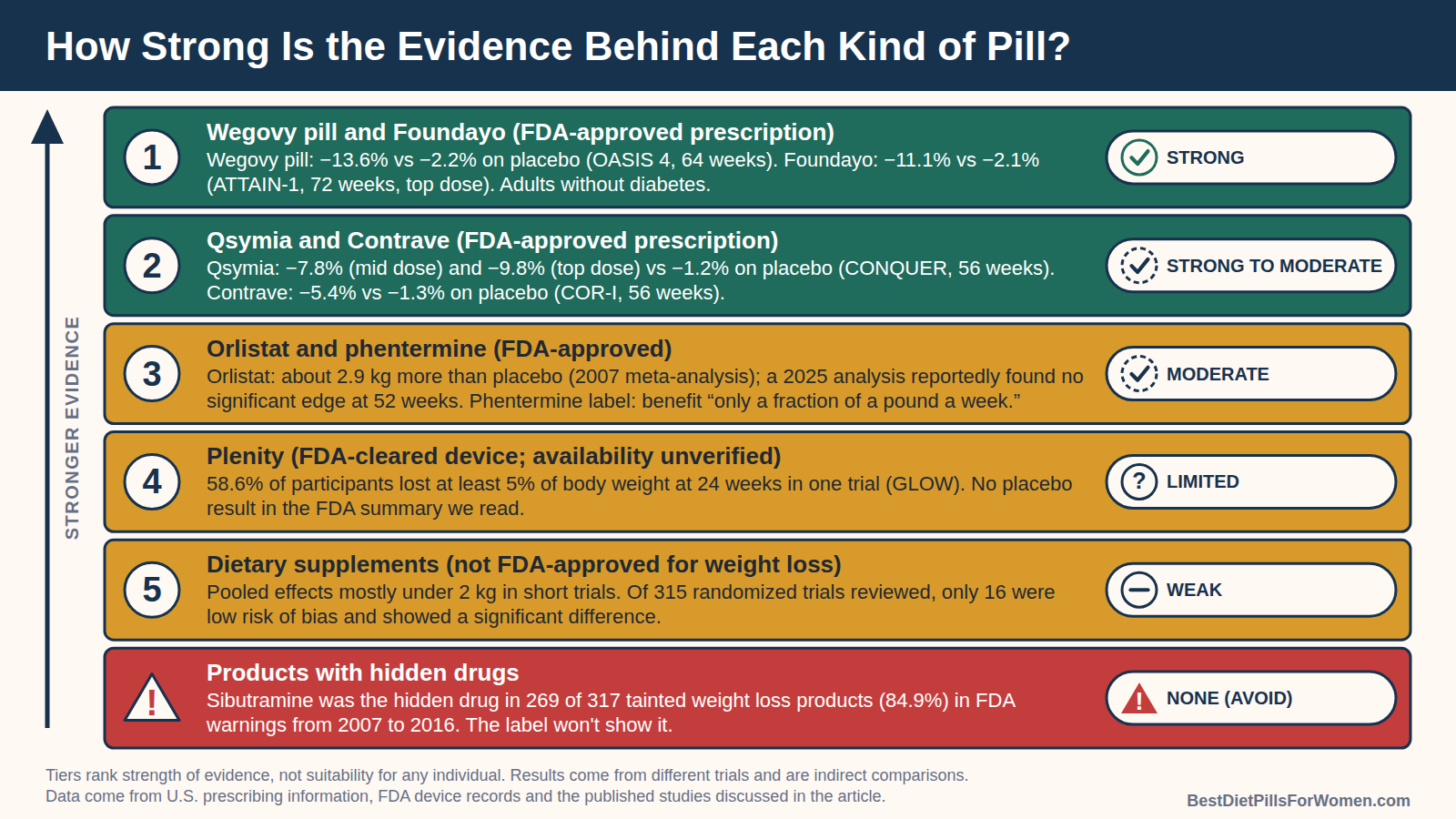
The best weight loss pills for women, ranked by the strength of the evidence, are prescription medications: the two new oral GLP-1 pills (the Wegovy pill and Foundayo), followed by Qsymia and Contrave. Over-the-counter options are much weaker. The only FDA-approved one, alli (orlistat 60 mg), has a modest effect, and most weight loss supplements have little reliable evidence behind them.
Here’s the catch: every number in this category is an average from a clinical trial, not a promise. In the pivotal trials, people taking the strongest pills lost roughly 11% to 14% of their starting weight on average, while people taking a placebo (alongside lifestyle counseling) lost about 2%. Women made up most of the participants in several of those trials, yet we found no published sex-specific results for the newest pills. And women face issues that men don’t: pregnancy and breastfeeding restrictions, birth-control instructions, and hair loss that the Foundayo and Zepbound labels report more often in women than in men.
This guide ranks categories of pills by evidence rather than ranking brands by popularity. It explains what each option is, what the trials found, which side effects and interactions matter, what the pills cost as of September 24, 2026, and which alternatives exist. It’s written to help you decide what to ask a clinician, not to tell you what to take.
The Short Answer: Ranking the Best Weight Loss Pills for Women by Evidence
The ranking below sorts options by how strong and how relevant the evidence is, using the criteria explained in the next section. It is a map of the evidence, not a shopping list.
A Quick-Answer Ranking Table
Table 1 puts every category on one page. Read across each row before you read down the columns, because a pill’s benefit and its main risk usually travel together.
| Tier | Option and status | Best-available result (population averages) | Biggest limitation | Biggest safety flag |
|---|---|---|---|---|
| 1 | Wegovy pill (oral semaglutide 25 mg). FDA-approved prescription drug | OASIS 4: −13.6% vs −2.2% placebo at 64 weeks (treatment-policy analysis); about 76–79% of participants were women | One main trial (307 people, no diabetes); strict empty-stomach dosing rules | Boxed warning for thyroid C-cell tumors (from rodent data); digestive effects; stop before planned pregnancy |
| 1 | Foundayo (orforglipron). FDA-approved prescription drug (April 1, 2026) | ATTAIN-1 label results: −11.1% at the top dose vs −2.1% placebo at 72 weeks; 64% women | Newest pill; little long-term data | Boxed warning for thyroid C-cell tumors; switch to a non-oral contraceptive or add a barrier method for 30 days after starting and after each dose increase |
| 2 | Qsymia (phentermine/topiramate ER). FDA-approved prescription drug | CONQUER: −7.8% (mid dose) and −9.8% (top dose) vs −1.2% at 56 weeks; 70% women | Older data; more side effects at higher doses | Can cause fetal harm (oral clefts); available only through a REMS program |
| 2 | Contrave (naltrexone/bupropion ER). FDA-approved prescription drug | COR-I: −5.4% vs −1.3% at 56 weeks; pooled trials were 83% women | Smaller average effect; responder rates differ between FDA and EMA documents | Boxed warning for suicidal thoughts and behaviors; nausea 32.5% vs 6.7% |
| 3 | Orlistat (alli 60 mg OTC; Xenical 120 mg Rx). FDA-approved | About 2.9 kg more than placebo in a 2007 meta-analysis (dose not confirmed as the 60 mg OTC strength); a 2025 network meta-analysis reportedly found no significant advantage at 52 weeks (read through a summary) | Small and inconsistent effect | Oily stools, urgency, reduced vitamin absorption; kidney warnings |
| 3 | Phentermine (Adipex-P, Lomaira, generics). FDA-approved, Schedule IV | Label: benefit over placebo is “only a fraction of a pound a week”; approved for a few weeks of use | No modern long-term outcome trials | Stimulant; not for people with heart disease; contraindicated in pregnancy |
| 4 | Plenity (oral hydrogel). FDA-cleared device, not a drug | GLOW: 58.6% lost at least 5% at 24 weeks (placebo rate not in the FDA summary we read) | 24-week evidence; market status unclear | Safety details not fully verified in the sources we read; availability unverified |
| 5 | Dietary supplements (green tea, fiber, caffeine, berberine and others). Not FDA-approved for weight loss | Pooled effects mostly under 2 kg in short trials | Small, short, often low-quality trials | Hidden drugs, liver injury, stimulant overload |
| Avoid | Products with hidden drugs or banned ingredients | No reliable benefit | Cannot be identified from the label | Sibutramine, sildenafil and others found in FDA-tested products |
Table 1 sources and method: results come from the cited trials, FDA labels and regulator pages. Trials differ in population, duration and analysis method, so the rows are indirect comparisons and not a head-to-head test.
How to Read the Ranking
Tiers reflect two things: how large the average effect was compared with placebo, and how solid the evidence behind it is. Tier 1 pills produced average losses above 10% at the top studied doses, in randomized trials lasting 64 to 72 weeks. Tier 2 pills produced average losses in the 5% to 10% range. Tier 3 and below are either modest, older, shorter or much less certain.
A lower tier isn’t automatically “bad.” Phentermine is cheap and familiar, and it has a real (if small and short-lived) effect. What the tier tells you is how much you can lean on the published evidence. It says nothing about whether a specific pill suits your health history, your medications, or your plans for pregnancy. Those questions can flip the order entirely. A pill in Tier 1 may be a poor fit if you have certain thyroid-cancer risk factors, while a Tier 3 pill may be the only one you can use.
Notice, too, that effect size and safety burden don’t move together in a neat line. A pill with a large average effect can still carry a long list of warnings, and a pill with a light side-effect profile may have little evidence behind it.
What the Ranking Deliberately Leaves Out
We did not rank individual supplement brands. The evidence for supplements is at the ingredient level (green tea extract, fiber, berberine), and the products on shelves change formulas, dose amounts and marketing names faster than the science changes. Ranking a brand would imply a level of verification that the evidence can’t support.
We also left out several things that deserve their own pages: weight loss patches, gummies and OTC appetite suppressants, plus the detailed comparison of pills versus injections, and the broader question of prescription versus OTC weight loss pills. Injectable drugs appear here only as benchmarks so you can see how the pills stack up. Compounded and “research peptide” GLP-1 products are left out on purpose, because they aren’t FDA-approved and the agency has raised specific safety concerns about them (covered in the safety section).
Finally, the ranking doesn’t cover cost or coverage. Those change monthly and depend on your insurance. They get their own section later.
Direct Answers to the Two Questions Women Ask Most
Two questions drive most searches on this topic. Here are the short answers, followed by the reasoning.
Do Weight Loss Pills Actually Work?
Some do, but only a small group. In trials lasting about 1 to 1.5 years, the stronger FDA-approved prescription pills produced average losses of about 5% to 14% of body weight versus about 1% to 5% on placebo. Older prescription pills and orlistat do less, and most supplements have little reliable evidence, with pooled effects usually under 2 kg (about 4 pounds).
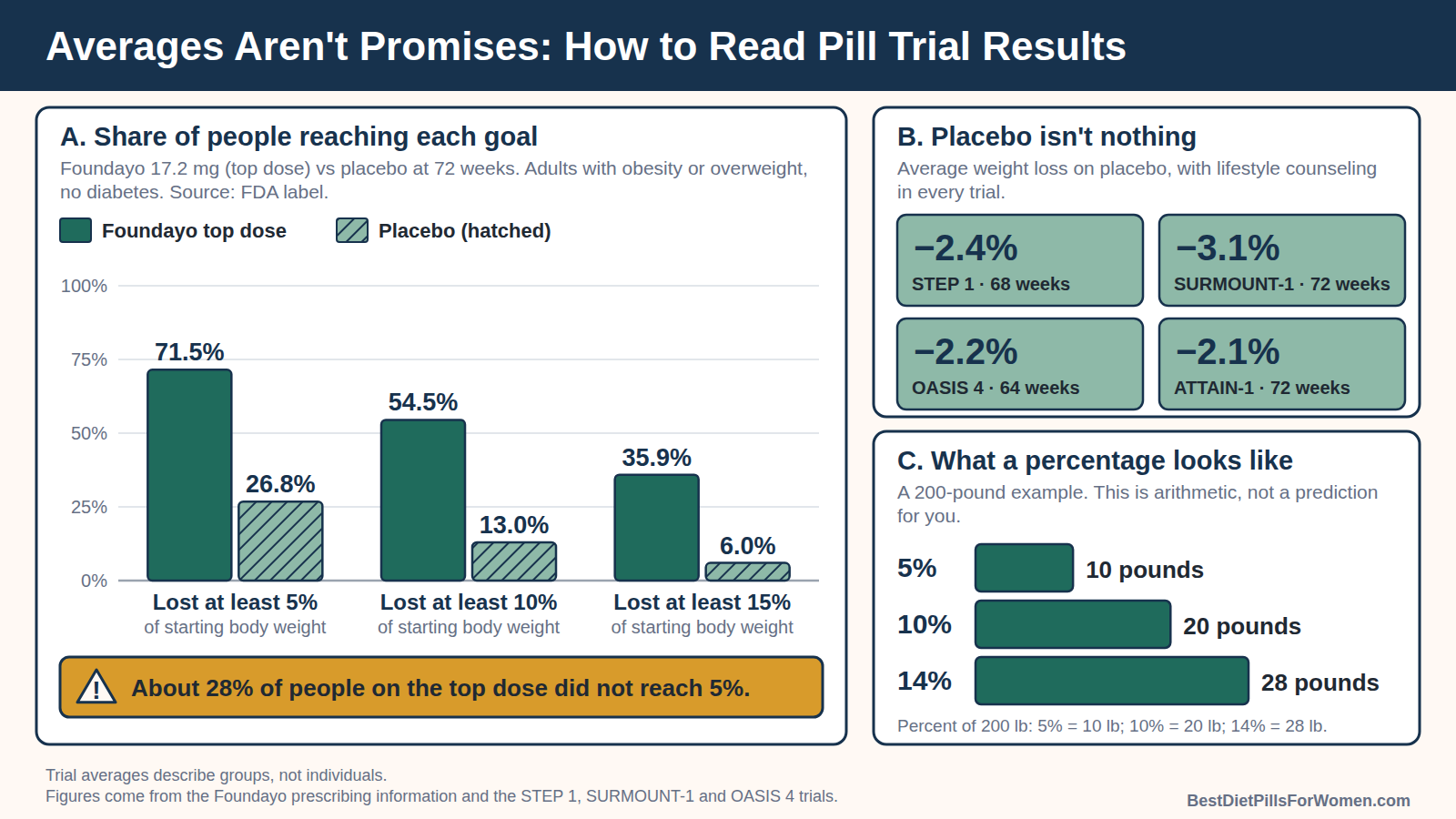
To make those percentages concrete, take a woman who weighs 200 pounds. A 5% loss is 10 pounds, 10% is 20 pounds, and 14% is 28 pounds. In OASIS 4, where the average starting weight was about 235 pounds (106.4 kg), a 13.6% average loss works out to roughly 32 pounds. These are illustrations of arithmetic, not predictions for you.
Two caveats matter more than the headline numbers. First, results vary widely from person to person, and trials report averages. Second, the effect depends on staying on the medication: when treatment stops, weight tends to come back (covered later in this guide). “Working” for a pill therefore means working while you take it, alongside changes to eating and activity, with side effects you can tolerate.
The largest reviews of dietary supplements, meanwhile, paint a discouraging picture. A systematic review of 315 randomized trials of 14 supplements or alternative therapies found that only 52 (16.5%) were at low risk of bias, and only 16 of those found significant differences in weight loss between groups.
Is There a Good Weight Loss Pill You Can Buy Without a Prescription?
Only one over-the-counter product is an FDA-approved weight loss drug: alli (orlistat 60 mg). Its effect is modest, its side effects are mostly digestive, and its label carries warnings about vitamin absorption, kidney problems and drug interactions. Supplements aren’t FDA-approved for weight loss, and their evidence is weak.
FDA’s own page says so directly: “alli is the only FDA-approved OTC (nonprescription) weight loss aid.” That sentence is worth remembering when you see a shelf full of products with “clinically proven” on the front. FDA’s OTC weight-control monograph, finalized in 1991, concluded that no active ingredient qualified as generally recognized as safe and effective for this use.
Plenity, an oral hydrogel, is a device rather than a drug and was cleared by FDA for over-the-counter use in January 2024, but its current availability in the United States is unclear (details below).
If you’re comparing OTC options, the practical question isn’t “which supplement is best?” It’s “is a modest, digestive-side-effect drug like orlistat worth it, or would a conversation with a clinician about prescription options serve me better?” We come back to that decision in the framework section.
How We Evaluated the Pills (and What We Did Not Do)
A ranking is only as good as its method. This section explains what we reviewed, what we did not do, and how to read the numbers that appear throughout the guide. If you skip ahead, skim the last subsection: it prevents the most common misreading of weight loss data.
The Evidence Base Behind This Guide
The guide draws on regulator documents, prescribing information, peer-reviewed trials and reviews, government health agencies, and manufacturer pages for price and label facts. Manufacturer material was used only to verify what a product says or costs, never as proof that it works.
Sources and the Evidence Hierarchy We Used
Our top tier was official sources: FDA approval announcements and prescribing information, FDA safety pages, CDC and NIH resources, and FTC guidance. Next came high-quality trials, systematic reviews and meta-analyses, plus major guideline documents. Trusted medical institutions were used for explanation. Manufacturers came last, and only for facts they control (ingredients, prices, refund terms).
We did not base medical conclusions on anonymous blogs, retailer customer reviews, affiliate competitors or social media posts. Those can suggest questions worth researching, but they aren’t evidence.
For several trials, we relied on the FDA-approved label’s trial tables, registry data, journal abstracts and independent summaries rather than the full journal papers. Where that affects a number, we say which source it came from. When a label figure and a journal figure differ, we state both and explain why. Prices and coverage details were checked on September 24, 2026, and are labeled as of that date.
Why This Is Desk Research, Not Product Testing
Nobody on this project bought, took or tested these products. Our assessment is based on current product labels, published research, manufacturer policies, pricing information and regulatory sources. We did not run lab tests, and we don’t quote personal experiences.
That distinction matters in this category. Many “reviews” of diet pills imply hands-on use that never happened, and FTC rules on fake reviews and endorsements apply to weight loss marketing. An honest evidence review can tell you what the science and the label say. It can’t tell you how a pill feels to take, and it won’t pretend to.

The Criteria We Used to Rank Each Option
Three criteria drove the tiers. Cost, convenience and coverage matter enormously in real life, but they change often and vary by plan, so we treat them separately in the cost section rather than baking them into the ranking.
Effect Size Compared With Placebo
We asked how much more weight people lost on the pill than on placebo, over what period. FDA’s own draft guidance for weight-reduction drugs treats a difference of at least 5 percentage points in mean weight loss between drug and control after one year as the benchmark for effectiveness. The guidance also cautions that responder analyses (such as “percent of people who lost at least 5%”) can exaggerate treatment effects.
We therefore lead with average percentage weight change and report responder rates as supporting detail. For supplements, where trials are usually shorter than 12 weeks and measured in kilograms, we report pooled kilograms and flag how much confidence to place in them.
Trial Length, Trial Population, and Women’s Representation
A 12-week trial can’t tell you what happens at a year. A trial in people with type 2 diabetes doesn’t necessarily predict results in people without it. And a trial that was 80% women tells you more about women than one that was 80% men.
For each pill, we noted duration, population and the share of women where the sources reported it. Several pivotal trials enrolled mostly women: about 83% in the pooled Contrave trials, 70% in CONQUER, 76% to 79% in OASIS 4, and 64% in ATTAIN-1. That makes the overall averages fairly relevant to women. It doesn’t replace a sex-specific analysis, and we found none published for the oral pills.
Regulatory Status and Safety Record
We checked whether each option is FDA-approved, cleared, or neither, what its label says about boxed warnings and contraindications, and whether any safety enforcement actions exist. Pregnancy, breastfeeding and contraception language got special attention because it matters more for women of reproductive age.
An option can score well on effect and still rank lower if its safety profile is heavier or its evidence is thin. Older drugs that were withdrawn after safety problems, such as sibutramine (2010) and lorcaserin (2020), are a reminder that approval isn’t a permanent guarantee.
How to Read Weight Loss Numbers Without Being Misled
Weight loss figures can look confusing or contradictory because they come from different analyses, different doses and different comparison groups. A little literacy goes a long way.
Placebo Groups Are Not “Nothing”
In modern obesity trials, the placebo group gets the same lifestyle counseling as the treatment group, and people in it do lose weight. In STEP 1, people on placebo lost 2.4% over 68 weeks. In SURMOUNT-1, they lost 3.1% over 72 weeks. In OASIS 4, 2.2%. In ATTAIN-1, 2.1%.
A pill’s benefit is the gap between the treatment and placebo arms, and that gap is smaller than the headline number. Another wrinkle is that “placebo” arms differ. In the Contrave COR-BMOD trial, everyone received intensive behavioral counseling and the placebo group still lost 4.9%. That’s why a 5-point gap in one trial isn’t the same thing as a 5-point gap in another.
Analysis method matters, too. Many trials report a “treatment-policy” estimate (everyone as randomized, whether or not they stayed on the drug) and a “trial-product” or “efficacy” estimate (as if everyone kept taking it). For the Wegovy pill in OASIS 4, those figures were −13.6% and −16.6%. We use treatment-policy or label figures for the marketed doses unless we say otherwise, because they’re the more conservative picture.
Averages, Responder Rates, and Why Your Result May Differ
An average hides a spread. Among semaglutide-treated participants in STEP 1, about 14% to 17% did not reach a 5% loss, while about half lost 15% or more, depending on whether you read the journal or the FDA label analysis (the two differ because of how missing data were handled).
Foundayo’s label shows the same spread. At the top dose, 71.5% of participants lost at least 5%, 54.5% lost at least 10%, and 35.9% lost at least 15%, compared with 26.8%, 13.0% and 6.0% on placebo. Even among the placebo group, more than one in four reached 5%. And even among the top-dose group, about 28% did not.
The behavioral side shows similar variation. The U.S. Preventive Services Task Force found that intensive behavioral programs helped about one additional person in eight reach a 5% loss (a number needed to treat of 8). Individual results depend on genetics, medical conditions, sleep, other medications, stress, food environment, and how well a person tolerates the drug. Trial averages are a starting point for a conversation with a clinician, not a forecast for you.
What Counts as a Weight Loss Pill? Four Categories With Very Different Evidence
“Weight loss pill” covers four regulatory categories that have almost nothing in common. Knowing which one a product falls into tells you what kind of evidence was required before it reached the market, and that’s often the most useful single fact you can learn.
Prescription Drugs: The Only Pills With Regulator-Reviewed Proof
Prescription weight loss drugs are the only pills where an independent regulator has reviewed randomized-trial data on safety and effectiveness before sale. Only a handful are currently marketed as pills in the United States: phentermine, phentermine/topiramate, naltrexone/bupropion, orlistat, and, since December 2025 and April 2026, the Wegovy pill and Foundayo.
What FDA Approval Does and Does Not Tell You
Approval means FDA reviewed evidence that the drug’s benefits outweigh its risks for a defined group of people, and it requires a label with the results, warnings, and instructions. It doesn’t mean the drug works for everyone, is free of serious risk or is right for your circumstances. The Wegovy pill and Foundayo, for instance, both carry boxed warnings about thyroid C-cell tumors seen in rodents, and both are contraindicated for people with a personal or family history of medullary thyroid carcinoma or MEN 2.
Approval also isn’t permanent. Lorcaserin (Belviq) was withdrawn at FDA’s request in 2020 after a large safety trial showed more cancers than on placebo, and sibutramine (Meridia) left the market in 2010 because of increased heart attack and stroke risk. Sibutramine still turns up as a hidden ingredient in illegal “supplements” today, which is its own warning about the supplement aisle (see the safety section).
Speed of approval can also be misread. FDA approved Foundayo on April 1, 2026, about 50 days after filing under its Commissioner’s National Priority Voucher program. That’s a fast review, but the pivotal trials were large, randomized and lasted 72 weeks. Speed reflects a special pathway, not thinner evidence.
The Efficacy Bar FDA Uses for Weight-Reduction Drugs
According to FDA’s January 2025 draft guidance, a drug is considered effective for weight reduction and maintenance if, after one year at the maintenance dose, the mean percentage weight reduction is at least 5 percentage points greater than in the control group, and the difference is statistically significant.
That bar is lower than many people assume. It means a drug can be approved when it beats placebo by five points on average, and some approved pills sit near that line. Older approvals, such as Contrave’s in 2014, were judged under earlier criteria. It also means “FDA-approved” alone doesn’t tell you how much a drug helps. The pivotal-trial numbers do, which is why this guide spends so much time on them.
One Over-the-Counter Drug and One Device
Only two products sold without a prescription carry an FDA approval or clearance for weight management. One is a drug, and one is a device.
alli: The Only FDA-Approved Over-the-Counter Weight Loss Aid
Orlistat 60 mg (alli) was approved for OTC sale in 2007 and is currently labeled by Haleon. It works in the gut rather than the brain: it blocks enzymes that digest some dietary fat, so part of the fat you eat passes through undigested. That’s a mechanism, not a guarantee of benefit, and the resulting digestive effects are the drug’s defining feature. Its Drug Facts label says it’s for overweight adults 18 and older, used with a reduced-calorie, low-fat diet, and directs users to take a multivitamin at bedtime because orlistat lowers absorption of some vitamins.
In 2026, FDA’s page on alli described new labeling about kidney stones and kidney injury. We cover the details in the OTC section.
Plenity: An FDA-Cleared Device With an Unclear Market Status
Plenity is a capsule containing a superabsorbent cellulose-based hydrogel that absorbs water and swells in the digestive tract to promote fullness. FDA cleared an over-the-counter version (510(k) K230133) on January 19, 2024, for adults with a BMI of 25 to 40, used with diet and exercise.
The 510(k) names Gelesis Inc. as the applicant, and a current seller’s own site says the “original maker” filed for bankruptcy in 2023. On September 24, 2026, a site called myplenity.com said the product was “not yet available for sale,” while another retail site listed prices and shipping. We couldn’t verify who owns or sells it now. Treat any availability claim as unconfirmed until an editor or you check with the seller.
Dietary Supplements and “Fat Burners”
Everything else on the shelf is a dietary supplement, and that’s a different legal category with different rules.
No Pre-Market Approval Under DSHEA
Under the Dietary Supplement Health and Education Act of 1994, FDA doesn’t approve supplements for safety or effectiveness before they’re sold. Companies are responsible for ensuring their products are safe and their labels truthful, and FDA can act after a problem appears.
Supplements can carry “structure/function” claims, which describe how an ingredient affects the body’s normal structure or function (for example, “supports a healthy metabolism”), without FDA approval, as long as the claim is truthful and not misleading, the company notifies FDA within 30 days of marketing it, and the label includes the disclaimer that FDA hasn’t evaluated the statement. A product that claims to treat or cure disease is legally a drug. Phrases such as “FDA-registered facility” or “made in a GMP facility” don’t mean FDA approved the product, and FDA says so explicitly.
NIH’s Office of Dietary Supplements is blunt about the state of the evidence: “There’s little scientific evidence that weight-loss supplements work.” About 15% of U.S. adults have used a weight loss supplement, women more than men (21% versus 10%), and fewer than one in three who do tell a health professional.
What “GLP-1 Support” Labels Do and Don’t Mean
Since prescription GLP-1 drugs became famous, many supplements have adopted names like “GLP-1 booster” or “nature’s Ozempic.” These labels are marketing terms, and we found no regulatory definition of them. PBS NewsHour reported products labeled “GLP-1” that contain ingredients such as berberine, glutamine and chromium, and a May 2026 trade-press article listed berberine, chromium picolinate, resveratrol, fiber, green tea extract and probiotics as common “booster” components. None of these is a GLP-1 drug.
In our review of manufacturer pages, one well-known vitamin brand sells a “GLP-1 companion” pack that is a multivitamin and mineral kit and states that it doesn’t contain GLP-1 medication. That’s an accurate disclosure and a useful illustration: the phrase in the product name says nothing about a supplement’s effect on weight or on GLP-1 hormone levels. We audit the “natural GLP-1” claim in detail in the supplement section.
Prescription GLP-1 Pills: The Wegovy Pill and Foundayo
GLP-1 receptor agonists mimic a gut hormone that helps regulate appetite, fullness and blood sugar. Until recently, they came only as injections. In the last nine months, two oral versions were approved for weight management in the United States, and they now sit at the top of the evidence ranking for pills. We’ll cover each one, then how they compare with each other and with the injections. (For the long version of that last comparison, see our guide to weight loss pills versus injections.)
The Wegovy Pill (Oral Semaglutide 25 mg)
Novo Nordisk announced FDA approval of the Wegovy pill on December 22, 2025, and it became available in the United States on January 5, 2026. It’s the same drug as the injectable Wegovy (semaglutide) in a once-daily tablet, and it shares a single label with the injection.
What the OASIS 4 Trial Found
OASIS 4 was a phase 3, double-blind, placebo-controlled trial. It randomized 307 adults with obesity, or overweight plus at least one weight-related condition, and no diabetes, in a 2-to-1 ratio to oral semaglutide 25 mg or placebo. After a 12-week dose escalation, people stayed on treatment for a total of 64 weeks.
The people in the trial looked like many readers of this guide. In the label’s safety population, the average age was 48, 76% were women, and the average weight was 106.4 kg (about 235 pounds), with a mean BMI of 37.5. (An ACC summary of the randomized group put the share of women at 79%; the difference comes from which participants were counted.)
At week 64, people taking the pill lost an average of 13.6% of body weight, compared with 2.2% on placebo, a difference of 11.4 percentage points (95% CI −13.9 to −9.0). If everyone had stayed on treatment, the average would have been 16.6% versus 2.7%. In Novo Nordisk’s trial materials, 63.0% of people on the pill lost at least 10% of their weight, versus 14.4% on placebo, and 50.0% lost at least 15%, versus 5.6%. Different documents report slightly different responder percentages because of analysis choices, so treat these as approximate.
Two limits are worth stating plainly. This is essentially one pivotal trial of modest size, and it excluded people with type 2 diabetes. Results in people with diabetes are smaller for most weight-loss drugs.
How It Is Taken, and What Side Effects to Expect
The dosing rules are strict. You take one tablet each morning on an empty stomach with a sip of water (up to 4 ounces), swallow it whole, and then wait at least 30 minutes before eating, drinking anything else, or taking other oral medicines. The dose steps up from 1.5 mg to 4 mg to 9 mg over the first three months, with the 25 mg maintenance dose starting on day 91. A missed dose is skipped and the next one is taken the following day.
Digestive effects are the main tradeoff. In OASIS 4, secondary summaries of the trial reported digestive-system adverse events in 74.0% of people on the pill, versus 42.2% on placebo. According to the label, permanent discontinuation because of adverse reactions was 6.9% on the pill versus 5.9% on placebo. As we read the label, skin sensations such as tingling (dysesthesia) were listed at 5% versus 0%, severe digestive reactions at 2% versus 0%, and gallstones (cholelithiasis) at 2.5% versus 1%. The label says the types and frequency of adverse reactions with the tablets were similar to those listed for the injection.
Two other label details matter for many women. The tablet raised exposure to the thyroid medicine levothyroxine by about 33% in an interaction study, so anyone taking thyroid hormone should raise this with their prescriber. And the label advises stopping the drug at least two months before a planned pregnancy, because semaglutide has a long half-life. We cover both in the women-specific section.
Foundayo (Orforglipron)
FDA approved Foundayo on April 1, 2026. It’s a once-daily tablet and the first new molecular entity approved under FDA’s National Priority Voucher program. Unlike the Wegovy pill, its label says to take it “with or without food.” Lilly markets it as usable any time of day without restrictions on food or water, but the label wording is the one to rely on.
What the ATTAIN-1 Trial Found
ATTAIN-1 was a 72-week, double-blind, placebo-controlled trial of 3,127 adults with obesity or overweight and at least one related condition, without diabetes. In the trial reported in the label, 64% of participants were women, the average age was 45, the average weight was 103.2 kg (about 227 pounds), and the mean BMI was 37.
Using the label’s numbers for the marketed doses, average weight change at 72 weeks was −7.4% at 5.5 mg, −8.3% at 9 mg and −11.1% at 17.2 mg, versus −2.1% on placebo. The share of people losing at least 10% of their weight was 32.5%, 39.8% and 54.5% across those doses, versus 13.0% on placebo.
You may see bigger numbers in news coverage: Lilly’s trial announcements cited −12.4% (about 27 pounds) at the top dose. That figure is an “efficacy estimand,” meaning it estimates results as if everyone had kept taking the drug. It also used the trial’s investigational doses of 6, 12 and 36 mg, which the label reports as equivalent to 5.5, 9 and 17.2 mg. The label’s −11.1% is the more conservative and more relevant number.
As with the Wegovy pill, the population excluded diabetes. A companion trial in people with type 2 diabetes produced smaller average losses, in line with other drugs in the class.
Dosing, Side Effects, and the Contraception Instruction
Treatment begins at 0.8 mg daily, moves to 2.5 mg after at least 30 days, then 5.5 mg after at least another 30 days. From there, a clinician may increase to 9, 14.5 or 17.2 mg based on response and tolerability, at intervals of at least 30 days. The label says that using it together with another GLP-1 receptor agonist is not recommended.
In the label’s pooled adverse-reaction table, nausea affected 26%, 34% and 35% at the 5.5, 9 and 17.2 mg doses versus 10% on placebo. Vomiting was 13%, 21% and 24% versus 4%, and diarrhea 21%, 23% and 25% versus 11%. Constipation ran 20%, 27% and 24% versus 9%. Overall, 8% of people on Foundayo permanently discontinued because of adverse reactions (6%, 9% and 10% by dose), versus 3% on placebo.
Here’s a detail specific to women. The label tells people who use oral hormonal contraceptives to “switch to a non-oral contraceptive method, or add a barrier method of contraception for 30 days after initiation with FOUNDAYO and for 30 days after each dose escalation.” Separately, the label notes that the pill delays gastric emptying and could affect how other oral drugs are absorbed. The contraception instruction is a label precaution, and your prescriber or pharmacist can explain how it applies to your birth control. The label also says Foundayo isn’t recommended for nursing women and that it should be discontinued when a pregnancy is recognized. Hair loss was reported in 7% of women versus 0.9% of men on the drug (3% versus 0.7% on placebo).
How the Two Pills Compare With Each Other and With Injections
People naturally want a scoreboard. The honest answer is that there’s a scoreboard for injections but not for these two pills against each other, because no trial has compared them.
| Trial | Drug and dose | Duration | Participants | Mean weight change vs comparator | At least 10% loss | Women | Notes |
|---|---|---|---|---|---|---|---|
| OASIS 4 | Wegovy pill (oral semaglutide 25 mg) | 64 wk | 307 | −13.6% vs −2.2% placebo (treatment-policy) | 63.0% vs 14.4% | 76–79% | No diabetes; mean BMI 37.5 |
| ATTAIN-1 | Foundayo 17.2 mg (label dose) | 72 wk | 3,127 (730 at this dose) | −11.1% vs −2.1% placebo | 54.5% vs 13.0% | 64% | No diabetes; mean BMI 37 |
| STEP 1 | Wegovy injection 2.4 mg | 68 wk | 1,961 | −14.9% vs −2.4% placebo | 69.1% vs 12.0% (journal); 66.1% vs 12.0% (label) | 74% | No diabetes; mean BMI 37.9 |
| SURMOUNT-1 | Zepbound (tirzepatide) 5, 10, 15 mg | 72 wk | 2,539 | −15.0%, −19.5%, −20.9% vs −3.1% placebo | 68.5%, 78.1%, 83.5% vs 18.8% | 68% | No diabetes; mean BMI 38 |
| SURMOUNT-5 | Tirzepatide vs semaglutide (maximum tolerated doses) | 72 wk | 751 | −20.2% vs −13.7% (head-to-head, no placebo) | Not shown here | 64.7% | Open-label |
| STEP UP | Semaglutide 7.2 mg vs 2.4 mg vs placebo | 72 wk | 1,407 | −18.7%, −15.6%, −3.9% (treatment-policy) | Not shown here | About 74% | Wegovy HD 7.2 mg was FDA-approved March 19, 2026 |
Table 2 method: percentages are as reported in the cited label or paper. Trials differ in duration, population and analysis method, so only SURMOUNT-5 is a direct comparison, and it compares two injections.
Why the Comparison Is Indirect
Reading across Table 2, the Wegovy pill’s −13.6% at 64 weeks looks close to the injection’s −14.9% at 68 weeks, and Foundayo’s −11.1% at 72 weeks looks lower. It’s tempting to declare rankings. Please don’t. The trials enrolled different people at different times, ran for different lengths, used different analysis methods, and (in the case of Foundayo) included many participants in Asia and other regions. Small differences in average loss between separate trials fall within what design and population differences can produce.
The strongest thing the evidence supports is a range: the two oral GLP-1 pills produced average losses in the low-to-mid teens percent in adults without diabetes, well above older pills, and below the best injections. Whether one pill would work better for you than the other is unknown, and it could depend on tolerability, dosing rules, cost and insurance as much as on average effect. Our Wegovy pill versus Wegovy injection page will cover that head-to-head question in detail.
What Injections Still Do Better
The strongest injections still lead on weight loss. In SURMOUNT-5, the only head-to-head trial we found in this group, tirzepatide produced an average 20.2% loss versus 13.7% for semaglutide, a 6.5-point difference (95% CI −8.1 to −4.9). It was an open-label trial of 751 adults over 72 weeks, and 64.7% of participants were women. In STEP UP, semaglutide 7.2 mg (approved as Wegovy HD on March 19, 2026) produced an 18.7% average loss versus 15.6% at the standard 2.4 mg dose, though FDA’s approval announcement notes that altered skin sensation (dysesthesia) was more frequent at the higher dose and generally resolved on its own or with dose reduction.
Injections also have longer records. Semaglutide 2.4 mg and tirzepatide have been on the market longer than either pill, and both pills are under a year old. Lilly reported that people who switched from Wegovy or Zepbound injections to orforglipron in a maintenance trial regained less weight than those switched to placebo. That’s a company-reported study, and the label doesn’t carry a switching indication.
Pills counter with practical advantages: no needles, no refrigeration, and self-pay prices that, as of September 24, 2026, were the same as or lower than the pen’s (some Foundayo prices are temporary; see the cost section). The Wegovy pill also carries a cardiovascular-risk-reduction indication for adults with established heart disease and obesity or overweight.
Other Prescription Pills: Qsymia, Contrave, Phentermine, and Older Options
Before the GLP-1 pills arrived, women who wanted a prescription pill had four main choices. They’re still available, they cost far less in some cases, and each has features that make it the right conversation to have for certain readers.
Qsymia (Phentermine/Topiramate)
Qsymia combines phentermine, a stimulant-type appetite suppressant, with topiramate, an anti-seizure medicine also used for migraine, in an extended-release capsule. FDA approved it in 2012. It carries no boxed warning, but its pregnancy risks are serious enough to trigger a special safety program.
Trial Results From CONQUER and SEQUEL
CONQUER enrolled 2,487 adults with BMI 27 to 45 and at least two weight-related conditions. About 70% (1,737) were women, and the average age was 51. At 56 weeks (intention-to-treat, with the last observation carried forward), average weight loss was 1.24% on placebo, 7.81% on 7.5/46 mg, and 9.84% on 15/92 mg. The manufacturer’s site reports that 62% and 70% of people on those two doses lost at least 5%, versus 21% on placebo, and 37% and 48% lost at least 10%, versus 7%.
SEQUEL extended the trial to 108 weeks in a subset of participants (676 people, roughly 65% to 69% women across groups). Average losses at week 108 were 1.8% on placebo, 9.3% on the mid dose and 10.5% on the top dose. The dropout patterns matter: only 66% of Qsymia participants and 57% of placebo participants completed CONQUER.
Qsymia’s efficacy sits between the older pills and the new GLP-1 pills. For readers who can’t or don’t want a GLP-1, it’s the strongest non-GLP-1 pill on the evidence, but that comes with a set of safety considerations that are unusually specific to women.
Pregnancy Risk, REMS, and Side Effects
Topiramate is linked to birth defects. Qsymia’s label warns that exposure to topiramate in the first trimester increases the risk of major congenital malformations, including cleft lip and cleft palate, and of babies being small for gestational age. In one pregnancy registry, oral clefts occurred in 1.4% of topiramate-exposed infants versus 0.3% with a reference anti-seizure drug and 0.11% in mothers without epilepsy or medication exposure (relative risk 12.5). Those are epilepsy-registry numbers, but they’re the ones the label cites.
Because of that, Qsymia is only available through a certified-pharmacy program (a Risk Evaluation and Mitigation Strategy, or REMS). For anyone who can become pregnant, the label recommends a negative pregnancy test before starting and monthly during treatment, plus effective contraception. The label also notes that Qsymia can change hormone exposure from combined oral contraceptives (ethinyl estradiol down 16%, norethindrone up 22%) and says irregular bleeding or spotting may be more frequent. Breastfeeding isn’t recommended.
Common side effects at the top dose include tingling sensations (paresthesia, 20% versus 2% on placebo), dry mouth (19% versus 3%), constipation (16% versus 6%), altered taste (9% versus 1%), insomnia (9% versus 5%) and dizziness (9% versus 3%). Other warnings include mood and sleep problems, suicidal ideation, eye problems (acute myopia and angle-closure glaucoma), metabolic acidosis, kidney stones, and seizure risk if the top dose is stopped abruptly, so the label directs a gradual, every-other-day taper.
Contrave (Naltrexone/Bupropion)
Contrave pairs naltrexone (an opioid blocker) with bupropion (an antidepressant that is also used for smoking cessation) in an extended-release tablet. FDA approved it in 2014. Its label carries a boxed warning about suicidal thoughts and behaviors, which applies to antidepressant drugs generally.
What the Pivotal Trials Showed
The FDA’s original approval label reports four pivotal trials with an average participant age of 46, 83% women, and a mean BMI of 36. In COR-I (56 weeks), average loss was 5.4% versus 1.3% on placebo. In COR-BMOD, where everyone also received intensive behavioral counseling, loss was 8.1% versus 4.9%. In COR-Diabetes (people with type 2 diabetes), loss was 3.7% versus 1.7%. A fourth trial, COR-II, lasted 28 weeks in the primary analysis and showed 5.7% versus 1.9% in the European drug regulator’s summary.
The responder rates depend on which regulator’s document you read. The FDA label reports that 42% of COR-I participants on Contrave lost at least 5%, versus 17% on placebo, while the European summary reports 31% versus 12% for the same trial. Both agree on the average weight change. The difference is most likely due to the way each document handled missing data, but the documents don’t say so directly.
The bottom line is a moderate effect: about 5% to 8% average loss in people without diabetes and about 4% in people with it. Subtract the placebo results and the gaps shrink to 4.1 points in COR-I, 3.2 in COR-BMOD, 3.8 in COR-II and 2.0 in COR-Diabetes. FDA’s 2025 draft guidance for obesity drugs describes a placebo-subtracted difference of at least 5 percentage points at one year as a meaningful benchmark. The three 56-week trials we could read (COR-I, COR-BMOD and COR-Diabetes) fell short of it, and we didn’t retrieve COR-II’s one-year result. Contrave was approved in 2014, under earlier criteria.
Boxed Warning, Side Effects, and Who Should Not Take It
The label’s boxed warning covers suicidal thoughts and behaviors, which notes that antidepressants increased suicidal thoughts and behaviors in children, adolescents and young adults and calls for monitoring. The most common adverse reactions compared with placebo were nausea (32.5% versus 6.7%), constipation (19.2% versus 7.2%), headache (17.6% versus 10.4%), vomiting (10.7% versus 2.9%), dizziness (9.9% versus 3.4%), insomnia (9.2% versus 5.9%), dry mouth (8.1% versus 2.3%) and diarrhea (7.1% versus 5.2%). About 24% of people on Contrave stopped treatment because of an adverse event, versus 12% on placebo.
Contraindications matter here. The label lists uncontrolled high blood pressure; seizure disorders or a history of seizures; bulimia or anorexia nervosa (which raise seizure risk); chronic opioid use; abrupt discontinuation of alcohol, benzodiazepines, barbiturates or anti-seizure drugs; use of other bupropion products; and use of monoamine oxidase inhibitors within 14 days. The eating-disorder contraindication is especially relevant to women, and we return to it in the disordered-eating section.
On pregnancy, the label states that weight loss offers no benefit to a pregnant patient and may cause fetal harm, and it directs that the drug be discontinued when pregnancy is recognized. Bupropion, naltrexone and their metabolites are present in breast milk.
Phentermine and the Older Stimulant-Type Pills
Phentermine has been approved since 1959, and generic versions are inexpensive. The modern evidence for it is thin.
What the Label and the Evidence Say About Phentermine
Phentermine’s FDA-approved indication is as a short-term adjunct, meaning a few weeks, in a weight-reduction program for adults with a BMI of 30 or higher, or 27 or higher with other risk factors. Adipex-P is taken once daily before breakfast or one to two hours after; Lomaira is an 8 mg tablet taken up to three times daily before meals. It’s a Schedule IV controlled substance.
The label itself is candid about the effect: “increased weight loss of drug-treated patients over placebo-treated patients is only a fraction of a pound a week,” and it says the benefit is greatest early and tends to decrease later. A roundtable in Obesity Pillars notes that a 2002 meta-analysis found placebo-corrected loss of less than 4 kg, that long-term outcome data are limited, and that no cardiovascular outcome studies have been done since approval. The 2025 network meta-analysis of 56 trials didn’t include phentermine on its own.
The contraindications list is long and relevant: history of cardiovascular disease (coronary artery disease, stroke, arrhythmias, heart failure, uncontrolled high blood pressure), hyperthyroidism, glaucoma, agitated states, a history of drug abuse, use of MAO inhibitors within 14 days, pregnancy and nursing. Adverse reactions listed include palpitations, fast heart rate, raised blood pressure, insomnia, dry mouth, tremor and restlessness, though the label gives no frequencies. The label’s pregnancy language is direct: weight loss offers no potential benefit to a pregnant woman and may result in fetal harm, and the drug is contraindicated in pregnancy.
Diethylpropion, Benzphetamine, and Phendimetrazine
Three older drugs share phentermine’s short-term “a few weeks” approval: diethylpropion (Schedule IV), and benzphetamine and phendimetrazine (both Schedule III). All are stimulant-type appetite suppressants. None has modern long-term outcome trials in the material we reviewed.
Their labels contain details that matter for women. Benzphetamine is contraindicated in women who are or may become pregnant. Phendimetrazine’s label says it shouldn’t be taken by women who are or may become pregnant, and it warns that use of anorectic agents for longer than three months was associated with a 23-fold increase in the risk of developing pulmonary hypertension. Diethylpropion is contraindicated with pulmonary hypertension, advanced arteriosclerosis, hyperthyroidism, glaucoma, severe hypertension and MAO inhibitors.
We rank these below Tier 2 because their evidence is old and short-term, not because they’re inherently more dangerous than newer drugs. If a clinician suggests one, it’s fair to ask how long you’d take it and what happens when you stop. (For more on this category, see our planned guide to prescription appetite suppressants.)
Putting the Older Prescription Pills Side by Side
The four established non-GLP-1 pills are easy to confuse. Table 3 lines up what the labels and pivotal trials show.
| Pill | Best-available trial result | Duration and population | Common side effects (label) | Women-relevant flags |
|---|---|---|---|---|
| Qsymia (phentermine/topiramate ER) | −7.8% (7.5/46) and −9.8% (15/92) vs −1.2% placebo (CONQUER) | 56 wk; 2,487 adults; 70% women | Tingling 20%, dry mouth 19%, constipation 16% at top dose | Fetal harm (oral clefts); REMS; monthly pregnancy tests; contraception; irregular bleeding or spotting may be more frequent with combined pills |
| Contrave (naltrexone/bupropion ER) | −5.4% vs −1.3% (COR-I); −8.1% vs −4.9% (COR-BMOD) | 56 wk; pooled trials 83% women | Nausea 32.5%, constipation 19.2%, headache 17.6%; 24% discontinued for adverse events | Boxed warning (suicidality); contraindicated with bulimia or anorexia nervosa; drug in breast milk |
| Phentermine (Adipex-P, Lomaira) | Label: “only a fraction of a pound a week” over placebo | Short-term (a few weeks); no demographic data in label | Palpitations, raised blood pressure, insomnia (no frequencies) | Contraindicated in pregnancy; decision needed about nursing; not for people with heart disease |
| Orlistat Rx (Xenical 120 mg) | About 2.9 kg more than placebo (2007 meta-analysis) | 1–4 years across trials | Oily spotting 26.6% vs 1.3%; urgency 22.1% vs 6.7% | Contraindicated in pregnancy; separate from levothyroxine by 4 hours; multivitamin timing |
| Diethylpropion, benzphetamine, phendimetrazine | No modern outcome trials | Short-term (a few weeks) | Stimulant effects; label-specific | Benzphetamine and phendimetrazine: not for women who are or may become pregnant |
Table 3 method: figures are from the cited labels and trials. Trials differ in duration, dose and analysis, so effects can’t be ranked head to head.
The Comparison Table in Context
Read Table 3 by asking three questions of each row: how big was the effect, how long was it studied, and what does the label say about pregnancy? For Qsymia, the answers are “moderately large,” “one to two years,” and “serious, so plan carefully.” For phentermine, they are “small,” “a few weeks,” and “contraindicated in pregnancy, per the label.”
The heart of the tradeoff is that the more effective older pills carry more complicated safety instructions, and the simpler ones deliver less. That’s the pattern across the whole category, and it’s why the decision is a conversation with a clinician and not a comparison-shopping exercise.
What the Differences Mean in Practice
For someone who might become pregnant in the next year, Qsymia demands the most planning and the greatest attention to contraception, while phentermine and older sympathomimetics are contraindicated outright. Contrave’s label has no pregnancy-test requirement or REMS, but it carries a boxed warning for suicidal thoughts and behaviors (Qsymia’s label also lists suicidal ideation and mood and sleep disorders among its warnings). For someone with a history of heart disease, phentermine and its cousins are the most concerning group, and GLP-1 drugs have their own considerations.
Cost differs, too, sometimes dramatically. Generic phentermine ran about $10 to $23 for a 30-day supply with coupons on September 24, 2026, while Qsymia cost about $75 per month through its manufacturer’s home-delivery program and Contrave about $99 through its own program. Those and other prices are dated and compared in the cost section.
Over-the-Counter Options: alli and Plenity
The over-the-counter category is small. A drug, orlistat 60 mg, has an FDA approval and a label. A device, Plenity, has a clearance and an uncertain market. Everything else is a supplement, covered in the next section.
alli (Orlistat 60 mg)
alli is the lower-dose, nonprescription version of orlistat (Xenical is the 120 mg prescription form). It is meant for overweight adults 18 and older, used along with a reduced-calorie, low-fat diet. The directions call for one capsule with each meal containing fat, up to three capsules a day.
How Much Weight Does Orlistat Help People Lose?
Not much, and the estimates vary by analysis. A 2007 BMJ meta-analysis of 16 orlistat trials (10,631 participants, with treatment lasting one to four years) found that orlistat produced 2.9 kg (95% CI 2.5 to 3.2) more weight loss than placebo. alli’s original 2007 label put it more practically: “for every 5 pounds you lose from diet alone, orlistat can help you lose 2-3 pounds more.”
A 2025 network meta-analysis in Nature Medicine of 56 trials and 60,307 participants reportedly found that at 52 weeks all the drugs it studied beat placebo except orlistat, which was not statistically significant. We read that result through a summary, not the paper, so treat it as provisional. The two findings could both be right, although the 2007 figure isn’t shown to apply to the 60 mg OTC dose. The older analysis pools many trials of different lengths and reports kilograms; the newer one is described as using percentage change at one year and indirect comparisons. Together they leave the same practical picture: an effect of a few pounds beyond diet alone, which some people find worth pursuing and others don’t.
Because alli depends on eating fat, the drug’s effectiveness is tied to your diet. The label directs users to follow a low-fat plan, and orlistat’s digestive effects are more likely when meals are high in fat.
Side Effects, Vitamins, Kidney Warnings, and Interactions
The characteristic side effects are digestive: gas with oily spotting, loose stools, and more frequent stools that may be hard to control. In the prescription-dose trials, oily spotting affected 26.6% of people versus 1.3% on placebo in year one, fecal urgency 22.1% versus 6.7%, and fecal incontinence 7.7% versus 0.9%. alli’s Drug Facts label lists the same types of effects, though we didn’t find frequencies for the 60 mg dose.
Because orlistat reduces absorption of fat-soluble vitamins, the label directs users to take a multivitamin once a day at bedtime. The Drug Facts label says not to use alli if you take cyclosporine, to ask a doctor first if you take thyroid medicine, blood thinners such as warfarin, or seizure medicine, and not to use it if you have problems absorbing food. It also says not to use alli if you’re pregnant or breastfeeding. The prescription label adds that levothyroxine should be taken at least four hours apart from orlistat, which matters to the many women with hypothyroidism.
In 2026, FDA’s alli page described labeling changes about kidney injury. The label now says to ask a doctor before use if you have kidney disease or a history of kidney stones, and to stop and get care for back or groin pain, painful urination, blood in the urine, swelling in the feet or legs, or less frequent urination. The rare kidney problems listed include acute kidney injury and oxalate nephropathy. The Drug Facts label also says to stop use and ask a doctor if you notice itching, yellow eyes or skin, dark urine or loss of appetite, which can signal liver trouble.

Plenity (Oral Hydrogel Capsules)
Plenity is a device, not a drug, so it went through a different regulatory pathway: a 510(k) clearance rather than a drug approval. The pivotal trial we could read about lasted 24 weeks, and we found far less outcome and safety data than exists for the prescription pills.
What the GLOW Trial Reported
FDA’s decision summary for the OTC clearance reports that in the pivotal trial (GLOW), 58.6% of participants achieved at least 5% total body weight loss at six months, and 27% lost at least 10%. Adverse events were similar overall (71.3% on Plenity versus 70.6% on placebo), while device-related adverse events were 39.5% versus 30.3%. There were no deaths or serious adverse events linked to the device.
The decision summary didn’t give the placebo group’s responder rate in the material we retrieved, and it didn’t provide the mean weight loss, so you can’t compute a placebo-subtracted difference from it. The maker’s website has described roughly 6% versus 4% average weight loss in the trial, which would be a small difference, but that is a marketing summary, not a regulatory document. The trial lasted 24 weeks, and the evidence for longer use is limited.
Why Availability Needs Checking Before You Plan Around It
As noted above, we found conflicting signals on September 24, 2026: one site said Plenity was “not yet available for sale,” and another listed it at $99 for one month, $700 for six months and $1,300 for twelve months, with a frequently-asked-questions page that quoted different monthly figures. We couldn’t confirm who currently owns the product, whether it remains cleared for over-the-counter sale under its new owner, or whether the site selling it is authorized.
If you’re considering it, check the seller’s identity, look up the clearance on FDA’s device database, and ask a clinician whether a 24-week evidence base is enough for your decision. Meanwhile, alli is the only OTC option with a clear, current, regulator-reviewed status.
Supplements and “Fat Burners”: What the Research Actually Shows
The supplement aisle is where the distance between marketing and evidence is widest. No weight loss supplement has anything close to the evidence behind the Tier 1 and Tier 2 pills, and the best-studied ingredients produce pooled differences that are mostly under 2 kilograms (about 4 pounds). That doesn’t make every ingredient useless or dangerous. It means the honest question isn’t “which supplement works?” but “how small is the effect, how sure are we, and what could go wrong?”
The biggest overview we found is the 2021 systematic review that looked at 315 randomized trials of 14 supplements and alternative therapies. Its authors concluded that dietary supplements have a limited high-quality evidence base for efficacy, and that practitioners and patients should be aware of the scientific evidence behind marketing claims. NIH’s Office of Dietary Supplements puts it more bluntly for consumers: “There’s little scientific evidence that weight-loss supplements work.”
Ingredient-by-Ingredient Evidence
Supplement research happens at the ingredient level, so that’s where we start. Table 4 lines up the most common ingredients with the best pooled estimates we could find, the size and length of the underlying trials, and the main safety note. Every effect in it is a difference from placebo in an average trial participant, mostly over 4 to 26 weeks.
| Ingredient | Best pooled estimate vs placebo | Trials and duration | Our reading of the evidence | Main safety note |
|---|---|---|---|---|
| Green tea extract (EGCG) | Cochrane: −0.04 kg in six trials (532 people), not significant. NIH fact sheet: about −0.95 kg across 14 trials (source of that figure not traced) | 12 to 13 weeks | Small; authors judged it unlikely to be clinically important | Liver injury is a well-documented risk (LiverTox category A); doses of 800 mg EGCG a day or more raised liver enzymes in trials |
| Caffeine | Dose-response meta-analysis of 13 trials (606 people); no simple kilogram figure; very high heterogeneity (I² above 90%) | Varied; not reported in the abstract we read | Possible small effect; hard to quantify | About 400 mg a day is the level FDA has cited for most healthy adults; less in pregnancy |
| Glucomannan (konjac fiber) | −0.22 kg (95% CI −0.62 to 0.19), eight trials; not significant | Up to 12 weeks in a 2015 six-trial review summarized by NIH | No significant effect on weight | NIH cites seven cases of esophageal obstruction with tablets; the EU health claim specifies taking it with water |
| Other fibers | −0.33 kg (62 trials, 3,877 people) for viscous fiber in one review; −2.52 kg (12 trials, 609 people, I² 96%) for isolated soluble fibers, some of them non-viscous, in another | Varied | Small and inconsistent; NIH says beta-glucan showed no significant effect on weight | Digestive effects such as gas and bloating; safety not reviewed fiber by fiber here |
| Berberine | −2.07 kg (12 trials, 2020); −0.88 kg (95% CI −1.36 to −0.39; 23 trials, 2025) | Varied; participants were mostly people with existing health conditions | Small; NCCIH notes high risk of bias in many trials | Digestive effects; cyclosporine interaction; NCCIH says it may be unsafe in pregnancy and breastfeeding and is likely unsafe for infants |
| Conjugated linoleic acid (CLA) | −0.70 kg body weight and −1.33 kg fat mass (seven trials of 6 months or longer) | 6 to 12 months | Authors: no convincingly clinically relevant effect | Digestive effects; higher fasting glucose in a meta-analysis of people at cardiovascular risk |
| Chitosan | −1.7 kg (Cochrane abstract: 15 trials, 1,219 people; NIH’s summary of the review says 13 trials); smaller in higher-quality trials | 4 weeks to 6 months | Minimal and unlikely to be clinically significant | Digestive effects; caution with shellfish allergy |
| Garcinia cambogia (HCA) | −0.88 kg (95% CI −1.75 to 0.00), nine pooled trials | 2 to 12 weeks | Small; confidence interval touches zero | Rare but serious liver injury reports (LiverTox category B) |
| Chromium | −0.50 kg (95% CI −0.97 to −0.03), 11 studies; NIH cites −1.1 kg (nine trials, 622 people) from a different review | 8 weeks to 6 months in the NIH-cited review | Small; relevance uncertain | Digestive effects, headache; no established upper limit |
| L-carnitine | −1.33 kg (95% CI −2.09 to −0.57), nine trials (911 people) | Varied | Small; effect shrank with longer trials | Digestive effects; NIH notes a possible cardiovascular concern with a gut-produced compound called TMAO |
| Probiotics | −0.60 kg (95% CI −1.19 to −0.01), 15 trials (957 people); fat mass change not significant | 3 to 12 weeks | Very small | Minor digestive effects |
| Bitter orange (synephrine) | No pooled estimate; NIH calls the evidence “contradictory and weak” | 23 small studies (360 people total) | Insufficient | Chest pain, rapid heart rate, stroke and heart attack reported, mostly in multi-ingredient products |
| Ephedra (banned in dietary supplements) | About 0.9 kg per month more than placebo in a 2003 meta-analysis | No trial longer than 6 months | Real short-term effect, judged not worth the risk | 2.2- to 3.6-fold higher odds of psychiatric, autonomic and digestive symptoms and palpitations; banned in 2004 |
Table 4 method: effects are the best pooled estimates we could retrieve, mostly from abstracts of meta-analyses; where two reviews disagree, both are shown. “Our reading” is an editorial summary of the reviews’ own conclusions, not a scoring system. Kilograms are not directly comparable with the percentage weight changes in the prescription-drug tables.
The Better-Studied Ingredients
Three ingredient families get most of the research attention: green tea, caffeine and fiber.
Green tea extract is a good example of how sources can summarize the same trials differently. The 2012 Cochrane review pooled six studies from Japan and found essentially no difference (−0.04 kg), while eight studies from elsewhere ranged from −0.2 to −3.5 kg and couldn’t be pooled. The authors concluded that any loss was small, not statistically significant and unlikely to be clinically important. NIH’s professional fact sheet reports a mean of about 0.95 kg over 12 to 13 weeks, which appears to summarize overlapping trials, though we couldn’t trace the source of that figure. Either way, pooled estimates are around 1 kg or less, and single trials went up to 3.5 kg (about 8 pounds). That’s from a product with a documented liver-injury signal (see the safety section). Brewed green tea isn’t the same thing: LiverTox says it hasn’t been linked to liver injury.
Caffeine does appear to nudge weight downward. A dose-response meta-analysis of 13 trials suggested that higher caffeine intake was associated with greater reductions in weight, BMI and fat mass. But the trials disagreed with each other a great deal (heterogeneity above 90%), and the abstract doesn’t give a simple kilogram figure, so we won’t invent one. NIH says caffeine “might help you lose a little weight.” The stimulant effects are the trade-off: FDA lists jitters, a fast heartbeat and trouble sleeping among caffeine’s effects.
Fiber has a plausible mechanism: viscous fibers thicken in the gut and slow digestion. The results are still small. A 2020 meta-analysis of 62 trials found viscous fiber reduced body weight by about 0.33 kg, and a 2017 analysis of 12 trials of isolated soluble fibers (some of them non-viscous) found 2.52 kg, but with extreme disagreement among the studies (I² of 96%). NIH’s consumer fact sheet says beta-glucans “don’t seem to have any effect on body weight.” For glucomannan specifically, the meta-analysis of eight trials found no significant weight effect. Europe permits a health claim that glucomannan “contributes to weight loss” as part of an energy-restricted diet at 3 grams a day in three 1-gram doses taken with water before meals, but a regulatory claim isn’t proof that the effect matters to your bathroom scale. If you’re thinking about a fiber product, our planned guide to glucomannan for weight loss will cover dosing and side effects in more depth.
A practical note for readers who like a food-first approach: the fiber and hydration habits that make these supplements plausible are available from beans, oats, vegetables and fruit. We cover that in the alternatives section.
Ingredients With Weak, Mixed, or Discredited Evidence
The rest of Table 4 shares a pattern. The best pooled estimates are under 2 kg, the trials are short, the confidence intervals often brush against zero, and the better-designed trials tend to show smaller effects than the poorly designed ones. Chitosan is the classic case: the Cochrane review found a 1.7 kg average loss, but its authors noted that the higher-quality trials showed substantially smaller decreases and concluded the effect was minimal and unlikely to be clinically significant. Garcinia’s pooled estimate has a confidence interval that runs right up to zero, and NIH’s fact sheet notes the effect is no longer statistically significant in the two most rigorously designed trials.
Some ingredients have essentially nothing. NIH’s fact sheets describe insufficient research, or no effect on body weight, for raspberry ketones, fucoxanthin, yohimbe, hoodia and forskolin, and the trials on African mango came from a single research group. Hoodia products have also had quality problems: NIH reports that only 30% to 60% of the products tested contained adequate amounts of hoodia. Yohimbe carries “significant safety concerns,” including high blood pressure and rapid heart rate, and NCCIH says there is no adequate evidence it helps any condition.
Apple cider vinegar deserves a special mention because you may have seen the headline. A 2024 trial in BMJ Nutrition, Prevention & Health reported large weight losses in adolescents and young adults, and the journal retracted it in September 2025. The retraction notice said the analyses could not be replicated and multiple errors had been identified, according to Retraction Watch’s account. That study shouldn’t be cited as evidence of anything.
Then there’s the history lesson. Ephedra did produce weight loss, about 0.9 kg a month more than placebo in a 2003 JAMA meta-analysis, and it also raised the odds of psychiatric, autonomic and digestive symptoms and palpitations by 2.2- to 3.6-fold. FDA banned ephedrine-alkaloid supplements in 2004 after concluding they posed an unreasonable risk of illness or injury. NCCIH notes that bitter orange became a popular “ephedra alternative” afterward, and that substitute ingredients carry comparable risks. The lesson isn’t that stimulants can’t work. It’s that the effect and the cardiovascular risk may come from the same mechanism, which is why FDA weighed a modest short-term benefit against stroke, heart attack and death when it banned ephedra.

The “Natural GLP-1” Claim, Audited
Since the prescription GLP-1 drugs went mainstream, supplement makers have borrowed the name. Labels say “GLP-1 booster,” “GLP-1 support” or, in social media slang, “nature’s Ozempic.” The claim implies that a plant compound can do what semaglutide or tirzepatide does. Let’s check that against the evidence.
What Berberine and Similar Ingredients Have and Haven’t Been Shown to Do
Berberine is the ingredient most often used to justify the label. Its case is a proposed mechanism: in cell and mouse experiments, berberine and its metabolites increased GLP-1 secretion or GLP-1 receptor expression and improved glucose tolerance. That’s biologically interesting. It’s also a long way from a weight-loss result in people.
In humans, the closest thing we found is a small, randomized crossover trial reported in August 2026: 36 people (average BMI 25.8, elevated fasting glucose) took a proprietary 200 mg-a-day berberine formulation for 14 days, and measured GLP-1 levels rose by about 29% fasting and 22% after meals. The trial didn’t measure weight, its authors were affiliated with the company behind the ingredient, and we read it only through a trade-press report. It’s a hint, not a finding.
On weight itself, the numbers are modest. The 2020 meta-analysis of 12 trials found berberine reduced weight by about 2.07 kg; the 2025 meta-analysis, which doubled the evidence base to 23 trials, found 0.88 kg (about 1.9 pounds). The two reviews probably overlap, so they aren’t independent confirmations, but the newer one covers more trials and found a smaller effect, which makes the lower figure the safer one to plan around. NCCIH says that some studies suggest berberine might help, “but the evidence is not conclusive,” that many trials had a high risk of bias, and that participants were mostly people with existing health conditions. The Department of Defense’s Operation Supplement Safety program goes further: “The evidence does not support claims for berberine as the ‘key to weight loss,’” and the safety of long-term use is unknown.
For scale, in STEP 1 the semaglutide injection produced a 14.9% average loss compared with 2.4% on placebo. A weight difference of under one kilogram isn’t in the same conversation, and C. Michael White, a University of Connecticut researcher quoted by PBS NewsHour, made the same point about marketing that suggests otherwise: the claim that natural products can match GLP-1 drugs is, in his words, “simply not the case.”
Berberine isn’t a benign bystander, either. Side effects are mostly digestive (nausea, abdominal pain, bloating, constipation, diarrhea), it can interact with the immune-suppressing drug cyclosporine, and NCCIH says it’s likely unsafe for infants and may be unsafe during pregnancy or breastfeeding because of possible effects on the fetus or infant. LiverTox rates it category E, meaning an unlikely cause of clinically apparent liver injury. Our planned page on berberine for weight loss covers this ingredient in full.
A May 2026 trade-press article lists other common “GLP-1 booster” components: chromium picolinate, resveratrol, fiber, probiotics and green tea extract. Most of those appear in Table 4, and the pooled effects there are small at best. We found no randomized trial showing that any supplement acts like a GLP-1 receptor agonist on body weight.
What Regulators and Researchers Say About GLP-1 Supplement Marketing
The regulatory picture is thinner than you might expect. FDA sent a warning letter in December 2024 to a company selling “Veronvy” products. The letter cited claims that people had “lost up to 52 pounds in 3 months” in clinical trials, statements that the product “suppresses appetite” and “accelerates the body’s metabolism,” and imagery suggesting it was “FDA approved.” FDA said those claims made the products unapproved new drugs and misbranded. That’s the line between a legal supplement and an illegal drug: FDA says a product intended to treat, prevent, cure or alleviate a disease is a drug, whatever the label calls it.
Beyond that one letter, we didn’t find much public enforcement aimed at “GLP-1 supplements” as such. FDA’s own page on unapproved GLP-1 drugs concerns compounded, counterfeit and research-use products, and the text we read doesn’t address supplements. A July 2026 Bloomberg Law report described a wave of unverified GLP-1 claims on supplements and foods, including a berberine product marketed with no clinical evidence of GLP-1-mimicking effects, and noted that USDA had received 21 label-approval requests for “GLP-1 Friendly” foods as of June 2, 2026. We read that report secondhand and haven’t independently verified those details.
The FTC’s general rules still apply. Its weight-loss ad guidance lists red flags that fit “natural GLP-1” marketing neatly: claims that you can lose weight without diet or exercise, that a pill is all you need, that a product alone produces permanent weight loss, or that a product works for everyone. The agency also requires “competent and reliable scientific evidence” for health claims, and says animal or lab studies and testimonials alone aren’t enough.
Reading a Supplement Label Like a Skeptic
Even when an ingredient has a defensible evidence base, the bottle in your hand may not match it. Two questions are worth asking before you buy anything: does the label tell you how much of each ingredient you’re getting, and has anyone independent checked that what’s on the label is what’s in the bottle?
Proprietary Blends, Stimulant Load, and Label Accuracy
A proprietary blend lists a total weight for a group of ingredients but usually not the amount of each one. That makes it impossible to compare a product against the doses used in trials. Ingredient lists in descending order can hint at what dominates, but they can’t tell you whether the blend contains an effective amount of anything.
Independent testing shows why this matters. In a 2024 analysis of 44 weight-loss supplements bought on or near U.S. military bases, 36 (82%) had inaccurate labels, 27 (61%) didn’t contain some listed ingredients, and 16 (36%) contained ingredients that weren’t declared, including berberine derivatives, synephrine and tryptophan. Thirty-nine products (89%) combined caffeine with several other stimulants, and 21 (48%) delivered more than 200 mg of caffeine per serving. None displayed a legitimate third-party certification seal. It’s a convenience sample from a specific retail setting, so it can’t tell us the national rate. It does tell us what’s possible.
FDA scientists found a similar problem with bitter orange. Of 59 products analyzed, only 5 of the 23 that stated a synephrine amount matched their labels (22%), and several contained synthetic stimulants that aren’t legal dietary ingredients. NIH also notes that some labels list herbal caffeine sources without declaring the caffeine amount, so you may not realize how much stimulant you’re taking.
If you do read a label, add up the caffeine from every source (guarana and green tea count), watch for several stimulants in one formula, and treat any “proprietary” stimulant blend as a reason to pass. Those are practical judgment calls rather than tested rules, but they follow directly from what the testing found.
What Third-Party Seals Verify, and What They Don’t
Independent seals can help, within limits. NIH’s Office of Dietary Supplements names ConsumerLab.com, NSF International and U.S. Pharmacopeia (USP) as independent testers and says that their seals “do not guarantee that a product is safe or effective.” A seal indicates that the product was manufactured properly, contains the ingredients on the label, and doesn’t contain harmful levels of contaminants.
The programs differ in detail. The USP Verified Mark checks that a product contains the labeled ingredients at the declared amounts, has no harmful levels of specified contaminants, breaks down properly and is made under FDA good manufacturing practices. NSF’s certification adds a toxicology review of intentionally added ingredients and screening for undeclared ingredients, with annual audits. Its “Certified for Sport” tier also screens for roughly 280 to 290 substances banned in athletics, which can be helpful when you’re worried about hidden stimulants. ConsumerLab buys products at retail and tests them, though it also runs a separate certification program that manufacturers pay for.
Here’s the important limit. None of the program descriptions we read claims to test whether a supplement helps you lose weight, all are voluntary, and a seal on one product doesn’t cover other products from the same brand. A sealed green tea extract is still a green tea extract, with the same modest evidence and the same liver signal. Also keep in mind that “FDA-registered facility” or “GMP” on a label isn’t a seal at all: FDA says that language doesn’t mean the agency approved anything.
Safety: Side Effects, Hidden Ingredients, Interactions, and Red Flags
Every option in this guide has trade-offs, and the trade-offs differ by category. Prescription pills come with detailed labels that quantify what happens. Supplements come with almost no required safety data, and some illegal products contain drugs that aren’t listed on the label at all. This section pulls those risks together so you can compare them on one scale. It’s general information, not a substitute for a conversation with a pharmacist or clinician who knows your medical history.
People often ask which pill is the safest. There isn’t a single answer, because safety depends on your health history, your medications and what you’re comparing. What the evidence does support is a distinction in how well each category’s risks are known: prescription drugs have regulator-reviewed safety data, boxed warnings and defined contraindications, while supplements have no FDA pre-market approval or review of safety and, in some cases, unlabeled ingredients. A pill with well-documented risks that a clinician can monitor isn’t automatically safer than one with few reported problems, but it’s a very different kind of uncertainty.
Side Effects by Type of Pill
Table 5 summarizes the effects that were reported most often or that matter most, with label or trial frequencies where they exist. The percentages come from different trials, doses and durations, so they show what to expect within each drug, not which drug is “safer.”
| Effect | Where it shows up | Reported frequency | Practical context | When to call a clinician |
|---|---|---|---|---|
| Nausea, vomiting, diarrhea, constipation | Wegovy pill, Foundayo, Contrave, Qsymia (constipation) | Wegovy pill: any digestive-system event 74.0% vs 42.2% (from secondary summaries of OASIS 4). Foundayo: nausea 26–35% vs 10%, vomiting 13–24% vs 4%. Contrave: nausea 32.5% vs 6.7% | A common reason for stopping; in the Wegovy pill label, digestive reasons accounted for 3.4% of the 6.9% who stopped because of adverse reactions | If you can’t keep fluids down, or you have severe abdominal pain |
| Oily spotting, urgency, loose stools | Orlistat (frequencies are for prescription-strength 120 mg) | Oily spotting 26.6% vs 1.3%; fecal urgency 22.1% vs 6.7%; fecal incontinence 7.7% vs 0.9% | Tied to how much fat you eat; alli’s Drug Facts label lists the same types of effects | If effects are severe or you can’t control them |
| Tingling, dry mouth, altered taste | Qsymia; Wegovy pill (tingling) | Qsymia top dose: tingling 20% vs 2%, dry mouth 19% vs 3%, taste change 9% vs 1%. Wegovy pill: skin sensations 5% vs 0% (as read from the label) | Usually not dangerous but hard to live with | If persistent or bothersome |
| Insomnia, dizziness, headache | Contrave, Qsymia | Contrave: insomnia 9.2% vs 5.9%, dizziness 9.9% vs 3.4%, headache 17.6% vs 10.4%. Qsymia: insomnia 9% vs 5%, dizziness 9% vs 3% | Dose and timing questions are worth raising early | If severe, or with vision changes or seizure activity |
| Palpitations, raised blood pressure, tremor | Phentermine and similar stimulant-type pills; stimulant supplements | Phentermine label lists them without frequencies | Not for people with heart disease or uncontrolled high blood pressure | Chest pain, fainting or a racing heart |
| Hair loss | Foundayo, Zepbound, Wegovy injection, Qsymia | Foundayo label: 4–5% vs 2% overall, 7% in women vs 0.9% in men. Zepbound label (pooled SURMOUNT-1 and -2): 5% overall, 7.1% in women vs 0.5% in men. Wegovy injection label: 3% vs 1%. Qsymia 15/92 mg (older label): 4% vs 1% | Labels list it without explaining why | If it’s distressing or you’re unsure of the cause |
| Gallbladder disease | GLP-1 drugs | Wegovy tablet gallstones 2.5% vs 1%; Foundayo (top dose) 1% vs 0.7% | Label warning for the drug class | Severe upper-abdominal pain, fever, or yellowing of the skin or eyes |
| Mood changes, suicidal thoughts | Contrave (boxed warning); Qsymia | No frequencies in the sources we read | Contrave’s boxed warning calls for monitoring and notes the risk in children, adolescents and young adults | Any new or worsening depression or thoughts of self-harm |
| Kidney injury or stones | alli (rare); Qsymia (stones) | Rare; no case counts on FDA’s page | New alli labeling in 2026 | Back or groin pain, blood in urine, swelling, or less frequent urination |
| Liver injury | Green tea extract, garcinia, some multi-ingredient “fat burners” | Sometimes severe; frequency unclear for most products (LiverTox estimates garcinia at likely under 1 in 10,000) | Often begins weeks to months after starting | Fatigue, nausea, dark urine, itching, or yellow skin or eyes |
Table 5 method: frequencies are copied from the cited labels and trials (drug versus placebo). They aren’t comparable across drugs. “When to call a clinician” summarizes symptoms named in the cited labels and safety pages; it is general information, not medical advice.
Digestive Effects of GLP-1 Pills, Orlistat, and Contrave
Digestive effects are the most common complaint across the GLP-1 pills, Contrave and orlistat, though the mechanisms differ. The GLP-1 pills act on appetite and slow stomach emptying, and nausea, vomiting, diarrhea and constipation are their most frequent adverse reactions. Orlistat, working through a different mechanism, causes fatty stools instead. Contrave’s nausea rate (32.5% versus 6.7% on placebo) is in the same range as Foundayo’s (26% to 35%), although the trials differ.
Discontinuation numbers put those effects in perspective. In the Wegovy pill’s label data, 6.9% of people on the pill permanently stopped because of adverse reactions, versus 5.9% on placebo. For Foundayo it was 8% overall (6%, 9% and 10% by dose) versus 3%. For Contrave, about 24% stopped because of an adverse event versus 12% on placebo. Those figures don’t mean most people can’t tolerate these drugs. They do mean a meaningful minority can’t, and that the first weeks are the period when you’d want a clinician to be reachable.
Gallbladder problems are the digestive risk people tend to overlook. Foundayo’s label warns that treatment with it and other GLP-1 receptor agonists is associated with an increased occurrence of acute gallbladder disease. The absolute numbers are small (see Table 5), but rapid weight loss of any kind can be associated with gallstones, so it’s a reasonable topic to raise if you’ve had gallbladder trouble before.
Stimulant and Central Nervous System Effects
The older prescription pills and many supplements act on the nervous system. Qsymia’s label lists tingling, insomnia, dizziness and altered taste as common, and warns about mood and sleep problems, suicidal thoughts, acute myopia and angle-closure glaucoma, metabolic acidosis and kidney stones. It also directs a gradual taper from the top dose because stopping abruptly can trigger seizures. Contrave’s label pairs a boxed warning for suicidal thoughts with a contraindication for seizure disorders. Phentermine’s label lists palpitations, fast heart rate, raised blood pressure, insomnia, tremor and restlessness, and the phendimetrazine label warns about pulmonary hypertension with prolonged use of anorectic drugs.
Stimulant supplements pose the same category of risk without the label discipline. FDA has cited 400 mg of caffeine a day as an amount not generally associated with negative effects for most healthy adults, and warns that seizures can occur with rapid consumption of about 1,200 mg. Pregnancy lowers the threshold: ACOG describes less than 200 mg a day as moderate consumption. The problem is that a “fat burner” can stack caffeine with other stimulants, and in the military-base analysis, 89% of the products did exactly that.
Population data show what this can look like in practice. A 2015 analysis of national emergency-department surveillance from 2004 to 2013 estimated about 23,005 emergency visits and 2,154 hospitalizations per year for dietary-supplement adverse events, with adults 20 to 34 accounting for 28.0% of visits. Weight-loss and energy products accounted for most of the supplement-related visits involving palpitations, chest pain or rapid heartbeat (an estimated 72%, taken from a reconstructed abstract we couldn’t check against the full paper). The data are more than a decade old, so treat them as a pattern rather than a current rate.

Serious Risks: Liver Injury, Hidden Drugs, and Counterfeits
Most people who take a weight loss pill won’t experience a serious harm. But the serious risks in this category are unusual in one respect: several come from products you can’t fully evaluate by reading the label.
Liver Injury From Supplements
Supplement-related liver injury is a serious and well-documented risk. NIH’s LiverTox database rates green tea extract as category A, a “well established cause of clinically apparent liver injury,” with more than 100 reported instances. Onset is typically one to six months after starting, most people recover within one to two months of stopping, but fatal liver failure and transplants have occurred. Brewed green tea isn’t associated with the problem. European regulators concluded that doses of 800 mg EGCG a day or more raised liver enzymes in trials, and a 2022 EU regulation restricts green tea extract products to daily portions with less than 800 mg EGCG and requires warnings, including one against use by pregnant or breastfeeding women.
Garcinia cambogia is rated category B, with at least a dozen reports of liver injury, some progressing to liver failure, transplant or death. LiverTox estimates the frequency as likely less than 1 in 10,000 people, with onset typically within one to four weeks. Multi-ingredient “fat burners” are harder to pin down, because the culprit is often unknown. Hydroxycut products were recalled in 2009 after 23 reported cases of liver injury, including one death. In 2013, CDC investigated 29 cases of acute hepatitis in Hawaii; 24 (83%) reported using OxyELITE Pro, 11 (38%) were hospitalized, two needed liver transplants and one died. A later review reports that the product originally contained DMAA, an amphetamine-like stimulant, and that a reformulation added aegeline without notifying FDA.
Zoom out, and the pattern is significant for women in particular. In the U.S. Drug-Induced Liver Injury Network, herbal and dietary supplements accounted for a rising share of cases, from 7% in 2004–2005 to 20% in 2013–2014. Injury from non-bodybuilding supplements occurred more often in middle-aged women and was clinically more severe: 13% of those cases ended in death or liver transplant, versus 3% of cases attributed to conventional medications, according to the study’s press summary.
Tainted Weight Loss Products and Counterfeit GLP-1s
The second serious risk is products that contain drugs the label never mentions. FDA says many products claiming to help with weight loss are likely to be contaminated with hidden drug ingredients, that they sometimes carry many positive reviews, and that FDA can’t test products before they’re sold. Its public list “covers only a small fraction of the contaminated products on the market,” and, in the agency’s words, “if a product is not on the list, that does not mean it is safe.”
The scale is documented. An analysis of FDA warnings from 2007 to 2016 found 776 adulterated supplements from 146 companies, and weight-loss products made up 317 of them (40.9%). In 269 of those 317 weight-loss products (84.9%), the hidden drug was sibutramine, which was withdrawn from the U.S. market in 2010 because of heart attack and stroke risk. Among 28 products that received more than one FDA warning, 19 (67.9%) had new unapproved ingredients by the later warning. That last figure matters: a product being flagged once and reformulated doesn’t mean it became clean.
It’s still happening. FDA notices in August and September 2026 named products with sibutramine (including a product called Esbelta Intense Loss, which also contained sildenafil), and a separate weight-loss supplement with sildenafil alone. Separately, an FDA safety alert warned that some weight-loss products sold as “tejocote root” or “Brazil seed” were found to contain toxic yellow oleander (the page shows March 11, 2026, which may be an update date).
Counterfeit and unapproved GLP-1 products are the newest version of the problem. FDA says unapproved GLP-1 drugs don’t go through review for safety, effectiveness or quality, and that counterfeit Ozempic has turned up in the U.S. supply chain, with FDA updates in December 2023, April 2025 and December 2025. Some sellers label products “research use only” while giving dosing instructions for human use, and FDA has received adverse-event reports, some requiring hospitalization, tied to dosing errors with compounded semaglutide. Separately, the FDA page as we read it cited 990 adverse-event reports for compounded semaglutide and more than 730 for compounded tirzepatide as of May 31, 2026; we couldn’t confirm which reporting system those counts come from or how many involved dosing errors. Compounded and research-peptide products are outside this guide’s scope, but the same principle applies: if a “pill” or “drop” promises to be a GLP-1 drug and isn’t one of the two FDA-approved GLP-1 pills for weight loss, that’s a red flag. One pharmacist quoted by Stanford Medicine put it this way: “Nobody legitimate makes sublingual semaglutide.”
Interactions and Who Needs Extra Caution
A drug interaction doesn’t have to be dramatic to matter. Several of the interactions below change how much of another medicine your body absorbs, which can quietly change how well that medicine works.
Medication Interactions Worth Knowing
The most relevant ones for women, drawn from the prescribing information:
- Thyroid medicine (levothyroxine). The Wegovy pill raised levothyroxine exposure by about 33% in an interaction study. Orlistat’s prescription label says to take levothyroxine at least four hours apart from it, and alli’s label says to ask a doctor first if you take thyroid medicine. Foundayo delays stomach emptying and may affect absorption of other oral drugs.
- Birth control pills. Foundayo’s label says to switch to a non-oral method or add a barrier method for 30 days after starting and after each dose increase; Zepbound’s says the same for four weeks. Qsymia’s label says irregular bleeding or spotting may be more frequent with combined pills.
- Antidepressants and other nervous-system drugs. Contrave, Qsymia and phentermine all list restrictions with monoamine oxidase inhibitors (within 14 days), and Contrave is contraindicated with other bupropion products and chronic opioid use.
- Blood thinners, seizure medicines and cyclosporine. alli’s label says not to use it with cyclosporine and to ask a doctor if you take warfarin or seizure medicine.
- Other GLP-1 drugs. Foundayo’s label says using it together with another GLP-1 receptor agonist is not recommended.
- Supplements. NCCIH reports that high-dose green tea can lower levels of nadolol and that green tea extract can lower atorvastatin levels. It also notes that berberine can interact with cyclosporine, that garcinia can interact with drugs affecting the liver and serotonin, and that yohimbe may interact with certain antidepressants.
Tell your pharmacist about every supplement you take. NIH notes that fewer than one in three U.S. adults who use weight-loss supplements discuss it with a health professional, and that’s how these interactions go unnoticed. Our planned guide to weight loss supplement interactions will go deeper.
Health Conditions That Rule Out or Complicate Specific Pills
Labels list specific conditions that rule out particular pills or call for extra care. A few examples, without turning this into a checklist for self-diagnosis:
- Personal or family history of medullary thyroid carcinoma or MEN 2: the two GLP-1 pills are contraindicated.
- Heart disease or uncontrolled high blood pressure: phentermine’s label lists cardiovascular disease and uncontrolled hypertension as contraindications, and Contrave is contraindicated with uncontrolled hypertension.
- Seizure disorders: Contrave is contraindicated, and Qsymia’s label warns about seizures on abrupt discontinuation.
- Hyperthyroidism or glaucoma: phentermine and Qsymia list these as contraindications.
- Eating disorders: Contrave is contraindicated with bulimia or anorexia nervosa. We return to this below.
- Malabsorption or cholestasis: prescription orlistat is contraindicated, and alli’s label says not to use it if you have problems absorbing food.
- Kidney disease or kidney stones: alli’s 2026 labeling says to ask a doctor before use.
- Pregnancy and breastfeeding: each label differs (see the women-specific section).

Warning Signs and How to Report a Problem
Most side effects are unpleasant, not dangerous. A few are neither. This is what the labels and regulators highlight.
Symptoms That Call for Prompt Medical Attention
The following come from the cited labels and safety pages. If you have chest pain, trouble breathing, fainting, signs of a stroke or thoughts of harming yourself, call 911 or, in the U.S., the 988 Suicide & Crisis Lifeline right away.
- Kidney warning signs (alli): back or groin pain, painful urination, blood in the urine, swelling in the feet or legs, or less frequent urination.
- Liver warning signs: itching, yellow eyes or skin, dark urine or loss of appetite (alli’s label), plus fatigue and nausea in the LiverTox descriptions of garcinia injury.
- Mood and vision (Contrave, Qsymia): new or worsening depression or suicidal thoughts, and eye problems such as acute myopia or glaucoma-type symptoms.
- Heart symptoms with stimulants: chest pain, palpitations, a racing heart or fainting. NIH lists chest pain, rapid heart rate, stroke and heart attack among the reported effects of bitter orange, and FDA warns that sibutramine can raise blood pressure and heart rate.
- Gallbladder symptoms: the GLP-1 labels warn of acute gallbladder disease, so ask your prescriber which symptoms to watch for.
Also stop and ask for help if a supplement is on FDA’s tainted-products list, or if you’ve taken a product you later learn contained an undeclared drug. Keep the bottle and packaging, because that information helps the people investigating.
How to Report Adverse Events and Deceptive Ads
Reporting matters because FDA can’t test everything before it’s sold. FDA’s MedWatch program accepts reports from consumers as well as clinicians, online or by phone at 1-888-INFO-FDA (1-888-463-6332). For dietary supplements, FDA directs consumers and health professionals to its Safety Reporting Portal. Supplement companies must report serious adverse events to FDA within 15 business days of receiving them, but non-serious problems reach FDA only if someone reports them.
For misleading advertising, including fake reviews and unsupported claims, the FTC takes complaints at ReportFraud.ftc.gov, and state attorneys general also handle them. The agency’s 2024 rule on consumer reviews and testimonials bans fake or false reviews, and its 2025 case against the telehealth company NextMed involved allegedly misleading prices, unsubstantiated weight-loss claims and testimonials from people who weren’t clients.
Women-Specific Considerations: Pregnancy, Menopause, PCOS, Bone, and Body Image
Women are the main audience for weight loss pills, and the numbers explain why. In the most recent national health exam survey (August 2021 to August 2023), 41.3% of U.S. women had obesity, and 12.1% had severe obesity (BMI of 40 or higher), compared with 6.7% of men. The rate was highest, at 47.4%, among women aged 40 to 59. In a 2013–2016 survey, 56.4% of women reported trying to lose weight in the past year, versus 41.7% of men, and that data is now a decade old. Women are also heavier users of the newest drugs: KFF’s late-2025 poll found 15% of women were currently taking a GLP-1 drug, compared with 9% of men, and NIH reports that 21% of women have used a weight loss supplement, versus 10% of men.
Yet most efficacy data aren’t broken down by sex, and the women-specific issues below rarely make it into marketing. This section covers the ones the labels and research treat as most important.
Pregnancy, Breastfeeding, and Contraception
For anyone who is pregnant, could become pregnant or is breastfeeding, the label language matters more than the average weight-loss number. NIDDK’s advice is unambiguous: never take weight management medications during pregnancy or if you’re planning a pregnancy. Table 6 shows how the individual labels differ.
| Option | Pregnancy | Breastfeeding | Birth control language | Other women-relevant notes |
|---|---|---|---|---|
| Wegovy pill (oral semaglutide) | No benefit and may cause fetal harm; discontinue when pregnancy is recognized; stop at least 2 months before a planned pregnancy (long half-life) | Tablets: breastfeeding not recommended | No switch-or-backup instruction in the text we read | Raised levothyroxine exposure by about 33% in an interaction study |
| Foundayo (orforglipron) | No benefit and may cause fetal harm; discontinue when pregnancy is recognized; no pre-conception washout period stated | Not recommended for nursing women | Switch to a non-oral method or add a barrier method for 30 days after starting and after each dose increase | Hair loss 7% in women vs 0.9% in men |
| Zepbound (injection; benchmark) | No benefit and may cause fetal harm; discontinue when pregnancy is recognized | Low or undetectable in milk in a single-dose study; the label text we read doesn’t say “not recommended” | Switch to a non-oral method or add a barrier method for 4 weeks after starting and after each dose increase | Hair loss 7.1% in women vs 0.5% in men |
| Qsymia (phentermine/topiramate) | Fetal harm (oral clefts, small for gestational age); available only through a REMS; monthly pregnancy tests | Not recommended | Irregular bleeding or spotting may be more frequent with combined oral contraceptives | Contraception is part of the safety program |
| Contrave (naltrexone/bupropion) | No benefit and may cause fetal harm; discontinue when pregnancy is recognized (check the label’s contraindication list; our reads of it conflicted) | Bupropion and naltrexone appear in breast milk; weigh benefits and risks | None found | Contraindicated with bulimia or anorexia nervosa |
| Phentermine (Adipex-P, Lomaira) | Contraindicated | Decide whether to stop nursing or stop the drug | None found | Not for people with heart disease |
| Orlistat (Xenical Rx; alli OTC) | Xenical contraindicated; alli: do not use if pregnant or breastfeeding | Xenical: unknown whether it’s in milk, use caution | Trial data showed no change in ovulation suppression | Take levothyroxine at least 4 hours apart from Xenical |
| Benzphetamine, phendimetrazine | Not for women who are or may become pregnant | Not assessed here | None found | Short-term use only |
Table 6 method: wording is paraphrased from the cited labels; check the current label before relying on any detail, because labels are revised often.
What Each Label Says
The labels fall into three groups. The strictest are the ones that treat pregnancy exposure as a known hazard: Qsymia, with its REMS and monthly pregnancy tests, and the older stimulant-type pills that are contraindicated or not recommended for women who may become pregnant. The second group, which includes the GLP-1 drugs and Contrave, says weight loss offers no benefit during pregnancy and may cause fetal harm, and directs that the drug be discontinued once pregnancy is recognized. The third is semaglutide’s unusual planning rule: because of its long half-life, the label says to stop it at least two months before a planned pregnancy.
Human pregnancy data for the newest drug are still years away. FDA’s approval letter for Foundayo requires a pregnancy exposure registry (with a completion date of June 2037), an alternative pregnancy study, and a study of the drug in breast milk. That’s how the agency signals that answers are still being collected. The World Health Organization’s 2025 guideline on GLP-1 therapies for adults with obesity likewise excludes pregnant women from its recommendation.
Planning Ahead: Contraception Rules and Washout Periods
Foundayo’s label notes that the drug delays gastric emptying and might change how other oral drugs are absorbed. Separately, it asks people who use oral hormonal contraceptives to switch or add a barrier method for 30 days after starting and after each dose increase. Zepbound’s label gives the same instruction for four weeks. Whether these drugs reduce the effectiveness of birth control pills in real life isn’t something the controlled data we found establish. The label language is a precaution, and your prescriber or pharmacist can explain how to apply it to your own birth control. Cleveland Clinic points to non-oral options such as an IUD, implant or ring during dose increases.
There’s a second reason contraception planning matters: weight loss itself may change fertility. Clinicians quoted by Cleveland Clinic describe several plausible ways GLP-1 drugs could lead to unplanned pregnancies, including improved ovulation as weight falls, but the same article acknowledges that research is limited and that “we just don’t know yet exactly what the long-term outcomes are.” That’s a mechanism, not a proven effect.
Stopping around conception has been studied, too. A 2025 cohort study in JAMA of women with obesity found that using a GLP-1 drug and then stopping before or early in pregnancy was associated with more gestational weight gain and a higher risk of preterm delivery, gestational diabetes and hypertensive disorders of pregnancy. It’s observational, and we read it through a press release, so it can’t tell us why the outcomes differed. What it suggests is that timing decisions around pregnancy are individual, and they belong in a conversation with your prescriber and obstetric clinician, not in a guess based on a label.
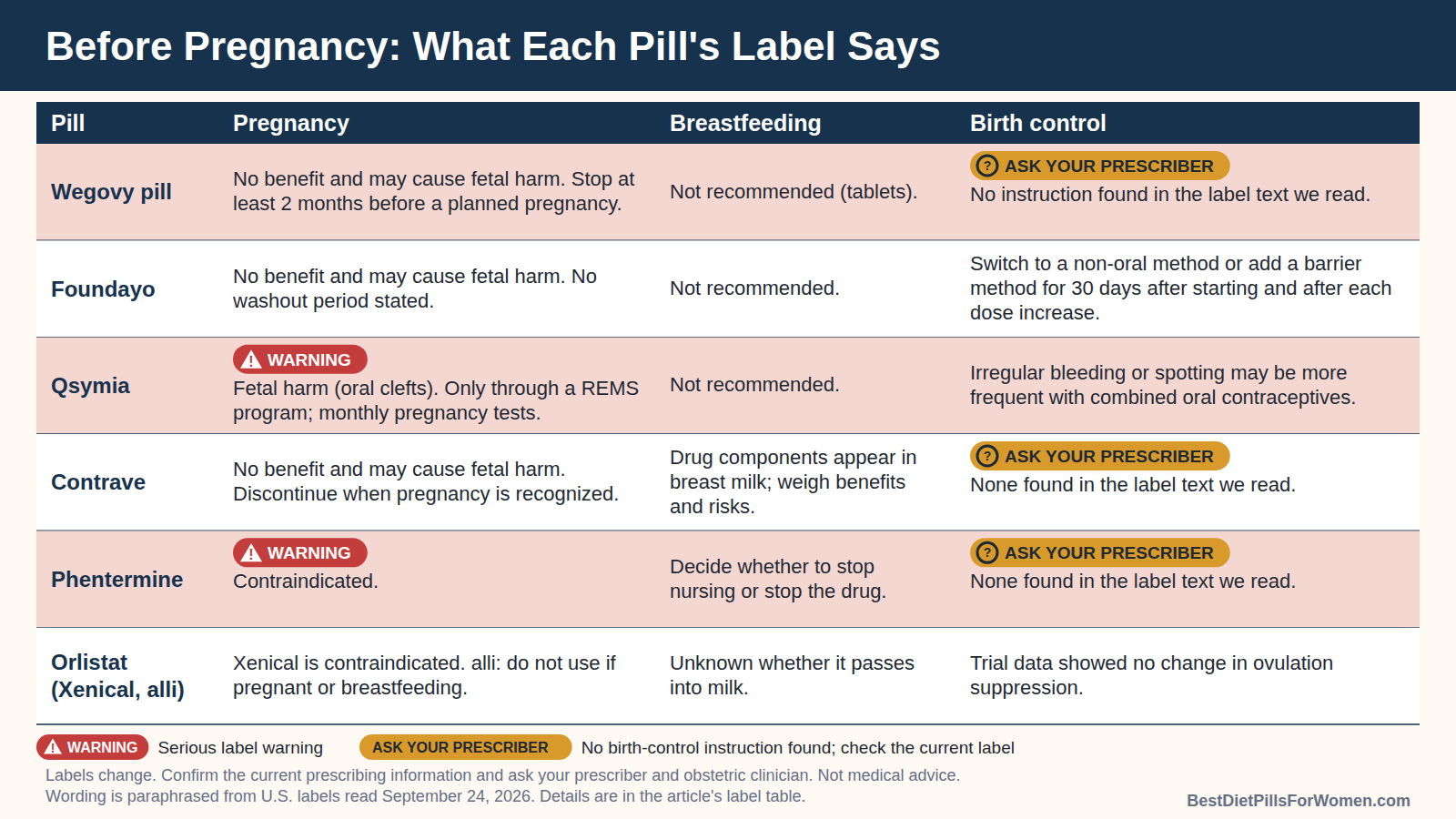
Menopause and Perimenopause
Midlife weight gain is real, but the story is more about where weight goes than how much.
What Actually Changes in Body Composition
The best long-running data come from the Study of Women’s Health Across the Nation (SWAN), which followed 1,246 women for up to 16 years and measured body composition by DXA scan. Total body weight rose about 0.5% a year before the transition and about 0.45% a year during it, with no acceleration. But fat mass gain nearly doubled during the transition (from about 0.25 kg to about 0.45 kg a year), and lean mass switched from a small gain to a small loss (about 0.06 kg a year). Over the roughly 3.5-year transition, that added up to about 1.6 kg of fat gain and about 0.2 kg of lean loss, and both stabilized about 1.5 to 2 years after the final period.
The results differed by race and ethnicity: Japanese women in the study didn’t show significant fat or weight gain during the transition, and Chinese women’s fat mass declined afterward, while Black and White women looked similar. NIH’s National Institute on Aging describes the same shift plainly: during the transition the body begins to use energy differently, the distribution of fat changes, and “your waist could get larger.”
One caution: the SWAN averages show small changes in absolute terms. They don’t justify alarm about “menopause muscle loss,” and they don’t show that any pill treats menopause-related weight gain specifically. Our planned pages on the best weight loss pills for menopause, perimenopause, women over 40 and women over 50 will focus on that question.
Do the newer drugs work at midlife? A post hoc analysis of three tirzepatide trials in 2,542 women, sorted by reproductive stage, reported similar percentage weight loss in premenopausal, perimenopausal and postmenopausal women (roughly 23% to 26% versus 2% to 3% on placebo in the figures reported by NewYork-Presbyterian, which may reflect only one of the trials and which we couldn’t tie to specific dose groups; we didn’t read the paper itself). Tirzepatide is an injection, and we found no comparable menopause-stage analysis for the two oral pills.
Hormone Therapy, and What It Isn’t For
Menopause hormone therapy (MHT) is prescribed for moderate to severe hot flashes and night sweats, osteoporosis prevention, and other menopause symptoms. A 2026 clinical review in Obesity Pillars concluded that MHT should not be marketed or prescribed as a weight-loss treatment, noted that no major organization recommends it as a primary treatment for obesity, and said obesity care needs nutrition, activity, behavioral and medical components regardless of whether someone uses MHT.
The evidence on combining MHT with GLP-1 drugs is preliminary. The same review describes two small retrospective studies: in one, 40 women on MHT lost 17% of their weight at 18 months on tirzepatide versus 14% for 80 women not on MHT, and in the other, 16 women on MHT lost 16% on semaglutide at 12 months versus 12% for 90 women without it. Neither was randomized, and differences in who received hormone therapy could explain the gap. It’s a hypothesis worth testing, not a reason to start or stop hormone therapy, which is a separate decision with a separate risk-benefit discussion.
PCOS (Now Also Called PMOS)
Polycystic ovary syndrome, or PCOS, was renamed polyendocrine metabolic ovarian syndrome (PMOS) in May 2026, following an Endocrine Society announcement backed by more than 50 patient and professional organizations. The name change phases in over three years, and most people, and most searches, still use PCOS.
What Guidelines and Trials Say About Medication
The international guideline says a supported healthy lifestyle remains vital, and that anti-obesity medications and bariatric surgery “may be considered based on general population guidelines, balancing potential for benefits and side-effects.” It recommends metformin for women with PCOS who have metabolic risk factors such as impaired glucose tolerance.
The trials underneath are limited. A systematic review that informed the guideline found 11 randomized trials (545 people on medication and 451 controls), most lasting 12 to 32 weeks, and concluded that data on anti-obesity agents in PCOS are “very limited.” Two meta-analyses of GLP-1 drugs reached different conclusions. One (13 trials, 795 women) found an average weight difference of −3.57 kg (95% CI −5.15 to −1.99), mostly against metformin, with more nausea (odds ratio 3.07) and an improvement in insulin resistance. The other (11 trials, 312 women in the BMI analysis) found a BMI difference of −1.38 (95% CI −2.39 to −0.38), rated low certainty, no significant difference in insulin measures, and high risk of bias in 8 of 11 studies. Semaglutide and tirzepatide weren’t among the drugs in the studies it analyzed.
Real-world data are more encouraging about response. In a UK digital weight-management service, 4,241 of 54,114 women taking tirzepatide reported PCOS. Average weight loss at six months was 14.9% with PCOS and 15.4% without, a difference that wasn’t statistically significant. It’s an observational, cash-pay, self-reported analysis, so it can’t be generalized casually, but it suggests PCOS isn’t a barrier to response.
Off-Label Reality and Realistic Expectations
No weight loss drug in this guide carries a PCOS-specific indication. Using them for PCOS follows the general obesity criteria (a BMI of 30 or higher, or 27 or higher with a related condition), which means the use is on-label for obesity but off-label for PCOS-specific goals like cycle regularity, excess hair growth or fertility. That’s our characterization from the drugs’ indications, not a statement from a PCOS source. We didn’t find a PCOS-specific trial of either oral GLP-1 pill.
Realistic expectations follow: PCOS shouldn’t be assumed to change how much weight a drug helps you lose, but it also isn’t a reason to expect a fix for other PCOS symptoms. And because weight loss may restore ovulation in some women, the contraception and pregnancy-planning points above apply with extra force. Our planned page on the best weight loss pills for PCOS will go deeper.

Hair Loss, Muscle, Bone, and Gallbladder
Weight loss affects the whole body, and a few effects come up often enough in labels and studies to be worth understanding before you start.
Hair Loss and Gallbladder Effects in the Label Data
Hair loss is one of the clearest sex differences in the label data. Foundayo’s label reports hair loss in 7% of women versus 0.9% of men on the drug (3% versus 0.7% on placebo), and Zepbound’s reports 7.1% of women versus 0.5% of men. Because the pooled figures in Table 5 (3% to 5%) mix women and men, they understate what women experienced. The labels list hair loss without explaining why it happens, and we didn’t find a source that establishes the mechanism, so we won’t guess. Our planned pages on hair loss on GLP-1 drugs and Foundayo hair loss will take up the question.
Gallbladder events are less common but more serious. Wegovy’s label reports gallstones in 2.5% of tablet users versus 1% on placebo (1.6% versus 0.7% for the injection), with inflammation of the gallbladder in 0.6% versus 0.2%. Zepbound’s rates were 1.1% versus 1% for gallstones and 0.7% versus 0.2% for cholecystitis. Foundayo’s, at the highest dose, were 1% versus 0.7% and 0.4% versus 0.3%. The absolute differences are small.
Lean Mass and Bone Health
Any large weight loss takes some lean tissue with it. In a 2026 meta-analysis of seven randomized trials (821 people) of GLP-1 drugs at obesity doses, lean mass fell by an average of 1.74 kg (95% CI −3.04 to −0.45), and lean mass made up roughly 14% to 22% of total weight lost with liraglutide, about 26% with tirzepatide and about 45% with semaglutide. The authors argued lean-mass loss “should not be considered a limitation” while stressing nutrition and exercise. A joint advisory from four U.S. nutrition and obesity organizations notes that in the STEP 1 DXA substudy, 5.3 kg of a 13.6 kg average loss (roughly two-fifths) was lean mass, and another meta-analysis found fat loss predominated with modest lean-mass reductions. Taken together, lean mass made up roughly 14% to 45% of the weight lost in these injection studies, depending on the drug and the study. All of this comes from injections, and we found no comparable data for the oral pills.
The advisory’s practical guidance is to eat 1.2 to 1.6 grams of protein per kilogram of body weight a day during weight reduction (roughly 82 to 109 grams a day for a 150-pound woman), do resistance training at least three times a week, and get at least 150 minutes of moderate aerobic activity weekly. Those targets are general rather than tailored, and anyone with kidney disease or other conditions should ask a clinician first. Our planned guides to protein for weight loss and muscle preservation during weight loss will cover this in detail.
Bone is the newer worry, and the evidence is mixed. Wegovy’s label reports more hip and pelvis fractures in women taking the drug than in women taking placebo in the SELECT cardiovascular trial: 1% (24 of 2,448 women) on semaglutide versus 0.2% (5 of 2,424) on placebo, and 2.4% versus 0.6% among women 75 and older. Those are small counts in older adults with heart disease, and a label observation isn’t proof of cause. A single-center 2026 study of 255 GLP-1 users and 255 matched controls (92% women, average age 64) found hip bone density fell in both groups, with a somewhat larger decline in users without diabetes (about 1% versus 0.6%), and bone loss tracked with weight loss. The most reasonable reading is that some bone loss with weight loss is expected, and whether fracture risk rises beyond that is unresolved. The joint advisory lists baseline muscle and bone assessment among its priorities, which is a good reason for postmenopausal women to raise the question with a clinician before starting.
Disordered Eating and Diet Pills
For some readers, the most important safety issue isn’t a drug interaction. It’s the relationship between weight loss products and eating disorders.
What Cohort Studies Found
In the Growing Up Today Study, which followed 10,058 girls and women aged 14 to 36 from 2001 to 2016, 1.8% of those who used diet pills for weight control received a first eating-disorder diagnosis over the following one to three years, versus 1.0% of non-users. For laxatives used for weight control the gap was larger: 4.2% versus 0.8%. A separate cohort of 1,015 females at the University of Minnesota reported that diet-pill users had a 258% greater risk of a first eating-disorder diagnosis within five years, according to the university’s release. We read both through press coverage rather than the papers, and the adjusted odds reported for the first study differ between outlets, so we use only the raw percentages.
The link may run both ways. A 2026 study of U.S. women aged 18 to 49 (431 at baseline, 266 followed six months later) found that higher eating-disorder symptoms predicted later use of weight loss medications or supplements: odds ratios of 1.67 for any product, 1.49 for over-the-counter supplements, 1.86 for prescription drugs and 2.00 for GLP-1 drugs per one-point increase in symptoms. It’s an online sample with meaningful attrition, so it points to a pattern, not a rate. Taken together, the studies suggest that diet pills can be both a marker of distress and a possible contributor to it.
Screening and Label Contraindications
Contrave’s label lists bulimia and anorexia nervosa as contraindications because they raise seizure risk, and NIDDK repeats that people with those conditions shouldn’t take it. The other prescription labels don’t carry a comparable line in the text we read, which doesn’t mean the risk is absent.
The practical step is honest screening. If you have a current or past eating disorder, or you notice yourself skipping meals, purging, or using laxatives or diuretics to control weight, talk to a clinician before using any weight loss product. The National Eating Disorders Association’s warning-signs page notes that laxative misuse doesn’t remove calories before absorption, and that severe dehydration from purging or diuretics can cause tremors, weakness, blurry vision, fainting, kidney damage and, in extreme cases, death. The National Alliance for Eating Disorders runs a free helpline staffed by licensed therapists; its website listed 866-662-1235, 9 a.m. to 7 p.m. Eastern, Monday through Friday, on September 24, 2026. If your weight loss goal is bound up with fear of food or distress about your body, support for that distress is a different and often more urgent need than a pill.
Pills Versus the Alternatives: What Else Works, and What Happens if You Stop
A pill is one option on a longer menu, and the rest of the menu sets the bar a pill has to clear. Table 7 lines up the main choices. The results come from different kinds of studies in different populations, so treat the table as a map of magnitudes, not a scoreboard.
| Option | Best-available result | Who and how long | Strength of evidence | Main drawback | Cost context |
|---|---|---|---|---|---|
| Intensive behavioral programs | 2.39 kg (about 5 lb) more than comparison groups at 12–18 months; about 1 extra person in 8 reaches a 5% loss | 67 studies, 22,065 adults; most programs ran 1–2 years, and most had at least 12 sessions in year one | Strong and broad, but the average effect is small | Needs sustained effort and access to a program; wide individual variation | Varies by program; in KFF’s 2025 employer survey, 34% of covering firms required enrollees to meet with a dietitian, case manager or therapist or join a lifestyle program before GLP-1 coverage |
| FDA-approved prescription pills (Tiers 1–2) | −5.4% (Contrave, 56 weeks) to −13.6% (Wegovy pill, 64 weeks) vs −1.2% to −2.2% on placebo | Pivotal trials, mostly adults without diabetes, 56–72 weeks | Strong for the pivotal trials; little long-term data for the two newest pills | Side effects, contraindications, regain after stopping | Manufacturer self-pay or program prices of roughly $66 to $349 a month for these drugs; average retail prices for Qsymia and Contrave were higher (Table 8) |
| GLP-1 and dual-agonist injections | −14.9% (semaglutide 2.4 mg, 68 weeks) to −20.9% (tirzepatide 15 mg, 72 weeks) vs −2.4% and −3.1% on placebo | 1,961 and 2,539 adults without diabetes | Strong; longest record of the newer drugs | Same boxed-warning class as the GLP-1 pills; regain after stopping; weekly injections | Cash about $349 to $449 or more a month once on a maintenance dose (Table 8) |
| Metabolic and bariatric surgery | Typically 15% to 30% of starting weight; in one large cohort, bypass 22% and sleeve 16% at 5 years | Adults who meet a BMI threshold, generally about 35 or higher; cohort of more than 31,000 surgical patients | Strong for durability, but the figures here are observational | Operative risk, lifelong vitamin needs, some regain | $15,000 to $25,000 or more (NIDDK page last reviewed September 2020) |
| Over-the-counter orlistat (alli) | About 2.9 kg more than placebo in a 2007 meta-analysis (dose not confirmed as the 60 mg OTC strength); a 2025 network meta-analysis reportedly found no significant advantage at 52 weeks (read through a summary) | 16 trials, 10,631 participants; treatment lasted 1–4 years | Moderate and inconsistent | Digestive effects, vitamin absorption, kidney warnings | About $58 to $64 per 30 days (Table 8) |
| Dietary supplements | Pooled effects mostly under 2 kg in NIH’s summary; a systematic review found limited high-quality evidence of efficacy | Trials ran from about 4 weeks to 12 months | Weak | Hidden drugs, liver injury, stimulant load | About $25 to $70 a month in the examples we checked |
Table 7 sources and method: figures come from the cited sources; the surgery row combines a government summary (NIDDK) with a Kaiser Permanente cohort that compared surgical and nonsurgical patients. The rows describe different populations, so read them as ranges of what has been reported.
Lifestyle and Behavioral Programs
Every guideline we reviewed places eating, activity and behavior change underneath any medication. What those programs deliver is worth knowing, because it tells you how much a pill has to add.
What Intensive Programs Deliver
The U.S. Preventive Services Task Force recommends that clinicians offer or refer adults with a BMI of 30 or higher to intensive, multicomponent behavioral interventions (a Grade B recommendation). Most of the interventions in its 2018 review lasted one to two years, and most included at least 12 sessions in the first year. Typical components were problem solving, self-weighing, peer support and relapse prevention.
Across 67 studies and 22,065 adults, people in behavior-based programs lost 2.39 kg more than comparison groups at 12 to 18 months (95% CI −2.86 to −1.93 kg). They were also nearly twice as likely to lose at least 5% of body weight (relative risk 1.94 across 38 trials), which works out to one extra person in eight. That figure is the difference from comparison groups, not the average loss in the program group. The review found no evidence of harm from these programs.
Longer follow-up shows both the value and the limits. In Look AHEAD, a trial of 5,145 adults with type 2 diabetes and overweight or obesity, an intensive lifestyle program produced an average first-year loss of about 8.6% versus 0.7% with diabetes support and education. By year 8 the averages were 4.7% versus 2.1%, and 50.3% of the program group was still at least 5% below starting weight, compared with 35.7% of the comparison group. The trial’s main cardiovascular outcome didn’t differ significantly between groups (hazard ratio 0.95; 95% CI 0.83 to 1.09), so in that population, the program’s weight loss did not translate into a statistically significant reduction in heart events.
The Diabetes Prevention Program (3,234 adults with elevated blood sugar) is the best-known example of what a lifestyle program can do for a specific outcome. A program with goals of losing at least 7% of body weight and exercising 150 minutes a week cut new diabetes cases by 58% (95% CI 48% to 66%) compared with placebo over about three years; metformin cut them by 31% (95% CI 17% to 43%). The 7% was a target, not the average result.
The guidelines treat the two approaches as partners. NIDDK says medications don’t replace healthy eating and physical activity and work best with a lifestyle program. The American College of Cardiology’s 2025 guidance says patients shouldn’t have to “try and fail” lifestyle changes before starting a drug, but that lifestyle support should always accompany it. The WHO’s 2025 guideline makes a conditional, low-certainty suggestion that intensive behavioral programs may be offered to adults who are prescribed GLP-1 therapies.
Protein, Resistance Training, and Sleep
The specific targets for protein, strength training and aerobic activity appear in the women-specific section above; they come from a joint advisory written for people taking GLP-1 drugs. Outside that advisory, the supporting evidence is thinner than the advice suggests.
A systematic review of 20 randomized trials in adults over 50 found that people who ate higher-protein diets while losing weight kept more lean mass and lost more fat than those on lower-protein diets. We could read only the abstract, which gave no effect sizes, and the review covers older adults specifically. So the direction is encouraging, but we can’t tell you how many grams of muscle a given protein target protects.
Sleep is even more of an association. A meta-analysis of 30 studies (634,511 participants, including 30,002 children) found that adults who reported short sleep had 1.55 times the odds of obesity (95% CI 1.43 to 1.68; 604,509 adults). Most of those studies were observational, and “short sleep” was defined differently from study to study. The finding shows a link. It doesn’t show that adding an hour of sleep produces weight loss, and we didn’t retrieve a randomized sleep trial that would settle it.

Injections and Surgery
Two alternatives sit above pills in average effect. Both deserve a fair description here, because for some readers they’re the more relevant comparison.
GLP-1 and Dual-Agonist Injections
The trial numbers for semaglutide and tirzepatide injections are in Table 2, and we won’t repeat them. What’s worth adding is where the major guidelines stand. The WHO’s December 2025 guideline conditionally recommends GLP-1 therapies (liraglutide, semaglutide and tirzepatide) for long-term obesity treatment in adults, excluding pregnant women, and lists limited long-term data, cost, health-system readiness and equity among the reasons the recommendation is conditional. The American College of Cardiology’s 2025 guidance says semaglutide and tirzepatide have demonstrated the highest efficacy of the available drugs, with tirzepatide producing slightly greater weight loss.
The trade-offs are practical as much as clinical. Injections give larger average losses and longer track records, but they mean weekly self-injection, and on September 24, 2026 they cost the same as or more than the pills for people paying cash (Table 8). Both classes carry boxed warnings about thyroid C-cell tumors and cause similar digestive side effects, and the regain question covered next applies to both, although the data come from injections. Our planned pages on pills versus injections and semaglutide versus tirzepatide will give each comparison its own space.
Metabolic and Bariatric Surgery
The 2022 guidelines from the American Society for Metabolic and Bariatric Surgery and the International Federation for the Surgery of Obesity recommend surgery for people with a BMI of 35 or higher regardless of other conditions, and say it should be considered at a BMI of 30 to 34.9 when metabolic disease is present. They put perioperative mortality between 0.03% and 0.2%. NIDDK, on a page last reviewed in September 2020, describes similar eligibility and says many people who have weight loss surgery lose 15% to 30% of their starting weight on average.
Long-term data come mostly from cohorts. In a Kaiser Permanente study comparing more than 31,000 surgical patients with nonsurgical patients, average weight loss at five years was about 22% of starting weight after gastric bypass and 16% after sleeve gastrectomy. At ten years, bypass patients had kept off about 20%, versus about 5% for usual-care patients. Those are observational comparisons, not randomized ones, and the patients who chose surgery may differ from those who didn’t.
Surgery also comes with costs and commitments that pills don’t: NIDDK’s 2020-era page puts the price at $15,000 to $25,000 or more, and it is a commitment of a different order than a monthly prescription. For women, that raises the same planning questions as any long-term treatment, including pregnancy timing, and they belong in a conversation with a surgical team, not in a table.
Weight Regain After Stopping Treatment
For anyone weighing a pill, this is the finding that changes the math most. The best trials of what happens after treatment stops involve injections, because the two newest pills are too new to have produced comparable data.
What the Stopping Trials Show
In the STEP 1 extension, researchers followed 327 participants for a year after both semaglutide and the lifestyle program ended. On average, people regained 11.6 percentage points of body weight, compared with 1.9 in the placebo group, and the net loss from baseline fell to 5.6% (from 17.3% at week 68 in this subset). The authors summarized it as regaining two-thirds of prior weight loss, with cardiometabolic improvements reverting toward baseline. Because the lifestyle intervention stopped at the same time, the trial can’t separate the effect of stopping the drug from the effect of stopping the program.
SURMOUNT-4 was designed to isolate the drug. All participants took tirzepatide (the maximum tolerated 10 or 15 mg dose) for 36 weeks in an open-label lead-in and lost an average of 20.9%. Then 670 of them (71% women) were randomized: 335 continued tirzepatide and 335 switched to placebo for 52 weeks. From week 36 to week 88, weight fell another 5.5% with continued tirzepatide and rose 14.0% with placebo, a difference of 19.4 percentage points (95% CI −21.2 to −17.7). At week 88, 89.5% of the continuation group had kept at least 80% of their lead-in loss, versus 16.6% of the placebo group. Measured from the start of the trial, total loss was 25.3% versus 9.9%.
What the 2026 BMJ Meta-Analysis Adds
A systematic review and meta-analysis published in the BMJ on January 7, 2026 pooled 37 studies (63 treatment arms, 9,341 participants) of weight loss medication and follow-up after stopping. Treatment averaged 39 weeks and follow-up 32 weeks. Across all medications, people regained about 0.4 kg a month (95% CI 0.3 to 0.5), and the analysis projected a return to baseline weight about 1.7 years after stopping (95% CI 1.3 to 2.1). Regain was faster than after behavioral weight management programs, by about 0.3 kg a month, and cardiometabolic markers were projected to return to baseline within about 1.4 years.
For semaglutide and tirzepatide specifically (10 arms, 1,776 participants), the numbers were larger because the starting loss was larger. Average loss at stopping was 14.7 kg, first-year regain was 9.9 kg (95% CI 8.4 to 10.8), monthly regain was 0.8 kg, and the projected return to baseline weight was 1.5 years (95% CI 1.0 to 1.9).
Three cautions apply. The authors rated certainty for the rate of regain as moderate, but said data on the newer, more effective drugs were limited to eight studies with a maximum of 12 months of follow-up. The comparison with behavioral programs is indirect. And “projected return to baseline” is an extrapolation from average rates, not a prediction that every person regains everything. The pooled estimate also includes many older oral drugs, and we couldn’t retrieve drug-by-drug figures, so we can’t say how the oral pills compare.
What does this mean for a reader deciding whether to start? NIDDK is direct that you probably will regain some weight after stopping a weight management medication, and that healthy habits may reduce the regain. The American College of Cardiology’s guidance frames obesity as a chronic, progressive disease. Whether to continue, stop or change a medication is a decision for you and your prescriber, and it’s one worth discussing before the first prescription, along with what you’d do if cost, side effects or a pregnancy forced a stop.
What Weight Loss Pills Cost: Prices and Coverage as of September 24, 2026
Cost decides what many women can actually take, and it’s the part of this guide most likely to be out of date first. Every price below was read on September 24, 2026, and several promotions end on December 31, 2026. Treat Table 8 as a dated snapshot, not a quote. Our planned pages on Wegovy pill cost and Wegovy insurance coverage will go deeper on the drugs that drive most of the questions.
| Option | Cash price per 30-day supply | Price source | 12-month arithmetic (30-day price × 12 unless noted) | Watch-outs |
|---|---|---|---|---|
| Wegovy pill | $149 (1.5 mg); $199 (4 mg); $299 (9 mg and 25 mg) | NovoCare Pharmacy self-pay, 30 tablets | At the 25 mg maintenance dose: 12 × $299 = $3,588. First year with the labeled titration: $149 + $199 + $299 + (9 × $299) = $3,338 | Novo can change the program; the 4 mg price was announced at launch as a $149 promotion through April 15, and it was $199 on September 24, 2026 |
| Foundayo | $149 (0.8 mg); $149 (2.5 mg, temporary, regular $199); $199 (5.5 mg, temporary, regular $299); $299 (9 mg); $299 (14.5 and 17.2 mg if refilled within 45 days, otherwise $349) | LillyDirect self-pay | At 17.2 mg: 12 × $299 = $3,588 (12 × $349 = $4,188 without the refill window). First year to the top dose at regular prices: $149 + $199 + $299 + $299 + $299 + (7 × $299) = $3,338 | Temporary reductions end 12/31/2026; the label makes escalation past 5.5 mg a prescriber decision, so not everyone reaches the top-dose price |
| Wegovy pen (injection benchmark) | $349 (0.25–2.4 mg); $199 for the first two fills of 0.25 and 0.5 mg (new patients, through 12/31/2026); $399 (7.2 mg Wegovy HD) | NovoCare Pharmacy self-pay, 4 pens | First year with the intro offer: (2 × $199) + (10 × $349) = $3,888. Steady state at 2.4 mg: 12 × $349 = $4,188; at 7.2 mg: 12 × $399 = $4,788 | Intro offer expires 12/31/2026 |
| Zepbound (injection benchmark) | $299 (2.5 mg); $399 (5 mg); $449 (7.5–15 mg if refilled within 45 days; otherwise $499 for 7.5 mg or $699 for 10–15 mg) | LillyDirect self-pay, vial or KwikPen | Steady state at 5 mg: 12 × $399 = $4,788; at 7.5–15 mg: 12 × $449 = $5,388 | Needles and syringes cost extra; refill window matters |
| Qsymia | $74.99 (Qsymia Engage home delivery, titration packs included); $65.99 (Costco members, cash); $75.00 (GoodRx); about $258 average retail | Manufacturer, Costco and GoodRx listings | 12 × $74.99 = $899.88 | Savings card excludes California and Massachusetts residents and people with government insurance |
| Contrave | $99 (CurAccess); no more than $199 at retail with the savings card and no insurance; $199.20 (GoodRx); about $742 average retail | Manufacturer and GoodRx | 12 × $99 = $1,188; 12 × $199 = $2,388 | No generic |
| Phentermine 37.5 mg (generic) | About $9.91 to $23.04 with SingleCare coupons; $10.35 at best on GoodRx; average retail about $40 to $50 | Price-comparison sites, 30 tablets | Short-term drug: 3 months = about $30 to $69 (3 × $9.91; 3 × $23.04) | Coupon prices vary by pharmacy; controlled substance |
| Lomaira (phentermine 8 mg) | Manufacturer says “no more than 50 cents per tablet”; $25.60 for 30 tablets on SingleCare | Manufacturer and SingleCare | At the labeled 3 tablets a day: 90 × $0.50 = up to $45 a month | Quantity pricing on coupon sites not verified |
| Orlistat 120 mg (Rx) | $554.21 (Drugs.com) to $634.16 (GoodRx low) for 90 capsules; about $688 average retail | Price guides | 12 × $554.21 = $6,650.52 | Far costlier than OTC alli; doses aren’t interchangeable |
| alli 60 mg (OTC orlistat) | $76.99 (Walmart), $79.99 (Walgreens) or $85.39 (Drugs.com guide) for 120 capsules | Retailer listings | At 3 capsules a day: $1.92 to $2.13 a day; $58 to $64 per 30 days; a bottle lasts about 40 days | Stock varied by retailer |
| Plenity | $99 (1 month); $700 (6 months, about $116.67 a month); $1,300 (12 months, about $108.33 a month) | Seller website (operator not identified) | 12-month bundle: $1,300 | Availability and seller unverified; the site’s FAQ lists different per-month figures |
| Supplement examples | About $25 to $70 a month across four examples ($24.99 to $69.99 per bottle or pack; Hydroxycut’s bottle lasts about 15 days, or roughly $50 a month); $0.83 to $2.33 a day | Manufacturer pages | Roughly 12 × $25 to 12 × $70 = $300 to $840 | Price says nothing about quality |
Table 8 method: prices were read from manufacturer pages, price-comparison sites and retailer listings on September 24, 2026. Arithmetic multiplies the 30-day price by 12 unless noted and assumes continuous fills. Figures exclude office visits, labs, needles, shipping and telehealth fees, and coupon prices vary by pharmacy. The titration scenarios assume the minimum labeled 30 days at each step, which many people don’t follow exactly.
Self-Pay Prices
“Self-pay” means paying cash without using insurance. Both Novo Nordisk and Eli Lilly now sell their GLP-1 drugs directly to patients at posted prices, and those posted prices are what Table 8 reflects.
GLP-1 Pills and the Injection Benchmarks
For people paying cash, the two GLP-1 pills cost about the same as, or less than, the injections they compete with. On NovoCare Pharmacy, the Wegovy pill runs $299 a month at the 25 mg maintenance dose, versus $349 for the Wegovy pen at most doses. Over a year, that’s $3,588 versus $4,188, a $600 difference. Foundayo’s top doses cost $299 a month when refilled within 45 days, compared with $399 to $449 for Zepbound at typical maintenance doses.
Cash prices are far below list prices. The White House said in February 2026 that the Wegovy pill fell from a $1,349 monthly list price to as low as $149, and at $1,349 a month, a year would come to $16,188. The $299 self-pay price is about 22% of that. We couldn’t find a published list price for Foundayo. Novo has announced that it will cut the Wegovy injection’s list price by roughly half on January 1, 2027, and says self-pay prices won’t change.
The federal TrumpRx.gov site, launched February 5, 2026, is a portal to those manufacturer cash prices rather than a separate discount. CBS News reported that it sends users to drugmakers’ own sites and that the discounted prices are only for cash-paying patients, which means the spending doesn’t count toward an insurance deductible. That’s a real trade-off if you have insurance that might cover the drug later in the year.
Several of these prices come with expiration dates. Novo’s $199 introductory offer on the Wegovy pen (first two fills, 0.25 mg and 0.5 mg, new patients) ends December 31, 2026. So do Lilly’s temporary reductions on Foundayo’s 2.5 mg and 5.5 mg doses. Lilly’s savings cards for Foundayo and Zepbound state that they expire on December 31, 2026 and cap fills at 10 and 11 per year, respectively. We couldn’t tell from the pages whether those limits govern the cash price or only the insurance savings card, so check before you plan a full year around them.
Older Prescription Pills, Orlistat, and Plenity
Generic phentermine is the cheapest prescription option by an order of magnitude: about $10 to $23 for 30 tablets with pharmacy coupons, against $40 to $50 without. Cheap isn’t the same as best. The label supports only short-term use, it’s a controlled substance, and the evidence is old (Table 3). Lomaira, a lower-dose phentermine, is priced by the tablet, and the manufacturer says patients pay no more than 50 cents a tablet.
Qsymia and Contrave sit in the middle. Qsymia’s manufacturer offers home delivery for $74.99 a month, with the titration packs included, and Costco members can pay $65.99 in cash. Contrave costs $99 a month through the manufacturer’s CurAccess program, or no more than $199 at a retail pharmacy with the savings card and no insurance. Both prices come from manufacturer pages with no page date, so confirm them.
Prescription orlistat is the surprise. A month of 120 mg capsules (90 capsules at three a day) costs $554 to $634 on the price guides we checked, while over-the-counter alli, at 60 mg per capsule, costs about $58 to $64 for 30 days at three capsules daily. The doses aren’t interchangeable and the labels differ, so this isn’t a like-for-like swap, but the gap explains why most people who use orlistat use the OTC version.
Plenity’s price depends on who is selling it. The one seller site that listed prices on September 24, 2026 showed $99 for a month and $1,300 for a year, while another site said the product wasn’t yet available for sale (see the OTC section). Until the seller and the product’s status are confirmed, we’d treat any price as unverified.
Insurance, Medicare, and Employer Coverage
Coverage for weight loss drugs is uneven, and it’s changing quickly. Being covered also doesn’t mean being free: prior authorization, BMI rules and lifestyle-program requirements are common.
Commercial and Employer Plans
The most recent KFF Employer Health Benefits Survey (released October 22, 2025) found that 16% of firms with 200 to 999 workers, 30% of firms with 1,000 to 4,999 workers, and 43% of firms with 5,000 or more covered GLP-1 drugs when used primarily for weight loss in 2025, up from 28% of the largest firms in 2024. KFF didn’t ask firms with fewer than 200 workers. Among covering firms, 34% required enrollees to meet with a dietitian, case manager or therapist or to join a lifestyle program. We didn’t find a 2026 KFF survey as of September 24, 2026; KFF has typically released it in the fall.
A newer survey from the Business Group on Health, released September 23, 2026, asked 105 large employers. Of those, 67% covered GLP-1s for weight management, 72% of the covering employers said they were likely to continue in 2027, and 10% said they were likely not to. It’s a small, non-representative sample of large employers, so it shows sentiment, not the national picture.
Insurers set their own rules. UnitedHealthcare’s commercial policy, effective September 1, 2026, lists prior authorization for products including the Wegovy tablet, Foundayo, Zepbound, Qsymia, Contrave, phentermine products and orlistat. In most states, initial approval requires a BMI of 30 or higher, or 27 or higher with a weight-related condition such as high blood pressure, dyslipidemia, type 2 diabetes or sleep apnea. Continuation requires a minimum loss from baseline: 3% for Qsymia, 4% for Saxenda and 5% for Wegovy, Foundayo and several others. That list applies where a plan includes weight loss coverage; it doesn’t mean every UnitedHealthcare plan covers these drugs.
Pharmacy benefit managers are shifting too. According to trade-press reports (we didn’t find the company’s own announcement), CVS Caremark said on May 28, 2026 that it would restore Zepbound and add Foundayo to its standard commercial formularies alongside Wegovy. We didn’t find an implementation date. Manufacturer savings programs for commercially insured patients advertise “as little as $25 a month,” but with a maximum savings of $100 a month, so anyone whose plan charges more than $125 a month pays more than $25. Government beneficiaries are excluded.
Medicare’s GLP-1 Bridge and Medicaid
Medicare Part D generally can’t cover drugs used specifically for weight loss, which is why the newest coverage arrives through a demonstration rather than the regular drug benefit. The Medicare GLP-1 Bridge, running July 1, 2026 through December 31, 2027, lets eligible people get Wegovy (injection or tablets), Foundayo or the Zepbound KwikPen for a $50 monthly copay. Zepbound vials and single-dose pens aren’t included.
Eligibility is narrower than the FDA labels. Beneficiaries must be 18 or older and have a BMI of at least 35; or a BMI of at least 30 with heart failure with preserved ejection fraction, uncontrolled hypertension or chronic kidney disease stage 3a or higher; or a BMI of at least 27 with prediabetes, a prior heart attack or stroke, or symptomatic peripheral artery disease. People with type 2 diabetes, moderate-to-severe obstructive sleep apnea or noncirrhotic MASH are routed to regular Part D, where the drugs are covered for those indications. Prior authorization is required. The arithmetic is $50 × 12 = $600 a year, or $900 across the program’s 18 months.
Because the Bridge sits outside Part D, the $50 copay doesn’t count toward the Part D out-of-pocket cap, the Part D deductible doesn’t apply, and CMS says there’s no appeals process. A related demonstration, the BALANCE model, was reported to begin its Medicaid portion on May 1, 2026, with state start dates rolling through January 1, 2027; we couldn’t verify which states are participating. CMS delayed the Medicare Part D portion on April 21, 2026 and hadn’t announced a new date in the sources we read.
State Medicaid coverage is shrinking. KFF reported that 13 state Medicaid programs covered GLP-1s for obesity in fee-for-service as of January 2026, after California, New Hampshire, Pennsylvania and South Carolina ended coverage starting in October 2025. Some state employee plans have cut back too: Massachusetts’s Group Insurance Commission voted in February 2026, according to WBUR, to end coverage of GLP-1s for weight loss alone, effective July 1, 2026, while still allowing requests for specific conditions. Which rules apply to you depend on your state and plan, and the only reliable source is your plan’s current formulary and prior authorization criteria.
Supplements, and Why Price Is Not a Quality Signal
Supplement prices vary widely, and none of the variation tells you how well a product works or how safe it is.
What a Month of Supplements Costs
We checked four manufacturer pages on September 24, 2026 as price illustrations only. We didn’t review these products for safety or effectiveness, and their appearance here isn’t a recommendation. A 60-capsule bottle of PhenQ was $69.99 at a sale price, or $2.33 a day at the labeled two capsules daily. Hydroxycut Hardcore was $24.99, which at the labeled four capsules a day and a retailer’s 60-count listing would last 15 days, or about $50 for 30 days. BioTrust’s “GLP-1 Elevate” was $59 on its product page (the homepage showed $44), and Nature Made’s “GLP-1 Companion Health Pack” was $24.99 for 30 packets, about 83 cents a day.
That’s a range of roughly $25 to $70 a month, or 83 cents to $2.33 a day. The Nature Made product is a vitamin and mineral pack that says it doesn’t contain GLP-1 medication, a good example of a product name implying more than the contents deliver. We didn’t verify capsule counts for every product from the manufacturer page, so treat the per-day figures as estimates.
Price also can’t stand in for quality. FDA says weight loss products with hidden drug ingredients “pose a serious health risk and are not guaranteed to work,” and those products can be sold at any price. Dietary supplements aren’t reviewed for safety or effectiveness before sale, and NIH’s Office of Dietary Supplements says there’s little scientific evidence that weight loss supplements work. Read refund terms closely, too. In one example we checked, a 60-day guarantee carried a 5% handling fee.
Prices That Will Change Soon
Several dated facts in this section have a short shelf life. Before you make a decision that depends on cost, re-check these:
- December 31, 2026: Novo’s $199 Wegovy pen introductory offer; Foundayo’s temporary 2.5 mg and 5.5 mg price reductions; and the expiration date printed on Lilly’s Foundayo and Zepbound savings cards.
- January 1, 2027: Novo’s planned cut to the Wegovy injection’s list price (self-pay prices unaffected, according to the company).
- Fall 2026: KFF’s next employer survey, expected around October, which will update the employer coverage figures above.
- Ongoing: the Medicare Bridge (through December 31, 2027), BALANCE model start dates, state Medicaid and state-employee plan decisions, and CVS Caremark’s formulary changes.
- Any time: manufacturer programs, coupon prices, alli stock (some retailers showed “low stock” or “unavailable”), and Plenity’s seller and status.
Novo and Lilly both state that their programs can change, and the Wegovy pill’s 4 mg price already has: at launch in January 2026 it was announced as a $149 promotion through April 15, and on September 24, 2026 it was $199.
How to Choose: A Decision Framework and Questions for Your Clinician
No article can tell you which pill to take. What it can do is help you narrow the field and arrive at an appointment with better questions. The framework below organizes what this guide covered. It isn’t a diagnosis or a recommendation, and the actual choice has to be made with a clinician who knows your medical history, your medications and your plans for pregnancy.
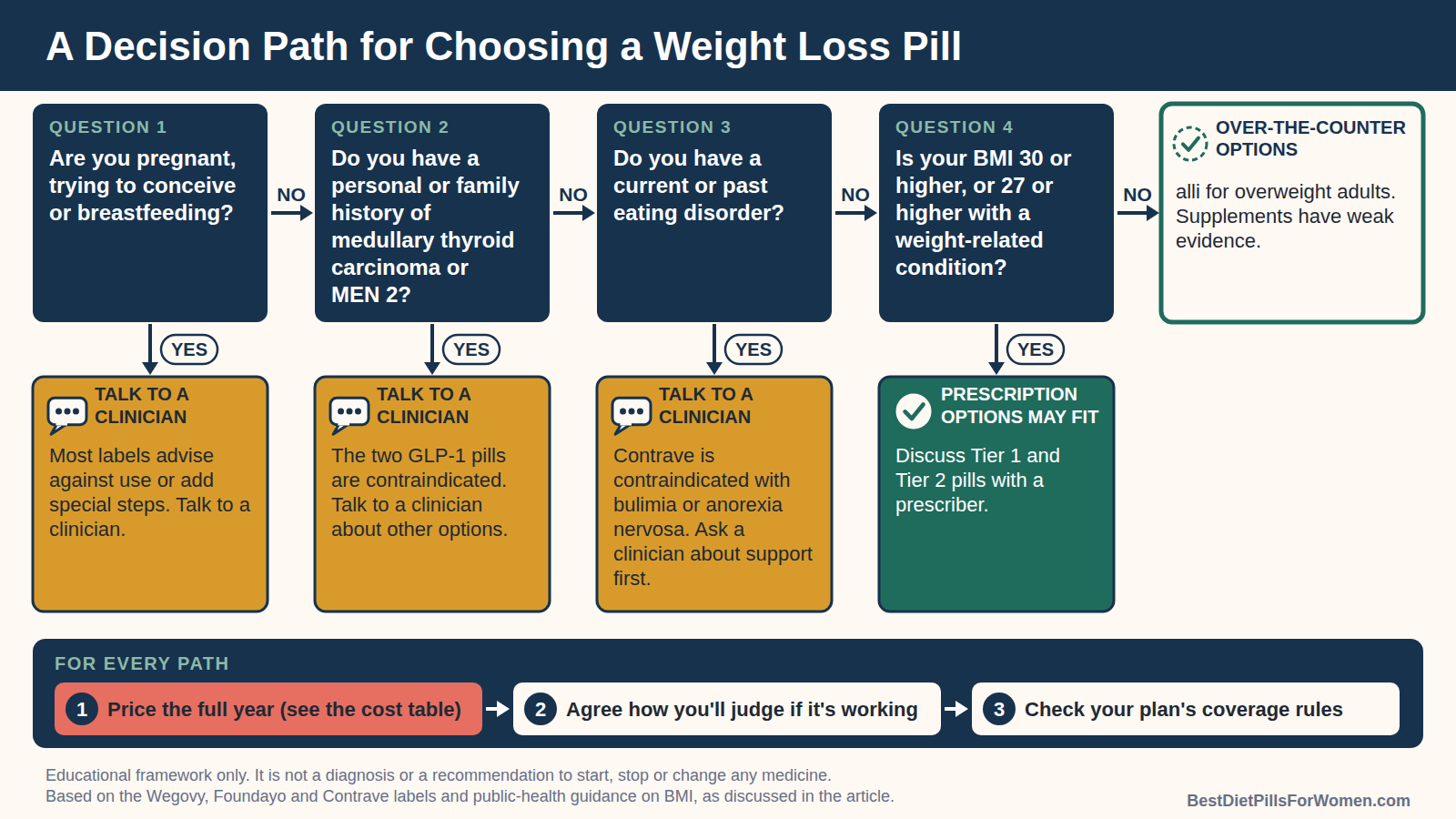
A Step-by-Step Way to Narrow the Options
The path has five steps. The first two decide what’s even on the table, and the last three help you compare what’s left.
Step 1: Eligibility and Goals
FDA-approved prescription weight loss drugs are generally intended for adults with a BMI of 30 or higher, or a BMI of 27 or higher with at least one weight-related health problem. That’s how NIDDK and the 2015 Endocrine Society guideline describe eligibility, and it’s the threshold UnitedHealthcare’s prior authorization policy generally uses. Plenity’s FDA clearance covers a BMI of 25 to 40, and alli’s label is for overweight adults 18 and older. Insurers and programs can set stricter rules. Medicare’s GLP-1 Bridge, for example, requires a BMI of at least 35 unless you have specific qualifying conditions.
BMI is a screening tool, not a verdict. The CDC notes that it doesn’t distinguish fat from muscle and bone, and that it doesn’t show where in the body a person carries fat. A clinician may look at waist size, blood pressure, blood sugar and other measures alongside it.
Then ask what you want the weight loss to do. NIDDK says a 5% to 10% loss may help improve health. For a woman who weighs 200 pounds, that’s 10 to 20 pounds. Someone aiming for easier movement, lower blood sugar or fewer joint aches may need a smaller change than the numbers in pill advertising imply, and a different goal can change which options make sense.
Step 2: Hard Stops and Cautions
Before comparing effectiveness, screen out options your situation may rule out. Here are the questions worth asking yourself, each tied to something established earlier:
- Are you pregnant, trying to conceive or breastfeeding? Nearly every label advises against use or attaches special steps (Table 6).
- Do you have a personal or family history of medullary thyroid carcinoma, or multiple endocrine neoplasia type 2 (MEN 2)? Both GLP-1 pills are contraindicated in that case.
- Do you have a current or past eating disorder? Contrave’s label lists bulimia and anorexia nervosa as contraindications, and screening matters for any weight loss product.
- Do you have heart disease? Phentermine’s label lists it as a reason not to use the drug, and other stimulant-type products carry similar cautions (see the safety section).
- What else are you taking? Prescription drugs, over-the-counter products and supplements can all interact. Our planned guide to weight loss supplement interactions will go further.
If any answer is “yes” or “I’m not sure,” that’s a reason to bring the question to a clinician before you spend money.
Steps 3 to 5: Match the Evidence, Price the Plan, and Set a Check-In
Step 3: Match the evidence to your goal. Tier 1 pills produced average losses above 10% at the top studied doses in trials of 64 to 72 weeks, Tier 2 pills produced 5% to 10%, and lower tiers did less (Table 1). A smaller health-focused goal may fit a wider range of options, while a larger one leans on the strongest evidence. Remember that the effect applies while you take the drug (see the regain section) and that the averages aren’t forecasts.
Step 4: Price the whole plan, not the first month. Use Table 8 to add up a full year, including the titration months, the refill windows, the promotional prices that expire on December 31, 2026, and what you’d do if insurance coverage changed. A pill that’s affordable for three months and not for twelve is a different decision than one you can sustain.
Step 5: Agree on a check-in before you start. Ask your prescriber how you’ll both judge whether the medicine is working and how you’ll monitor side effects. The timing for that check is covered in the questions section below.
Questions Worth Bringing to an Appointment
Clinicians have limited time, and the most useful visits are the ones where the patient arrives with specific questions. These lists are starting points, not scripts.
About the Medicine
- Given my medical history and current medications, which of these options are ruled out, and why?
- What result would count as success at the first check-in, and what happens if I don’t reach it?
- How do my plans for pregnancy and my birth control fit with each option? If I use oral contraceptives, does this drug change what I need to do?
- Which side effects should make me call you, and which are expected?
- What monitoring will I need (blood pressure, heart rate, labs), and how often?
- How will we protect muscle and bone while I lose weight, including protein and strength training?
- Are any of my current supplements or over-the-counter products a concern?
About Cost, Coverage, and the Long Game
- Does my plan cover this drug? If so, what prior authorization, BMI or lifestyle-program requirements apply, and how much weight loss do I need to show to keep coverage?
- What will I pay after any promotional price ends?
- If I need to stop because of cost, side effects or a pregnancy, what’s the plan for the weeks and months afterward?
- How long do we expect to use this medicine?
- What happens if my insurance changes or my employer drops coverage?
- Is a lifestyle program included, and how do I connect with a dietitian or behavioral support?
Red Flags That a Pill Isn’t Worth Your Money
Most of the supplement aisle fails one or more of these tests. So do some online programs.
Claims to Walk Away From
The FTC’s weight-loss advertising guidance lists red flags: claims that you can lose weight without diet or exercise, that a pill is all you need, that a product alone produces permanent weight loss, or that a product works for everyone. Add to that list any product that promises to “melt” fat, target belly fat, “detox” your body or “reset” your metabolism. We found no good evidence that any pill does these things.
Other warning signs include:
- A “clinically proven” claim with no trial of the actual product. The FTC says health claims need competent and reliable scientific evidence, and that animal studies, lab studies and testimonials alone aren’t enough.
- A “proprietary blend” that hides ingredient amounts. You can’t judge the dose of what you can’t see (see the supplement section).
- A “GLP-1” name on a product that isn’t a GLP-1 drug. We found no regulatory definition of the term, and PBS NewsHour reported such products containing ingredients like berberine, glutamine and chromium, none of which is a GLP-1 drug.
- Regulatory language that doesn’t mean approval. “Made in an FDA-registered facility” doesn’t mean FDA approved the product.
- A “pill” or “drop” that claims to be a GLP-1 drug but isn’t one of the two FDA-approved GLP-1 pills. FDA has warned about unapproved and counterfeit GLP-1 products.
Reviews, Endorsements, and “Doctor-Approved” Language
Since October 21, 2024, an FTC rule has banned fake or false consumer reviews and testimonials. The FTC’s Endorsement Guides also say that connections between an endorser and a company, such as payment or free product, have to be disclosed. Retailer star ratings, influencer posts and before-and-after photos aren’t evidence of effectiveness, and they aren’t a substitute for a trial.
“Doctor-approved” and “clinically proven” aren’t the same thing as FDA approval. When a product uses them, ask which doctor, which trial and which population. And apply the same skepticism to us: we disclose any affiliate relationship, and evidence comes before commissions (see the disclosure at the end of this guide). If a website ranks products without explaining how, treat the ranking as marketing.
Questions Women Still Ask About Weight Loss Pills
The earlier sections answered most of what readers ask. These are the questions that remain.
Choosing and Using a Pill
How Long Should I Give a Pill Before Deciding It Isn’t Working?
Guidelines check response at about 12 weeks. NIDDK and the 2015 Endocrine Society guideline both treat a loss of at least 5% of starting weight at roughly three months as the usual sign to continue. Titration schedules can mean you haven’t reached a full dose by then, so ask your prescriber how they’ll judge your response.
NIDDK says that a person who loses at least 5% after 12 weeks may be advised to continue, and that otherwise a provider will probably recommend stopping. Both sources predate the two oral GLP-1 pills, though (NIDDK’s page was last reviewed in June 2024, and the Endocrine Society guideline is from 2015). The pills’ own labels show why timing gets complicated. The Wegovy pill’s labeled schedule takes 90 days to reach the 25 mg maintenance dose, and Foundayo’s steps last at least 30 days each. On the fastest labeled schedules, someone at week 12 would still be on 9 mg of the Wegovy pill or 5.5 mg of Foundayo, short of the top doses tested in the pivotal trials. UnitedHealthcare’s continuation rules use thresholds of 3% to 5% of baseline weight, depending on the drug. Falling short of a benchmark is a prompt for a conversation with your prescriber, not a verdict you have to reach alone.
Can I Take a Weight Loss Supplement With a Prescription Pill?
Don’t assume it’s safe, and tell your prescriber and pharmacist about every supplement. Some weight loss products contain stimulants, and FDA has repeatedly found undeclared drugs in others. NIH reports that fewer than one in three people who use weight loss supplements tell a health professional.
A supplement can interact with a prescription drug, add to its side effects, or, if it’s a tainted product, introduce an ingredient no one knows about. The safety section explains the stimulant and interaction concerns in more detail, and our planned guide to weight loss supplement interactions will go further. The practical point is that your prescriber can only manage what they know about. That includes the “GLP-1 support” products, which can’t be assumed to be harmless because the name sounds gentle.
How Can I Tell Whether an Online Weight Loss Program Is Legitimate?
Check who prescribes, what the price includes, and whether the drug is FDA-approved or compounded. FDA says it doesn’t review compounded drugs for safety, effectiveness or quality before they’re marketed, and it has issued warning letters to telehealth firms, so it’s worth asking exactly what you’d be receiving.
The FTC’s 2025 case against the telehealth company NextMed shows what to look for. The agency alleged that an advertised price didn’t include the GLP-1 drug itself, that weight-loss claims were unsupported, and that testimonials came from people who weren’t clients. Questions worth asking any program:
- Will a licensed clinician review my health history and medications before prescribing anything?
- Does the advertised price include the medicine, the clinician visits and shipping, and what doesn’t it include?
- Is the drug an FDA-approved brand-name product or a compounded version?
- What are the cancellation and refund terms?
- Are the testimonials from real customers, and is that disclosed?
Women, Men, and Differences in Response
Do Women Lose More Weight Than Men on These Drugs?
In some injection trials, women lost a larger percentage of body weight than men, but the evidence is partial and we found no sex-specific results for the two oral pills. The strongest reports come from commentary and a sponsor-authored analysis, not from the primary trial papers we could read.
For semaglutide 2.4 mg, a 2023 commentary reported treatment differences against placebo of 14.0 percentage points in women versus 8.0 in men in STEP 1, 7.5 versus 4.6 in STEP 2, and 16.2 versus 9.3 in STEP 4. Its authors argued that men were understudied in the program and suggested men might be underexposed to the drug at approved doses, which is a hypothesis, not a finding. As a rough consistency check of our own, weighting the STEP 1 figures by the trial’s sex mix (73.1% women) gives about 12.4 points, which matches the trial’s overall difference.
For tirzepatide, a pooled post hoc analysis of SURMOUNT-1 through -4 (4,677 adults, of whom 2,999 were women), led by an Eli Lilly researcher and presented at a 2024 diabetes meeting, reported that women lost more of their body weight at 72 to 88 weeks: 11.5% to 27.6% in women versus 8.8% to 18.9% in men, depending on trial and dose. The same summary said similar proportions of women and men reached weight-reduction thresholds in most trials, that nausea and vomiting were numerically more common in women, and that overall safety was broadly similar by sex. The ranges span trials with different populations and durations, and we read the analysis through news coverage of the presentation, so the details need checking.
One possible contributor, which is our inference and isn’t tested in the sources, is that a smaller starting weight makes the same fat loss a larger percentage. Whatever the reason, these differences aren’t a basis for choosing or avoiding a drug. What is clear from the labels is that some side effects differ by sex: hair loss was reported far more often in women than in men on both Foundayo and Zepbound (Table 6).
Are Weight Loss Pill Trials Based Mostly on Women?
Often, but not always. Women made up about 83% of participants in the pooled Contrave trials, 70% in CONQUER (Qsymia), 76% to 79% in OASIS 4 (Wegovy pill) and 64% in ATTAIN-1 (Foundayo). Women were only 47% of the second Foundayo trial listed in the label and roughly 28% of the SELECT cardiovascular trial that supports Wegovy’s heart-protection indication (our arithmetic from the label’s fracture counts).
High representation means the overall averages are reasonably relevant to women. It doesn’t replace an analysis that reports results by sex, and for the oral pills we found none. When a trial’s results are reported only as overall averages, the honest conclusion is that women probably resemble the average, but that nobody has shown it.
The Bottom Line on the Best Weight Loss Pills for Women
The evidence points in one direction, and it isn’t the direction most marketing points. The best-supported weight loss pills for women are prescription medications, chosen with a clinician, and the supplements most heavily advertised have the weakest evidence.
What the Total Evidence Means
Weighing everything in this guide, three things stand out.
The Biggest Realistic Benefit
In trials lasting about 1 to 1.5 years in adults without diabetes, the two oral GLP-1 pills produced average losses of about 11% to 14% of starting weight, versus about 2% on placebo, and Qsymia and Contrave produced average losses of about 5% to 10%. NIDDK says a 5% to 10% loss may improve health, so for many people a well-matched prescription option could plausibly move the needle in a way no supplement in this guide has been shown to. That’s a statement about averages in trials, with lifestyle support in every arm, and about what’s possible, not about what will happen to you.
The Biggest Limitation or Safety Concern
The largest limitation is that the effect lasts about as long as the treatment does. In the STEP 1 extension, people who stopped semaglutide and the lifestyle program regained two-thirds of their prior loss within a year, and the 2026 BMJ meta-analysis projected a return to baseline weight in roughly 1.5 to 1.7 years after stopping. The two newest pills have short track records, so the long-term safety picture is still being built. For supplements, the equivalent concern is that the evidence is weak and the contents can’t always be verified, with documented cases of hidden drugs and liver injury. For women specifically, the pregnancy and contraception rules in Table 6 are the constraint most likely to shape which options are even available.
A Rational Next Step
You don’t need to make a decision today. You do need good inputs for making one.
What to Do This Week
- Write down your list: every medication, supplement and over-the-counter product you use, and whether you’re pregnant, trying to conceive or breastfeeding.
- Use the questions in this guide to prepare for an appointment with a prescriber, and bring your goals as well as your weight.
- Look up your plan’s coverage and its prior authorization criteria before you assume a price.
- Treat prescription medicines as your prescriber’s call. If you already take one, changes to how you take it are decisions to make with them.
- Report problems. FDA’s MedWatch program accepts reports from consumers, FDA directs supplement problems to its Safety Reporting Portal, and the FTC takes complaints about deceptive advertising.
What to Re-Check Before You Spend Money
Prices, promotions, coverage rules, the availability of alli and Plenity, and FDA safety notices can all change within weeks. Before you buy anything, re-check the dated facts in Table 8, look for new FDA notices about tainted weight loss products, and confirm the current label of any prescription drug you’re considering. The number that matters most isn’t the one on a bottle or a banner. It’s the answer to a question only you and a clinician can answer together: what result, at what risk, for how long, and at what cost, would make this worth it for you.
Sources
These are the main sources behind this guide, chosen because they are the ones to check first for current facts. Labels and regulator pages change, so confirm the latest version before you make decisions.
- Novo Nordisk. Wegovy (semaglutide) injection and tablets, prescribing information (label revised 06/2026). https://www.novo-pi.com/wegovy.pdf ; DailyMed set ID ee06186f-2aa3-4990-a760-757579d8f77b.
- Eli Lilly and Company. Foundayo (orforglipron) tablets, prescribing information (label revised 07/2026); FDA NDA 220934 label. https://pi.lilly.com/us/foundayo-uspi.pdf ; https://www.accessdata.fda.gov/drugsatfda_docs/label/2026/220934Orig1s000lbl.pdf
- VIVUS LLC. Qsymia (phentermine and topiramate extended-release) capsules, prescribing information (label revised April 2026), DailyMed set ID 40dd5602-53da-45ac-bb4b-15789aba40f9. https://dailymed.nlm.nih.gov/dailymed/drugInfo.cfm?setid=40dd5602-53da-45ac-bb4b-15789aba40f9
- Nalpropion Pharmaceuticals LLC. Contrave (naltrexone HCl/bupropion HCl extended-release) tablets, prescribing information (DailyMed revision 11/2025), set ID 485ff360-32c8-11df-928b-0002a5d5c51b. https://dailymed.nlm.nih.gov/dailymed/drugInfo.cfm?setid=485ff360-32c8-11df-928b-0002a5d5c51b
- Haleon US Holdings LLC. alli (orlistat 60 mg) capsules, Drug Facts label (DailyMed, effective March 18, 2026), set ID a2d3bd73-f3af-4ea5-a57c-66b0004cfe4f. https://dailymed.nlm.nih.gov/dailymed/drugInfo.cfm?setid=a2d3bd73-f3af-4ea5-a57c-66b0004cfe4f
- U.S. Food and Drug Administration. Questions and answers on dietary supplements (page dated August 27, 2026). https://www.fda.gov/food/information-consumers-using-dietary-supplements/questions-and-answers-dietary-supplements
- National Institutes of Health, Office of Dietary Supplements. Dietary supplements for weight loss: health professional fact sheet (page modified September 17, 2026). https://ods.od.nih.gov/factsheets/WeightLoss-HealthProfessional/
- Batsis JA, et al. A systematic review of dietary supplements and alternative therapies for weight loss. Obesity. 2021. doi:10.1002/oby.23110
- U.S. Food and Drug Administration. Weight loss product notifications (page updated September 4, 2026). https://www.fda.gov/drugs/medication-health-fraud-notifications/weight-loss-product-notifications
- Tucker J, Fischer T, Upjohn L, Mazzera D, Kumar M. Unapproved pharmaceutical ingredients included in dietary supplements associated with US Food and Drug Administration warnings. JAMA Network Open. 2018;1(6):e183337. doi:10.1001/jamanetworkopen.2018.3337