
Generic metformin is one of the least expensive prescription drugs sold in the United States. Without insurance, 60 tablets of the standard 500 mg immediate-release version commonly runs somewhere between $4 and $25 a month at a typical pharmacy, and discount cards or store programs can push that even lower. With insurance, including Medicare Part D, it’s almost always placed on the lowest-cost generic tier.
Here’s the catch: “metformin cost” isn’t one number, and the reason it’s cheap in the first place is tied to why pricing data about it looks so inconsistent. Metformin has been generic and multi-sourced for decades, so dozens of manufacturers compete on price, and that competition is exactly why one pricing tool can show an average price under $10 while another shows an average well over $100 for the same 60 tablets. A second complication matters just as much for many readers of this site: metformin’s FDA-approved use is type 2 diabetes, and when it’s prescribed for weight management in someone without diabetes, that’s an off-label use. The pill itself doesn’t cost more for that reason, but the visit required to get it, and how your insurer processes the claim, can look different.
A third factor worth flagging up front: metformin comes in an immediate-release form and a once-daily extended-release form, and in generic and brand versions of each, and those four variables, release type, brand status, pharmacy and whether a discount is applied, together explain nearly every dollar figure you’ll see attached to “metformin cost” anywhere online, including the ones in this guide.
This guide walks through what metformin actually costs in cash, how store discount programs and coupons change that number, how commercial insurance, Medicare and Medicaid typically treat it, what changes (and doesn’t) when it’s prescribed off-label for weight-related reasons, and the safety information worth knowing before you fill a prescription either way. We also look past the sticker price on the bottle to the total cost of actually using metformin well: the clinician visit that gets you the prescription in the first place, the follow-up labs a responsible prescriber orders, and how those add-on costs compare with the medication itself. Our assessment is based on current pharmacy and discount-card pricing pages, the FDA label, Medicare’s own 2026 program rules, and consumer-health resources, checked on October 2, 2026, not a hands-on test of any pharmacy or discount program. Nothing here is personalized medical or financial advice, and nothing in this guide should be read as encouragement to request a prescription for a use your clinician hasn’t evaluated.
Metformin Cost at a Glance
Start with the headline numbers, then look at how confident we are in each one and how we checked them.
The Direct Answer and How Sure We Are
Two different questions are worth separating here: what the typical price actually is, and how much that typical price can be trusted as “the” number.
What Does Metformin Cost Without Insurance?
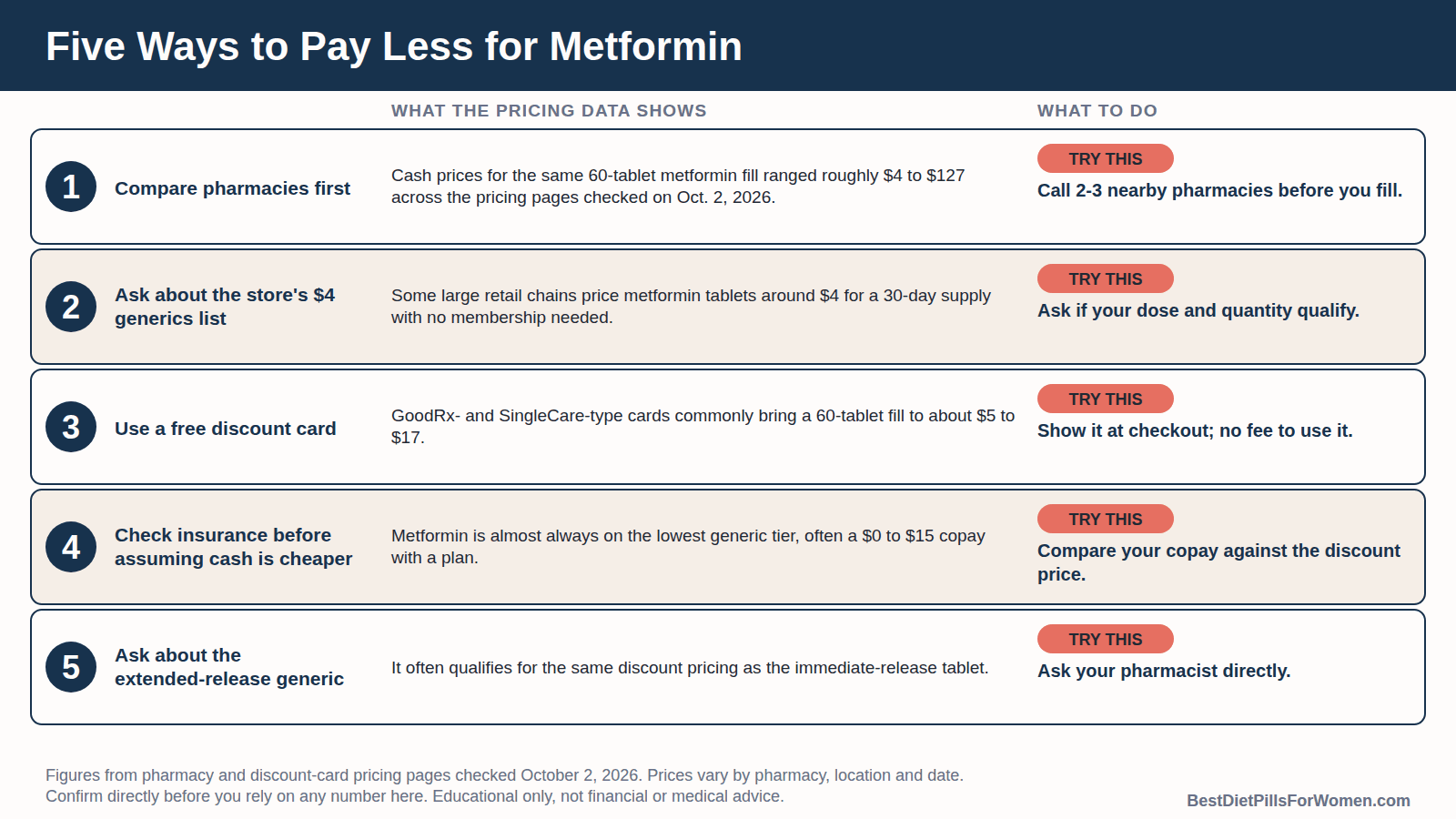
Generic metformin immediate-release tablets typically cost between about $4 and $25 for a 30-day supply of 60 tablets without insurance, depending on the pharmacy, dose and any discount program used; extended-release tablets and brand-name versions cost more. Store programs such as Walmart’s $4 generics list and free pharmacy discount cards routinely bring the price toward the bottom of that range, while paying full retail price at a pharmacy counter with no discount applied tends to land near the top of it or higher.
How Sure We Are About That Answer
We’re highly confident that metformin sits among the cheapest prescription drugs sold in the U.S., since every pricing source we checked agrees on that general point, and we’re confident in the $4 to $25 range as a realistic planning figure for the immediate-release tablet. We’re less confident in any single “average cash price” figure, because two of the pricing tools we checked on the same day reported average prices for the same 60-count, 500 mg prescription that differed by roughly $100, which tells you more about how each tool calculates its average than about what you’re likely to actually pay. Treat every number below as a planning estimate, confirm it with your own pharmacy before you rely on it, and use Table 1 as a starting map rather than a quote.
How We Checked These Prices
A fair cost guide needs to say plainly what was checked and what wasn’t, so the numbers that follow aren’t confused with firsthand pharmacy shopping.
Sources and Dates
Every price in this guide was read from pharmacy and discount-card pricing pages, Medicare’s own published 2026 program rules, and the current FDA label, on October 2, 2026. Pharmacy cash prices change often and differ by location, so a number that was accurate on the day we checked may not be accurate at your pharmacy today.
What This Guide Is and Isn’t
This is a desk-research cost guide built from pricing pages, government program documents and the drug’s FDA label, not a hands-on price-shopping exercise at physical pharmacies and not financial or medical advice. We didn’t fill a prescription, negotiate with a pharmacist or test any discount card ourselves. It’s also not a guide to whether metformin is a good choice for any particular reason; our planned guide to metformin for weight loss and our PCOS-specific guide go deeper on evidence and suitability questions that this cost-focused page intentionally leaves to them, and our weight loss medications hub is the place to start if you’re still comparing medication categories broadly rather than focused on metformin specifically.
The Options at a Glance
Table 1 lines up the main ways people end up paying for metformin, before the rest of this guide unpacks each one.
The Summary Table
| Payment path | Typical price for 60 tablets, 500 mg IR | What it requires | Best fit |
|---|---|---|---|
| Cash, no discount | Roughly $9 to $26 at major chains, sometimes higher | Nothing beyond the prescription | A backup option, not usually the cheapest |
| Store $4 generics list | About $4 for a 30-day supply at participating retailers | No membership or insurance; ask at the counter | Budget-conscious, uninsured fills |
| Free discount card (GoodRx-type, SingleCare-type) | Roughly $5 to $17 depending on pharmacy | A free sign-up, shown at checkout | Comparing prices across nearby pharmacies |
| Store pharmacy membership program | As low as $0 at some grocery-chain pharmacies | A paid or free membership with that specific chain | Shoppers already loyal to one grocery pharmacy |
| Commercial insurance | Often a $0 to $15 copay on the lowest generic tier | An active plan; metformin is almost always “Tier 1” | Most insured patients |
| Medicare Part D | Typically a low copay; counts toward the 2026 $2,100 out-of-pocket cap | An active Part D or Medicare Advantage drug plan | Medicare beneficiaries |
Table 1 method: cash and discount-card figures are as published on the pricing pages checked on October 2, 2026; the Medicare figure reflects CMS’s own published 2026 program rule. Figures vary by pharmacy, location and plan, so treat this table as a planning map, not a quote for your own pharmacy.
How to Read the Table
Read Table 1 the way you’d read a menu, not a receipt. Every row is a realistic path, but which one is cheapest for you depends on where you live, which pharmacy is nearby, and whether you already have insurance that covers prescription drugs. The rest of this guide walks through each row in more depth, starting with what metformin actually is and why the reason it’s prescribed matters for cost conversations even though it doesn’t change the sticker price.
What Metformin Is and Why the Reason It’s Prescribed Matters for Cost
The price of the pill itself doesn’t change based on why someone is taking it, but what a cost conversation should cover absolutely does, so it’s worth being precise about this before getting to dollar figures.
What Metformin Is Approved to Treat
Metformin’s regulatory story is simple and worth stating plainly, because it shapes everything else in this guide.
The FDA-Approved Indication: Type 2 Diabetes
Metformin is FDA-approved as an adjunct to diet and exercise to improve blood sugar control in adults with type 2 diabetes, and its label explicitly states it should not be used for type 1 diabetes or diabetic ketoacidosis. It’s been available in the U.S. since the mid-1990s, is now sold by dozens of generic manufacturers, and remains one of the most commonly prescribed medications in the country for that approved use. Its price reflects that long, crowded generic market, not a judgment about how well it works.
What the Label Does Not Say
Metformin’s FDA-approved label is about blood sugar control in type 2 diabetes. It does not include a weight-loss indication, and it does not describe metformin as a treatment for obesity, prediabetes alone, or polycystic ovary syndrome (PCOS), even though clinicians sometimes prescribe it for those situations based on their own clinical judgment and the research available. That distinction matters because a drug’s approved indication is also what most insurance formularies and prior-authorization rules are built around, which is part of why the “off-label” question below isn’t just a technicality.
It’s also worth separating “prediabetes” from “type 2 diabetes” here, since they’re sometimes blurred in casual conversation. Metformin’s approved indication is specifically type 2 diabetes; using it for prediabetes, a related but distinct diagnosis where blood sugar is elevated but hasn’t crossed the diabetes threshold, is itself a step outside the approved label, even though it’s a common and well-studied off-label practice discussed further below.
Metformin for Weight Loss or PCOS Is an Off-Label Use
Using an FDA-approved drug for a purpose other than its approved indication is common in American medicine, legal, and governed by a specific set of expectations that are worth understanding before a cost conversation makes sense.
What “Off-Label” Actually Means
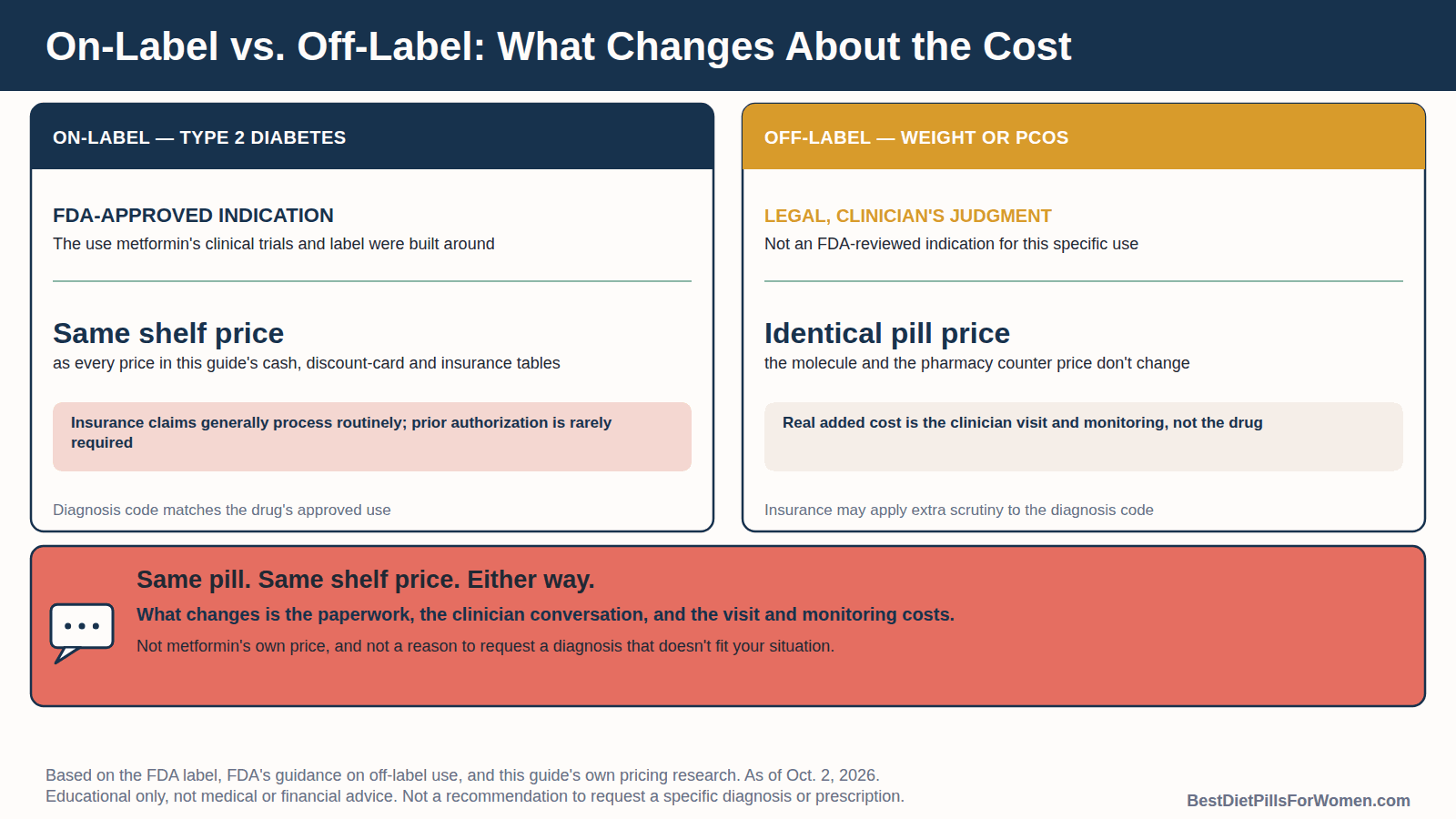
Prescribing metformin to help with weight, insulin resistance or PCOS symptoms in someone who doesn’t have type 2 diabetes is an off-label use: it’s legal and relatively common, but it means FDA hasn’t reviewed clinical trial evidence specifically for that purpose the way it reviewed evidence for type 2 diabetes. FDA’s own guidance on this is direct: once a drug is approved, a healthcare provider may prescribe it for an unapproved use when they judge that doing so is medically appropriate for that patient, and the clinical judgment and responsibility for that decision sits with the prescriber, not the patient and not the drug’s manufacturer. That’s a meaningfully different situation from a patient deciding on their own to take a leftover prescription for a new reason, which off-label prescribing does not mean and which this guide isn’t suggesting.
Why Some Clinicians Prescribe It Off-Label Anyway
Metformin improves how the body responds to insulin, and insulin resistance shows up often in PCOS and in some other weight-related metabolic patterns, which is the biological rationale clinicians cite for considering it outside diabetes. The UK’s National Institute for Health and Care Excellence (NICE) notes plainly in its own evidence summary that metformin “does not have a license for use in PCOS” in the UK either, and that trials supporting its use there have mostly been short, with limited evidence on symptoms like excess hair growth or irregular periods. Some prescribers also use metformin as a low-cost adjunct alongside other weight-management strategies, including alongside GLP-1 medications, based on its insulin-sensitizing effect and its long safety track record, rather than because a clinical trial specifically proved it causes meaningful weight loss on its own. None of that changes the pill’s shelf price. It does change what you should expect an insurance claim, a clinician visit and a monitoring plan to look like, which the rest of this guide addresses directly.
What the Long-Term Evidence Actually Shows
The clearest weight-related data on metformin doesn’t come from a weight-loss trial at all; it comes from a diabetes-prevention study. In the Diabetes Prevention Program Outcomes Study, adults at elevated risk for type 2 diabetes who took metformin for 15 years maintained about 6.2% average weight loss, compared with about 3.7% in the group that received an intensive lifestyle-change program alone, with the lifestyle group’s early, larger weight loss eroding over time while the metformin group’s more modest loss held up better. That’s a real, long-term result worth knowing about, but it comes from a prediabetes-focused diabetes-prevention trial, not a trial designed to test metformin as a weight-loss treatment in the general population, so it’s evidence of a plausible, durable metabolic effect, not proof that metformin produces similar numbers for every woman considering it off-label. A proposed insulin-sensitizing mechanism is one thing; a demonstrated, general weight-loss outcome is a different, stronger claim that this specific evidence doesn’t fully support on its own.
Generic Metformin Prices Without Insurance
Cash prices are where most of the confusion about “the” metformin cost comes from, so it helps to separate the immediate-release tablet from the extended-release one before looking at a single number.
Immediate-Release Metformin Cash Prices
Immediate-release (IR) metformin, taken two or three times a day with meals, is the oldest and most widely stocked version, and it’s usually the cheapest.
Typical Price Per Tablet and Per Month
Pricing pages we checked on October 2, 2026 put a 60-tablet, 500 mg supply of generic metformin IR anywhere from about $4 at a participating discount pharmacy to the high double digits at full cash retail price, with reported “average” prices ranging from roughly $26 on one pricing tool to well over $100 on another for what’s nominally the same prescription. That’s not a typo or an error in either source; it reflects how differently these tools calculate an “average,” and it’s exactly why Table 2 shows a range instead of a single figure. Higher doses (850 mg, 1000 mg) and 90-day fills change the per-tablet math slightly but tend to follow the same relative pattern.
Broken down to a per-tablet basis, that same spread looks even starker: a $26 average works out to roughly 43 cents a tablet, while a $127 average works out to a little over $2 a tablet, for what is, on paper, an identical 500 mg generic pill. Neither number is wrong; they’re simply measuring different things, one closer to a heavily discounted, shopped-around price and the other closer to an undiscounted retail sticker price averaged across pharmacies that don’t compete as hard on this specific drug. That gap is also larger, in percentage terms, than almost any other price spread in this guide, which is part of why Table 1’s “quick-answer” row for cash pay gives a range instead of one number.
Why Cash Prices Vary So Much by Pharmacy
The single biggest lever on what you’ll actually pay for metformin in cash is which pharmacy you use and whether you apply any discount at all, not the drug itself. The same pricing checks that found a roughly $26 average also found specific, named pharmacies charging $0 with a store membership, about $5 to $9 with a free discount card, and $17 to $20 paying cash with no discount applied. A $0 price usually requires signing up for that specific grocery chain’s own pharmacy membership program, which may carry its own membership fee, so it isn’t automatically free once you account for that cost. Because the spread is this wide, the single most useful thing you can do before filling a metformin prescription is compare two or three nearby pharmacies, not assume any one of them has the best price.
Large chain pharmacies tend to land in the middle of this range at full cash price, often somewhere in the high single digits to low $20s for a 60-tablet fill with a basic discount card applied, while warehouse-club pharmacies sometimes price the same prescription a bit higher at full retail, partly offset for members by the club’s own membership benefits. None of this is a reason to switch pharmacies for every prescription you fill; it’s a reason to specifically shop metformin, since it’s inexpensive enough everywhere that the dollar difference between the cheapest and most expensive nearby option is still meaningful relative to the drug’s own baseline price, even if it would barely register on a $300 prescription.
Extended-Release Metformin Cash Prices
Extended-release (ER) metformin is taken once a day and is often prescribed specifically to reduce the gastrointestinal side effects covered later in this guide, but it comes with its own cost pattern.
ER vs. IR Price Differences
Generic metformin ER tablets are also widely available and, like the immediate-release version, qualify for several store discount-generic programs at the same nominal price point in many cases. Where ER pricing tends to diverge from IR pricing is at full cash retail outside a discount program, where the once-daily dosing form can run somewhat higher per month than the twice-daily generic, depending on dose and pharmacy.
Part of that gap simply reflects manufacturing: an extended-release tablet uses a more complex coating or matrix designed to release the drug slowly over the day, which costs a bit more to produce than a plain immediate-release tablet, and fewer generic manufacturers currently compete on the ER formulation than on the IR one. Fewer competitors generally means a smaller downward pull on price, even for a drug this old. That said, the gap between IR and ER generic pricing is nowhere near as large as the gap between either generic and a brand-name product, which is the comparison that matters most for your wallet.
Brand-Name ER Products Cost More
Brand-name extended-release metformin products (such as Fortamet, Glumetza and Glucophage XR) exist alongside the generic ER tablets, and brand pricing for metformin-containing products we were able to check, even for a non-tablet formulation, ran into the hundreds of dollars at full retail price before any discount, with a discount-card price still several times the generic tablet’s cost. If a prescriber writes for a brand-name extended-release product specifically, ask your pharmacist whether a generic ER substitution is available, since in most cases it covers the same once-daily dosing goal for a fraction of the price.
A brand name on a prescription pad doesn’t automatically mean a better drug; for metformin specifically, it almost always just means a higher price for the same active ingredient. The main legitimate reason a prescriber might stick with a specific brand is a documented difference in how a particular person absorbs or tolerates that exact formulation, which is uncommon with metformin but not impossible. If cost is a concern and you’ve been prescribed a brand name, that’s a reasonable, specific question to bring back to your prescriber or pharmacist rather than something to simply accept on the first fill.
| Product | Typical quantity | Cash price range, no discount | Price with a free discount card or store program |
|---|---|---|---|
| Metformin IR 500 mg (generic) | 60 tablets (30-day) | About $17 to $26 average reported; up to $127 reported by one pricing tool | About $0 to $9 |
| Metformin IR 850 mg/1000 mg (generic) | 60 tablets (30-day) | Similar range to 500 mg, varies by pharmacy | About $4 to $12 |
| Metformin ER 500 mg (generic) | 60 to 120 tablets (30-day, dose-dependent) | Comparable to or somewhat above IR pricing | About $4 to $15 |
| Metformin ER 750 mg (generic) | 60 tablets (30-day) | Comparable to or somewhat above IR pricing | About $4 to $15 |
| Brand-name extended-release metformin products | Varies by product and strength | Several hundred dollars at full retail for products we could check | Still commonly in the high double digits or more |
Table 2 method: figures are as published on pharmacy and discount-card pricing pages checked on October 2, 2026; brand-name figures reflect a metformin-containing branded product’s listed pricing rather than a single confirmed tablet price, since tablet-specific brand pricing wasn’t directly verified in this session. Prices vary by pharmacy, location, dose and date, so confirm directly before you fill.
Lowering the Cash Price: Discount Cards, $4 Lists and Coupons
If you’re paying cash, there’s rarely a reason to pay full retail for metformin, because several overlapping discount options exist specifically for inexpensive generics like this one.
Store-Based Generic Discount Programs
Several large retail pharmacy chains run their own flat-fee generic drug programs, and metformin is one of the drugs they’re built around.
The Walmart $4 Generic List
Walmart’s long-running $4 generics program lists metformin immediate-release tablets (500 mg, 850 mg and 1000 mg) at about $4 for a 30-day, 60-tablet supply, or $10 for a 90-day supply, with metformin extended-release tablets listed at similar price points. This program requires no membership, fee or insurance; you simply ask the pharmacist whether your prescription qualifies at that price. One important caveat: the page documenting this list notes its own content hasn’t been substantively updated in several years, so treat the exact figure as “approximately $4,” and confirm the current price and your specific dose’s eligibility directly with a local Walmart pharmacist before counting on it.
Other Retailers With Similar Programs
Walmart isn’t the only chain with a flat-fee generic list; several supermarket pharmacy chains and some regional pharmacies run comparable programs, and some grocery-chain pharmacies price metformin at $0 specifically for members of their own pharmacy loyalty or discount program. Pricing research we checked specifically named Kroger and Meijer pharmacies among the lowest-priced options for metformin when their own membership program applied, with Walgreens, CVS, Walmart and Sam’s Club each showing their own separate price points for the same prescription on the same day. Because these programs are chain-specific and change their drug lists periodically, the most reliable approach is to call two or three pharmacies within driving distance and ask directly what a 30-day metformin fill costs this week, rather than relying on any list, including this one, as a current price quote.
Membership-based pharmacy discount programs are a related but distinct option from a flat-fee generics list: instead of (or alongside) a per-drug price list, you pay one recurring fee to that specific grocery or pharmacy chain and get reduced pricing on a defined set of generics, metformin typically included, for as long as the membership stays active. Whether that membership pays for itself depends on how many prescriptions you fill there and at what frequency, which is a household-budget question this guide can’t answer for you, but it’s worth doing the arithmetic once before signing up for a recurring fee to save a few dollars on one inexpensive generic.
Prescription Discount Cards and Coupons
Free prescription discount cards are a second, overlapping way to lower a cash metformin price, and they work differently from a store’s own flat-fee list.
How GoodRx-Type Cards Work
Free discount cards from services such as GoodRx and SingleCare negotiate pharmacy pricing on your behalf and are shown at checkout instead of insurance, typically bringing a 60-tablet metformin fill down to somewhere in the $5-to-$17 range depending on which nearby pharmacy you choose. These cards aren’t insurance, don’t require a monthly fee to use, and can be presented at most major chain pharmacies; the pharmacist applies whichever price, insurance or discount card, is lower for that fill. Mechanically, these services negotiate volume-based rates with pharmacy benefit networks and pass a version of that negotiated rate on to you at the register, which is why the same card can show a different price at two pharmacies a mile apart; it’s shopping the network, not a universal fixed discount.
What a Metformin Coupon Can and Can’t Do
A discount card can meaningfully lower what you pay compared with walking in and paying full retail, but it can’t make an already-cheap generic free everywhere, and it generally can’t be combined with insurance on the same fill; you pick whichever option is cheaper for that specific prescription. If you have insurance with a low generic copay, your insurance price is very often cheaper than any discount card for metformin specifically, since the drug is almost always on the lowest-cost formulary tier to begin with. Discount cards tend to matter most if you’re uninsured, between plans, or your plan’s copay happens to be unusually high for a reason unrelated to the drug itself.
With the main cash-price levers covered, insurance coverage is the next piece of the cost picture, and it changes the math more than any discount card can.
Insurance Coverage for Metformin
Most people who take metformin pay for it through insurance rather than cash, and the coverage picture is one of the more reliably good-news parts of this guide.
Commercial Insurance and Formulary Tiers
Commercial health plans sort covered drugs into cost tiers, and where a drug lands on that list drives most of what you’ll pay at the counter.
Why Metformin Is Almost Always “Tier 1”
Generic metformin is a decades-old, multi-source generic drug, which is exactly the profile insurers use to define their cheapest formulary tier, so it’s placed on “Tier 1” or an equivalent lowest-cost generic tier on the large majority of commercial plans. That typically means a copay in the $0-to-$15 range for a 30-day supply rather than a percentage-based coinsurance charge, though the exact number depends on your specific plan design. Because this tier placement is so consistent across insurers, metformin coverage denials for the type 2 diabetes indication are uncommon, and prior authorization is rarely required for the drug itself.
Most commercial formularies use a tier structure with roughly four or five rungs: a bottom tier for widely available, low-cost generics; a middle tier or two for brand-name and preferred drugs; and a top tier for specialty or non-preferred medications, often with coinsurance instead of a flat copay. Metformin’s defining features, multiple manufacturers, decades on the market, and a well-established safety record, are the exact criteria that keep a drug on that bottom tier, which is why Table 3 below shows it landing in roughly the same place across very different plan types.
When Coverage Gets More Complicated
Coverage can look different in two situations worth flagging. First, a brand-name extended-release product may sit on a higher tier than the generic ER tablet, so ask your pharmacist about a generic substitution if your plan’s cost-share surprises you. Second, when metformin is prescribed off-label, for weight management or PCOS rather than type 2 diabetes, some plans’ claims systems key off the diagnosis code submitted with the prescription, and a diagnosis code that doesn’t match an FDA-approved indication can occasionally trigger extra scrutiny or a coverage question, even though the drug itself remains inexpensive either way. This isn’t a certainty, and it isn’t common for a drug this cheap, but it’s worth asking your plan about directly if cost predictability matters to you, rather than assuming either outcome.
A third, smaller wrinkle: if your prescriber combines metformin with another medication in a single combination tablet, such as a metformin-and-sulfonylurea or metformin-and-DPP-4-inhibitor product used for diabetes, that combination product follows its own, separate formulary placement rather than inheriting metformin’s rock-bottom tier. That’s a different scenario from simply taking metformin on its own alongside another pill, which is how it’s typically used in an off-label, weight-related context.
One more practical note that applies regardless of insurance status: because metformin is a legitimate prescription drug rather than a dietary supplement, it’s generally an eligible expense under a health savings account (HSA) or flexible spending account (FSA), the same as any other prescribed medication. Keeping your pharmacy receipt is a simple way to use pre-tax dollars toward either the copay or the cash price, which effectively lowers the real cost a bit further for anyone with access to one of those accounts.
Medicare and Medicaid Coverage
Government insurance programs cover the large majority of older and lower-income adults who take metformin, and both programs have specific rules worth understanding.
Medicare Part D and the 2026 Out-of-Pocket Cap
Medicare Part D plans and Medicare Advantage drug plans place generic metformin on their lowest cost-sharing tier in the overwhelming majority of cases, and any copay you pay for it counts toward the 2026 Part D annual out-of-pocket spending threshold of $2,100, the dollar amount set by CMS for the year, after which a Part D enrollee owes nothing more for covered drugs for the rest of the calendar year. For most people taking only metformin, the drug’s own cost is low enough that this cap is irrelevant; it becomes relevant mainly if you’re also taking more expensive medications that push your total spending toward that threshold over the course of the year.
It’s worth being precise about what that cap does and doesn’t cover, since it’s easy to over-read a Medicare benefit. The $2,100 threshold caps what you personally pay out of pocket for drugs covered under your plan’s formulary; it doesn’t mean Medicare pays for any drug prescribed for any reason, and it doesn’t turn an off-label weight-management prescription into something a plan is obligated to cover just because the total-spending math is favorable. Metformin’s own low price, prescribed for its approved diabetes indication, is simply unlikely to meaningfully move you toward that cap on its own.
Medicaid Coverage Across States
Medicaid programs are run state by state, and formulary and copay rules for generic drugs like metformin vary accordingly, but because the drug is both inexpensive and used to treat a common chronic condition, it’s broadly covered with low or no copay across state Medicaid programs; some states waive cost-sharing for diabetes medications specifically. If you’re on Medicaid, your state’s preferred drug list, available through your state Medicaid agency’s website, is the most reliable place to confirm your own exact copay rather than a national generalization like this one.
Federal Medicaid rules generally limit how much states can charge enrollees for a covered generic drug, which is part of why copays for a drug like metformin tend to be nominal, often a few dollars or less, rather than a meaningful share of the drug’s own low price; several states set that cost-sharing amount at $0 for certain populations or certain drug categories. State Medicaid programs do differ on whether an off-label weight-related diagnosis is treated the same as the approved diabetes indication for coverage purposes, which is another reason to check your own state’s rules rather than assume national uniformity.
| Payer type | Typical formulary placement | Typical out-of-pocket cost | What can change the picture |
|---|---|---|---|
| Commercial insurance | Lowest generic tier (commonly “Tier 1”) | $0 to $15 copay for a 30-day supply, plan-dependent | Brand-name ER product; off-label diagnosis code |
| Medicare Part D / Medicare Advantage | Lowest generic cost-sharing tier in the large majority of plans | Low copay; counts toward the 2026 $2,100 out-of-pocket cap | Which specific plan you’re enrolled in; total annual drug spending |
| Medicaid (varies by state) | Broadly covered given low cost and chronic-disease use | Low or no copay in most states | State-specific preferred drug list and copay rules |
| No insurance / cash pay | Not applicable | Roughly $4 to $26 for 60 tablets with a discount; higher without one | Pharmacy choice; whether a discount is applied |
Table 3 method: formulary-tier and cost-sharing patterns reflect how insurers generally treat long-established, multi-source generic drugs, informed by CMS’s published 2026 Part D program rule for the out-of-pocket threshold; this table describes typical patterns, not a guarantee for any specific plan. Confirm your own plan’s exact copay and formulary tier directly.
What It Costs When Metformin Is Prescribed Off-Label for Weight Management
This is the section most relevant to readers of this site who are considering metformin for a reason other than type 2 diabetes, and the honest short version is that the pill’s price doesn’t change, but a few things around it do.
The Pill Itself Doesn’t Get More Expensive
It’s worth saying this plainly, because marketing around off-label weight-management use sometimes implies otherwise.
Same Drug, Same Price, Different Reason for Taking It
A metformin tablet costs the same amount at the pharmacy counter whether it’s prescribed for type 2 diabetes, for PCOS-related insulin resistance, or as an off-label adjunct alongside a broader weight-management plan; the molecule, manufacturing cost and pharmacy pricing don’t know or care which diagnosis is on the prescription. Every cash and discount-card price in Tables 1 and 2 applies regardless of the reason for the prescription.
Why Insurance May Treat an Off-Label Prescription Differently
What can change is how a health plan processes the claim, since many plans’ systems are built around approved indications and the diagnosis code submitted with a prescription. In practice, metformin’s low cost means this rarely becomes a real financial problem even if a plan flags it, but it’s a reasonable thing to ask your prescriber’s office or your insurer about directly if you want to avoid a surprise, rather than assuming either a smooth approval or a denial.
Some prescribers sidestep this question entirely by billing the visit and the prescription under a diagnosis that genuinely applies, such as prediabetes, insulin resistance or PCOS itself, rather than an off-label diabetes code; that’s a documentation decision for your clinician to make accurately based on your actual health picture, not something to request be written a certain way. Either way, the pill’s price at the counter stays the same low number from Tables 1 and 2.
The Costs That Actually Change
The real added cost of off-label use usually isn’t the pill. It’s everything around getting and monitoring the prescription.
Clinician Visits and Telehealth Fees
The most meaningful added cost of pursuing metformin for an off-label, weight-related reason is usually the clinician visit itself, not the medication. A primary care or telehealth visit to discuss candidacy, get an initial prescription and follow up on labs can run anywhere from a copay under an existing insurance plan to a self-pay telehealth or membership fee if you go through a cash-pay weight-management service, and that fee structure varies enormously by provider and region. Periodic follow-up, including the kidney-function and vitamin B12 monitoring described in the safety section below, adds a smaller recurring cost on top of the visit itself.
Cash-pay telehealth and weight-management platforms have grown substantially as a way to access this kind of care, and their pricing is typically structured as a recurring membership or subscription fee that bundles the clinician visit, follow-up messaging and sometimes lab-ordering together, separate from whatever the pharmacy charges for the medication itself. We don’t have current, verified pricing for any specific platform to report here, and a platform’s own marketing claims about results deserve the same skepticism this site applies to any weight-loss marketing; the FTC has repeatedly flagged exaggerated weight-loss advertising as a consumer-protection concern worth watching for. If you’re comparing platforms, ask specifically what the membership fee covers, how often you’ll have a real clinician interaction, and whether the metformin prescription itself is filled at a normal retail or mail-order pharmacy, where this guide’s pricing tables actually apply, or bundled into the platform’s own markup.
Combining Metformin With Other Weight-Management Approaches
Some clinicians prescribe metformin off-label as a low-cost adjunct alongside a GLP-1 medication, alongside structured lifestyle changes, or as a first, lower-cost step before considering a more expensive prescription option, specifically because its own price is so low relative to nearly every other weight-management medication on the market. Our guide to prescription vs. OTC weight loss pills and our PCOS-specific guide go further into how clinicians typically sequence or combine options; this page’s job is just to be clear that combining approaches multiplies the visit and monitoring costs discussed above, even though it doesn’t multiply metformin’s own small price tag.
With cost mechanics covered, it’s worth pausing on safety before moving to how metformin’s price compares with other weight-management options, since cost decisions and safety decisions aren’t really separable in practice.
Safety: What to Know Before Weighing Metformin’s Cost Against Its Risks
A price only makes sense in context, and metformin’s long track record comes with a specific, well-documented safety profile that’s worth understanding whether it’s prescribed on-label or off-label.
Common Side Effects and How to Manage Them
Most people who start metformin notice something digestive before they notice anything else, and that pattern is well established in the drug’s own label.
GI Side Effects and the Extended-Release Workaround
Diarrhea, nausea, stomach discomfort, gas and indigestion are the most common metformin side effects, and they tend to show up when starting the drug or raising the dose, often easing over time. Taking metformin with food and starting at a low dose before increasing it are standard ways clinicians try to reduce these effects, and switching from the immediate-release tablet to the extended-release version is a common next step when GI symptoms don’t settle down, since many people tolerate the once-daily ER form better.
Table 4 below summarizes these effects alongside the more serious risk discussed next, specifically so cost and safety sit side by side rather than in separate mental categories; a cheap medication that causes side effects you stop taking isn’t actually a good value, whatever the sticker price says.
Vitamin B12 Deficiency With Long-Term Use
Long-term metformin use can lower vitamin B12 levels: in clinical trials, roughly 7% of patients developed decreased serum B12 levels, an effect the label describes as generally reversible with discontinuation or supplementation. Because B12 deficiency can cause fatigue, nerve symptoms and other effects that are easy to mistake for something else, periodic blood testing is a reasonable part of long-term monitoring, and it’s worth mentioning any history of low B12 to whoever prescribes metformin for you.
In practical terms, this usually means an annual blood test once you’ve been on metformin for a while, not a frequent or expensive monitoring schedule, and a low result is typically managed with an inexpensive over-the-counter or prescription B12 supplement rather than stopping metformin outright. That monitoring cost is small, but it’s a real one, and it belongs in the same mental ledger as the pill’s own price when you’re thinking about what metformin actually costs over a year, not just what one fill costs today.
Serious Risks and Who Should Avoid Metformin
Beyond the common digestive effects, metformin carries one specific, rare but serious risk that drives most of its prescribing cautions.
Lactic Acidosis Warning and Kidney Function
Metformin carries an FDA boxed warning for lactic acidosis, a rare but serious and potentially life-threatening buildup of lactic acid in the blood; the risk rises with impaired kidney function, and the label states metformin is contraindicated at an estimated glomerular filtration rate (eGFR) below 30 mL/min/1.73m² and that starting it isn’t recommended for an eGFR between 30 and 45. Symptoms that need immediate medical attention include unusual tiredness, weakness or discomfort, nausea, vomiting and stomach pain, especially together. This is exactly why a prescriber checks kidney function before starting metformin and periodically afterward, on-label or off.
A baseline kidney-function blood test before the first prescription, and a periodic recheck afterward, is standard practice precisely because of this warning, and it’s one more small, recurring cost that belongs in the same conversation as the pill’s own price. Age over 65, dehydration, significant infection, heart failure and heavy alcohol use can each raise lactic acidosis risk further on top of reduced kidney function, which is part of why this isn’t a drug to restart casually after a gap, a serious illness or a major change in kidney function without checking in with whoever prescribes it.
That eGFR-based threshold is also a useful illustration of why “cheap” and “risk-free” aren’t the same idea. Metformin’s low price doesn’t change based on a person’s kidney function, but whether it’s an appropriate, safe choice absolutely does, and that’s a clinical judgment call that a pharmacy receipt can’t make for you.
Other Contraindications and Cautions
Metformin’s label states it shouldn’t be used for type 1 diabetes or diabetic ketoacidosis, and it carries cautions around heavy alcohol use, significant liver disease, and situations involving IV contrast dye for certain imaging procedures, since these can each affect the kidney function and metabolic state that metformin’s safety depends on. People who are pregnant, breastfeeding or considering pregnancy should discuss metformin specifically with their own clinician, since that’s an individualized decision this guide can’t make for you. None of this is a reason to self-diagnose or to start, stop or adjust a dose on your own; it’s the reason a prescriber orders labs before and during treatment, whether the goal is blood sugar control or an off-label use.
If you have an imaging procedure scheduled that involves IV contrast dye, tell both the radiology team and whoever manages your metformin prescription; the specific precaution (sometimes a temporary pause around the procedure) depends on your kidney function and the type of imaging, and it’s a coordination point between your care team rather than something to decide on your own. None of these cautions are reasons for alarm about a drug with this long a track record; they’re the specific, well-defined reasons a prescriber asks about your kidney function, alcohol use and other medications before writing the prescription in the first place, on-label or off.
| Effect | Common or serious | What it typically looks like | When to seek care |
|---|---|---|---|
| Diarrhea, nausea, gas, stomach upset | Common | Often starts early in treatment or after a dose increase; frequently eases over time | If severe, persistent or paired with dehydration |
| Decreased vitamin B12 | Common with long-term use (about 7% in trials) | May cause fatigue or nerve symptoms if it progresses | Routine periodic lab monitoring; report unusual fatigue or tingling |
| Lactic acidosis | Rare but serious (boxed warning) | Unusual tiredness, weakness, nausea, vomiting, stomach pain | Seek care immediately; this is a medical emergency |
| Low blood sugar (when combined with certain other diabetes medicines) | Uncommon with metformin alone | Shakiness, sweating, confusion | Follow your care team’s guidance for managing and reporting it |
Table 4 method: effects and framing are as described in the current FDA label and MedlinePlus consumer drug information, read October 2, 2026; frequencies are approximate and drawn from the sources named in this guide rather than recalculated. This table is a summary, not a complete list of every possible effect or interaction.
Comparing Metformin’s Cost to Other Weight-Management Options
Metformin’s price only means something in context, and the clearest context is what the alternatives cost.
Metformin vs. Other Oral Medications
Among pills used in weight-management conversations, metformin sits at the inexpensive end almost by itself.
Metformin vs. Prescription Appetite Suppressants on Price
Older prescription appetite suppressants and newer oral options are, with few exceptions, meaningfully more expensive than generic metformin on a monthly basis, since most of them are newer, patent-protected or have fewer generic manufacturers competing on price. Phentermine, itself a decades-old generic, comes closest to metformin’s price range, while newer combination pills and oral GLP-1 medications sit well above it, as Table 5 below shows. Our guide to prescription appetite suppressants, our guide to the best appetite suppressants for women and our prescription vs. OTC comparison break down those individual price points in more depth than fits in this cost-focused guide.
Metformin as a Low-Cost Adjunct, Not a Substitute
Metformin’s low price is a real practical advantage, but it isn’t evidence that it produces the same weight-related results as drugs that are FDA-approved specifically for weight management. Being inexpensive and being effective for a given purpose are two different questions, and this guide isn’t suggesting price should be the deciding factor in a decision that belongs between you and your clinician.
It’s a common and understandable instinct to look at a large price gap like the one in Table 5 and wonder whether the expensive option must simply be “better.” Price in this market mostly reflects patent status and how many manufacturers compete to make a drug, not a ranking of effectiveness, and a thorough look at what each option’s own trial evidence actually shows, population studied, duration, average result and how it was measured, is a more reliable way to weigh options than price alone. That kind of evidence comparison is exactly what our guide to the best appetite suppressants for women and our prescription vs. OTC comparison are built to walk through.
Metformin vs. GLP-1 Medications
The widest price gap in this entire comparison is between metformin and the GLP-1 class of medications.
The Cost Gap Is Enormous
On a monthly cash-price basis, generic metformin can cost roughly one-tenth to well under one-hundredth of what a brand-name GLP-1 medication costs without insurance or a manufacturer savings program, a gap driven almost entirely by metformin’s decades-old, fully generic status versus the GLP-1 drugs’ current patent protection. Table 5 lines up rough annual figures side by side; these GLP-1 and older-pill figures are carried forward from other cost research on this site rather than independently re-checked in this session, so treat them as directional, not current quotes, and see our planned Wegovy pill cost guide and our planned semaglutide vs. tirzepatide comparison for a dedicated, more current deep dive on those specific drugs.
Manufacturer savings programs can narrow this gap substantially for eligible, commercially insured patients on a GLP-1 medication, sometimes for a limited time or up to an annual cap, which is exactly the kind of detail that changes month to month and deserves its own current check rather than a number repeated here. Even with a savings card applied, though, metformin typically remains the least expensive option in this entire comparison by a wide margin.
Why Some Clinicians Combine or Sequence Them
Because of this price gap, some prescribers use metformin as a starting point or an adjunct, particularly for patients with insulin resistance, PCOS or prediabetes, before or alongside a more expensive medication, rather than as a direct substitute for drugs with a different, FDA-approved weight-management indication. Whether that sequencing makes sense for you is a clinical question, not a pricing one, and it’s worth raising directly with your own prescriber.
This sequencing logic also shows up with orlistat and with Contrave, two other prescription options with their own cost and side-effect profiles; orlistat’s generic and brand versions sit closer to metformin’s price range than the GLP-1 drugs do, while Contrave is priced closer to the newer oral options. None of these comparisons are head-to-head trial results, just a cost map, so treat Table 5 as a planning tool for budgeting a conversation with your prescriber, not as a ranking of which option is “best.”
| Medication category | Approximate monthly cash price | Approximate annual cash price |
|---|---|---|
| Generic metformin (IR or ER) | About $4 to $26 | About $48 to $312 |
| Older prescription appetite suppressants (e.g., phentermine) | Roughly $15 to $20 | Roughly $180 to $240 |
| Newer oral prescription options (e.g., Qsymia) | Roughly $70 to $80 | Roughly $840 to $960 |
| Oral GLP-1 medications | Roughly $150 to $300 | Roughly $1,800 to $3,600 |
| Injectable GLP-1 medications | Roughly $300 to $450 | Roughly $3,600 to $5,400 |
Table 5 method: the metformin row reflects this guide’s own Table 2 figures, checked October 2, 2026. The remaining rows are rounded, directional figures carried forward from other cost research on this site, not independently re-verified in this drafting session; confirm current pricing directly, especially for any patent-protected drug, before relying on them. All figures exclude manufacturer savings programs, which can substantially lower several of the non-metformin rows for eligible patients.
Practical Steps to Get the Lowest Price
With the pricing landscape mapped out, here’s how to actually apply it the next time you’re standing at a pharmacy counter or picking up a new prescription.
Before You Fill Your First Prescription
A few quick questions can save real money before you ever hand over a prescription.
Questions to Ask Your Pharmacist
Ask whether your specific dose and quantity qualify for a store’s flat-fee generic program, whether a free discount card would beat your insurance copay for this particular fill, and whether an extended-release version is available if gastrointestinal side effects become a problem on the immediate-release tablet. Pharmacists price-check these things routinely and can usually tell you on the spot which option is cheapest for that visit. It’s also worth asking whether a 90-day supply changes the per-tablet math in your favor, since some discount programs and insurance plans price a 90-day fill at less than three times the 30-day price specifically to encourage it.
Comparing Price Across Pharmacies Near You
Because cash prices for the same metformin prescription varied by roughly $100 between pharmacies and pricing tools we checked, calling or checking two or three pharmacies within a reasonable distance, including at least one large chain and one discount or grocery-chain pharmacy, is a reasonable five-minute habit before your first fill or any time your insurance status changes. A quick online price-comparison tool can speed this up, but treat its displayed “average” skeptically for the reasons explained earlier in this guide, and confirm the actual price by phone or at the counter before counting on it.
If Cost Is Still a Barrier
For the small number of situations where even metformin’s low price is a real obstacle, a few more options exist.
Patient Assistance and State Programs
Some manufacturers and independent patient-assistance organizations offer support programs for generic diabetes medications, and some state Medicaid or public health programs offer additional help for people who qualify; availability and eligibility rules vary and change, so a current search through your state health department or a reputable patient-assistance directory is more reliable than any general statement this guide could make. Community health centers and federally qualified health centers, which often price visits and sometimes medications on a sliding scale based on income, are another avenue worth asking about if cost is a barrier to the clinician visit itself rather than to the pill.
When to Talk to Your Prescriber About Alternatives
If cost remains a genuine barrier even after trying the options above, say so directly to your prescriber or pharmacist. Because metformin already sits near the bottom of the price range for anything in this category, a cost conversation at this point is more often about confirming you’ve found the cheapest available path to the same prescription than about switching to a fundamentally different, usually pricier, medication. If an HSA or FSA account is available to you, as mentioned in the insurance section above, using it is a simple way to stretch pre-tax dollars a little further on either the pill or the visit that got you the prescription.
Frequently Asked Questions About Metformin Cost
These are the practical questions that come up most once the main pricing and coverage picture above is clear.
Price and Coverage Questions
The first set of questions is about what you’ll actually pay.
Is Metformin Covered by Insurance?
Yes, in the large majority of cases. Generic metformin is placed on the lowest-cost generic tier by most commercial insurance plans, Medicare Part D and Medicare Advantage drug plans, and state Medicaid programs, typically resulting in a low copay rather than a coinsurance percentage. Coverage can look different for a brand-name extended-release product or, occasionally, for an off-label diagnosis code, so confirm your own plan’s specifics if you want certainty.
Why Is Metformin So Cheap Compared to Other Diabetes or Weight Drugs?
Metformin has been generic and sold by many competing manufacturers for decades, which is the main reason its price is so low. Patent-protected drugs, including current GLP-1 medications and several newer oral options, don’t yet have that same generic competition, which is the single biggest driver of the large price gap shown in Table 5 above, not a difference in how the drugs are made or regulated.
Does Extended-Release Metformin Cost More Than Regular Metformin?
Sometimes, though often only modestly for the generic ER tablet, and more significantly for brand-name extended-release products. Generic ER tablets frequently qualify for the same discount programs as the immediate-release tablet, while brand-name versions like Fortamet, Glumetza or Glucophage XR typically cost substantially more than either generic option, so ask your pharmacist about a generic substitution if cost matters to you.
Off-Label and Access Questions
The second set of questions is about the specific situation of pursuing metformin for a weight-related or PCOS-related reason.
Can I Get Metformin Prescribed Just for Weight Loss?
That’s a decision for a licensed clinician, not something this guide can tell you to request or expect. Prescribing metformin outside its FDA-approved diabetes indication is legal and happens in practice, including for PCOS-related insulin resistance, based on a prescriber’s individualized judgment about your health, not simply a patient’s preference, so the honest next step is a conversation with a clinician who knows your history.
Will Insurance Pay for Metformin If It’s Prescribed Off-Label?
Often yes, because the drug is so inexpensive to begin with, but it isn’t guaranteed. Some plans’ systems key off the diagnosis code on a prescription, and a non-diabetes code can occasionally prompt extra review, though this is uncommon for a drug this cheap. If predictable cost matters to you, ask your plan or your prescriber’s billing staff directly rather than assuming either outcome.
Is It Safe to Buy Metformin Online Without a U.S. Prescription?
We’d treat that as a real red flag rather than a cost-saving shortcut. A legitimate U.S. prescription is required for metformin, and because the real, prescribed version is already inexpensive through normal pharmacy channels, there’s little price advantage to an unverified online seller, while there’s a meaningful risk of receiving a product with unknown ingredients, dosing or quality. The FTC has separately warned that weight-loss marketing claims in general are frequently exaggerated or misleading, which is a useful general caution when any product, metformin included, is marketed online with unusually bold promises.
Practical and Safety Questions
A final pair of questions comes up often enough at the pharmacy counter and in a first appointment to be worth answering directly here.
What Should I Tell My Pharmacist Before Filling a Metformin Prescription for the First Time?
Mention every other medication and supplement you take, any history of kidney or liver problems, how much alcohol you typically drink, and whether you have any upcoming imaging scans that use IV contrast dye. This takes a couple of minutes and lets your pharmacist flag a genuine safety or cost issue, such as a cheaper equivalent or a GI-reducing extended-release option, before you’ve already paid for the fill.
Does Metformin Interact With Common Weight-Management Supplements?
Potentially, and it’s worth asking rather than assuming it’s fine to combine freely. Supplements that also affect blood sugar, such as berberine, or that carry their own GI effects can compound metformin’s side effects, and proprietary blends make it hard to know an exact combined dose. Our guide to weight loss supplement interactions and our prescription vs. OTC comparison go deeper on specific combinations; the short version here is to tell your prescriber and pharmacist about every supplement you’re taking, not just your other prescriptions.
The Bottom Line on Metformin Cost
Pulling the pieces in this guide together, here’s what they add up to.
What This Means for Your Wallet
The practical, numbers-first takeaway deserves to be stated plainly before the more qualitative points.
The Biggest Realistic Advantage
Metformin’s biggest advantage in this guide is simply how little it costs relative to almost any other medication discussed on this site, whether you’re paying cash with a basic discount or using insurance. For most people with coverage, it lands near the bottom of a formulary’s cost-sharing structure; for most people without it, a bit of pharmacy comparison and a free discount card typically gets it into single digits or low double digits a month. That holds true regardless of which approved or off-label reason brought you to this guide in the first place.
The Biggest Limitation and Safety Consideration
The biggest limitation isn’t really about price at all: metformin’s FDA approval is specifically for type 2 diabetes, and using it for weight management or PCOS is an off-label decision that belongs to you and a clinician, not a conclusion this cost guide can draw for you. On the safety side, the combination of common GI side effects, a long-term B12 monitoring need, and a rare but serious lactic acidosis risk tied to kidney function means the drug’s low price shouldn’t be mistaken for a low-stakes decision.
A Rational Next Step
A sensible next step here is less about shopping and more about asking the right questions.
Questions Worth Asking Your Prescriber or Pharmacist
Worth asking directly: does my current kidney function support starting or continuing metformin safely; would the extended-release version reduce my GI side effects; does my insurance plan’s cost-sharing change based on the diagnosis code on this prescription; and, if the goal is weight-related, what does the actual evidence suggest metformin can and can’t realistically do for someone in my situation. That last question is exactly what our planned metformin for weight loss guide is built to answer in depth, since it’s a different question from the one this cost guide set out to cover.
It’s worth repeating the throughline of this entire guide one more time, because it’s easy to lose in all the dollar figures: the price tag on a metformin bottle tells you almost nothing about whether metformin is the right choice for your specific situation. It tells you that if a clinician decides it’s appropriate, cost is unlikely to be the obstacle that stands in the way.
What to Re-Check Before You Fill or Refill
Prices, store discount-program drug lists and insurance formularies all change. Before your next fill, a two-minute check, comparing your pharmacy’s current price against a free discount card and confirming your plan’s current copay, is worth more than memorizing any specific dollar figure from this guide, including the ones in Table 1 through Table 5 above.
Related Reading
Sources
These are the main sources behind this guide, chosen because they are the ones to check first for current facts. Prices, discount programs and coverage rules change, so confirm the latest version before you make decisions.
- U.S. Food and Drug Administration. Prescribing information for metformin hydrochloride extended-release tablets (NDA 021748, labeling supplement dated 2017, read October 2, 2026). https://www.accessdata.fda.gov/drugsatfda_docs/label/2017/021748s020lbl.pdf
- U.S. Food and Drug Administration. Understanding Unapproved Use of Approved Drugs “Off-Label” (page read October 2, 2026). https://www.fda.gov/patients/learn-about-expanded-access-and-other-treatment-options/understanding-unapproved-use-approved-drugs-label
- MedlinePlus (U.S. National Library of Medicine). Metformin, drug information page (read October 2, 2026). https://medlineplus.gov/druginfo/meds/a696005.html
- Centers for Medicare & Medicaid Services. Final CY 2026 Part D Redesign Program Instructions (fact sheet stating the 2026 annual out-of-pocket threshold of $2,100, read October 2, 2026). https://www.cms.gov/newsroom/fact-sheets/final-cy-2026-part-d-redesign-program-instructions
- GoodRx. Metformin price page, pharmacy cash prices and GoodRx discount prices (read October 2, 2026). https://www.goodrx.com/metformin
- SingleCare. Metformin price page, average cash price and discount-card prices by pharmacy (read October 2, 2026). https://www.singlecare.com/prescription/metformin
- GoodRx. The Walmart $4 Generic Prescriptions List (blog post naming metformin tablets and extended-release tablets among the listed drugs; read October 2, 2026, content last updated by GoodRx in 2018 per the page’s own note, so the list should be confirmed directly with a local Walmart pharmacy). https://www.goodrx.com/blog/the-walmart-4-generic-prescriptions-list/
- National Institute for Health and Care Excellence (NICE, UK). Evidence summary: metformin for treating polycystic ovary syndrome in women who are not trying to get pregnant (ESUOM6; read October 2, 2026). https://www.nice.org.uk/advice/esuom6/resources/metformin-for-treating-polycystic-ovary-syndrome-in-women-who-are-not-trying-to-get-pregnant-17664476101
- Pennington Biomedical Research Center. Metformin may help patients maintain weight loss long-term (news summary of the Diabetes Prevention Program Outcomes Study’s 15-year results; read October 2, 2026). https://www.pbrc.edu/news/media/2019/Metformin-Long-term-Weight-Loss.aspx
- Federal Trade Commission Consumer Advice. The Truth Behind Weight Loss Ads (read October 2, 2026). https://consumer.ftc.gov/articles/truth-behind-weight-loss-ads

