
Wegovy Pill Cost: The Short Answer
The Direct Answer and How Sure We Are
What Does the Wegovy Pill Actually Cost?
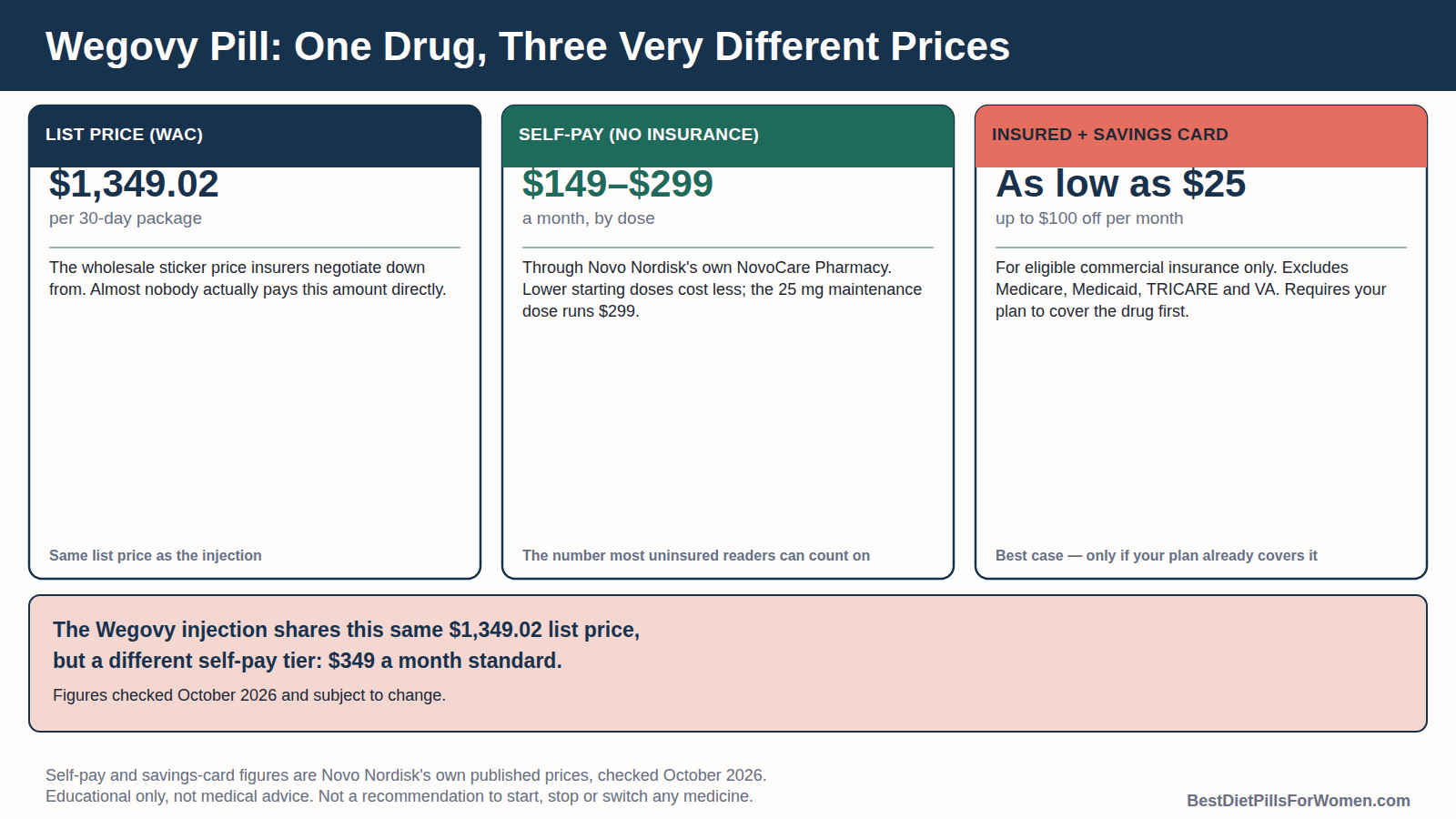
Wegovy pill cost is really three different numbers, not one, and which number applies to you depends on your insurance and your dose. The tablet lists at $1,349.02 per 30-day package, but almost nobody pays that. Through Novo Nordisk’s own self-pay pharmacy, cash price runs $149 to $299 a month depending on your dose, and people with eligible commercial insurance can pay as little as $25 a month through the manufacturer’s savings card. What you’ll actually pay depends heavily on your dose, your insurance, and which pharmacy channel you use, which is exactly what this guide walks through.
Those self-pay numbers come directly from Novo Nordisk’s NovoCare Pharmacy and savings-card pages, checked for this guide, so they can change without notice. Insurance figures are harder to pin down precisely because coverage for this specific tablet is still being finalized at many health plans, so we’ve flagged where the picture is still moving. A reader comparing three different price quotes for the same drug in the same week isn’t being misled by any one of them; she’s probably just looking at three different parts of the same pricing structure, cash price, list price, and an insured copay, without realizing they’re different questions.
How Confident We Are, and Why Prices Keep Moving
We’re confident about the list price and the self-pay tiers, because they come straight from Novo Nordisk’s own pricing pages. We’re far less confident about any single “your cost will be X” number for insured readers, because prior authorization rules, formulary placement, and benefit-design choices vary by plan and keep changing month to month. Even the self-pay numbers aren’t permanent; Novo Nordisk has already adjusted list pricing for its GLP-1 lineup once since the tablet launched, while stating that its self-pay channels weren’t part of that particular change.
That split between list-price moves and self-pay-price stability is worth sitting with for a second, because it tells you something useful: the number that actually governs what a self-pay reader experiences isn’t the same number making headlines when a company announces a price cut. The most useful number in this whole guide isn’t a single price — it’s the fact that list price, self-pay price, and insured price for the Wegovy pill can differ by more than $1,300 a month. That gap is the entire reason this guide exists. Treat every dollar figure below as a snapshot, and re-check it before you commit to a pharmacy or a plan.
Wegovy Pill vs. Rybelsus vs. the Wegovy Injection — Clearing Up the Confusion
Why “Wegovy Pill” Searches Often Lead to Rybelsus by Mistake
A lot of “Wegovy pill cost” searches actually land on information about Rybelsus, and that’s an understandable mix-up, not a silly one. Rybelsus is also an oral semaglutide tablet from Novo Nordisk, but it was approved in September 2019 for type 2 diabetes, in low doses of 3 mg, 7 mg, and 14 mg, not for weight loss in people without diabetes. Both products share the same active ingredient and the same manufacturer, and both come as a small tablet you swallow, which is exactly why search engines, forum threads, and even some pharmacy staff sometimes blur the two together.
The product most people mean by “Wegovy pill” is a separate, newer tablet that the FDA approved on December 22, 2025, specifically for chronic weight management and for reducing cardiovascular risk in adults with obesity or overweight. It uses the Wegovy brand name, comes in a different, higher-dose lineup (1.5 mg, 4 mg, 9 mg, and a 25 mg maintenance dose), and launched in U.S. pharmacies in early January 2026. If a page is talking about a 3 mg, 7 mg, or 14 mg oral semaglutide tablet, it’s describing Rybelsus, not the Wegovy pill, even though they’re chemically the same molecule. The dose ranges don’t overlap at all, which is one of the fastest ways to tell which product a given price or dosage chart is actually describing.
Part of why an oral version took years longer to reach the market than the injection comes down to basic biochemistry: semaglutide is a peptide, and peptides are normally broken down by stomach acid and digestive enzymes before they can be absorbed. Both Rybelsus and the new Wegovy tablet get around that with a co-formulated absorption enhancer that temporarily raises the stomach’s local pH and helps enough of the drug cross the stomach lining intact, which is also the reason both products come with the unusually strict empty-stomach dosing instructions covered later in this guide. That’s a mechanism point, not a cost point, but it explains why the two products look and behave so much alike despite targeting different conditions at different doses.
How We Checked What’s Actually Approved and Priced Today
This guide is based on Novo Nordisk’s current prescribing information for the Wegovy tablet, the FDA’s own approval announcement, Novo Nordisk’s current self-pay and savings-card pages, and publicly reported insurance and coverage information, all checked as of early October 2026. We didn’t buy, fill, or test the medication ourselves. Where a figure comes from a secondary pricing or news source rather than an official label or company page, we say so, and we flag anything that needs a final check before you rely on it.
Because oral semaglutide now exists as two genuinely different FDA-approved products under two different brand strategies — a low-dose diabetes pill (Rybelsus) and a separate, higher-dose weight-management pill (the new Wegovy tablet) — it’s worth treating “Wegovy pill cost,” “Rybelsus cost,” and “Wegovy injection cost” as three distinct questions with three distinct answers, even when a search engine blends them together. We also checked how the Wegovy tablet’s pricing and positioning compares with Foundayo, Eli Lilly’s competing oral GLP-1 medicine, since the two now get shopped against each other by name in a way that didn’t exist before either tablet launched.
The Numbers at a Glance
The Quick-Answer Table
| What You’re Asking About | Typical Monthly Figure | Who It Applies To |
|---|---|---|
| List price (WAC) | $1,349.02 per package | Almost nobody pays this; it’s the sticker price insurers negotiate down from |
| Cash price, no insurance | $149–$299, by dose | Self-pay patients using NovoCare Pharmacy |
| Commercially insured, with savings card | As low as $25, up to $100 off | Patients with eligible private insurance; government insurance excluded |
| Medicare Part D | Not covered for weight loss alone in most cases | May be covered only under a cardiovascular-risk pathway, and rules are in flux |
| Medicaid | Covered in some states, not others | Depends entirely on your state’s program |
Table 1 method: list and self-pay figures are Novo Nordisk’s own published prices as of early October 2026; insurance rows summarize the general pattern described later in this guide and are not a quote for any individual plan.
How to Read the Table
Table 1 is a starting point, not a quote for your situation. The self-pay row is the number you can actually count on if you have no coverage at all and use Novo Nordisk’s own pharmacy channel. Every other row depends on decisions made by your specific insurer, your employer’s benefit design, or your state Medicaid program, which is why the rest of this guide breaks each of those down separately instead of trying to average them into one figure. Read the table as a map of which question to ask next, rather than as a final answer.
If you only remember one thing from this table, make it this: the $25-to-$100 insured range and the $149-to-$299 self-pay range are not competing with each other, they’re answers to two different questions (do you have coverage, and if not, what’s the cash alternative). Don’t let a headline quoting one of those ranges make you assume it describes your own situation until you’ve confirmed which category you actually fall into.
What the Wegovy Pill Is, and Why Its Cost Structure Looks the Way It Does
A New Oral GLP-1, Not the Same Thing as Rybelsus
What Wegovy’s Tablet Actually Is and How It’s Dosed
The Wegovy tablet is an oral form of semaglutide, the same active ingredient as the Wegovy injection and Ozempic, built with an absorption technology that lets enough of the drug survive the stomach to work as a once-daily pill. It’s approved for chronic weight management in adults with obesity, or with overweight plus at least one weight-related health condition, and separately for reducing the risk of major cardiovascular events in adults who have established cardiovascular disease along with obesity or overweight.
Dosing starts low and increases on a fixed schedule: 1.5 mg once daily for the first 30 days, 4 mg for the next 30 days, 9 mg for the 30 days after that, and then a 25 mg once-daily maintenance dose for ongoing treatment. It has to be taken on an empty stomach with no more than 4 ounces of plain water, with a wait of at least 30 minutes before eating, drinking anything else, or taking other oral medicines. That administration rule matters for cost as much as for effectiveness, which we’ll come back to in the safety section, because a dose that isn’t absorbed properly is still a dose you paid for.
Why the Dose You’re On Changes the Price You Pay
Novo Nordisk prices the oral tablet by dose tier rather than as one flat monthly fee, which is different from how it prices the injection. That means your cost genuinely changes as you move through the titration schedule: the 1.5 mg starting dose costs less per month than the 25 mg maintenance dose you’ll likely stay on long-term. A new patient’s first few months and their tenth month on the medication aren’t the same price, and any cost estimate that doesn’t account for titration is probably oversimplified.
This dose-based pricing isn’t unique to Wegovy’s tablet; Foundayo, the competing oral GLP-1 from Eli Lilly, uses a similar tiered structure, which we cover in the comparison section later in this guide. What’s worth noticing here is the logic behind it: a company pricing lower starting doses lower isn’t necessarily doing a new patient a favor out of generosity, it’s also pricing in line with the smaller amount of active drug in each tablet during the early titration weeks. Knowing that helps set a realistic expectation that your bill will rise over your first three months even if nothing about your insurance or pharmacy changes.
It’s a different pricing philosophy from how many older generic pills are priced, where a 90-day supply usually costs roughly three times a 30-day supply regardless of strength. Here, the price curve is intentionally front-loaded to be gentler, which is worth knowing if you’re the kind of planner who likes to build a full-year budget before starting a new medication rather than taking it one month at a time.
Why List Price, Cash Price and Your Price Are Three Different Numbers
List Price (WAC): the Sticker Price Almost Nobody Pays
The $1,349.02 list price is the wholesale acquisition cost, the number manufacturers set before any rebate, discount, or insurance negotiation happens. Pharmacy benefit managers and insurers negotiate their own net prices off that list price, and self-pay channels are priced separately and don’t move in lockstep with it. Novo Nordisk cut the list prices of several Ozempic and Wegovy products in early 2026, but explicitly said its self-pay channels weren’t affected by that cut, which is a useful reminder that list price and the price you’ll actually encounter can move independently.
It helps to think of list price the way you’d think of a car’s manufacturer’s suggested retail price: it’s a real number that matters to the negotiation happening behind the scenes between the manufacturer and insurers, but it’s rarely the number that lands on an individual buyer’s receipt. If you see a news headline about a GLP-1 “price cut,” read closely to see whether it’s describing list price, a specific self-pay program, or an insurance-negotiated rate, because those three can move in three different directions in the same year.
List price also matters indirectly even if you’ll never personally pay it, because it’s the baseline pharmacy benefit managers use when negotiating the rebates that help determine your plan’s formulary tier and your copay. A higher list price gives a PBM more room to negotiate a larger rebate back from the manufacturer, which is part of why cutting list price doesn’t automatically translate into a lower price for an insured patient; it can simply shrink the rebate pool being negotiated behind the scenes instead.
Cash (Self-Pay) Price vs. Insurance Price
Cash price is what Novo Nordisk’s own NovoCare Pharmacy charges a patient who pays out of pocket, with no insurance billing involved at all. Insurance price is whatever your specific plan’s benefit design produces after prior authorization, formulary tier, deductible, and copay or coinsurance rules are applied, and it can land anywhere from less than the self-pay price to more than it, depending on your plan. For many people without coverage for weight-management drugs, going the self-pay route can genuinely be cheaper than what a high-deductible plan would charge before the deductible is met, which is worth checking rather than assuming.
A practical way to think about it: if your plan hasn’t met its deductible yet, or doesn’t cover weight-management drugs at all, ask your pharmacist to run the self-pay NovoCare Pharmacy price as a comparison before you let your insurance billing go through by default. Pharmacies don’t always offer that comparison proactively, and a patient who assumes insurance billing is automatically the cheaper path can end up overpaying for months before realizing the self-pay tier would have cost less.
Wegovy Pill Price Without Insurance
NovoCare Pharmacy’s Self-Pay Price by Dose
What Each Titration Dose Costs Per Month
| Dose | Typical Use | Self-Pay Price Per 30-Day Supply |
|---|---|---|
| 1.5 mg | Starting dose, days 1–30 | $149 |
| 4 mg | Titration step, days 31–60 | $199 |
| 9 mg | Titration step, days 61–90 | $299 |
| 25 mg | Ongoing maintenance dose | $299 |
Table 2 method: prices are Novo Nordisk’s published NovoCare Pharmacy self-pay figures for the oral tablet, read October 2026; one month is defined as one 30-tablet bottle.
Novo Nordisk’s own pharmacy charges these tiered prices directly to self-pay patients, with no insurance involved and no middleman markup added on top. Separately, trade press coverage of the January 2026 U.S. launch reported the same $149 starting-dose price for cash-paying patients, which lines up with what Novo Nordisk still lists today. The fact that an independent news report from launch week and a company page checked many months later show the same starting price is a reasonably good sign that this particular figure has stayed stable, even while other parts of GLP-1 pricing have shifted around it.
Notice that the 9 mg and 25 mg doses share the same $299 price, even though 25 mg is nearly three times the dose. That’s a meaningful detail for budgeting: once you reach the third month of treatment, your price stops climbing even as your dose continues to increase to its final maintenance level, which means the steepest part of the cost curve is actually behind you by month three, not month twelve.
What a Full Year on the Pill Costs at Cash Price
Following the standard titration schedule, a first year at NovoCare Pharmacy’s self-pay price works out to roughly $3,338: one month at $149, one month at $199, and ten months at $299 (the 9 mg titration month plus nine months of 25 mg maintenance). A second full year at the 25 mg maintenance dose alone would run about $3,588, or $299 times 12. That first-year total is still a meaningful amount of money, but it’s less than a quarter of what the $1,349-a-month list price would suggest.
It’s worth sitting with how different those two framings sound. “The Wegovy pill costs $1,349 a month” and “a self-pay patient following the standard schedule spends about $3,338 in her first year” describe the same product, but the second framing is the one that actually predicts what a self-pay reader will see on her bank statement. If you’re budgeting month to month rather than thinking in annual totals, plan for roughly $150 to $300 depending on which month of treatment you’re in, and expect the number to plateau rather than keep climbing after your third month.
Where Else Cash Prices Show Up, and Why They Differ
Retail Pharmacy Cash Price vs. NovoCare Pharmacy
Retail pharmacies that fill the Wegovy tablet without going through NovoCare Pharmacy’s direct channel typically price closer to list price, since they’re buying the drug at wholesale cost rather than through Novo Nordisk’s discounted self-pay program. If you’re paying cash, routing through NovoCare Pharmacy specifically, rather than a traditional retail pharmacy counter, is generally what gets you the $149-to-$299 tier instead of something closer to the $1,349 list price. A major chain pharmacy can still fill the prescription, but unless you specifically request the manufacturer’s self-pay program or mail-order channel, the default cash price quoted at the counter is likely to be the wholesale-based number, not the discounted one.
This is one of the more common, entirely innocent reasons someone reports wildly different prices for the “same” medication: one person priced it through NovoCare Pharmacy, another through a neighborhood pharmacy counter billing cash at a wholesale-adjacent rate, and both are telling the truth about what they personally saw.
Why “Cheap Wegovy Pill” Listings Should Make You Pause
Because the oral tablet relies on a patented delivery technology rather than a simple molecule a compounding pharmacy can easily replicate, we found no indication that legitimate compounding pharmacies currently offer an oral semaglutide tablet the way some have offered compounded injectable semaglutide. A website advertising a “generic Wegovy pill,” a “compounded Wegovy tablet,” or a price dramatically below $149 a month is a signal to slow down, not a bargain to grab. We cover how to vet a pharmacy or offer in more detail later in this guide, including the specific marketing language FDA has already flagged as misleading in this drug category.
Wegovy Pill Insurance Coverage
Commercial Insurance: What Usually Determines Your Copay
The Manufacturer Savings Card, and Its Real Limits
Novo Nordisk’s savings card lets eligible patients with commercial insurance pay as little as $25 for each one-month supply, with a maximum savings of $100 per month off whatever your plan would otherwise charge you. That’s a genuinely good deal if your plan covers the drug at all, but it comes with real limits: it excludes anyone on Medicare, Medicaid, TRICARE, VA benefits, or other government insurance, and Novo Nordisk can change or end the program at any time. It also doesn’t help if your plan simply denies coverage outright, since the card reduces your copay, not your insurer’s decision to cover the drug at all.
It’s worth being precise about what “up to $100 off” actually means in practice. If your plan’s copay for the tablet is $40 a month, the savings card can only take $40 off, not the full $100, because the card reduces what you owe, it doesn’t pay you extra. The card does its most work for patients whose plan assigns the drug to a higher specialty tier with a $120-plus copay, where the $100 ceiling meaningfully closes the gap down toward that $25 floor.
Prior Authorization and Step Therapy, in Plain Language
Most commercial plans that cover GLP-1 obesity medications require prior authorization, meaning your prescriber has to document that you meet specific criteria, usually tied to BMI and the presence of weight-related health conditions, before the plan will pay. Some plans add step therapy, which can mean trying a different weight-management drug first, or trying the injectable form of Wegovy before the plan will approve the newer tablet. Because the oral tablet is newer than the injection, formulary placement for it is still catching up at a number of insurers, so don’t assume your plan treats the pill exactly the same way it treats the pen.
In practice, a prior-authorization request usually asks your prescriber’s office to submit your current BMI, any related diagnoses such as high blood pressure, type 2 diabetes, or sleep apnea, and sometimes documentation of prior diet or exercise efforts. If your initial request is denied, most commercial plans have a formal appeal process, and a denial over missing documentation is a different problem than a denial because the plan excludes the drug class entirely; your prescriber’s office can usually tell you which situation you’re in and whether an appeal is worth the time.
Medicare and Medicaid: Why Coverage Is Still Catching Up
Medicare Part D and the Cardiovascular-Risk Exception
Original Medicare has historically excluded coverage for weight-loss drugs used only for obesity, but that line has started to blur because Wegovy also carries an FDA-approved indication for reducing cardiovascular risk in people with established heart disease. That cardiovascular indication exists because the injectable form of Wegovy was already shown in a large outcomes trial to reduce serious heart events in people with existing cardiovascular disease, and the newer tablet inherited that same approved use rather than needing to prove it over again from scratch.
CMS has described pathways — including a mechanism sometimes referred to as the Medicare GLP-1 Bridge and a broader demonstration often called the BALANCE model — intended to extend some Medicare coverage of GLP-1 obesity medications. Implementation has been uneven: reporting in spring 2026 described CMS delaying the Part D portion of that expansion, so coverage through Medicare specifically for the oral tablet is best treated as a moving target rather than a settled benefit. If you’re on Medicare, the practical takeaway is to ask your plan directly whether you qualify for coverage under the cardiovascular-risk indication, since that pathway, however it’s eventually finalized, is a meaningfully different question from whether Medicare covers weight loss on its own.
Medicaid’s State-by-State Patchwork
Medicaid coverage of GLP-1 medications for obesity varies dramatically by state, with some states covering them under specific criteria and others excluding obesity-only use entirely. A policy tracker that counted state Medicaid programs covering GLP-1s for obesity found only a minority of states doing so as of its reporting date, which gives a sense of just how incomplete coverage remains nationally even as individual states continue to add or adjust their own policies.
If you’re on Medicaid, the only reliable way to know whether the Wegovy tablet is covered is to check your specific state program’s current preferred drug list or call your plan directly, since a neighboring state’s policy tells you nothing about your own. Some states that do cover GLP-1 obesity medications still require a prior authorization process similar to commercial plans, including documented BMI thresholds and evidence of prior weight-management attempts, so coverage and automatic approval aren’t the same thing even in a state that technically covers the drug class.
If you move across state lines, don’t assume your Medicaid coverage for this specific tablet moves with you. Because each state Medicaid program sets its own preferred drug list, a move from a state that covers the Wegovy tablet to one that doesn’t can mean losing coverage entirely, even though your diagnosis, your prescriber’s documentation, and your medical need haven’t changed at all.
Coverage at a Glance, by Payer Type
Table 3 lays out how these different payer categories tend to compare, side by side, so you can see at a glance which hurdle applies to your own situation.
| Payer Type | Typical Coverage Pattern | Main Hurdle |
|---|---|---|
| Commercial (employer or marketplace) | Varies widely by plan; often covered with prior authorization | Prior authorization criteria, step therapy, possible BMI threshold |
| Medicare Part D | Largely excluded for weight loss alone; a cardiovascular-risk pathway exists but rollout has been delayed | Must qualify under the heart-disease-risk indication, not obesity alone |
| Medicaid | Covered in some states, excluded in others | Depends entirely on your state’s program and preferred drug list |
| Uninsured / self-pay | Not applicable; use NovoCare Pharmacy’s tiered cash price instead | Affordability at $149–$299 per month |
Table 3 method: this table summarizes general payer patterns described in federal coverage guidance, state Medicaid policy trackers, and commercial prior-authorization documentation reviewed for this guide as of October 2026; it isn’t a coverage determination for any individual plan.
Employer Plans Are Moving Targets
Why Some Employers Are Scaling Back GLP-1 Coverage
Large-employer surveys have found a mixed and shifting picture: some employers have expanded GLP-1 coverage for obesity in response to employee demand, while a notable share have added tighter prior-authorization rules, lower BMI thresholds, or coverage caps specifically because of the cost of this drug class. Those tightening moves tend to show up as practical friction rather than an outright “no”: a higher BMI cutoff than your plan used last year, a new requirement that you also be enrolled in a weight-management or coaching program, or an annual or lifetime dollar cap on how much the plan will pay toward GLP-1 drugs as a category.
Pharmacy benefit managers have also shifted which specific obesity drugs sit on their preferred formularies; one major PBM publicly restored broader coverage for certain GLP-1 products in 2026 after previously narrowing it, which shows how quickly these lists can move in either direction. A formulary decision made by your employer’s PBM in January can be reversed, tightened, or expanded by the time your plan year renews, which is exactly why this guide keeps repeating the instruction to re-verify rather than rely on last year’s answer.
Self-funded employers, meaning companies that pay employee medical claims directly rather than buying a standard insurance product, have particularly wide latitude to set their own GLP-1 coverage rules, since they aren’t bound by a single insurer’s standard formulary. That’s part of why two coworkers at different companies, enrolled in plans administered by the very same insurance carrier, can get completely different answers about whether this tablet is covered: the carrier is just administering claims, while the employer is the one actually deciding the benefit design.
What to Ask Your HR or Benefits Team Before You Fill It
Before you assume your employer plan covers the Wegovy tablet the same way it covered the injection last year, ask your benefits team three specific questions: is the oral tablet on this year’s formulary, does it require a new prior authorization separate from the injection’s, and has the BMI or comorbidity threshold changed since last plan year. Benefit designs for this drug class are being revised frequently enough that last year’s answer may not be this year’s answer. It’s also reasonable to ask whether your employer has added a coaching, nutrition-counseling, or lifestyle-program requirement alongside drug coverage, since some plans have started bundling those requirements into GLP-1 benefits rather than covering the medication on its own.
Wegovy Pill Coupon and Savings Programs, Explained
The Official Manufacturer Offers
The Commercial Savings Card, Terms and Exclusions
The only “coupon” that reliably applies to the brand-name Wegovy tablet is Novo Nordisk’s own commercial savings card, available by enrolling through the Wegovy website or by texting a short code to sign up. It reduces your copay to as little as $25 per month, capped at $100 in savings, and it explicitly excludes anyone with government-funded insurance. It’s not a discount off the cash price; it’s a reduction applied on top of what your commercial insurance already covers, so it only helps if your plan is billing for the drug in the first place.
Enrollment is typically quick: you provide basic insurance information, confirm you aren’t enrolled in a government health plan, and the card activates for use at participating pharmacies. Because eligibility and terms are set entirely by the manufacturer and can change without much notice, it’s worth re-confirming your card is still active every time your insurance changes, including a change as small as switching employers within the same industry.
NovoCare Pharmacy’s Self-Pay Channel
For people without insurance coverage for the drug at all, NovoCare Pharmacy functions less like a coupon and more like a separate, lower-priced purchasing channel, with the $149-to-$299 tiered pricing already covered in Table 2. That’s the path most relevant to someone whose insurance denies the drug outright rather than someone trying to shave a few dollars off an existing covered copay. Because this channel ships directly rather than running through a local retail pharmacy, it’s also worth confirming shipping timelines when you first enroll, particularly around a dose-tier change, so you don’t run short between the end of one titration month and the arrival of the next.
Third-Party Coupons, Discount Cards and Patient-Assistance Programs
Why a Pharmacy Discount Card Rarely Beats the Manufacturer Offer
General pharmacy discount cards and coupon-aggregator sites can sometimes shave a modest amount off a retail cash price for many generic drugs, but for a brand-name product like the Wegovy tablet, those discounts rarely come close to Novo Nordisk’s own self-pay tier or its manufacturer savings card. If a third-party site advertises a Wegovy tablet price dramatically below what NovoCare Pharmacy itself charges, treat that as a red flag rather than a better deal, for the reasons covered later in this guide’s section on spotting a scam pharmacy.
A useful rule of thumb: for a patented brand-name drug with no generic competitor, the manufacturer’s own self-pay and savings programs are almost always going to be the best-available legitimate discount, simply because the manufacturer has the most room to discount off its own list price. A coupon aggregator sourcing its listed price from standard pharmacy claims data has no comparable lever to pull.
Patient Assistance for the Uninsured
For patients who are uninsured and don’t qualify for the self-pay tier for financial reasons, manufacturer patient-assistance programs are the more realistic path than hunting for a steeper coupon, and eligibility is typically based on income and lack of other coverage rather than a flat discount percentage. If cost is the barrier, it’s worth asking your prescriber’s office directly whether they have experience helping patients apply, since the application process and required documentation, often including proof of income and a formal denial letter from any insurance you do have, can be more involved than a simple coupon code. Community health centers and some diabetes or obesity specialty clinics also sometimes keep an up-to-date list of current assistance programs across manufacturers, which can save you from having to track down the right application on your own.
It’s worth separating patient assistance, which is typically a manufacturer program for people with little or no prescription coverage at all, from the commercial savings card, which is meant for people who already have private insurance billing the drug. Applying to the wrong program wastes time without lowering your cost, so ask directly which category your situation falls into before you start gathering paperwork. A prescriber’s office that regularly treats patients on GLP-1 medications will usually be able to tell you within a single phone call which program fits your coverage status, which can save you from filling out the wrong application entirely.
How the Wegovy Pill’s Cost Compares to the Alternatives
Wegovy Pill vs. the Wegovy Injection
Side-by-Side Monthly Cost
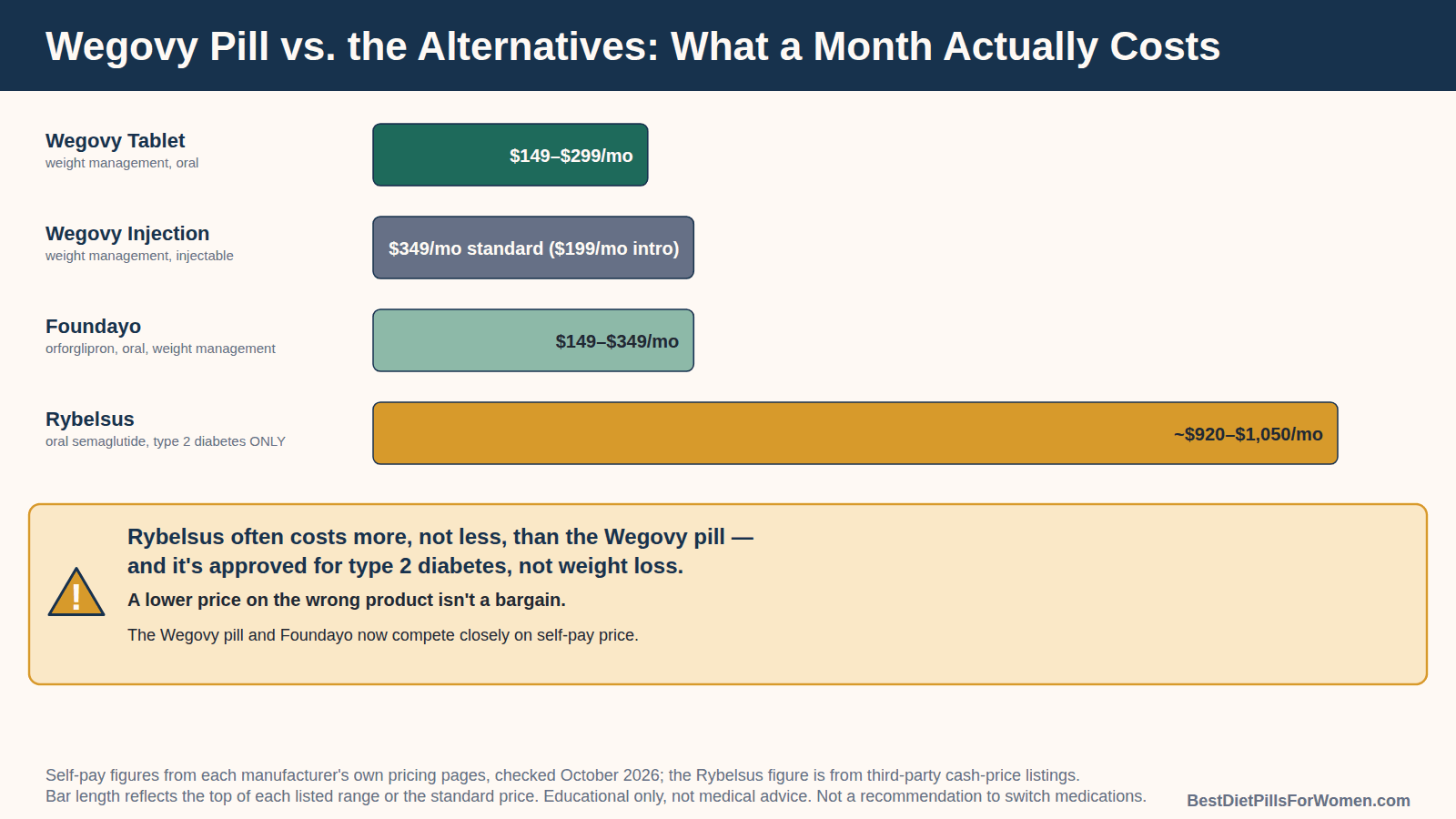
Table 4 puts the Wegovy tablet’s self-pay price next to its closest competitors, so you can see how much of the recent price movement in this category has actually been about the Wegovy brand specifically, versus the oral-GLP-1 category as a whole.
| Option | Self-Pay Price Per Month | Notes |
|---|---|---|
| Wegovy tablet (oral) | $149–$299, by dose | NovoCare Pharmacy self-pay tier; commercial savings card can bring cost to as little as $25 |
| Wegovy injection | $349 standard; $199/month introductory offer for new patients | List price $1,349.02; same savings-card structure as the tablet |
| Foundayo (orforglipron, oral) | $149–$349, by dose | Eli Lilly’s competing oral GLP-1; similar tiered self-pay structure via LillyDirect |
| Rybelsus (oral semaglutide, lower dose) | Roughly $920–$1,050 for a 30-day supply at typical cash-price listings | Approved only for type 2 diabetes, not weight loss; not a substitute for the Wegovy tablet |
Table 4 method: Wegovy and Foundayo figures are each manufacturer’s own published self-pay prices as of October 2026; the Rybelsus figure is drawn from third-party cash-price listings rather than a manufacturer self-pay program, since Rybelsus doesn’t have the same dedicated self-pay tier, and should be reconfirmed directly before relying on it.
What You’re Actually Paying Differently For
The injection’s $349 standard self-pay price and the tablet’s $149-to-$299 tiered pricing aren’t really “the same drug at two prices” so much as two different products with two different pricing strategies. The tablet’s lower entry price partly reflects its lower starting doses; once you reach the 25 mg maintenance dose, the gap between the two self-pay prices narrows to $50 a month ($299 versus $349) rather than disappearing. On top of the sticker prices, the two forms carry different practical costs that don’t show up on a price list at all: the injection needs a needle, sharps disposal, and refrigeration for unopened pens, while the tablet needs strict empty-stomach timing every single morning, which some people find easier to live with and others find harder, depending on their daily routine.
Neither price tells you anything about which form will work better for you — that’s a separate conversation about your own response, tolerance, and preference for a pill versus an injection, not a cost question. A woman who travels frequently for work, for instance, might find a 30-day bottle of tablets easier to pack and store than pens requiring cold storage, while someone whose mornings are already tightly scheduled might prefer a once-weekly injection to a once-daily pill with a 30-minute waiting rule attached to it.
Insurance can also break the tie in either direction. Because the tablet and the injection are billed as separate products, your plan can place them on different formulary tiers with different copays, even though they share an active ingredient and a manufacturer. It’s entirely possible for a given plan to make the injection the cheaper covered option and the tablet the cheaper self-pay option, which means the “which form costs less” answer can flip depending on whether insurance ends up covering the claim at all.
Wegovy Pill vs. Foundayo (Orforglipron) and Rybelsus
Foundayo’s Price and How It Differs
Foundayo, Eli Lilly’s oral GLP-1 medicine, uses a different active ingredient (orforglipron) and was approved for chronic weight management on April 1, 2026. Its self-pay pricing follows a similar dose-tiered structure to the Wegovy tablet, running roughly $149 to $349 a month depending on strength, with Lilly’s own savings card bringing eligible commercially insured patients down to as little as $25 a month. Because it’s a different molecule with its own trial data, it isn’t a direct substitute for the Wegovy tablet from an effectiveness standpoint, even though the two now compete closely on price.
One structural difference worth flagging: Foundayo’s labeled dose range runs across more individual strengths than the Wegovy tablet’s four-step schedule, which generally means more price tiers to move through before reaching a stable maintenance price. That doesn’t make either drug objectively better priced; it just means a direct “which pill costs less in month one” comparison can look different from a “which pill costs less by month six” comparison, so pick the timeframe that actually matches how long you expect to stay on treatment before comparing the two on cost alone.
The fact that two competing manufacturers landed on such similar self-pay price bands for their oral GLP-1 tablets within months of each other isn’t a coincidence so much as ordinary competitive pressure: once one company sets a visible, publicized self-pay price for a new oral weight-management drug, the other has a strong incentive to land in the same neighborhood rather than looking dramatically more expensive at launch. That’s useful context if you’re trying to predict where either price goes next, since neither manufacturer is pricing in a vacuum.
Why Rybelsus Is Usually Cheaper, and Why That’s Not the Point
Here’s a detail that surprises a lot of people: at typical cash-price listings, Rybelsus often costs more per month than the new Wegovy tablet, not less, even though Rybelsus has been on the market since 2019 and comes in lower doses. That’s because Rybelsus never got its own dedicated self-pay discount tier the way the Wegovy tablet did at launch; its cash price largely reflects standard list-driven pricing, and it remains under patent protection with no generic competitor to push that price down the way a generic launch eventually does for most older drugs.
The real reason not to substitute Rybelsus for the Wegovy tablet isn’t price, though — it’s that Rybelsus is approved for type 2 diabetes, at doses well below what the trial data behind the Wegovy tablet’s weight-management approval actually tested. A lower price on the wrong product isn’t a bargain, and a prescriber choosing between the two is making a decision about your diagnosis and your dosing needs, not shopping for the cheaper tablet on your behalf. If you don’t have type 2 diabetes and you’re looking for a weight-management option, Rybelsus simply isn’t the product this guide, or your prescriber, would be comparing the Wegovy tablet against in the first place.
Safety: What the Wegovy Pill’s Side Effects Mean for Its Real Cost
Common Side Effects and What They Can Cost You Indirectly
GI Side Effects and the “Paying for Pills You Can’t Tolerate” Problem
The most common side effects reported with the Wegovy tablet are gastrointestinal: nausea, vomiting, diarrhea, constipation, and abdominal discomfort, generally consistent with what’s seen with injectable semaglutide. These effects tend to be most noticeable during dose increases, which is exactly when the medication’s titration schedule is moving you toward higher-priced tiers. If side effects force you to pause, extend a lower dose, or stop altogether, you’re effectively paying for months of treatment that didn’t get you to a sustained maintenance dose, which is a real cost even though it never shows up on a price list.
This is also where talking to your prescriber early pays for itself. Many prescribers can slow a titration schedule down, holding a dose for an extra month instead of advancing on the fixed 30-day clock, specifically to manage side effects without abandoning treatment altogether. Staying at the 4 mg or 9 mg tier a little longer costs less per month than the 25 mg tier anyway, so a slower, better-tolerated path isn’t necessarily a more expensive one.
The Empty-Stomach Rule and Why Skipping It Wastes Money
Because the tablet has to be taken on an empty stomach with no more than 4 ounces of water and a 30-minute wait before eating or taking other oral medicines, missing that window can reduce how much of the dose actually gets absorbed. A dose taken incorrectly is still a dose you paid for. If the administration routine doesn’t fit your morning schedule, that’s worth raising with your prescriber before you’ve spent several months’ worth of co-pays on a pill that isn’t being absorbed the way it’s meant to be.
The same timing rule also affects other oral medicines you take. Because this drug slows how quickly the stomach empties, and because it specifically asks you to wait before taking anything else by mouth, it can change how well other pills you swallow around the same time of day are absorbed. If you take other daily oral medications, tell your prescriber and pharmacist so they can advise on spacing, rather than guessing at a schedule on your own.
Who Needs Extra Caution, and Serious Risks to Know
The Boxed Warning and Who Should Avoid This Medicine
The Wegovy tablet carries a boxed warning about thyroid C-cell tumors seen in rodent studies at clinically relevant exposures, with the human risk not established. It’s contraindicated for anyone with a personal or family history of medullary thyroid carcinoma or Multiple Endocrine Neoplasia syndrome type 2, and for anyone with a prior serious hypersensitivity reaction to semaglutide or its other ingredients. This isn’t a medication to start, stop, or dose-adjust based on anything in this article — that decision belongs with a prescriber who knows your full medical history.
If you’re pregnant, breastfeeding, or planning a pregnancy, tell your prescriber before starting or continuing this medication. GLP-1 medications in this class generally aren’t recommended during pregnancy, and that conversation, including how far in advance to stop treatment if you’re planning to conceive, needs to happen with a clinician who knows your specific situation rather than through a generic rule found online.
Prolonged vomiting or diarrhea, from this medication or from any other cause, is also worth flagging to your prescriber specifically for this drug class, since significant fluid loss on top of an already slowed digestive system has been associated with dehydration severe enough to affect kidney function in some patients taking GLP-1 medications. Staying ahead of fluid intake during a rough GI stretch isn’t just a comfort measure; it’s a safety one.
When to Call Your Prescriber or Pharmacist
Seek prompt medical attention for symptoms like severe abdominal pain (which can signal pancreatitis), signs of gallbladder problems such as right-upper-abdomen pain with fever, a lump or swelling in the neck, hoarseness that doesn’t resolve, or trouble swallowing. If you experience side effects severe enough that you’re tempted to simply stop taking a pill you’ve already paid for without telling anyone, call your prescriber or pharmacist first; they may be able to adjust your plan rather than leaving you to absorb both the side effect and the wasted cost on your own. If you think you’re having a medical emergency, call 911 or your local emergency number rather than waiting for a callback.
Red Flags That Mean You’re Not Looking at the Real Wegovy Pill
Compounded and “Generic” Oral Semaglutide Claims
Why a Legitimate Compounded Wegovy Pill Is Unlikely to Exist
There’s no FDA-approved generic version of the Wegovy tablet, and we found no indication that legitimate compounding pharmacies currently offer a compounded oral semaglutide tablet the way some have offered compounded injectable semaglutide during past supply shortages. The tablet’s absorption technology is more specialized to replicate than a simple injectable solution, which is likely part of why compounded copies of the pill specifically haven’t become the widespread category that compounded injections did. Any site selling a “generic Wegovy pill” or an unbranded “oral semaglutide tablet” at a steep discount deserves real skepticism, since it’s describing a product category that, as best we could confirm, doesn’t legitimately exist yet.
This matters because the compounded-injectable-semaglutide story has gotten enough mainstream coverage that some readers reasonably assume a compounded pill version must exist too, following the same logic. It’s a logical assumption, but it isn’t the same technical situation, and treating it as equivalent is exactly the kind of mix-up that can lead someone toward an unverified product.
What FDA Has Said About Copycat GLP-1 Marketing
In 2026, FDA sent warning letters to telehealth companies over misleading marketing claims about compounded GLP-1 products, including claims that compounded semaglutide was a “clinically studied” ingredient or came from an “FDA-approved pharmacy,” language the agency said misrepresented products that haven’t been shown to be safe, effective, or consistently manufactured the way an FDA-approved drug has. The agency has separately warned consumers about counterfeit semaglutide products turning up in the drug supply chain. None of this means every compounding pharmacy is acting in bad faith, but it does mean marketing language alone isn’t proof of legitimacy, and a claim that sounds reassuring and official isn’t the same thing as a claim that’s actually been verified by a regulator.
Signs of a Scam Pharmacy or Coupon Site
Red Flags in Pricing and Marketing Language
Treat these as warning signs on any site selling or discounting the Wegovy tablet: a price well under NovoCare Pharmacy’s own $149 starting tier, pressure to pay by wire transfer or cryptocurrency, no licensed-pharmacist contact information, claims of “FDA-approved generic” status for a drug that has no approved generic, and guarantees of a specific amount of weight loss. A legitimate pharmacy will never need to guarantee your results to justify its price. Urgency tactics, like a countdown timer on a “limited time” cash price that resets every time you reload the page, are another common sign that the pricing is marketing theater rather than a real, stable offer.
How to Verify a Pharmacy or Savings Offer Is Legitimate
Check that an online pharmacy is licensed in your state through your state board of pharmacy’s website, confirm a savings card is listed on Novo Nordisk’s own official Wegovy site rather than only on a third-party coupon aggregator, and call the pharmacy’s listed phone number before sending payment. If a telehealth company’s offer sounds meaningfully better than Novo Nordisk’s own published pricing, verify it directly with Novo Nordisk or your insurer before assuming it’s real. A few extra minutes spent confirming a license number or calling a listed phone line is a small price to pay compared with the cost, financial and otherwise, of sending payment to a pharmacy that turns out not to be one.
It’s also reasonable to ask a telehealth prescriber directly where the medication they’re dispensing or shipping actually comes from, and to expect a clear, specific answer naming a licensed pharmacy rather than a vague assurance that it’s “FDA-regulated.” A legitimate telehealth service built around the real Wegovy tablet has no reason to be evasive about which pharmacy is filling your prescription, and a straightforward answer naming a specific, checkable pharmacy is itself a small but meaningful piece of evidence that you’re dealing with a real operation rather than a storefront built purely around marketing copy.
Getting the Lowest Realistic Price: A Practical Checklist
Steps Before You Fill Your First Prescription
Questions to Ask Your Prescriber and Pharmacist
Ask your prescriber whether your diagnosis and BMI meet the specific criteria your insurance plan requires for prior authorization, since a mismatch here is one of the most common reasons a claim gets denied. Ask your pharmacist whether they fill through NovoCare Pharmacy directly or through standard wholesale channels, since that choice can be the difference between the $149-to-$299 self-pay tier and a price much closer to list. It’s also reasonable to ask your prescriber’s office how many prior-authorization requests they’ve submitted for this specific tablet so far, since an office with recent experience will often know your insurer’s current documentation preferences better than a generic checklist can.
Questions to Ask Your Insurance Plan
Call your plan and ask three things in this order: is the oral Wegovy tablet specifically on this year’s formulary (not just the injection), does it require step therapy or a separate prior authorization from the injection, and what will your actual copay be once prior authorization is approved. Get the answer in writing or reference a call log number, since verbal quotes from a call center aren’t always what shows up at the pharmacy counter. If the representative can’t answer the formulary-status question directly, ask them to check the plan’s most current preferred drug list by name rather than relying on memory, since these lists are updated more often than most call-center scripts. Keep a simple written log of who you spoke with, the date, and what you were told; if a claim is later denied on grounds that contradict what you were told on the phone, that log is often the fastest way to get an appeal moving.
What to Re-Check Every Few Months
Why Prices and Coverage Keep Changing
Everything in this guide — list price, self-pay tiers, savings-card terms, Medicare and Medicaid policy, and employer formulary decisions — has changed at least once since the Wegovy tablet launched in January 2026, and there’s no reason to expect that to stop. Manufacturers adjust self-pay pricing, CMS has already delayed part of its own Medicare expansion timeline once, and employers revisit GLP-1 benefit design at least annually. A guide like this one is only as useful as its weakest, most time-sensitive number, which is exactly why every price and policy claim above is dated rather than presented as permanent.
When It’s Worth Reassessing Your Option
If your plan year is about to renew, if you’re switching jobs or insurance, or if it’s been more than three months since you last confirmed your actual copay, it’s worth a five-minute call to re-verify pricing and coverage rather than assuming last quarter’s answer still holds. The same goes if a lower price suddenly appears somewhere online; verify it before assuming the market simply got cheaper. It’s also worth reassessing if your dose has changed, since a dose change on the Wegovy tablet is also, by design, a price-tier change. And if your household budget is planned around a single flat monthly figure, build in some slack for the first three months specifically, since that’s the window where your price is most likely to shift as you move through the titration schedule.
Frequently Asked Questions About Wegovy Pill Cost
Price and Coupons
Is There a Generic Version of the Wegovy Pill?
No. As of this guide’s publication, there’s no FDA-approved generic for the Wegovy tablet, and we found no evidence of a legitimate compounded version of the oral tablet specifically. Any product marketed as a “generic Wegovy pill” should be treated as a red flag rather than a cost-saving option until proven otherwise through your state pharmacy board or Novo Nordisk directly.
Does the Wegovy Pill Cost Less Than the Injection?
At the starting doses, yes: the tablet’s self-pay price starts at $149 a month versus the injection’s $349 standard self-pay price. At the maintenance dose, the gap narrows to $299 versus $349. Both share the same $1,349.02 list price and the same general commercial savings-card structure, so the form you choose should be driven mainly by how you tolerate and prefer to take the medication, not primarily by price.
Can I Use a GoodRx Coupon for the Wegovy Pill?
Standard discount-card coupons from sites like GoodRx typically don’t beat Novo Nordisk’s own self-pay tier or its manufacturer savings card for this brand-name drug, since there’s no generic competition driving down a cash price the way there is for many older medications. The manufacturer’s own savings card and NovoCare Pharmacy’s self-pay program are the offers most likely to actually lower your cost; treat any third-party coupon claiming a dramatically better price with caution.
Insurance and Access
Does Medicare Cover the Wegovy Pill?
Generally not for weight loss alone. Original Medicare has historically excluded anti-obesity medications, and while a pathway exists for coverage tied to Wegovy’s cardiovascular-risk-reduction indication, that pathway’s rollout — including the Medicare Part D piece — has faced delays. If you’re on Medicare, ask specifically whether you qualify under the cardiovascular indication rather than assuming obesity alone will get the drug covered.
Why Did My Insurance Deny the Wegovy Pill but Approve the Injection?
This happens because many insurers added the injection to their formulary well before the oral tablet existed, and formulary updates for the newer tablet are still catching up at a number of plans. It can also happen if your plan’s prior-authorization criteria require trying the injection first as a step-therapy requirement. Ask your insurer specifically whether the denial was about the tablet’s formulary status or about your individual criteria, since the next step is different depending on which one it is.
Is the Wegovy Pill the Same As Rybelsus for Insurance Purposes?
No. Even though both are oral semaglutide tablets from the same manufacturer, they’re FDA-approved for different conditions, at different doses, under different brand names, and insurers generally evaluate and cover them separately. Coverage for Rybelsus under a diabetes diagnosis tells you nothing about whether your plan covers the Wegovy tablet for weight management, and vice versa.
Switching, Combining and Long-Term Cost
What Happens to My Cost If I Need a Higher or Lower Dose Later?
Because Novo Nordisk prices the oral tablet by dose tier, moving to a higher dose can mean moving to a higher self-pay price, up to the $299 ceiling at 9 mg and 25 mg. If your prescriber moves you back down a dose tier to manage side effects, your self-pay price would generally follow the lower tier too. If you’re insured, a dose change can also trigger a new prior-authorization review at some plans, so it’s worth asking your prescriber’s office whether a dose adjustment needs a fresh insurance submission before it takes effect at the pharmacy.
Is It Cheaper Long-Term to Start With the Pill or the Injection?
Based on the self-pay numbers in this guide, starting with the tablet and staying on it is modestly cheaper at every stage than the injection’s standard self-pay price, by $50 to $200 a month depending on which doses you’re comparing. That said, “cheaper” and “right for you” aren’t the same question. If you switch forms partway through treatment for tolerability or lifestyle reasons, you should expect a new round of pricing and possibly a new prior authorization, so switching forms isn’t a cost-neutral decision purely on administrative grounds, even when the sticker prices are close.
The Bottom Line on Wegovy Pill Cost
What the Full Picture Means for You
The Biggest Realistic Advantage
The Wegovy tablet’s biggest practical advantage on the cost side is that Novo Nordisk built a genuinely accessible self-pay path for it from launch: $149 to $299 a month, by dose, with no insurance required. That’s a meaningfully lower bar than the $1,349.02 list price suggests, and it beats what many people currently pay out of pocket for Rybelsus, a lower-dose product approved for an entirely different condition. For someone who’s uninsured, underinsured, or facing a denial, that self-pay tier is a real, usable option rather than a theoretical one.
The Biggest Limitation and What Could Change It
The biggest limitation is that insurance coverage for this specific tablet, as opposed to the injection, is still catching up across commercial plans, Medicare, and Medicaid, and that picture has already shifted more than once since launch. What could change it fastest is formulary updates at major pharmacy benefit managers and the outcome of CMS’s delayed Medicare expansion timeline, neither of which is fully settled as this guide was checked. A reader relying on this guide six months from now should expect at least one of these numbers to have moved, and should treat “verify before you commit” as a standing instruction rather than a one-time step.
A Rational Next Step
Questions Worth Bringing to a Clinician or Pharmacist
Bring three questions to your next appointment: does my BMI and health history fit this specific tablet’s approved use, is the oral form or the injection a better fit for how I’ll realistically take a medication long-term, and has your office had recent experience getting this tablet approved through my type of insurance. A prescriber or pharmacist who regularly deals with GLP-1 prior authorizations will often know your specific insurer’s current pattern better than a general coverage summary can, including which specific wording in a chart note tends to get a request approved on the first try rather than kicked back for more documentation.
What to Re-Verify Before You Commit Money
Before you commit to a pharmacy, a plan year, or a specific dose, re-verify the current self-pay price directly on Novo Nordisk’s own site, confirm your plan’s current formulary status for the tablet specifically, and confirm any savings-card terms haven’t changed since this guide was checked. Prices and coverage in this category have moved every few months since the tablet launched, and there’s no reason to expect that pattern to stop just because you’ve found a number you like.
None of that uncertainty is a reason to avoid the conversation altogether. It’s a reason to have it with current numbers in hand, from your own plan and your own prescriber, rather than relying on a single remembered figure from a friend’s experience, a forum post, or an advertisement that may already be out of date by the time you read it. A five-minute phone call today is a small cost next to the risk of planning a year’s budget around a number that quietly changed months ago.
Related Reading
Sources
These are the main sources behind this guide, chosen because they are the ones to check first for current facts. Prices, savings-card terms and coverage rules change, so confirm the latest version before you make decisions.
- Novo Nordisk. Wegovy (semaglutide) injection and tablets, prescribing information (label revised 06/2026). https://www.novo-pi.com/wegovy.pdf ; DailyMed set ID ee06186f-2aa3-4990-a760-757579d8f77b.
- Novo Nordisk. FDA approves Novo Nordisk’s Wegovy pill, the first and only oral GLP-1 for weight loss in adults (press release, December 22, 2025). https://www.prnewswire.com/news-releases/fda-approves-novo-nordisks-wegovy-pill-the-first-and-only-oral-glp-1-for-weight-loss-in-adults-302648344.html
- Novo Nordisk. NovoCare Pharmacy and Wegovy self-pay prices and savings offer (pages read September 24, 2026). https://www.novocare.com/pharmacy/wegovy.html ; https://www.wegovy.com/obesity/what-to-pay-for-wegovy.html
- Eli Lilly and Company. LillyDirect Foundayo self-pay prices and savings terms (pages read September 24, 2026). https://www.lilly.com/lillydirect/foundayo ; https://foundayo.lilly.com/hcp/savings-coverage
- U.S. Food and Drug Administration. FDA approves first new molecular entity under National Priority Voucher program (Foundayo/orforglipron). April 1, 2026. https://www.fda.gov/news-events/press-announcements/fda-approves-first-new-molecular-entity-under-national-priority-voucher-program
- Centers for Medicare & Medicaid Services. Medicare GLP-1 Bridge (pages last modified July 13 and August 6, 2026). https://www.cms.gov/medicare/coverage/prescription-drug-coverage/medicare-glp-1-bridge
- KFF. What to know about the BALANCE model for GLP-1s in Medicare and Medicaid (May 11, 2026). https://www.kff.org/medicare/what-to-know-about-the-balance-model-for-glp-1s-in-medicare-and-medicaid/
- KFF. Medicaid coverage of and spending on GLP-1s (January 16, 2026). https://www.kff.org/medicaid/medicaid-coverage-of-and-spending-on-glp-1s/
- UnitedHealthcare. Commercial prior authorization notification: weight loss medications (effective September 1, 2026). https://www.uhcprovider.com/content/dam/provider/docs/public/prior-auth/drugs-pharmacy/commercial/r-z/PA-Notification-Weight-Loss.pdf
- U.S. Food and Drug Administration. FDA clarifies policies for compounders as national GLP-1 supply begins to stabilize (April 1, 2026). https://www.fda.gov/drugs/drug-alerts-and-statements/fda-clarifies-policies-compounders-national-glp-1-supply-begins-stabilize

