The best appetite suppressant for women, judged by the strength of the evidence, is a prescription GLP-1 medicine such as Wegovy, Zepbound or Foundayo, for the women who qualify for one and can take one safely. Their labels say the drugs decrease calorie or food intake, an effect the labels attribute to appetite, and in the main trials they produced average weight losses of about 7% to 21% of body weight, against about 2% to 3% on placebo. No over-the-counter appetite pill has evidence in that league, and the word “suppressant” promises more than most products have shown.
Here’s the catch: “best” doesn’t mean “right for you.” The prescription medicines need a clinician, and their labels restrict or bar them in pregnancy and for some medical histories. NIDDK describes prescription medicine as an option for adults with a body mass index (BMI) of 30 or higher, or 27 or higher with weight-related health problems. For a woman who doesn’t meet those criteria, or who doesn’t want a medicine, the best-supported ways to tame hunger are habits rather than capsules, such as protein, fiber-rich and water-rich foods, enough sleep and a structured program. Their effects are smaller, and they come without a side-effect table.
This guide sorts the main appetite options into evidence tiers, checks each against what women in different situations need to know, and compares safety and cost. We deliberately didn’t build a numbered top-ten list, because the results come from separate trials that nobody ran against each other. It’s part of our wider coverage of weight loss pills for women, and it’s meant to give you better questions for a clinician, not a recommendation to start or stop anything.
Best Appetite Suppressant for Women: The Short Answer
Start with the conclusions, then check them against the sections that follow. Each answer says how sure we are and what limits it.
The Direct Answer and How Sure We Are
Two things need separating here: what the evidence says, and how much weight we put on each part of it.
What Is the Best Appetite Suppressant for Women?
For women who qualify and can take them safely, the prescription GLP-1 medicines have the strongest evidence. Wegovy (semaglutide), Zepbound (tirzepatide) and Foundayo (orforglipron) lowered intake and produced the largest average weight losses in trials, and two 2026 U.S. guidelines put semaglutide and tirzepatide at or near the top of their lists. For everyone else, no supplement has comparable evidence, and everyday habits are the best-supported option.
How Sure We Are About That Answer
We’re most confident about what the labels say, because the appetite statements, warnings and pregnancy language come from FDA-approved prescribing information, though we read those labels through summaries and label mirrors. We’re moderately confident about the size of the differences between medicines, because they come from separate trials in different populations. We have low confidence about how any product performs over many years, and about over-the-counter products in particular, where most trials are small, short and paid for by the seller. Nobody has run a randomized trial that lines these options up against each other on appetite, so every ranking here is indirect.
The Evidence Tiers at a Glance
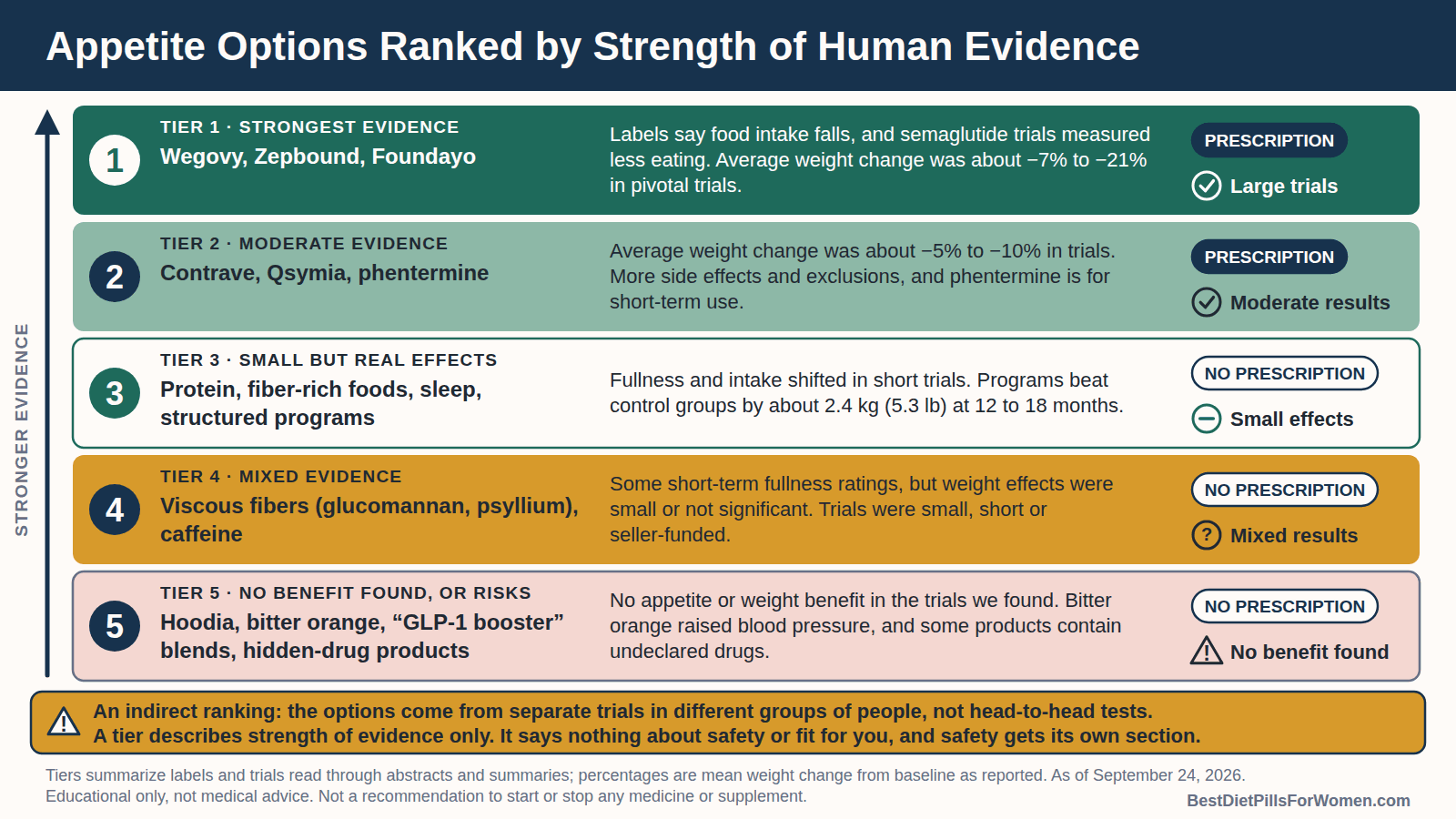
We sorted the options by how strong the human evidence is that they lower appetite, food intake or weight. The tiers describe evidence only. They say nothing about whether a product is safe or suitable for a particular woman, which is why safety gets its own section and its own table later.
The Summary Table
Read across each row before reading down a column, because an option’s evidence and its limits belong together.
| Tier | Options | What the human evidence shows | Biggest limit | How you get it |
|---|---|---|---|---|
| 1. Strongest evidence | Semaglutide (Wegovy injection and pill), tirzepatide (Zepbound), orforglipron (Foundayo) | Labels say they decrease calorie or food intake; semaglutide trials measured lower eating and less hunger; average weight change about −7% to −21% in pivotal trials | Prescription only; digestive side effects; pregnancy rules; cost; subjective hunger benefit shrank after week 20 in one trial | Prescriber |
| 2. Moderate evidence | Naltrexone-bupropion (Contrave), phentermine-topiramate (Qsymia), phentermine | Average weight change about −5% to −10% in trials; Contrave trials found fewer problems controlling eating; phentermine’s label says appetite suppression isn’t established as its main action | More side effects and exclusions; phentermine is short-term and controlled; Qsymia has pregnancy restrictions | Prescriber |
| 3. Small but real effects | Protein, fiber-rich and water-rich foods, sleep, structured programs | Fullness ratings and intake shifted in short trials; programs beat controls by about 2.4 kg at 12 to 18 months | Small effects; short studies; take effort | No prescription needed |
| 4. Mixed evidence | Viscous fibers (glucomannan, psyllium), caffeine | Some short-term fullness ratings; weight effects small or not significant | Trials small, short or seller-funded; caffeine adds up across products | Retail shelf |
| 5. No benefit found, or safety concerns outweigh the evidence | Hoodia, bitter orange, “GLP-1 booster” blends, products with hidden drugs | No appetite or weight benefit in the trials we found; blood-pressure rises with bitter orange; undeclared drugs in some products | Some carry real cardiovascular or contamination risks | Retail shelf, online |
Table 1 method: tiers reflect our reading of the human evidence summarized in Tables 3 to 8, and each cell’s sources appear in the sections that follow. Percentages are mean weight change from baseline as reported on labels or in trials, and they come from different trials, so the table isn’t a head-to-head ranking. A tier says nothing about safety or fit for a particular woman. Trial and label details were read through abstracts, label mirrors and page summaries.
How to Read the Tiers
Table 1 is a summary, so here’s how to read it. Tier 1 sits at the top because it’s the only group with large, consistent results in randomized trials and with labels that describe an appetite effect. That’s a statement about strength of evidence, not a prescription. Tier 2 medicines produce smaller average losses and carry more exclusions, and some women do better on them than on a GLP-1 drug, or can’t take a GLP-1 drug at all. Tier 3 has no drug risks but small effects. Tiers 4 and 5 are the shelf products, where the honest summary is that the evidence is thin or absent. Our review of OTC appetite suppressants covers those ingredients in more depth. Infographic 1 shows the ladder at a glance.
How We Judged “Best”: Criteria, Limits and Why There’s No Top Ten
“Best” is a loaded word in a category full of hype, so we set the rules before looking at any product. A best-of list is only as good as its criteria, and the criteria have to be ones a reader could check for herself.
The Five Criteria We Used
Each option was judged on the same five questions, and Table 2 summarizes how we applied them. We didn’t add the answers into a score, because a score would suggest a precision the evidence doesn’t have.
Appetite and Intake Evidence
The first question was whether anyone measured appetite. Stronger evidence meant a randomized trial that recorded hunger, fullness or cravings on a rating scale or questionnaire, or measured how much people ate when offered food freely. Weaker evidence meant a label statement with no supporting trial in what we read, a one-meal lab study, or a claim about a proposed mechanism.
Weight and Health Outcomes
Appetite matters mostly because of what it changes, so we also looked at weight over months, not days. We favored trials of a year or more, results compared with a placebo group, and the share of participants who lost at least 5% of their weight. We report averages, and an average isn’t a promise for any one woman.
Safety and Women-Specific Risks
Next came what an option can do wrong. We read label warnings and contraindications, side-effect rates against placebo, and the points that matter most to women: pregnancy, contraception, breastfeeding, eating-disorder history and interactions with common medicines. A product with good weight results and a serious warning for a woman in your situation isn’t best for you.
Access, Cost and Practicality
An appetite option that a woman can’t get, afford or stay on isn’t much use. We checked whether a prescription is required, the price we could read on September 24, 2026, and the practical routine, such as daily pills or a weekly injection.
Independence and Quality of the Evidence
Finally, we asked who ran the study, who paid for it, how many people it included and how we read it. Most large drug trials were funded by the manufacturer, which is normal and doesn’t invalidate them, but it’s a reason to be careful with head-to-head claims. For supplements, seller-funded and unblinded studies are more common.
| Criterion | What we looked for | What counted as stronger | What limited our judgment |
|---|---|---|---|
| Appetite and intake evidence | Measured hunger, fullness, cravings or test-meal intake | Randomized, placebo-controlled trial with a measured appetite outcome | Many options have only a label statement or a one-meal lab study |
| Weight and health outcomes | Mean weight change versus placebo; share reaching 5% loss | Trials of 52 weeks or longer with a placebo group | Averages hide wide individual differences; most trials are industry-funded |
| Safety and women-specific risks | Warnings, contraindications, side-effect rates, pregnancy and eating-disorder language | Rates reported against placebo in the label or trial | Labels differ in how they were written; we read many through summaries |
| Access, cost and practicality | Prescription status, price on September 24, 2026, routine | Price read on a manufacturer or retailer page | Prices and offers change; several end December 31, 2026 |
| Independence and quality | Funder, size, blinding, how we read the source | Large, blinded trials with a registered design | Many sources were read as abstracts or page summaries |
Table 2 method: this is our own framework, built for this guide. It’s a description of how we read the evidence, not a scoring formula, and no numbers are added or averaged. Sources for each option appear in the sections that follow.
Why This Guide Doesn’t Give a Numbered Top Ten
A ranked list would look tidy, and it would mislead. Two things get in the way.
Cross-Trial Numbers Aren’t Rankings
The trials behind these medicines differ in length, dose, population and the way missing data were handled. When one trial reports a 14.9% average loss and another reports 11.1%, the gap could reflect the drugs, or the people enrolled, or the design. That’s why every comparison here is labeled indirect, and why we don’t declare a winner from separate trials. Where a randomized trial did compare two drugs directly, we say so.
“Best” Depends on the Woman
The same medicine can be a reasonable option for one woman and off the table for another. A woman planning a pregnancy, a woman with an eating-disorder history and a woman with uncontrolled high blood pressure each face different labels. The situation guide later in this article shows how the ranking shifts, and it’s meant to sharpen questions for a clinician, not to replace one.
What We Reviewed and What We Couldn’t Check
Comparison pages can mean anything from hands-on use to a summary of a seller’s own site. We’d rather be exact about what this one is.
What We Reviewed
This guide is desk research. We read FDA-approved labels, trial abstracts, professional-society guidelines, FDA and government pages, and manufacturer and retailer price pages checked on September 24, 2026. We didn’t buy, take or inject any product, and nothing here describes personal experience with one.
What We Couldn’t Check
PubMed, PubMed Central, the New England Journal of Medicine, The Lancet and several other sites blocked automated access, so we read many trials through abstracts, label tables and summaries, and we say so when it matters. We couldn’t search ClinicalTrials.gov, so when we write that we found no trial of something, we mean the sources we could read didn’t report one. The two 2026 guidelines were read through summaries. Prices are one-day snapshots. And several appetite studies were paid for by the maker of the drug they tested.
What an Appetite Suppressant Can and Can’t Do: Mechanism vs Measured Outcome
An appetite suppressant makes two promises. The first is about mechanism: that it acts on the signals that drive eating. The second is about outcome: that you’ll feel less hungry, eat less and lose weight. Evidence for the first isn’t evidence for the second, and product pages routinely blur them. Separating the two is the fastest way to size up any option in this guide.
How Trials Measure Appetite
When a study says a product “reduced appetite,” it matters a great deal how that was measured. The measures differ in strength, and knowing which one a trial used tells you how much weight to give it.
Ratings, Test Meals and Craving Questionnaires
The simplest measure is a rating scale, in which people mark how hungry or full they feel at a given moment. It’s quick and cheap, and it’s subjective. A stronger measure is a test meal, in which researchers offer food freely and record how many calories people eat, which shows behavior instead of feelings. A third measure is a questionnaire on cravings and control over eating, such as the Control of Eating Questionnaire used in the naltrexone-bupropion (Contrave) trials. Some studies add tests of food reward, meaning how strongly people respond to appealing foods. Each measure captures something different, and a product can move one without moving the others.
Why Weight Change Isn’t Appetite Change
Weight is an even further downstream outcome. A drug can lower weight by reducing intake, but also by other routes, and the reverse is true too: a person can feel less hungry without losing weight if she eats the same amount out of habit. The 60-week semaglutide trial we discuss below shows how far the measures can drift apart. Test-meal intake stayed lower at 20, 40 and 60 weeks, while participants’ own ratings of hunger and food preoccupation stopped differing from placebo after week 20. Neither result is wrong. They measure different things.
What the Labels Say About How These Drugs Work
Prescription labels are the most reliable place to see what a manufacturer can claim about mechanism, because FDA reviews the wording. They’re also more cautious than the marketing that surrounds them.
The GLP-1 Labels
The Wegovy, Zepbound and Foundayo labels each say the drug decreases calorie or food intake. Wegovy’s says the effect is “likely mediated by affecting appetite,” and Foundayo’s uses similar language about decreased appetite. All three also say the drug delays gastric emptying, meaning food leaves the stomach more slowly, and Zepbound’s and Foundayo’s labels add that the delay is largest after the first dose and diminishes over time. That detail suggests slower digestion may not be the whole story. In the 20-week semaglutide study discussed below, stomach emptying was about 8% slower than on placebo, which was no longer statistically significant once body weight was taken into account. Zepbound acts on a second hormone, GIP, as well as GLP-1.
The Phentermine, Contrave and Qsymia Labels
The older prescription drugs are more modest about how they work. Phentermine is a stimulant-type drug whose activity resembles amphetamine, and its label says it hasn’t been established that appetite suppression is the primary action of drugs in this class in treating obesity. The label also notes that tolerance to the effect has been demonstrated, and it limits use to a few weeks. Contrave’s 2014 label says the exact brain effects behind its weight loss aren’t fully understood. We couldn’t see Qsymia’s mechanism section in the label pages we read. So “appetite suppressant” describes what these drugs are used for and how they’re marketed, and it isn’t a proven description of how every one of them works.
| Option | What the label or source says about how it works | Was appetite or intake measured? | Average weight result | Our reading |
|---|---|---|---|---|
| Wegovy (semaglutide) | Lowers calorie intake, likely via appetite; slows gastric emptying | Yes: two randomized trials of 20 and 60 weeks | −14.9% (injection) and −13.6% (pill) in pivotal trials | Mechanism and measured outcome both supported |
| Zepbound (tirzepatide) | Lowers calorie intake, likely via appetite; acts on GLP-1 and GIP | Label statement; we read no appetite-outcome trial | −15.0% to −20.9% (SURMOUNT-1) | Mechanism labeled; appetite trial not read |
| Foundayo (orforglipron) | Lowers food intake, likely via decreased appetite; slows gastric emptying | Label statement only in what we read | −7.4% to −11.1% (ATTAIN-1) | Mechanism labeled; appetite trial not read |
| Contrave (naltrexone-bupropion) | Exact brain effects not fully understood | Yes: craving item favored Contrave in four trials | −5.4% (COR-I) | Outcome supported, mechanism unclear |
| Qsymia (phentermine-topiramate) | Mechanism section not seen in what we read | Not seen in what we read | −7.81% and −9.84% (CONQUER) | Weight outcome supported; appetite outcome not read |
| Phentermine | Appetite suppression not established as the main action; tolerance noted | Not in what we read | Label: added loss over placebo is a fraction of a pound a week | Long used; “suppressant” is a description, not proof |
| Fibers (glucomannan, psyllium, others) | Swell or gel and may slow digestion | Mixed: most fiber types showed no significant appetite change in a review of 136 studies | −0.22 kg (glucomannan, not significant) and −0.33 kg (viscous fiber) | Plausible mechanism, mixed outcome |
| Caffeine and stimulant blends | Stimulant effects on alertness and energy use | Possibly less intake at the next meal; appetite ratings equivocal | Not established as an appetite effect | Mixed |
| “GLP-1 booster” supplements | Marketed as raising the body’s own GLP-1 | GLP-1 level rose in one small 14-day trial; no appetite outcome | About −0.84 kg for berberine, gone when low-quality studies are excluded | Proposed mechanism, no demonstrated outcome |
Table 3 method: entries paraphrase label sections and summarize the studies cited in each row. The Contrave figure is from the 2014 label’s first trial, and the phentermine row paraphrases the label instead of giving a trial figure. “Not in what we read” means the pages we could read didn’t report it, not that it doesn’t exist. Weight figures come from different trials and analyses, so the column isn’t a ranking.
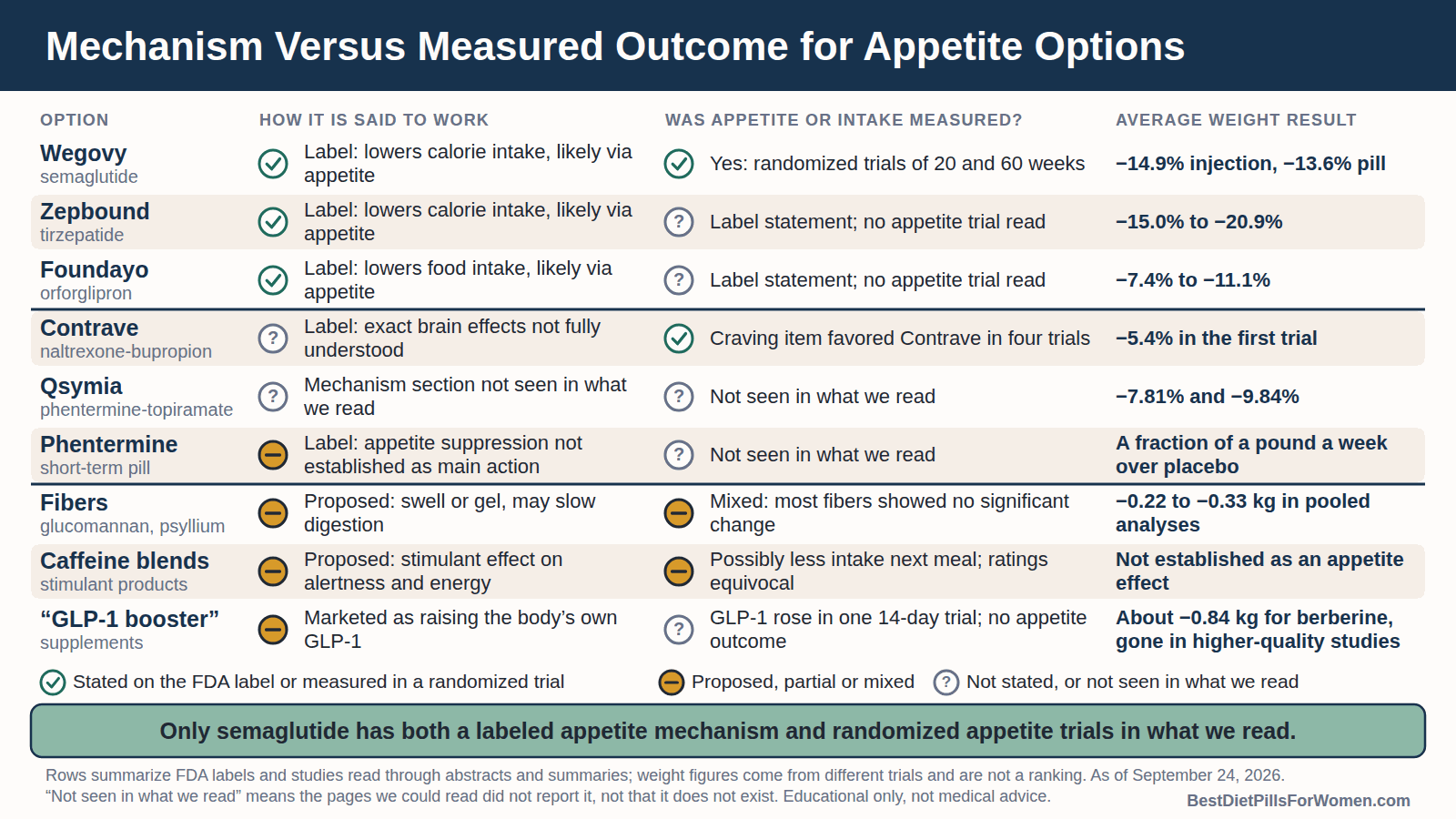
Table 3 has a clear pattern. Only semaglutide has both a labeled appetite mechanism and randomized appetite-outcome trials that we could confirm, and Contrave has an outcome without a clear mechanism. The supplement rows have neither one at the strength of a medicine. Infographic 2 puts the same comparison in picture form.
Prescription GLP-1 Medicines: The Strongest Evidence for Appetite Control
GLP-1 is a gut hormone that helps regulate appetite and blood sugar, and these medicines mimic it. Wegovy (semaglutide) comes as a weekly injection and a daily pill, Zepbound (tirzepatide) is a weekly injection, and Foundayo (orforglipron), approved by FDA on April 1, 2026, is a daily pill. They’re the only appetite-related products with both large trial results and labels that describe an appetite effect. Our guide to weight loss pills vs injections compares the two routes in more depth, and this section stays on what matters for appetite.
Semaglutide: Wegovy Injection and Pill
Semaglutide has the deepest appetite evidence of the three, including two randomized trials that measured eating directly.
What the Appetite Studies Found
A 2021 double-blind trial gave 72 adults with obesity semaglutide 2.4 mg or placebo for 20 weeks and measured how much they ate when food was offered freely. Intake was 35% lower on semaglutide (1,736 versus 2,676 kilojoules, about 415 versus 640 calories), and people reported less hunger, more fullness, fewer cravings and better control of eating. Stomach emptying was about 8% slower, a difference that wasn’t significant after adjusting for body weight, and average weight change was −9.9% versus −0.4%. We read that trial through a news summary, which didn’t say whether the intake measure was a single meal.
A longer 2026 trial followed 120 adults, 78.3% of them women, for 60 weeks. Lunch intake was lower on semaglutide by about 292 calories at week 20, 240 at week 40 and 270 at week 60. Ratings of hunger and food preoccupation were significantly better at week 20 but not at weeks 40 or 60, and the drop in food reward was significant at weeks 20 and 40 but not at week 60. The authors concluded that semaglutide kept participants eating fewer calories even as some subjective benefits declined, and a Novo Nordisk research grant helped fund the work.
What the Weight Trials Found
The pivotal trials measured weight, not appetite. In STEP 1, 1,961 adults without diabetes taking weekly Wegovy for 68 weeks lost an average of 14.9% of their body weight, against 2.4% on placebo, and 74% of participants were women. In OASIS 4, 307 adults taking the daily Wegovy pill at 25 mg for 64 weeks lost 13.6% against 2.4% on placebo by the label’s analysis, and 76% to 79% were women. The trial paper reports a placebo figure of 2.2% under a different analysis, which is why numbers for this study vary between sources.
Tirzepatide (Zepbound) and Orforglipron (Foundayo)
The other two drugs have a labeled appetite effect and large weight results. What we didn’t find is an appetite-outcome trial as detailed as semaglutide’s.
Zepbound: What We Know About Appetite and Weight
Zepbound’s label says tirzepatide decreases calorie intake, an effect likely mediated by appetite. In SURMOUNT-1, 2,539 adults without diabetes lost 15.0%, 19.5% and 20.9% of body weight at 5, 10 and 15 mg over 72 weeks, against 3.1% on placebo, and 68% were women. It’s also the only drug here with a randomized head-to-head result against another obesity drug. In SURMOUNT-5, 751 adults took Zepbound or Wegovy for 72 weeks and lost an average of 20.2% and 13.7%, a 6.5-point gap, in an open-label trial funded by Lilly.
Women appear to lose a larger percentage of body weight on tirzepatide. A post hoc analysis by Lilly-affiliated authors of 4,677 people in SURMOUNT-1 to -4 reported reductions of 11.5% to 27.6% in women and 8.8% to 18.9% in men across the trial arms, which is suggestive and not proven.
Foundayo: What We Know About Appetite and Weight
Foundayo’s label says orforglipron decreases food intake, an effect likely mediated by decreased appetite. In ATTAIN-1, adults without diabetes lost 7.4%, 8.3% and 11.1% of body weight at 5.5, 9 and 17.2 mg over 72 weeks, against 2.1% on placebo, and 64% were women. We found no sex-specific analysis for either pill and no appetite-outcome trial for Foundayo in the pages we could read. Hair loss was reported by 7% of women and 0.9% of men on the label, a pattern seen across the GLP-1 class. Table 4 lists the studies behind these figures.
| Study | Who and how long | What was measured | Result, drug vs placebo | Funder or caveat |
|---|---|---|---|---|
| Friedrichsen 2021 (semaglutide 2.4 mg) | 72 adults with obesity; 20 weeks | Free-eating intake, hunger, fullness, cravings, stomach emptying | Intake 35% lower; less hunger, more fullness; weight −9.9% vs −0.4% | Read through a summary; phase 1 trial |
| 60-week appetite trial (semaglutide 2.4 mg) | 120 adults, 78.3% women; 60 weeks | Lunch intake, appetite ratings, food reward | Lunch intake about 292, 240 and 270 calories lower at weeks 20, 40, 60; ratings differed only at week 20 | Novo Nordisk grant; abstract only |
| STEP 1 (Wegovy injection) | 1,961 adults; 68 weeks; 74% women | Weight | −14.9% vs −2.4% | Read through label and abstract |
| OASIS 4 (Wegovy pill) | 307 adults; 64 weeks; 76% to 79% women | Weight | −13.6% vs −2.4% (label analysis) | Placebo figure is −2.2% in the paper |
| SURMOUNT-1 (Zepbound) | 2,539 adults; 72 weeks; 68% women | Weight | −15.0%, −19.5%, −20.9% vs −3.1% | Manufacturer-funded |
| ATTAIN-1 (Foundayo) | Adults without diabetes; 72 weeks; 64% women | Weight | −7.4%, −8.3%, −11.1% vs −2.1% | Manufacturer-funded |
| SURMOUNT-5 (Zepbound vs Wegovy) | 751 adults; 72 weeks; open-label | Weight, head to head | −20.2% vs −13.7% | Lilly-funded |
Table 4 method: figures are as reported in the abstracts, labels and press releases, and no result was recalculated. Percent figures are mean weight change from baseline. The trials differ in length, dose and population, so apart from SURMOUNT-5 (a direct comparison of two drugs) the rows can’t be ranked against each other. We read most sources through summaries, label tables and abstracts.
What the Appetite Effect Means in Practice
A drug that lowers appetite raises two follow-up questions: does the effect last, and who can actually use it?
Does the GLP-1 Appetite Effect Fade?
In the one long trial we found, measured eating stayed lower for 60 weeks, while participants’ own hunger ratings stopped differing from placebo after week 20.
That’s a single trial of one drug, mostly in women and partly funded by its maker, and we found no comparable long-term appetite data for tirzepatide or orforglipron. What’s better established is what happens after treatment stops: in a 2026 meta-analysis of stopping trials, people regained about 0.8 kilograms a month, and the 2026 obesity-medicine guideline recommends continuing medication during maintenance. We found no stop-treatment trial for either pill.
Who Can Get These Medicines and Who Can’t
NIDDK describes prescription medicine as an option for adults with a BMI of 30 or higher, or 27 or higher with weight-related health problems. The labels list the barriers. All three carry a boxed warning about the risk of thyroid C-cell tumors (Foundayo’s label adds that orforglipron was inactive in rodents and that the risk in humans hasn’t been determined), and all are contraindicated with a personal or family history of medullary thyroid carcinoma or multiple endocrine neoplasia type 2. The Zepbound and Foundayo labels say weight loss offers no benefit to a pregnant patient and may cause fetal harm, and every GLP-1 label we read says to discontinue the drug when pregnancy is recognized. Cost and coverage are the third barrier, which the cost section covers. Only a prescriber who knows your history can say whether one of these is appropriate.
Phentermine, Contrave and Qsymia: The Older Prescription Options
Many women who search for an appetite suppressant are really asking about these three drugs. They were on the market long before the GLP-1 medicines, they cost far less, and their average results are smaller. Each also has its own set of warnings, so the evidence looks different from the GLP-1 story. Our guide to prescription appetite suppressants covers the group in more depth.
Phentermine
Phentermine is the oldest of the three and the one most often described as “the” appetite suppressant. Its label is more restrained than its reputation.
What the Label Says and Doesn’t Say
Phentermine is a sympathomimetic amine, a stimulant-type drug whose activity is similar to amphetamine, and it’s indicated as a short-term add-on to diet and exercise for adults with a BMI of 30 or higher, or 27 or higher with weight-related risk factors. The label says the added weight loss over placebo is only a fraction of a pound a week, tolerance to the effect has been demonstrated with this class of drugs, and it hasn’t been established that appetite suppression is the primary way they work. It’s a controlled substance, and its contraindications include cardiovascular disease, uncontrolled high blood pressure, an overactive thyroid, glaucoma, agitated states, a history of drug abuse, use of an MAO inhibitor and pregnancy. The label says weight loss offers a pregnant woman no benefit and may harm the fetus.
What Longer-Term Data Show
Real-world use runs longer than the label allows. A cohort study using electronic health records followed 13,972 adults who filled a first phentermine prescription between 2010 and 2015. Among those who used it continuously for more than 12 months, weight loss at 24 months was 7.4% greater than in the comparison group, and heart disease or death was rare (0.3%) with no significant difference between groups. Because the study was observational, people who stayed on phentermine may differ from those who didn’t in ways the analysis couldn’t capture, and the authors’ reassurance applies to the people studied. It doesn’t override the label. The gap between the label and practice is one reason the 2026 guidelines treat phentermine differently, as the guideline section explains.
Contrave (Naltrexone-Bupropion)
Contrave combines two older drugs, one used for opioid and alcohol dependence and one for depression and smoking cessation. It’s the only older option with published craving data that we could confirm.
Craving Evidence and Weight Results
A Canadian health-technology review covered four 56-week trials with about 4,500 participants in total: COR-I (1,742), COR-II (1,496), COR-BMOD (793) and COR-DM (505, in people with type 2 diabetes). Women made up 85% to 92% of the first three trials and 53% to 58% of the diabetes trial. On the Control of Eating Questionnaire item asking about difficulty controlling eating, Contrave beat placebo in all four trials, by 4.98 to 7.23 points on the item’s scale. The label’s first trial reported weight change of −5.4% on Contrave against −1.3% on placebo. The reviewers’ own placebo-adjusted estimates were smaller, about −3.3 to −4.8 percentage points, they noted consistently smaller effects in sensitivity analyses, and only 50% to 59% of participants completed the trials.
Tolerability and Who Can’t Take It
Stopping because of side effects was common. In the four trials, 19.5% to 29.4% of people on Contrave quit for that reason, against 9.8% to 15.4% on placebo, an excess of roughly 10 to 14 percentage points. The label’s pooled rates for common effects were nausea 32.5% versus 6.7%, constipation 19.2% versus 7.2% and vomiting 10.7% versus 2.9%. Contrave carries a boxed warning about suicidal thoughts and behaviors, which is standard for drugs containing an antidepressant ingredient, and its contraindications include uncontrolled high blood pressure, a seizure disorder, bulimia or anorexia nervosa, and chronic opioid use. That eating-disorder contraindication is worth knowing about before a visit.
Qsymia (Phentermine-Topiramate)
Qsymia combines phentermine with topiramate, an anticonvulsant, in a once-daily capsule, and it’s the older drug with the largest average result in trials.
Results and What They Cost in Side Effects
In CONQUER, 2,487 adults lost an average of 7.81% of body weight at the lower dose and 9.84% at the higher dose over 56 weeks, against 1.24% on placebo, and 70% of participants were women. At the top dose, the label lists tingling or numbness in 20% of people versus 2% on placebo, dry mouth in 19% versus 3% and constipation in 16% versus 6%. We didn’t find appetite-specific outcomes for Qsymia in what we read, so its place in this guide rests on weight results.
Pregnancy Rules and the March 2026 Label Change
Qsymia is the most tightly restricted of the three for women who could become pregnant. Its label makes it contraindicated in pregnancy because topiramate can cause fetal harm, says breastfeeding isn’t recommended, and calls for a negative pregnancy test before starting and every month afterward. It’s sold through a restricted program, called a Risk Evaluation and Mitigation Strategy, for that reason. The label was revised in April 2026, with March 2026 changes to its contraindications and to two warnings, and we couldn’t see what changed, so check the current label for details. Table 5 puts the older options side by side.
| Option | What the label says about how it works | Trial result | Appetite or craving evidence | Main cautions |
|---|---|---|---|---|
| Phentermine | Stimulant-type drug; appetite suppression not established as the main action | Label: added loss is a fraction of a pound a week; cohort: 7.4% more loss at 24 months with continuous use | None in what we read | Controlled substance; heart, blood pressure, thyroid and glaucoma contraindications; pregnancy |
| Contrave | Exact brain effects not fully understood | −5.4% vs −1.3% (COR-I) | Craving item favored Contrave in four trials | Boxed warning on suicidal thoughts; nausea; not for bulimia or anorexia nervosa |
| Qsymia | Not seen in the pages we read | −7.81% and −9.84% vs −1.24% (CONQUER) | Not seen in what we read | Contraindicated in pregnancy; monthly pregnancy tests; tingling, dry mouth |
| Orlistat (Xenical, alli) | Blocks fat absorption in the gut and isn’t an appetite drug | 2.9 kg more than placebo in a 2007 meta-analysis | Not applicable | Oily stools; kidney warnings; vitamin absorption |
Table 5 method: entries paraphrase the label sections and trial summaries cited in each row. The Contrave weight figure is from the 2014 label’s first trial and the CADTH review’s estimates are smaller. The phentermine cohort figure is observational and isn’t comparable with trial results. Orlistat is included because it’s often grouped with appetite products but doesn’t act on appetite. We read the labels through summaries and label mirrors.
What 2026 Guidelines and a 56-Trial Analysis Say About Ranking These Drugs
We can’t rank these drugs ourselves from separate trials, but professional groups have looked at the same evidence and made their own calls. Two new U.S. guidelines and one large pooled analysis give the closest thing to an expert ranking, and they agree on more than they disagree. Table 6 shows where each one places each option.
The Two 2026 U.S. Guidelines
Both guidelines cover prescription medicines for adults, and neither is written specifically for women. We read each through a summary, so recommendation strengths and evidence ratings weren’t visible to us.
The Obesity Society, Obesity Medicine Association and Obesity Action Coalition
The March 2026 guideline from these three groups recommends using naltrexone-bupropion, semaglutide and tirzepatide in adults, and it suggests orlistat, phentermine (for three months or longer), phentermine-topiramate and liraglutide. It also recommends continuing obesity medications during weight maintenance. The summary we read didn’t mention over-the-counter supplements or give statements specific to women or pregnancy. Its phentermine suggestion, for use beyond three months, runs longer than the drug’s label, which limits use to a few weeks.
The American College of Physicians
The ACP’s living guideline for nonpregnant adults, dated 2026, ranks the options in order. Semaglutide and tirzepatide are first-line, phentermine-topiramate is second-line, liraglutide is third-line and naltrexone-bupropion is fourth-line for obesity. In the item we read, the guideline didn’t address phentermine alone, orlistat, over-the-counter supplements or the oral GLP-1 pills, and it advises counseling on nutritional deficiencies and on muscle and bone loss. The ACP newsroom item is dated June 15, 2026, while a search listing for the Annals article showed April 2026, so we cite only the year.
What a 56-Trial Network Meta-Analysis Adds
A network meta-analysis pools many trials and uses shared comparison groups, such as placebo, to estimate how drugs stack up against each other. It’s still an indirect method for drugs that were never tested head to head, but it’s more careful than lining up single trials.
What It Found
A 2025 Nature Medicine analysis pooled 56 randomized trials with 60,307 participants (32,598 on active drugs and 27,709 on placebo), searching through January 31, 2025. Every drug beat placebo on total body weight loss except orlistat, and only semaglutide and tirzepatide reached a loss of at least 10%. Phentermine-topiramate landed in the middle, and liraglutide and naltrexone-bupropion produced more modest losses. Serious adverse events weren’t significantly increased by any of the medicines except naltrexone-bupropion.
What It Couldn’t Tell Us
The analysis had no trials of phentermine on its own, it included few head-to-head comparisons and little data for people with a BMI of 27 to 30 or 40 and above, and its search ended before the Wegovy pill or Foundayo reached the U.S. market. We also couldn’t see its numeric estimates. It says nothing about over-the-counter supplements, which weren’t part of it.
| Option | TOS, OMA and OAC guideline (March 2026) | ACP living guideline (2026) | 2025 network meta-analysis |
|---|---|---|---|
| Semaglutide | Recommended | First-line | Loss of at least 10% |
| Tirzepatide | Recommended | First-line | Loss of at least 10% |
| Phentermine-topiramate | Suggested | Second-line (obesity) | Moderate loss |
| Liraglutide | Suggested | Third-line (obesity) | Modest loss |
| Naltrexone-bupropion | Recommended | Fourth-line (obesity) | Modest loss; more serious adverse events |
| Phentermine alone | Suggested (three months or longer) | Not in the ranking we read | No trials included |
| Orlistat | Suggested | Not addressed in what we read | The one drug that didn’t beat placebo |
| OTC supplements | Not mentioned in the summary we read | Not addressed in what we read | Not included |
| Wegovy pill and Foundayo | Not stated in the summary we read | Oral GLP-1 pills not addressed | Search ended before they reached the market |
Table 6 method: the guideline columns summarize how each group’s recommendations were described in a Guideline Central summary (TOS, OMA and OAC) and an ACP newsroom item, and “not addressed in what we read” means the summary didn’t mention it, not that the guideline omits it. The network meta-analysis column summarizes the abstract page, whose numeric estimates we couldn’t see. “Suggested” and “recommended” are the terms used in the summary of the TOS guideline and aren’t equivalent to ACP’s line-of-therapy ranking.
The table’s clearest message is a negative one. Neither guideline, as we read it, recommends an over-the-counter appetite product, and both put the GLP-1 drugs at or near the top. The groups disagree about naltrexone-bupropion, which one recommends alongside semaglutide and tirzepatide and the other ranks fourth. Because the guidelines were written for adults in general, their rankings don’t answer questions about pregnancy plans, menopause or eating-disorder history, which is what the situation guide later in this article is for.
Over-the-Counter Appetite Suppressants: The Best-Studied Ingredients and the Ones to Avoid
If you’re shopping for a pill without a prescription, the evidence gets thin quickly. FDA doesn’t review dietary supplements for safety or effectiveness before they’re sold, and NIH says many weight loss supplements haven’t been tested for safety. This section pulls out how the main ingredient groups rank against each other. Our full review of OTC appetite suppressants and our guide to natural appetite suppressants go through the ingredients in far more detail.
Fibers: The Best of a Weak Field
Fiber is the one OTC group with a plausible, well-understood way to affect fullness and the most trials behind it, which makes it the fairest place to start.
What Trials Found on Appetite and Weight
A review of 136 human studies of extracted fibers found that most fiber types didn’t significantly change appetite ratings or energy intake, with alginate, guar gum and oat fiber most often lowering appetite ratings right after a dose. Weight results were small: a pooled analysis of eight glucomannan trials found an average change of −0.22 kilograms that wasn’t statistically significant, and an analysis of 62 trials of viscous fiber found a small but significant −0.33 kilograms. Two psyllium crossover trials found lower hunger and higher fullness between meals, but they used controlled meals and rating scales, and the maker of Metamucil paid for the work.
The Safety Catch With Fiber Capsules
Fibers have a physical risk that other supplements don’t. Health Canada warned in 2010 that glucomannan products in tablet, capsule or powder form can cause choking or blockage of the throat, esophagus or intestine if taken without enough fluid. Gas, bloating and cramping are the usual complaints. So fiber ranks as the lowest-risk OTC option in this guide if it’s taken with plenty of water, and that’s a low bar. The evidence still doesn’t support calling any fiber capsule an appetite suppressant.
Caffeine, Green Tea and Bitter Orange
Stimulant-based blends fill most of the shelf, usually under names that hide how much caffeine they contain.
Caffeine, Guarana and Yerba Maté
A review of caffeine and appetite concluded that caffeine taken 0.5 to 4 hours before a meal may reduce energy intake at that meal, while effects on appetite perception were equivocal. FDA has cited 400 milligrams a day as an amount not generally associated with negative effects in most healthy adults, and NIH warns that supplements with large amounts of caffeine or caffeine-containing herbs may raise heart rate. The practical catch is that guarana, yerba maté and green tea extract all count toward the same total, so a label can hide the sum.
Green Tea Extract and Bitter Orange
The Cochrane review of green tea found a non-significant loss of −0.04 kilograms in six studies conducted outside Japan and called it too small to matter. NIH’s LiverTox rates green tea extract as a well-established cause of clinically apparent liver injury. Bitter orange (synephrine) fares worse: a meta-analysis of 18 trials and 341 participants found blood pressure rose about 6.4 mmHg (systolic) and 4.3 mmHg (diastolic) after roughly eight weeks, with no significant weight loss.
Plant Extracts, “GLP-1 Boosters” and Hidden Drugs
The newest marketing wave borrows the names of prescription drugs, and it’s where evidence is weakest and label reading matters most.
Hoodia, Caralluma and Other Plant Extracts
Hoodia has one human trial we could find, in 49 overweight women over 15 days, and it found no difference from placebo in intake or weight and reported nausea, vomiting and skin-sensation changes. NIH says little is known about hoodia’s safety. Caralluma has manufacturer-funded trials that reported lower intake, but a 2021 meta-analysis of seven articles found no significant effect on weight, BMI or appetite, and its authors said they were unlikely to recommend it.
Supplements Marketed as GLP-1 Support and Hidden Drugs
Supplements sold as “GLP-1 boosters,” often built around berberine or cinnamon, don’t deliver GLP-1 the way a prescription drug does. A Geisinger obesity physician said in March 2026 that there’s little to no scientific evidence that they raise GLP-1 enough to cause significant weight loss, and a Department of Defense supplement-safety program notes that berberine’s reported 0.84-kilogram average loss disappears when low-quality studies are excluded. The larger risk is contamination. FDA says it has found weight loss products sold as supplements that contain hidden prescription drugs and other illegal ingredients, and it keeps a running list. Natural on a label isn’t a safety claim, and a low price isn’t a sign of value.
| Ingredient or product type | Best human evidence on appetite or weight | Main risk | Our read |
|---|---|---|---|
| Fibers (glucomannan, psyllium, others) | Most types showed no significant appetite change; −0.22 to −0.33 kg in pooled weight analyses | Choking or blockage without enough fluid; gas | Mixed: best of a weak field, lowest risk |
| Caffeine, guarana, yerba maté | May lower intake at the next meal; appetite ratings equivocal | Faster heart rate; hidden totals across ingredients | Mixed |
| Green tea extract | −0.04 kg across six non-Japan studies | Liver injury reports | Mixed, with a liver signal |
| Bitter orange (synephrine) | No significant weight loss in 18 trials | Blood pressure rose in pooled trials | No benefit found |
| Hoodia | One 15-day trial: no difference in intake or weight | Nausea, skin-sensation changes; safety data thin | No benefit found |
| Caralluma | Manufacturer-funded trials positive; meta-analysis found no effect | Little independent safety data | Mixed, mostly seller-funded |
| “GLP-1 booster” supplements (berberine, cinnamon) | GLP-1 level rose in one small trial; no appetite outcome | GI effects; contamination and hidden-drug risk in the category | Limited: no demonstrated appetite outcome |
| Products with hidden drugs | Not applicable | Undeclared drugs such as sibutramine, which can raise blood pressure | A risk to screen out, not a product to rate |
Table 7 method: the “best human evidence” column summarizes the reviews and trials cited in each row, all read as abstracts or through summaries, and the ratings apply the same definitions as our OTC review (Mixed, Limited, No benefit found). Effects are averages from trials of different lengths and designs, so the rows aren’t a ranking of effect size. “Our read” describes evidence and risk together and isn’t advice to take or avoid any product.
Habits That Blunt Hunger Without a Pill: What the Research Shows
For a woman who isn’t a candidate for a prescription, or who wants to try something before a medicine, the options with the best evidence aren’t products at all. None of these habits is glamorous, and their effects are smaller than a GLP-1 drug’s, but several have been tested in randomized trials and none has a side-effect table.
Food Choices That Change Fullness
What’s on the plate shifts how full you feel, how long the feeling lasts and how much you end up eating.
Protein and Satiety
A review of protein research found that higher-protein meals modestly increase fullness, though the evidence didn’t clearly show that people ate less at their next meal, and longer studies were limited and conflicting, with adherence the main reason. The authors’ summary range was 1.2 to 1.6 grams of protein per kilogram of body weight a day, with at least about 25 to 30 grams per meal. For a woman who weighs 150 pounds (68 kilograms), that works out to roughly 82 to 109 grams a day. Our guide to protein for weight loss covers the practical side, and our guide to preserving muscle during weight loss explains why protein matters more as you age.
Fiber-Rich, Water-Rich and Less-Processed Foods
In a classic lab study, people ate 240-calorie portions of 38 foods and rated their fullness for two hours. Boiled potatoes scored 323% on a scale where white bread is 100%, and croissants scored 47%, with scores rising with a food’s weight, protein, fiber and water content and falling with fat content. A year-long trial in 97 women with obesity compared advice to cut fat with advice to cut fat and eat more water-rich foods such as fruit and vegetables. Among the 71 who finished, the second group lost 7.9 kilograms and the first lost 6.4, and the fruit-and-vegetable group reported less hunger, though about a quarter of the women didn’t finish. Food processing matters, too: in a 20-person inpatient trial, people ate about 508 more calories a day on an ultra-processed diet than on an unprocessed one, even though the meals were matched on several nutrition measures.
Sleep, Stress and How You Eat
Some of the largest appetite effects in the research come from ordinary conditions, and none is sold in a bottle.
Sleep and Energy Intake
In a randomized trial, 80 adults with overweight who usually slept under 6.5 hours got counseling that added about 1.2 hours of sleep a night, and their energy intake fell by about 270 calories a day compared with a control group over roughly two weeks. A meta-analysis of experimental sleep restriction found that intake rose by about 385 calories in the short-sleep condition. Both come from short studies, so they show a direction and not a certain result for a woman whose sleep is disrupted by menopause or a newborn. Stress has a real but small average link to eating more, according to a meta-analysis of 54 studies, with a lot of variation between studies.
Eating Pace, Water and Mindfulness
Eating more slowly lowered intake in a meta-analysis of 22 studies, though it made no significant difference to reported hunger, and the studies were mostly short experiments at single meals. Drinking 500 milliliters of water before each meal was followed by about 2 kilograms more weight loss over 12 weeks in 48 adults aged 55 to 75 on a reduced-calorie diet, but the difference in intake at a test meal wasn’t statistically significant. Mindfulness-based programs reduced binge-eating symptoms in a meta-analysis of randomized trials, but they didn’t reduce body mass more than control conditions.
Structured Programs
A structured program combines several habits with feedback, which is why guidelines start from it.
What Programs Achieve
The U.S. Preventive Services Task Force gave a Grade B recommendation in 2018 for clinicians to offer or refer adults with a BMI of 30 or higher to intensive behavioral programs. Across 67 studies and 22,065 people, participants lost 2.39 kilograms (about 5.3 pounds) more than controls at 12 to 18 months, and about one in eight more people reached a loss of at least 5%. The CDC says people who lose weight gradually, about 1 to 2 pounds a week, are more likely to keep it off.
What Habits Can’t Do
None of these strategies removes hunger, and each takes effort and repetition, which is exactly what a capsule promises to spare you. They also don’t work equally for everyone: the year-long trial above lost about a quarter of its participants. The honest comparison with a prescription medicine is that habits produce small, low-risk shifts, and medicines produce larger ones with trade-offs. Many women use both, and the Medicare GLP-1 Bridge, for one, lists ongoing lifestyle changes among its eligibility requirements.
| Strategy | Best evidence | Size and study context | Main limit |
|---|---|---|---|
| Higher-protein meals | Review of protein and satiety | Modest fullness effect; 1.2 to 1.6 g/kg/day and 25 to 30 g per meal suggested | Next-meal intake effect not shown; long studies mixed |
| Water-rich, fiber-rich foods | Year-long trial in 97 women | 7.9 vs 6.4 kg lost; less hunger; 71 finished | Both groups lost weight; about a quarter dropped out |
| Less ultra-processed food | 20-person inpatient trial | About 508 fewer calories a day; two weeks | Small and short |
| More sleep | Randomized trial, 80 adults | About 270 fewer calories a day over two weeks | Short; not tested in midlife women |
| Slower eating | Meta-analysis of 22 studies | Lower intake at a meal; no significant hunger change | Mostly single-meal experiments |
| Water before meals | Trial in 48 adults aged 55 to 75 | About 2 kg more loss over 12 weeks | Test-meal intake difference not significant |
| Structured behavioral programs | USPSTF review, 67 studies | 2.39 kg more than controls at 12 to 18 months | Effect on hunger not the main outcome |
Table 8 method: figures come from the abstracts or summaries of the studies and are reported as the authors gave them, without pooling or recalculation. Calorie figures are differences in energy intake between conditions, and kilogram figures are weight differences. The studies differ in population, duration and design, so the rows aren’t directly comparable.
Best Appetite Suppressant for Women by Situation: A Decision Guide
The answer to “which is best” changes with a woman’s situation, and for some situations the honest answer is “none of the pills.” This section walks through the circumstances that most often change the ranking. It describes what labels and studies say, and it isn’t a diagnosis or a recommendation to start, stop or change any medicine.
If You Could Become Pregnant, Are Pregnant or Are Breastfeeding
Pregnancy plans are the biggest single filter for prescription appetite medicines, because several labels bar them outright.
What the Prescription Labels Say
Wegovy’s label says to stop the drug at least two months before a planned pregnancy, and every GLP-1 label we read says to discontinue it once pregnancy is recognized. Zepbound’s label advises switching to a non-oral contraceptive or adding a barrier method for four weeks after starting and after each dose increase, and Foundayo’s gives the same advice for 30 days, while Wegovy’s label has no such advice. Phentermine and Qsymia are contraindicated in pregnancy, and Qsymia’s label requires a pregnancy test before starting and every month afterward. Breastfeeding language differs: Foundayo and Qsymia aren’t recommended for nursing women, and phentermine’s label tells the prescriber to decide between stopping the drug and stopping nursing. We didn’t read Contrave’s pregnancy language, so check its label. Our comparison of weight loss pills vs injections has a full label table.
Caffeine and Supplements Around Pregnancy
For supplements the reliable information is thinner. ACOG says caffeine under 200 milligrams a day doesn’t appear to be a major contributing factor in miscarriage or preterm birth, and MotherToBaby says most experts suggest pregnant women limit caffeine to 200 milligrams or less a day. NIH says berberine may be unsafe in pregnancy and breastfeeding, and that bitter orange may not be safe. If you’re pregnant, breastfeeding or trying to conceive, ask your obstetric clinician before taking any appetite product.
If You’re in Perimenopause, Menopause or Living With PCOS
These stages come with real changes in appetite and body composition, and they’re where a lot of women’s questions start. They’re also where the evidence is thinnest. Our guides to weight loss pills for menopause and for PCOS go further.
Appetite, Body Composition and GLP-1 Results in Midlife
In the MONET cohort of 94 women followed through the menopausal transition, hunger and desire to eat rose during the transition and stayed higher afterward, while food-diary intake fell, a mismatch the abstract doesn’t explain. In the SWAN study of 1,246 women, fat gain roughly doubled around the transition, from about 0.25 to 0.45 kilograms a year. The Menopause Society calls aging the primary driver of midlife weight gain and notes that muscle declines 3% to 8% per decade after 30, which is why protein and strength work matter whichever route you choose. For the GLP-1 drugs, post hoc analyses, which look at subgroups a trial wasn’t designed to test, suggest women lose weight at every menopausal stage: in one analysis of SURMOUNT trials, women taking tirzepatide lost an average of 26% of body weight if premenopausal and 23% if peri- or postmenopausal, against 2% to 3% on placebo. We found no appetite-specific trial in midlife women.
PCOS, Now Also Called PMOS
Polycystic ovary syndrome was renamed polyendocrine metabolic ovarian syndrome (PMOS) in May 2026, though most readers still search for PCOS. The condition’s international guideline says anti-obesity medicines may be considered on the same basis as in the general population, balancing benefits and side effects. The trials specific to PCOS are small and short: a review that informed the guideline found 11 randomized trials of 12 to 32 weeks and called the data very limited, and a 2026 meta-analysis of GLP-1 trials in PCOS found none of semaglutide or tirzepatide. A UK observational study found that women with self-reported PCOS lost about as much on tirzepatide as women without it at six months. We found no PCOS-specific data for the pills.
If You Have an Eating-Disorder History or Other Health Conditions
Some health histories make certain options a poor fit, and a few labels say so explicitly.
Eating-Disorder History and Diet Pill Use
This is a risk that doesn’t appear on most labels. Contrave is contraindicated in bulimia and anorexia nervosa. In a study that followed 1,015 female adolescents and young adults, those who used diet pills for weight control had 3.58 times the risk of a first-time eating disorder diagnosis within five years, and the study shows association, not cause. A 2026 study of U.S. women found that higher eating-disorder symptoms predicted later use of OTC weight loss supplements, prescription medicines and GLP-1 drugs. If you notice that you’re restricting, bingeing, purging or feeling distressed about food, please talk with a clinician. The ANAD helpline is 1-888-375-7767 (Monday through Friday, 9 a.m. to 9 p.m. Central), the National Alliance for Eating Disorders helpline is 1-866-662-1235 (Monday through Friday, 9 a.m. to 7 p.m. Eastern), and you can call or text 988 in a crisis.
Heart, Blood Pressure, Mood and Medication Interactions
Phentermine’s contraindications include cardiovascular disease and uncontrolled high blood pressure, Contrave’s include uncontrolled high blood pressure and a seizure disorder, and bitter orange raised blood pressure in pooled trials. Foundayo’s label reports a heart-rate rise of 4 to 5 beats a minute from baseline. On mood, FDA asked in January 2026 to remove the suicidal ideation warning from GLP-1 labels but still advises reporting new or worsening depression or mood changes, and Contrave keeps its boxed warning. Interactions matter too: 5-HTP can contribute to serotonin syndrome with antidepressants, and the Wegovy pill raised levothyroxine exposure by 33%, so its label says to wait 30 minutes before other oral medicines. A pharmacist can check the full list of what you take, and Table 9 pulls the situations together.
| Situation | Where the evidence is strongest | Where labels or evidence call for extra caution | Worth raising with a clinician |
|---|---|---|---|
| Planning a pregnancy | Habits (Tier 3); prescription options need advance planning | Wegovy: stop at least 2 months before; phentermine and Qsymia contraindicated in pregnancy | Timing, contraception and a stop-before-conception plan |
| Pregnant or breastfeeding | Habits, with guidance from an obstetric clinician | Every prescription option we read carries pregnancy language; caffeine above about 200 mg a day; berberine, bitter orange | Any product before use |
| Taking a birth control pill | Label advice differs by product, so no one option stands out | Zepbound: backup for 4 weeks after each start and increase; Foundayo: 30 days; Wegovy label has none | Which method to rely on |
| Perimenopause or menopause | GLP-1 post hoc results at every stage; protein and strength work | No appetite-specific trial in midlife women found | Muscle, bone and sleep |
| PCOS or PMOS | Guideline allows medicines on the general-population basis | Condition-specific trials small; none for the pills | Medicine choice with your specialist |
| Eating-disorder history | A clinician’s assessment first | Contrave contraindicated in bulimia and anorexia nervosa; diet pill use linked to later diagnoses | Any appetite product, including supplements |
| High blood pressure or heart disease | Habits; prescription choice by a clinician | Phentermine and Contrave contraindications; bitter orange; Foundayo heart-rate rise | Blood pressure monitoring plan |
| Depression, anxiety or antidepressants | Habits; clinician choice | Contrave boxed warning; 5-HTP interaction | Mood monitoring and interactions |
| BMI under 27 without a weight-related condition | Habits | Prescription criteria (BMI 27 or higher with a condition, or 30 or higher) not met | Whether a medicine is appropriate at all |
| Family history of medullary thyroid cancer or MEN 2 | Habits | GLP-1 labels contraindicate it | Family history before any GLP-1 drug |
Table 9 method: each row summarizes label language and study findings cited elsewhere in this guide, read through summaries, and it isn’t a complete list of contraindications. “Where the evidence is strongest” means the best-supported group for that situation, not a recommendation to use it. Labels can change, so confirm against the current prescribing information.
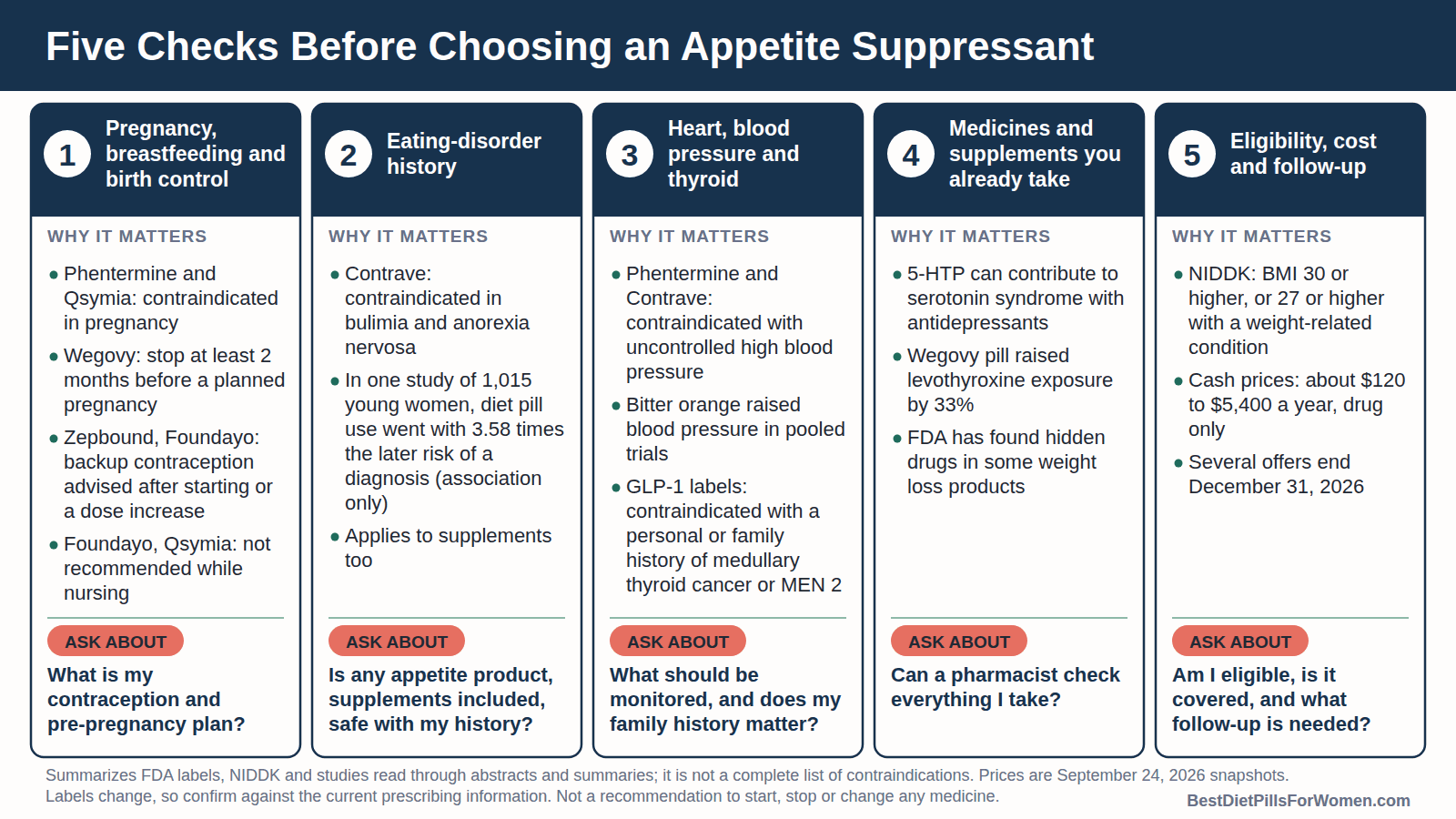
Five checks run through nearly every row in the table, and Infographic 3 turns them into a short checklist you can take to an appointment.
Safety of Appetite Suppressants: Side Effects, Warnings and When to Get Help
Natural doesn’t mean harmless, and prescription doesn’t mean risk-free. Each option here has its own safety profile, and the differences between them are as important as the differences in results. This section covers the side effects most people notice, the warnings on the labels, the hidden risks in some supplements and the symptoms that call for prompt medical care. It isn’t medical advice, and the current prescribing information and a pharmacist are the places to check for your own situation.
Common Side Effects by Option Type
For nearly every prescription option, the side effects people notice first are digestive or sensory, and they tend to be worst while the dose is being raised.
GLP-1 Medicines: Digestive Effects and Hair Loss
For the GLP-1 drugs, the common side effects are nausea, vomiting, diarrhea and constipation. Table 10 puts the label percentages next to each other, with the placebo rate in parentheses. The first thing to notice is the placebo column: nausea on placebo ran from 8% in the pooled Zepbound trials to 10% in Foundayo’s and 16% in Wegovy’s, so the same drug effect would look different in each program. Stopping is more informative than symptom rates. Subtracting the placebo figures, the extra share of people who quit because of side effects was about 3.6 points on the Wegovy injection, 3.3 on Zepbound 15 mg, 1.0 on the Wegovy pill and 7 on the top Foundayo dose. Hair loss was reported by 7.1% of women versus 0.5% of men on Zepbound and 7% versus 0.9% on Foundayo, and Foundayo’s label associates it with weight reduction.
Phentermine, Contrave and Qsymia: Effects to Expect
Phentermine’s label gives no side-effect frequencies. Contrave’s most common effects in the label’s pooled trials were nausea (32.5% versus 6.7% on placebo), constipation (19.2% versus 7.2%) and vomiting (10.7% versus 2.9%), and 24% of people quit for side effects against 12% on placebo. Qsymia’s higher dose caused tingling or numbness in 20% of people (2% on placebo), dry mouth in 19% (3%) and constipation in 16% (6%).
| Option | Most common effects, % on drug (% on placebo) | Stopped because of side effects, % (placebo) | Source note |
|---|---|---|---|
| Wegovy injection, 2.4 mg weekly | Nausea 44 (16); vomiting 24 (6); diarrhea 30 (16); constipation 24 (11) | 6.8 (3.2) | Label pooled tables |
| Wegovy pill, 25 mg daily | Nausea 46.6 (18.6); vomiting 30.9 (5.9) | 6.9 (5.9) | Nausea and vomiting from secondary reports of OASIS 4; the label doesn’t tabulate them |
| Zepbound, 15 mg weekly | Nausea 28 (8); vomiting 13 (2); diarrhea 23 (8); constipation 11 (5) | 6.7 (3.4) | Label pooled tables |
| Foundayo, 17.2 mg daily | Nausea 35 (10); vomiting 24 (4); diarrhea 25 (11); constipation 24 (9) | 10 (3) | Label pooled tables |
| Contrave, daily | Nausea 32.5 (6.7); vomiting 10.7 (2.9); constipation 19.2 (7.2) | 24 (12) | Label pooled tables |
| Qsymia, top dose | Tingling or numbness 20 (2); dry mouth 19 (3); constipation 16 (6) | Not read | Label |
| Phentermine | Label gives no frequencies | Not given | Label |
Table 10 method: figures are from the prescribing information (pooled label tables), except the Wegovy pill’s nausea and vomiting rates, which come from secondary reports of the OASIS 4 trial. Placebo rates are in parentheses. Populations, dose schedules, trial lengths and the way events were collected differ, so the table isn’t a ranking. The excess-stopping figures in the text are our subtraction of the placebo rate from the drug rate.
Serious Warnings and Contraindications
A boxed warning is the strongest warning FDA puts on a label. The options differ in which ones they carry and in how much the warnings matter to women.
Boxed and Class Warnings
The three GLP-1 drugs share a boxed warning about the risk of thyroid C-cell tumors and a contraindication for people with a personal or family history of medullary thyroid carcinoma or multiple endocrine neoplasia type 2. Their labels also carry warnings about pancreatitis, gallbladder disease and acute kidney injury from dehydration, and about aspiration during anesthesia or deep sedation because of delayed stomach emptying. In January 2026, FDA asked to remove the suicidal behavior and ideation warning from the Wegovy, Zepbound and Saxenda labels after reviewing 91 placebo-controlled trials, and it still tells patients to report new or worsening depression or unusual mood changes. Contrave carries its own boxed warning about suicidal thoughts and behaviors, and Qsymia’s label lists embryo-fetal toxicity, mood and sleep effects, and kidney stones among its warnings.
Hidden Ingredients and Contamination in Supplements
The most serious supplement risk isn’t on the label at all. FDA says it has found weight loss products sold as dietary supplements that contain hidden prescription drugs and other illegal ingredients, including sibutramine, and it says it can’t test every weight loss product on the market. Sibutramine was sold as the prescription drug Meridia until FDA withdrew its approval in December 2010 because of an increased risk of heart attack and stroke. FDA has also linked products made of pure or highly concentrated caffeine to at least two deaths. Buying from a seller with a real return address, checking FDA’s health fraud pages before ordering and being wary of any product that claims to work like a prescription drug lowers the odds, though a label can’t eliminate the risk.
When to Get Medical Help and How to Report a Problem
Knowing when to stop and who to tell is part of using any of these products responsibly.
Symptoms That Need Prompt Medical Care
Persistent or severe abdominal pain, sometimes radiating to the back, with or without nausea or vomiting, is how the labels describe possible pancreatitis, and vomiting and diarrhea can lead to dehydration and kidney injury. With stimulant-type products, chest pain, a racing or irregular heartbeat, fainting, severe headache or trouble breathing are reasons to seek care, and with green tea extract, abdominal pain, dark urine or yellowing of the skin or eyes may signal liver trouble. Those are reasons to contact a clinician promptly or seek emergency care, not to wait it out, and new or worsening depression or thoughts of self-harm warrant an immediate call to a clinician or to 988.
Reporting Problems to FDA
FDA takes voluntary reports of problems with prescription drugs and dietary supplements through its MedWatch program and its Safety Reporting Portal, and it uses them to spot patterns. Reports help even if you’re not sure the product caused the problem. Keep the bottle, the lot number and the seller’s details, and tell your clinician exactly what you took, including the dose and how long.
What Appetite Suppressants Cost and How Women Actually Get Them
Price and access decide which of these options a woman can actually use, and both have changed quickly this year. Every price in this section is a snapshot from September 24, 2026 that a manufacturer or retailer can change, and we kept to prices we could read on manufacturer and retailer pages. We left out cost per pound lost, because the trial results are averages from different studies and dividing a price by them would suggest a precision the evidence doesn’t have.
What a Year Costs Without Insurance
Both Novo Nordisk and Eli Lilly now sell directly to people paying without insurance, at monthly prices that rise with the dose. That makes a rough annual comparison possible, with the older pills and supplements at the low end.
GLP-1 Cash Prices
Table 11 puts the prices side by side. At maintenance doses, the Wegovy pill costs $299 a month and Foundayo costs $299 if each refill is bought within 45 days of the last one and $349 if not, so 12 fills come to $3,588 or $4,188. The Wegovy injection is $349 a month, or $4,188 for 12 fills, and Zepbound is $399 a month at 5 mg and $449 at 7.5 to 15 mg with on-time refills, or $4,788 to $5,388 for 12 fills, with needles and syringes extra. The injections come in 28-day fills, so a full 52 weeks takes 13 of them, which adds another $349 to $449. The first year costs less, because the lower starting doses are cheaper, and our guide to Wegovy pill costs covers the dose-by-dose picture.
Older Pills and Over-the-Counter Products
Generic phentermine ran about $10 to $23 for 30 tablets in the coupon prices we read, or roughly $120 to $280 a year if used continuously, though its label limits it to short-term use. Qsymia was $74.99 a month through the manufacturer’s home-delivery program, about $900 a year, and Contrave was $99 a month through the manufacturer’s program, about $1,188 a year, or up to $199 a month at a retail pharmacy without insurance. Over-the-counter supplement listings ran from about $8 to about $107 per 30 days, or roughly $100 to $1,300 a year. A low price isn’t a sign of value. The supplement trials found small and inconsistent differences, and FDA has found some weight loss products to contain hidden drug ingredients.
| Option | Price per fill (30 days unless noted) | 12-fill total | Conditions |
|---|---|---|---|
| Wegovy pill 25 mg | $299 | $3,588 | Self-pay price on NovoCare |
| Foundayo 14.5 or 17.2 mg | $299 (on-time refill) or $349 | $3,588 or $4,188 | The lower price needs a refill within 45 days |
| Wegovy injection 2.4 mg (28 days) | $349 | $4,188 | Standard self-pay price; 13 fills cover 52 weeks |
| Zepbound 5 mg (28 days) | $399 | $4,788 | Needles and syringes extra |
| Zepbound 7.5 to 15 mg (28 days) | $449 | $5,388 | Needs refills within 45 days; needles extra |
| Contrave | $99 (manufacturer program) or up to $199 (retail) | $1,188 or $2,388 | Without insurance |
| Qsymia | $74.99 | About $900 | Manufacturer home delivery |
| Phentermine | About $10 to $23 | About $120 to $280 | Coupon prices; label limits use to a few weeks |
| OTC supplements | About $8 to $107 | About $100 to $1,300 | Retail listings, varied products |
Table 11 method: totals are price per fill multiplied by 12, and the phentermine, Qsymia and supplement annual figures are rounded. Prices come from manufacturer, coupon and retailer pages read through summaries on September 24, 2026. Totals exclude clinician visits, lab tests, telehealth fees, shipping and needles, assume no missed fills, and don’t imply equal results at these prices. The Zepbound single-dose pen has no self-pay price on the page we read, so it isn’t in the table.
How Women Get a Prescription and What Coverage Can Change
A price only matters if you can get the drug, and access runs through a prescriber, a pharmacy and, for many women, an insurance plan.
In-Person and Telehealth Visits
Most of these medicines need a prescriber, and telehealth is now common. Phentermine is a controlled substance, and federal rules on prescribing it by telemedicine without an in-person visit have been extended through December 31, 2026 while permanent rules are finalized. Not every online offer is legitimate. In March 2026, FDA warned 30 telehealth companies over marketing that implied compounded GLP-1 products were equivalent to approved drugs, and FDA’s page on unapproved GLP-1 drugs lists signs of trouble such as an unfamiliar pharmacy, a sale with no prescription and unrealistic pricing. We didn’t research state telehealth rules.
Insurance, Medicare and Employer Coverage
Coverage can change the math more than any difference between drugs. A temporary program called the Medicare GLP-1 Bridge charges eligible Medicare beneficiaries a $50 copay from July 1, 2026, through December 31, 2027, covering the Wegovy injection and tablets, Foundayo and the Zepbound KwikPen, with eligibility based on BMI and health conditions. Medicaid is patchy: KFF counted 13 state Medicaid programs covering GLP-1s for obesity in January 2026. Employer plans vary, and a plan might cover one product and not another. Our guide to Wegovy insurance coverage goes into plan details, and your pharmacist or benefits office can say what your own plan does.
What May Change Soon
Some of the facts above have a short shelf life, and one drug is under review.
Offers and Rules That End December 31, 2026
Several prices and rules end on the same date. The Wegovy pen’s $199 introductory price for the first two fills ends December 31, 2026, Foundayo’s temporary prices for its two lowest doses end then, and Lilly’s savings cards for Foundayo and Zepbound expire on that date. The telemedicine extension for controlled substances is also scheduled to end December 31, 2026. Re-check each before you plan around it.
A Drug Under FDA Review
Novo Nordisk filed CagriSema, a weekly injection combining semaglutide with an amylin analogue, for FDA approval on December 18, 2025, and it says FDA is expected to review it in 2026. The company reported an average weight change of −20.4% versus −3.0% on placebo at 68 weeks in its first phase 3 trial, a manufacturer figure we didn’t verify independently. We didn’t find an approval as of September 24, 2026, and we left it out of the tiers, because an unapproved drug can’t be judged against labels and real-world experience.
Questions Women Ask Before Choosing an Appetite Suppressant
These are the questions readers most often raise that the sections above answer only in part. Each answer is short, with a pointer to where the evidence sits.
Prescription and Eligibility Questions
Most of these come down to what the labels say and who a prescriber can treat.
Is Phentermine the Strongest Appetite Suppressant?
No, not on the evidence we read. Phentermine’s label says the added loss over placebo is only a fraction of a pound a week and that appetite suppression isn’t established as its main action, while the GLP-1 medicines produced far larger average losses in their trials. We found no randomized trial that compared phentermine with a GLP-1 drug, so the gap is an indirect comparison.
Do I Need a Certain BMI to Get a Prescription Appetite Suppressant?
Usually, yes, though the exact rules depend on the drug and the payer. NIDDK describes prescription weight-loss medicine as an option for adults with a BMI of 30 or higher, or 27 or higher with weight-related health problems, and phentermine’s label uses the same cutoffs. Medicare’s temporary GLP-1 program sets its own criteria: a BMI of at least 35, or a lower BMI with specific conditions.
Supplements and Everyday Habits
The over-the-counter questions mostly circle one issue, which is whether a product can do what its label suggests.
Do Any Over-the-Counter Appetite Suppressants Work?
The evidence is thin, and no product has evidence comparable to prescription options. Fibers have modest, inconsistent effects on fullness and small effects on weight, caffeine may lower intake at a meal, and several popular ingredients showed no benefit in the trials we found. Some carry real risks, so Table 7 pairs each ingredient’s evidence with its main safety concern.
Does “GLP-1 Support” Mean a Supplement Works Like Wegovy?
No. A supplement labeled “GLP-1 support” doesn’t contain a GLP-1 drug, and experts we read say the phrase can lead shoppers to expect effects the product can’t deliver. In the one small trial of a berberine formulation we found, GLP-1 blood levels rose, but appetite and weight weren’t measured.
What’s the Best Natural Way to Feel Less Hungry Between Meals?
The habits with the most research behind them are higher-protein meals, fiber-rich and water-rich foods, and enough sleep, and their effects are modest. In one trial, adding about 1.2 hours of sleep a night lowered intake by roughly 270 calories a day over two weeks, but that result came from a short study of mostly younger adults. Table 8 lists the rest.
Women’s Life Stages and Staying Power
Some questions matter more at particular points in a woman’s life, and some only appear after treatment starts working.
Does Menopause Make Appetite Harder to Control?
Some research suggests it may, but the evidence is limited. In one cohort of 94 women, hunger and desire to eat rose during the menopausal transition and stayed higher, though food-diary intake fell, and in another study fat gain roughly doubled around the transition. We found no trial that tested an appetite suppressant specifically in midlife women.
Can I Use an Appetite Suppressant While Breastfeeding?
The labels we read mostly advise against it or offer little data. Foundayo’s and Qsymia’s labels say they aren’t recommended for nursing women, and the Wegovy pill’s label says the same. Zepbound’s label describes a single-dose study that found low levels in milk with unknown effects on infants. Supplement safety data are thinner still, so ask your clinician first.
What Happens to Appetite and Weight if I Stop?
Weight tends to come back. A 2026 meta-analysis of stopping trials estimated that people regained about 0.8 kilograms a month after stopping the newer weight-loss drugs, and the 2026 obesity-medicine guideline recommends continuing medication during maintenance. We found no stop-treatment trial for the pills and no data on how hunger changes after stopping.
The Bottom Line on the Best Appetite Suppressant for Women
The search for the best appetite suppressant for women has one honest answer for most readers and a different one for the rest, and neither is a product recommendation. Here’s what the whole picture means, what’s worth taking from it and what to do next.
What the Total Evidence Means for You
The evidence sorts into tiers, and the tiers don’t overlap much. The prescription GLP-1 medicines have labels that describe an appetite effect, trials that measured eating, and average weight losses of roughly 7% to 21% of body weight. The older prescription drugs sit in the middle, with smaller results and more exclusions. Everyday habits have small effects and no drug risks. Over-the-counter products have thin evidence at best, and a few carry real risks.
The Biggest Realistic Benefit
For a woman who’s a candidate and can access and stay on a GLP-1 medicine, the most realistic gain is a meaningful average reduction in eating and in weight. At the top doses, between 71.5% and 90.9% of trial participants lost at least 5% of their weight, the level many guidelines treat as the start of health benefit. For a woman who isn’t a candidate, or who wants to start with habits, the most realistic gain is smaller and comes with no side-effect table: more protein and fiber-rich food, more sleep and a structured program.
The Biggest Limitation and Safety Concern
The biggest limitation is durability and the gaps in the evidence. Weight tends to return after treatment stops, the participants’ own hunger ratings stopped differing from placebo after week 20 in the one long appetite trial we found, and we found no trial that lined these options up against each other on appetite. On safety, the deciding factors are the ones that differ by woman: pregnancy plans and contraception, eating-disorder history, heart and blood pressure, mood and the other medicines you take. Among supplements, the concern is what’s in the bottle, because some contain undeclared drugs.
A Rational Next Step
You don’t need to settle on a product to take a next step. What helps most is a conversation with a prescriber or pharmacist who knows your history, and you can start it with better questions.
Questions Worth Bringing to a Clinician or Pharmacist
If you’re weighing a prescription option, a supplement or a habit-based plan, these questions give a professional something to work with:
- Given my health history, medications and any plans for pregnancy, which options with clinical trial evidence fit me, and which should I avoid?
- Do I meet the criteria for a prescription medicine, and if I do, how would we decide between a GLP-1 drug and an older option?
- What result is realistic for me, and how will we judge in the first few months whether something is working?
- If I’ve had disordered eating, or take medicine for thyroid, mood, blood pressure or blood sugar, how should that shape which options are safe for me?
- What does my plan cover, what happens to the cost if a promotion or coverage ends, and what’s the plan for maintenance if I stop?
- If I’m considering a supplement instead, can you check the ingredients against my medicines?
What to Re-Check Before You Spend Money
Several facts in this guide have a short shelf life. Before you buy, or make a decision that depends on them, re-check these:
- Prices and offers: every price here was read on manufacturer and retailer pages on September 24, 2026 through page summaries, and several introductory and temporary prices end on December 31, 2026.
- Labels and warnings: prescribing information is revised often, we read several labels through summaries, and Qsymia’s contraindications and two of its warnings changed in March 2026 in ways we couldn’t see, so confirm details against the current label for your product.
- Guidelines: we read the 2026 TOS, OMA and OAC guideline and the ACP living guideline through summaries, and the ACP guideline’s date appears as June 2026 in one source and April 2026 in another.
- Telehealth and coverage rules: the federal telemedicine flexibilities for controlled substances such as phentermine are scheduled to end December 31, 2026, and the Medicare GLP-1 Bridge runs through December 31, 2027, so check both before you plan around them.
- New research and approvals: we couldn’t search ClinicalTrials.gov, so a search there and in the medical literature would reveal any appetite trial or stop-treatment study published after this guide, and CagriSema’s FDA decision was still pending when we checked.
Related Reading
- best weight loss pills for women over 40
- best weight loss pills for women over 50
- best weight loss pills for menopause
- best weight loss pills for perimenopause
- best weight loss pills for PCOS
- prescription vs. OTC weight loss pills comparison
- prescription appetite suppressants guide
- natural appetite suppressants guide
Sources
These are the main sources behind this guide, chosen because they are the ones to check first for current facts. Labels, prices and regulator pages change, so confirm the latest version before you make decisions.
- Novo Nordisk. Wegovy (semaglutide) injection and tablets, prescribing information (revised June 2026). https://www.novo-pi.com/wegovy.pdf
- Eli Lilly and Company. Zepbound (tirzepatide) prescribing information (revised August 2026). https://pi.lilly.com/us/zepbound-uspi.pdf
- Eli Lilly and Company. Foundayo (orforglipron) tablets, prescribing information (revised July 2026). https://pi.lilly.com/us/foundayo-uspi.pdf
- Teva Pharmaceuticals. Adipex-P (phentermine) prescribing information (revised March 2024), DailyMed. https://dailymed.nlm.nih.gov/dailymed/drugInfo.cfm?setid=f5b2f9d8-2226-476e-9caf-9d41e6891c46
- Nalpropion Pharmaceuticals. Contrave (naltrexone and bupropion extended-release) tablets, prescribing information, DailyMed. https://dailymed.nlm.nih.gov/dailymed/drugInfo.cfm?setid=485ff360-32c8-11df-928b-0002a5d5c51b
- VIVUS LLC. Qsymia (phentermine and topiramate extended-release) capsules, prescribing information (revised April 2026), DailyMed. https://dailymed.nlm.nih.gov/dailymed/drugInfo.cfm?setid=40dd5602-53da-45ac-bb4b-15789aba40f9
- American College of Physicians. Living clinical guideline on using medications to manage overweight and obesity (2026; newsroom summary). https://www.acponline.org/acp-newsroom/acp-issues-new-living-clinical-guideline-on-using-medications-to-manage-overweight-and-obesity
- The Obesity Society, Obesity Medicine Association and Obesity Action Coalition. Pharmacological management of U.S. adults with overweight or obesity (guideline dated March 2026; summary at Guideline Central). https://www.guidelinecentral.com/insights/mar-2026-tosomaoac-pharmacologicalmanagementoverweightobesity-guideline-spotlight/
- Short- and long-term effects of semaglutide 2.4 mg on energy intake, appetite, and food reward: a 60-week, double-blind randomized controlled trial. American Journal of Clinical Nutrition, 2026. https://www.sciencedirect.com/science/article/pii/S0002916526002121
- U.S. Food and Drug Administration. Weight loss product notifications (page updated September 4, 2026). https://www.fda.gov/drugs/medication-health-fraud-notifications/weight-loss-product-notifications