
The best weight loss pills for menopause, judged by the strength of the evidence, are the same prescription medicines that lead the field at any life stage: the GLP-1 pills, semaglutide (Wegovy) and orforglipron (Foundayo), along with the weekly injections semaglutide and tirzepatide (Zepbound). What’s new is that three separate manufacturer-run analyses in 2026 broke their trial results down specifically by menopausal status, premenopausal, perimenopausal or postmenopausal, and all three found broadly similar weight loss across the groups. Older prescription pills such as phentermine, Contrave and Qsymia trail on average results, over-the-counter “menopause” pills haven’t shown comparable effects, and menopausal hormone therapy, while genuinely useful for hot flashes and night sweats, isn’t a weight loss treatment in its own right.
Here’s the catch: menopause itself doesn’t change who qualifies for a prescription weight loss medicine, since eligibility still runs on body mass index (BMI) and weight-related health conditions, not on reproductive stage. What does change is the body underneath the number, and how often the two questions, “should I treat my weight” and “should I treat my hot flashes,” get tangled together. Estrogen’s decline during the menopause transition shifts where fat is stored toward the abdomen, obesity is more common in the 40s and 50s than in either younger or older women, and roughly 6 in 10 midlife women report weight gain as a symptom of the transition itself, alongside sleep disruption from hot flashes and night sweats that has its own, separate effects on how a woman feels day to day.
This guide checks what the new menopause-specific trial evidence actually shows for each pill category, works through the honest answer on whether hormone therapy helps with weight, and lays out the safety, interaction and cost questions that matter most at this life stage, including whether hormone therapy and a GLP-1 pill can be used together. It’s part of our wider coverage of the best weight loss pills for women and our guides for women over 40 and women over 50, and it’s meant to sharpen the questions you bring to a clinician, not to tell you to start or stop anything.
Best Weight Loss Pills for Menopause: The Short Answer
Start with the conclusions, then check them against the sections that follow. Each answer says how sure we are and what limits it.
The Direct Answer and How Sure We Are
What Are the Best Weight Loss Pills for Menopause?
The GLP-1 medicines, semaglutide (Wegovy pill and injection), tirzepatide (Zepbound) and orforglipron (Foundayo), have both the largest average effects and the most menopause-specific evidence of any option covered here. Three 2026 post hoc analyses, one per drug, each broke trial results down by menopausal status and found weight loss was broadly similar whether a woman was premenopausal, perimenopausal or postmenopausal.
That’s a meaningfully more specific answer than “these drugs work in adults,” but it still comes from post hoc analyses of trials that weren’t designed around menopausal status from the start, a limit worth keeping in view through the rest of this guide.
How Sure We Are About That Answer
We’re most confident about the size of the average effect, since it’s been measured in large randomized trials and now cross-checked by menopausal status specifically. We’re less confident about how any one woman will respond, since averages describe groups, and about long-term outcomes for the two newest options, the Wegovy pill and Foundayo, which haven’t been on the market long enough for multi-year safety data.
How We Judged “Best”
No independent lab tested these products side by side. “Best” here means best-supported by the evidence available, not a taste test or a ranked countdown.
The Four Criteria We Used
We weighed four things for every option: the size and quality of the human evidence, including whether it’s been examined specifically by menopausal status; the safety and interaction profile most relevant to women at this life stage; practical access, including cost and prescription requirements; and how honestly the marketing around a product matches what trials actually show. No option scored perfectly on all four.
What This Assessment Is and Isn’t
This is a synthesis of labels, trial data and post hoc analyses, not a clinical recommendation, a product test or firsthand use of any drug or supplement discussed. Nothing here tells a reader to start, stop or change a medicine or hormone therapy; that decision belongs to a woman and her clinician.
The Options at a Glance
Table 1 puts the main options next to each other before the rest of this guide goes deeper on each one.
The Summary Table
| Option | Main trial or analysis | Average weight change, drug vs placebo | Biggest consideration during menopause |
|---|---|---|---|
| Wegovy pill (semaglutide, daily; prescription) | OASIS 4 | −13.6% vs −2.4% | Raised levothyroxine exposure by 33%; take at least 30 minutes before other oral medicines |
| Wegovy injection (semaglutide, weekly; prescription) | STEP UP by menopausal stage | −22.6% (premenopausal), −19.7% (perimenopausal), −19.8% (postmenopausal) | A related SELECT trial analysis found similar heart-protection benefit regardless of menopausal status |
| Zepbound (tirzepatide, weekly; prescription) | SURMOUNT-1 by reproductive stage | −26% (premenopausal), −23% (perimenopausal), −23% (postmenopausal) vs −2% to −3% | Largest average effect of any option here, but injectable only |
| Foundayo (orforglipron, daily; prescription) | ATTAIN-1/ATTAIN-2 pooled by menopause stage | Up to −14% vs placebo, reported as uniform across all three menopausal groups | Newest pill on the market; least long-term safety data |
| Contrave (naltrexone-bupropion, daily; prescription) | Pooled trials | −5.4% vs −1.3% (first trial) | Boxed warning for suicidal thoughts; caution when mood symptoms are already common at this life stage |
| Qsymia (phentermine-topiramate, daily; prescription) | CONQUER | −7.81% and −9.84% vs −1.24% | Contraindicated with uncontrolled high blood pressure, more common by midlife |
| Phentermine (short-term; prescription) | Not in the label | A fraction of a pound a week over placebo (label) | Stimulant-type; contraindicated with cardiovascular disease and uncontrolled hypertension |
| Orlistat (alli 60 mg OTC; Xenical 120 mg prescription) | Pooled analysis | About 2.9 kg (6.4 lb) more than placebo | Different mechanism (blocks fat absorption); can reduce absorption of fat-soluble vitamins and some medicines |
| Menopausal hormone therapy (estrogen, with or without progestin) | Cochrane review, 28 trials, 28,559 women | No significant effect on body weight | Treats hot flashes, night sweats and other menopause symptoms; not classified or evidenced as a weight loss treatment |
Table 1 method: mean ages, menopausal-status breakdowns and weight figures are as reported in the labels, trial abstracts, post hoc analyses and a Cochrane review, read through abstracts, label mirrors and page summaries as of September 25, 2026, and no result was recalculated. The three menopause-stage analyses come from separate, manufacturer-run post hoc studies of three different drugs, not a single head-to-head trial, so the rows are an indirect comparison, not a ranking.
How to Read the Table
Read the third column as reported results from separate studies with different designs, populations and dosing, not as a head-to-head contest. A bigger average number doesn’t automatically mean a better fit for one particular woman, and hormone therapy’s inclusion here is intentional: it belongs in this conversation because so many readers ask about it in the same breath as weight loss pills, not because it works the same way.
The fourth column is where menopause actually changes the calculus for a given woman, more than the second and third columns do. A woman who is perimenopausal and still ovulating faces a different set of practical considerations, pregnancy testing, contraception interactions, than a woman who is years past her final period, even though both may be looking at the same drug and the same average result. The sections that follow work through each row’s fourth-column consideration in more depth, along with the muscle, bone and hormone therapy questions the table can’t fully capture in a single line.
Why Menopause Changes the Weight Loss Picture
Menopause is a single event, the point one year after a woman’s last period, but the years around it, perimenopause before and the postmenopausal years after, are when most of what readers actually notice happens. Untangling what’s caused by menopause itself from what’s caused by ordinary aging matters for figuring out what a pill can realistically do.
What Menopause Does to Body Weight and Fat Distribution
The honest answer has two parts, and conflating them is where a lot of marketing goes wrong.
Does Menopause Itself Cause Weight Gain?
Aging is the primary driver of overall weight gain in midlife, not menopause itself, according to a National Institute on Aging summary; what menopause does more specifically is encourage the body to store a larger share of fat around the abdomen as estrogen declines. That’s a distinction worth sitting with, because “menopause made me gain weight” and “menopause changed where my weight is going” are different claims with different evidence behind them.
The practical result is the same for many women either way: a body that looks and measures differently even at a similar weight, with more of it concentrated in the abdomen, which independently raises cardiovascular and metabolic risk. The Menopause Society’s own patient guidance frames it as multiple factors working together, aging, hormonal shifts and lifestyle changes, rather than hormones alone.
The proposed mechanism behind the redistribution, not a proven cause of total weight gain, involves estrogen’s role in where the body prefers to store fat. Before menopause, estrogen favors fat storage in the hips and thighs; as estrogen declines, that preference weakens, and a larger share of any fat the body stores tends to go to the abdomen instead, including the visceral fat that sits around internal organs and carries more metabolic risk than fat stored elsewhere. That’s a plausible biological explanation for the redistribution pattern, not evidence that hormonal change is the primary driver of how much total weight a woman gains, which the aging research cited above still points to more strongly.
What the SWAN Study Found About Body Composition
The Study of Women’s Health Across the Nation, a long-running federal study that followed women through the menopause transition, found that the rate of fat gain rose from about 1.0% of body weight per year before the transition began to about 1.7% per year during it, an increase of about 70%, while lean mass declined over the same window. That’s a change in the pace of fat gain during a specific window, not proof that menopause alone explains total midlife weight gain, since aging, activity levels and other factors were changing over the same years.
Muscle loss matters as much as fat gain here. Women in the SWAN cohort lost lean mass during the transition years, on top of the age-related muscle loss already covered in our guide to muscle preservation during weight loss, which compounds any pill’s tendency to reduce lean mass along with fat, a theme this guide returns to in detail below.
Vasomotor Symptoms, Sleep and Muscle Loss
Hot flashes and night sweats, known clinically as vasomotor symptoms, are what most people associate with menopause, and readers reasonably ask whether they’re part of the weight story too.
Do Hot Flashes and Night Sweats Affect Weight?
There’s no good evidence that hot flashes or night sweats directly cause weight gain. They’re common at the same life stage as midlife weight changes, and a review of sleep and the menopause transition found vasomotor symptoms are consistently linked to poorer sleep quality, with women who have moderate to severe hot flashes almost three times more likely to report frequent nighttime awakenings, but that same review didn’t establish a causal path from disrupted sleep to weight gain specifically.
Weight gain is reported by 60% to 70% of midlife women as a symptom of the transition, in the same surveys that ask about hot flashes, which is likely why the two get linked in conversation even without a proven causal connection. Poor sleep is independently associated with weight gain in the general population, so a plausible indirect path exists, but it hasn’t been demonstrated specifically for menopause-related sleep disruption in what we read.
Sleep, Mood and Muscle Loss During the Transition
Beyond hot flashes, the menopause transition brings a cluster of changes that can each affect weight indirectly: sleep fragmentation, shifts in mood, and the muscle loss already described above. None of these appears in a pill’s clinical trial as a measured outcome, which is one reason a weight loss medicine’s trial results, even broken down by menopausal status, can’t capture everything a woman experiences during this transition. The next section covers what those trial results actually show once researchers did break them down by menopausal status specifically, which is where this guide’s most useful new evidence comes in.
Do GLP-1 Weight Loss Pills Work the Same During Menopause? The New Evidence
This is the question this guide can answer better than most, because 2026 brought three separate post hoc analyses, one for each major GLP-1 medicine, that broke trial results down specifically by menopausal status. None of the original trials was designed around menopause from the start, but the follow-up analyses come closer to a real answer than a label’s one-line statement about “older patients.”
Three Trials Now Broken Down by Menopausal Stage
Each drugmaker ran its own analysis, using its own trial data and its own approach to classifying women as premenopausal, perimenopausal or postmenopausal, so read Table 2 as three separate snapshots rather than one coordinated study.
What Semaglutide and Tirzepatide Showed by Menopausal Stage
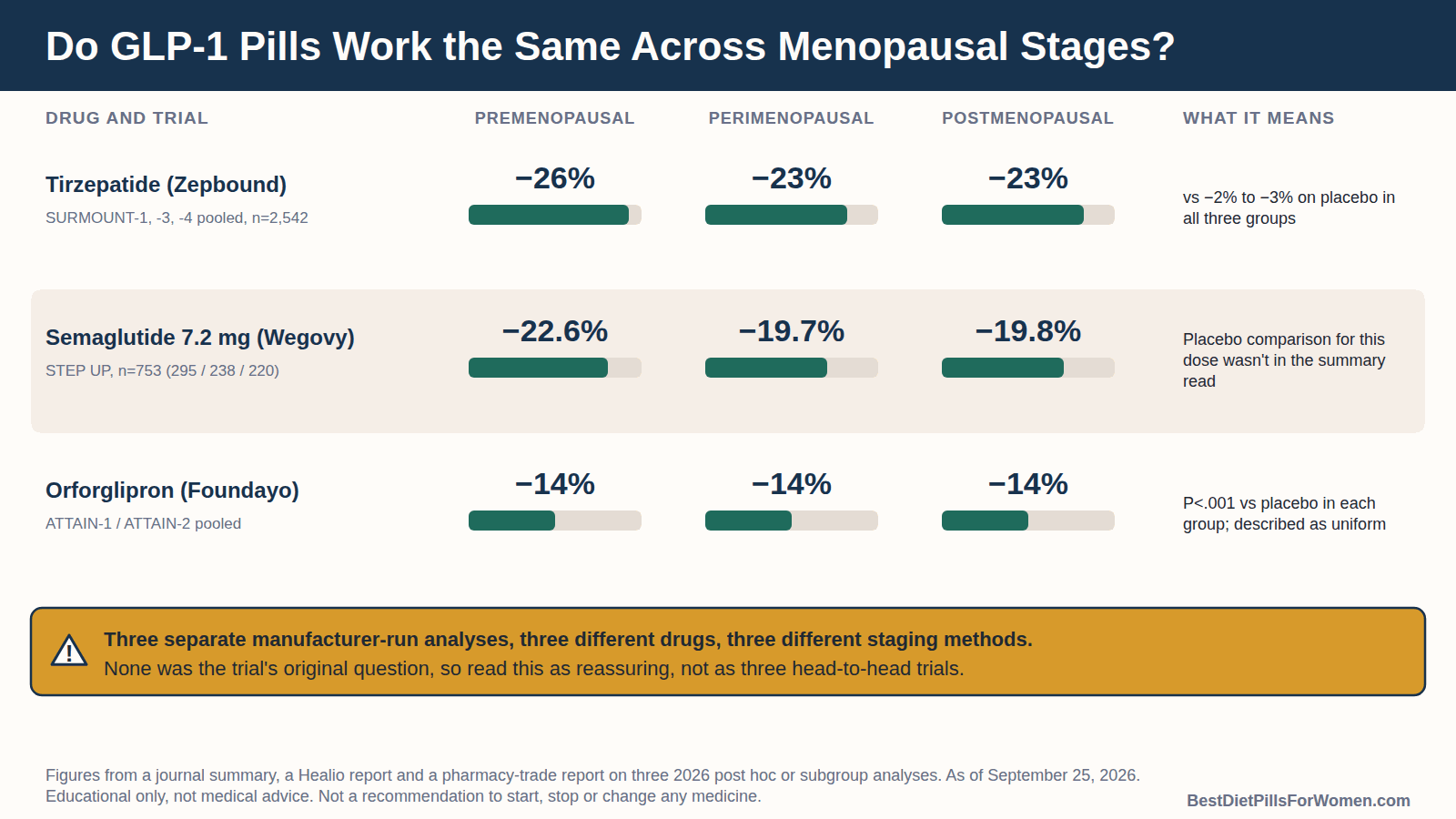
Tirzepatide (Zepbound) was examined in a published analysis of 2,542 women pooled from the SURMOUNT-1, -3 and -4 trials, sorted by reproductive stage using a combination of menstrual history and age. Semaglutide at the 7.2 mg dose (the higher-dose version of Wegovy) was examined in a separate 753-woman post hoc analysis of the STEP UP trial, split into 295 premenopausal, 238 perimenopausal and 220 postmenopausal participants. Table 2 puts both next to the third analysis.
The Three Menopause-Stage Analyses at a Glance
| Drug and trial | Premenopausal | Perimenopausal | Postmenopausal | Notes |
|---|---|---|---|---|
| Tirzepatide (Zepbound), SURMOUNT-1 | −26% vs −2% (placebo) | −23% vs −3% (placebo) | −23% vs −3% (placebo) | Part of a 2,542-woman pooled analysis across SURMOUNT-1, -3 and -4 |
| Semaglutide 7.2 mg (Wegovy), STEP UP | −22.6% (41.4% lost ≥25%) | −19.7% | −19.8% | 753 women total (295/238/220); a placebo comparison for this dose wasn’t given in the summary we read |
| Orforglipron (Foundayo), ATTAIN-1/ATTAIN-2 pooled | Up to −14% vs placebo | Reported as similar to the premenopausal figure | Reported as similar to the premenopausal figure | 83% reached at least 5% weight loss vs 23% on placebo (P<.001), pooled across all three groups |
Table 2 method: figures are as reported in three separate manufacturer-run post hoc or subgroup analyses, presented at the European Congress on Obesity (semaglutide and tirzepatide analyses) and the American Diabetes Association Scientific Sessions (orforglipron analysis) in 2026, read through a peer-reviewed journal summary, a medical-news report and a pharmacy-trade report. Each analysis used its own criteria for classifying menopausal status, none was the trial’s pre-specified primary analysis, and the three drugs weren’t compared to each other directly, so this table is an indirect comparison across three separate studies, not a ranking.
What Orforglipron Showed, and What It Adds
The orforglipron analysis is the most reassuring of the three on one specific point: instead of reporting three different numbers that happened to be similar, it explicitly tested for and reported statistically significant placebo-adjusted weight loss in each of the three menopausal groups (P <.001 for each), describing the effect as uniform across premenopausal, perimenopausal and postmenopausal women. That’s a more direct statistical answer to “does menopausal status change the result” than simply eyeballing three similar-looking percentages, which is closer to what the other two analyses provide.
What These Findings Mean and Their Limits
Three independent analyses landing on the same broad conclusion, using three different drugs and three different research teams, is a genuinely encouraging pattern. It isn’t the same as a single trial purpose-built to answer this question.
Does Menopause Stage Change How Well These Pills Work?
Based on the evidence available, no: all three 2026 analyses found broadly similar weight loss whether a woman was premenopausal, perimenopausal or postmenopausal. The largest gap in Table 2, tirzepatide’s 26% premenopausal result versus 23% postmenopausal, is a 3-percentage-point difference, smaller than the differences typically seen between two different doses of the same drug in its own label.
A related finding adds a cardiovascular angle: a subgroup analysis of the SELECT trial, which tested semaglutide injection for heart protection rather than weight loss, found similar reductions in cardiovascular events in 611 perimenopausal and 4,251 postmenopausal women, with no statistical interaction between menopausal status and how well the drug worked. That’s a separate outcome (heart attacks, strokes and cardiovascular death, not weight on a scale) but it points the same direction: menopausal status alone doesn’t appear to blunt these drugs’ effects.
What These Three Analyses Have in Common, and Their Limits
All three are post hoc or subgroup analyses, run after the main trials finished, using data collected for other purposes; none was the trial’s original, pre-specified question. None compares the three drugs to each other head-to-head. And classifying a woman’s exact reproductive stage is inherently approximate, mixing menstrual history, age and sometimes hormone levels, so the three studies aren’t using an identical yardstick. With those caveats stated plainly, this is still meaningfully more specific evidence than most drug categories have for any single life stage. Infographic 1 below lays out all three analyses side by side.
There’s also a plausible biological reason the three analyses agree with each other: GLP-1 receptor medicines work primarily by acting on receptors in the brain and gut that regulate appetite and how quickly the stomach empties, a pathway that doesn’t depend on estrogen the way fat distribution does. That’s a reasonable explanation for why menopausal status might not meaningfully change these drugs’ effect on appetite and intake, but it’s a proposed mechanism consistent with the findings above, not proof of why the three results line up, since none of the three analyses was designed to test the underlying biology directly.
Who Qualifies for Weight Loss Medication During Menopause
Menopause itself isn’t a line item on any prescribing checklist. Understanding how common weight gain and related conditions are at this life stage helps explain why so many women end up asking about these medicines around the same time.
The Numbers for Midlife Women
Federal survey data describe the age range that overlaps with perimenopause and early postmenopause for most U.S. women, even though the surveys track age, not reproductive stage.
How Common Is Weight Gain and Obesity During Menopause?
Nearly half of U.S. women aged 40 to 59, 47.4%, had obesity in 2021 to 2023, a higher share than women aged 20 to 39 (36.8%) or 60 and older (39.6%), and severe obesity affected 14.7% of women in that midlife group. That age range covers most of perimenopause and the early postmenopausal years for the typical American woman, who reaches menopause around age 52.
Those figures describe a population, not a prediction for any individual, and they don’t separate out how much is attributable to menopause itself versus ordinary aging, a distinction covered in more depth earlier in this guide. What they show clearly is that a woman going through menopause who is dealing with weight gain is dealing with something very common at this life stage.
How Common Are Related Conditions Like High Blood Pressure and High Cholesterol?
High blood pressure is the condition most relevant to which weight loss pills are even an option, since several are contraindicated with uncontrolled hypertension. In 2021 to 2023, 52.5% of adults aged 40 to 59 had hypertension, compared with 23.4% of those 18 to 39 and 71.6% of those 60 and older, and only 51.2% of adults with hypertension were taking medicine for it. A blood pressure check is a sensible, low-cost first step before considering a stimulant-type pill specifically because of how common uncontrolled hypertension is at this age.
Who Medication Is For
Eligibility criteria are written around BMI and health conditions, not reproductive stage, and a clinician still makes the final call.
Who Qualifies for a Prescription Weight Loss Medicine?
Federal guidance describes prescription weight loss medicine as an option for adults with a BMI of 30 or higher, or 27 or higher with a weight-related health condition such as high blood pressure, type 2 diabetes or high cholesterol, used alongside changes in eating and activity.
Two 2026 U.S. clinical guidelines, from The Obesity Society and allied groups and from the American College of Physicians, both rank the GLP-1 medicines as first-line options, and neither is written specifically for menopause; our guide to the best appetite suppressant for women covers both guidelines in more depth. Being in perimenopause or postmenopause doesn’t move these thresholds. Pregnancy, trying to become pregnant, breastfeeding, and certain medical histories can rule out a specific drug regardless of menopausal status, which the safety section below covers in detail.
BMI alone can also miss something specific to this life stage: a woman whose weight hasn’t changed much but whose fat has redistributed toward the abdomen, the pattern described earlier in this guide, can have a normal or borderline BMI while still carrying the metabolic risk that comes with visceral fat. Waist circumference is sometimes used alongside BMI for exactly this reason, though it isn’t part of the federal BMI-based eligibility threshold itself, and a clinician weighing a borderline case may consider it as added context rather than a separate qualifying number.
Menopausal Hormone Therapy Is a Different Question
Hormone therapy is prescribed for menopause symptoms, hot flashes, night sweats, vaginal dryness and related concerns, evaluated on its own criteria that have nothing to do with BMI. A woman can qualify for hormone therapy, a weight loss medicine, both or neither, and qualifying for one says nothing about the other. The next section works through what hormone therapy does and doesn’t do for weight specifically, since that’s one of the most common points of confusion we found in researching this guide.
Menopausal Hormone Therapy and Weight Loss Pills: What the Evidence Shows
This is one of the most common points of confusion in midlife weight research, and it deserves a section of its own rather than a passing mention. Hormone therapy treats menopause; it isn’t, and was never studied as, a weight loss drug.
Hormone Therapy and the Scale
The evidence on this specific question is more settled than most of what’s covered in this guide.
Does Hormone Therapy Cause Weight Loss?
No. A Cochrane review of 28 randomized trials in 28,559 women found menopausal hormone therapy had no significant effect on body weight, though it may modestly reduce visceral fat and help preserve lean mass. For weight specifically, the honest answer is that hormone therapy is a menopause-symptom treatment with some incidental effects on body composition, not a weight loss drug in its own right.
That distinction matters because hormone therapy is sometimes marketed or discussed online as if it reverses menopausal weight gain directly. The trial evidence doesn’t support that framing, even though the visceral-fat and lean-mass findings suggest it isn’t irrelevant to body composition either.
Body Composition vs the Number on the Scale
A woman on hormone therapy and a woman not on it might weigh the same after a year, yet have different amounts of visceral fat and lean muscle, based on the Cochrane review’s findings. That’s a real distinction, but it’s not the same as the double-digit percentage weight losses reported for the GLP-1 medicines in the previous section, and no responsible reading of this evidence supports choosing hormone therapy as a substitute for a weight loss medicine when weight loss itself is the primary goal.
This is also why the two decisions are worth keeping conceptually separate even when a woman ends up making both at once. A woman who starts hormone therapy for hot flashes and later loses weight on a GLP-1 medicine may reasonably credit the hormone therapy for feeling better overall, since sleep and mood often improve alongside symptom relief, but the trial evidence says the weight change itself is doing the work the GLP-1 medicine was designed to do, not the hormone therapy.
Combining Hormone Therapy With a Weight Loss Pill
Many women arrive at this question already on hormone therapy, or considering it alongside a weight loss medicine, which raises a narrower and more practical question than “does hormone therapy cause weight loss.”
Can You Take Hormone Therapy and a GLP-1 Pill Together?
No specific reason to avoid combining them turned up in the trials, labels or interaction databases we reviewed, though each type of medicine carries its own separate cardiovascular or clotting warnings worth reviewing together with a clinician. Table 3 summarizes what a drug-interaction database and a single published case report say about combining hormone therapy with a GLP-1 medicine or an older prescription pill.
| Combination | What we found | Source |
|---|---|---|
| Estrogen (or estrogen-progestin) plus a GLP-1 medicine | No established drug-drug interaction; large randomized trials of tirzepatide (SURMOUNT and SURPASS) found no increased blood clot risk overall | and a case-report discussion citing those trial findings |
| Estrogen plus phentermine or Qsymia | A drug-interaction checker found no direct interaction between estradiol and phentermine, but flagged 53 separate condition-based warnings for the two drugs combined, since estrogen carries its own blood-clot warning and phentermine carries its own cardiovascular warnings | Drugs.com interaction checker |
| An isolated safety signal | One published case report described a “probable” (not confirmed) association between tirzepatide and a blood clot in a 57-year-old woman who also had obesity, recent weight loss and a history of breast cancer, all independent risk factors for clotting | JCEM Case Reports, 2025 |
Table 3 method: this table summarizes what a drug-interaction database and a single published case report say about combining these medicine types; it isn’t a complete interaction list, isn’t a substitute for a pharmacist or prescriber reviewing an individual woman’s full history, and a single case report doesn’t establish a general risk.
No trial or interaction database we reviewed identified a specific reason estrogen and a GLP-1 medicine can’t be used together. The more relevant question for most women is whether either type of medicine, or a combination, fits their own blood clot, cardiovascular and cancer history, which is a conversation for a clinician who has the full picture, not something a drug-interaction checker can settle alone.
Why Does Age 60 Matter for Hormone Therapy?
Research, including subgroup findings from the Women’s Health Initiative, suggests starting hormone therapy within 10 years of menopause or before age 60 carries a different, generally more favorable cardiovascular risk profile than starting it later, known as the timing hypothesis. Major societies generally frame hormone therapy as a consideration mainly for women under 60 and close to their final period, individualized to each woman’s own risk, rather than a treatment to start well into the postmenopausal years.
The age-60 line is worth raising with a clinician regardless of what a woman decides about weight loss medicine, since the two decisions, whether to start hormone therapy and whether to start a weight loss pill, can reasonably be made together or separately depending on a woman’s own symptoms, risk factors and priorities.
The Older Prescription Pills During Menopause: Phentermine, Contrave, Qsymia and Orlistat
These four predate the GLP-1 pills by years, cost less, and post smaller average results. None was studied specifically in menopausal women, but several of their known side effects and warnings intersect with menopause symptoms and midlife health conditions in ways worth spelling out.
Phentermine and Contrave
Both carry cardiovascular or psychiatric warnings that deserve a closer look at this life stage.
Do Stimulant-Type Pills Interact With Menopause Symptoms?
We found no clinical evidence that phentermine or Qsymia worsen hot flashes or night sweats specifically. Phentermine’s documented side effects include sweating, a rapid heartbeat and restlessness, none of which is described in the sources we reviewed as linked to vasomotor symptoms, but a woman experiencing both a stimulant’s side effects and menopausal hot flashes at the same time may find it genuinely hard to tell which symptom is causing what.
That overlap is a practical reason to mention both sets of symptoms to a prescriber before starting a stimulant-type pill, not evidence that the drug makes menopause symptoms objectively worse. Phentermine and Qsymia remain contraindicated with uncontrolled high blood pressure and cardiovascular disease regardless of menopausal status, a restriction that matters given how common hypertension becomes by midlife, covered earlier in this guide.
Contrave: Boxed Warning and Who Should Avoid It
Contrave carries the most serious labeled warning in this guide, a boxed warning for suicidal thoughts and behaviors, and it’s contraindicated in uncontrolled high blood pressure, seizure disorders and current or recent eating disorders. Because Contrave contains bupropion, an antidepressant, it can raise blood levels of certain other antidepressants, including some SSRIs, and it requires avoiding any other bupropion-containing medicine. That matters specifically for menopause because SSRIs and SNRIs like venlafaxine and paroxetine are common non-hormonal treatments for hot flashes, making Contrave a medicine to flag clearly if a woman is already using one of these for menopause symptoms.
Qsymia, Orlistat and Medicines Common at Midlife
The remaining two older pills work through different mechanisms, and midlife brings its own list of medicines worth checking against either one.
Qsymia and Orlistat: Results and What’s Reported for This Group
Qsymia (phentermine-topiramate) produced average losses of 7.81% and 9.84% at its two doses versus 1.24% on placebo in its pivotal CONQUER trial, and it requires monthly pregnancy testing under its restricted prescribing program, a requirement that becomes largely moot once a woman is confirmed postmenopausal but still applies during perimenopause, when pregnancy remains possible. Orlistat works through a different mechanism entirely, blocking fat absorption in the gut rather than suppressing appetite, and produced about 2.9 kg (6.4 lb) more weight loss than placebo in a pooled analysis, with gastrointestinal side effects as its main drawback.
Qsymia’s label carries a specific warning that matters for perimenopausal women who haven’t reached menopause yet: topiramate, one of its two ingredients, can make hormonal birth control less effective, including the pill, the patch and the ring, which is a separate reason the prescribing program requires monthly pregnancy testing rather than relying on contraception alone. A woman who is perimenopausal and still using hormonal contraception for either pregnancy prevention or cycle-related symptoms should raise this specifically with a prescriber before starting Qsymia, since it’s easy to assume a birth control method is fully protective when a medicine in the same prescription is working against it.
Medicines Common During Menopause and What to Ask
Table 4 lays out the medicine categories most likely to already be part of a midlife woman’s routine, alongside what to raise with a prescriber before adding one of the older weight loss pills.
| Medicine type | Example | What to raise with a prescriber |
|---|---|---|
| SSRIs or SNRIs for hot flashes | Venlafaxine, paroxetine, fluoxetine | Contrave can raise blood levels of some SSRIs and requires avoiding other bupropion-containing medicines |
| Statins, blood pressure pills | Atorvastatin, lisinopril, amlodipine | Whether an existing prescription needs monitoring alongside a stimulant-type pill’s effects on heart rate or blood pressure |
| Levothyroxine (thyroid) | Levothyroxine, Synthroid | Relevant mainly if a GLP-1 pill is added later; the older pills in this section don’t carry the same labeled interaction |
| A blood thinner | Warfarin, apixaban | Orlistat can reduce vitamin K absorption and affect anticoagulant control, requiring closer monitoring |
| Menopausal hormone therapy | Estrogen, estrogen-progestin | No established drug interaction with these pills, but each carries its own separate cardiovascular or clotting warnings worth reviewing together |
Table 4 method: this table summarizes cautions stated in the FDA labels and a manufacturer interaction resource; it isn’t a complete interaction list, and a pharmacist or prescriber should review a woman’s full medicine list, including anything taken specifically for menopause symptoms, before starting anything new.
Over-the-Counter “Menopause” Weight Loss Pills: What the Claims Miss
Supplement marketing aimed at menopause leans on hormones, cortisol and a “sluggish” metabolism, three ideas that sound plausible together but don’t add up to evidence for a pill.
Claims Aimed at This Life Stage
The pitch changes with the audience; the underlying evidence gap usually doesn’t.
Do “Menopause Belly” or Hormone-Balance Pills Work?
There’s no good evidence that an over-the-counter “hormone balance,” “menopause belly” or cortisol-control pill produces meaningful weight loss. The Federal Trade Commission has pursued this category for two decades: in 2004 it targeted marketers of cortisol-focused products and sent warning letters to more than 25 sites, and in 2007 it settled with several more over allegations of unsubstantiated weight loss claims. The marketing has shifted to target menopause specifically since then, but the evidence gap it’s built on hasn’t closed.
Black Cohosh, Soy Isoflavones and Other Menopause-Marketed Ingredients
Black cohosh is the most commonly marketed “menopause” ingredient, typically for hot flashes rather than weight, and the evidence for even that use is weak: a 2012 Cochrane review of 16 trials in 2,027 women found insufficient evidence to support or oppose it, a 2016 meta-analysis found no significant effect on hot flashes, and both ACOG and The Menopause Society consider it unlikely to help. It also carries a real safety signal, with at least 83 case reports of liver damage associated with its use, even though a causal link hasn’t been proven. We found no evidence linking black cohosh to weight loss at all.
Soy isoflavones have modest, inconsistent evidence for reducing hot flash frequency, but no evidence for weight loss or body composition change in what we reviewed, and a genuine interaction risk exists between high-tyramine soy products and MAO inhibitor antidepressants, an older drug class still prescribed for some patients. Neither ingredient is marketed primarily as a weight loss product on its own merits; both get folded into “menopause support” blends that imply broader benefits than the underlying research shows.
What’s FDA-Approved for Menopause, and a Claim Audit
One genuinely FDA-approved menopause medicine exists outside hormone therapy, and it’s worth naming specifically because readers sometimes assume any approved menopause drug also helps with weight.
What Is Fezolinetant (Veozah), and Does It Cause Weight Loss?
Fezolinetant (Veozah) is FDA-approved specifically for moderate to severe hot flashes and night sweats caused by menopause, working by blocking a brain chemical involved in the body’s temperature regulation; it is not approved or evidenced as a weight loss treatment, and we found no information connecting it to weight change in either direction.
It carries its own warning about rare but serious liver injury, requiring blood tests before and during treatment. We mention it here only because it’s a real, FDA-approved menopause medicine, unlike the supplements audited below, and confusing the two categories is an easy mistake for a reader to make: a reader searching “menopause medicine” can land on a page for either fezolinetant or an unregulated supplement without an obvious signal, from the name alone, about which one has gone through FDA review.
A Claim-by-Claim Audit
Table 5 audits the marketing claims most common in this category against what the evidence actually supports.
| Claim | Audit | Why |
|---|---|---|
| “Rebalances your hormones for weight loss” | Unsupported | No cited trial shows a supplement corrects a hormone imbalance in a way that produces meaningful weight loss |
| “Targets menopause belly fat” | Unsupported | No supplement trial we found demonstrated site-specific fat loss at any age or life stage |
| “Clinically studied for hot flashes and weight” | Misleading without context | Black cohosh and soy isoflavones have weak, inconsistent evidence for hot flashes and no cited evidence for weight |
| “All-natural, so it’s safe during menopause” | Misleading | Black cohosh carries documented liver-injury case reports, and “natural” doesn’t mean free of drug interactions |
| “Works like hormone therapy, without the risks” | Unsupported | Hormone therapy itself has no significant weight-loss effect in trials, so a supplement claiming to outperform it on weight is claiming to beat a treatment that doesn’t do this either |
| “Fiber blend supports metabolism during menopause” | Plausible but modest | Some viscous fibers show small effects in pooled trials; results are inconsistent across products and aren’t menopause-specific |
Table 5 method: claims are composites of language commonly seen in this product category, not quotes from one specific brand, audited against the regulatory and evidence sources.
FDA has also repeatedly found weight loss products sold as dietary supplements that secretly contain active pharmaceutical ingredients, including prescription stimulants, a risk that applies to this category as much as any other. Our guide to over-the-counter appetite suppressants covers this broader category, including fiber and caffeine-based ingredients, in more depth.
A separate, more mundane problem shows up on the label itself before a reader even gets to whether an ingredient works: many “menopause support” products list their ingredients inside a single proprietary blend, with one combined weight for several ingredients rather than a dose for each. That makes it impossible to check any individual ingredient, black cohosh or otherwise, against the amount used in the trials cited above, so even a product built around a genuinely studied ingredient can’t be evaluated on the label alone.
Do Added Vitamins Change Whether These Products Work for Weight?
No good evidence supports a vitamin or mineral add-on producing weight loss on its own in a woman who isn’t deficient in it. Menopause-marketed blends frequently bundle in a B-vitamin complex, magnesium or a general multivitamin alongside the headline ingredient, framed as supporting energy or mood during the transition.
A vitamin can correct a genuine deficiency, which is worth checking with a clinician if fatigue or low mood is a concern, but correcting a deficiency and producing weight loss are different outcomes, and marketing that blurs the two is a version of the same evidence gap covered throughout this section.
Protecting Muscle and Bone While Losing Weight During Menopause
Every weight loss method removes some muscle along with fat, at any age. During menopause, that ordinary trade-off collides with a much faster, estrogen-driven bone loss window that has nothing to do with any pill, which is why this topic deserves its own section rather than a footnote.
Why This Matters So Much at This Life Stage
The physiology here is specific to the menopause transition itself, not just general aging, which is what separates this section from a generic muscle-preservation tip list.
What Do Trials Show About Lean Mass Loss?
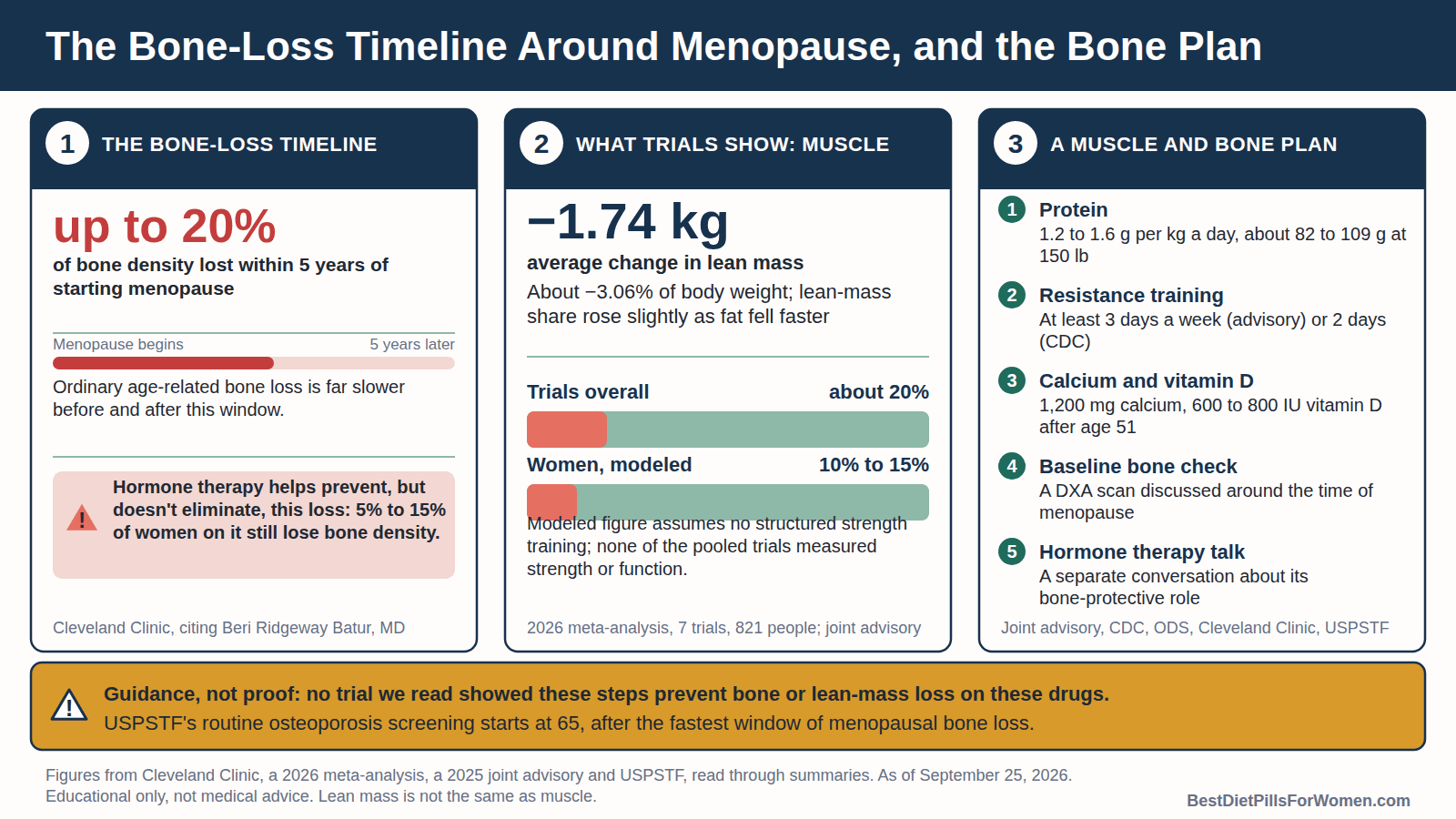
A 2026 meta-analysis of 7 randomized trials with 821 people taking GLP-1 medicines for weight loss found that lean mass fell by an average of 1.74 kg (about 3.06% of body weight), while lean mass as a share of total weight rose slightly because fat fell faster. A joint advisory from four obesity and nutrition organizations estimates that lean tissue makes up about 20% of a typical loss on these drugs overall, rising to a modeled 10% to 15% in women without structured strength training.
None of the pooled trials measured whether that lean mass loss affected strength or physical function, which remains an open question. Our guide to muscle preservation during weight loss covers this trade-off across all life stages in more depth than this section can.
The “Perfect Storm”: Menopause, GLP-1 Drugs and Bone
Bone loss during menopause is dramatically faster than the muscle-loss story above, and it happens regardless of whether a woman takes any weight loss medicine at all. Women can lose up to 20% of their bone density within five years of starting menopause, according to Cleveland Clinic, a rate of loss far steeper than ordinary age-related bone loss before or after that window. Layer intentional weight loss, which causes bone loss on its own regardless of exercise, on top of that window, and a University of Colorado geriatric medicine researcher, Wendy Kohrt, describes the current moment for midlife women as a “perfect storm” for bone health.
Hormone therapy is genuinely useful here in a way it isn’t for weight: it helps prevent bone loss, though not completely, since 5% to 15% of women continue losing bone density even while on it. That’s a real, evidence-backed reason hormone therapy comes up in bone-health conversations even though, as covered earlier in this guide, it isn’t an evidence-backed weight loss treatment.
The reason estrogen protects bone in the first place is that it normally restrains the cells that break bone down, known as osteoclasts, while supporting the cells that build bone back up. When estrogen drops sharply at menopause, that restraint weakens and bone breakdown temporarily outpaces bone building, which is the physiological reason bone loss accelerates so specifically around this transition rather than climbing at a steady rate throughout adult life. Intentional weight loss adds a second, independent pressure on bone during the same window, through mechanisms researchers are still working out, which is why the two effects are described as compounding rather than simply adding up in a predictable way.
A Practical Muscle and Bone Plan
None of this argues against weight loss medicine; it argues for pairing it with steps that have their own separate evidence base.
Protein, Resistance Training and Bone Testing
Table 6 lays out the main components of a muscle- and bone-protective plan, using a woman weighing about 150 lb (68 kg) as a worked example for the protein target.
| Step | Target | Why it’s suggested |
|---|---|---|
| Protein intake | 1.2 to 1.6 g per kg body weight a day (about 82 to 109 g for a 150 lb woman) | Supports lean mass preservation during a calorie deficit |
| Resistance training | At least 3 days a week (joint advisory) or at least 2 days a week (CDC) | Muscle-strengthening activity is the main tool shown to blunt lean mass loss |
| Calcium and vitamin D | 1,200 mg calcium and 600 to 800 IU vitamin D a day after age 51 | Federal nutrient targets rise at this age as bone loss accelerates |
| Baseline bone density check | A DXA scan, discussed with a clinician around the time of menopause if risk factors are present | USPSTF recommends routine screening starting at 65, but a geriatric medicine researcher suggests an earlier conversation given the menopause-specific bone-loss window |
| Discuss hormone therapy’s bone benefit | A separate conversation from weight loss goals | Hormone therapy helps prevent, but doesn’t eliminate, menopause-related bone loss |
Table 6 method: each row summarizes the source cited in it, and the 82 to 109 gram figure is our arithmetic: 68 kilograms multiplied by 1.2 and by 1.6. The sources address people taking GLP-1 medicines, postmenopausal women generally, or federal nutrient guidance, not specifically phentermine, Contrave or Qsymia users, and none of this is medical advice.
When to Get a Baseline Bone Density Scan
USPSTF’s routine screening recommendation starts at 65, well after most women complete the menopause transition, which means the fastest window of bone loss described above can pass before formal screening guidance would otherwise suggest a scan. That gap is exactly why a geriatric medicine researcher recommends raising a baseline DXA scan with a clinician around the time of menopause itself, particularly for a woman also considering a weight loss medicine, rather than waiting for the standard screening age. Infographic 2 below summarizes this bone-loss timeline alongside the muscle and bone plan above.
Safety of Weight Loss Pills During Menopause: Side Effects, Warnings and When to Get Help
The safety information on a drug’s label doesn’t change for menopause specifically, but a few side effects and warnings deserve extra attention when they overlap with symptoms a woman may already be managing.
Common and Serious Side Effects
Gastrointestinal side effects dominate the GLP-1 pills; psychiatric and cardiovascular warnings dominate the older prescription pills.
Common Side Effects by Option
Nausea, constipation, diarrhea and vomiting are the most common complaints across every GLP-1 option in this guide, and they’re also the leading reason people stop taking them. Table 7 compares how often people discontinued each drug because of side effects, against how often people on placebo did the same.
| Option | Stopped due to side effects (drug) | Stopped due to side effects (placebo) | Difference |
|---|---|---|---|
| Wegovy injection | 6.8% | 3.2% | 3.6 points |
| Wegovy pill | 6.9% | 5.9% | 1.0 point |
| Zepbound | 6.7% | 3.4% | 3.3 points |
| Foundayo | 10% | 3% | 7 points |
| Contrave | 24% | 12% | 12 points |
Table 7 method: figures are as reported in each drug’s prescribing information, read through label mirrors, and reflect discontinuation due to adverse reactions in the pivotal trials; they aren’t directly comparable across drugs because the trials differ in length, dose and population, and none was specific to menopausal women.
Boxed Warnings and Who Should Avoid Certain Options
Contrave’s boxed warning for suicidal thoughts and behaviors and its contraindication in uncontrolled high blood pressure, seizure disorders and current or recent eating disorders were covered in detail in the previous section. The GLP-1 drugs carry a contraindication unrelated to menopause: a personal or family history of medullary thyroid cancer or multiple endocrine neoplasia type 2, worth confirming with a prescriber regardless of life stage.
The GLP-1 drug labels also list gallbladder problems, including gallstones and inflammation of the gallbladder, as a risk associated with rapid or substantial weight loss, not something specific to any one drug in this class. Sudden, severe pain in the upper right abdomen, especially after eating fatty food, along with nausea or fever, is worth reporting promptly rather than assuming it’s a routine digestive side effect, since gallbladder problems sometimes require treatment beyond adjusting or stopping the medicine.
Extra Caution Points During Menopause
Two things deserve plain, direct attention because they layer onto symptoms many women are already navigating.
Why Mood and Sleep Changes Deserve Extra Attention Now
Mood changes, irritability and sleep disruption are already common during the menopause transition on their own, which can make it harder to tell whether a new symptom after starting a weight loss pill is from the drug, from menopause, or from both together. Contrave’s boxed warning for suicidal thoughts makes this distinction especially important for that drug, and any new or worsening mood symptom after starting any weight loss medicine is worth reporting to a prescriber promptly rather than assuming it’s “just menopause.”
Sleep disruption from hot flashes and night sweats, covered earlier in this guide, is common enough on its own that adding a medicine with its own sleep-related side effects (insomnia appears in several labels) can compound an already difficult symptom. Tracking which symptoms started before and after a medicine change, in a simple note or app, can help a clinician sort out cause from coincidence at a follow-up visit.
When to Get Medical Help and How to Report a Problem
Get medical help right away for a fast or irregular heartbeat, chest pain, severe abdominal pain, signs of pancreatitis, vision changes, thoughts of self-harm, or a severe allergic reaction, whichever drug is involved. For any other side effect that feels wrong or doesn’t improve, call the prescriber before deciding on your own to stop or change a dose. Side effects and product problems, including anything involving a supplement marketed for menopause, can also be reported directly to the FDA through its MedWatch program.
None of the safety information above is specific to menopause in the sense of being caused by it; it’s the same label information that applies to any adult taking these medicines. What menopause adds is context: a woman navigating hot flashes, sleep disruption and mood changes on their own has less margin to absorb an additional, unrelated side effect without it affecting how she feels day to day, which is a reasonable factor to weigh when choosing among options with otherwise similar evidence, even though it isn’t a formal part of any drug’s safety data.
What Weight Loss Pills Cost During Menopause and How to Get a Prescription
Most women going through menopause are years away from Medicare eligibility at 65, which makes insurance and manufacturer savings programs, rather than any federal program, the main cost lever for most readers of this guide.
What a Year Costs Without Insurance
List prices and manufacturer self-pay programs both move often, so treat Table 8 as a snapshot, not a guarantee.
The Cost Table
| Option | Monthly self-pay price | Estimated annual cost |
|---|---|---|
| Wegovy pill (1.5 mg to 25 mg) | $149 to $299 | $1,788 to $3,588 |
| Wegovy injection, standard doses | $349 ($399 for the 7.2 mg dose) | $4,188 ($4,788 for 7.2 mg) |
| Zepbound single-dose vials | $299 to $449 | $3,588 to $5,388 |
| Foundayo (0.8 mg to 17.2 mg) | $149 to $299 | $1,788 to $3,588 |
| Contrave | About $199 | About $2,388 |
| Qsymia | About $75 | About $900 |
| Phentermine | About $16 | About $192 |
| Alli (OTC orlistat 60 mg) | About $88 | About $1,056 |
| Xenical (prescription orlistat 120 mg) | About $431 | About $5,172 |
| Fezolinetant (Veozah, for hot flashes, not weight) | About $700 retail, about $485 with a discount | About $5,820 to $8,400 |
Table 8 method: monthly figures are self-pay or lowest-listed prices from manufacturer cost pages, an investor press release and retail price aggregators, read through page summaries on September 25, 2026, and annualized by multiplying by 12; totals exclude clinician visits, lab tests, telehealth fees, shipping and needles, and assume no missed fills. Fezolinetant is included for comparison only, since it treats hot flashes rather than weight, and it isn’t a weight loss option.
How Women Get a Prescription
A prescription for any drug in this guide starts with a clinician visit, in person or through telehealth, where BMI, related conditions and current medicines, including anything taken for menopause symptoms, are reviewed. The federal telehealth flexibility that lets many prescribers issue controlled-substance prescriptions, which covers phentermine and Qsymia, remotely without an in-person exam first is currently set to run through December 31, 2026, though that date has moved before. Our Wegovy pill cost guide and Wegovy insurance coverage guide go deeper on one option’s pricing and paperwork specifically.
Insurance, Medicare and What May Change Soon
Coverage for these drugs when prescribed for weight loss alone remains inconsistent across private insurance plans, and menopause itself doesn’t change an insurer’s coverage rules.
Does Insurance Cover Weight Loss Pills for Menopause?
Menopausal status has no bearing on insurance coverage for these drugs; coverage depends on the specific insurance plan, the diagnosis code used, and whether the plan covers anti-obesity medicine at all, which varies widely by employer and by state.
A woman on Medicare specifically, generally 65 or older, may be able to use the Medicare GLP-1 Bridge program, which offers a $50 monthly copay for certain GLP-1 drugs through December 31, 2027, but this applies to relatively few readers of this guide given that most women complete menopause well before 65. For most midlife women, the more relevant coverage questions are whether an employer’s plan includes an anti-obesity medicine benefit, whether a diagnosis like type 2 diabetes or sleep apnea (rather than obesity alone) changes coverage, and whether a manufacturer savings card can bridge the gap regardless of insurance status.
A flexible spending account or health savings account can also help regardless of what a plan covers, since the IRS treats a prescribed weight loss medicine as an eligible medical expense the same way it treats other prescription drugs. That doesn’t lower the sticker price, but for a woman with either account already funded through her employer, it can meaningfully reduce the effective after-tax cost of a monthly prescription, which is worth asking a benefits administrator about before assuming a drug is unaffordable.
What Else May Change
A few developments could shift this cost picture before this guide is next updated. Novo Nordisk filed for FDA approval of CagriSema, a combined GLP-1 and amylin drug, in December 2025, with a decision expected sometime in 2026; it isn’t approved as this guide is written. Every manufacturer savings program listed in Table 8, along with the DEA telehealth flexibility, has its own end date that can move. None of that changes what a woman should do today, but it’s a reason to re-check prices and coverage close to any actual purchase or prescription.
How to Choose: A Decision Guide for Menopause
There’s no single best answer here, but there is a better and worse way to work through the decision, starting with matching the option to a woman’s actual situation, including where she is in the menopause transition, rather than to whichever drug is most talked about.
Questions to Work Through Before Choosing a Pill
Table 9 groups common situations during menopause with what the evidence and labels in this guide say about them.
The Situation Guide
| Your situation | What matters most | Worth raising with a clinician |
|---|---|---|
| Perimenopausal, periods still occur | Pregnancy remains possible; Qsymia requires monthly pregnancy testing under its restricted program | Contraception plans alongside any prescription weight loss medicine |
| Postmenopausal, considering hormone therapy | Hormone therapy doesn’t treat weight directly, and its favorable risk window is generally framed as under 60 | Whether to sequence or combine the hormone therapy and weight loss decisions |
| Bothered by hot flashes or night sweats | No good evidence any weight loss pill improves vasomotor symptoms; fezolinetant and hormone therapy treat that separately | Whether to address hot flashes and weight as one conversation or two |
| Taking an SSRI or SNRI for hot flashes | Contrave can raise blood levels of some SSRIs and requires avoiding other bupropion-containing medicines | Whether Contrave specifically fits your current antidepressant |
| High blood pressure or heart disease | Phentermine and Contrave are contraindicated with uncontrolled blood pressure; the SELECT trial supports a heart benefit for semaglutide | Whether your blood pressure needs monitoring after starting a GLP-1 drug |
| On a blood thinner | Orlistat can affect vitamin K absorption and anticoagulant control | Closer coagulation monitoring if orlistat is considered |
| Concerned about bone density | Menopause can bring bone loss of up to 20% within five years; rapid weight loss adds to that risk | Whether a baseline DXA scan makes sense now rather than waiting until 65 |
| Cost-conscious, not yet 65 | Medicare’s GLP-1 Bridge program doesn’t apply before 65; manufacturer savings cards are the main lever | Which savings program fits your specific drug and insurance situation |
Table 9 method: this table groups the guidance already cited throughout this article by situation rather than by drug; it’s a starting point for a conversation, not a set of eligibility rules, and it doesn’t cover every possible health situation.
Non-Pill Options With Evidence
Pills aren’t the only options with real evidence behind them at this life stage. Structured lifestyle programs combining diet changes, activity and behavioral support have outperformed usual care in trials for decades, and resistance training has evidence independent of any pill for preserving muscle and bone, covered in detail earlier in this guide. For hot flashes specifically, fezolinetant and hormone therapy both have real evidence behind them, separate from any weight-related decision.
Diet quality matters here too, and not only for weight: the Women’s Health Initiative finding cited earlier in this guide, that a low-fat dietary pattern was linked to fewer hot flashes over a year, came from a structured dietary intervention rather than a pill or a single food swap, which is a reminder that the highest-quality evidence in this category often comes from sustained behavior change studied over months, not a bottle purchased once. None of this argues against medication when a woman meets the criteria for it; it argues for treating lifestyle change as a genuine option with its own evidence base, not a placeholder step to get through before a prescription.
Five Checks and Other Paths to Consider
Five questions come up in almost every row of Table 9, worth turning into a short checklist before any appointment.
The Five Checks Before Choosing
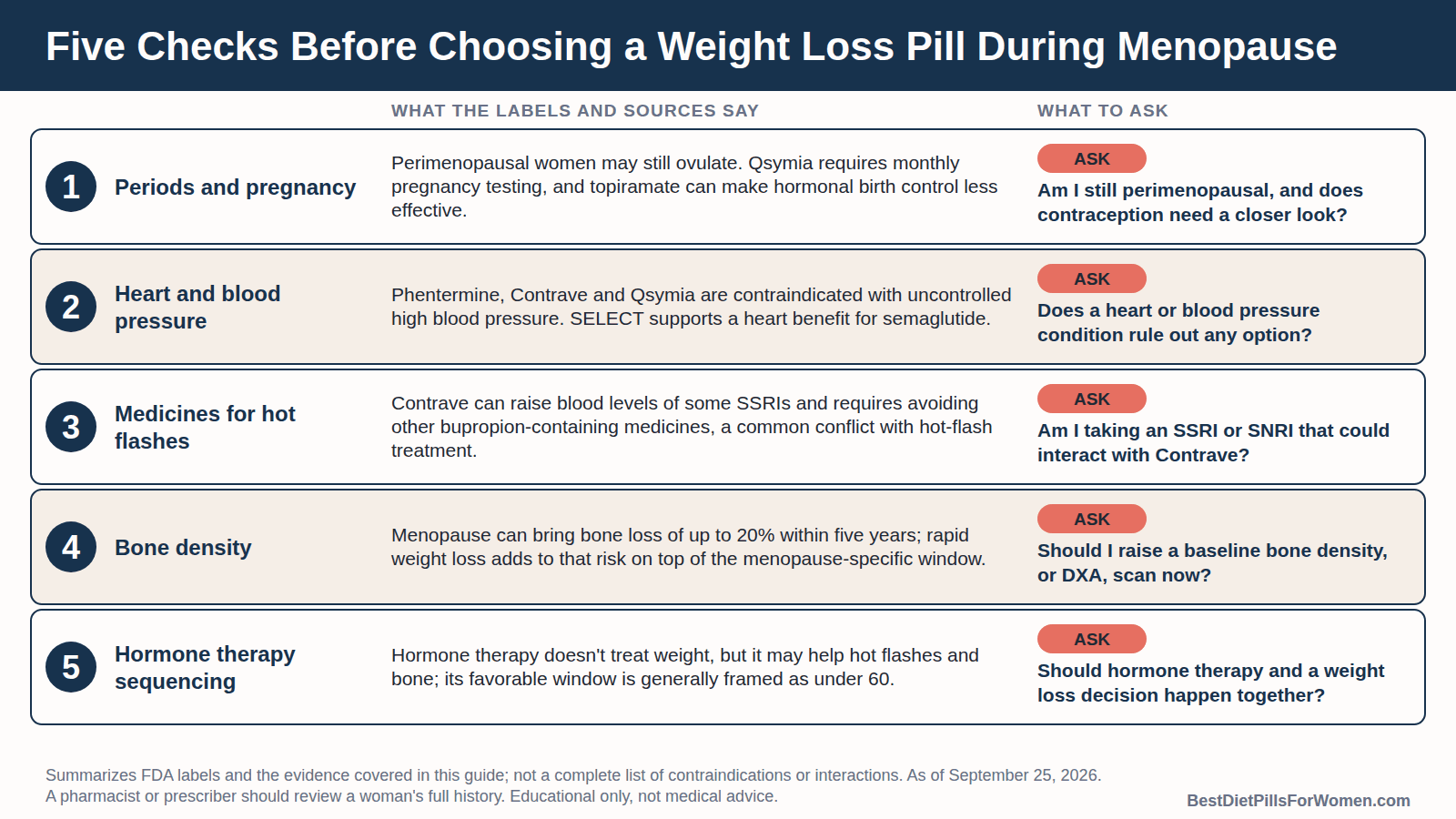
The checks are: whether periods still occur and pregnancy remains a factor; whether a heart or blood pressure condition rules any option out; whether a medicine already taken for hot flashes, especially an SSRI or SNRI, needs a closer look before adding Contrave specifically; whether bone density has been checked, or should be, given how fast bone loss can move during this window; and whether hormone therapy is part of the picture, either already underway or under consideration alongside a weight loss decision. Infographic 3 below turns these into a short list with the specific facts behind each one.
Surgery and Other Medical Routes
The American Society for Metabolic and Bariatric Surgery and the International Federation for the Surgery of Obesity have recommended surgery starting at a BMI of 35 or higher regardless of other conditions, and for consideration at 30 to 34.9 when a condition like diabetes is present. NIDDK reports that many people who have weight loss surgery lose 15% to 30% of their starting weight on average, a larger and generally more durable result than most pills achieve, though it’s major surgery with its own risks and lifelong nutrition monitoring, including for the same calcium, vitamin D and protein concerns raised earlier in this guide. Whether surgery, a GLP-1 drug, an older pill, hormone therapy or a structured lifestyle program fits best is a conversation for a surgeon, an obesity-medicine specialist or a primary care clinician who knows a woman’s full history, not a conclusion this guide can reach for anyone. Our overview of weight loss medications puts the drug options in a wider context.
Frequently Asked Questions About Weight Loss Pills for Menopause
These questions come up repeatedly in menopause-related searches and weren’t fully answered by the sections above.
Effectiveness and Expectations
Three questions here are really the same question asked three different ways: does menopause change the math.
Do Weight Loss Pills Work as Well During Menopause?
Based on the three 2026 menopause-stage analyses covered earlier in this guide, yes: semaglutide, tirzepatide and orforglipron all showed broadly similar weight loss whether a woman was premenopausal, perimenopausal or postmenopausal. These are post hoc analyses rather than trials purpose-built to answer this exact question, so treat the finding as reassuring rather than definitive.
How Much Weight Can I Realistically Expect to Lose?
Trial averages in this guide range from about 5% (Contrave) to over 20% (Zepbound) of starting weight, but averages describe groups, not individuals, and the menopause-stage analyses found results within a few percentage points across premenopausal, perimenopausal and postmenopausal women. Adherence, dose, diet and activity all affect where any individual woman lands relative to a trial average.
What Happens If I Stop Taking a Weight Loss Pill?
Weight regain is common after stopping a GLP-1 medicine, since these drugs work by affecting appetite and metabolism while they’re in the body, not by producing a permanent change. None of the menopause-specific analyses in this guide followed women after they stopped their medicine, so we can’t say whether regain differs by menopausal status specifically; general trial data suggests it doesn’t reliably differ by age either.
Will Losing Weight Reduce My Hot Flashes?
Possibly. A Women’s Health Initiative analysis of 17,473 postmenopausal women found that those who lost weight through a low-fat diet were about twice as likely to eliminate their hot flashes after one year as women who didn’t change their diet, with greater weight loss linked to greater symptom improvement. That study used diet, not a weight loss medicine, so the same benefit from a GLP-1 pill or an older drug hasn’t been directly tested, but it’s a reasonable, evidence-based possibility rather than a guarantee.
Safety and Medicines
These three questions come up whenever a reader is already managing another condition or medicine alongside menopause.
Can I Take a Weight Loss Pill With High Blood Pressure or Heart Disease?
It depends on the pill: phentermine, Qsymia and Contrave are contraindicated with uncontrolled high blood pressure or cardiovascular disease, while the SELECT trial found semaglutide reduced cardiovascular events in adults with existing heart disease. A clinician needs your current blood pressure readings and cardiac history to make this call, not a general guide.
Will a Weight Loss Pill Affect My Thyroid Medicine or Other Medicines?
The Wegovy pill can raise levothyroxine (thyroid medicine) exposure, and GLP-1 pills more broadly slow stomach emptying, which can change how other oral medicines are absorbed. Contrave has its own interaction with certain SSRIs, covered earlier in this guide, which matters if you take one for hot flashes. A pharmacist review of your full medicine list catches interactions a general guide can’t.
Is It Safe to Combine a Weight Loss Pill With Hormone Therapy?
No established drug-drug interaction was found between hormone therapy and either the GLP-1 medicines or the older pills, though each type of medicine carries its own separate cardiovascular or clotting warnings worth reviewing together with a clinician. One published case report described a possible, not confirmed, link between tirzepatide and a blood clot in a woman with several other independent risk factors, covered in detail earlier in this guide.
Hormones, Cost and Next Steps
These last three questions are about sequencing the decision, not about any single drug’s evidence.
Should I Try Hormone Therapy Instead of a Weight Loss Pill?
Not if weight loss is the primary goal: a Cochrane review of 28 trials found hormone therapy has no significant effect on body weight, though it may help with hot flashes, night sweats and bone loss, which are separate benefits worth weighing on their own terms. Many women reasonably use hormone therapy for symptom relief and a separate medicine, or none, for weight.
Does Medicare or Insurance Cover Weight Loss Pills for Menopause?
Menopausal status itself doesn’t affect coverage; it depends on your specific insurance plan and, for women 65 or older, potentially Medicare’s GLP-1 Bridge program, which offers a $50 monthly copay for certain drugs through December 31, 2027. Most women going through menopause aren’t yet 65, so manufacturer savings cards are usually the more relevant option.
What Should I Ask My Doctor Before Starting?
Ask about your BMI and weight-related health conditions, your blood pressure and heart history, any medicine you take for hot flashes or mood, whether a baseline bone density scan makes sense given the menopause-specific bone-loss window, and how the option being considered might interact with hormone therapy if you’re using or considering it. Bring your full medicine and supplement list to that conversation, including anything marketed specifically for menopause.
The Bottom Line on the Best Weight Loss Pills for Menopause
Pulling the evidence in this guide together into a single, honest conclusion.
What the Total Evidence Means for You
Menopause changes the body more than it changes which pill works, based on what 2026’s new evidence shows.
The Biggest Realistic Benefit
The genuinely new, useful finding this year is that three separate GLP-1 medicines have now each been examined specifically by menopausal status, and all three showed broadly similar results whether a woman was premenopausal, perimenopausal or postmenopausal. That’s a more specific, more reassuring answer than “these drugs work in adults broadly,” and it’s evidence that didn’t exist when our earlier guides for women over 40 and women over 50 were researched.
The Biggest Limitation and Safety Concern
The biggest limitation is that none of these three analyses was the trial’s original purpose, so the finding, while consistent across three independent studies, hasn’t been confirmed in a trial purpose-built around menopausal status from the start. The biggest safety concern is less about any single drug and more about the layering effect: menopause brings its own accelerated bone-loss window, its own mood and sleep changes, and often its own medicines for hot flashes, all of which can interact with a weight loss pill’s own side effects and warnings in ways a general drug label doesn’t fully anticipate.
Hormone therapy deserves one more mention here because it’s so often confused with a weight loss treatment in this category specifically. Nothing in this guide should be read as encouragement to start, stop or substitute hormone therapy for a weight loss medicine, or the reverse; the two treat different problems, backed by different evidence, and a woman can reasonably use one, both or neither depending on her own symptoms and goals.
A Rational Next Step
The goal of this guide was never to pick a winner; it was to sharpen the conversation a woman has with her own clinician.
Questions for a Clinician
Bring the specifics: your BMI and any weight-related health conditions, your blood pressure and cardiovascular history, any medicine already taken for hot flashes or mood, whether hormone therapy is part of the picture now or being considered, and whether a baseline bone density scan makes sense given the menopause-specific bone-loss window covered in this guide. A clinician who has all of that can make a recommendation this guide deliberately doesn’t.
What to Re-Check Before You Spend Money
Prices, manufacturer savings terms, the Medicare GLP-1 Bridge program’s rules, and drug labels all change. Re-check Table 8’s prices, confirm any manufacturer offer’s current end date, and confirm current label language for any drug you’re considering before spending money based on anything in this guide, which reflects information gathered as of September 25, 2026.
Related Reading
Sources
These are the main sources behind this guide, chosen because they are the ones to check first for current facts. Labels, prices, coverage rules and regulator pages change, so confirm the latest version before you make decisions.
- Novo Nordisk. Wegovy (semaglutide) injection and tablets, prescribing information (revised June 2026). https://www.novo-pi.com/wegovy.pdf
- Eli Lilly and Company. Zepbound (tirzepatide) prescribing information (revised August 2026). https://pi.lilly.com/us/zepbound-uspi.pdf
- Eli Lilly and Company. Foundayo (orforglipron) tablets, prescribing information (revised July 2026). https://pi.lilly.com/us/foundayo-uspi.pdf
- Prescribing information for the older prescription pills, on DailyMed: Adipex-P (phentermine, Teva; https://dailymed.nlm.nih.gov/dailymed/drugInfo.cfm?setid=f5b2f9d8-2226-476e-9caf-9d41e6891c46), Contrave (naltrexone and bupropion; https://dailymed.nlm.nih.gov/dailymed/drugInfo.cfm?setid=485ff360-32c8-11df-928b-0002a5d5c51b) and Qsymia (phentermine and topiramate; https://dailymed.nlm.nih.gov/dailymed/drugInfo.cfm?setid=40dd5602-53da-45ac-bb4b-15789aba40f9).
- H2-Pharma LLC. Xenical (orlistat) capsules, prescribing information (revised 07/2024), including its vitamin K/anticoagulant interaction section. https://dailymed.nlm.nih.gov/dailymed/drugInfo.cfm?setid=6240792b-9224-2d10-e053-2a91aa0a2c3e
- National Institute of Diabetes and Digestive and Kidney Diseases. Prescription medications to treat overweight and obesity (last reviewed June 2024). https://www.niddk.nih.gov/health-information/weight-management/prescription-medications-treat-overweight-obesity
- Lincoff AM, et al. Semaglutide and cardiovascular outcomes in obesity without diabetes. N Engl J Med. 2023;389:2221-2232. https://pubmed.ncbi.nlm.nih.gov/37952131/
- Healio. Semaglutide confers similar weight, cardiovascular benefits across all menopausal stages (report on a post hoc analysis of the STEP UP trial and a SELECT trial subgroup analysis by menopausal status, presented at the European Congress on Obesity, May 2026). https://www.healio.com/news/endocrinology/20260603/semaglutide-confers-similar-weight-cardiovascular-benefits-across-all-menopausal-stages
- Cochrane review of menopausal hormone therapy and body weight (28 randomized trials, 28,559 women), read through a 2026 clinical-review page summary.
- Cleveland Clinic. Osteoporosis and menopause, citing Beri Ridgeway Batur, MD. https://health.clevelandclinic.org/osteoporosis-and-menopause